Takuto Adachi, Kazunori Kaede, Keiichi Watanuki (2025). Measurement of User Perception Time for Speed Changes in Virtual Reality. In: Human Factors in Design, Engineering, and Computing. AHFE Open Access, vol. 199, pp. 714–720. https://doi.org/10.54941/ahfe1006884
In conventional role-playing and action games, players control characters via a remote or control panel, often greatly enhancing their physical abilities and providing increased entertainment and exhilaration. Recently, head-mounted displays (HMDs) have enabled players’ movements to synchronize directly with in-game characters, offering greater In conventional role-playing and action games, players control characters via a remote or control panel, often greatly enhancing their physical abilities. In conventional games, enhancing a character’s physical abilities leads to increased entertainment and exhilaration. However, in virtual reality (VR) games, the movements of in-game characters and players are synchronized, enhancing the sense of physical presence and immersion. Therefore, the entertainment value of VR games can be enhanced by extending the characters’ physical abilities. This study focused on the perception of speed as a factor contributing to a reduced sense of agency during jump extension. Experiments were conducted to clarify differences in the perception of speed changes between ascent (deceleration) and descent (acceleration), and the results were evaluated using reaction times. The results suggest that during jumping, the sensation of speed may be more easily perceived during the ascent phase than during the descent phase. Therefore, for significantly extended jumps, a trajectory that maintains a constant airborne time while shortening the ascent time and lengthening the descent time may be effective.
In television and smartphone games, such as action- and role-playing games, players control in-game characters through controllers and control panels, and the physical abilities of the characters are often greater than those of real people. This expansion of physical capabilities in games contributes significantly to their exhilaration and entertainment value. However, the market for virtual reality (VR) games using head-mounted displays (HMDs) has expanded in recent years, and VR games often synchronize the movements of characters with those of real players. This provides a superior sense of physicality and immersion in gameplay compared with existing games. However, because the player’s physical abilities are strongly reflected in the character, it is difficult to significantly expand the physical abilities of the player as in existing games, because they would be uncomfortable, and the game may lack a sense of exhilaration and entertainment. Therefore, we believe that proposing a method to effectively expand the players’ physical
Measurement of User Perception Time for Speed Changes in Virtual 715
abilities in VR games without compromising their sense of autonomy and immersion will improve the exhilaration and entertainment value of VR games and lead to further expansion of the game experience.
Currently, redirected walking and jumping have been proposed as methods for augmenting real-world movements in the VR space. These augmentation methods are limited to extending the physical capabilities within a range that is unrecognizable to the player. Because the extension magnification is smaller than that of conventional games, they are unlikely to improve the exhilaration and entertainment value of games. Therefore, it is necessary to propose an expansion method that does not impair the sense of motor subjectivity, even if it achieves the same effect as that in conventional games through expansion.
In this study, the motion subject to the extension was “jumping,” which is a basic human motion commonly used in daily life and games. In redirected jumping, which also targets jumping, the range of unrecognizable vertical jumps has been shown to be 0.06 to 2.20 times larger than that of unrecognizable vertical jumps (Hayashi et al., 2019). In our previous study, we investigated the effects on players when they extended their leaps significantly beyond the above range, that is, within the range that can be recognized (Adachi et al., 2023). The results showed that a large jump extension causes a gap between the player’s jump sensation and visual information and decreases the sense of motor initiative. In addition, players may experience discomfort when they extend their jumps, particularly when they fall. Next, we investigated the effects on the sensation, timing, and impression of discomfort (discrepancy between the player’s sensation of jumping and visual information) that occur when the player makes a large jump extension. The results showed that the sense with particularly large discrepancies was speed (Adachi et al., 2024).
Based on these findings, this study conducted a “Cognitive Evaluation Experiment on Acceleration and Deceleration,” focusing on acceleration and deceleration movements, with the aim of elucidating the perception of “sense of speed” in VR space.
ACCELERATION AND DECELERATION PERCEPTION EVALUATION EXPERIMENT To elucidate the perception of “speed sensation” during jumps in VR space, we interpreted upward movement as deceleration and downward movement as acceleration. We then evaluated the differences in the perception of speed changes between acceleration and deceleration using reaction times.
The experiment involved participants wearing an HMD and viewing a video showing a random dot pattern moving through space on the HMD. This video depicted a point moving in uniform linear motion for the first few seconds under each condition, followed by 10 s of uniformly accelerated linear motion. Participants clicked the mouse when they perceived a change in speed, and their reaction times were measured. The participants were also asked to indicate whether they perceived acceleration or deceleration
at that moment. The experimental environment was constructed in Unity. A post-experiment questionnaire was used to survey the participants’ dominant eyes.
EXPERIMENTAL CONDITIONS As experimental conditions, three variables were varied: acceleration, initial velocity, and direction of motion. The experiments were conducted under a total of 23 conditions, as shown in Table 1.
Table 1: Experimental conditions.
Table available in the original PDF paper.
Direction
Condition Initial Velocity [×9.80665m/s]
Acceleration [×9.80665m/sˆ2] A 5 –0.5 Z:+ B 10 –0.5 Z:+ C 10 –1 Z:+ D 20 –1 Z:+ E 20 –2 Z:+ F 40 –2 Z:+ G 5 0.5 Z:+ H 10 0.5 Z:+ I 0 1 Z:+ J 10 1 Z:+ K 20 1 Z:+ L 20 2 Z:+ M 40 2 Z:+ N 10 1 Z:– O 10 –1 Z:– P 10 1 Y:+ Q 10 –1 Y:+ R 10 1 Y:- S 10 –1 Y:– T 10 1 X:+ U 10 –1 X:+ V 10 1 X:– W 10 –1 X:–
EVALUATION METHODS Three factors influence reaction time: “speed of motor response,” “concentration on the experiment,” and “familiarity with the experiment.” We controlled for “concentration on the experiment” by filtering the data and for “familiarity with the experiment”by randomly presenting conditions. Therefore, reaction time was used as an indicator of cognitive ease in this study.
Regarding data filtering, we selected seven participants out of 19 experiment collaborators who did not misidentify acceleration or deceleration responses under any condition for analysis. Additionally, data where responses took longer than 10 s were interpreted as requiring more than 10 s to notice the event. For these data, we defined survival time
Measurement of User Perception Time for Speed Changes in Virtual 717
as reaction time and the event as the notice of velocity change. We then performed survival time analysis using the Kaplan-Meier method.
RESULTS
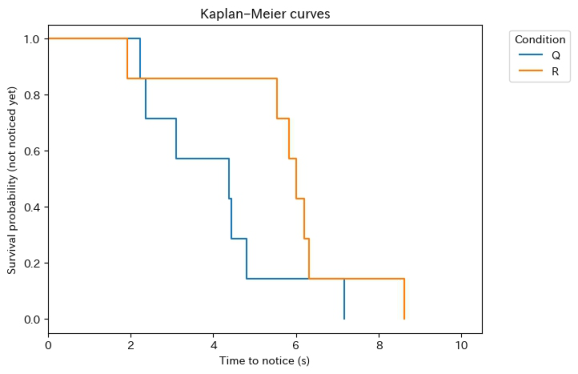
When performing a log-rank test under upward deceleration conditions (Q) and downward acceleration conditions (R) as conditions approximating the ascent and descent of a jump, no significant difference was found. However, it was observed that upward deceleration conditions (Q) tended to be more easily recognized. This suggests that, during a jump, the sensation of speed may be more easily recognized during ascent than during descent. The respective survival curves are shown in Figure 1.
Figure 1: Comparison of Kaplan–Meier survival curves between Conditions Q and R.
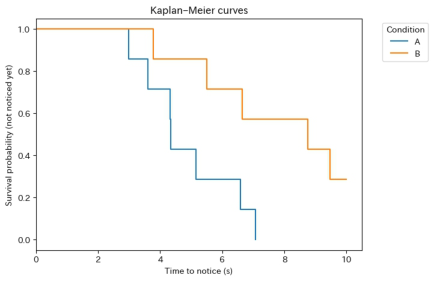
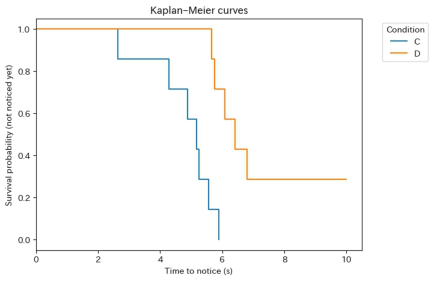
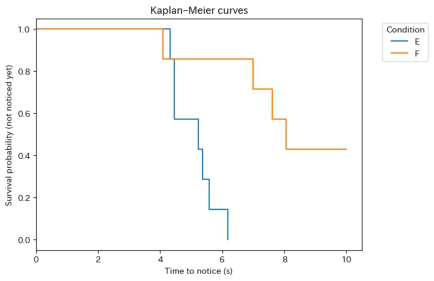
Regarding the effect of initial velocity on the perception of velocity change, log-rank tests were performed between conditions differing only in initial velocity. Significant differences were observed under all deceleration conditions. This suggests that initial velocity may influence the perception of velocity change during deceleration. The survival curves for each condition are shown in Figures 2, 3, and 4. These figures indicate that, in all comparisons, higher initial velocities made the change more difficult to perceive.
Regarding differences in perception between acceleration and deceleration in the same direction, log-rank tests were performed between conditions differing only in acceleration sign. Significant differences were observed only between Conditions A and G. The absence of significant differences under other conditions indicates that there is no difference in perceptual ease between acceleration and deceleration in the same direction.
Figure 2: Comparison of Kaplan–Meier survival curves between Conditions A and B.Figure 3: Comparison of Kaplan–Meier survival curves between Conditions C and D.Figure 4: Comparison of Kaplan–Meier survival curves between Conditions E and F.
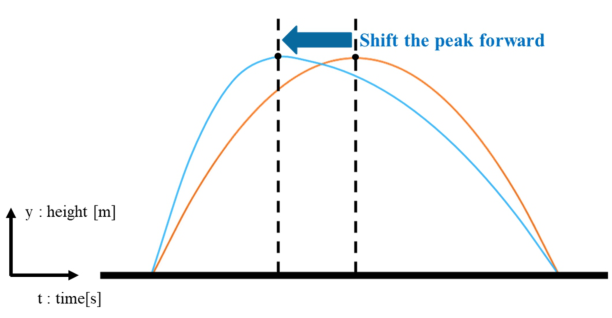
CONSIDERATIONS The upward deceleration condition (Q) tended to be more easily recognized than the downward acceleration condition (R). It is believed that upward motion is more easily perceived as having a sense of speed than falling. Therefore, for significantly extended jumps, trajectories like the one shown
Measurement of User Perception Time for Speed Changes in Virtual 719
in Figure 5—where the airborne time remains constant but the ascent time is shortened and descent time lengthened—are considered Increasing the proportion of the less-perceptible downward acceleration phase, i.e., the descent, allows for more accurate perception of the sense of speed during jump extension and is thought to enhance the subjective feeling of control over the jump.
Figure 5: Shortened ascent time jump trajectory.
When comparing conditions that differed only in initial speed, a significant difference was observed only in the deceleration condition, suggesting that initial speed affects the perception of speed change during deceleration. This phenomenon was likely caused by a mechanism similar to the speed aftereffect. The speed aftereffect refers to a phenomenon in which, after observing a stimulus moving at a constant speed for a certain period, a subsequently presented stimulus appears slower or faster than its actual speed. This effect is thought to arise from changes in the sensitivity distribution of speed-selective neurons in the visual cortex following adaptation to a specific speed, which results in the suppression of neural activity around the adapted speed (Anstis et al., 1998). Such an adaptation alters the response balance to subsequent speed stimuli, leading to distortions in perceived speed. In the present study, we assumed that speed-selective neurons adapted to the initial speed, causing a reduction in sensitivity. Consequently, under the deceleration condition, even as the stimulus slowed down, the activity of the adapted high-speed channels may not have fully recovered, making it difficult to detect the change in speed. In contrast, under the acceleration condition, as the speed increased, the previously unadapted high-speed channels were newly activated, resulting in little effect on speed-change detection.
In addition, misjudgments of acceleration or deceleration were observed in 12 of the 19 participants. Most of these errors involved the perception of deceleration as acceleration. This tendency to misperceive deceleration as acceleration may stem from the asymmetry in visual motion processing. Speed-selective neurons in the middle temporal area (MT/V5) are known
to respond more strongly to velocity increases, whereas their responses to velocity decreases are often delayed or persistent (Werkhoven & Koenderink, 1991). This neural asymmetry may have led to the perceptual illusion of acceleration during actual deceleration. The influence of the speed aftereffect described above may also have contributed to this perceptual bias.
CONCLUSION
This study evaluated differences in the perception of velocity changes during acceleration and deceleration using reaction times to elucidate the perception of “sense of speed” in VR space. The results suggest that during jumps, ascending may facilitate the perception of speed more readily than descending. Consequently, for significantly extended jumps, trajectories with the same airborne time but shorter ascent and longer descent periods are considered effective. Future research should investigate the optimal ratio of ascent to descent time during significantly extended jumps.
REFERENCES
Adachi, T. Watanuki, K. Kaede, K. Osawa, Y. (2023) “Effects of Displacement of Bodily Sensation and Visual Information on Mood during Leap Extension in Virtual Space”, in: Proceedings of the 24th System Integration Division, pp. 2172–2175. Adachi, T. Watanuki, K. Kaede, K. Osawa, Y. (2024) “Factor of Discomfort
During Jumping Extended in Virtual Space”, in: 15th International Conference on Applied Human Factors and Ergonomics, Affective and Pleasurable Design, Vol. 123, pp. 8–17. Anstis, S. Verstraten, F. A. J. Mather, G. (1998) “The motion aftereffect”, in: Trends in Cognitive Sciences, Volume 2, No. 3 pp. 111–117. Hayasi, D. Fujita, K. Takashima, K. Lindeman, R. Kitamura, Y. (2019) “Redirected
Jumping: A method for manipulating the amount of movement during jumping in VR”, in: Virtual Reality Society of Japan, Volume 24, No. 4, pp. 341–350. Werkhoven, P. Koenderink, J. J. (1991) “Visual processing of rotary motion”, in: Perception & Psychophysics, Volume 49, No. 1 pp. 73–82.
LISTED IN THE AHFE DIGITAL BOOKSTORE CATALOGUE
Explore the complete digital volume
Human Factors in Design, Engineering, and Computing
Read this individual research paper free through the original publisher, or explore the full digital proceedings book.
ISBN 978-1-964867-75-5
Explore this ISBN in the AHFE Bookstore ↗Listed in the July 2026 bookstore catalogue; search by ISBN to confirm current availability · Digital book purchase optional