Shinada Nachi, Kazunori Kaede, Keiichi Watanuki (2026). Influence of Social Appearance Attributes of Cyber Driving Support Agents on the Passenger Effect. In: Affective and Pleasurable Design. AHFE Open Access, vol. 204, pp. 113–120. https://doi.org/10.54941/ahfe1007337
Graduate School of Science and Engineering, Saitama University 255 Shimo-okubo Sakura-ku, Saitama-shi, Saitama 338-8570, Japan; Advanced Institute of Innovative Technology, Saitama University 255 Shimo-okubo Sakura-ku, Saitama-shi, Saitama 338-8570, Japan ↗
The “passenger effect,” where a passenger’s presence influences a driver’s behavior, has been observed with human passengers and cyber driving support agents. However, it remains unclear exactly how the passenger effect manifests in relation to passengers’ social appearance attributes, such as age and gender. This study aimed to investigate the influence of an agent’s social appearance attributes on the passenger effect. The experiment was conducted in a virtual driving environment with six types of agents with varying social appearance attributes, such as age and gender. We collected the impression ratings of the agent and passenger ratings as evaluation metrics, and electrocardiogram data were acquired as physiological response indicators. From the electrocardiogram data, we calculated the heart rate, heart rate variability index (RMSSD; root mean square of successive differences), high-frequency components (HF), and the ratio of low-frequency to high-frequency components. The results showed a positive correlation between the driver’s sense of responsibility toward the agent and the frequency of contact with the agent, indicating that a higher frequency of contact leads to a greater sense of responsibility. This is because a stronger awareness of the agent’s presence enhances the sense of responsibility. Furthermore, as a positive correlation was observed between the sense of responsibility and both RMSSD and HF, an increase in the sense of responsibility is anticipated to lead to greater psychological stability. This is thought to be because agents that foster a sense of responsibility enhance the driver’s self-esteem, thereby reducing stress. Thus, it can be inferred that recognizing the presence of an agent leads to psychological stability.
Distracted driving has been cited as a cause of road traffic accidents. It is caused by decreased safety awareness. Therefore, increasing safety awareness is crucial for preventing accidents caused by distracted driving. Furthermore, the “passenger effect,” in which the presence of
a passenger influences the driver’s behavior and awareness, has been reported and confirmed in cyber-type driving support agents displayed on screens and other media. Advances in artificial intelligence technology have made it possible to freely customize the design of agents, including their appearance, voice, and movements, thus enabling the provision of driving support agents tailored to individual drivers. The passenger effect involves multiple psychological mechanisms, such as social facilitation based on the perception of being evaluated, the activation of social norms, and a sense of emotional reassurance. However, the relationship between these mechanisms and socio-appearance attributes (age and gender) that form the basis of the relationship with passengers has not yet been fully elucidated. We believe that clarifying the relationship between the psychological aspects of driving and the socio-appearance attributes of an agent will lead to the development of driving support systems that utilize the passenger effect. In this study, we focused on age and gender and aimed to investigate the influence of the agent’s socio- appearance attributes on the passenger effect. By manipulating these sociodemographic attributes, we compared and examined the differences in the psychological and physiological responses elicited by the drivers. Furthermore, by linking the subconscious perceptions of the agent with physiological data, we examined the physiological responses triggered by the agent’s sociodemographic characteristics. Based on these results, we aimed to deepen our fundamental understanding of the design of agents that effectively harness the positive aspects of the passenger effect.
EXPERIMENTAL METHODS We assessed the influence of an agent’s socio-appearance attributes on the passenger effect using biometric data and a questionnaire on the subjective evaluations of the agent. The driving simulator used in the experiment was a virtual (VR) driving environment created using the real-time development platform Unity (6000.2.12f1), and the experiment was conducted with participants wearing a Meta Quest Pro (Meta). The experimental participants were 10 males (aged 23.2 ± 1.1 years).
Creating Agents In this study, to examine the psychological effects arising from differences in appearance between agents, we created several types of agent models based on combinations of age groups (children, young adults, and older adults) and gender (male and female). For each agent, visual characteristics, such as facial shape, body proportions, hairstyle, facial expression parameters, and skin texture, were adjusted according to uniform criteria, ensuring that unnecessary decorative elements or distinctive features did not influence the psychological evaluations. Table 1 lists the six agents used.
Table 1: Appearance of agents.
Table available in the original PDF paper.
Male Female Child Young Elder
EXPERIMENTAL CONDITIONS The agents were anthropomorphic and anime-style, comprising six types based on combinations of age groups (child, young adult, and elderly) and gender (male and female). The experimental conditions consisted of seven conditions: the six agent types, plus a “no agent” condition as a control. Preliminary experiments were conducted to assess age and gender, confirming that the average perceived age was 11 years for children, 21 years for young adults, and 72 years for the elderly; gender was also distinguished.
Driving Tasks
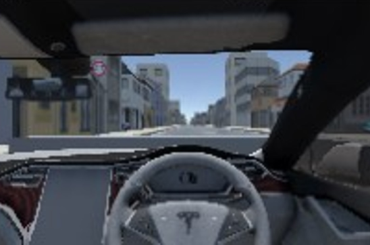
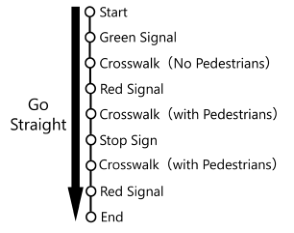
Figure 1 shows the driving scenarios used in the experiment. The test participants performed the driving task along a road simulating a residential area with two lanes in each direction and a road width of 3.5 m, following the driving scenario shown in Figure 2. To mitigate VR sickness, the routes consisted solely of straight roads. Furthermore, the speed limit was set to 40 km/h, and the driving distance was set to 5.5 km. During the experiment, the agent was displayed on the screen of the car navigation system. The agent’s utterances were designed to assist the driver, rather than issue direct driving instructions. The agent’s utterances were timed 150 m before the driving event.
EXPERIMENTAL PROCEDURE The experiment was conducted in accordance with the protocol shown in Figure 3. During the experiment, biosignalsplux (PLUX wireless biosignals) was used to measure the electrocardiogram data and evaluate the physiological responses. After sufficient practice in the driving task, the participants took a five-minute rest before performing the actual driving task. The participants then completed a subjective evaluation questionnaire. When an agent was present, the agent greeted the participants verbally prior to driving and engaged in preliminary interactions with them.
Performance Indicators The physiological indicators used were heart rate (HR), root mean square of successive differences (RMSSD), high frequency (HF), and the ratio of low- frequency to high-frequency components (LF/HF). High values of HR and LF/ HF indicate a state of tension and stress characterized by sympathetic nervous system dominance, whereas low values indicate a relaxed state characterized by parasympathetic nervous system dominance. Furthermore, high RMSSD and HF values indicate a relaxed state with parasympathetic dominance, whereas low values indicate a state of tension and stress with sympathetic dominance. A seven-point Likert scale was used to assess the subjective evaluations of the passengers, and a seven-point semantic differential method was used to evaluate the impressions of the agent. Statistical analyses were performed using the Wilcoxon signed-rank test at a significance level of 5%.
EXPERIMENTAL RESULTS Based on the results of the agent impression evaluation questionnaire, factor analysis was conducted to identify four factors: affability, reliability, activity, and excessiveness. A high score on the affability factor indicates that the
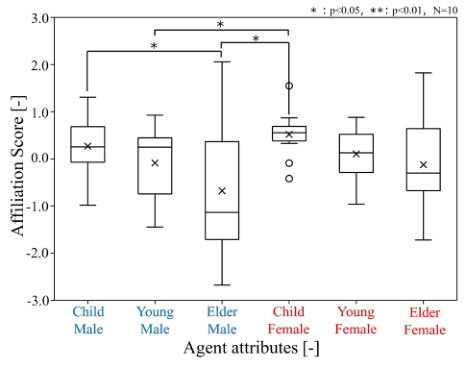
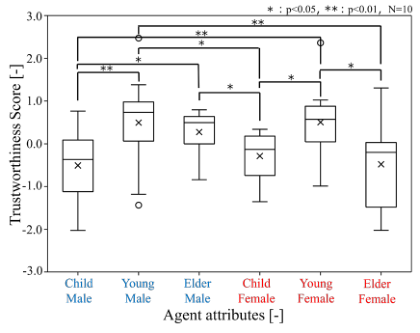
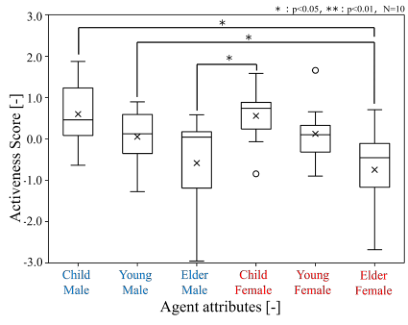
Influence of Social Appearance Attributes of Cyber Driving Support Agents 117 agent is approachable, whereas a high score on the reliability factor indicates that the agent is trustworthy. Furthermore, a high score on the activity factor indicates that the agent gives the impression of being lively, whereas a high score on the intrusiveness factor indicates that the agent gives the impression of being overly intrusive. The scores for the affinity, activity, and trustworthiness factors are shown in Figures 4, 5, and 6, respectively. For the affinity and activity factors, the scores tended to be highest for the elderly agent, followed by the young adult agent, and then the child agent. Regarding the trustworthiness factor, the male elderly and young adult agents were observed to have significantly higher scores.
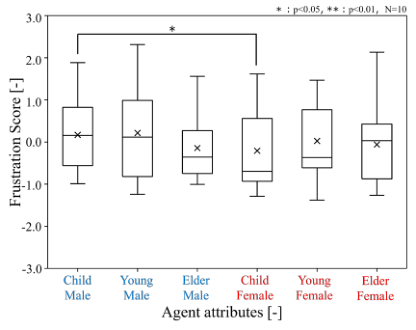
Based on the results of the passenger evaluation questionnaire, factor analysis was performed, which resulted in the extraction of five factors: frustration, a sense of responsibility, emotional stability, inattention, and self- presentation. A higher frustration factor indicates that the driver feels more irritation toward the agent; a higher sense of responsibility factor indicates a desire to protect the agent; and a higher emotional stability factor indicates that the agent helps stabilize the driver’s emotions. A higher inattention factor leads to reduced attention while driving, and a higher self-presentation factor indicates a tendency to attempt to present oneself in a favorable light. The frustration factor scores are shown in Figure 7. Regarding the frustration factor, it was significantly demonstrated that male child agents scored higher than female ones. Table 2 presents the correlation coefficients between the factors related to the agent’s impression and the passenger evaluation factors. The results revealed a negative correlation between frustration and reliability factors, and a positive correlation between the sense of responsibility and excessiveness.
Table 3 lists the correlation coefficients between the factors related to the agent’s impression and the passenger evaluation factors, and HR, RMSSD, HF, and LF/HF. The results revealed positive correlations between the inattentiveness factor and heart rate, the sense of responsibility factor and RMSSD, and the sense of responsibility factor and HF, whereas a negative correlation was observed between the agreeableness factor and LF/HF.
Figure 4: Affilication score for each agent attribute.Figure 5: Trustworthiness Score for each agent attribute.Figure 6: Activeness Score for each agent attribute.Figure 7: Frustration Score for each agent attribute.Table 2: Correlation coefficients between factors.
INVESTIGATION Regarding agent impressions, the affinity and activity factors tended to be highest for elderly agents, followed by young agents and then child agents. This suggests that, as the agents’ age increases, they may appear more composed, but their approachability may decrease. The high ratings given to young agents for the reliability factor are attributable to the fact that the experimental participants were in their early 20s, indicating that the agents’ ages were similar to their own. Furthermore, for the elderly male agents, characteristics, such as judgement and authority, were more readily perceived, and it is conceivable that these were integrated as factors contributing to reliability. Regarding passenger evaluations, the fact that male child agents were rated higher than female child agents on the frustration factor is presumed to be because male children were more readily perceived as having characteristics that were unpredictable and uncontrollable.
Regarding the correlation between factors related to agent impressions and those related to passenger evaluations, the negative correlation observed between the frustration and reliability factors suggests that irritation or discomfort toward the agent is directly linked to a decrease in perceived reliability. Furthermore, the positive correlation observed between the sense of responsibility and intrusiveness factors is presumed to be because the more the intervention from the agent is perceived as excessive, the more
strongly the driver becomes aware of its presence, thereby evoking a sense of responsibility.
Regarding the correlations between factors related to the agent’s impression and passenger-related factors, and HR, RMSSD, HF, and LF/HF, the positive correlation between the distraction factor and HR is thought to be because distraction from driving leads to a perceived need for concentration, resulting in a state of tension. The positive correlation observed between the sense of responsibility factor and RMSSD as well as HF indicates that a sense of responsibility toward the passenger promotes calm, normative behavior accompanied by a sense of security, rather than merely causing tension or stress. Furthermore, the negative correlation observed between the affinity factor and the LF/HF ratio suggests that a friendly passenger provides the driver with a sense of psychological security. Based on the analysis of the sense of responsibility factor, it can be inferred that recognizing the presence of an agent contributes to psychological stability. Furthermore, the negative correlation observed between the affinity factor and the LF/HF ratio suggests that a friendly passenger provides the driver with a sense of psychological reassurance.
CONCLUSION
In this experiment, we focused on age and gender as the agent’s socio- appearance attributes and compared the differences in the psychological and physiological responses elicited by the drivers. The results suggest that the younger the agents, the more likely they are to be perceived as approachable and energetic. Furthermore, we observed that agents who conveyed a sense of responsibility and approachability supported the driver’s psychological stability, thereby bringing about the positive aspects of the passenger effect. In the future, we will investigate how changes resulting from familiarity and attachment toward the agent influence the passenger effect and explore agents that can further enhance the positive aspects of this effect.
REFERENCES
Matuura, T. (2003) The impact of passengers in car accidents, Research in Social Psychology, Volume 19, No. 1, pp. 1–10. Miyazawa, K., Kagetani, T., Sei, M., Kikuti, H., Ogawa, Y., and Sen, J. (2009) An
Investigation into the Mechanisms by Which Drivers Accept Suggestions from Robotic Navigators in a Driving Environment, HAI Symposium 2009. Nakagawa, Y. and Park, K. (2014) Transportation Research Part F: Traffic Psychology and Behavior, Psychological effect of passenger presence on drivers and its dimensions: Scale development and validation, Volume 25, pp. 86–97. Sato, S., Katayama, D., Inaba, T., and Tanaka, T. (2015) Development of an
anthropomorphic agent to reduce the psychological burden on drivers, HAI Symposium 2015, pp. 308–316.
LISTED IN THE AHFE DIGITAL BOOKSTORE CATALOGUE
Explore the complete digital volume
Affective and Pleasurable Design
Read this individual research paper free through the original publisher, or explore the full digital proceedings book.
ISBN 978-1-964867-80-9
Explore this ISBN in the AHFE Bookstore ↗Listed in the July 2026 bookstore catalogue; search by ISBN to confirm current availability · Digital book purchase optional