Weilin Ye (2026). Design of a Community-Based Digital Platform for Standardized Stray Cat Rescue Based on Service System Design. In: Affective and Pleasurable Design. AHFE Open Access, vol. 204, pp. 121–131. https://doi.org/10.54941/ahfe1007338
Current urban stray cat rescue is hindered by fragmented processes, inconsistent Trap-Neuter-Return (TNR) standards, and financial pressures among diverse stakeholders. This "intention–action" gap prevents individual goodwill from becoming sustainable intervention. To address this, this study identifies four key user dimensions through a survey of potential volunteers: economic capacity, rescue experience, knowledge, and intention. Based on these findings, a tiered participation framework was developed using a capability-matching logic. This framework allows users to transition from observers to certified rescuers, aligning responsibilities with personal preparedness. To operationalize this, a community-based digital platform was designed for semi-enclosed settings like campuses and residential areas. Centered on the TNR lifecycle, the system integrates several key service modules: digital case registration for process tracking, transparent donation visualization to build trust, AI-assisted veterinary consultation for capacity building, and a "cloud adoption" model to sustain engagement. User clustering further refined the design decisions for interaction and service touchpoints. By converting individual goodwill into structured, traceable, and collaborative actions, this research demonstrates how human-centered digital systems can support localized animal welfare governance. The study concludes by discussing challenges in collaborative governance and diversified funding, proposing a design-driven model to activate community participation and standardize rescue practices.
Research Background Urbanization is accelerating globally. Consequently, stray cats have become a critical ecological and social factor in modern multispecies urban governance. The unregulated growth of stray cat populations poses potential public health risks. It also triggers intense conflicts between conservationists and animal welfare advocates within local communities (Longcore et al., 2009). Currently, Trap-Neuter-Return (TNR) is widely recognized as the mainstream intervention model for managing stray cats. Numerous empirical studies support this approach. Long-term adherence to TNR, when combined with
122 Ye adoption mechanisms, effectively and humanely reduces local stray cat densities (Levy et al., 2003).
However, current grassroots rescue practices are highly fragmented. Various stakeholders participate in these efforts. These include self-organized community residents, professional volunteer groups, university student clubs, and individual animal lovers. Yet, significant barriers exist among them regarding resource access, professional expertise, and responsibility allocation (Seo et al., 2023). This loose collaboration severely fragments the rescue process. On one hand, a lack of information sharing and coordination mechanisms isolates rescue actions. These efforts rarely scale up to a systematic intervention. On the other hand, funding sources are often singular, and responsibility boundaries remain blurred. Consequently, grassroots rescue efforts face heavy financial pressures and execution resistance (Zhang & Zhou, 2023). Without structured coordination mechanisms, stray cat governance falls into a structural dilemma. It is characterized by abundant individual goodwill but insufficient systemic effectiveness.
Core Human Factors Problem This study argues that the failure of community rescue efforts stems from a core “human factors problem.” Specifically, individual rescue intentions fail to translate into sustained and standardized intervention actions. Service design theory emphasizes that social innovation requires more than activating individual motivations. It necessitates an “enabling platform” to support the transformation of complex social behaviors (Sangiorgi, 2011).
This “Intention-Action Gap” manifests across four psychological and behavioral dimensions: First, a lack of action paths. Volunteers possess strong motivations but lack a systematic and structured intervention channel. Second, a lack of relevant knowledge. Caregivers often misunderstand scientific TNR standards. Consequently, spontaneous overfeeding can exacerbate population explosions and environmental pollution (Longcore et al., 2009). Third, a lack of collaboration. Experienced rescuers easily suffer from fatigue and burnout during long-term independent efforts. They urgently need a structured socio-technical system to share this burden (Björgvinsson et al., 2012). Fourth, a lack of trust. Potential donors often hesitate because rescue processes and financial usages remain opaque.
Therefore, bridging this cognitive and behavioral gap through systemic interventions is crucial for improving community animal welfare governance.
Research Objectives and Questions Addressing these dilemmas, this study explores how to reconstruct community stray cat rescue processes using Service System Design. The goal is to transform isolated individual goodwill into structured governance efficiency. Through digital platform interventions, stray cats transition from vague community burdens into governable subjects. They can be digitally recorded and continuously tracked (Guo & Yu, 2025). Service design acts as a bridge between social values and personal cognition. It provides systematic and affective solutions to these complex social conflicts (Gao, 2019).
METHODS
Research Design Framework This study employs a mixed-methods approach. It aims to identify user clustering characteristics through quantitative data and uncover behavioral pain points through qualitative interviews. This provides an empirical basis for constructing the digital service system. The research process consists of three stages:
Empirical Research Stage: An online survey (N = 176) collected data on demographic characteristics, rescue cognition, and resource contribution intentions. Simultaneously, semi-structured in-depth interviews were conducted with key members of university student clubs, senior volunteers, and community residents.
Modeling and Analysis Stage: Descriptive statistics identified critical gaps in public cognition. A role-stratification model was then developed using the K-means clustering algorithm based on four dimensions: intention, knowledge, experience, and economic capacity.
Design Transformation Stage: System permissions were defined based on the role models. Finally, a service blueprint was utilized to map service paths covering the entire TNR lifecycle.
Subjects and Data Collection Quantitative Survey
An online questionnaire was distributed, yielding 176 valid responses. The sample distribution shows several key characteristics: Gender Distribution: Female participants (73.86%) significantly outnumbered males (26.14%). This indicates that females are the primary empathetic and active group in community stray cat rescue.
Identity and Income: Respondents were primarily students or employed individuals. Notably, those with an income of 3,000 RMB or less formed the largest group. Within this group, 86.26% demonstrated significant cognitive errors in rescue scenarios (e.g., “bathing a cat immediately after taking it home”).
Rescue Background: Over 90% of respondents reported seeing stray cats in their living or working areas. However, only 28.4% were “willing to take active rescue measures.” This contrast between “universal witnessing” and “low proactive rates” confirms the prevalence of the “Intention-Action Gap.”
Qualitative In-depth Interviews To explore deep behavioral motivations and emotional pain points, semi- structured interviews were conducted with five representative potential users. Participants included leaders of university animal protection associations, experienced volunteers, individual rescuers, and community residents. The interviews focused on financial anxiety, social pressure, and family conflicts. These findings support the need for “transparent donations” and “role- stratification mechanisms” within the service system.
Interview results show that a lack of funds and equipment is the biggest barrier for individual rescuers. One rescuer noted, “Purchasing medical equipment like incubators for a litter of sick kittens cost several thousand RMB.” Such sudden, high costs often deter potential rescuers.
Emotional Exhaustion Triggered by Skill Panic Inexperienced respondents expressed significant anxiety regarding “how to rescue” newborn or severely injured cats. Without timely professional guidance, rescue failures often lead to intense self-reproach and emotional trauma.
Adoption Trust Crisis and High Screening Costs Experienced volunteers highlighted the “instability of online adoption.” To prevent abandonment or abuse, they must spend immense energy on background checks, home visits, and follow-ups. This lack of trust makes the adoption process lengthy and exhausts core volunteers.
Measurement Dimensions To construct precise user personas, four key dimensions were defined: Economic Capacity: This corresponds to the “affordable rescue cost” in the survey. The low percentage of people willing to spend over 500 RMB suggests the need for crowdfunding or corporate partnerships to lower individual barriers.
Rescue Experience: Weighting is based on pet ownership and prior rescue participation. “Senior rescuers” are often constrained by time and money, while “novices” suffer from skill panic. This necessitates a “mentor- collaboration mode.”
Rescue Knowledge: Evaluation was based on four situational questions. Results showed that misconceptions (e.g., “ear-tipping is cruel” or “immediate bathing”) are prevalent among inexperienced groups.
Rescue Intention: This is measured by “willingness to invest time and energy.” Most people can only provide temporary help (less than 3 hours), requiring lightweight participation paths.
Data Analysis The analysis focused on interaction differences between groups: Cross-tabulation Analysis: High-income groups showed more scientific views on sterilization. In contrast, students showed strong empathy but lacked practical knowledge.
K-means Clustering: Respondents were categorized into three core groups:Observers: Moderate intention, low knowledge, and fragmented time.Junior Volunteers: High intention and some economic foundation, but lacking professional guidance.Senior Volunteers: Rich experience and strong resource links, but facing high risks of rescue fatigue.
Design of a Community-Based Digital Platform for Standardized Stray Cat 125 Design Tools
Service Blueprint: This tool was used to restructure the “back-end logic” of rescue efforts. It specifically includes “AI-assisted screening” and “digital file tracking” to resolve information asymmetry and adoption tracking difficulties.
Interaction Framework: Figma was used to build interactive prototypes. Service touchpoints, such as “online education” and “equipment rental,” were designed to address psychological pain points and enhance emotional security.
RESULTS
User Clustering Results Based on K-means clustering analysis, potential participants were categorized into three distinct user groups. This provides an empirical basis for precision intervention:
Table 1: Clustering characteristics of potential community stray cat rescue users.
Table available in the original PDF paper.
User Group Sample % Core Characteristics Design Intervention Focus A. Observers 58.5% Strong intention but low knowledge; mostly students or junior workers; fragmented participation time.
Lowering entry barriers; focusing on affective education and lightweight interaction (e.g., photo-reporting).
B. Junior Volunteers
Providing standardized TNR collaboration paths and resource-sharing platforms to enhance efficacy.
32.4% Moderate economic base and pet-keeping experience; average knowledge scores; facing resource linkage barriers.
C. Senior Volunteers
9.1% Rich experience and professional skills; facing high risks of financial overdraft and emotional burnout.
Decentralizing authority and empowerment (mentors/ admins); focusing on trust mechanisms and external funding.
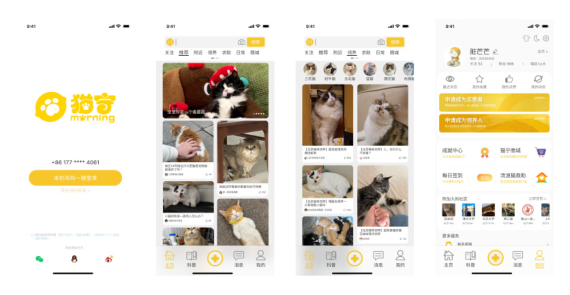
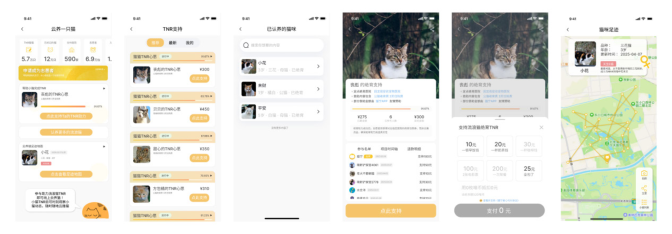
Tiered Participation Framework Construction Based on these findings, this study developed the “Moring” (Morning/Meow- ing) platform. To bridge the “Intention-Action Gap,” a “Capability-Role- Authority” matching framework was established. By decomposing complex rescue tasks into sub-tasks of varying difficulty, the system ensures that every user contributes value without psychological burden:
Primary Participants (Perception Layer): Corresponding to “Observers.” Permissions are limited to cat discovery, online “cloud adoption,” reading educational content, and posting help requests. Their core responsibility is to act as the community’s “sensory network.”
Figure 1: UI design of the mobile application.
Certified Rescuers (Action Layer): Corresponding to “Junior Volunteers.” These users must pass an in-system “Volunteer Assessment” to unlock intermediate permissions, allowing them to participate in onsite rescue, medical transport, and foster coordination.
Figure 2: Rescue post interface design (Volunteer perspective).
Community Administrators (Dispatch Layer): Corresponding to “Senior Volunteers.” Certified as administrators, they hold the highest dispatch authority. They are responsible for auditing donation usage, allocating public resources, and providing decision support for novices.
Service System Architecture Design To address inconsistent rescue standards and opaque funding, the study designed an integrated service system architecture covering three layers:
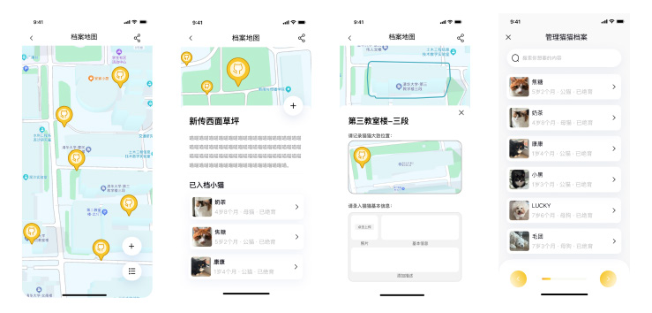
Process Layer: Standardized Lifecycle Management The system standardizes informal rescue into six consecutive stages: Discovery → Digital Registration → Trapping & Medical Care → AI-Assisted Triage/Sterilization → Release/Adoption → Long-term Tracking. Each node generates a digital footprint, transforming stray cats into “certified community residents.”
Figure 3: Community cat profile and map interface design.
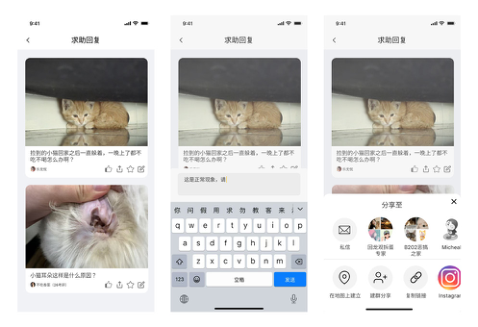
Collaboration Layer: Multi-Stakeholder Synergetic Network The system breaks the isolation of individual rescuers by building a task- oriented matrix. Residents provide daily observations; volunteers execute TNR and rescue actions; and administrators coordinate medical and property management resources. This creates a streamlined “rescue assembly line.”
Figure 4: Volunteer response interface for help requests.
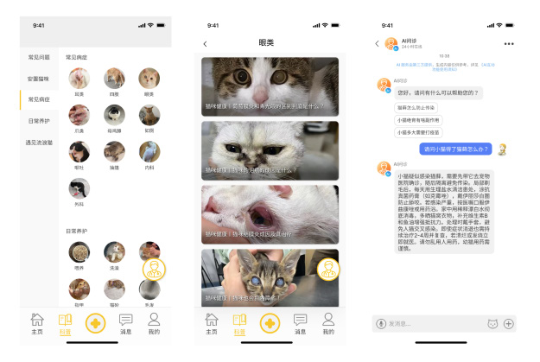
Digital Support Layer: Key Technical Modules Digital Filing and AI Triage: To mitigate “skill panic” among novices, the system integrates AI vision and Large Language Models (LLM) for preliminary medical triage and operational risk warnings.
Figure 5: Interface design for digital education and AI-assisted diagnosis.
Transparent Donation and “Cloud Adoption” Visualization: To alleviate financial anxiety, the system converts users who cannot adopt pets into “online supporters.” Users can donate to specific cats, with funds tracked via a real-time data dashboard (covering sterilization/surgery/treatment). By linking donations to a cat’s dynamic footprint on a digital map after release, the system reshapes social trust and sustains emotional engagement.
Figure 6: Interface design for digital education and AI-assisted diagnosis.
DISCUSSION
Application Implications Community Governance: From “Spontaneous Action” to “Digital Co-governance”.
This platform introduces a novel governance paradigm for semi-enclosed communities. Stray cat management is often a trigger for emotional conflict within neighborhoods. By utilizing digital archives and geographical tagging, the platform transforms stray animals into “computable governance units” (Guo & Yu, 2025). This digital environmental governance approach enhances communication efficiency between property management and residents, suppresses disordered feeding behaviors through explicit rules, and ultimately reconstructs the order of public spaces.
Design of a Community-Based Digital Platform for Standardized Stray Cat 129 Animal Welfare: Consistency Standards and Trust Loops
Given the high prevalence of cognitive biases even among motivated groups, the system seamlessly embeds Standard Operating Procedures (SOPs) into the interaction flow. This design strategy replaces manual instruction with systemic constraints, ensuring the scientific rigor and consistency of TNR operations. Furthermore, the visualized donation tracking and “cloud adoption” mechanism create a closed-loop feedback system for both emotion and material resources. Consequently, animal welfare no longer relies on individual heroism but on the “collective resilience” of the system.
Service Design: A Human Factors-Based “Intention-Action” Conversion Model The core contribution of this study is the “low-threshold entry, tiered growth” interaction model. Through the role-stratification mechanism, high-cognitive-load rescue tasks are deconstructed. This effectively mitigates common psychological barriers identified in human factors engineering, such as “diffusion of responsibility” and “skill panic,” providing a clear pathway from emotional empathy to tangible action.
Theoretical Contributions This research integrates multiple academic perspectives. First, it applies service system design theory to the intersection of animal welfare and community governance, validating the efficacy of Transformation Design in addressing marginalized issues. Second, the empirical “Tiered Participation Framework” offers a user-modeling paradigm for social-good digital products. Finally, by introducing human factors into multispecies co-design, the study highlights individual decision-making limitations in complex social contexts, thereby expanding the boundaries of Affective Design.
Limitations Despite its contributions, this study has several limitations. First, the sample size is relatively small and primarily consists of highly educated individuals; its adaptability to diverse environments, such as aging communities, requires further validation. Second, due to time constraints, long-term data tracking of population dynamics and community satisfaction post-TNR implementation has not yet been conducted. Third, the stability of the multi-stakeholder coordination mechanism and the actual conversion rates of the transparent donation model remain to be tested in real-market environments.
Future Research Directions Future research can be extended in three dimensions: Sustainable Business Models: Exploring “Tech for Good” mechanisms by involving pet brands or local merchants in incentive programs (e.g., integrated pet malls or discounted sterilization packages) to build a robust social enterprise model.
130 Ye Advanced AI Integration: Deepening the use of AI and automated monitoring to explore animal safety risk warnings based on behavioral data.
Cross-Community Comparative Studies: Conducting longitudinal studies across multiple communities to optimize privacy protection, data de-identification, and multi-agent game mechanisms.
CONCLUSION
This study addresses the deep-seated human-factor dilemma in urban multispecies governance—the systemic disconnect between “individual goodwill” and “scientific governance practices.” Through the integration of quantitative data mining and qualitative pain-point analysis, the findings demonstrate that singular moral mobilization or fragmented individual rescue efforts are no longer sufficient to address complex animal welfare demands. Instead, a structured service system design is urgently needed as a critical intervention.
The proposed digital platform for stray cat rescue, based on a tiered participation mechanism, lowers the barrier to public involvement through capability matching, dissolves knowledge barriers via digital empowerment, and reshapes community trust through visualized tracking. The results confirm that a design-led intervention model can effectively transform scattered emotional resources into standardized community synergetic power. By employing service system design methodologies, this research converts individual goodwill into a structured community intervention mechanism. This not only provides a replicable design path for urban animal welfare governance but also highlights the significant value of service design in carrying social emotions and reconstructing public collaboration.
REFERENCES
Björgvinsson, E., Ehn, P. and Hillgren, P.A. (2012) ‘Agonistic participatory design: Working with marginalised social movements’, CoDesign, 8(2–3), pp. 127–144. doi: 10.1080/15710882.2012.672577. Gao, Y. (2019) ‘Research on the innovative path of experience value in service
design’, Journal of the National Academy of Art, 40(04), pp. 92–96. Guo, L. and Yu, Y. (2025) ‘Governing feral cats through platform: The StreetCat project, digital environmental governance, and multispecies urbanism’, Geoforum, 165, p. 104365. doi: 10.1016/j.geoforum.2025.104365. Levy, J.K., Gale, D.W. and Gale, L.A. (2003) ‘Evaluation of the effect of a long-term
trap-neuter-return and adoption program’, Journal of the American Veterinary Medical Association, 222(1), pp. 42–46. doi: 10.2460/javma.2003.222.42. Longcore, T., Rich, C. and Sullivan, L.M. (2009) ‘Critical assessment of claims regarding management of feral cats by trap–neuter–return’, Conservation Biology, 23(4), pp. 887–894. doi: 10.1111/j.1523-1739.2009.01174.x. Sangiorgi, D., Lima, F., Patrício, L., Joly, M.P. and Favini, C. (2019) ‘A human-centred,
multidisciplinary, and transformative approach to service science: A service design perspective’, in Maglio, P.P. et al. (eds) Handbook of Service Science, Volume II. Springer, pp. 147–181. doi: 10.1007/978-3-319-98512-1_7.
Design of a Community-Based Digital Platform for Standardized Stray Cat 131 Seo, A., Ueda, Y. and Tanida, H. (2023) ‘Population dynamics of community cats
living in a tourist area of Onomichi City, Japan, before and after the trap-test- vaccinate-alter-return-monitor event’, Journal of Applied Animal Welfare Science, 26(2), pp. 153–167. doi: 10.1080/10888705.2021.1901226. Zhang, Y. and Zhou, C. (2023) ‘Exploration of digital management of stray animals in institutions of higher education’, China Animal Health Inspection, 40(11), pp. 41–45. doi: 10.3969/j.issn.1005-944X.2023.11.009.
LISTED IN THE AHFE DIGITAL BOOKSTORE CATALOGUE
Explore the complete digital volume
Affective and Pleasurable Design
Read this individual research paper free through the original publisher, or explore the full digital proceedings book.
ISBN 978-1-964867-80-9
Explore this ISBN in the AHFE Bookstore ↗Listed in the July 2026 bookstore catalogue; search by ISBN to confirm current availability · Digital book purchase optional