Timothy Berens, Sandra Kitting, Benedikt Salzbrunn, Andreas Sackl, Niklas Fraissl (2026). Exploring Empathy for Emotion-Aware Vehicles: How Should a Car Respond?. In: Human Interaction and Emerging Technologies (IHIET-AI 2026): Artificial Intelligence and Future Applications. AHFE Open Access, vol. 201, pp. 32–42. https://doi.org/10.54941/ahfe1007158
Empathic vehicles aim to enhance driving by addressing both emotional and functional needs. Yet, current systems such as Advanced Driver Assistance Systems (ADAS) often overlook drivers’ dynamic emotional states, which strongly influence behaviour and decision-making. Existing research largely focuses on detecting emotions rather than responding to them in meaningful ways. This study applies a human-centered design approach to explore how multimodal feedback can support drivers through context-sensitive, emotion-aware interactions. Two groups – daily commuters and young drivers (18-24 years) – were investigated using a mixed-methods approach. Semi-structured interviews (n = 23) identified emotional triggers, coping strategies, and expectations, informing a driving simulator prototype featuring visual, auditory, and tactile feedback. 18 participants evaluated these strategies in three emotionally challenging driving scenarios. Results show that adaptive music was perceived as the most effective strategy for influencing emotions, followed by ambient lighting, whereas emojis and seat vibrations were rated less effective. No statistically significant differences were found between groups. Participants stressed the need for empathic systems that are transparent, subtle, and customisable, with strong concerns regarding data privacy. The findings underline the potential of multimodal, context-sensitive feedback and highlight the need for further testing in real-world driving environments.
Roads are environments where millions of people commute daily in diverse emotional states. Some emotions are internally carried into the vehicle – such as stress from work, time pressure, or personal tension – while others emerge externally from the driving context itself, including road conditions or the behaviour of other drivers. Regardless of their origin, these emotional states significantly shape how people drive and interact in traffic (Schauer, 2024).
According to Eyben et al. (2010), considering emotional and affective states is essential for improving both safety and comfort in driving environments. Recent studies demonstrate that negative emotions such as anger, fear and sadness lead to riskier driving, particularly among younger drivers, manifesting in abrupt braking, speeding, and reduced awareness of others. In contrast, positive emotions such as joy or calmness are associated
Exploring Empathy for Emotion-Aware Vehicles: How Should a Car Respond? 33 with safer and more defensive driving patterns (Pizzo et al., 2024). Further studies consistently confirm the influence of emotions on driving behaviour (Abdu, Shinar and Meiran, 2012; Eyben et al., 2010; Jeon, Walker and Yim, 2014; Lau, 2016; Steinhauser et al., 2018; Zhang et al., 2020). Accurately detecting these emotions is the first step towards creating empathic vehicles, and the foundation for this development has already been laid. Rapid advances in machine learning have enabled a widespread adoption of systems such as facial recognition software in everyday life. Building on this momentum, recent emotion-recognition research increasingly uses machine learning—particularly deep neural networks (Younis et al., 2024; Zhang et al., 2020). These systems can analyse physiological signals, voice tone, language, facial expressions, and gestures and posture (Younis et al., 2024). The feasibility of emotion recognition is proven by Weber (2018), who demonstrated how facial expression analysis (FEA) was used to capture over 2,600 emotional events during driving, with up to 94% successfully linked to specific triggers.
Further steps towards safer driving through assistance systems have been taken with the development of technologies such as Advanced Driver Assistance Systems (ADAS) and Automated Driving (AD). Supported by data and analyses from the European Road Safety Observatory (ERSO) and driven by EU safety regulations, these systems aim to enhance road safety by supporting crash avoidance, crash mitigation and protection, as well as post-crash response (European Road Safety Observatory, 2018). However, these systems are predominantly short-term focused and largely overlook the mitigation of unsafe driving behaviours influenced by heightened emotional states. Moreover, Khastgir et al. (2018) underscore that the automotive industry continues to lack sufficient testing and validation of ADAS and AD systems.
An initial exploration of different mobile use cases was conducted by Braun et al. (2020), who identified possible starting points for affective automotive user interfaces (UI) and reported a high demand for such interfaces across cultures. Their findings highlight the potential for context-aware, emotion- sensitive systems that can, for example, adapt routes based on weather or traffic conditions, provide emotionally tailored playlists, display both drivers and baby’s state and offer entertainment options for passengers.
The next missing step is the development of systems that can respond appropriately to drivers’ emotions, particularly in stressful or high-risk traffic situations. This study focuses on what happens after an emotion is detected: how should a car respond? More specifically, it explores how interaction design can positively influence drivers’ emotional states to enhance safety and comfort. To investigate this research question, the study employs qualitative and design-oriented methods to explore user expectations, preferred feedback strategies (visual, auditory, or tactile), and sensory channels for emotion- aware vehicles, emphasising real-world needs and customisation preferences. As a first-of-its-kind approach linking emotion recognition with empathic feedback, the study is intentionally designed as an exploratory, upstream concept to examine possible forms of response and interaction.
METHODOLOGY
The study included 23 participants, 11 female and 12 male, aged between 18 and over 65 years. During recruitment, attention was given to ensuring an equal number of novice drivers (young participants who had recently obtained their driving license and were aged between 18 and 24 years) and experienced drivers (daily commuters with more than five years of driving experience). The former group represented the high-risk category in terms of crash involvement as identified by Pizzo et al. (2024), whereas the latter were chosen because they tend to experience a lower task or cognitive load while driving (Patten et al., 2006) and can therefore devote more attention to the developed feedback strategies.
Semi-structured interviews were conducted with each participant to begin the study. The goal was to investigate user expectations, emotional needs in the context of emotion-aware vehicle interaction, current experiences with existing driver-assistance features, personal strategies for regulating emotions while driving, as well as demographic and general driving information.
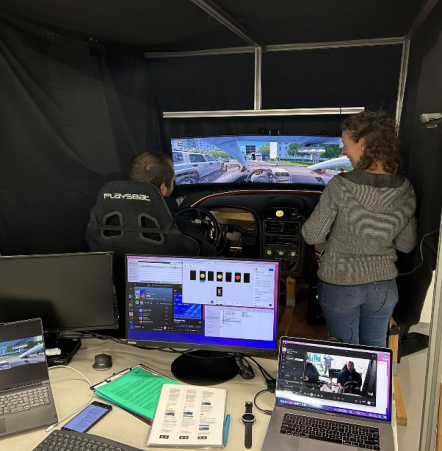
Between the interviews and the simulator testing (a two-week interval), the participant count decreased to 18 due to natural attrition (9 from each group). User testing took place in a driving simulator equipped with a car seat, a curved widescreen monitor and a steering wheel. All tests were conducted using an automatic transmission, due to the cognitive load considerations discussed earlier by Patten et al. (2006). City Car Driving by the company Forward Development was chosen as the software driving simulation. An overview of the test setup is shown in Figure 1.
Emotions were induced using story-based scenarios to which participants could relate. In total, participants experienced three emotionally charged trigger scenarios designed to evoke common affective states and stressors: one sad, one time-pressured, and one involving an aggressive driver.
Figure 1: Prototype of the driving simulator in its final stage.
Exploring Empathy for Emotion-Aware Vehicles: How Should a Car Respond? 35 The feedback strategies were tested using the Wizard of Oz method, first introduced by Don Norman in 1973. This approach is beneficial for simulating and evaluating a “huge, powerful system long before it can be built”, making it particularly effective during the early stages of development (Norman, 2013).
The five developed strategies were designed according to Gross’s Process Model of Emotion Regulation (Gross, 1998), targeting sensory, cognitive and social levels:
1) Social-cognitive level (visual): Animated emojis to mirror the drivers’ emotional state. Previous studies have demonstrated the successful use of emojis to increase the understanding of the emotional state of passengers (Chao, He and Fu, 2019), babies (Braun et al., 2020) and the driver itself (Braun, Chadowitz and Alt, 2019; Völkel et al., 2018). 2) Sensory level (haptic): Seat vibration to increase comfort. In previous studies this has led to higher comfort and reduced muscle activity (Durkin et al., 2006; Franz et al., 2011). Whilst there is concern whether seat vibration could also increase drowsiness in the long-term (Azizan et al., 2017), it remains unclear whether massage seats can be used to influence the drivers’ emotions. 3) Sensory level (visual): Ambient lighting using colours schemes grounded in psychological research (Elliot, Fairchild and Franklin, 2015). For the sad scenario, orange interior lighting was used for it signals warmth and is perceived as stimulating, associated with joy, optimism and activation. Green was chosen for the time-pressing scenario because it is considered regenerative, balancing and conveys not only calmness, but also a sense of safety. For the aggressive driver scenario blue was chosen because it stands for trust, stability, and emotional distance having a calming effect in escalating situations and helping to cool down. 4) Sensory-cognitive level (auditive): Adaptive music, with tempo-controlled tracks to calm or activate the driver. It has been proven that individual selected music can positively influence one’s mood and also have a positive effect in high demanding situations, e.g. less swerving (van der Zwaag et al., 2012). However, this study expands this theory and keeps the music selected constant across participants varying only music speed in between scenarios. For the scenarios in this experiment uplifting, fast music was chosen (150 beats per minute) for the sad scenario as well as in the time-pressing and aggressive driver scenario slower and calming music was chosen (75–80 beats per minute). 5) Social-cognitive level (auditive): An emotionally intelligent voice assistant providing contextual feedback to support cognitive reappraisal based on the driving scenarios (Eyben et al., 2010). This is supported by Harris and Nass (2011), who found that voice assistants can improve driving behaviour and reduce negative emotions when they reframe frustrating events and thus help drivers see them in a more positive light.
Procedure for Simulator Testing After being welcomed, informed of the study’s goals, and having signed the consent form, participants were asked to get comfortable in the driving seat and adjust the seat and steering wheel height to their preference. Following a ten-minute free drive for familiarisation, participants were introduced to the story-based scenario. During each scenario, they were asked to drive in the simulator according to their typical driving style in that context. The aim was to reduce cognitive load and avoid negative effect on driving performance, such as reduced speed control, or reduced monitoring control (Östlund et al., 2006).
During each scenario, participants were encouraged to think aloud about any thoughts related to the scenario, as well as any relevant reflections or observations. After each scenario, participants were asked how they felt and if they noticed any of the feedback strategies being applied. In all three scenarios (as mentioned at the beginning of this section), the order of the feedback strategies remained consistent and followed the sequence introduced above.
After the simulator testing, participants completed a custom questionnaire using a 5-point Likert scale (1 = strongly disagree, 5 = strongly agree) for each developed feedback strategy. They were asked to rate the following statements: “I can imagine that this strategy influences my emotions”, and “I can imagine that this strategy influences most people’s emotions”. Lastly, participants completed an emoji-based user experience questionnaire (UEQ), on a 7-point Likert scale, to evaluate the system as a whole (Colley, Mayer and Häkkilä, 2023).
RESULTS
Interviews Over 90% of participants reported prior experience with ADAS features, most commonly cruise control, parking assistance, blind-spot monitoring, lane-keeping assistance, and hill-start assist (all above 50%). The three most frequently reported emotional trigger scenarios were: emotional preload, time pressure, and aggressive or inappropriate behaviour from other drivers – which subsequently informed the design of the study scenarios. Other mentioned trigger scenarios were certain road regulations, police presence, technical difficulties/problems, vehicle breakdowns and conflicts with passengers.
Nine participants raised issues related to data protection, transparency, and uncertainty about which data would be stored and how it would be used. Six participants voiced fears of misuse of personal data, surveillance, or feeling “observed”, as well as unease about entering an overly transparent state. Five participants stated that such systems must be fully de-activatable, while four indicated they would prefer a physical “pull the plug” option. Another four participants expressed general scepticism towards AI, questioning its authenticity and emotional capability.
Exploring Empathy for Emotion-Aware Vehicles: How Should a Car Respond? 37 A notable preference emerged in the choice of voice assistant: across both groups, 18 participants selected a female voice, while only 2 selected a male voice (showing an 8:1 ratio in each group).
User Testing Across both user groups, adaptive music emerged as a highly influential modality, with participants describing noticeable changes in emotional state through variations in tempo and volume. Ambient lighting was also perceived as effective, with green tones generally associated with calmness and comfort. Blue and orange tones elicited more varied responses. Seat vibrations, voice assistant feedback and emojis were also noticed by participants, though their perceived influence varied across individuals.
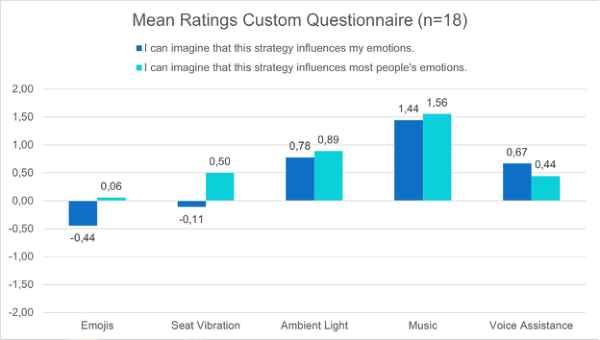
When examining the numerical ratings across the −2 to 2 scale, adaptive music received the highest mean values from both commuters and novice drivers for personal emotional influence (1.44 for both groups) and perceived influence on most people (commuters: 1.33; novices: 1.78). Ambient lighting also scored positively, particularly among commuters, who rated its emotional effect higher than novice drivers. Voice assistant feedback received moderate ratings from both groups. Seat vibrations were generally rated as having limited personal emotional influence, though both groups believed they might have a stronger effect on others. Emojis received the lowest ratings, with negative or near-neutral values for personal influence and only slightly positive ratings regarding their effect on others.
Overall, no statistically significant differences were found between the groups across any of the ten comparisons (Mann-Whitney U test; all p > .05). Effect sizes (r) ranged from .01 to .36, indicating negligible to moderate effects according to Cohen’s (1988) guidelines.
The largest effects were observed for ambient lighting (r = .34), adaptive music (r = .35) and the voice assistant (r = .36), suggesting moderate group differences in these specific items, though they did not reach statistical significance. The results indicate that while small to moderate trends may exist in some strategy-question combinations, the overall pattern does not support a consistent or significant difference in responses between the two groups.
The Emoji-UEQ was used to highlight overall impressions of the system. Results showed a similar pattern for both groups but again no significant differences between groups. With ratings ranging from -3 to 3, Novelty (2.06) and Stimulation (1.94) achieved the highest mean ratings, followed by Attractiveness (1.44) and Dependability (1.44). The lowest ratings came from Efficiency (0.94) and Perspicuity (0.87). Splitting the groups showed an identical trend, however, all ratings besides Dependability were slightly lower for the novice driver group. These findings suggest that while the system is engaging and innovative for both groups, improvements in clarity and usability may enhance the experience for novice drivers.
Figure 2: Overall mean ratings of feedback strategies.
As neither questionnaire revealed statistically significant group differences, the data were summarised into a single combined sample. The final overall ratings for feedback strategies of the custom questionnaire, along with mean values per item, are presented in Figure 2.
DISCUSSION
Study findings demonstrate that adaptive music consistently emerged as the most effective and positively received modality across both user groups. Notably, this strong performance occurred despite the music not being personally tailored, in contrast to earlier work such as van der Zwaag et al. (2012). This suggests that the emotional regulatory potential of music may be robust even in non-personalised form.
Ambient lighting also received favourable evaluations, particularly among commuter drivers, who associated green tones with calmness and comfort. Responses to blue and orange lighting, however, were more heterogeneous, highlighting the context-sensitive nature of colour-based feedback. Previous research similarly suggests that lighting can support emotion regulation, but typically only to a moderate degree and most effectively as part of a multimodal strategy rather than as a standalone solution (Braun, Weber and Alt, 2022; Liu, Wang and Zhu, 2025).
Voice assistant feedback was received moderately well, with a notable preference for a female voice across both groups, echoing broader patterns in automotive HMI studies. Earlier research emphasises that the effectiveness of voice cues depends strongly on their design and emotional congruence (Liu, Wang and Zhu, 2025), which may explain the comparatively lower ratings observed here.
Seat vibrations and emojis were perceived as less personally influential, although participants believed these modalities might be more effective for others. Both strategies are underexplored in the literature, and their interpretation may have been ambiguous within the test environment. Tactile cues, such as seat vibration, are often associated with ADAS warnings, which
Exploring Empathy for Emotion-Aware Vehicles: How Should a Car Respond? 39 may have led to confusion or reduced their perceived emotional relevance. Emojis, by contrast, were sometimes interpreted to signalling that the vehicle itself was “reacting”, which may have contributed to their underwhelming impact.
The Mann–Whitney U tests revealed no statistically significant differences between novice and commuter drivers in their questionnaire ratings, suggesting that perceived emotional influence of the strategies was broadly consistent across groups. However, small to moderate effect sizes for music, ambient lighting, and voice assistant feedback indicate that subtle trends may exist and could warrant further exploration with larger samples. The questionnaire framing may also have contributed to response patterns: the comparison between “influence on my emotions” and “influence on most people’s emotions” appears to have encouraged different forms of reflection, potentially leading to higher ratings for perceived influence on others than on oneself.
Several limitations should be acknowledged. First, the study relied on story-induced emotional scenarios, and the simulator environment did not reproduce corresponding events visually or dynamically. This may have reduced ecological validity and weakened the connection between emotional state and driving behaviour. Second, sample size was modest. A larger participant pool may have strengthened the statistical analyses, particularly regarding subtle group differences. Third, each feedback strategy was tested individually, whereas real-world automotive interfaces often combine modalities; future research should examine such combinations to identify potentially synergistic effects. Additionally, the sequence of strategies was fixed throughout the study. Randomising the order or assigning varied sequences across participant groups may yield different results and should be explored in later work. Finally, the study did not measure objective driving metrics (e.g., speed variability, steering behaviour), limiting conclusions about how empathic feedback may influence driver performance beyond subjective perception.
CONCLUSION
This study provides an initial exploration of empathic feedback strategies for emotion-aware vehicles and highlights the potential of adaptive, contextually sensitive systems to support emotional regulation during driving. A key finding is that effective empathic vehicle systems must offer high levels of contextual intelligence, transparency, and user control.
Future research should expand beyond simulated environments and incorporate real-world driving contexts. Longitudinal field studies would offer insights into how emotional feedback interacts with naturalistic driving behaviour, enabling the integration of both emotion detection and empathic response mechanisms. Additionally, further work is needed to examine how combinations of feedback strategies may influence emotional regulation differently than individual modalities alone.
Finally, while this study focused on perceived usefulness and subjective impact, an important direction for future research lies in linking empathic
vehicle systems with existing ADAS technologies. Understanding how emotional feedback interacts with quantitative driving metrics will be essential for designing systems that support not only emotional well-being but also measurable safety outcomes. In this sense, empathic vehicles should not only recognise emotional cues such as facial expressions or gestures but also infer emotional states through sudden or atypical changes in driving style. Together, such developments will contribute to the advancement of safer, more responsive, and emotionally intelligent mobility systems.
ACKNOWLEDGMENT
This research was funded by the Vienna Business Agency under the Tech4People 2023 call. It forms part of the Empathic Vehicle research project, a collaboration between the University of Applied Sciences Technikum Wien, emotion3D GmbH, and the Vienna University of Technology.
The authors would also like to express their sincere gratitude to all participants who took part in the interview and testing phases of the study.
REFERENCES
Abdu, R., Shinar, D. and Meiran, N. (2012) ‘Situational (state) anger and driving’, Transportation Research Part F: Traffic Psychology and Behaviour, 15(5), pp. 575–580. doi: 10.1016/j.trf.2012.05.007. Azizan, A., Fard, M., Azari, M.F. and Jazar, R. (2017) ‘Effects of vibration on occupant
driving performance under simulated driving conditions’, Applied Ergonomics, 60, pp. 348–355. doi: 10.1016/j.apergo.2016.12.020. Braun, M., Chadowitz, R. and Alt, F. (2019) ‘User Experience of Driver State Visualizations: A Look at Demographics and Personalities’, Human-Computer Interaction – INTERACT 2019, Cham, 2019. Cham: Springer International Publishing, pp. 158–176. Braun, M., Li, J., Weber, F., Pfleging, B., Butz, A. and Alt, F. (2020) ‘What If Your Car
Would Care? Exploring Use Cases For Affective Automotive User Interfaces’, MobileHCI ‘20: 22nd International Conference on Human-Computer Interaction with Mobile Devices and Services, Oldenburg Germany, 05 10 2020 08 10 2020. New York, NY, USA: ACM, pp. 1–12. doi: 10.1145/3379503.3403530. Braun, M., Weber, F. and Alt, F. (2022) ‘Affective Automotive User Interfaces– Reviewing the State of Driver Affect Research and Emotion Regulation in the Car’, ACM Computing Surveys, 54(7), pp. 1–26. doi: 10.1145/3460938. Chao, C., He, X. and Fu, Z. (2019) ‘Emo-View: Convey the Emotion of the Back-
Seat Passenger with an Emoji in Rear-View Mirror to the Driver’, in Rau, P.-L.P. (ed.) Cross-Cultural Design. Culture and Society. (Lecture Notes in Computer Science). Cham: Springer International Publishing, pp. 109–121. Cohen, J. (1988) Statistical Power Analysis for the Behavioral Sciences. 2nd edn.
New York, NY, USA: Lawrence Erlbaum Associates. Colley, A., Mayer, S. and Häkkilä, J. (2023) ‘Developing an Emoji-based User Experience Questionnaire: UEQ-Emoji’, MUM ‘23: International Conference on Mobile and Ubiquitous Multimedia, Vienna Austria, 03 12 2023 06 12 2023. New York, NY, USA: ACM, pp. 65–73. doi: 10.1145/3626705.3627767.
Exploring Empathy for Emotion-Aware Vehicles: How Should a Car Respond? 41 Durkin, J.L., Harvey, A., Hughson, R.L. and Callaghan, J.P. (2006) ‘The effects of
lumbar massage on muscle fatigue, muscle oxygenation, low back discomfort, and driver performance during prolonged driving’, Ergonomics, 49(1), pp. 28–44. doi: 10.1080/00140130500356882. Elliot, A.J., Fairchild, M.D. and Franklin, A. (2015) Handbook of color psychology.
eds.: Cambridge University Press. European Commission (ed.) (2018) Advanced driver assistance systems.
Available at: https://road-safety.transport.ec.europa.eu/system/files/2021-07/ ersosynthesis2018-adas-summary.pdf (Accessed: 29 October 2025). Eyben, F., Wöllmer, M., Poitschke, T., Schuller, B., Blaschke, C., Färber, B. and Nguyen-Thien, N. (2010) ‘Emotion on the Road—Necessity, Acceptance, and Feasibility of Affective Computing in the Car’, Advances in Human-Computer Interaction, 2010, pp. 1–17. doi: 10.1155/2010/263593. Franz, M., Zenk, R., Vink, P. and Hallbeck, S. (2011) ‘The effect of a lightweight
massage system in a car seat on comfort and electromyogram’, Journal of Manipulative and Physiological Therapeutics, 34(2), pp. 107–113. doi: 10.1016/j. jmpt.2010.12.002. Gross, J. (1998) ‘The Emerging Field of Emotion Regulation: An Integrative Review’, Review of General Psychology (Vol. 2), pp. 271–299. Available at: https://www.elaborer.org/psy1045d/cours/Gross(1998).pdf (Accessed: 30 October 2025). Harris, H. and Nass, C., 2011, May. Emotion regulation for frustrating driving
contexts. In Proceedings of the SIGCHI conference on human factors in computing systems, pp. 749–752. Jeon, M., Walker, B.N. and Yim, J.-B. (2014) ‘Effects of specific emotions on subjective judgment, driving performance, and perceived workload’, Transportation Research Part F: Traffic Psychology and Behaviour, 24, pp. 197–209. doi: 10.1016/j. trf.2014.04.003. Khastgir, S., Birrell, S., Dhadyalla, G. and Jennings, P. (2018) ‘The Science of Testing:
An Automotive Perspective’, SAE Technical Paper Series, WCX World Congress Experience, doi: 10.4271/2018-01-1070. Lau, C. (2016) ‘Emotional Driving: Examining how Mood-Valence affects Driving Performance’. Master Thesis, University of Guelph., pp. 1–130. Liu, J., Wang, X. and Zhu, L. (2025) ‘The impact of two computer-aided emotion
regulation strategies on risky driving behaviors in a virtual environment’, BMC Psychology, 13(1), p. 865. doi: 10.1186/s40359-025-03211-z. Norman, D.A. (2013) The design of everyday things. New York, NY: Basic Books. Östlund, J., Nilsson, L., Törnros, J. and Forsman, Å. (2006) ‘Effects of cognitive and visual load in real and simulated driving’, VTI (VTI rapport 533A). Available at: https://www.diva-portal.org/smash/get/diva2:675275/FULLTEXT02.pdf (Accessed: 30 October 2025). Patten, C.J.D., Kircher, A., Ostlund, J., Nilsson, L. and Svenson, O. (2006) ‘Driver
experience and cognitive workload in different traffic environments’, Accident; Analysis and Prevention, 38(5), pp. 887–894. doi: 10.1016/j.aap.2006.02.014. Pizzo, A., Lausi, G., Burrai, J., Quaglieri, A., Mari, E., D’Alessio, I., Barchielli, B., Cordellieri, P., Giannini, A.M. and Cricenti, C. (2024) ‘Emotion behind the Wheel: Unravelling the Impact of Emotional (dys)Regulation on Young Driving Behaviour—A Systematic Review’, Sustainability, 16(8), p. 3384. doi: 10.3390/ su16083384.
Schauer, V. (2024) Wenn Wut und Freude lenken: Emotionen sind unsere alltäglichen Begleiter im Straßenverkehr. Wie sie uns beeinflussen, wann sie zur Gefahr werden und wie wir am besten mit unserem Gefühlschaos umgehen. Available at: www.oeamtc.at/autotouring/reportage/emotionen-im-strassenverkehr-73216235 (Accessed: 29 October 2025). Steinhauser, K., Leist, F., Maier, K., Michel, V., Pärsch, N., Rigley, P., Wurm, F. and
Steinhauser, M. (2018) ‘Effects of emotions on driving behavior’, Transportation Research Part F: Traffic Psychology and Behaviour, 59, pp. 150–163. doi: 10.1016/j.trf.2018.08.012. Van der Zwaag, M.D., Dijksterhuis, C., Waard, D. de, Mulder, B.L.J.M., Westerink, J.H.D.M. and Brookhuis, K.A. (2012) ‘The influence of music on mood and performance while driving’, Ergonomics, 55(1), pp. 12–22. doi: 10.1080/00140139.2011.638403. Völkel, S.T., Graefe, J., Schödel, R., Häuslschmid, R., Stachl, C., Au, Q. and
Hussmann, H., 2018, September. I Drive My Car and My States Drive Me: Visualizing Driver’s Emotional and Physical States. In Adjunct Proceedings of the 10th International Conference on Automotive User Interfaces and Interactive Vehicular Applications, pp. 198–203. Weber, M. (2018) Automotive Emotions: A Human-Centred Approach Towards the Measurement and Understanding of Drivers’ Emotions and Their Triggers. Doctoral Dissertation. Brunel University, pp. 1–234. Younis, E.M.G., Mohsen, S., Houssein, E.H. and Ibrahim, O.A.S. (2024) ‘Machine
learning for human emotion recognition: a comprehensive review’, Neural Computing and Applications, 36(16), pp. 8901–8947. doi: 10.1007/ s00521-024-09426-2. Zhang, Q., Qu, W., Ge, Y., Sun, X. and Zhang, K. (2020) ‘The effect of the emotional state on driving performance in a simulated car-following task’, Transportation Research Part F: Traffic Psychology and Behaviour, 69, pp. 349–361. doi: 10.1016/j.trf.2020.02.004. Zhang, J., Yin, Z., Chen, P. and Nichele, S. (2020) ‘Emotion recognition using multi-
modal data and machine learning techniques: A tutorial and review’, Information Fusion, 59, pp. 103–126. doi: 10.1016/j.inffus.2020.01.011.
LISTED IN THE AHFE DIGITAL BOOKSTORE CATALOGUE
Explore the complete digital volume
Human Interaction and Emerging Technologies (IHIET-AI 2026): Artificial Intelligence and Future Applications
Read this individual research paper free through the original publisher, or explore the full digital proceedings book.
ISBN 978-1-964867-77-9
Explore this ISBN in the AHFE Bookstore ↗Listed in the July 2026 bookstore catalogue; search by ISBN to confirm current availability · Digital book purchase optional