Lei Zhong, Mengfan Li (2026). Design of Handheld Fire Extinguishers Based on Human-Centered Design Principles. In: Human Factors and Ergonomics In Design. AHFE Open Access, vol. 210, pp. 298–308. https://doi.org/10.54941/ahfe1007451
The high incidence of fire accidents poses a serious threat to life and property safety. The practical performance of handheld fire extinguishers directly determines the effectiveness of fire rescue. Currently, commercially available handheld fire extinguishers commonly suffer from issues such as complex operational procedures, excessive overall weight, and a limited scope of suitable user groups. It is challenging to master their operation methods. This study aims to provide new insights for the innovative design of handheld fire extinguishers based on human-centered design principles, fully considering the diverse needs of users, thereby enhancing their operational efficiency. To achieve these objectives, this study employed methods including literature review, expert interviews, and questionnaire surveys to analysis user behavior and needs. By synthesizing the above research, an innovative design framework for handheld fire extinguishers was proposed. Based on this framework, a handheld fire extinguisher design scheme that aligns with users' actual needs was proposed. This study provides theoretical and practical references for product innovation design research of handheld fire extinguishers.
Background and Significance As urban living environments become increasingly dense, a variety of factors— such as the widespread use of high-power electrical appliances, improper handling of fire, and inappropriate disposal of combustible materials— have led to increasingly diverse causes of fire. Fire safety directly affects both human life and property security, rendering its importance ever more prominent. Portable fire extinguishers currently available on the market are often characterized by cumbersome operational procedures, substantial mass, and limited suitability for diverse user populations. For elderly individuals and female users in particular, the operation tends to be challenging and the user experience unsatisfactory. The practicality of portable fire extinguishers directly influences the effectiveness of fire emergency response. Therefore, their design must not only fulfill functional requirements but also emphasize
Design of Handheld Fire Extinguishers Based on Human-Centered Design Principles 299 how it can accommodate and enrich users’ psychological and spiritual needs (Zhang, 2022).
The practical effectiveness of portable fire extinguishers in real-world settings falls considerably short of the desired level. As a critical tool for safeguarding life and property in emergency situations, the reasons for its lack of widespread and effective use warrant thorough investigation. This paper examines the underlying causes from a design perspective and proposes corresponding solutions. The fundamental purpose of design is to solve problems, enabling products to better serve people and contribute to a better quality of life. This study establishes a design framework for portable fire extinguishers grounded in human-centered design principles, distills relevant design strategies, and ultimately proposes a design solution that aligns with users’ actual needs, aiming to address the existing issues in the practical application of portable fire extinguishers.
Overview of Human-Centered Design Principles The human-centered design principle is a user-centered design philosophy and methodological framework. Its core lies in consistently prioritizing human needs, behaviors, and experiences throughout the design process, with the aim of enhancing people’s quality of life, efficiency, and well-being. This principle emphasizes that design should begin with an understanding of real users, develop solutions that more closely align with their actual needs, and ultimately return to the context of users’ real-world scenarios.
The core concept of the human-centered design principle is to regard human value and dignity as the starting point and ultimate goal of all activities, emphasizing “respecting people, empowering people, relying on people, and designing for people” (Zhu, 2025). Throughout the design process, consideration should be undertaken from the user’s perspective to ensure that, while fulfilling functional requirements, the product embodies humanistic care to the greatest extent possible and conveys the warmth of design.
Definition and Classification of Fire Extinguishers A fire extinguisher is a type of portable firefighting equipment containing an extinguishing agent. It is primarily used to suppress incipient-stage fires, thereby controlling or extinguishing the fire and preventing its spread. This facilitates the timely evacuation of personnel and allows professional firefighting services to intervene. The core function of a fire extinguisher lies in the rapid discharge of the extinguishing medium to interrupt the combustion process—through mechanisms such as oxygen deprivation and temperature reduction.
Fire extinguishers are not limited to a single type. Classified by the composition of their internal extinguishing agents, the most common type in daily life is the dry powder extinguisher. It effectively suppresses incipient fires caused by solid materials, liquids, gases, and electrical equipment, earning it the designation of a “general-purpose” extinguisher. This type is widely used in households, vehicles, and public spaces. Another prevalent
300 Zhong and Li type is the carbon dioxide (CO2) extinguisher. It operates by discharging a low-temperature gaseous fog to extinguish flames and is particularly suited for protecting precision instruments, electrical equipment, or important documents.
Classified according to the applicable types of fire, special cases such as kitchen oil pan fires require the use of specialized water-based fire extinguishers or Class F extinguishers. These extinguishers are capable of rapidly cooling and covering the oil surface, effectively preventing the splashing of burning oil. In environments with specific risks, such as laboratories and warehouses, Class D fire extinguishers—specifically designed for combating metal fires— are also deployed.
METHODOLOGY
Through a comprehensive review of academic literature, relevant documentation, and user interviews, information regarding the needs of fire extinguisher users was systematically collected. The thorough collection, accurate interpretation, and effective integration of user needs information directly influence the final outcomes of the design process (Wu, Zhu, Li, Zhang and Wu, 2025). Categorize and organize the interrelated information to formulate design strategies for fire extinguishers.
The survey findings indicate that residents without fire safety training are prone to developing negative stress responses when confronted with major fires. Firstly, traditional handheld fire extinguishers often feature excessive overall mass and lack ergonomic grip design, neglecting the physical strength and grasping limitations of specific user groups such as the elderly and women. Interviews with two residents who had participated in fire drills revealed that they were able to complete the process of activating a fire extinguisher and aiming it at the flames within three to five minutes. Relevant studies indicate that existing extinguishers are often excessively heavy, making one-handed operation difficult to perform smoothly (Lin, Ran, Kui and Ye, 2010). This not only creates practical difficulties during use but also diminishes their sense of self-efficacy. Secondly, considering the potential for user panic, it is essential to ensure that even the most inexperienced and highly stressed users can operate the device safely and correctly under the most adverse circumstances. Finally, in extreme environments such as fires, individuals are prone to high levels of emotional tension. The exterior form and appearance of a fire extinguisher should help reduce users’ sense of fear during emergencies. Therefore, the exterior design of portable fire extinguishers should incorporate diverse shapes, colors, and material textures to meet users’ aesthetic and perceptual needs.
By analyzing the psychological and behavioral patterns of individuals affected by fires, key design requirements are summarized. The analysis and conclusions of psychological and behavioral factors among fire-affected populations are presented in Table 1.
Table 1: Analysis summary of psychological and behavioral factors in fire-affected populations.
Table available in the original PDF paper.
User Behavior
1. Panic and Distraction. 2. Operational Difficulty: Due to excessive weight and poor ergonomic grip, single-handed operation is challenging (for the elderly and women).
User Needs 1. Reducing Operational Burden. 2. Ensuring Fault Tolerance and Safety. 3. Psychological Comfort Needs.
Key Design Points
1. Easy Grip: The overall design improves the gripping method to accommodate different user groups. 2. Intuitive and Simple. 3. Psychological Soothing: The form, color, and material texture of the appearance help alleviate user tension. 4. Inclusive Design: Considering the elderly, women, and the most inexperienced or stressed users.
Based on the aforementioned findings, this study further proposes design principles and a design scheme for handheld fire extinguishers.
RESULT: DESIGN PRINCIPLES AND PRACTICE The ability of product form to elicit user behavioral intention plays a decisive role in shaping user experience. However, traditional methods often fall short of adequately capturing the user experience evoked by product form, particularly users’ perceptions during anticipated use (Ding, Guo, Zhang, Qu and Liu, 2016).
Adhering to Ergonomic Principles Design must be grounded in a scientific attitude in order to achieve the perfect integration of art and science (Dandasena, Devi, Raj and Mohanta, 2025). Traditional handheld fire extinguishers primarily rely on manual operation to suppress fires, involving relatively complex procedures that hinder rapid and efficient fire extinguishing. The general steps include: gently retrieving the extinguisher, removing the lead seal, pulling out the safety pin, holding the nozzle with the left hand and the handle with the right hand, and then pressing the handle firmly to discharge the extinguishing agent. Without prior fire safety training, residents typically require three to four minutes to complete the entire extinguishing operation (Yu, Cai and Ren, 2021). Existing fire extinguisher designs fail to meet the needs of household users for simple and convenient operation. Their shortcomings are reflected in their bulky size, which makes one-handed operation particularly difficult for women and elderly individuals. The integration of ergonomic design helps create a healthier, more innovative, and more sustainable environment for the organization (Hasanein, Al-Romeedy, Khairy and Aliane, 2025). In the design process of the fire extinguisher product addressed in this thesis, an in-depth investigation will be conducted from four aspects: intuitive
302 Zhong and Li interaction, inclusive operation, multisensory coordination, and the principle of fault tolerance and trust.
Principles of Intuitive Interaction. Based on the principles of intuitive interaction design derived from cognitive psychology, the design of fire extinguishers must align with users’ instinctive response patterns in emergency situations. Firstly, the product should adhere to the principle of mental model correspondence. In moments of panic, users often instinctively associate with the operation methods of common tools. Therefore, the appearance of a fire extinguisher should employ formal design language to enable users to understand its operation immediately through visual cues and intuition, without the need for conscious thought or reading instructions, thereby transforming the action into an instinctive behavior. Secondly, the design should adhere to the principles of information simplification and salience. Under conditions of high stress, human attention becomes severely limited and easily distracted. Therefore, the design should eliminate all unnecessary text, icons, and complex structures, concentrating the entire product’s visual design around a single, central focal point.
Principles of Inclusive Operation. Addressing social barriers is crucial for creating a safe and inclusive environment, a concept that aligns closely with the principle of inclusive operation in fire extinguisher design (Chuangchai and Pothisiri, 2025). The principle of “inclusive operation”, grounded in physiology and behavioral science, requires that fire extinguisher designs comprehensively accommodate the variations in physical capabilities and operational constraints exhibited by different users under extreme stress. Firstly, the design should adhere to the principle of strength inclusivity. Full consideration must be given to the significant variations in users’ grip strength and upper limb strength, particularly under conditions of hand trembling or sweating induced by stress. To this end, the handle may be positioned at an oblique angle relative to the cylinder, with a non-slip pad added to the lower portion of the handle and a slightly curved hook incorporated at its rear end to enhance grip comfort and stability. Secondly, the design should implement the principle of postural stability to address the practical scenario in which users may experience bodily instability during a fire and often need to operate the extinguisher with one hand. Accordingly, an auxiliary handle may be added to the cylinder to accommodate the other hand, providing users with an additional point of stable support when operating from unconventional postures.
Grounded in the principle of multisensory coordination, the design aims to ensure operational reliability in fire scenarios through the synergistic integration of multiple sensory modalities. Historically, research on learning—particularly perceptual learning—has predominantly focused on learning in response to stimuli from a single sensory modality. In contrast, real-world experience is consistently accompanied by the convergence of multisensory inputs (Shams and Seitz, 2008). Accordingly, the design specifically adheres to the principle of visuotactile coordination. Distinctive forms are incorporated into the key operational components to achieve “tactile navigation recognizable with eyes closed”, enabling users to
Design of Handheld Fire Extinguishers Based on Human-Centered Design Principles 303 effectively overcome sensory limitations caused by factors such as smoke or darkness, thereby ensuring accurate operation even under extreme stress.
Principles of Fault Tolerance and Trust. Based on the principle of fault tolerance and trust, the aim is to establish operational certainty and user confidence at the level of design. Error-proofing design employs physical constraints to make the correct operation the only possible path, fundamentally eliminating the risk of misuse. Trust is cultivated through appropriate weight and the tactile quality of robust materials—such as a flexible, non-slip layer wrapped around the handle—thereby conveying a sense of reliability and professional quality. This eliminates hesitation and enables users to trust and operate the device without hesitation in critical moments.
Principles of Product Safety Based on an in-depth analysis of crowd psychology and behavioral characteristics in fire scenarios, designers must prioritize the safety design principles of fire extinguishers.
Cognitive Security. The design must meet the following requirements: simplify the operational process to the greatest extent possible; utilize high-contrast colors for visual guidance to ensure rapid identification of the operational area within effective time limits; and establish a cross-sensory feedback system where device status is simultaneously conveyed through visual (color) and tactile (texture change) cues to guarantee intuitive comprehension in any environment.
Physiological Safety. The design must ensure that the device can be operated safely and effectively by all users, ranging from women with lower physical strength to men with greater strength, as well as from adolescents to the elderly. Specifically, the overall weight and center of gravity distribution of the fire extinguisher should be optimized so that even users with the least physical strength can easily lift and stably operate it. Additionally, the handle should be ergonomically shaped and incorporate guiding textures to prevent incorrect gripping and ensure that the hand naturally settles into the optimal position for force application. These requirements collectively ensure that the device can accommodate the physiological conditions of diverse users in real-world fire scenarios.
Psychological Safety. The purpose of addressing psychological safety needs is to establish users’ “sense of trust and sense of control”, thereby eliminating hesitation during operation and prompting them to act swiftly. The design should ensure that the quality of the device intuitively conveys reliability— communicating a sense of robustness and professionalism through materials, craftsmanship, and weight. The aiming process should remain intuitive— assisted by form to reduce aiming difficulty and enhance users’ confidence in controlling the product. Together, these elements enable users to act decisively and confidently in emergency situations.
Environmental Safety. The design must take ensuring the usability of the fire extinguisher in complex fire scene scenarios as its core objective. Specific requirements include that all critical markings remain clearly identifiable under conditions of low light, smoke, water exposure, or oil contamination;
304 Zhong and Li and that the core operational area enables tactile localization and operation without visual input, through the use of distinctive textures or morphological differentiation. Through targeted design optimization, the aim of enhancing man-machine coordination within the man-machine-environment system and reducing the rate of accidents can be achieved (Zhang and Luo, 2020). These elements collectively ensure the immediate usability and operational reliability of the device under extreme conditions in real fire scenarios.
Principles of Product Design Innovation As technology advances and design objects grow increasingly complex, the demands placed on product form design continue to rise (Qiu and Zhang, 2021). To enable users, at the very first sight and touch of the product, to instinctively comprehend its correct operation through the overall semantics conveyed by its form, color, and material. This allows users, under the intense stress of a fire, to focus entirely on the core task of “fire suppression”, thereby maximizing the likelihood of a safe escape.
Shape. Existing product forms are generally similar, leaving considerable room for innovation. Through analytical research, the following improvements are proposed: first, to imbue the overall product form with semantic meaning, thereby transforming the cold industrial image of the cylinder while enhancing adaptability through features such as an auxiliary handle; second, to shift the visual focal point of the form forward, adopting an angled nozzle design to expand the fire-extinguishing coverage area, and positioning it within the easily controllable zone in front of the handle— ensuring that users can achieve rapid and precise operation even in stressful emergency situations.
Color. Currently, there is a demand for diverse designs of simple fire extinguishers that can serve as decorative elements in daily home environments while also being capable of extinguishing fires when necessary (Lee, 2020). Color is a ubiquitous perceptual stimulus, and it is typically considered from an aesthetic perspective (Elliot and Maier, 2014). Designers should focus on innovation in color design. First, the use of highly visible colors such as red or yellow can directly attract attention and highlight operational points, enabling efficient visual guidance. The grip areas should employ neutral and stable colors such as black or gray to convey a sense of reliability and security. Finally, self-luminous materials or high-reflectivity coatings should be applied to critical lines and markings, ensuring that the product’s operating paths and functional areas remain clearly distinguishable in low-visibility fire scenarios characterized by darkness or smoke, thereby guaranteeing the device’s usability under extreme conditions.
Texture. In terms of innovation in texture design, first, directional raised stripes are applied to the surface of the handle to naturally guide the hand into the correct gripping position. Second, the activation component features a distinctive form and texture, creating a significant tactile differentiation from the smooth handle, thereby enabling precise localization without reliance on vision. These design features collectively enhance physical anti-slip
Design of Handheld Fire Extinguishers Based on Human-Centered Design Principles 305 performance while conveying, through a sense of solid tactile feedback, the psychological suggestion of “a firm and controlled grip”, together helping users establish reliable operational confidence in chaotic environments.
Material. At the level of material innovation, the main body should be made of matte-finished engineering plastic or lightweight alloy, conveying a sense of robustness without appearing cold. The non-slip pad on the handle should be composed of a high-friction, moisture-absorbing microporous soft elastomeric material, which prevents slipping due to hand perspiration while providing a gentle tactile experience to alleviate tension. Critical markings should be coated with reflective materials to ensure clear visibility in dark or smoke-filled environments. In this way, material selection directly contributes to users’ sense of security and operational confidence.
Craftsmanship. At the level of material innovation, the key lies in internal reinforcement and specialized surface treatments, ensuring lightweight durability while conveying a promise of reliability through tactile quality. Craftsmanship thus becomes a direct source of a sense of security.
Design Practice This product adheres to human-centered design principles, integrating ergonomic principles, product safety principles, and innovation principles in product design to transform the traditional fire extinguisher into an intuitive, inclusive, and highly reliable fire safety tool. Its squared form combined with a curved top achieves a balance between structural stability and visual approachability, while the angled handle and forward-positioned inclined nozzle collectively enable an intuitive “grip-aim-discharge” operation. The dual-grip system—comprising a primary handle and an auxiliary rear grip— together with non-slip materials and a hook-shaped anti-detachment design, effectively reduces grip strain and enhances stability, making it well-suited for users with varying levels of physical strength. Furthermore, large-format labels and high-contrast color schemes establish clear operational guidance and a reliable product perception. Ultimately, the product achieves a transition from “requiring skill” to “instinctive operation”, and from “suitable for able-bodied adults” to “usable across all age groups”, thereby redefining the value standard for emergency fire safety products. The application of human- centered design principles and methods offers an alternative approach for conducting such design (Junginger, 2018).
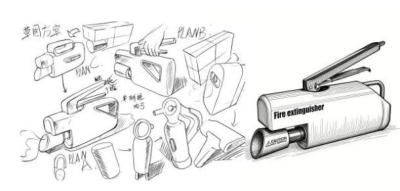
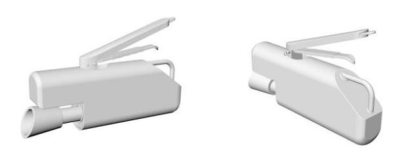
Sketching and Modeling Exploration. A design sketch of the handheld fire extinguisher is shown in Figure 1, and its design model is presented in Figure 2.
Figure 1: Conceptual sketch of the handheld fire extinguisher.Figure 2: Handheld fire extinguisher modeling diagram.
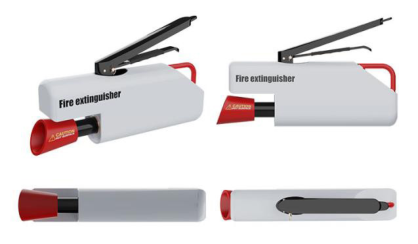
Final Rendering. The design rendering of the handheld fire extinguisher is shown in Figure 3.
Figure 3: Final rendering of handheld fire extinguisher.
User Verification User interviews using product images indicate that the product achieved its anticipated usability and lightweighting objectives. In terms of usability, multiple interviewees reported that they were able to intuitively understand the operational logic without any guidance, directly confirming that the relevant issues have been effectively addressed. Regarding the lightweighting improvement, the product’s outer casing material was replaced from metal to high-performance engineering plastic, achieving significant weight reduction while maintaining structural integrity.This indicates that this change precisely addresses users’ core demand for portability.Both optimizations received explicit user approval, collectively addressing core functional and psychological needs.
DISCUSSION
This study proposed 3 main design strategies with sub-strategies for fire extinguisher design. These design strategies are ergonomic principles, product safety principles, and design innovation principles. Introducing the design principles into the portable fire extinguishers design aims to address the issue of low utilization rates. The design was then evaluated by potential users and showed great interests by them. However, there is one limitation of the current study. The proposed design has not yet been produced and evaluated in real scenario by target users to verify whether it truly achieves the research objectives of usability and intuitiveness. Nevertheless, this study offers a new
Design of Handheld Fire Extinguishers Based on Human-Centered Design Principles 307 approach for the innovative design of fire extinguishers. The researchers are planning to produce it and do the test in the near future, and the design will be further refined based on the findings.
ACKNOWLEDGMENT
This research was funded by the Tianjin Municipal Art Science Planning Key Project, Research on the Construction and Development of Tianjin’s “Mountains, Sea, Rivers, Buildings, and Lively Atmosphere” Cultural Tourism Belt (Project No.: B24002).
REFERENCES
Aided Product Modeling Design Based on Virtual Reality Technology. 2021.
International Journal of New Developments in Engineering and Society, 5(3). Available at: https://doi.org/10.25236/IJNDES.2021.050302. Accessed: February 1, 2026 Chuangchai, W. and Pothisiri, W. 2025. Inclusive Public Spaces for Vulnerable Populations: Assessing Needs and Social Implications for Bangkok Metropolitan Area. City and Environment Interactions, 28: 100272. Available at: https://doi. org/10.1016/j.cacint.2025.100272 Dandasena, S., Devi, M., Raj, S., and Mohanta, D.S. 2025. Integrating Biological
and Physical Principles into Ergonomic Furniture Design: Enhancing Posture and Comfort. Journal of Advances in Biology & Biotechnology, 28(12): 177–186. Available at: https://doi.org/10.9734/jabb/2025/v28i123374 Ding, Y., Guo, F., Zhang, X., Qu, Q., and Liu, W. 2016. Using Event Related Potentials to Identify a User’s Behavioural Intention Aroused by Product Form Design. Applied Ergonomics, 55: 117–123. Available at: https://doi.org/10.1016/j. apergo.2016.01.018 Elliot, A.J. and Maier, M.A. 2014. Color Psychology: Effects of Perceiving Color
on Psychological Functioning in Humans. Annual Review of Psychology, 65(1): 95–120. Available at: https://doi.org/10.1146/annurev-psych-010213-115035 Hasanein, A.M., Al-Romeedy, B.S., Khairy, H.A., and Aliane, N. 2025. Designing for Sustainability: How Ergonomics Enhances Green Motivation and Innovation in the Hospitality Sector. Tourism and Hospitality, 6(5): 280. Available at: https:// doi.org/10.3390/tourhosp6050280 Junginger, S. 2018. Inquiring, Inventing and Integrating: Applying Human-Centered
Design to the Challenges of Future Government. JeDEM - eJournal of eDemocracy and Open Government, 10(2): 23–32. Available at: https://doi.org/10.29379/ jedem.v10i2.520 Lee, S.-W. 2020. Methods to Improve the Design of Household Fire Extinguishers through an Empirical Analysis of Consumer Compatibility. Fire Science and Engineering, 34(3): 58–66. Available at: https://doi.org/10.7731/KIFSE.d72f3d22 Lin L, Ran X, Kui H, and Ye D. 2010. Innovative Design Research on Fire Escape
Equipment for High-Rise Buildings. Packaging Engineering, 31(24): 29–31, 47. Available at: https://doi.org/10.19554/j.cnki.1001-3563.2010.24.009 Shams, L. and Seitz, A.R. 2008. Benefits of Multisensory Learning. Trends in Cognitive Sciences, 12(11): 411–417. Available at: https://doi.org/10.1016/j.tics.2008.07.006 The Enlightenment of Nordic Emotional Design on Product Design. 2022.
International Journal of Frontiers in Sociology, 4(5). Available at: https://doi. org/10.25236/IJFS.2022.040503. Accessed: February 1, 2026
Heterogeneous User Requirement Information in Complex Product Design. Symmetry, 17(8): 1192. Available at: https://doi.org/10.3390/sym17081192 Yu S, Cai Y, and Ren J. 2021. Design Research on a Multi-functional Household Firefighting Backpack. Packaging Engineering, 42(4): 154–158, 165. Available at: https://doi.org/10.19554/j.cnki.1001-3563.2021.04.021 Zhang, J. and Luo, B. 2020. Man-Machine-Environment Virtual Design and JACK
Simulation of Rosa Roxburghii Picking Machine. E3S Web of Conferences, 179: 01007. Available at: https://doi.org/10.1051/e3sconf/202017901007 Zhu J. 2025. Research on the Emotional Design of Pharmaceutical Packaging under the People-Oriented Principle. Footwear Technology and Design, 5(5): 166–168
LISTED IN THE AHFE DIGITAL BOOKSTORE CATALOGUE
Explore the complete digital volume
Human Factors and Ergonomics In Design
Read this individual research paper free through the original publisher, or explore the full digital proceedings book.
ISBN 978-1-964867-86-1
Explore this ISBN in the AHFE Bookstore ↗Listed in the July 2026 bookstore catalogue; search by ISBN to confirm current availability · Digital book purchase optional