Sayaka Noda, Toshihisa Doi, Luo Weiyang, Sayaka Yamane, Seiji Minami, Satsuki Harada (2026). Mapping Experiential Values of Office Chairs: Insights from Qualitative Observations. In: Human Factors and Ergonomics In Design. AHFE Open Access, vol. 210, pp. 12–19. https://doi.org/10.54941/ahfe1007421
As Activity-Based Working (ABW) becomes standard, office chairs play a vital role in supporting productivity. However, many advanced functions remain underutilized due to unintuitive design, suggesting a gap between chair features and user understanding. This study aims to identify the experiential values workers seek in office chairs to establish more effective design guidelines. Observations were conducted in varied settings, including island-style offices at Itoki Corporation and Osaka Metropolitan University, as well as modern open spaces. Data were analyzed using the KA method to construct a value map. The integrated value map indicates that one group of prioritized values exists along a continuum, shifting from chair-specific attributes, such as stability and physical support during focused work, to broader workspace-related values, including mobility and environmental fit. In contrast, another group of prioritized values is associated with task engagement, ranging from support for deep concentration to features that enable mental refreshment and rest. This research clarifies how experiential values transition from physical chair features to holistic workspace qualities. This research clarifies how experiential values shift from physical chair features to more holistic workspace qualities, as well as how user needs dynamically fluctuate between states of concentration and rest depending on the task context. These qualitative findings offer meaningful guidance for future product development grounded in human-centered design.
In recent years, the evolution of office environments has intensified the demand for furniture that optimizes both employee efficiency and ergonomic comfort (Baba et al., 2021; Bai, 2024). As the primary interface between the worker and the workspace, the office chair remains a critical determinant of physical well- being and productivity (Harsha, et al., 2026). This role is further emphasized by the global transition toward Activity-Based Working (ABW), which necessitates a shift from traditional, fixed-seating layouts to flexible solutions that accommodate diverse, dynamic workstyles (Engelen et al., 2019).
Although office chairs have become increasingly advanced, a gap remains between what the chair can do and how it is actually used. Studies show that users often ignore complex adjustment features, frequently utilizing fewer than half of Received January 30, 2026; Revised April 4, 2026; Accepted April 20, 2026; Available online July 20, 2026
Mapping Experiential Values of Office Chairs: Insights From Qualitative Observations 13 the available functions due to a lack of knowledge or intuitive understanding (Underwood & Sims, 2019). As a result, the intended health benefits, such as reduced physical strain, are often not realized. This implies that simply adding more mechanical features is not enough to improve the user experience.
To address this gap, this study proposes a paradigm shift in design methodology: moving beyond functional technicality to prioritize “User Experience (UX) Value.” By adopting a user-centric lens, designers can bridge the gap between intent and utility, ensuring that office furniture effectively enhances the working lives and performance of its users.
The objective of this study is to identify and categorize the authentic experiential values of office chairs through a multidimensional analysis of actual usage and user perceptions. By doing so, the research provides a human- centric foundation for future design guidelines. Ultimately, these insights aim to inform the development of next-generation office chairs that prioritize intuitive interaction and support the multifaceted needs of contemporary office environments.
METHOD
To investigate actual usage patterns of office chairs, observational data were collected at Itoki Corporation and Osaka Metropolitan University. In island- style office layouts at both sites, video recordings were conducted during a two-hour morning period as well as during the lunch break, and these recordings were later observed. In addition, direct in-person observations were carried out from 13:00 to 16:00 in a co-working space environment at Osaka Metropolitan University, where a diverse range of seating options was available. Observation notes focused on three primary dimensions: task characteristics, observable behaviors, and inferred insights.
The qualitative data obtained from these observations were analyzed using the KA method (Asada, 2006), a qualitative analysis technique designed to identify what users truly value. The effectiveness of the KA method for addressing user experience (UX) has been reported by Ando (2016). Rather than focusing solely on surface-level behaviors, this method aims to uncover the “hidden needs” underlying users’ actions.
The analysis began with the extraction of objective facts from the observational data. At this stage, careful attention was paid to clearly distinguishing actual user behaviors from the researchers’ interpretations or assumptions. Next, KA cards were employed (Figure 1). Based on each extracted objective fact, the user’s feeling was inferred from the observation in order to interpret the underlying motivation behind the behavior. For example, when a worker placed their feet on the wheel of the chair, the objective fact was the act of placing their feet on the chair wheel. The user’s feeling was then interpreted as, “It would be nice to have a place to rest my feet.” Finally, the “value delivered to the user,” defined as the essential benefit the user genuinely seeks, was identified. In this case, the value was defined as “the value of having a footrest.”
These individual values were then organized and grouped to construct a Value Map, which visualizes the overall structure of the user experience.
Figure 1: An example of KA cards used to analyze the observation facts.
Figure available in the original PDF paper.
RESULTS AND DISCUSSION
Island-style Offices
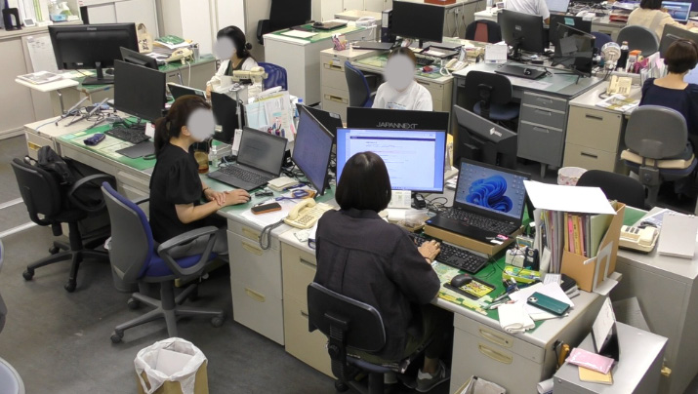
Figure 2 illustrates the Value Map derived from observations conducted across island-style office environments, one example of which is shown in Figure 3. Analysis revealed that the identified experiential values could be classified into two primary categories. The first category relates to the physical environment, extending from the chair itself to the surrounding workspace. This includes environmental fit, spatial efficiency, and mobility. The second category consists of values emerging from the work process itself and the user’s internal mental state. These values relate to the chair’s capacity to support varying levels of task engagement, ranging from deep concentration to periods of mental refreshment and rest.
Within the category “value of the chair,” the “value of customizing non- personal assets” was identified. This value was derived from observations of users placing personal cushions on communal chairs, suggesting a desire to adapt shared, non-private equipment to individual comfort needs.
Within the category “value arising between the chair and the user,” the “value of activity-based posture” was identified. Observations indicated that users actively adjusted their posture according to the task: engaging the backrest during handwriting tasks to enhance stability, while adopting a forward-leaning posture without backrest support during mouse operations to facilitate precise movement.
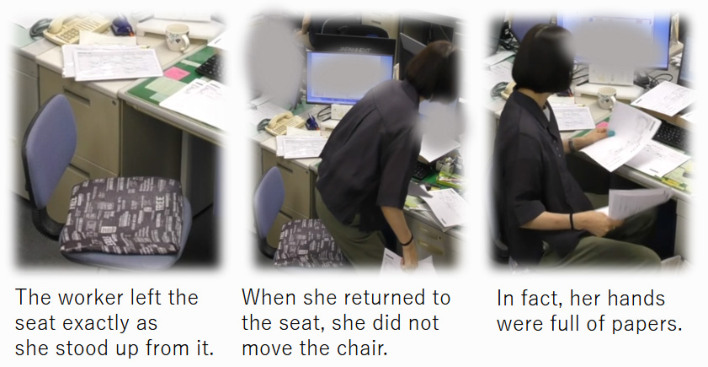
Within the category “value arising in the workspace,” the “value of hands-free seating access” was identified. Some users were observed carrying luggage in both hands, approaching the chair, and sitting down without using their hands, as illustrated in Figure 4, highlighting the need for hands-free seating access.
Based on users’ mental states, a functional axis representing a spectrum between “Concentration” and “Rest” was established. This highlights the Contextual Fluidity of user needs, where prioritized values evolve dynamically depending on the level of cognitive focus.
For example, observations of users stretching during short breaks illustrate the “value of active movement during tasks,” demonstrating how physical relief can be seamlessly incorporated into the workflow.
Toward the “Rest” end of the axis, the “value of enhancing the quality of rest” was identified. This value was evidenced by users utilizing multiple chair functions, such as reclining mechanisms and armrests, to adjust their postures into more relaxed positions.
Figure 2: Value map derived from observations in island-style offices, illustrating two primary dimensions: (1) a physical axis ranging from chair-
Figure available in the original PDF paper.
specific attributes to broader workspace-related values, and (2) a psychological axis representing task engagement, ranging from concentration to
rest, indicating how user needs vary depending on task context.
Figure 3: An island-style office at Osaka Metropolitan University. Desks are arranged in clusters (“islands”), a layout commonly found in Japanese offices. In this setting, workers typically use assigned seats and sit next to and across from one another.Figure 4: A worker sitting down without using their hands while carrying luggage, illustrating the need for hands-free seating access.
The Co-Working Space Observations were conducted in a co-working space at Osaka Metropolitan University, characterized by a variety of seating options such as sofas and shared desks, offering a more flexible and open environment compared to island-style offices. Figure 5 illustrates the Value Maps derived from observations conducted in a co-working space. The identified experiential values shared the same structure as those observed in the value maps of island-style offices.
Figure 5: Value map derived from observations in a co-working space, illustrating the same two primary dimensions: (1) a physical axis ranging
Figure available in the original PDF paper.
from chair-specific attributes to broader workspace-related values, and (2) a psychological axis representing task engagement, ranging from
concentration to rest, while also revealing both shared values and values specific to the co-working environment.
Within the category “value arising between the chair and the user,” the “value of intuitive usability” was identified. Observations showed that outlets located in less conventional positions were not discovered, whereas users utilized outlets located further away that were more prominent and familiar.
Within the category “value arising around the chair and the user,” the “value of having a personal space” was identified. Observations showed that users placed their belongings around themselves, suggesting a concern for personal space even in a public environment. Another value identified within this category was the “value of keeping belongings clean.” This value was derived from observations showing that users placed their belongings on open seats or desks rather than on the floor.
Within the category “value arising in the workspace,” the “value of having options for chairs and desks” was identified. Observations showed that when a preferred seat was unavailable, a user initially sat in the only seat available. When the preferred seat later became available, the user moved to that seat.
Along the mental state axis toward “Concentration,” the “value of comfortable tension for active focus” was identified. Rather than using highly functional task chairs, users were observed performing tasks while seated on lightweight chairs or sofas, suggesting a preference for spaces with a moderate level of arousal rather than quiet, highly formal environments such as study rooms.
In the middle of the axis, the “value of taking breaks while maintaining work motivation” was identified. Users were observed connecting multiple chairs to lie down and rest without leaving the workspace. By remaining in the same environment rather than disengaging from it, users appeared to preserve contextual continuity with their tasks, thereby maintaining their motivation to resume work after the break.
Toward the “Rest” end of the axis, the “value of domestic comfort and relaxation” was identified. A user was observed removing their shoes and sitting cross-legged on a sofa in a relaxed posture.
CONCLUSION
The objective of this study was to identify the experiential values workers seek in office chairs and to address the discrepancy between chair functionality and user utilization. The findings revealed that experiential values are not confined to the chair itself but extend to the surrounding workspace. Furthermore, user needs dynamically fluctuate between states of concentration and rest depending on the task context. In conclusion, maximizing the value of office chairs requires a shift in design paradigms from a focus on functional specifications to an emphasis on experiential value. These qualitative insights provide a foundation for future quantitative research aimed at developing human-centered design guidelines.
REFERENCES
Ando, M. (2016). User experience design textbook. Maruzen. Asada, K. (2006) Product Development Marketing, JMA Management Center, pp. 92. Baba, E. I., Danjuma, D. B., & Oborah, J. O. (2021) Effect of Office Ergonomics on Office Workers’ Productivity in the Polytechnics, Nigeria. Journal of Education and Practice, 12(3), 67–75. Bai, Y. (2024) A systematic review of research on sitting and working furniture
ergonomic from 2012 to 2022: Analysis of assessment approaches. Systematic Literature Review, Elsevier Ltd. Engelen, L., Chau, J., Young, S., Mackey, M., Jeyapalan, D., & Bauman, A. (2019) Is activity-based working impacting health, work performance and perceptions? A systematic review. Building Research & Information, 47(4), 468–479. Harsha, T. S. et al. (2026). The Impact of Workplace Ergonomics on Employee
Productivity, Comfort, and Health. Indian Journal of Physiotherapy and Occupational Therapy. Itoki Corporation. (2025, November 6). Case study: Osaka Metropolitan University.
https://www.itoki.jp/case-studies/omu/ Underwood, D., & Sims, R. (2019). Do office workers adjust their chairs?
End-user knowledge, use and barriers to chair adjustment. Applied Ergonomics, 77, 100–106.
LISTED IN THE AHFE DIGITAL BOOKSTORE CATALOGUE
Explore the complete digital volume
Human Factors and Ergonomics In Design
Read this individual research paper free through the original publisher, or explore the full digital proceedings book.
ISBN 978-1-964867-86-1
Explore this ISBN in the AHFE Bookstore ↗Listed in the July 2026 bookstore catalogue; search by ISBN to confirm current availability · Digital book purchase optional