Lance Chong (2025). Toward a Probability-Based Framework for Cognitive Ergonomics in Future AI User Interfaces. In: Neuroergonomics and Cognitive Engineering. AHFE Open Access, vol. 167, pp. 105–120. https://doi.org/10.54941/ahfe1006132
Based on a year-long autoethnographic study of ChatGPT and DALL-E, this paper examines the intersection of cognitive ergonomics, focusing on mental processes in human-technology interactions, and the design of both prompt and graphical user interfaces (UI) for generative artificial intelligence (GenAI) models. It investigates how probabilistic reasoning frameworks can be optimized to enhance user interaction in design and graphical content production tasks. By exploring the cognitive and logical foundations of these interactions, the study confirms that the inherent probabilistic nature of GenAI demands a shift from rule-based interfaces to those that embrace the ubiquitous uncertainty present in both the system and the user. A probabilistic approach to UI design is proposed to improve clarity and effectiveness amid increasing complexity and unpredictability, addressing the limitations of current natural language-based prompts and feedback interfaces in professional workflows. Drawing on the newly developed Networked Two-Way Communication Channels (NTCC) theory and its entropy alignment techniques, the paper evaluates interdisciplinary comparisons across various design practices to determine the effectiveness and limitations of GenAI as a design aid, providing both qualitative and quantitative insights into tool performance. Additionally, the paper introduces a set of situation-specific graphical “Turing tests” as benchmark assessment procedures for evaluating AI models’ readiness in graphical production tasks. The findings underscore that randomness will persist in GenAI technology and that embracing probability-based mental modeling in complex UI design is likely essential for harnessing the transformative potential of AI models, thereby fully realizing their creative and productive capabilities.
Generative artificial intelligence (GenAI) is evolving rapidly, yet the prevailing prompt text-based interfaces, used for both language and graphics-based content generation, often limit communication accuracy and can lead to unpredictable “hallucinations.” These issues have been widely discussed on social media throughout 2024 and documented in numerous studies (Zou et al., 2025; Chen et al., 2024). Such challenges not only hamper general- purpose readiness but also undermine the production-readiness of AI systems intended to facilitate professional-level visualization work.
Traditional visualization user interfaces have historically drawn on analog media production tools. Professional applications like Adobe Photoshop and Autodesk Maya, as well as consumer-oriented tools in Apple’s iOS (e.g., Camera and Photos), typically feature icons and functions reminiscent of physical implements such as paper sheets, brushes, pens, erasers, color palettes, and magnifying glasses. These design conventions evolved during an era when the computer mouse, keyboard, pen tablets, and touchscreens were used to simulate tangible, physical visualization methods.
In contrast, AI-driven generative technologies operate in a domain empowered by probabilistic computing, closer to rolling dice than making precise pencil markings on paper. As stated by Brown et al. (2020) in their findings on GPT-3, these systems are largely “task agnostic,” with outputs determined by sampling from probability distributions instead of following deterministic rules. Consequently, it is time to reconsider the essence of designing AI-powered generative visualization tools.
To address this paradigm shift, this paper evaluates OpenAI’s DALL-E and ChatGPT through autoethnographic research and benchmark assessments spanning diverse visualization needs. Going beyond rule-based interfaces, this study advances a probability-based framework underpinned by information theory and the Networked Two-Way Communication Channels (NTCC) theory (Chong, 2023; 2024b). NTCC models cognitive interactions as interconnected nodes, applying entropy and mutual information to quantify uncertainty and align AI outputs more effectively with user intent. In contrast to traditional rule-based UIs, the approach proposed here integrates principles from information theory to quantify and manage uncertainty. It enables the measurement of entropy and mutual information to track and align communication between the system and the user. This perspective not only addresses limitations in current natural language-based prompts and feedback interfaces but also opens new avenues for designing AI-powered tools that are more robust, intuitive, and effective.
By drawing parallels throughout this study, we observe that both human cognitive processes and the algorithmic mechanisms in GenAI are probability-based, as are many conventional UIs (e.g., in CGI software). As a conclusion, this paper calls for a probabilistic interface framework inspired by information theory and NTCC theory to accommodate the inherent uncertainties of GenAI. By embedding information-theoretic design and evaluation, we aim to build more reliable, human-centered interfaces in an increasingly dynamic digital environment. Ultimately, this study advocates for developing a probabilistic-based interface model that better fits the evolving landscape of AI-powered visualization.
RATIONALE “Many people say we will never be able to trust these big neural networks until we understand how they work. I think we may well never understand in detail how these big models work. We programmed them, so we roughly know the architecture of the network, but how they function depends on what they learn from data. When something with a trillion real-valued parameters makes a decision, there might be no simpler explanation for its decision than the values of those trillion parameters.”
—“Geoffrey Hinton, Fireside Chat with Yoni Kahn, University of Toronto, March 21, 2025.”
In a renowned proclamation, “The simulacrum is never what hides the truth – it is truth that hides the fact that there is none. The simulacrum is true,” Baudrillard (1981/1994) wryly misquotes Ecclesiastes arguing that cognitive simulations of truth are ultimately all we can truly access.
Toward a Probability-Based Framework for Cognitive Ergonomics 107
Each simulation—every layer of mediated representation—resembles a stage in Plato’s Cave (Plato, Republic, 514a–517a), where our perceptions of reality are filtered through successive layers of mediated interpretation or simulation. While we rely on our senses and technologies to interact with truth and attempt to achieve deeper understanding, each layer of mediation remains merely a simulation or model: inherently imperfect and never fully accurate or certain. Recognizing this probabilistic paradox typically occurs gradually, necessitating both practical and philosophical acceptance of the inherently uncertain, layered, often masked, and contradictory nature of our traditionally rule-based cognitive frameworks.
In the realm of AI, AlexNet’s advent (Krizhevsky et al., 2012) triggered a new wave of deep learning success, culminating in GPT-3’s launch by OpenAI 2020, which can be seen as another layer in our metaphorical “Plato’s Cave.” GenAI’s explosive growth has opened unprecedented possibilities in generating text, images, and other creative outputs, transforming fields ranging from design to journalism by enabling rapid, high-quality content creation with minimal input. Yet this paradigm shift challenges conventional ideas of creativity, authenticity, and knowledge—fueling both excitement and controversy over its broader implications. From a UI/UX standpoint, we face a powerful technology that operates on a probabilistic core, enabling AI models to speak (or visualize) in human-like ways, yet perplexing us with unexpected results at higher professional levels.
Recent publications consistently confirm that GenAI models are innately probabilistic. They are fundamentally “guessing work” by sampling from learned probability distributions (Brown et al., 2020). Bender et al. (2021) similarly emphasize that large language models do not truly “understand” language, but instead mimic patterns, much like rolling a biased die. This probabilistic perspective underscores that while generative models can appear coherent, they do so by harnessing probabilities from their vast training datasets, rather than operating from genuine comprehension. Although numerous papers spotlight how unpredictability and inconsistencies hamper professional-level work, many do not delve into the deeper technical origins of these issues or propose workable solutions beyond standard calls for AI alignment and human-centered design, the concepts that remain nebulous without concrete approaches.
Moreover, design practitioners acquire nuanced, production-oriented knowledge often missing in academic AI discourse. To address this gap, the author performed a year-long investigation into GenAI’s usability in graphic content production and design workflows, supported by the emerging NTCC theory, which offers novel analytical methods. This study thus serves as both an explorative and a proof-of-concept approach, examining how information theory and NTCC can inform and enhance our understanding of user interactions with GenAI.
BACKGROUND
Artificial Intelligence for Graphics Visualization Visualization has played a central role in human culture, from prehistoric cave paintings to modern digital displays. As technology advanced, pioneers
108 Chong
like Douglas T. Ross, Ivan Sutherland, and Jim Blinn helped transition visualization workflows into the digital realm, leading to the widespread adoption of software by companies such as Alias|Wavefront, Adobe, and Autodesk. Historically, these workflows were primarily deterministic: artists honed precise skills with physical and digital tools (brushes, erasers, layers, pointers, bar sliders), ensuring predictable, step-by-step processes.
However, the emergence of generative AI has introduced a fundamentally different paradigm—probabilistic computing. Instead of strict, cause-and- effect operations, text prompts can now produce dynamic outputs. As noted by Brown et al. (2020) in their work on GPT-3, modern Transformer- based models generate responses by sampling from learned probability distributions rather than by following deterministic rules. This shift demands a re-evaluation of how we design AI-powered visualization tools.
In recent years, GenAI has achieved mainstream traction, evolving beyond early procedural methods (e.g., L-systems, cellular automata in tools like Bryce, Maya’s Paint Effects, or Unreal Engine’s Procedural Generation) to deep learning and Transformer-based systems such as DALL- E, Midjourney, Sora, and Veo. Unlike procedurally generated graphics, which rely on extensive manual configuration, these modern neural networks autonomously produce sophisticated visuals from minimal text prompts, simplifying the creative workflow. Yet these text-based prompt interfaces, though powerful, often fail to address the inherent unpredictability of probabilistic outputs, signaling a pressing need for UI strategies that explicitly visualize and manage uncertainty.
Historically, probability developed out of contexts like gambling and cryptography (Wikipedia, 2008; Britannica, 2025), and it underpins today’s GenAI, where large neural networks operate in a manner reminiscent of statistical physics. Recognizing unpredictability as integral to GenAI suggests that UI design should embed probabilistic frameworks. Given that human cognition itself appears to function probabilistically—an idea traced back to early neural network theories in the 1940s (McCulloch & Pitts, 1943)—deterministic logic alone no longer suffices for understanding AI-driven transformations. The Networked Two-Way Communication Channels (NTCC) theory offers one such probabilistic model for analyzing interactions between users and GenAI systems.
Shannon’s (1948) original Information Theory introduced concepts like entropy, encoding/decoding, and rate-distortion, foundational to understanding the randomness in GenAI, including misalignment and “hallucination.” Building on these ideas, NTCC (Chong, 2023; 2024b) integrates information theory with modern human-centered design, focusing on usability and AI alignment through a probabilistic lens (Chong, 2024a; 2024c). NTCC posits that advanced AI user interfaces should explicitly incorporate probability-based approaches to clarify uncertainty, a critical need given GenAI’s inherent unpredictability.
In rule-based systems, classical engineering assumptions presume full predictability: if a condition is satisfied, the outcome is guaranteed (Dorf & Bishop, 2001; Liu, Gegov & Cocea, 2016; Science Direct, 2025). This approach emphasizes certainty and repeatability. By contrast, probability- based methods acknowledge inherent variability and randomness (Sienicki,
Toward a Probability-Based Framework for Cognitive Ergonomics 109
2025; Dickson, 2023). Drawing from statistical physics, quantum mechanics, and information theory, these models incorporate measures of entropy and likelihood.
This contrast underpins the motivation to adopt NTCC for GenAI— an inherently uncertain technology—thus bridging traditional, deterministic user interface paradigms with more adaptive, user-focused designs. In cognitive ergonomics, where the focus has gradually shifted from mechanistic human–machine interactions to complex cognitive tasks (such as creativity and problem-solving), a probabilistic perspective is crucial. Deterministic models alone can’t capture real-world uncertainties, like an artist’s intuitive control in physical tools, as they transition to AI-driven processes.
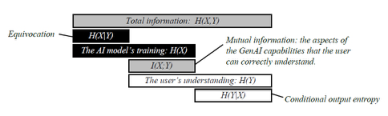
Shannon’s framework, though originally geared toward one-way communication, remains vital for understanding GenAI’s internal randomness. Extending these ideas, NTCC expands upon entropy-based measures to account for interactive interfaces, shifting from true/false logic to the management of “noise” and “relevancy.” For instance:
Conditional entropy H(Y|X) maps to the user’s functional goals, i.e., how the user decodes system outputs.
Mutual information I(X;Y) gauges how effectively the system’s output aligns with the user’s needs.
Under NTCC, a human-in-the-loop model becomes integral to quantitative analysis. The framework incorporates tools like Interface Temperature (IT), Actionable Interface Options (AIO), and entropy alignment techniques, particularly relevant for dynamic, AI-driven environments like ChatGPT or DALL-E. Additionally, a time-slicing approach loosely inspired by William James’s “stream of consciousness” (1890) helps capture evolving user interactions and shifting system states. By uniting cognitive ergonomics and information theory, NTCC proposes a robust, probability-based model for designing human–AI interactions in visual production tasks.
METHODOLOGY SUMMARY
1. Investigate GenAI Mechanisms Through Benchmark Tests
Objective: Gain insight into GenAI’s workings by designing targeted tests.
Approach: Probe different facets of ChatGPT and DALL-E behavior to assess performance, focusing on how the models handle visual tasks, including interpretation and output generation.
2. Case Study: ChatGPT and DALL-E
Scope: Test GenAI in graphic content production and design workflows.
Task Diversity: Five test categories covering four production project types, plus a final test evaluating DALL-E’s post-production output compatibility. Tasks initially align with specific production objectives but allow flexibility for open-ended explorations.
Hallucination Analysis: Each instance of misalignment or “hallucination” is examined via ad hoc, follow-up inquiries with ChatGPT.
110 Chong
3. NTCC Model as Simplified Framework
Philosophical Choice: NTCC folds “interpretability” concerns into the broader category of “misalignment” (or “noise”).
Implementation: Focus on identifying and mitigating misalignment without separately isolating interpretability issues.
4. Research Questions
RQ1: Can GenAI handle both breadth (multiple subject areas) and depth (high-fidelity design/production tasks)?
RQ2: How adaptable is AI to diverse designer thinking, especially across different production stages?
RQ3: In what ways does GenAI differ from earlier production software, and to what extent is it an “intelligent entity” versus an advanced automation tool?
By uniting these methods with the NTCC perspective, we aim to systematically evaluate GenAI’s capabilities while maintaining a design- focused lens on probability and uncertainty.
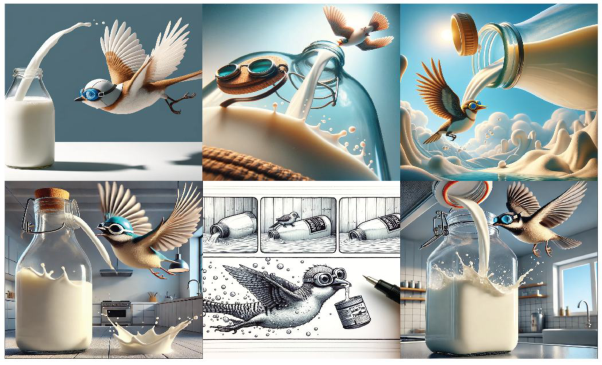
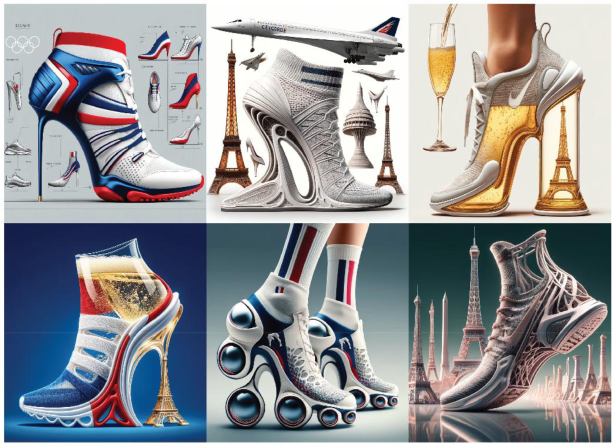
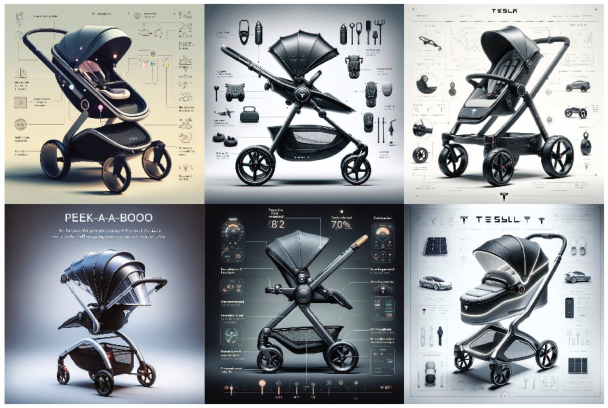
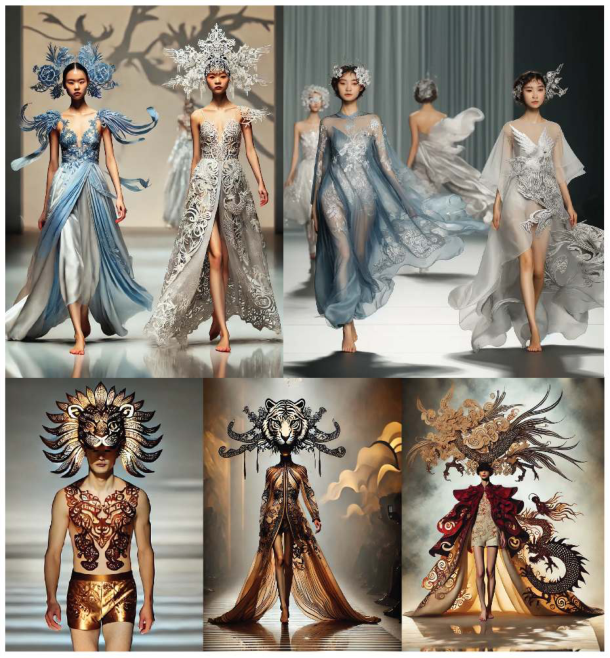
AUTOETHNOGRAPHIC BENCHMARK TESTS From April 2024 to March 2025, this study conducted five benchmark tests using DALL-E 3 and multiple versions of ChatGPT (GPT 3.5, ChatGPT 4, 4o, o1, o3 mini, and GPT 4.5 Preview) to evaluate their suitability for professional visual design workflows. Sample outputs and brief commentary are shown in Figures 1–4. Initial findings, presented at the HCII 2024 conference, were refined through ongoing evaluations that incorporated subsequent updates to ChatGPT.
Early tests indicated that GenAI operated more as automated machinery than a collaborative “partner,” largely due to the inherently probabilistic nature of its outputs and the frequent, yet somewhat predictable “hallucinations” over time. These outcomes remained consistent throughout the year-long tests, raising concerns about genuine AI alignment and user assumptions about AI’s ability to “internalize” instructions. To address alignment challenges, Shannon’s information theory was applied alongside the Networked Two-Way Communication Channels (NTCC) model, emphasizing the importance of integrating probability-based approaches into UI design to reduce friction and foster creativity (see Figure 5).
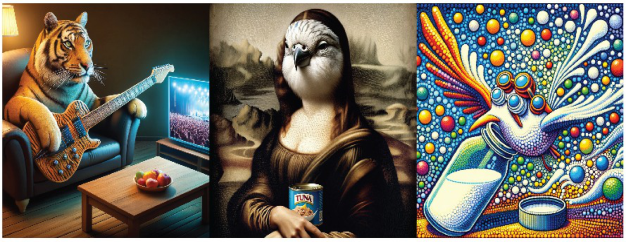
Technical analyses during these tests aimed both to understand operational nuances and to debug generative shortcomings. Notably, both ChatGPT and DALL-E consistently struggled with cultural accuracy, detailed artistic styles, and complex compositing requirements, for instance, having difficulty in accurately rendering Jerry Garcia’s guitar or replicating specific art styles such as pointillism (see Figure 6). While the generated outputs often featured strong visual appeal, their lack of functional attributes (e.g., ergonomic or wearable considerations) highlighted the gap between probabilistic AI inference and human creative insight that is often powered by domain- specific knowledge and experiences. Consequently, due to limitations in
Toward a Probability-Based Framework for Cognitive Ergonomics 111
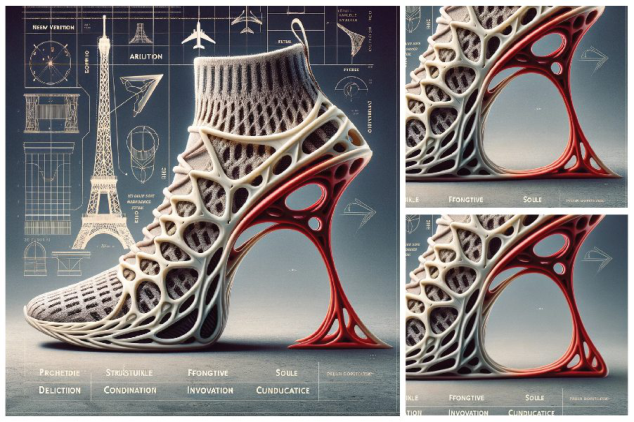
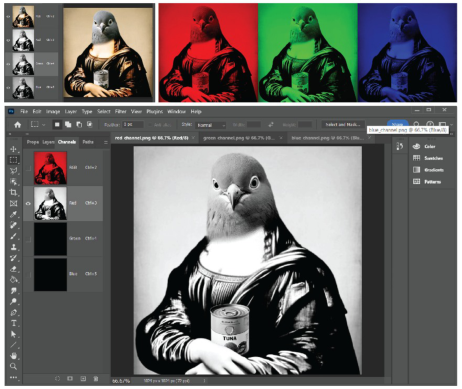
graphical editing and detailed generative modifications (Figures 7–10), conventional software such as Photoshop remained indispensable for post- production refinement.
Additionally, frequent undocumented interface and settings changes to ChatGPT resulted in inconsistent user experiences reinforcing the need for probability-oriented UI designs that transparently manage user expectations and adapt to the rapid evolution of AI technology.
Figure 1: (April 2024). Examples of animation storyboards and production conceptual art generated with DALL-E via ChatGPT 4, illustrating AI-assisted ideation and rapid visual exploration in preproduction workflows.Figure 2: (April 2024). Conceptual outputs for the prompt “haute couture sports shoes design for the 2024 Paris Olympic Games Opening Ceremony,” produced by ChatGPT 4 and DALL-E 3, showcasing the AI’s capacity for high-level thematic creativity.
112 Chong
Figure 3: (April 2024). Product design ideation for “Tesla-brand baby strollers” using ChatGPT 4 and DALL-E. The AI quickly produces brand-oriented product prototypes.Figure 4: (October 2024). Fashion design ideation incorporating an “oriental paper-cut” motif, generated by ChatGPT 4 and DALL-E 3, demonstrating the AI’s ability to adapt cultural and artistic elements in visual designs.
Toward a Probability-Based Framework for Cognitive Ergonomics 113
Figure 5: A Gantt chart diagram illustrating the comparison between the AI model’s capabilities H(X) with user expectations H(Y ) (Shannon, 1948; Chong, 2023). Equivocation H(X|Y ) denotes what the user still does not understand, while H(Y |X) represents misunderstandings or erroneous assumptions by the user.Figure 6: (April 2024). When DALL-E was prompted for “surrealism” styles and given detailed requirements, it misinterpreted directives in every case, producing “hallucinated” images that diverged from both cultural common sense and user expectations.Figure 7: (April 2024). Using DALL-E and ChatGPT-4 in ChatGPT’s Inpainting Editor to edit shoe designs produced highly variable outcomes, revealing limited responsiveness to technical structures and ergonomic-specific user prompts.
114 Chong
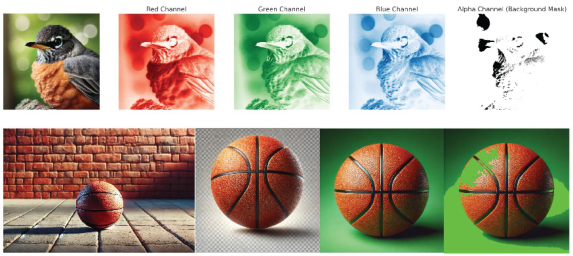
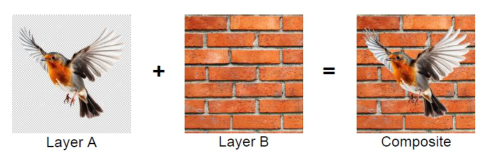
Figure 8: (April 2024). Attempts to export separate R, G, and B color-separation using DALL-E and ChatGPT-4 were partially successful, yet still required subsequent processing in Photoshop, indicating the AI models’ comprehension of color separation.Figure 9: (December 2024). Efforts to generate alpha channels for compositing through DALL-E and ChatGPT-4o failed repeatedly, demonstrating the AI models’ scant knowledge of basic CGI terminology and professional compositing workflows.Figure 10: (March 2025). DALL-E 3 and GPT-4.5 produced rudimentary “layered output” PNG files with limited transparency and lacking anti-alias detail around the bird’s feathers. Parallel tests with ChatGPT-4o offered no transparency functionality, signifying inconsistent model capabilities.
Toward a Probability-Based Framework for Cognitive Ergonomics 115
Do We Need “Graphical Turing Tests”?
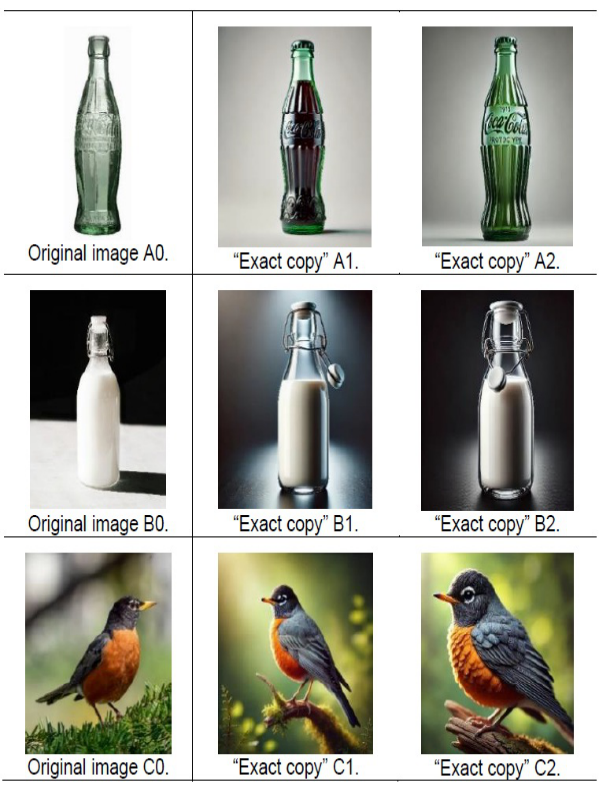
Production tests revealed substantial uncertainties in generative models, traceable to their extensive training data and complex architectures. From the NTCC viewpoint, unpredictable user needs require systems capable of responding effectively to diverse requests. Building on Alan Turing’s original benchmarking concept (Turing, 1950), this paper proposes a “graphical Turing test”—namely, a graphic art-copying task—to gauge GenAI’s visual performance.
While ChatGPT arguably passes certain text-based Turing tests (Mei et al., 2024; Biever, 2023), it faced significant difficulties in our image-copying experiments, often deviating from reference images in terms of both visual details and semantic or conceptual accuracy when compared to typical human perception or specialized, domain-specific professional standards. Moreover, GPT and DALL-E showed limited awareness of their inaccuracies, as exemplified in Figure 11.
Figure 11: (March, 2025). Graphical outcome from a series of “graphical Turing tests” designed to detect likely causes of “hallucinations” in the ChatGPT-to-DALL-E workflow—focusing on simple “copying” tasks.
116 Chong
These findings underscore the necessity for advanced AI training tailored to visual production tasks and probabilistically transparent NTCC-based entropy alignment designs (see Figure 5). AI systems must “see”what the user perceives. When inaccuracies occur, they should notify users about potential discrepancies and suggest effective remedies. Such interfaces support richer feedback loops, allowing users to more effectively identify, understand, and leverage generative AI’s inherent misalignments and hallucinations.
DISCUSSION
A central reason for hallucinations in GenAI models lies in their training on publicly accessible data, often devoid of specialized, proprietary knowledge (Lichtenthaler, 2011; Belderbos et al., 2010). While GenAI excels at open- domain, improvisational tasks, it remains an “outsider” in specialized contexts—a gap attributed partly to these closed-source models’ opaque internal workings (OpenAI, 2023).
A fully deterministic, randomness-free AI interface overlooks real-world uncertainties. Conversely, enabling controllable and transparently visualized randomness can better align AI functionality with human cognition. Recognizing multiple probabilistic dimensions helps designers craft UIs that guide users toward accurate mental models, enhancing control and satisfaction, two fundamental principles of human-centered design frequently overlooked by traditional engineering approaches. Historically, humans⣙ intuitive reliance on mechanical hardware, cause-and-effect reasoning, physical-mechanism-inspired graphical UI design, and rule-based command- and-execution-oriented interactions has proven insufficient. Such approaches will become even more inadequate given the anticipated surge in automation and corresponding increases in interface complexity. Therefore, it is crucial to evolve our social and technical perspectives toward probability-based mental models, following the trajectory established by modern scientific advancement over the past two centuries. The NTCC theory offers a novel conceptual toolkit explicitly designed to facilitate such probabilistic thinking and UI mediation.
Moreover, the rapid commercialization of GenAI coincides with closely guarded corporate knowledge, leading to fragmented communication and increased informational noise (Shannon, 1948). This fragmentation echoes earlier, more localized economic landscapes, such as Adam Smith’s late- 18th-century Glasgow (Maver, 2004), which contrast starkly with our hyperconnected modern era.
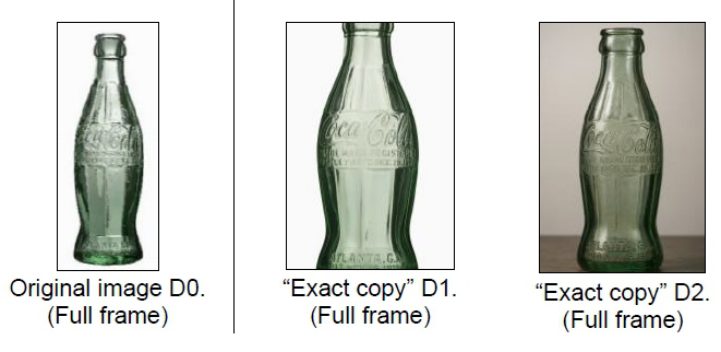
By March 2025, ChatGPT had reached approximately 122.58 million daily users and processed over one billion daily queries (NerdyNav, 2025), reflecting exponential growth. Despite improvements, GPT-4o still struggles with visualization tasks when directing DALL-E (Figure 12). Conceptually, DALL-E functions like a skilled yet “blind” painter reliant on GPT’s descriptive prompts. As generative technologies evolve, probabilistically transparent interfaces—those revealing the underlying mechanism—will be pivotal in producing reliable, user-friendly AI solutions.
Toward a Probability-Based Framework for Cognitive Ergonomics 117
Figure 12: (March, 2025). A “graphical Turing test” using a photograph of a historical Coca-Cola bottle indicates GPT-4os enhanced prompt mediation capabilities with DALL-E 3; however, key visual features such as the shape and proportions of the original design remain inaccurately represented in the generated “copy.”
CONCLUSION
Probability has profoundly shaped human endeavors, though we often confront it blindly, describing it loosely as “fate.” The 1999 STS-93 mission of the Space Shuttle Columbia, which deployed the Chandra X-Ray Observatory (Hale, 2014; Manley, 2018; Uri, 2024; Wikipedia, 2025), exemplifies this precarious dance with uncertainty in high-stakes technology. In today’s rapidly evolving landscape of GenAI, it is time to explicitly integrate probability and entropy measures into our designs, offering systematic ways to visualize and navigate both technological and human unpredictability.
In ancient Greece, pilgrims might spend a lifetime deciphering cryptic oracles, a high-entropy, low-frequency method of grappling with the unknown. In contrast, modern systems like GPS must immediately disclose signal distortions caused by urban high-rises, as even split-second delays can risk traffic safety and compromise navigation accuracy and effectiveness. This contrast underscores the urgent need for transparent interaction designs, particularly for future AI systems. Rather than obscuring complexity, openly revealing it allows users to confront Tyche, the Greek goddess of chance, with greater clarity.
As of May 2025, new tools such as Sora, Veo, and GPT-4.5 extend into professional still-image and video production; extended evaluations of Midjourney and Adobe Firefly are forthcoming. These emerging AI solutions echo the early days of Maya 1.0 or the first versions of Adobe Photoshop— tools that felt deterministic yet were inherently probabilistic during their pioneering phases. As information theory and the NTCC framework suggest, statistical entropy permeates every stage of production, reinforcing the necessity for interaction designs that accommodate diverse users within networked digital ecosystems. Furthermore, the NTCC framework exemplifies how cognitive ergonomics and interface design can be seamlessly
118 Chong
integrated with contemporary scientific theories and cutting-edge computing technologies.
Inevitably, AI tools and their users will encounter scenarios beyond prior training or experience. While product marketing often overstates capabilities, probability remains a pivotal factor in real-world adoption and performance. By acknowledging and explicitly integrating probability into product interfaces, designers can create resilient, transparent, and more human-centered solutions, capable of meeting the challenges of an evolving digital frontier with clear-sighted confidence and well-informed adaptability.
REFERENCES
Belderbos, R., Faems, D., Leten, B. & Van Looy, B. (2010). Technological activities and their impact on the financial performance of the firm: Exploitation and exploration within and between firms. Journal of Product Innovation Management, 27(6), 869–882. Bender, E. M., Gebru, T., McMillan-Major, A. & Shmitchell, S. (2021). FAccT ‘21:
Proceedings of the 2021 ACM Conference on Fairness, Accountability, and Transparency, 610–623. Biever, C. (2023, 25 July). ChatGPT broke the Turing test — the race is on for new ways to assess AI. Nature. Retrieved 9 April 2025 from https://www.nature.com/ articles/d41586-023-02361-7. Baudrillard, J. (1981/1994). Simulacra and Simulation. Glaser, S. F., transl. University
of Michigan Press, Ann Arbor, MI. (Originally published in French as Simulacres et Simulation, Éditions Galilée, Paris). Britannica. (2025). Probability and Statistics. Britannica.com. Last accessed March 19, 2025. https://www.britannica.com/science/probability Brown, T. et al. (2020). Language Models are Few-Shot Learners. In Advances in
Neural Information Processing Systems 33 (NeurIPS 2020), 1877–1901. https:// doi.org/10.48550/arXiv.2005.14165 Chen, K., Chen, Q., Zhou, J., Tao, X., Ding, B., Xie, J., Xie, M., Li, P., Zheng, F. & He, L. (2025). Enhancing uncertainty modeling with semantic graph for hallucination detection. https://doi.org/10.48550/arXiv.2501.02020 Chong, L. (2023). Temperature, entropy, and usability: The theoretical and
practical resemblances between thermodynamics and user interface design. In Stephanidis, C., Antona, M., Ntoa, S., Salvendy, G. (Eds.) HCI International 2023 Posters, HCII 2023. Communications in Computer and Information Science, vol. 1832. Springer, Cham. Chong, L. (2024a). Decoding the alignment problem: Revisiting the 1958 NYT report on Rosenblatt’s perceptron through the lens of information theory. In Stephanidis, C., Antona, M., Ntoa, S., Salvendy, G. (Eds.) HCI International 2024 Posters, HCII 2024. Communications in Computer and Information Science, vol. 2120. Springer, Cham. Chong, L. (2024b). The relevancy of knowledge and the knowledge of relevancy:
An information theory-based quantitative methodology for evaluating UI design and usability. In Tareq Ahram et al. (Eds.) Usability and User Experience. AHFE (2024) International Conference. AHFE Open Access vol. 156, AHFE International, USA. Chong, L. (2024c). Multi-dimensional nature of human-centered design: An autoethnographic analysis of the Seiko Bell-Matic wristwatch using information- theoretic methodologies. In Ahram T. et al. (Eds.) Human Factors in Design, Engineering, and Computing. AHFE (2024) International Conference. AHFE Open Access, vol. 159. AHFE International, USA.
Toward a Probability-Based Framework for Cognitive Ergonomics 119
Dickson, M. (2023). Quantum logic and probability theory. In E. N. Zalta & U.
Nodelman (Eds.), The Stanford Encyclopedia of Philosophy (Spring 2023 ed.). Retrieved 6 April 2025 from https://plato.stanford.edu/entries/qt-quantlog/. Dickson, M. (2023). Quantum Logic and Probability Theory. In E. N. Zalta and U. Nodelman (Eds.), The Stanford Encyclopedia of Philosophy (Spring 2023 Edition). Retrieved April 6, 2025, from https://plato.stanford.edu/entries/ qt-quantlog/. Dorf, R. C. & Bishop, R. H. (2001). Modern Control Systems (9th ed.). Prentice Hall, p. 2. Hale, W. (2014, 26 October). STS-93: We don’t need any more of those. Wayne Hale’s
Blog. Retrieved April 7, 2025, from https://waynehale.wordpress.com/2014/10/ 26/sts-93-we-dont-need-any-more-of-those/. Hinton, G. (2025, 25 February). Boltzmann Machines: Statistical Physics meets Neural Networks [Lecture recording]. Arts & Science – University of Toronto. https://www.youtube.com/watch?v=juif0T8NOsY James, W. (1890). The Principles of Psychology (Vol. 1). Macmillan and Co., London. Krizhevsky, A., Sutskever, I. & Hinton, G. (2012). ImageNet classification with deep
convolutional neural networks. Communications of the ACM, 60(6), 84–90. Lichtenthaler, U. (2011). Open Innovation: Past Research, Current Debates, and Future Directions. Academy of Management Perspectives, 25(1), 75–93. Liu, H., Gegov, A. & Cocea, M. (2016). Rule-based systems: A granular computing
perspective. Granular Computing, 1, 259–274. Manley, S. (2018). How a Gold (en) Bullet Almost Destroyed A Space Shuttle [Video].
Scott Manley’s channel on YouTube. Last accessed March 21, 2025. https:// www.youtube.com/watch?v=u6rJpDPxYGU Maver, I. (2004). Industrial Revolution: 1770s to 1830s. In The Glasgow Story. Last accessed March 19, 2025. https://www.theglasgowstory.com/story/?id=TGSCA McCulloch, W. S. & Pitts, W. (1943). A logical calculus of the ideas immanent in
nervous activity. Bulletin of Mathematical Biophysics, 5, 115–133. Mei, Q., Xie, Y., Yuan, W. & Jackson, M. O. (2024). A Turing test of whether AI chatbots are behaviorally similar to humans. Proceedings of the National Academy of Sciences, 121(9). https://doi.org/10.1073/pnas.2313925121 NerdyNav. (2025). 107+ ChatGPT Statistics and User Numbers (Mar 2025). Last
accessed March 21, 2025. https://nerdynav.com/chatgpt-statistics/ OpenAI. (2023). How ChatGPT and Our Foundation Models Are Developed.
Retrieved March 27, 2025, from https://help.openai.com/en/articles/7842364- how-chatgpt-and-our-foundation-models-are-developed. ScienceDirect. (n.d.). Rule-Based System. In ScienceDirect Topics: Engineering.
Retrieved April 2, 2025, from https://www.sciencedirect.com/topics/engineering/ rule-based-system Shannon, C. E. (1948). A mathematical theory of communication. Bell System Technical Journal, 27, 379–423 & 623–656. Sienicki, K. (2025). Classical Mechanics as an Emergent Compression of Quantum
Information. arXiv. https://arxiv.org/abs/2503.07666 Turing, A. M. (1950). Computing machinery and intelligence. Mind, 59(236), 433–
460. https://doi.org/10.1093/mind/LIX.236.433 Uri, J. (2024). 25 Years Ago: STS-93, Launch of the Chandra X-Ray Observatory.
NASA. Last accessed March 19, 2025. https://www.nasa.gov/history/25-years- ago-sts-93-launch-of-the-chandra-x-ray-observatory/
120 Chong
Wikipedia. (2008). Timeline for Probability and Statistics. Wikipedia.org. Last accessed March 12, 2025. https://en.wikipedia.org/wiki/ Timeline_of_probability_and_statistics Wikipedia. (2025). STS-93. Wikipedia.org. Last accessed March 9, 2025. https:// en.wikipedia.org/wiki/STS-93 Zou, X., Zhang, W. & Zhao, N. (2025). From Fragment to One Piece: A Survey
on AI-Driven Graphic Design. arXiv preprint arXiv:2503.18641. https://doi.org/ 10.48550/arXiv.2503.18641
LISTED IN THE AHFE DIGITAL BOOKSTORE CATALOGUE
Explore the complete digital volume
Neuroergonomics and Cognitive Engineering
Read this individual research paper free through the original publisher, or explore the full digital proceedings book.
ISBN 978-1-964867-43-4
Explore this ISBN in the AHFE Bookstore ↗Listed in the July 2026 bookstore catalogue; search by ISBN to confirm current availability · Digital book purchase optional