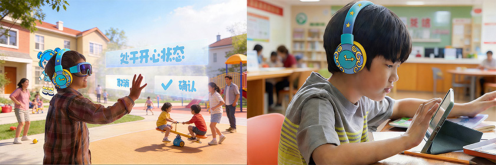
Yingsha Zhang (2026). "Starlight & Listening Fox": Design and Construction of an Inclusive AR Therapeutic IP System for Community-Based Autistic Children. In: Human Factors in Communication of Design. AHFE Open Access, vol. 216, pp. 13–26. https://doi.org/10.54941/ahfe1007621
Autism Spectrum Disorder (ASD) is a neurodevelopmental disorder with a high incidence among children; children aged 4 to 10 with mild to moderate symptoms account for more than 70% of the total ASD children, yet the supply of community-based healing products and interactive services for this group is severely insufficient, and immersive intervention based on Augmented Reality (AR) technology and inclusive design has become a preferred solution for the community integration of this group. However, the contradiction between conventional healing models and the community intervention needs of autistic children, which is also the key to poor intervention effects, is concentrated in three imbalances: disconnection of healing models, insufficient community support, and conflicting intervention concepts, which are specifically manifested as the lack of personalized design, the breakdown of linkage mechanisms, and the neglect of emotions and active participation. Based on the core concept of inclusive design, this study proposes "Starlight & Listening Fox": an inclusive AR healing IP system design scheme for community autistic children, and the research content covers extracting three core principles under inclusive design, namely adapting to sensory sensitivity, stimulating active participation, and constructing a closed loop of community support, and building an integrated healing framework of "IP+AR+Inclusive UI", aiming to improve the design of AR healing systems, verify their feasibility and healing effects, provide community autistic children with healing schemes that combine adaptability and interactivity, promote the theoretical and practical development of AR and inclusive design empowering the community rehabilitation of ASD children, and offer experience-oriented practical references for the application of IP+AR technology in the field of children's rehabilitation.
The number of children diagnosed with Autism Spectrum Disorder (ASD) keeps increasing. Data from the U.S. CDC (2025) shows that 1 in 36 children has ASD. The growing number of autistic children has placed heavy physical, psychological and economic burdens on their parents, which greatly harms their well-being (Turnage et al., 2025). In 2024, several Chinese authorities issued the Action Plan for the Care and Promotion of Autistic Children Received February 6, 2026; Revised April 9, 2026; Accepted April 29, 2026; Available online July 20, 2026
14 Zhang (2024–2028). This plan extended rehabilitation assistance to age 16 and added 29 medical and nursing items to medical insurance (Lan, 2025). The Juniper Garden Children’s Project (JGCP) at the University of Kansas has focused on school-family collaborative intervention for autistic children. It has promoted targeted training methods for children, parents and school staff to improve their communication and social skills (Bourque et al., 2025). These policies and projects have laid a solid foundation for autism rehabilitation. They support the practice of autism healing in communities and provide solutions for the shortage of rehabilitation resources and community integration difficulties for autistic children.
In modern society, the poor effect of community intervention for autistic children has three main causes. Traditional rehabilitation focuses on institutional passive training, with courses disconnected from daily community scenes and no personalized plans for children’s language, behavior or social disorders, so abilities cannot be used in daily life. Some communities lack acceptance, flexible social scenes and exclusive intervention resources, and the medical-education-family linkage is broken without a full intervention loop (Cheng et al., 2018). Wrong intervention cognition overemphasizes skill training and ignores children’s emotional connection, even forcing them to accept interventions, which lowers their initiative. This also fits the common problem of passive service acceptance in community participation (Suwankhong & Liamputtong, 2025).
In recent years, autism rehabilitation research has integrated AR technology and inclusive design. It creates a low-anxiety intervention environment and improves the immersion of social skill training. However, the quality of AR rehabilitation products varies greatly. Many do not fit the cognitive, motor and sensory characteristics of autistic children (Liu et al., 2021). Complex interfaces and insufficient emotional interaction increase their learning burden. Some products only use AR as a gimmick, lack deep integration with inclusive design, and fail to connect with family and community scenarios (Lee & Huang, 2025).
Therefore, based on existing research at home and abroad, and along with the present needs of community intervention for autistic children, this paper puts forward the following research questions.
1. This study explores IP+AR healing content and inclusive UI design, combining the sensory preferences and cognitive traits of 4–10-year- old autistic children, to ensure the system’s adaptability and emotional appeal. 2. This study explores scene-based interaction by deeply integrating AR technology and community scenarios, to improve autistic children’s community adaptation and social participation willingness.
This study aims to improve the social and adaptive skills of 4-10-year- old autistic children. It follows inclusive design and uses AR technology through IP+AR healing content, inclusive UI interfaces and community scene interaction, helping AR better play its healing role in community support for autistic children.
Starlight & Listening Fox 15
RELATED WORK
Current Status of Inclusive Design Products for Children Parents pay more attention to autistic children’s all-round development and worry about their poor social integration and insufficient traditional rehabilitation, so more families and institutions focus on inclusive design products to help special needs children adapt and integrate into society (Hu et al. 2020) designed inclusive play and teaching aids for visually impaired preschoolers, enabling equal interaction with normal children through games to promote cognitive and social development. Monika’s team developed the “Catch the Thief” voice game using VUI technology, fitting joint play needs and providing inclusive experiences even in low-resource environments (Johry, 2025). Karina’s team proposed an inclusive classroom model for autistic children, building a low-stimulation structured space to meet the needs of both autistic and normal children (Calle & Almeida, 2025).
Children’s inclusive design products have grown diverse and focused on multi-sensory experience and social inclusion. However, they still face problems. There are not enough exclusive adaptive products for visually impaired and autistic children, and supporting services and R&D systems are incomplete, which limits targeted support (Hu et al., 2020). Spatial design neglects sensory needs, with physical and sensory barriers and poor personalization, which hinders daily integration and intervention effects (Calle & Almeida, 2025).
The Application of Augmented Reality (AR) Technology in the Intervention for Autistic Children AR technology has been widely applied in autism intervention globally. Li’s team combined AR with concept maps to develop a gamified intervention system for symbolic ability (Lee & Chen, 2025). Li and Wang built the AR-TBRP role-play game to boost imagination and social cognition (Lee & Wang, 2025). Li and Huang designed the CMAR-ST system to train social skills through AR tabletop games (Lee & Huang, 2025). Liu et al. created an AR travel system to improve independent travel ability based on sensory integration (Liu et al., 2024).
Currently, AR application in autism intervention shows a positive trend, providing immersive, gamified and personalized experiences to improve children’s intervention engagement and core abilities in multiple scenarios. However, it faces dilemmas: some autistic children resist AR devices, affecting intervention continuity (Zhao et al., 2024); existing AR interventions have small samples and single scenarios, hindering skill transfer (Zhao et al., 2024); some lack a unified teaching framework and personalized mechanism, failing to meet different children’s needs (Lee & Chen, 2025).
METHODOLOGY
The solution proposed in this study consists of three parts: 1. It proposes a four-dimensional integrated scenario-based inclusive healing model with the Starlight & Listening Fox IP as the core. 2. It establishes an AR dynamic
16 Zhang feedback mechanism adapted to the sensory characteristics of autistic children to create a low-risk social sandbox. 3. Based on inclusive design, it creates an all-ability friendly interaction entry that fits the cognition of autistic children.
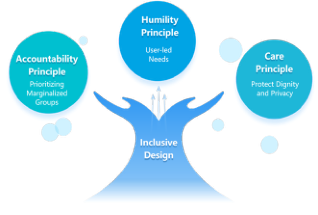
System Overview Inclusive design is a design thinking and practical system rooted in the diverse nature of humanity, which aims to ensure that design outcomes can be used by the widest possible range of people, respects the natural differences of people in dimensions such as sensory perception, ability, culture, and context, and creates adaptable and accessible products, services, or spaces through the core approach of co-designing with users rather than designing for users. Its core lies in adhering to the three fundamental principles of humility, accountability, and care, aiming to break intangible barriers and achieve the goal of “designing for one, benefiting all”; it is an underlying thinking that runs through the entire design process and avoids various design biases (Gilbert, 2025), and is highly consistent with the core needs of community rehabilitation and digital healing for children with special needs (see Figure 1).
Figure 1: Core principles of the inclusive design concept.
Based on this idea, this study deals with practical problems autistic children face in communities—lack of rehabilitation resources, unsuitable services, and difficulty fitting into society. It aims to set up an inclusive AR therapeutic IP system for these children, with “Starlight & Listening Fox” as its core logo. The system provides a tailored and organized intervention tool for their rehabilitation and community integration. Its overall goal is to mix virtual IP images, AR interaction technology, inclusive UI and real community scenarios to build a multi-faceted integrated intervention system, which helps improve autistic children’s social skills and their integration into the community.
To achieve this goal, this study establishes a three-level and four- dimensional integrated framework. This framework follows three core principles of inclusive design. It forms a complete cycle from theory to practice. It systematically guides later design and practical work.
The Theoretical Adaptation Layer follows the Accountability Principle. It sorts out the theoretical links between inclusive design and digital healing. It builds a response method for autistic children’s three main difficulties:
Starlight & Listening Fox 17 social interaction, sensory perception and adaptation. This layer proves the four-dimensional integrated system is practical. It also establishes the study’s theoretical validity and core design direction.
The Demand Research Layer implements the Principle of Humility, conducts collaborative research and user co-creation in conjunction with autistic children, parents, and rehabilitation experts, accurately identifies the diverse needs and core pain points in family and community contexts, and ensures that the system design always takes real user demands as the fundamental starting point.
The Four-Dimensional Design Layer, as the practical core of the framework, aims to implement the Principle of Care and realize inclusive healing functions by constructing four mutually coordinated dimensions. Among them, the IP Emotional Dimension takes dual-IP narration as the emotional carrier to establish connections, alleviate anxiety and guide behaviors; the AR Interaction Dimension develops community AR tasks and builds a low- risk social sandbox connecting virtual and real social interactions; the UI Interaction Dimension follows accessibility standards to create an inclusive interface. This framework establishes a clear context for the collaboration of theory, demand and practice, which advance layer by layer and support each other, thus systematically covering the complete process from laying the theoretical foundation, defining core issues, generating solutions to finally verifying the effectiveness in specific scenarios, and providing clear practical guidance for the IP image creation, UI interface optimization, AR interaction development and community implementation and application of the “Starlight & Listening Fox” inclusive AR therapeutic IP system.
IP Image and Narrative Design: Constructing an Emotional Guidance Carrier The dual IPs of Starlight & Listening Fox are positioned as inclusive emotional guidance subjects, designed specifically for autistic children and strictly adhering to the principles of inclusive design; based on their sensory sensitivity and deficiencies in emotional expression, they construct a bridge of emotional connection through a companion-guidance collaborative model, adapting to the healing needs of all scenarios including families, communities, and institutions. Their modeling, proportions, color tones, and costumes are all designed around inclusivity, with the specific design as follows:
The modeling of Starlight & Listening Fox centers on adapting to the healing needs of autistic children, adopting a soft and approachable cartoon style to construct a bridge of emotional connection through low-stimulus, high-empathy visual language (see Table 1).
Double ponytail
hairstyle
with circular
decorative
elements
Fox-ear
headdress in a
blue-and-yellow
contrasting
color scheme,
featuring a tech-
savvy and tactile
design
Vivid and
lively, with
a playful
touch
Playful and
lively, with
a fox-like
mischievous
charm
Scheme Expression Hair Accessories
Cozy casual-
style top and
shorts in
blue-and-white
tones, with
cute decorative
details
Cute
windbreaker-
style outfit in a
yellow gradient
(pale yellow to
light yellow),
with fox-themed
design elements
Enjoys studying
the thinking
patterns of children
with autism,
guiding their
communication,
and exploring
astronomy
Assists Starlight
in communicating
with children
with autism,
explores innovative
communication
methods, and loves
adventures
Idiosyncratic
communication
style; struggles
with verbal
expression and
interpersonal
interaction at times
Playful and
mischievous by
nature
sensitive
sensory
perception,
with unique
thinking
patterns
cheerful,
intelligent, and
wise
Female Helpful, fox spirit, in an infant-
like form
Table 1: Role positioning design.
Table available in the original PDF paper.
Name Age Gender Personality Flaws Hobbies Costumes Color
Starlight 10 years old Female Highly
Listening
Fox Millennial
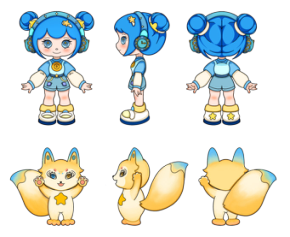
Starlight & Listening Fox 19 The design prototype of Starlight comes from observations of autistic children’s daily lives. It has cute and lively features, with double ponytails and bright but soft colors. It uses a gentle smiling expression to bring a sense of companionship. It adopts low-saturation light blue and beige to reduce visual stimulation. Its 1:2.5 head-to-body ratio and soft shapes lower children’s sensory pressure and increase friendliness. Listening Fox takes the fox as its prototype and uses the agile and warm qualities of foxes. It simplifies facial lines to help autistic children recognize emotions more easily. It uses ear and tail movements to show different feelings. Its fluffy orange tail brings warmth and emotional security. Soft and round shapes make the whole image gentle and easy to approach. Neither character uses complex expressions to show emotions. They use body language, soft colors and simple accessories to communicate emotions clearly. These two character designs act as professional emotional support tools. They provide companionship and therapeutic comfort for autistic children. The clothing and accessories of the characters balance practical functions and emotional comfort. This design fully meets the core needs of inclusive user interface design (see Figure 3).
Figure 3: IP Image design.
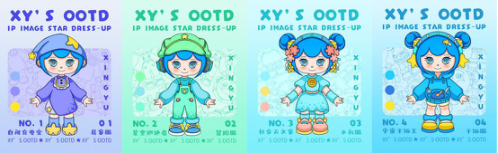
Starlight uses soft cotton and linen with loose Velcro straps. This stops children from getting upset when using buttons. It also has emotional dressing cards, suitable for home, community and calming moments. It links different emotions with soft colors, helping children express themselves more easily in social situations (see Figure 4).
Figure 4: Dressing cards.
These related products are designed under the “IP-AR-UI-Community” four-dimensional framework. They include behavior guide cards, 16 sets of emotion expression packs, and dress-up cards for autistic children. The IP
20 Zhang character designs will be extended for three main scenarios to match different intervention tools. This combination improves the integration of emotional guidance and healing situations, and puts the concept of inclusive design into practice.
The IP emotional narrative system focuses on emotional guidance and healing support. It matches the cognitive traits and emotional needs of autistic children. The two IP images have different appearances and emotional expressions. The system uses gentle and low-stimulation interaction. It builds an online-offline immersive experience. This experience helps children understand emotions and build emotional connections. It also gradually improves their social adaptation skills.
This system follows the concept of inclusive design. It adopts a framework of overall planning and step-by-step implementation. It forms a complete two- way cycle from online preparation to offline practice. The online part provides simple and low-stimulation content to help children recognize emotions. The offline part uses real-life interaction to support emotional expression and social practice. This rhythm fits children’s sensory characteristics and learning pace, and reflects the spirit of inclusive design.
This study focuses on family participation and understanding. It adds inclusive and supportive healing concepts to the story content. It encourages parents to take part in the guidance actively. It forms a positive cycle of IP guidance, parental company and children’s growth. This makes the support system more complete and shows the inclusive design idea of multi-party cooperation and full-scenario integration.
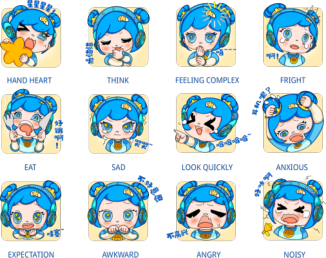
In actual use, the IP emoticon packs retain the shapes and clothing features of the two IP characters. They use soft colors and simple poses. They provide daily help for families and organizations, and spread kindness and acceptance through online sharing (see Figure 5).
Figure 5: Starlight IP image emoticon packs.
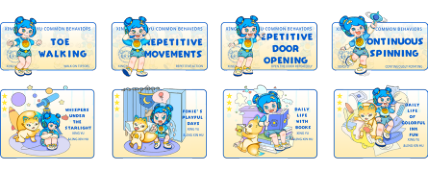
The dynamic design has a calm rhythm and simple movements. It shows emotions through the gentle body language of the IPs. It uses soft colors. It builds a consistent visual feeling. This feeling lets children join in naturally. The story scenes also include the common behaviors of autistic children. Positive story guidance lowers children’s resistance. It also makes the healing support work better (see Figure 6).
Starlight & Listening Fox 21
Figure 6: Action guidance card design.
Inclusive User Interface Design The healing APP is the main tool. It focuses on family participation. It connects online and offline content. It provides suitable materials for children’s habits and family conditions. It follows mild design rules to avoid overstimulation. It cooperates with IP-related content. It helps parents carry out regular emotional guidance. It also expands the application scenarios of the system.
The interface design follows soft visual standards and IP features. It has three principles: fair, easy to use, gentle adaptation and simple operation. It focuses on a gentle, safe environment, friendly IP images and flexible adjustment. Its layout is clear, balancing common and personal needs and allowing parent-child participation. This lays a good foundation for healing functions.
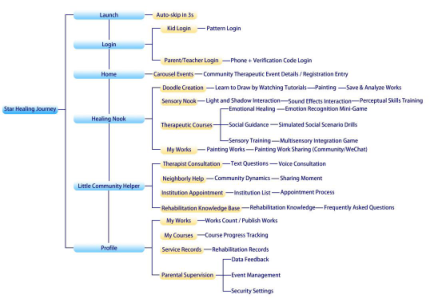
The interface structure uses the two IP images to mark different function areas. It divides the interface into emotional guidance, interactive experience and settings adjustment. It simplifies page levels and lowers understanding difficulty. It fits the guidance needs of rehabilitation therapists, keeps the community service entrance, and connects online and offline use. This makes the interface more inclusive and practical (see Figure 7).
Figure 7: UI information architecture.
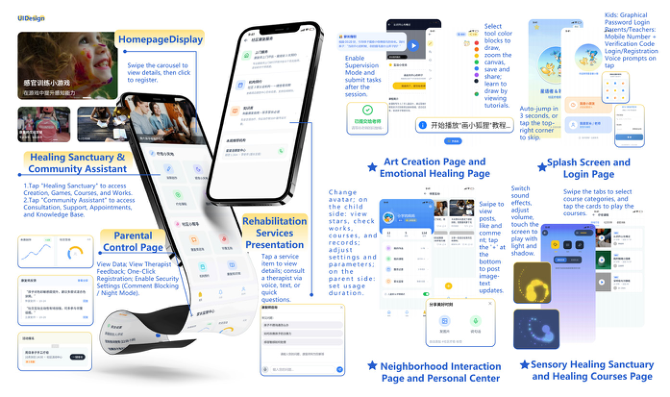
Overall, this project has created a set of digital service interfaces for autistic children. These interfaces combine online and offline situations. The design focuses on gentle and low-stimulus interaction. It brings together many functions, including healing training, emotional expression, community
22 Zhang communication, and family cooperation. The interface offers a clear and immersive visual and interactive experience. It helps children train on their own. It also helps families take part and communities offer help to each other. The interfaces cover many daily intervention situations. They finally build a complete and connected support cycle. All designs fully think about the thinking traits and sensory needs of autistic children. They also provide a convenient collaboration channel for parents and professional institutions (see Figure 8).
The system includes the following key pages: the launch and login page uses soft color transitions to reduce visual stimulation, provides a clear login method with a simple and focused layout that both children and parents can easily understand for quick access to services; the homepage serves as the main entry for all functions, displays core services such as sensory games, therapy courses and community interaction in separate blocks, follows the low-stimulation rule with simple icons and a clear layout to avoid excessive information and help children quickly find and navigate to target sections; the sensory therapy and courses page focuses on multi-sensory training and structured content, presents tactile and visual training materials through immersive visuals, displays courses as cards that can be filtered by difficulty, includes simple guide animations to help children complete training step by step, and progresses from easy to difficult to gradually improve children’s sensory adaptation and skills; the rehabilitation service page integrates standard service application and management functions, supports booking professional interventions and submitting training feedback, connects smart device access points to smoothly link online training data with offline services, and provides professional institutions with a tool to manage the entire service cycle; the art creation and emotional therapy page combines artistic expression with emotional guidance, offers simple drawing tools and guided emotional exercises like drawing a little fox, uses direct operations, soft colors and dynamic prompts to let children naturally express and understand emotions through relaxed creation; the community interaction and personal center page creates a safe social space for children to share creations and join friendly topics, and the personal center collects training records, growth achievements and setting preferences to help children develop a sense of self-management. It also gives parents an entrance to help with management. It connects children’s independent growth with family support. The healing training and community mutual aid page focuses on structured tasks and experience sharing. It offers goal-oriented training activities and communication areas. Children can get encouragement when they finish tasks. The community connects families and professional institutions. It helps them share experiences and resources. It improves the effect of multi-party cooperation. The parent perspective page gives parents a clear intervention management tool. Parents can check their child’s training progress. They can check emotional records and social activities. They can also contact virtual coaches or expert teams for advice. It combines remote monitoring and offline professional services. It improves the family support systema.
Starlight & Listening Fox 23
Figure 8: UI information architecture.
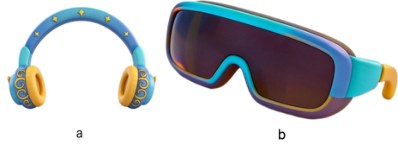
AR System Design and Full-Process Collaborative Therapeutic Closed Loop The core design of the AR system targets the main difficulties of autistic children. These difficulties include large personal differences and different abilities to handle senses. Its multi-device system includes AR headsets (see Figure 9a), lightweight tablets, and AR glasses (see Figure 9b). In essence, this system is the practical application of the inclusive help idea. It uses the gentle design of the two IPs to avoid sensory irritation. It relies on wireless fast connection rules and the healing APP to form a complete data cycle. It gives children, parents, and rehabilitation therapists the right to choose their own sensory adjustment. It finally achieves the unity of flexible and targeted help.
The functional division of the three carriers follows the logic of focused priorities and collaborative empowerment, focusing on auditory comfort, simplified touch control and data visualization, and hypoallergenic virtual immersion respectively, and all are linked with the dual IPs to achieve emotional guidance. Its operation mechanism is reflected in a closed loop of data upload-integration-regulation: data collected by the carriers is synchronized to the APP interface and rehabilitation files, the APP can issue personalized regulation instructions based on data feedback, and all carriers support parameter adjustment to accurately adapt to children’s sensory tolerance, demonstrating design inclusiveness.
The core design of the single-use and combined-use modes is to accommodate the ability differences of autistic children: the single-use mode can reduce the operation burden and accurately adapt to the characteristics of children’s abilities—headsets are suitable for highly sensitive children, and tablets are suitable for children with weak operational abilities; the combined use achieves functional complementarity, covers diverse scenarios through multi-carrier linkage, and collects data in an all-round way to support rehabilitation therapists in precise intervention, meeting the intervention needs of multiple subjects.
Figure 9: Carrier design.
AR interaction scenarios are anchored based on scene adaptation, focusing on three core scenes: community squares, rehabilitation stations and family- community courtyards. It aims to connect online tasks and offline practice. It builds low-pressure virtual-real training areas to lower intervention difficulty, covers children’s daily community scenes, realizes smooth links between family and community intervention, and shows inclusive adaptation at the scene level.
The core of scenario interaction design is to match scenarios, devices and children’s needs. The square uses glasses and headsets for virtual immersion and gentle sound. The station uses tablets and headsets for task control and emotional stability (see Figure 10). The courtyard allows single-device use to lower operation burden. This design reduces sensory stimulation, ensures comfortable intervention, and practices the idea of inclusive help.
Figure 10: AR community square and community station scenarios.
The combination of AR devices and community scenes breaks the limits of intervention scenes with technology. It improves children’s social and sensory abilities through scene interaction. It also provides accurate support for helpers via data connection between devices and the APP. This improves the complete healing cycle. Its design logic always follows the idea of inclusiveness. It explores the practical ways and use value of AR technology in community intervention.
Based on the design of AR devices and the arrangement of community scenes, a cooperative complete cycle of “IP emotional support - APP central control - AR hardware use” is built. Its original design purpose is to solve the main problems in traditional intervention. These problems include insufficient emotional guidance, unconnected scenes, and poor data support. It combines the advantages of the three parts. It achieves the complete connection of emotional support, scene use, and data feedback. It makes the best use of the value of cooperative healing. It shows a complete solution to the rehabilitation needs of autistic children.
Starlight & Listening Fox 25 The complete cycle operation of the whole-process healing path includes four step-by-step parts. These parts all follow the idea of inclusion. IP is placed at the beginning. It builds emotional bonds and lowers children's resistance. The APP finishes setting adjustment and data control. It makes sure the process is accurate. AR hardware completes scene use and data gathering. It makes sure the process is practical. Finally, data feedback helps adjust the plan. It promotes the improvement of healing help to be more personal and targeted.
CONCLUSION
Autism Spectrum Disorder (ASD) is a common neurodevelopmental disorder in children, with children aged 4-10 with mild to moderate ASD accounting for more than 70%. The insufficient supply of community-based therapeutic products and services has become the core bottleneck restricting their community integration. To address the practical challenges of insufficient community-based therapeutic supply and hindered community integration, intervention models integrating emerging technologies and scientific design concepts have become an important direction to break the deadlock. AR and inclusive design-enabled immersive intervention is an effective path to break through the existing intervention dilemmas. The “Starlight & Listening Fox” AR Therapeutic IP System follows the idea of inclusive design. It aims to fix three key imbalances in therapy and community intervention. The system draws key elements and builds a complete framework. It solves main problems like the lack of personalized design. This study refines the design logic of the AR therapeutic system. It provides a suitable and interactive plan for community children with ASD. It integrates theory and practice of related technologies and ideas, and offers a practical example of IP+AR application in children’s rehabilitation. In the future, researchers can increase participants, carry out long-term multi- center and community verification, and improve the system’s interaction rules and personalized tools. They can also strengthen ties with community rehabilitation and special education institutions, set standard procedures, and make the IP+AR therapeutic system more widely used and effective.
REFERENCES
Bourque, K., Buzhardt, J., Kamps, D. and others. (2025). “Interventions benefitting young autistic children”, Educ. Treat. Child. Volume 48, pp. 245–258. Calle, K.J.C., Almeida, J.A.V. (2025) “Interior design model for an inclusive classroom
focused on children with autism”, in: Perspectives and Trends in Education and Technology. ICITED 2024, Abreu, A., Carvalho, J.V., Mesquita, A., Sousa Pinto, A., Mendonça Teixeira, M. (Eds.). Lecture Notes in Networks and Systems, vol. 859. Cham: Springer. Cheng, Y.R., Xiong, Z.F., He, A.N. (2018). “Practice of providing traditional Chinese medicine nursing for children with autism in cooperation with special education institutions”, Chinese Nursing Research Volume 32, No. 20, pp. 3256–3258. Gilbert, R.M. (2025) “Inclusive design research”, in: Inclusive Design for a Digital
World. Design Thinking, Berkeley, CA: Apress.
design for preschool visually impaired children from the perspective of inclusive design”, Packaging Engineering Volume 41, No. 20, pp. 139–144. DOI:10.19554/j. cnki.1001-3563.2020.20.022. Johry, A. Monika. (2025) “Voice user interface for designing inclusive games for children with visual impairment and sighted pupils”, in: Human-Computer Interaction. Design and Research. IndiaHCI 2024, Rangaswamy, N., Sim, G.R., Borah, P.P. (Eds.). Communications in Computer and Information Science, vol. 2338. Cham: Springer. Lan, H. (2025). “Study on the construction of China's rehabilitation service system
for children with autism”, China Civil Affairs Volume 2025, No. 16, pp. 36–38. Lee, I.J., Chen, C.M. (2025) “Application of augmented reality technology combined with concept maps to enhance symbolic play abilities in children with autism”, in: Universal Access in Human-Computer Interaction. HCII 2025, Antona, M., Stephanidis, C. (Eds.). Lecture Notes in Computer Science, vol. 15781. Cham: Springer. Lee, I.J., Huang, Y.C. (2025). “Improving social skills in children with autism spectrum
disorder using augmented reality and mixed reality technology combined with concept maps”, Univ Access Inf Soc Volume 24, pp. 1255–1281. Lee, I.J., Wang, W.Z. (2025). “Applying theatre-based role-playing combined with AR and VR game strategies to enhance imagination and symbolic play skills in children with autism spectrum disorder”, Univ Access Inf Soc Volume 24, pp. 2531–2552. Liu, S., Wang, Z.X., Wang, J. (2024). “Design of AR technology-assisted travel system
for autistic children based on sensory integration theory”, Design Volume 37, No. 11, pp. 109–113. DOI:10.20055/j.cnki.1003-0069.001838. Liu, X.W., Cao, S.J., Liu, N. (2021). “Product design research based on shape preference characteristics of ASD children”, Packaging Engineering Volume 42, No. 12, pp. 128-134+175. DOI:10.19554/j.cnki.1001-3563.2021.12.017. Suwankhong, D., Liamputtong, P. (2025) "Community participation and health
promotion", in: Handbook of Concepts in Health, Health Behavior and Environmental Health, Liamputtong, P. (Ed.). Singapore: Springer. Turnage, D., Conner, N., Hinojosa, M. and others. (2025). “Stress, coping, and quality of life of parents of children with autism”, J Autism Dev Disord. Zhao, T., Li, Y., Liu, R., Ding, N. (2024) “A study of gaze contact conditioning in
children with autism based on AR technology”, in: Extended Reality. XR Salento 2024, De Paolis, L.T., Arpaia, P., Sacco, M. (Eds.). Lecture Notes in Computer Science, vol 15028. Cham: Springer. Zhao, W., Xu, S., Zhang, Y. and others. (2024). “The application of extended reality in treating children with autism spectrum disorder”, Neurosci. Bull. Volume 40, pp. 1189–1204.
LISTED IN THE AHFE DIGITAL BOOKSTORE CATALOGUE
Explore the complete digital volume
Human Factors in Communication of Design
Read this individual research paper free through the original publisher, or explore the full digital proceedings book.
ISBN 978-1-964867-92-2
Explore this ISBN in the AHFE Bookstore ↗Listed in the July 2026 bookstore catalogue; search by ISBN to confirm current availability · Digital book purchase optional