Yuan Yao, Kunjie Zhou, Yaming Liu, Yuxin Yao (2026). When Creativity Encounters Algorithms: Personality Traits as Predictors of Design Students’ Adoption and Dependence on AI-Assisted Design. In: Human Factors in Communication of Design. AHFE Open Access, vol. 216, pp. 160–170. https://doi.org/10.54941/ahfe1007634
With the rapid development of generative AI, AI-assisted design tools are increasingly integrated into design education, yet students show marked differences in acceptance, continuance intention, and dependence. Given the creative nature of design learners, personality traits may strongly shape their responses to AI. This study examines how the Big Five influence attitudes toward AI-assisted design and how these attitudes drive continuance intention and AI dependence. Using PLS-SEM with data from 345 design majors, the model “Personality Traits → Attitude → Continuance Intention → AI Dependence” was tested. Conscientiousness positively predicts attitude, while extraversion, neuroticism, and openness negatively predict it; agreeableness shows no effect. These results indicate differing sensitivities to efficiency, uncertainty, and creative constraints in AI-generated outputs. Attitude significantly predicts continuance intention and directly and indirectly contributes to AI dependence. Overall, the study reveals personality’s critical role in AI adoption and provides insights for developing personalized, human–AI collaborative design education.
With the rapid advancement of AIGC in visual creativity and conceptual exploration, AI-assisted design tools are reshaping design education and significantly enhancing students’ efficiency and creative output (Huang et al., 2025). Yet design students differ markedly in their responses to AIGC—some readily adopt and depend on it, while others remain cautious or resistant. Although technology acceptance research highlights perceived usefulness and ease of use (Wang et al., 2024), it has largely overlooked stable personality traits, which are crucial in design contexts emphasizing aesthetic judgment, creative autonomy, and subjective expression. Despite the Big Five framework’s extensive use in technology adoption studies, its applicability to AIGC—characterized by high generativity, uncertainty, and limited controllability—remains underexplored. Concerns over reduced creative control and authorship (Jago & Carroll, 2023), emerging AI dependence driven by psychological stickiness and capability reliance (Liu, 2025), and Received December 3, 2025; Revised April 4, 2026; Accepted April 21, 2026; Available online July 20, 2026
When Creativity Encounters Algorithms: Personality Traits as Predictors 161 the context-specific effects of traits such as openness, agreeableness, and extraversion (Kumar et al., 2024) indicate that personality may shape attitudes and behaviors differently in creativity-intensive settings. To address these gaps, this study proposes an integrated pathway—“Big Five personality traits → attitude → continuance intention → AI dependence”—to explain how personality influences design students’ evaluations and long-term use of AIGC. This framework advances understanding of creative technology adoption and offers insights for personalized pedagogy in AIGC-driven design education.
Related Work
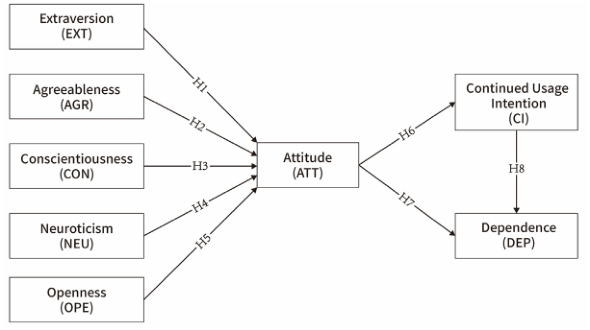
The Big Five Personality Traits—extraversion, agreeableness, conscientiousness, neuroticism, and openness—are a widely used framework for explaining differences in technology acceptance, innovation adoption, and learning behaviours (John & Srivastava, 1999). In prior research, openness fosters exploration of new tools; extraversion enhances proactive engagement; agreeableness and conscientiousness support task involvement; whereas neuroticism heightens anxiety and risk perception, reducing acceptance of intelligent technologies (Devaraj et al., 2008; Kumar et al., 2024). In design education, these traits are also linked to creativity, collaboration, aesthetic judgment, and engagement with emerging technologies such as 3D modeling and generative design (George & Zhou, 2001; Paunonen & Ashton, 2001). Given their relevance to creative work, the Big Five provide a robust foundation for examining design students’ responses to AIGC-assisted design. Accordingly, this study develops the model “Big Five Personality Traits → Attitude → Continuance Intention and Dependence” to explain how personality shapes attitudes and long-term engagement with AIGC (See Figure 1).
Figure 1: Proposed framework (created by the authors).
Extraversion—marked by sociability and proactivity—supports openness to new technologies and positive interaction experiences (Fu et al., 2024). Agreeableness, associated with empathy and cooperation, fosters favourable
evaluations of collaborative tools (Dalvi-Esfahani et al., 2020; Devaraj et al., 2008). Conscientiousness aligns with the efficiency and workflow optimization offered by AIGC, such as rapid sketching and automated refinement (Barnett et al., 2015). In contrast, neuroticism—linked to emotional instability and risk sensitivity—reduces acceptance due to concerns about errors and loss of control (Wang et al., 2020; Li et al., 2024). Openness, characterized by curiosity and receptivity to novelty, encourages experimentation with innovative tools and inspiration from AI outputs (Goldberg, 2013; Li et al., 2024). Thus, we hypothesize: H1: Extraversion positively influences attitude toward AI-assisted design. H2: Agreeableness positively influences attitude toward AI-assisted design. H3: Conscientiousness positively influences attitude toward AI-assisted
Attitude is a central predictor of technology adoption and continued use (Zhang et al., 2008). Positive attitudes enhance satisfaction, strengthen continuance intention (Bhattacherjee & Premkumar, 2004), and may directly increase reliance on AI tools (Turel & Serenko, 2012). Repeated and productive use further fosters functional and psychological dependence, making continuance intention a key mechanism in dependence formation (Turel, 2015). Therefore, we propose: H6: Attitude positively affects continuance intention. H7: Attitude positively affects AI dependence. H8: Continuance intention positively affects AI dependence.
Questionnaire Design and Data Collection The questionnaire comprised two parts: (1) demographic information (gender, age, and design specialization) and (2) measurement scales for the eight variables in the proposed model. All items were adapted from validated instruments in prior studies and assessed using a five-point Likert scale (1 = strongly disagree, 5 = strongly agree). Following expert review and a pilot test, the items were revised and finalized for the official survey.
Table 1: Measurement model.
Table available in the original PDF paper.
Variables CA CR AVE Items FL VIF 0.831 0.854 0.660 EXT1 0.839 1.836 Extraversion (EXT) (Laouiti et al., 2022)
DEP1 0.841 1.601 This study employed a snowball sampling approach targeting university students majoring in design-related disciplines. Data were collected via the online survey platform SoJump. A total of 345 valid responses were obtained. Detailed demographic information is presented in Table 2.
Table 2: Sample description.
Table available in the original PDF paper.
Category Options Frequency Percentage (%) Gender Male 135 39.13
Female 210 60.87 Age 18–21 227 65.80
22–25 118 34.20
Undergraduate 280 81.16
Educational Level Graduate student 65 18.84
(Continued)
Table 2: Continued.
Table available in the original PDF paper.
Category Options Frequency Percentage (%) Major Type Product Design / Industrial Design 81 23.48
50 14.49
Environmental Design / Architectural & Environmental Art
51 14.78
Visual Communication Design / Graphic Design
86 24.93
Digital Media Art / Animation / Interaction Design Others 77 22.32
Data Analysis and Result Common Method Bias
Common method bias refers to systematic, non-substantive variance that may distort relationships among variables in survey research and threaten the validity of empirical findings. To assess this issue, Harman’s one-way test was conducted using SPSS 27.0. The analysis extracted eight factors with eigenvalues greater than 1, explaining 72% of the cumulative variance, while the first factor accounted for only 19%—well below the 40% threshold. These results indicate that common method bias is not a significant concern in this study (Podsakoff et al., 2003).
Reliability and Validity Analysis This study used SmartPLS 4.1 to evaluate the measurement and structural models. All latent variables showed strong reliability, with Cronbach’s α and Composite Reliability values exceeding 0.70, and all VIFs below 5, indicating no multicollinearity (Nunnally & Bernstein, 1994; Neter et al., 1990). Convergent validity was supported by standardized loadings above 0.70 and AVE values greater than 0.50 (Fornell & Larcker, 1981) (see Table 1). Discriminant validity was confirmed using the Fornell-Larcker criterion, as the square root of each construct’s AVE exceeded its correlations with other constructs (see Table 3). Overall, the measurement model demonstrated solid reliability and validity, providing a strong foundation for structural model analysis.
ATT 0.391 −0.158 0.144 0.254 −0.153 0.850 CI 0.453 −0.023 −0.010 0.114 −0.012 0.549 0.783
NEU −0.213 0.064 −0.064 −0.146 −0.011 −0.241 −0.109 0.837
When Creativity Encounters Algorithms: Personality Traits as Predictors 165 Structural Model Assessment
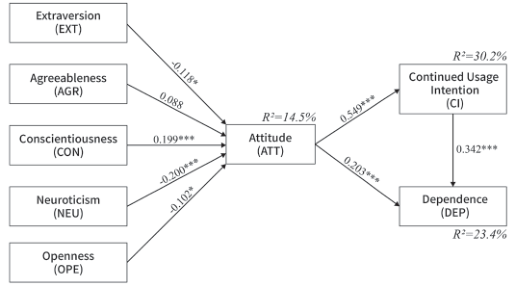
The structural model was assessed using path coefficients and R² values, with Bootstrapping (5,000 resamples) performed in SmartPLS 4.1. As shown in Table 5 and Figure 2, five hypotheses were supported. Specifically, conscientiousness, neuroticism, attitude, continuance intention, and dependence showed significant relationships, supporting H3, H4, H6, H7, and H8. Conscientiousness had a significant positive effect on attitude, neuroticism had a significant negative effect on attitude, attitude had a significant positive effect on continuance intention, continuance intention had a significant positive effect on dependence, and attitude had a significant positive effect on dependence. In contrast, the hypothesized relationships between extraversion, agreeableness, openness, and attitude were not supported, so H1, H2, and H5 were not supported. The R² values indicate acceptable explanatory power: attitude (14.5%), continuance intention (30.2%), and dependence (23.4%), demonstrating that the model has good predictive validity (Sarstedt et al., 2017).
Table 4: A summary of the results of hypotheses testing.
Table available in the original PDF paper.
Hypothesis Original Sample (O)
Mean (M) STDEV T Statistics P values Result EXT →ATT −0.118 −0.133 0.048 2.480 0.013 Unsupport AGR→ATT 0.088 0.100 0.067 1.307 0.191 Unsupport
ATT→CI 0.549 0.550 0.045 12.164 0.000 Support CI→DEP 0.342 0.345 0.058 5.878 0.000 Support ATT→DEP 0.203 0.203 0.055 3.686 0.000 Support
Figure 2: Results of model analysis (created by the authors).
Mediating Effect Test To further clarify how attitude and continuance intention shape dependence, a mediation analysis was conducted. As shown in Table 5, attitude had a significant indirect effect on dependence through continuance intention. This
indicates that attitude not only directly influences users’ continued use but also indirectly fosters psychological dependence via continuance intention, supporting the chain mediation of “attitude → continuance intention → dependence.”
Table 5: Indirect effects.
Table available in the original PDF paper.
Paths O T P 0.025 0.975 Result ATT −> CI −> DEP 0.188 4.945 0.000 0.063 0.168 Support
DISCUSSION
Consistent with prior research (Devaraj et al., 2008; Li et al., 2024; Bhattacherjee & Premkumar, 2004; Turel & Serenko, 2012; Turel, 2015), the supported paths reveal the core psychological mechanisms linking personality, attitude, and behaviour in AIGC-assisted design, indicating that generative AI follows a distinct adoption logic. First, conscientiousness positively affects attitude. In line with Task-Technology Fit Theory (Goodhue & Thompson, 1995), conscientious individuals value order, efficiency, and controllability, which align with AIGC’s workflow optimization and automation, enhancing perceived fit and evaluation. Second, neuroticism negatively affects attitude. AIGC’s black-box nature and uncertain outputs heighten risk sensitivity among neurotic individuals, reducing acceptance—consistent with the “emotional stability-risk perception” mechanism (Meuter et al., 2003). Third, attitude strongly promotes continuance intention, consistent with TAM and ECM. Positive attitudes reflect perceived creative augmentation, reinforcing confirmation effects and motivating sustained use (Tella & Olasina, 2014). Finally, attitude and continuance intention jointly foster AI dependence, with continuance intention serving as a key mediator. Dependence emerges through repeated engagement, habit formation, and growing perceptions of AIGC’s irreplaceability in creative and efficiency-related tasks. This process aligns with Media Dependence Theory (Ball-Rokeach & DeFleur, 1976), which outlines behavioural inertia and cognitive reinforcement as dual pathways to dependence. The indirect effect of “attitude → continuance intention → dependence” demonstrates AIGC’s strong psychological stickiness in creative design. Overall, these findings confirm a sequential psychological chain of “personality → attitude → behaviour → dependence,” showing that generative AI adoption reflects a deep process shaped by personality traits, risk judgments, and perceived creative control.
This study finds that extraversion, agreeableness, and openness do not significantly predict attitude, diverging from traditional technology acceptance findings and revealing the unique psychological mechanisms of AIGC in creative contexts. First, the nonsignificant effect of extraversion reflects strong context dependency. Extraverted individuals are motivated by social interaction, whereas AIGC tools emphasize individual creation without social cues. According to Trait Activation Theory, traits such as extraversion are not triggered when situational cues are absent (Tett & Burnett, 2003), explaining the lack of effect. Second, the nonsignificant effect of agreeableness suggests that social personality traits are less relevant in individualized creative tasks. AIGC use centers on personal style and
When Creativity Encounters Algorithms: Personality Traits as Predictors 167 aesthetic judgment rather than collaboration, aligning with Person–Task Fit Theory, which posits that prosocial traits matter only when task demands involve sociality (Barrick et al., 1998). Most notably, the nonsignificant effect of openness deviates from common findings in innovation adoption. Although openness reflects curiosity and novelty seeking, AIGC’s style- driven outputs and potential creative substitution may weaken perceived creative control and evoke originality anxiety, thereby suppressing positive attitudes. This indicates that openness operates differently in creative domains, moderated by mechanisms such as perceived creative autonomy and aesthetic congruence—consistent with Self-Determination Theory. In sum, extraversion, agreeableness, and openness do not influence attitude because AIGC’s core value lies in efficiency and generativity rather than social interaction, and its generative nature may threaten creative autonomy for highly open individuals. These findings suggest that conventional adoption predictors may be less applicable in creative contexts, underscoring the need for context-sensitive technology acceptance models.
This study contributes to creative-technology adoption research in three ways. First, applying the Big Five framework to AIGC-assisted design shows that conscientiousness and neuroticism shape attitudes via task-technology fit and risk sensitivity, extending personality explanations into creative technology contexts. Second, the nonsignificant effects of extraversion, agreeableness, and openness reveal boundary conditions of models like TAM and UTAUT, suggesting that AIGC’s individualized workflows and algorithmic stylistic dominance alter the role of social and openness-related traits. Third, the study identifies a dual-path “attitude → behaviour → dependence” mechanism, demonstrating that AI dependence arises through both habitualization and attitude-driven valuation of AIGC’s creative augmentation. Together, these insights refine theories of AI dependence and highlight the need for context- sensitive models of creative-technology acceptance.
This study offers several practical implications for design education and the pedagogical use of AIGC. The findings support personalized AIGC instruction: conscientious students benefit from structured, efficient workflows, whereas neurotic students require more predictable feedback to reduce anxiety, suggesting differentiated teaching strategies. Because attitude drives both continuance intention and dependence, educators should mitigate over-reliance on AI by incorporating balanced approaches such as AI-free creation stages, originality training, and pre-AI ideation. The results also inform tool development and industry deployment: risk-sensitive users require greater interpretability and controllability, while structure-oriented users benefit from stronger workflow integration. Enhancing these features may broaden adoption. Overall, this study provides actionable guidance for integrating AIGC into design education and improving user experience in the design industry.
This study has several limitations. The sample of mainland Chinese design majors restricts cultural and disciplinary generalizability; future work should include more diverse populations. The cross-sectional design cannot capture changes in attitudes and dependence, highlighting the need for longitudinal or experimental studies. Creative-domain factors such as perceived creative
control, originality anxiety, and algorithmic trust were not assessed and may improve explanatory depth. Self-reported dependence may be affected by social desirability, suggesting the value of behavioral or qualitative data. Finally, differences among specific AIGC tools were not examined, indicating a need for tool- and task-specific analysis.
CONCLUSION
This study systematically demonstrates how personality traits shape design students’ adoption and dependence on AI-assisted design. Using the Big Five framework, the findings reveal a sequential mechanism in which conscientiousness and neuroticism significantly influence attitudes through task-technology fit and risk sensitivity, whereas extraversion, agreeableness, and openness do not exhibit the expected effects found in traditional technology adoption contexts. These results highlight the contextual specificity of personality in creative domains, where aesthetic autonomy, originality concerns, and uncertainty tolerance play a pronounced role. Furthermore, attitude is shown to be a pivotal driver of continuance intention and a direct contributor to AI dependence. Continuance intention also mediates the development of dependence, indicating that repeated use, habit formation, and perceived irreplaceability jointly reinforce reliance on AIGC tools. This chain mechanism—“personality → attitude → continuance intention → dependence”—advances theoretical understanding of creative-technology adoption by revealing both cognitive–affective and behavioural pathways underlying AI reliance. Overall, this research provides new empirical evidence for the role of personality in AIGC-assisted design and offers practical implications for differentiated pedagogy, responsible AI integration, and the cultivation of balanced human–AI collaboration in design education.
ACKNOWLEDGMENT
We sincerely thank all participants for their valuable contributions to this study.
REFERENCES
Ball-Rokeach, S.J., DeFleur, M.L., 1976. A dependency model of mass-media effects.
Commun. Res. 3, 3–21. https://doi.org/10.1177/009365027600300101 Barnett, T., Pearson, A.W., Pearson, R., Kellermanns, F.W., 2015. Five-factor model personality traits as predictors of perceived and actual usage of technology. European Journal of Information Systems 24, 374–390. https://doi.org/10.1057/ejis.2014.10 Barrick, M.R., Stewart, G.L., Neubert, M.J., Mount, M.K., 1998. Relating member
ability and personality to work-team processes and team effectiveness. J. Appl. Psychol. 83, 377–391. https://doi.org/10.1037/0021−9010.83.3.377 Bhattacherjee, A., Premkumar, G., 2004. Understanding changes in belief and attitude toward information technology usage: a theoretical model and longitudinal test. MIS Q. 28, 229–254. https://doi.org/10.2307/25148634 Dalvi-Esfahani, M., Alaedini, Z., Nilashi, M., Samad, S., Asadi, S., Mohammadi, M.,
2020. Students’ green information technology behavior: beliefs and personality traits. J. Cleaner Prod. 257, 120406. https://doi.org/10.1016/j.jclepro.2020.120406
When Creativity Encounters Algorithms: Personality Traits as Predictors 169 Davis, F.D., 1989. Perceived usefulness, perceived ease of use, and user acceptance of
information technology. MIS Q. 13, 319. https://doi.org/10.2307/249008 Devaraj, S., Easley, R.F., Crant, J.M., 2008. Research note—how does personality matter? Relating the five−factor model to technology acceptance and use. Inf. Syst. Res. 19, 93–105. https://doi.org/10.1287/isre.1070.0153 Fornell, C., Larcker, D.F., 1981. Evaluating structural equation models with
unobservable variables and measurement error. J. Mark. Res. 18, 39–50. Fu, P., Gao, C., Chen, X., Zhang, Z., Chen, J., Yang, D., 2024. Proactive personality and its impact on online learning engagement through positive emotions and learning motivation. Sci. Rep. 14, 28144. https://doi.org/10.1038/s41598−024−79776−3 George, J.M., Zhou, J., 2001. When openness to experience and conscientiousness
are related to creative behavior: an interactional approach. J. Appl. Psychol. 86, 513–524. Goldberg, L.R., 2013. An alternative “description of personality”: The Big-Five factor structure. In: Personality and Personality Disorders. Routledge, pp. 34–47. Goodhue, D.L. & Thompson, R.L., 1995. Task-technology fit and individual
performance. MIS Quarterly, 19(2), pp. 213–236. https://doi.org/10.2307/249689 Huang, Z., Fu, X., Zhao, J., 2025. Research on AIGC-integrated design education for sustainable teaching: an empirical analysis based on the TAM and TPACK models. Sustainability 17, 5497. https://doi.org/10.3390/su17125497 Jago, A.S., Carroll, G.R., 2024. Who made this? Algorithms and authorship credit.
Personal. Soc. Psychol. Bull. 50, 793–806. https://doi.org/10.1177/0 1461672221149815 John, O., 1999. The big-five trait taxonomy: history, measurement, and theoretical perspectives. Publ. as. Kumar, A., Shankar, A., Nayal, P., 2024. Metaverse is not my cup of tea! An
investigation into how personality traits shape metaverse usage intentions. J. Retail. Consum. Serv. 77, 103639. https://doi.org/10.1016/j.jretconser.2023.103639 Laouiti, R., Haddoud, M.Y., Nakara, W.A., Onjewu, A.-K.E., 2022. A gender-based approach to the influence of personality traits on entrepreneurial intention. J. Bus. Res. 142, 819–829. https://doi.org/10.1016/j.jbusres.2022.01.018 Li, H., Ren, T., Zhang, Z., 2025. Assistive tools or insecurity: the impact of
technological readiness on willingness to use AI. Int. J. Hum.–Comput. Interact. Li, H., Xue, T., Zhang, A., Luo, X., Kong, L., Huang, G., 2024. The application and impact of artificial intelligence technology in graphic design: a critical interpretive synthesis. Heliyon 10. https://doi.org/10.1016/j.heliyon.2024.e40037 Liu, J., 2025. When usefulness fuels fear: the paradox of generative AI dependence
and the mitigating role of AI literacy. Int. J. Hum.–Comput. Interact. 0, 1–22. Meuter, M.L., Ostrom, A.L., Bitner, M.J., Roundtree, R., 2003. The influence of technology anxiety on consumer use and experiences with self-service technologies. J. Bus. Res., Strategy in e-marketing 56, 899–906. Morales-García, W.C., Sairitupa-Sanchez, L.Z., Morales-García, S.B., Morales-
García, M., 2024. Development and validation of a scale for dependence on artificial intelligence in university students. Front. Educ. 9. https://doi.org/10.3389/ feduc.2024.1323898 Neter, J., Wasserman, W. & Kutner, M.H., 1990. Applied Linear Statistical Models: Regression, Analysis of Variance, and Experimental Designs. 3rd ed. Homewood, IL: Irwin. Nunnally, J.C. & Bernstein, I.H., 1994. Psychometric Theory. New York: McGraw-
Hill.
Paunonen, S.V., Ashton, M.C., 2001. Big five factors and facets and the prediction of behavior. J. Pers. Soc. Psychol. 81, 524–539. Podsakoff, P.M., MacKenzie, S.B., Lee, J.-Y., Podsakoff, N.P., 2003. Common method
biases in behavioral research: a critical review of the literature and recommended remedies. J. Appl. Psychol. 88, 879–903. https://doi.org/10.1037/0021−9010.88.5.879 Sarstedt, M., Ringle, C.M. & Hair, J.F., 2017. Partial least squares structural equation modeling. Handbook of Market Research, 26(1), pp.1–40. Tella, A., Olasina, G., 2014. Predicting users’ continuance intention toward E−
payment system: an extension of the technology acceptance model. Int. J. Inf. Syst. Soc. Change 5, 47–67. https://doi.org/10.4018/ijissc.2014010104 Tett, R., Burnett, D., 2003. A personality trait-based interactionist model of job performance. J. Appl. Psychol. 88, 500–517. Turel, O., 2015. Quitting the use of a habituated hedonic information system: A
theoretical model and empirical examination of facebook users. Eur. J. Inf. Syst. 24, 431–446. Turel, O., Serenko, A., 2012. The benefits and dangers of enjoyment with social networking websites. Eur. J. Inf. Syst. https://doi.org/10.1057/ejis.2012.1 Wang, Q., Lau, R.Y.K., Yang, K., 2020. Does the interplay between the personality
traits of CEOs and CFOs influence corporate mergers and acquisitions intensity? An econometric analysis with machine learning-based constructs. Decis. Support Syst. 139, 113424. https://doi.org/10.1016/j.dss.2020.113424 Wang, Q., Li, C., Zhu, L., 2024. Analysis on the acceptance of AIGC technology by art and design students in universities in China. Abac J. 44. Zhang, P., Aikman, S.N., Sun, H., 2008. Two types of attitudes in ICT acceptance and
use. Intl, J. Hum.–comput. Interact. https://doi.org/10.1080/10447310802335482
LISTED IN THE AHFE DIGITAL BOOKSTORE CATALOGUE
Explore the complete digital volume
Human Factors in Communication of Design
Read this individual research paper free through the original publisher, or explore the full digital proceedings book.
ISBN 978-1-964867-92-2
Explore this ISBN in the AHFE Bookstore ↗Listed in the July 2026 bookstore catalogue; search by ISBN to confirm current availability · Digital book purchase optional