Hanna Neroj, Bruce Walker (2025). The Innovation Effect: How Futurism Shifts Risk Perception in Vehicles. In: Advances in Human Factors of Transportation. AHFE Open Access, vol. 186, pp. 372–378. https://doi.org/10.54941/ahfe1006526
Technology adoption models, such as UTAUT 2, focus on various technologies but might be too broad to effectively predict futuristic, highly innovative technology adoption. In this paper, we investigate potential futuristic technology adoption determinants and argue that perceived risk and time horizon (futurism) might play an important role. This study is a replication and extension of our previous study on the risk perception of futuristic vehicles, investigating the effects of different modes and autonomy levels of vehicles on risk perception. The study utilizes 3x3 mixed MANOVA design. The data was collected through an anonymous survey on students from a technical university. The results suggest that the futurism component of technology seems to lower perceived risk and that futuristic technology adoption may call for more tailored models that capture risk perception, familiarity, and expected exposure.
Technology adoption studies tend to focus on existing technologies. The Technology Acceptance Model (TAM) includes perceived usefulness, perceived ease of use, and attitude toward using (Davis, 1986). The extension, TAM 2, also includes social components, quality of output, and job relevance (Venkatesh and Davis, 2000). The unified theory of acceptance and use of technology (UTAUT), and more recent UTAUT 2 go beyond just acceptance and focus on different aspects of adoption, such as hedonic motivation (pleasure from using the technology), or price value (perceived benefit of technology versus monetary cost) (Venkatesh, Thong, & Xu, 2012). But what happens when we try to apply TAM, UTAUT, or similar models to futuristic, unknown technology? Adoption cannot be easily predicted. In our research, we investigate the factors influencing the adoption of futuristic technologies, specifically in transportation (i.e., flying cars that can both drive and fly). We consider perceived risk as a necessary component in building technology trust (Stuck, Tomlinson, & Walker, 2021). In a previous study, we showed that participants were more fearful, anxious, and worried about familiar technology than about highly futuristic tech in a fully autonomous context (Neroj and Walker, 2024). However, it was uncertain whether those effects could be due to the flying component of the multimodal vehicles, or due to their futurism. Further, we exposed participants to two extreme cases of automation: fully autonomous and fully human-operated. Therefore, there is
The Innovation Effect: How Futurism Shifts Risk Perception in Vehicles 373
a need to investigate the impact of the flight component on risk perception, as well as a moderate point of automation, where some of the control remains with a human operator. To address these needs, the current study looks into the factors that could influence risk perception by extending the types of technology and modes of automation. We do this by introducing flying-only vehicles and a third level of automation: fully autonomous with a safety driver.
Our goal is to investigate the potential of adopting highly innovative, futuristic technology by looking at the factors that we believe could be crucial in such decisions. By going beyond mere consumer studies, and delving deeper into the behavioral considerations, we hope that our studies will inform academic research on the technology adoption in a futuristic context, as well as the industry that seeks to introduce revolutionary, unknown technology.
Futuristic Technology Adoption Determinants To understand the technology adoption determinants, Foster and Rosenzweig (2010) looked into various technologies that were presumed to profit human welfare and found the determinants will vary depending on the context (e.g., agriculture will have different determinants than healthcare). An important factor that seems to be common across technologies is the net gain (inclusive of all costs of using the tech) to the user (Foster and Rosenzweig, 2010). There are challenges in measuring the outcomes for technologies where the gain cannot be directly measured, like a gain in one’s well-being and lifestyle, in contrast to, for instance, monetary gains. Moreover, technological gains may be uncertain, particularly in the context of new, revolutionary technology. Foster and Rosenzweig (2010) argue that risk is another important adoption determinant, particularly for new technologies. It can be a constraint on the adoption due to the usual upfront cost needed to purchase the technology with uncertainty on the outcomes of its use. This combination of cost and uncertainty suggests that the wealth of an agent/stable source of income plays a role in the decision to adopt new, riskier technologies and is in line with the evidence from the literature (e.g., Moser and Barrett, 2003). Flying cars can be categorized as a technology with non-straightforward gains for the end user that are difficult to measure. Thus, we believe that perceived risk will play an important role when adopting these futuristic and innovative technologies.
Time Horizon in Risk Perception Literature suggests that the time horizon also influences people’s preferences and beliefs. One of the models aiming to explain real-life decision-making is hyperbolic discounting, i.e., devaluation of outcomes much more steeply when it is distant in the future versus in the present. In consumer studies, the savings/consumption behavior is characterized by a dynamic inconsistency: “a conflict between the optimal contingent plan from today’s perspective and the optimal decision from tomorrow’s perspective” (Laibson, 1994, p. 9). The literature suggests that discounting behavior is directly linked to
374 Neroj and Walker
risk preferences (Epper, Fehr-Duda, & Bruhin, 2011) and that more risk- averse people tend to discount the future more heavily (Eckel, Johnson, & Montmarquette, 2005). Epper et al. (2011) showed that the uncertainty of the future interacts with how people distort probabilities and how steeply they discount future rewards; several explanations were hypothesized. Hyperbolic discounting may be affected by the environment, such as a lack of trust toward institutions that lead to unstable economies and thus uncertain future; or emotionally charged outcomes that can lead to biased judgments compared to neutral outcomes, like financial gains (Epper et al., 2011). We believe that those factors need to be taken into account when assessing the adoption of technologies that are to be deployed in the future, meaning its outcomes and potential gains are delayed in time.
The above discussion suggests that technology adoption might be predicted based on the net gain of using the technology for the end-user, yet this can be difficult to measure for futuristic technology with uncertain outcomes where risk may play a significant role. Moreover, there may be an impact of the time horizon of such technology deployment on the way people estimate outcomes, with a possible influence of the emotional component. In our study, we use a perceived risk scale that includes sub- scales assessing emotional aspects (affect component), and time horizon (exposure component). This will allow us to evaluate those aspects in the context of known technologies (traditional cars, helicopters), less known technologies (self-driving and self-flying vehicles), and unknown, highly futuristic technologies (self-driving+flying, i.e., multimodal and autonomous vehicles).
METHOD
We conducted an IRB-approved study via an anonymous online survey using Qualtrics software. The study design consisted of a within-subjects independent variable (IV) of vehicle mode driving only, flying only, driving+flying (called ‘multimodal’ throughout this paper) and a between- subjects IV of autonomy level (no autonomy, full autonomy with a safety driver, full autonomy). The ‘driving-only’ mode refers to a vehicle’s capability to only drive on the road (we use a sedan-type car). The ‘flying-only’ mode is the sole capability of flying (we use a helicopter). The ‘multimodal’ mode is a sedan-type car with side rotors that can drive on the road, pull over, and take off to fly like a drone (we use a photo rendering as this technology does not yet exist on the market). The ‘no autonomy’ level refers to full control of the vehicle by a human operator at all times. The ‘fully autonomous with a safety driver’ level refers to a situation where the vehicle is fully autonomous, but there is a qualified human driver/pilot present who can take over control in certain situations. The ‘fully autonomous’ level assumes that control is never given to a human operator. Four outcome variables reflect four sub-scales of perceived risk: affect, severity, exposure, and susceptibility (Walpole & Wilson, 2021).
Participants (N = 153 undergraduate students from a US technical university) first responded to demographic questions. Then, each participant
The Innovation Effect: How Futurism Shifts Risk Perception in Vehicles 375
was randomly assigned to one autonomy mode and all three mode types, which were presented in random order. Participants were provided with a brief description of the assigned technology, including one photograph of the exterior and one photograph of the interior design. A total of 16 questions related to perceived risk were asked. These were drawn from (Walpole & Wilson, 2021). Each question followed a 5-point Likert-type agreement scale for response. We analyzed the data using a 3x3 mixed MANOVA design using SPSS v29 software. Provided a significant omnibus test, we planned to conduct univariate tests to investigate the effects on each DV individually, followed by contrast analyses.
HYPOTHESIS We hypothesize that perceived risk would be lower for multimodal autonomous vehicles (i.e., the most “futuristic”) than for the flying-only autonomous vehicles. This outcome would indicate that perceived risk may depend on the time horizon rather than vehicle’s flying capabilities. We also expected to replicate the results of our first study (Neroj & Walker, 2024) and find significant interaction between mode and autonomy, and observe lower perceived risk for driving-only vehicles than multimodal vehicles for all automation modes.
RESULTS
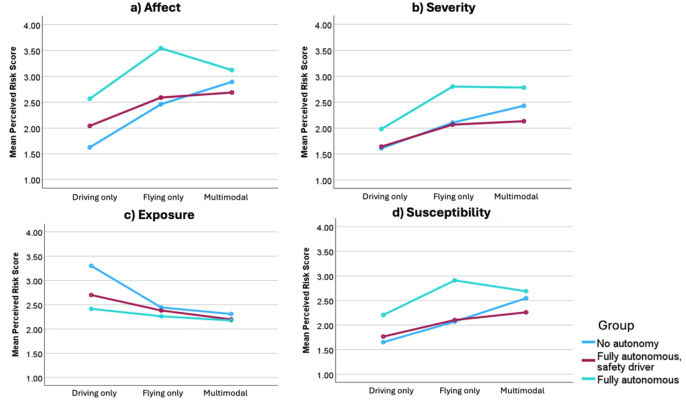
Our analyses started with the review of descriptive statistics, a visual inspection of means plots across all perceived risk subscales, and subsequent inferential statistical analyses. Figure 1 presents the mean perceived risk score plots for each perceived risk subscale: Affect (Figure 1a), Severity (Figure 1b), Exposure (Figure 1c), and Susceptibility (Figure 1d). These means are broken down depending on the mode and the autonomy level (‘No autonomy’ in blue, ‘Fully autonomous with a safety driver’ in red, ‘Fully autonomous’ in green).
Figure 1: Estimated marginal means of perceived risk per mode per autonomy level for a) affect b) severity c) exposure d) susceptibility.
376 Neroj and Walker
Our results indicate that the effect of mode on risk perception varies across different automation modes (Figure 1). This is supported by a statistically significant interaction, Pillai’s Trace = .350, F(16, 288) = 3.82, p <.001, partial η2=.175. This means that participants’ perceived risk differs depending on whether the vehicle was controlled by a human, had full autonomy but a human operator could take over the control, or was fully autonomous. This finding is in line with our hypothesis.
When there was no autonomy, people perceived multimodal vehicles as the riskiest for affect (Figure 1a), severity (Figure 1b), and susceptibility (Figure 1d). They also perceived driving-only vehicles as the least risky across those dimensions. However, when the vehicle was fully autonomous, a quadratic trend was followed for affect (Figure 1a) and susceptibility (Figure 1d), where the flying-only vehicle was perceived as the riskiest. This also supports our hypothesis.
Indeed, our statistical analyses suggest a quadratic trend (F = 31.082, p<.001, partial η2=.172) for the affect component, suggesting an increase in perceived risk on the affect component for flying-only vehicles compared to multimodal vehicles. For the severity component, the scores increase visibly from driving-only to flying-only, with a less steep, yet significant, drop in perceived severity for multimodal vehicles, with quadratic trend (F = 12.308, p<.001, partial η2=.076). This effect was not observed for severity, where the line flattens between flying-only and multimodal vehicles. Statistical analyses further support this finding, with a significant interaction effect for affect: F(4,153)=7.064, p<.001, partial η2=.086; and susceptibility: F(4,153)=7.064, p=.002, partial η2=.055, but no significant interaction for the severity outcome variable.
The middle level of automation, where the vehicle was autonomous, but the critical control is left to the human operator, appears to reduce risk perception variability. It seems that introducing a human operator for critical situations moderates perceived risk between driving, flying, and driving+flying modes. The graphs presented in Figure 1 show a more linear trend of mean perceived risk for this level of automation, compared to the fully autonomous case, yet less linear than for the no autonomy case. Nevertheless, a fully autonomous vehicle with a safety driver is still perceived as riskier than no autonomy case.
As for the exposure, participants felt they would be mostly exposed to driving-only vehicles and least exposed to multimodal vehicles in the near future; this linear trend was followed in all automation conditions, yet fully autonomous vehicles had smaller differences in perceived exposure than no- autonomy vehicles.
DISCUSSION AND CONCLUSION Previously (Neroj and Walker, 2024), we found that futuristic multimodal vehicles were perceived as less risky than traditional cars, but there was no difference in perceived risk for multimodal vehicles based on the autonomy level. However, after introducing the flying-only mode in the present study, that effect shifted: multimodal vehicles were perceived as
The Innovation Effect: How Futurism Shifts Risk Perception in Vehicles 377
more risky than traditional cars but significantly less risky than flying-only vehicles. The quadratic patterns, particularly for affect and susceptibility, suggest that flying-only vehicles represent the highest perceived risk and emotional response, likely due to a perceived danger of flying, compared to both the more familiar driving-only vehicles, and unknown multimodal (driving+flying) vehicles. Another important finding is the more linear trend of perceived risk across different vehicle modes for the ‘full autonomy with a safety driver’ case. People seemed to perceive flying-only vehicles very similarly to multimodal vehicles in terms of risk. Yet, when the human operator is removed from the environment, the more familiar vehicle (i.e., a helicopter) is far more risky than an unknown “flying car”. This suggest that the futurism component of technology seems to lower perceived risk. There are several potential explanations for this result.
First, it may be related to the availability heuristic (Tversky & Kahneman, 1973). People may have fewer (if any) salient examples of accidents involving flying cars, whereas crashes of flying-only vehicles (planes, helicopters) are often associated with high severity outcomes. This reasoning is in line with Slovic (1987), who argued that familiarity tends to increase the perception of risk because people are more aware of the limitations or dangers of familiar technologies. The unknown technology might be perceived as less risky if participants have not yet developed a detailed mental model of its dangers. In addition, the novelty and excitement about futuristic technologies may influence the affect component of risk perception. This could be supported by evidence from Epper et al. (2011) discussed above, where emotionally-charged outcomes can lead to biased judgments of the outcomes. Furthermore, lower perceived risk for futuristic technologies may be influenced by hyperbolic discounting. People may assign a lower value of perceived risk in a t + 1 time horizon, compared to the present (t). Most likely, our evidence may be a combination of those effects, yet the weight of each of those components requires further investigation. Further investigations should also expand the sample to more diverse populations.
This study’s findings underscore the role of familiarity in shaping risk perceptions for emerging technologies. Further, futuristic technology adoption may call for more tailored models that capture risk perception, familiarity, and expected exposure. Those models should also account for the biases that emerge with the increase of the time horizon for a given technology implementation.
REFERENCES
Davis, F. D. (1986). A technology acceptance model for empirically testing new enduser information systems: Theory and results. Doctoral dissertation. MIT Sloan School of Management, Cambridge, MA. Eckel, C., Johnson, C., & Montmarquette, C. (2005). Saving decisions of the
working poor: Short-and long-term horizons. In Field experiments in economics (pp. 219–260). Emerald Group Publishing Limited. Epper, T., Fehr-Duda, H., & Bruhin, A. (2011). Viewing the future through a warped lens: Why uncertainty generates hyperbolic discounting. Journal of risk and uncertainty, 43, 169–203.
378 Neroj and Walker
Foster, A. D., & Rosenzweig, M. R. (2010). Microeconomics of technology adoption. Annu. Rev. Econ., 2(1), 395–424. Laibson, D. I. (1994). Hyperbolic discounting and consumption (Doctoral dissertation, Massachusetts Institute of Technology). Moser, C. M., & Barrett, C. B. (2003). The disappointing adoption dynamics of a
yield-increasing, low external-input technology: The case of SRI in Madagascar. Agricultural systems, 76(3), 1085–1100. Neroj, H. J., & Walker, B. N. (2024, September). What Makes Futuristic Vehicles Risky? Preliminary Design Considerations Based on Automation Level and Driving Versus Flying Modes. In Adjunct Proceedings of the 16th International Conference on Automotive User Interfaces and Interactive Vehicular Applications (pp. 88–93). Stuck, R. E., Tomlinson, B. J., & Walker, B. N. (2021). The importance of
incorporating risk into human-automation trust. Theoretical Issues in Ergonomics Science, 23(4), 500–516, doi: 10.1080/1463922X.2021.1975170. Tversky, A., & Kahneman, D. (1973). Availability: A heuristic for judging frequency and probability. Cognitive psychology, 5(2), 207–232. Venkatesh, V., Davis, F. D. (2000). A theoretical extension of the technology
acceptance model: Four longitudinal field studies. Manag. Sci. 46(2), 186–204. Venkatesh, V., Thong, J. Y., & Xu, X. (2012). Consumer acceptance and use of information technology: Extending the unified theory of acceptance and use of technology. MIS quarterly, 157–178. Walpole, H. D., & Wilson, R. S. (2021). Extending a broadly applicable measure
of risk perception: The case for susceptibility. Journal of Risk Research, 24(2), 135–147.
LISTED IN THE AHFE DIGITAL BOOKSTORE CATALOGUE
Explore the complete digital volume
Advances in Human Factors of Transportation
Read this individual research paper free through the original publisher, or explore the full digital proceedings book.
ISBN 978-1-964867-62-5
Explore this ISBN in the AHFE Bookstore ↗Listed in the July 2026 bookstore catalogue; search by ISBN to confirm current availability · Digital book purchase optional