Lance Chong (2025). Maxwell’s Demon, System Boundary, and Interface ROI: The Importance of Logical Integrity in UI/UX Design and Evaluation. In: Cognitive Computing and Internet of Things. AHFE Open Access, vol. 165, pp. 21–36. https://doi.org/10.54941/ahfe1006087
This paper examines the theoretical foundations of UI/UX design and human–system interaction, with a focus on how logical integrity impacts cognitive processes. Despite advancements in technology and interface design methodologies, many contemporary systems remain unintuitive and frustrating. Scholars have metaphorically linked these persistent usability issues to the second law of thermodynamics, suggesting an inevitable “entropic progression” toward technological complexity. By revisiting classical thought experiments, such as Maxwell’s demon, this study provides novel insights into current interface design challenges. Employing a newly developed information-theoretic framework to model and enhance user interactions, the paper emphasizes the crucial role of human reasoning and cognitive validity in designing coherent, intuitive interfaces. Through this innovative perspective, the research demonstrates that effective user–system interactions fundamentally depend on maintaining logical integrity within both the system and the user, underscoring its significance in contemporary UI/UX design.
“Each day we awake to a world that appears more confused and disordered than the one we left the night before.”
– Jeremy Rifkin (Rifkin, 1980) In Entropy: A New World View, Jeremy Rifkin (1980) contends that global industrial development mirrors the rising entropy levels predicted by the second law of thermodynamics. Over the past several decades, numerous scholars have echoed this perspective (Ellul, 1964; Perrow, 1984; Tainter, 1988; Tenner, 1996; Taleb, 2007, 2012; Arbesman, 2016), arguing that many modern technological frustrations stem from a psychological alignment with an ever-increasing measure of disorder. Meanwhile, other researchers, from Loschmidt (Wu, 1975) and Schrödinger (1948) to Kauffman (1993, 1995), question whether the second law dooms humanity to ceaseless entropy
growth, positing that living systems naturally strive to curb localized entropy within larger networks. The former viewpoint provides what some see as “psychological comfort and moral relief,” whereas the latter challenges human innovation to actively maintain order amid escalating functional complexity.
Focusing specifically on user interface (UI) design, this paper examines how human innovation unfolds within the deliberately constructed, laboratory- like niche environment of interactivity. It explores the cognitive reasoning that users employ, particularly with respect to maintaining “boundary integrity” in user logic, a persistent challenge in an era of escalating technological complexity.
RATIONALE AND BACKGROUND In human–computer interaction (HCI) and UI/UX design, scholars have long recognized users’ limited cognitive resources, such as attention, memory, and reasoning capacity. Gibson (1979) suggested that humans’ perceptual capabilities are directly “afforded” by objects themselves; Norman (1988, 2004) demonstrated that users often develop mental models that misinterpret interface behaviors; and Nielsen (1994) formalized usability heuristics explicitly designed to address human biases and memory constraints. Across overlapping fields, including cognitive science, design theory, and AI safety (Vicente & Matute, 2023; Leffer, 2023). Yet the fundamental question remains: How can science and technology effectively accommodate genuine human limitations?
Despite these scholarly contributions, much of the literature implicitly attributes interaction failures to “human error”, often without fully accounting for the complexities inherent in an evolving technological landscape (Reason, 1990). Terms such as “human biases” (IxDF, 2021), the “assimilation paradox” (Carroll & Bosson, 1987), or even the second law of thermodynamics itself (Rifkin, 1980), do not consistently resolve practical design issues. While industry frequently provides localized solutions, these approaches may require fundamental reconsideration when new technologies emerge (de Winter, 2024).
Human cognitive limitations and their resulting complexities extend beyond just UI/UX and interaction design. For instance, Wikipedia (2025a) currently lists over one hundred logical fallacies, a catalogue that has steadily expanded since Aristotle’s time. While such enumerations are valuable for theoretical discourse, they provide limited practical guidance for enhancing UI design. Simply instructing designers or developers to “avoid each recognized fallacy” offers minimal actionable advice. Consequently, this paper adopts an alternative approach: it analyzes how user cognition generates and navigates paradoxes within human–system interactions by revisiting and deconstructing the conceptual foundations exemplified in the paradox of Maxwell’s demon.
Maxwell’s Demon, System Boundary, and Interface ROI: The Importance of Logical Integrity 23
MAXWELL’S DEMON: A STATISTICAL LAW & A BOUNDARY LEAK James Clerk Maxwell proposed his famous thought experiment in 1867, ostensibly challenging the second law of thermodynamics (Maxwell, 1871a; Clausius, 1867). He envisioned a diminutive, intelligent being— “Maxwell’s demon,” as Kelvin later named it (Thomson, 1874)—governing a small door between two gas-filled chambers (Maxwell, 1871b). By selectively allowing faster molecules to pass one way and slower molecules the other, the demon seemed able to create a temperature gradient without performing external work, thereby contravening the second law. Subsequent analyses generally concluded that the demon itself must expend energy during measurement, data storage, or erasure, thus preserving the validity of the second law.
Maxwell’s earliest reference to the paradox can be traced to an 1867 letter (Knott, 1911), expanded upon in Theory of Heat (Maxwell, 1871b). He wrote: “If we conceive a being whose faculties are so sharpened that he can follow every molecule in its course, such a being, whose attributes are still as essentially finite as our own, would be able to do what is at present impossible to us. For we have seen that the molecules in a vessel full of air at uniform temperature are moving with velocities by no means uniform, though the mean velocity of any great number of them, arbitrarily selected, is almost exactly uniform. Now let us suppose that such a vessel is divided into two portions, A and B, by a division in which there is a small hole, and that a being, who can see the individual molecules, opens and closes this hole, so as to allow only the swifter molecules to pass from A to B, and only the slower ones to pass from B to A. He will thus, without expenditure of work, raise the temperature of B and lower that of A, in contradiction to the second law of thermodynamics.”
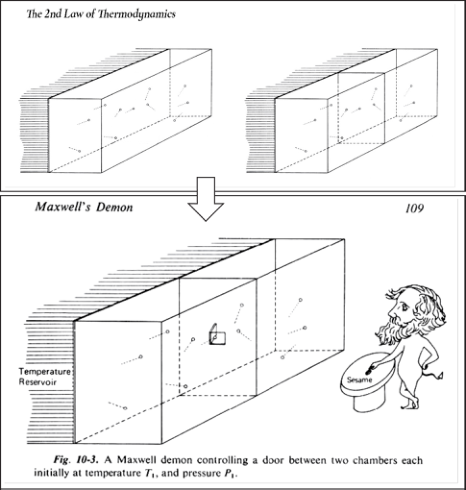
Closer inspection reveals that the thermodynamic environment assumed by the second law—a single chamber or, in some versions, two chambers tending toward thermal equilibrium—is fundamentally altered once Maxwell introduces a trapdoor and an intelligent “demon” (see Figure 1).
This reframing effectively modifies the system boundaries. Rather than directly challenging the second law itself, Maxwell’s scenario juxtaposes two distinct contexts. Maxwell’s demon highlights the statistical underpinnings of the second law: although it is exceedingly unlikely for entropy to spontaneously decrease in large or long-term systems, smaller-scale or transient fluctuations can momentarily reduce entropy within the boundary of a defined system. Over decades, extensive debate about whether Maxwell’s demon genuinely violates the second law (Leff & Rex, 2003) has introduced additional complexities, examining potential constraints on the law’s scope and applicability (Szilard, 1929; Landauer, 1961; Bennett, 1982; Zurek, 1984; Vedral, 2000). Maxwell originally intended to illustrate the statistical rather than absolute nature of the second law, where entropy increases by overwhelming probability rather than necessity. Thus, Maxwell’s thought experiment demonstrates how rare fluctuations could locally reduce entropy, defying typical expectations. Yet by introducing a demon and trapdoor, Maxwell fundamentally transforms the thermodynamic setup from that initially
24 Chong
considered by the second law, incorporating external elements absent in the original scenario. From a Networked Two-Way Communication Channels (NTCC) perspective (Chong, 2023, 2024a, 2024b), this additional apparatus constitutes a conceptual boundary leak: the system ceases to be the passive (or non-intelligent) thermodynamic entity on which the second law relies. Maxwell’s molecule-sorting “being” and its trapdoor introduce new “nodes” into the communication channel, representing an unavoidable shift away from the isolated container assumed by the second law of thermodynamics.
Figure 1: A graphical depiction of Maxwell’s demon, adapted from Entropy for Biologists (Morowitz, 1970). By introducing both a trapdoor and a selective, trapdoor-controlling “being” into the thermodynamic system, Maxwell’s paradox fundamentally alters the conditions assumed by the second law.
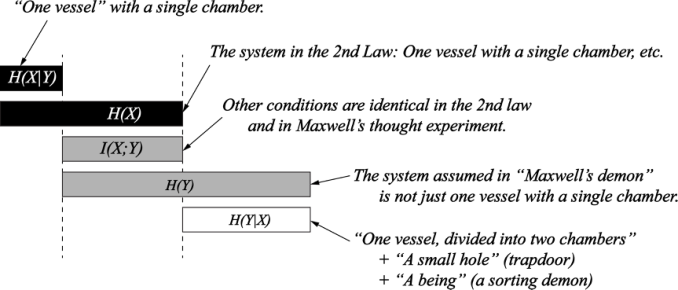
MISINTERPRETATION AND BOUNDARY LEAKAGE Shannon (1948) famously demonstrated that information-theoretic analysis could apply to linguistic phenomena. Recent work has extended these insights to both linguistic and product interfaces (Chong, 2024a, 2024c), employing the Networked Two-Way Communication Channels (NTCC) theory to analyze “entropy alignment.” In this framework, Maxwell’s introduction of a trapdoor and a “sorting demon” effectively creates a noisy communication channel (Shannon’s term) in his reinterpretation of the second law. In the original thermodynamic system described by the law, one might consider the “input entropy” to be H (X). However, once Maxwell adds a partition, a trapdoor, and the demon’s selective actions, the resulting “output entropy” H (Y) is redefined, introducing a conditional entropy H (Y|X). Essentially, Maxwell’s scenario alters the conceptual boundary states by adding the demon and door, fundamentally redefines the initial conditions of the system,
Maxwell’s Demon, System Boundary, and Interface ROI: The Importance of Logical Integrity 25
making the “system” he describes fundamentally different from the one originally addressed by the second law.
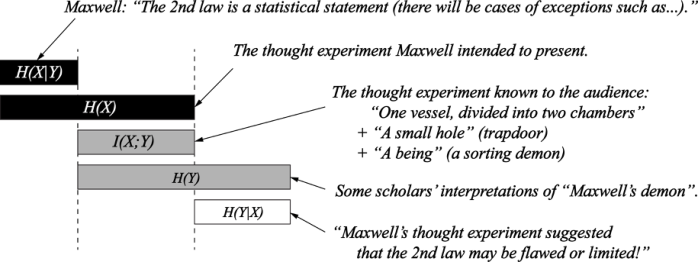
In the centuries since Maxwell’s formulation, many have misconstrued his argument as challenging or even invalidating the second law. Maxwell himself never claimed the law was “wrong” or “limited”; rather, he emphasized its inherently probabilistic nature. The second law does not forbid local or momentary decreases in a system’s entropy, it only states that such decreases are highly improbable on large scales or over time. Interpreting Maxwell’s demon as a refutation of the second law is therefore a conceptual error—a form of conditional entropy H (Y|X) or “noise,” in Shannon’s sense—where Maxwell’s original message (highlighting the law’s statistical core) becomes distorted (see Figures 2 and 3). In subsequent sections, this paper refers to such conceptual misinterpretation as “concept boundary leakage (CBL)” or a “Shannon-system boundary leak” within the NTCC model.
Figure 2: A diagram depicting entropy alignment analysis, comparing system conditions assumed by the second law with those introduced by Maxwell in his thought experiment.Figure 3: An alternative entropy alignment analysis illustrating how Maxwell’s original intent may become misaligned in subsequent scholarly interpretations.
26 Chong
From an NTCC perspective, both Maxwell’s introduction of the demon-trapdoor subsystem and the subsequent scholarly misinterpretations represent conceptual boundary leakage (CBL). The demon alters system boundaries, undermining the closed-system premise essential to the second law. Meanwhile, misunderstanding Maxwell’s argument—that the second law is probabilistic—as an assertion that it “can be violated” exemplifies H (Y|X) noise, obscuring essential details. Although some scholars cite Maxwell’s demon to claim the second law’s limitations warrant re- examination (Brillouin, 1949; Klein, 1970; Weinberg, 1982), Maxwell’s own writings do not support the notion that he sought to invalidate the law. Instead, many subsequent interpretations treat his example as a direct challenge rather than recognizing it as a demonstration of statistical nuance, yet another example of boundary misalignment or “noise.” In essence, if we anthropomorphize logical reasoning, this becomes analogous to “human error,” revealing how easily interpretations can drift when critical details or assumptions are rendered “leaky” and subsequently overlooked.
Viewing Maxwell’s demon as an illustration of rare, low-probability fluctuations, rather than a direct contradiction of the second law, clarifies Maxwell’s actual intent: to show that probability-based laws allow for small, transient deviations. The “trapdoor” concept underscores how highly unlikely microstates might emerge briefly without truly violating a law framed around near-certainty rather than absolute infallibility. Such misconceptions, termed “noise” or “conceptual boundary leaks”, commonly occur in linguistic communication about scientific or technical topics (Chong, 2024a), reinforcing how these “human hallucinations” are largely intrinsic to human reasoning and interactions. The next section provides additional examples illustrating this point.
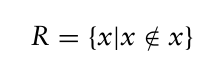
RUSSELL’S PARADOX, BOUNDARY LEAK, AND CIRCULAR INDEX Similar to Maxwell’s demon, the renowned Russell’s paradox (Russell, 1919a; Irvine & Deutsch, 2021), and its popular offshoot, the “barber paradox”, can be understood through the NTCC boundary leakage model. As Wikipedia (2025b) notes, Russell’s paradox can be formally stated as:
Let R = {x|x /∈x}, then R ∈R ⇔R /∈R In standard logic, “logical validity” is assumed to hold universally. However, Russell’s paradox employs an initially counter-valid premise
Equation reproduced from the original PDF.
thereby introducing a self-referential, self-inverting condition—like a Möbius strip—where x /∈x directly contradicts x ∈R. This circular or looping index produces what may be called the smallest possible infinite loop: a single node, R, whose membership status endlessly toggles between R ∈R and R /∈R. Conceptually, it resembles a computer program caught in an infinite loop, perpetually re-checking contradictory conditions without resolution.
Maxwell’s Demon, System Boundary, and Interface ROI: The Importance of Logical Integrity 27
By contrast, the barber paradox—“one who shaves all and only those who do not shave themselves” (Russell, 1919b)—introduces additional semantic nodes in its premises, resulting in a more extended loop and thus a less direct illustration of the core paradox. In this formulation, the act of shaving either triggers a logical crash (akin to a segmentation fault) or becomes indefinitely stuck the moment the barber attempts to shave himself, thereby disqualifying him from receiving his own shave. Both outcomes arise because the barber’s “legibility state” shifts, driven by a premise that simultaneously affirms two contradictory conditions, and effectively creates a Shannon-system boundary leak (or conceptual boundary leak). Notably, Russell himself dismissed the barber paradox as a faithful representation of his original argument (Russell, 1919b), suggesting that this popular re-imagining is itself another leaky exegetic attempt.
Whether expressed through cyclical membership (a ∈b, b ∈c, c ∈a) or by the axiomatically self-contradictory Möbiusian set {x|x /∈x}, circular indexing in inductions can create self-referential “bugs” or boundary leaks akin to a program stuck in an infinite loop. In UI/UX design, if such “looping logic” (Chong, 2025a) remains unspecified by well-defined affordances or signifiers, users risk becoming trapped in repetitive cycles. This underscores the necessity of distinguishing between leaky and non-leaky boundaries to maintain clarity in interactive systems.
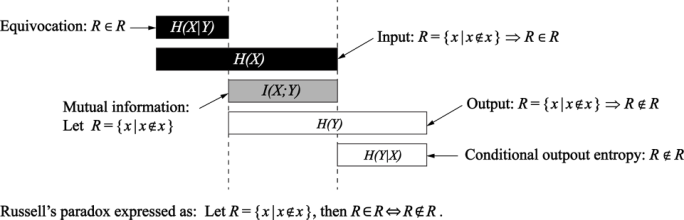
Figure 4: An entropy alignment analysis of Russell’s paradox. The set definition R = {x|x /∈x } acts as the interfacing mutual information under NTCC. The two conflicting statements, R ∈R and R /∈R, are modeled as input entropy and output entropy, respectively. Their contradiction, in which one posits R ∈R and the other asserts R /∈R, can each be interpreted as equivocation H(X|Y ) versus conditional entropy H(Y |X). The misalignment between these conditional entropies underlies the famous paradox.
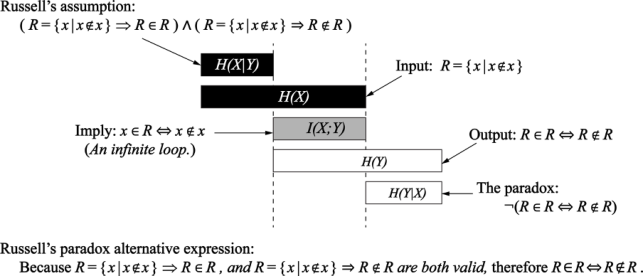
In conclusion, entropy alignment analysis under the NTCC model demonstrates that both Maxwell’s demon and Russell’s paradox hinge on logical contradictions triggered by conceptual boundary leaks (see Figures 4 and 5). This finding highlights the importance of scrutinizing the internal logic of linguistic statements and UI reasoning processes to avoid paradoxical or self-referential pitfalls. Maintaining coherent boundaries and monitoring leaks can help to prevent unintended infinite regressions, thus ensuring clarity, consistency, and usability.
28 Chong
Figure 5: Another entropy alignment interpretation of Russell’s paradox. In this view, the condition R = {x|x /∈x} represents the input entropy H(X), while the two equally plausible yet mutually exclusive outcomes R ∈R and R /∈R constitute the output entropy H(Y ). The internal conflict within H(Y ) gives rise to the conditional entropy H(Y |X), exposing the paradoxical core as a boundary leak in the Shannon-system.
SHANNON-SYSTEMS, INTERFACE ROI, AND BOUNDARY LEAKAGE Using Maxwell’s demon and Russell’s paradox as illustrative examples, we see that conceptual misalignments in linguistic communication can produce paradoxical contradictions—what we call conceptual boundary leaks (CBL). Foundational works by Maxwell and Russell themselves encountered such leaks, indicating that even canonical publications are not immune to them. Suppose conceptual leaks appear in these seminal references, one can infer that they arise frequently across diverse logical scenarios, particularly when the validity of axiomatic assumptions is fluid and remains unexamined.
A commonly cited deductive fallacy serves as a clear example (Fontainelle, 2016; Wikipedia, 2025c):
Premise A (concept 1): “Cats have four legs.”
Premise B (concept 2): “Dogs have four legs.”
Conclusion (concept 3): “Therefore, dogs are cats.”
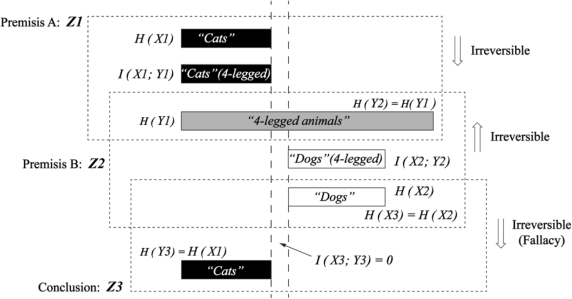
By analyzing this using information theory and the NTCC framework, each premise and conclusion (each “concept”) is viewed as a one-way Shannon communication channel, an internal “self-talk” step in the user’s cognition. In user interface interactions, users engage in analogous steps. Labeling each concept as a separate communication channel yields:
Channel 1 (concept 1): Input entropy: H (X1) = “Cats.” Output entropy: H (Y1) = “Have four legs (are four-legged animals).” Mutual information: I (X1; Y1) = “Cats (all, four-legged).”
Channel 2 (concept 2): Input entropy: H (X2) = “Dogs.” Output entropy: H (Y2) = “Have four legs (are four-legged animals).” Mutual information: I (X2; Y2) = “Dogs (all, four-legged).”
Maxwell’s Demon, System Boundary, and Interface ROI: The Importance of Logical Integrity 29
Channel 3 (concept 3): Input entropy: H (X3) = “Dogs.” Output entropy: H (Y3) = “Cats.” Mutual information: I (X3; Y3) = 0 (a “fallacy”, ∵“Dogs” ⇎”Cats”).
Each concept-forming step is a unidirectional Shannon system, highlighting potential biases or conceptual leaks. Although in practice we often see two-way communications (e.g., conversations or UI interactions), each concept-forming step is inherently one-directional. We label these one-directional communication channels as Shannon-systems, denoted by Z. Thus, the three encapsulated concepts—Premise A, Premise B, and the Conclusion—are represented by Z1, Z2, and Z3 (see Figure 6).
Figure 6: Entropy alignment analysis illustrating how the logical fallacy “Dogs are cats” arises. Shannon-systems Z1, Z2, and Z3 represent Premise A, Premise B, and the Conclusion, respectively, highlighting the irreversible information flow and entropy misalignment.
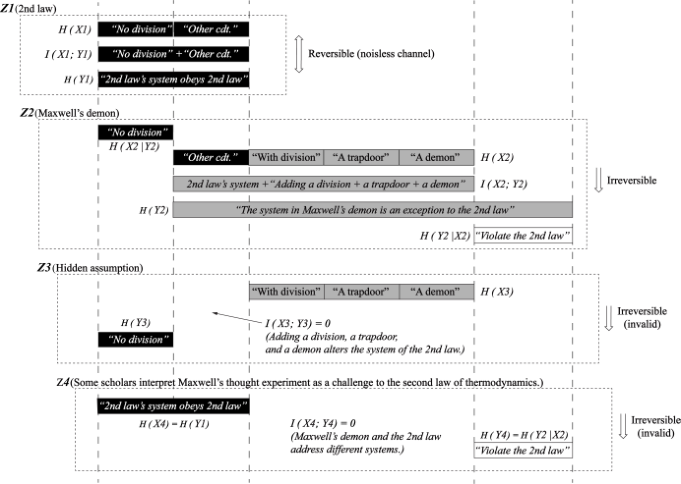
This entropy alignment approach similarly applies to Maxwell’s demon (see Figure 7), where we define:
Z1: The second law,
Z2: Maxwell’s thought experiment,
Z3: The hidden assumption that Maxwell did not alter the system’s setup.
Z4: Alternative interpretations to Maxwell’s original thought experiment.
Analyzing these Shannon-systems reveals that Maxwell’s demon does not truly contradict the second law. Instead, the process exposes a boundary leak in the original assumption.
As shown in the preceding analyses, each Shannon-system Z represents a distinct conceptual unit—essentially a premise, an assumption, an impression, or a conclusion—a unit that can be nested or scaled arbitrarily. Within the NTCC model, a Shannon-system can be formally represented as a 6-tuple: Z = (H (X, Y) , H(X), H(Y), I (X; Y) , H (X|Y) , H (Y|X))
30 Chong
Here, H (X) and H (Y) represent input and output entropies, H (X, Y) denotes joint entropy, I (X; Y) indicates mutual information, and H (X|Y), H (Y|X) quantify conditional entropies that are often indicative of “noise” or boundary leaks.
In NTCC, an Actionable Interface Option (AIO) (Chong, 2023, 2024b) is conceptualized as an atomic interface element on par with the Shannon- system units. Each AIO comprises a sequential index (e.g., natural numbers), an associated entropic variable, and a semantic label (or “signature”) specifying its contextual origin in the actual use case. In linguistic user interfaces, premises—like those in Maxwell’s demon and in Russell’s paradox—can be decomposed into discrete AIOs and nested across sequential time slices t ∈N, forming dynamic arrays:
Equation reproduced from the original PDF.Figure 7: Entropy alignment analysis illustrating Maxwell’s demon scenario. Shannon- systems Z1, Z2, Z3, and Z4 represent the different conceptual reasoning arguments surrounding the original second law context, Maxwell’s system-modifying thought experiment, and the subsequent reinterpretations of Maxwell’s work.
Each Z(ti) represents the system’s state at a moment ti. This temporal indexing captures the user’s evolving cognitive progression, highlighting changes in both attention and uncertainty. By distinguishing between reversible (noiseless) and irreversible (noisy) communications, NTCC thus enables a detailed, deconstructive diagnosis of how the system and the UI align with design objectives and user functional goals.
For empirical convenience, we can extend NTCC’s concept of Shannon- system boundaries to incorporate the notion of a Region of Interest (ROI),
Maxwell’s Demon, System Boundary, and Interface ROI: The Importance of Logical Integrity 31
adapted from computer graphics (Brinkmann, 1999). An ROI represents a focal subset of data—comparable to an AIO (Actionable Interface Option) in NTCC—serving as an anchor for Shannon-systems and bridging the notion of boundaries and boundary leaks with real-world scenarios. This approach mirrors engineering practice, where designers and researchers isolate critical areas to align human cognitive focus with precise technical system (or sub- system) boundaries.
Natural language frequently exhibits “leakage” when cognitive boundaries, modeled in NTCC as Shannon-systems (Z), shift in response to the user’s changing regions of interest (ROIs). These shifting boundaries often lead to misalignments in both linguistic exchanges and user-interface interactions. By contrast, well-structured computational frameworks and robust theoretical models are indispensable tools that can help to preserve consistent or dynamic conceptual boundaries, thereby enhancing user comprehension and system reliability.
With the conceptually “anchored” network nodes and the inherent entropic-to-semantic reference mechanism, the NTCC provides stable indexing and allows entropy-based quantification as UI interactions unfold, not only revealing boundary leaks at points of misalignment or confusion, but also making them trackable and correctable. UI performance and overall efficiency can thus be technically diagnosed and measurably improved. Such an approach also has substantial potential to mitigate probabilistically unavoidable AI “hallucinations” (Chong, 2025b), ensuring that evolving user and system states remain entropically and semantically aligned in ever-shifting cognitive and computational environments.
Boundary leaks commonly occur when ROIs shift, leading to logical fallacies or UI glitches that are essentially “lossy” Shannon-systems, where the noisy channel from H (X) to H (Y) becomes irreversible in its information flow. Hence, ROIs and Shannon-system boundaries appear closely correlated. Conversely, noiseless Shannon-systems maintain reversible information transfers internally, underscoring the importance of well-defined semantic boundaries in UI design.
Within the NTCC network, each Two-Way Communication Channel (TCC) node implements a dual instantiation of the one-way Shannon-system: one entropic system (Zs) represents system-to-user communication, and the other (Zu) captures user-to-system communications. We can denote a TCC node as TCC = (Zs, Zu) or TCC = Zs ⊕Zu
These TCC nodes form a graph G = (V, E), where each vertex v ∈V is a TCC node, and edges in E denote semantic connections between the nodes and usually represent entropy patching. This hierarchical structure, starting with one-way Shannon-system units and atomic AIO elements, indexing them over time via time-slicing within the TCC nodes, and extending to the full NTCC network—models the dynamic interplay between humans and artificial systems. By visualizing and measuring conditional entropy and mutual information at every structural layer and within each time slice, the NTCC framework pinpoints and deconstructs entropy misalignments
32 Chong
(or “boundary leaks”), paving the way for more predictable, meaningful interactions while averting paradoxical or logically fallacious gaps and process-trapping infinite loops.
DISCUSSION: ROI, REVERSIBILITY, AND UI DESIGN From earlier examples of paradoxical reasoning and logical fallacies, it is evident that both human cognition and artificial systems exhibit inherent “leakiness” or “hallucination.” Loosely echoing Gödel’s incompleteness theorem (Gödel, 1962), no logical or computational framework can be entirely perfect or complete. This fundamental limitation underscores the essential interdependence of humans (users) and technology (systems). By emphasizing a thorough understanding of both user needs and system constraints, the NTCC theory acknowledges that neither humans nor systems can fully replace the other in an axiomatically civilized society. Consequently, the design of automation tools, theoretical developments, and real-world applications must involve all stakeholders, thereby transforming the one-way concept-forming channels in an interaction design into non-leaky, reversible Shannon-system nodes.
A historical illustration of this principle can be seen in the establishment of Paris’s pneumatic clock network in 1880 (Dikeç, 2025; Nature, 1880). By synchronizing clocks citywide, Parisians’ shared Shannon-system of time was unified down to the minute, effectively minimizing the “hallucinations” arising from unsynchronized clocks and pocket watches. Similarly, the multi-national adoption of standardized, bidirectional traffic rules (Kincaid, 1986) in the 18th and 19th centuries provided a clear, non-leaky mental Shannon-system for directional cues, offering what Chong (2025a) terms a “prefix-free indexing” solution for visual and cognitive interfaces in public transportation.
NTCC continues this tradition by striving for an equilibrium between humanity and automation. Its AIO and ROI concepts align with William James’s seminal theories on human attention and consciousness (James, 1890), while remaining firmly grounded in Shannon’s quantitative information theory. This balanced approach merges psychological insight with mathematical rigor without exceeding theoretical boundaries. James’s pragmatic philosophy underscores the fluid, ever-changing nature of human experience, making stable perceptual boundaries difficult to anchor. In contrast, Shannon’s quantitative framework offers a steady reference, much like the continuously spinning Earth still serves as our baseline for measurement. Such reliable theoretical tools allow us to consistently measure, navigate, and interpret our environment. As Box (1976) famously observed, although all models may be “wrong,” they can still “work” if they are neither deliberately nor inadvertently “leaky” or “bendable”.
CONCLUSION
Many paradoxes and logical fallacies can be traced to entropic misalignments, often manifested as conditional entropy H (Y|X) errors,
Maxwell’s Demon, System Boundary, and Interface ROI: The Importance of Logical Integrity 33
where user assumptions or interpretations diverge from original boundaries or intended meanings. In theory, both designers and users might monitor these H (Y|X) measures; however, the practical limitations of human linguistic communication often overshadow such efforts. This highlights the persistent challenge of aligning mental models, where even meticulously designed interfaces can fail if conditional entropy remains high—often due to ambiguous or misplaced assumptions, many of which arise from linguistic imprecision. As Wittgenstein (1922, Proposition 5.6) famously noted, “The limits of my language mean the limits of my world,” underscoring that language alone lacks built-in safeguards against conceptual boundary leaks (CBLs) and logical inconsistencies. While Wittgenstein astutely highlighted these linguistic constraints, he offered no direct technical remedies, leaving modern practitioners, equipped with their evolving “bicycles for the mind” (Jobs, 1980), to develop practical instruments that empower both humans and the artificial systems upon which we increasingly rely.
User interface interactions involve an array of cognitive reasoning processes, many of which are influenced by linguistic information flows. Whether formal or informal, intuitive or spontaneous, these exchanges inevitably entail entropic encoding and decoding at varying degrees of precision. Emerging methodologies, such as the NTCC framework’s Shannon-system construct, entropy alignment, and time-slicing—enable a systematic modeling of these intercommunications, pinpointing where paradoxes and fallacies may emerge. By examining linguistic paradoxes and logical fallacies through the lens of user–system interaction, we underscore the importance of defining non-leaky conceptual boundaries and building robust yet anchored (non-leaky and non-drifting) theoretical models. Such an approach fosters more efficient, scientifically grounded, and cognitively human-centered UI/UX solutions—an essential undertaking in today’s increasingly complex technological landscape.
REFERENCES
Arbesman, S. (2016). Overcomplicated: Technology at the Limits of Comprehension.
Current, New York. Box, G. (1976). Science and statistics. Journal of the American Statistics Association, 71(356), pp. 791–799. Brillouin, L. (1949). Life, thermodynamics, and cybernetics. American Scientist, 37,
pp. 554–568. Brinkmann, R. (1999). The Art and Science of Digital Compositing. Morgan Kaufmann, p. 184. Chong, L. (2023). Temperature, entropy, and usability: The theoretical and practical
resemblances between thermodynamics and user interface design. In Stephanidis, C., Antona, M., Ntoa, S. and Salvendy, G. (eds.), HCI International 2023 Posters, Communications in Computer and Information Science, vol. 1832. Springer, Cham. Chong, L. (2024a). Decoding the alignment problem: Revisiting the 1958 NYT report on Rosenblatt’s perceptron through the lens of information theory. In Stephanidis, C., Antona, M., Ntoa, S. and Salvendy, G. (eds.), HCI International 2024 Posters, Communications in Computer and Information Science, vol. 2120. Springer, Cham.
34 Chong
Chong, L. (2024b). The relevancy of knowledge and the knowledge of relevancy: An information-theory-based quantitative methodology for evaluating UI design and usability. In Ahram, T. et al. (eds.), Usability and User Experience, AHFE Open Access, vol. 156. AHFE International, USA. Chong, L. (2024c). Multi-dimensional nature of human-centered design: An autoethnographic analysis of the Seiko Bell-Matic wristwatch using information- theoretic methodologies. In Ahram, T. et al. (eds.), Human Factors in Design, Engineering, and Computing, AHFE Open Access, vol. 159. AHFE International, USA. Chong, L. (2025a). Computational perspectives on affordance and signifier: Indexing
and logics in UI perception and cognition. Human-Intelligent Systems Integration, 6(2). Springer, Cham (Accepted manuscript). Chong, L. (2025b). Toward a probability-based framework for cognitive ergonomics in future AI user interface. In Ahram, T. et al. (eds.), Cognition and Decision- Making in Complex Human-System Interactions, AHFE Open Access. AHFE International, USA. (Accepted manuscript). Clausius, R. (1867). The Mechanical Theory of Heat: With Its Applications to the
Steam-Engine and to the Physical Properties of Bodies. Translated from the second German edition by John Tyndall. London: John van Voorst. Dikeç, M. (2025). Urban temporal infrastructures in nineteenth-century Paris. Urban History. Published online 2025, pp. 1–19. doi: 10.1017/S0963926824000725. Ellul, J. (1964). The Technological Society. Vintage Books, New York. Fontainelle, E. (2016). Logic: The ancient art of reason. In Trivium: The Classical
Liberal Arts of Grammar, Logic, & Rhetoric. Bloomsbury, New York, p. 180. Gibson, J. (1979). The theory of affordance. In The Ecological Approach to Visual Perception. Houghton Mifflin Harcourt, Boston, p. 127. Gödel, K. (1962). On formally undecidable propositions of Principia Mathematica
and related systems. In Feferman, S. et al. (eds.), Kurt Gödel Collected Works, Vol. 1. Oxford University Press, pp. 145–195. Interaction Design Foundation - IxDF. (2021). What is Bias in UX/UI Design?
Retrieved from https://www.interaction-design.org/literature/topics/bias. Irvine, A. D. and Deutsch, H. (2021). Russell’s paradox. In Zalta, E. N. (ed.), The Stanford Encyclopedia of Philosophy (Spring 2021 ed.). Stanford University. Retrieved from https://plato.stanford.edu/entries/russell-paradox/. James, W. (1890). The Principles of Psychology, Vol. 1. Macmillan and Co., London. Jobs, S. (1980). Steve Jobs rare footage conducting a presentation on 1980 (Insanely
Great). YouTube video (2011). Retrieved from https://www.youtube.com/ watch?v=0lvMgMrNDlg. Kauffman, S. (1993). Origins of Order. Oxford University Press, Oxford. Kauffman, S. (1995). At Home in the Universe. Oxford University Press, Oxford. Kincaid, P. (1986). The Rule of the Road: An International Guide to History and Practice. Greenwood Press, pp. 50, 86–88, 99–100, 121–122, 198–202. Klein, M. J. (1970). Maxwell, his demon, and the second law of thermodynamics.
American Scientist, 58, pp. 84–97. Knott, C. G. (1911). Quote from undated letter from Maxwell to Tait. In Life and Scientific Work of Peter Guthrie Tait. Cambridge University Press, pp. 213–215. Retrieved from https://archive.org/stream/lifescientificwo00knotuoft#page/212/ mode/2up. Leffer, L. (2023). Humans absorb bias from AI – And keep it after they stop using the algorithm. Scientific American Online. Retrieved April 5, 2025, from https://www.scientificamerican.com/article/humans-absorb-bias- from-ai-and-keep-it-after-they-stop-using-the-algorithm/.
Maxwell’s Demon, System Boundary, and Interface ROI: The Importance of Logical Integrity 35
Leff, H. and Rex, A. (2003). Maxwell’s Demon 2: Entropy, Classical and Quantum Information, Computing. Institute of Physics, London. Maxwell, J. C. (1871a). Theory of Heat. Longmans, Green, London, New York, pp. 153–155. Retrieved from https://archive.org/details/ theoryofheat00maxwrich. Maxwell, J. C. (1871b). Theory of Heat. Longmans, Green, London, New York, pp. 338–339. Retrieved from https://archive.org/details/ theoryofheat00maxwrich. Morowitz, H. J. (1970). Entropy for Biologists: An Introduction to Thermodynamics. Academic Press, New York, p. 109. Nature. (1880). Pneumatic clocks. Nature, 22, pp. 226–228. doi: 10.1038/
022226a0. Nielsen, J. (1994). Enhancing the explanatory power of usability heuristics. CHI ‘94: Proceedings of the SIGCHI Conference of Human Factors in Computing Systems, pp. 152–158. Norman, D. (1988). Psychology of Everyday Things. Basic Books, New York. Norman, D. (2004). Emotional Design. Basic Books, New York. Perrow, C. (1984). Normal Accidents: Living with High-Risk Technologies. Basic
Books, New York. Proctor, R. W. and van Zandt, T. (2018). Research methods in human factors. In Proctor, R. W. and van Zandt, T. (eds.), Human Factors in Simple and Complex Systems (3rd ed.). CRC Press, pp. 25–52. Reason, J. T. (1990). Human Error. Cambridge University Press, Cambridge. Rifkin, J. (1980). Entropy: A New World View. Viking Press, New York, pp. 3, 6. Russell, B. (1919a). Introduction to Mathematical Philosophy. George Allen
& Unwin, London, p. 136. Retrieved from https://archive.org/details/ introductiontomarussuoft. Russell, B. (1919b). The philosophy of logical atomism. Reprinted in The Collected Papers of Bertrand Russell, 1914–19, Vol. 8, p. 228. Scientific American (1998). Russell’s paradox is based on examples like this:
Consider a group of barbers who shave only those men who do not shave themselves. Scientific American, August 17, 1998. Schrödinger, E. (1948). What is Life? Cambridge University Press, Cambridge. Tainter, J. (1988). The Collapse of Complex Societies. Cambridge University Press, Cambridge. Taleb, N.N.(2007). The Black Swan: The Impact of the Highly Improbable. Random
House, New York. Taleb, N. N. (2012). Antifragile: Things That Gain from Disorder. Random House, New York. Tenner, E. (1996). Why Things Bite Back: Technology and the Revenge of Unintended
Consequences. Alfred A. Knopf, New York. Thomson, W. (1874). Kinetic theory of the dissipation of energy. Nature, 9(232), pp. 441–444. doi: 10.1038/009441c0. Vicente, L. and Matute, H. (2023). Humans inherit artificial intelligence biases.
Scientific Reports, 13, Article 15737. doi: 10.1038/s41598-023-42384-8. Weinberg, A. M. (1982). On the relation between information and energy systems: A family of Maxwell’s demons. In Leff, H. and Rex, A. (eds.), Maxwell’s Demon: Entropy, Information, Computing. Princeton University Press (reprinted in the first edition of the same title). Wikipedia (2025a). List of fallacies. Retrieved April 5, 2025, from https://
en.wikipedia.org/wiki/List_of_fallacies.
36 Chong
Wikipedia (2025b). Russell’s Paradox. Retrieved March 19, 2025, from https:// en.wikipedia.org/wiki/Russell%27s_paradox. Wikipedia (2025c). Affirming the consequent. Retrieved April 8, 2025, from https://
en.wikipedia.org/wiki/Affirming_the_consequent. de Winter, J. C. F. and Eisma, Y. B. (2024). Ergonomics & human factors: Fade of a discipline. Ergonomics, Published online, pp. 1–9. doi: 10.1080/ 00140139.2024.2416553. Wittgenstein, L. (1922). Tractatus Logico-Philosophicus (Ogden, C. K., trans.).
Kegan Paul, Trench, Trubner & Co. (Original work published 1921). Wu, T. Y. (1975). Boltzmann’s H theorem and the Loschmidt and the Zermelo paradoxes. International Journal of Theoretical Physics, 14(5), p. 289. doi: 10.1007/BF01807856. S2CID: 119792996.
LISTED IN THE AHFE DIGITAL BOOKSTORE CATALOGUE
Explore the complete digital volume
Cognitive Computing and Internet of Things
Read this individual research paper free through the original publisher, or explore the full digital proceedings book.
ISBN 978-1-964867-41-0
Explore this ISBN in the AHFE Bookstore ↗Listed in the July 2026 bookstore catalogue; search by ISBN to confirm current availability · Digital book purchase optional