Connie Chen, Li Liu, Vickie Yu (2026). Enhancing the Trust of SLPs Towards AI-based Speech Therapy Tools. In: Human Factors and Systems Interaction. AHFE Open Access, vol. 230, pp. 165–176. https://doi.org/10.54941/ahfe1007988
Artificial intelligence (AI) presents transformative potential for speech-language pathologists (SLPs) from early diagnostics to predictive modeling for augmentative communication and autonomous therapy; however, clinical adoption remains constrained by significant trust deficit regarding technological precision and clinical efficacy. This research addresses the socio-technical divide by introducing a human-factors-centric framework for the systematic design and evaluation of AI-driven speech therapy tools. Synthesized from the Digital Health Scorecard, the proposed framework delineates four fundamental pillars of validation: technical performance, clinical efficacy, human-centered usability, and cost-benefit transparency. The paper identifies actionable technical strategies, such as the integration of Explainable AI (XAI) and the utilization of geographically and demographically diverse training datasets to enhance predictive reliability and mitigate bias. The framework emphasizes rigorous alignment with Evidence-Based Practice (EBP) to ensure that digital interventions remain grounded in peer-reviewed clinical standards. This framework also provides a rigorous methodology for developers to align AI innovation with SLPs' professional values, facilitating a more effective integration of technology into human-centered clinical environments.
Given recent advances in artificial intelligence (AI), many AI tools have been developed across a variety of fields, including speech-language pathology. AI can be broadly defined as programming computers to learn from inputs and make inferences from data instead of producing deterministic, static output (Fetzer, 1990). Over the past few years, many apps that use AI in speech- language pathology have been developed, including automated AI-based speech or language therapy apps, increasing accessibility and reducing the cost of speech therapy. Speech-language pathologists (SLPs) are licensed professionals who diagnose and treat speech and language disorders, typically through speech therapy, a broad term that encompasses interventions aimed at improving communication. However, speech therapy with SLPs can be time-intensive and expensive, which is a limiting factor for accessibility,
especially for lower-income patients and patients living in rural areas (Deka et al., 2024).
Therefore, some SLPs have begun to incorporate AI-based speech therapy tools into their clinical practice. These tools include web applications that assign therapy exercises (Desolda et al., 2021), games that provide automatic speech therapy (Duval et al., 2018), and even speech therapy robot assistants (Robles-Bykbaev et al., 2015). While AI-based speech therapy tools have many benefits, there is still some skepticism towards their use. One challenge of using AI-powered tools proposed by Bhardwaj et al. (2024) is that it can be difficult to discern which apps are high quality as there is no consistent way to assess their effectiveness. Another study found that the perceived effectiveness of AI tools by SLPs was low due to the lack of personalization, issues with ethics and data privacy, and doubts about the accuracy of the AI tools (Ainz and Imtiaz, 2025).
Existing research indicates that trust in AI-based speech therapy tools is a key factor influencing SLPs’ willingness to adopt them. AI-based speech therapy app developers must establish sufficient trust to ensure that clinicians and clients or patients feel comfortable using these tools. Without sufficient trust, even effective tools may encounter resistance during adoption. Despite growing interest in AI-based speech therapy technologies, there remains a gap in the existing literature regarding how trust in these AI tools can be established. The aim of this paper is to propose a framework for AI-based speech therapy tools that addresses SLPs’ concerns and supports their trust and integration into clinical practice.
RELATED WORK
The following section reviews existing research relevant to building trust in AI, looking at what trust is and how it develops, speech therapy outcome measures, and existing AI-based speech therapy apps.
Trust Broadly, trust can be defined as a psychological and social phenomenon, and it can exist on multiple levels, from interpersonal (between people) to societal (the building blocks of community). What most people think of as trust is interpersonal trust, which is a relation between a trustor and a trustee where the trustor has confidence in the trustee’s competence, goodwill, or future actions. Interpersonal trust is also the level of trust that humans have toward technology since humans tend to interact with their computers and other devices on a one-on-one basis (Kelton et al., 2008).
Prior to building trust, three preconditions must be met: uncertainty, vulnerability, and dependence. Uncertainty and vulnerability refer to the lack of information and a perception of risk that the trustor experiences, respectively. Technology offers information that can decrease the feelings of uncertainty and vulnerability. Dependence refers to the trustor depending on the trustee because the trustor has a need and the trustee can fill that need. This can be applied to humans and technology, as humans want information,
Enhancing the Trust of SLPs Towards AI-Based Speech Therapy Tools 167 convenience, or connection, and technology can offer these things. Once the preconditions are met, then trust can be developed following the processes: prediction (past actions), attribution (dependability), bonding (development of an emotional relationship), reputation (recommendations from others), and identification (goal congruence) (Kelton et al., 2008).
Speech Therapy Outcome Measures Speech therapy serves as a primary intervention for diverse communication disorders, including articulation disorders, phonological disorders, speech sound disorders, and dysarthria-related impairments in speech intelligibility. One common goal of speech therapy is to help clients improve pronunciation and learn to speak more clearly, which can be achieved through a range of techniques targeting articulation and/or the strengthening of muscles involved in speech production (In brief: What is speech therapy?, 2025). There are different types of outcome measures in speech therapy, including quality of life outcome measures and skill-based outcome measures that measure improvements in skills.
One example of a quality-of-life measure is the ASHA Quality of Communication Life Scale (ASHA QCL). Instead of focusing on improvement of symptoms like many other outcome measures, the ASHA QCL takes a holistic look at how the impairment affects the individual. This scale is mostly used for neurogenic disorders like aphasia or dysarthria (Paul, 2017).
An example of a skill-based outcome measure is the Goldman-Fristoe Test of Articulation (GFTA), which is used to assess speech therapy progress and outcomes in children and young adults. Patients are presented cards with images on them and asked to pronounce what is presented on the cards (Sherman, 1970). The GFTA focuses more on the pronunciation of words and whether they improve over time, whereas the ASHA QCL measures the way communication in general affects daily life and can help measure whether speech or/and language therapy has provided improvements in the patient’s quality of life.
Current Speech Therapy Apps Based on a review conducted by (Vaezipour et al., 2020), there were 70 SLP approved speech-language therapy apps available on app stores. The apps target therapy for producing written and spoken words and sentences, perception and production of speech, vocal loudness and pitch, and cognitive skills. Only half of the apps were developed by or with SLPs. Additionally, none of the apps that were reviewed had evidence of high clinical effectiveness.
Another survey looked at AI-based speech therapy tools created for research studies (Deka et al., 2024). Many researchers in the studies built fully autonomous AI-based speech therapy tools emphasizing automatic speech recognition, which did not always involve the input of caregivers and SLPs. These fully autonomous tools included assessment tools, speech therapy tools with feedback, games with automated feedback, as well as robots that evaluate speech exercises. Only a few of the studies surveyed
compared the automated AI-based speech therapy tools with conventional speech therapy but generally had good results with the AI tools being rated as good as or better than therapy provided by SLPs. As the studies were mostly about mobile based apps, there seemed to be an emphasis on creating less expensive and more accessible ways to access speech therapy tools.
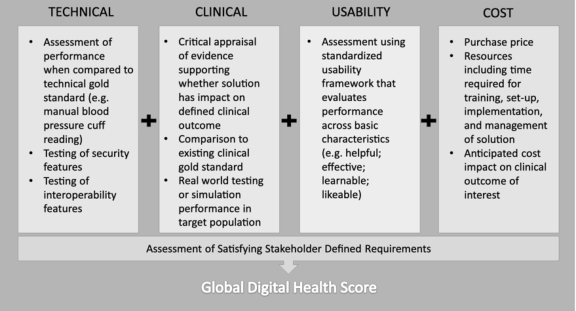
FRAMEWORK OVERVIEW The methodology for developing the proposed framework will be adapted from the Digital Health Scorecard framework from Matthews et al. (2019) which is proposed for evaluating and validating mobile health apps. The framework looks at four main areas: technical validation, clinical validation, usability, and cost. Technical validation looks at whether the application performs what it says it does with accuracy and precision while also considering privacy and security. Clinical validation compares the application to the clinical gold standards, which include measures of clinical outcomes and processes. Often when it comes to digital health products, there is not enough emphasis on clinical validation because many digital health products do not have clinicians or experts involved in the development process. Usability is concerned with whether the apps are easy to use and if it aligns with user needs. Lastly, cost, the amount the consumer pays to access the app, should be balanced in terms of cost benefit. Figure 1 shows a summarized diagram of the Digital Health Scorecard.
Figure 1: Summary of the four pillars that make up the digital health scorecard as described by Matthews et al. (2019).
The areas discussed in the Digital Health Scorecard can be applied to speech therapy apps and the concerns SLPs have towards AI-based speech therapy apps. Technical validation can address concerns SLPs have voiced about discerning which apps are high quality and do what they claim (Bhardwaj et al., 2024). Clinical validation can help address SLP concerns about the effectiveness of AI-based speech therapy apps (Vaezipour et al., 2020). This can be facilitated using speech therapy measures of progress to
Enhancing the Trust of SLPs Towards AI-Based Speech Therapy Tools 169 measure whether the app leads to patient/user progress (In brief: What is speech therapy?, 2025). For usability, since speech therapy patients include diverse individuals such as children or stroke patients who may also have motor, visual, etc. impairments, it is necessary that the apps accommodate their needs and can be easily used by all users (Ain and Imtiaz, 2025). Lastly, cost is a major impediment to many seeking speech therapy, so the apps should have a clear benefit to the patient given the cost (Deka et al., 2024).
FRAMEWORK PILLARS Technical Validation
To ensure that AI-based speech therapy apps meet technical standards, the app must be accurate, reliable, and secure. In terms of accuracy, the datasets used to train the AI models used for the speech therapy app must draw from a diverse group of people. Since many users of AI-based speech therapy apps have reported frustrations with the app not accurately recognizing their speech, the diversity of the datasets will help increase accuracy for more users and improve their perceptions of the app, building trust. Some considerations for diverse datasets include age, dialects/accents, types of speech disorders, and recording environment.
Reporting performance metrics for the model used in the AI-based speech therapy app is also necessary to understand how accurate the software is. Some standard performance metrics that can be used include accuracy, precision, recall, F1-score, word error rate, or more. These performance metrics should be made available to SLPs, ideally with context for the metrics as most will not have technical knowledge on what the metrics mean. This will help SLPs make more informed decisions on whether to use the AI-based speech therapy app.
A significant barrier to trust is the “black box” nature of many AI systems, where a user may be told their pronunciation is “incorrect” without understanding the underlying reasoning. This lack of transparency can lead to user frustration and perception that the software is defective. Implementing Explainable AI (XAI) addresses this by providing the “why” behind an output, strengthening the attribution phase of trust.
In a systems interaction context, XAI should move beyond text-based explanations toward visual feedback patterns that support therapeutic goals: Phonetic Heatmaps: A system can use heatmaps to highlight specific segments of a word where the phoneme production deviated from the clinical target in addition to a binary “correct/incorrect” indicator. Articulatory Visualization: A system can provide a comparative visual mock-up, showing the patient’s estimated tongue or lip placement versus the ideal clinical position for that specific sound.
To ensure reliability, there is also a need to test the app in many real- world environments. This includes testing across different devices with different operating systems, various degrees of Internet connectivity, and different noise levels. Diverse groups of users with different types and levels
of speech impairments should also be recruited for testing how accurately the app can perform. Additionally, when the app encounters errors in real world environments, there should be robust ways to handle those errors. One example would be to display a prominent message when there is too much background noise, or the input speech could not be properly parsed. The message should prompt the user to move to a quieter environment or give the option to continue the session later.
Maintaining trust requires rigorous data security measures to protect sensitive patient information and audio recordings. Systems must utilize end-to-end encryption for data both in transit and at rest, ensuring full compliance with regulatory frameworks such as Health Insurance Portability and Accountability (HIPAA) or the Family Educational Rights and Privacy Act (FERPA). Access to session data should be further secured through multifactor authentication (MFA) and subject to regular security audits.
Clinical Validation The most important recommendation for creating clinically valid AI-based speech therapy apps is to ensure that the app is rooted in evidence-based practice (EBP). Speech therapy is grounded in EBP; therefore, SLPs are more likely to trust mobile apps that have undergone clinical validation and are evidence-based. EBP is defined as an approach that uses evidence from research combined with experience the practitioner must provide care to a client/patient that aligns with that client’s/patient’s preferences or values (Zipoli and Kennedy, 2005). This could take the form of basing the speech therapy exercises in the app on protocols that are peer-reviewed and determined to lead to significant improvements. This could also include using recognized outcome measures such as the ASHA QCL built into the app that can be administered after sessions to track patient progress. There should also be a way for clinicians to view reports related to session data or periodic patient outcome measures.
Before launching any AI-based speech therapy apps, there should be small scale pilot studies in real-world therapy or at-home settings. This would allow developers and researchers to get data on the outcome measures as well as feedback from the SLPs, users, and parents or caregivers, which can further refine the speech therapy exercises provided, what kind of feedback the app should provide, etc. Additionally, from a clinical perspective, it is also important to test across diverse populations as well as environments. Participants should be from different age groups, language backgrounds, and have different types of speech impairments. This will help ensure that the results are more generalizable.
When testing and building the app, SLPs should be involved throughout the process. It would be best to have SLPs help design the studies, create or adapt existing outcome measures, and interpret the results as they can understand what the data means from a clinical perspective. This will help the iterative design process, ensuring that the opinions of speech therapy
Enhancing the Trust of SLPs Towards AI-Based Speech Therapy Tools 171 professionals are incorporated into the design of the app. To incentivize SLPs to participate in studies and incorporate apps into their clinical practices, perhaps the app could be offered at a discounted rate in exchange for feedback.
If possible, results from studies and pilot programs should be published in peer reviewed journals, including those relating to speech language pathology. Going back to EBP, this can help establish credibility with SLPs and potentially intrigue other SLPs into using AI-based speech therapy apps in their practice, establishing the reputation step of building trust.
Usability and Accessibility Human-Centered Design (HCD) provides an iterative design framework that focuses on making systems usable and useful by applying human factors and ergonomics knowledge to the design process. Within this framework, usability is not merely a feature of the interface but a fundamental component of building trust and creating a positive user experience that lowers the barrier to technology adoption. Effective AI-based speech therapy requires a sophisticated understanding of the interaction between the primary users: patients, SLPs, and caregivers, a triadic interaction model. The proposed framework requires their involvement at every stage of the lifecycle, including requirement gathering, iterative prototyping, and longitudinal testing, to ensure the system aligns with real-world therapeutic workflows and to adhere to HCD principles.
A core requirement for system interaction in this domain is accessibility, as the target population includes diverse groups such as pediatric patients and stroke survivors who may possess concurrent motor, visual, or cognitive impairments. The design of an AI-based speech therapy app should follow established accessibility standards like ISO 9241-171:2025. Interface design should prioritize high-contrast color palettes, adjustable font sizes, and compatibility with screen readers. System communication should utilize plain, non-complex language to ensure the broadest possible audience can navigate the tool without external assistance. Navigation should be streamlined through recognizable icons and intuitive menu structures to reduce the user’s cognitive load. By prioritizing inclusive design from the onset, these tools become more universal and are more likely to be recommended by practitioners.
The app’s language should also be plain and not overly complex to maximize the number of people who can understand it without assistance. Easy-to-understand menu structures and recognizable icons should be used when possible. This will help navigate the app more quickly. Gamification can be beneficial, especially in apps targeted at younger children, but game elements should not distract too much from the original goal of providing speech therapy.
With more SLPs having long waiting lists and large caseloads, the amount of time it takes to learn how to use a new app and navigate through it should be considered, and improving usability can decrease the amount of time
it takes to complete tasks. There should also be options to create custom dashboards so that SLPs can quickly and easily access important functions. The addition of an introductory tutorial for how to use and navigate the app can also make the learning curve less steep. It could be a video or, more ideally, an interactive walkthrough, so that users begin to engage with the app and start learning earlier. A help guide or even an AI-based chatbot could also help the user if they are stuck.
Cost Even if an AI-based speech therapy tool is technically and clinically validated and has good usability, there will be difficulty in getting many people to use the app if it is not affordable. On one hand, SLPs often have smaller budgets, especially for new technologies, and clients and patients who would benefit the most from an AI-based speech therapy app might not be able to pay out of pocket for an expensive app. On the other hand, investors and other stakeholders in the app want to see a clear return on investment, so there must be a balance when deciding on a price.
To best build trust, pricing should be transparent and fair for the features that the app offers. Any costs should be clearly communicated before even downloading the app. For instance, users should be made aware of any subscriptions immediately, rather than having to download the app to find out that there is a subscription cost. Or, if future updates will cost money, then that should also be communicated to consumers. The division of features into different paid tiers could also make the app more affordable and accessible to more users.
Developers can also consider providing a subsidized version of the app for schools, clinics, or patients who are low-income. Additionally, a free trial or free version with limited features could help SLPs and patients decide whether they want to continue using the app. This can reduce risk aversion and help build trust. There could also be an option to work with insurance companies or government programs to help reimburse the cost of the app.
While cost might be a major consideration in the adoption of AI-based speech therapy tools, there may be some SLPs who are willing to invest in them if they do, in fact, perform well technically or save them a lot of time. This is known as return on investment (ROI) and can be demonstrated by collecting data to give consumers evidence about how the app can help save time and money while also being clinically effective. This data should be published and made available to anyone interested in purchasing the app. This can help demonstrate that even if there is a high initial cost, there is a lot of value to be gained from the app, which can help make users more inclined to buy the app.
To help with ensuring global equity, developers can consider adjusting pricing based on different countries’ average income. In many developing countries, especially in rural areas, patients can have difficulties accessing SLPs due to difficulties with reliable transportation, cost concerns, etc. so having an affordable speech therapy app could make speech therapy a lot
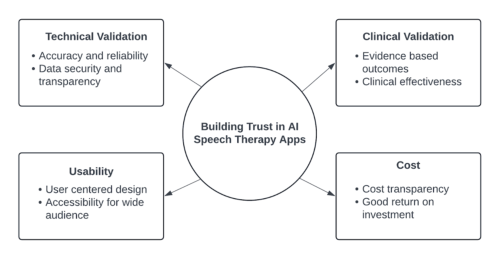
Enhancing the Trust of SLPs Towards AI-Based Speech Therapy Tools 173 more accessible to these populations. Figure 2 shows a diagram summarizing the framework.
Figure 2: Summarized diagram of framework for building trust with SLPs.
DISCUSSION
Primary Insights As previously established, even with the abundance of general AI tools and AI tools geared for speech therapy, SLPs have shown some hesitation towards the adoption of these apps. This is often due to a lack of trust in the quality and ability of the app, and there is not much research specifically regarding trust in AI apps for clinical purposes. The resulting framework shows that the building of trust relies on many different factors including technical, clinical, usability, and cost factors, all of which are very interconnected.
The main insight from this framework is that trust in AI-based speech therapy apps cannot be established through only technical capability. As mentioned earlier, trust can start developing once the preconditions of trust are addressed, and the technical and clinical aspects of AI-based speech therapy apps can help address that by offering the user a source of “intelligence” that can help them.
However, the actual process of developing trust requires the steps of prediction, attribution, bonding, reputation, and identification, which require more than just technical and clinical validation. A good user interface can help with bonding, allowing the user to begin forming an emotional connection with the app. Reputation, which comes from the recommendations of other users, can be established by establishing a reasonable cost, great usability, and sound technical and clinical validity. From here, the user can have a common goal with the app, which is to practice speech therapy exercises to improve their speech therapy goals, leading to identification.
Implications for the Future This framework has many practical implications for developers and clinicians. For developers, it creates a roadmap for creating AI-based speech therapy tools that can meet the expectations of SLPs who expect evidence-based clinical practice as the standard. The framework encourages developers to
use diverse datasets when creating models, validate their apps with diverse users and environments, and to implement transparency features. This aligns technical and user interface design choices with the values of SLPs, along with the needs of the users, which helps develop trust with them.
For clinicians, this framework offers a way to effectively evaluate AI-based speech therapy tools before using them in their practice. SLPs can use the four pillars as a checklist when looking at potential apps, giving them a more concrete list of things to look for. This can help SLPs feel more confident that they are choosing the right tool and feel more likely to trust the tool. Beyond just developers and clinicians, this framework also has implications for how society can benefit from digital health apps that follow it. A structured framework aimed at developing trust towards AI apps can serve as a foundation for the creation of ethical and evidence-based AI apps that can make healthcare more accessible.
Limitations and Future Research Directions There are several limitations. Firstly, the framework is conceptual, drawing from existing literature rather than empirically collected data. Future research could focus on empirically testing the framework to refine and evaluate its effectiveness. Next, research for the framework came mostly from English- based or Western sources, which may limit its generalizability to other languages. Exploring speech therapy practices and regulations in other regions of the world can help increase generalizability to other languages and regions. Lastly, the framework focuses on a smaller scale, mostly booking at design and evaluation principles. It does not explore higher-level organizational or cultural factors that could influence trust. Future work could explore how these higher-level factors influence SLP trust.
CONCLUSION
Artificial intelligence represents a transformative paradigm for speech- language pathology, offering unprecedented capabilities for enhanced diagnostic precision and the scalability of personalized therapeutic interventions. By facilitating more accurate speech identification and providing tailored automated feedback, these AI-driven tools have the potential to significantly increase healthcare accessibility, reduce burden, and improve long-term adherence to therapeutic protocols.
However, the successful integration of these systems into clinical environments is fundamentally contingent upon establishing a robust foundation of trust among SLPs and their clients. This research has delineated a multi-dimensional framework anchored in four pillars: technical validation, clinical validation, usability, and cost-benefit transparency, providing a rigorous methodology for the design and evaluation of trustworthy AI systems. As AI models continue to evolve at increasing velocity, cultivating trust must be viewed as an ongoing, iterative process rather than a static milestone. Developers are tasked with a dual responsibility: advancing technological innovation while maintaining a steadfast alignment with the
Enhancing the Trust of SLPs Towards AI-Based Speech Therapy Tools 175 evidence-based values and ethical standards of the clinical community. By adhering to modern ergonomic standards and implementing transparency features like Explainable AI (XAI), the industry can bridge the gap between complex algorithmic outputs and actionable clinical insights.
In summary, this framework offers a structured path toward digital health solutions that do not merely automate tasks but actively enhance the human-centered therapeutic relationship, ensuring that technology serves as a reliable catalyst for improved speech-language outcomes.
REFERENCES
Ain, Q. and Imtiaz, R. (2025) “The Role of Technology in Speech-Language Therapy: Perceptions, Effectiveness, and Challenges in a Resource-Limited Setting,” Journal of Health and Rehabilitation Research, 5(1), pp. 1–8. Available at: https://doi. org/10.61919/jhrr.v5i1.1754. Bhardwaj, A. et al. (2024) “Transforming pediatric speech and language disorder
diagnosis and therapy: The evolving role of artificial intelligence,” Health Sciences Review, 12, p. 100188. Available at: https://doi.org/10.1016/j.hsr.2024.100188. Deka, C. et al. (2024) “AI-based automated speech therapy tools for persons with speech sound disorder: a systematic literature review,” Speech, Language and Hearing, pp. 1–22. Available at: https://doi.org/10.1080/2050571X.2024.2359274. Desolda, G. et al. (2021) “A System to Support Children in Speech Therapies at
Home,” in Proceedings of the 14th Biannual Conference of the Italian SIGCHI Chapter. New York, NY, USA: Association for Computing Machinery (CHItaly ’21), pp. 1–5. Available at: https://doi.org/10.1145/3464385.3464745. Duval, J. et al. (2018) “SpokeIt: building a mobile speech therapy experience,” in Proceedings of the 20th International Conference on Human-Computer Interaction with Mobile Devices and Services. New York, NY, USA: Association for Computing Machinery (MobileHCI ’18), pp. 1–12. Available at: https://doi. org/10.1145/3229434.3229484. Fetzer, J.H. (1990) “What is Artificial Intelligence?,” in J.H. Fetzer (ed.) Artificial
Intelligence: Its Scope and Limits. Dordrecht: Springer Netherlands, pp. 3–27. Available at: https://doi.org/10.1007/978-94-009-1900-6_1. “In brief: What is speech therapy?” (2025) in InformedHealth.org [Internet].
Institute for Quality and Efficiency in Health Care (IQWiG). Available at: https:// www.ncbi.nlm.nih.gov/books/NBK561506/ (Accessed: March 23, 2025). ISO 9241-171:2025. Available at: https://www.iso.org/standard/86308.html (Accessed: January 25, 2026). Kelton, K., Fleischmann, K.R. and Wallace, W.A. (2008) “Trust in digital information,” Journal of the American Society for Information Science and Technology, 59(3), pp. 363–374. Available at: https://doi.org/10.1002/asi.20722. Mathews, S.C. et al. (2019) “Digital health: a path to validation,” npj Digital
Medicine, 2(1), pp. 1–9. Available at: https://doi.org/10.1038/s41746-019- 0111-3. Paul, D. (2017) “ASHA Quality of Communication Life Scale,” in J. Kreutzer, J.
DeLuca, and B. Caplan (eds.) Encyclopedia of Clinical Neuropsychology. Cham: Springer International Publishing, pp. 1–4. Available at: https://doi. org/10.1007/978-3-319-56782-2_9143-2. Robles-Bykbaev, V.E. et al. (2015) “SPELTA: An expert system to generate therapy plans for speech and language disorders,” Expert Systems with Applications, 42(21), pp. 7641–7651. Available at: https://doi.org/10.1016/j.eswa.2015.06.011.
Sherman, D. (1970) “Review of Goldman-Fristoe Test of Articulation,” Professional Psychology, 1(5), pp. 493–494. Available at: https://doi.org/10.1037/h0020663. Vaezipour, A. et al. (2020) “Mobile Apps for Speech-Language Therapy in Adults
With Communication Disorders: Review of Content and Quality,” JMIR mHealth and uHealth, 8(10), p. e18858. Available at: https://doi.org/10.2196/18858. Zhang, P. and Li, N. (2004) “An assessment of human–computer interaction research in management information systems: topics and methods,” Computers in Human Behavior, 20(2), pp. 125–147. Available at: https://doi.org/10.1016/j. chb.2003.10.011. Zipoli, R.P. and Kennedy, M. (2005) “Evidence-Based Practice Among Speech-
Language Pathologists,” American Journal of Speech-Language Pathology, 14(3), pp. 208–220. Available at: https://doi.org/10.1044/1058-0360(2005/021).
LISTED IN THE AHFE DIGITAL BOOKSTORE CATALOGUE
Explore the complete digital volume
Human Factors and Systems Interaction
Read this individual research paper free through the original publisher, or explore the full digital proceedings book.
ISBN 979-8-950676-06-2
Explore this ISBN in the AHFE Bookstore ↗Listed in the July 2026 bookstore catalogue; search by ISBN to confirm current availability · Digital book purchase optional