Catarina Santos, Ana Teresa Videira Gabriel, Cláudia Quaresma, Isabel L. Nunes (2026). Lower limb exoskeletons for orthopedic surgeons: A user-centred specification of design requirements. In: Human Factors and Systems Interaction. AHFE Open Access, vol. 230, pp. 7–17. https://doi.org/10.54941/ahfe1007972
1 UNIDEMI, Department of Mechanical and Industrial Engineering, NOVA School of Science and Technology, NOVA University Lisbon, Monte da Caparica, 2829-516 Caparica, Portugal ↗
2 Laboratory of Instrumentation, Biomedical Engineering and Radiation Physics (LIBPhys- UNL), NOVA School of Science and Technology, NOVA University of Lisbon, 2829-516 Caparica, Portugal ↗
Orthopedic surgeons are frequently exposed to awkward and sustained body postures and repetitive or forceful movements during surgical procedures. These demands may contribute to the development of work-related musculoskeletal disorders (WRMSD), particularly in the lower limbs. Such conditions may negatively affect the surgeon’s motor skills and quality of life. Consequently, there is a pressing need for solutions that mitigate physical strain without interfering with surgical performance or concentration.Lower limb exoskeletons have emerged as promising assistive solutions, designed to reduce muscular and joint loading through mechanical or torque-based support. While their effectiveness has been investigated in industrial settings, their application in surgical environments remains limited and insufficiently tailored to surgeon’s needs.This study identifies and prioritizes user-centered design requirements for a lower limb exoskeleton intended for orthopedic surgeons operating in standing postures. A mixed-methods approach was employed, integrating a literature review, consultation with an exoskeleton distributor, and direct input from orthopedic surgeons at a Portuguese hospital. Requirements were prioritized using the Mudge diagram and classified using the Kano model, with Satisfaction and Dissatisfaction Coefficients calculated to determine their relative impact. Internal consistency was verified through Cronbach’s alpha.Results indicate that stability, freedom of movement, and long-term comfort are the most critical design priorities. The findings provide a structured, human-centered framework for the development of a lower limb exoskeleton, contributing to lower limb WRMSD prevention while ensuring clinical acceptability.
Orthopedic surgery practice is physically and cognitively demanding. Surgeons frequently adopt awkward or sustained body postures and perform repetitive or forceful movements (Lester et al., 2012; Swank et al., 2022). The cumulative effects of these work-related demands, combined with insufficient recovery time, can contribute to the development of work-related musculoskeletal disorders (WRMSD) (Lunde et al., 2014).
Lower limb WRMSD are particularly concerning because the affected body regions play a central role in maintaining balance and postural stability during surgery. These disorders may negatively affect motor skills, endurance, and surgical precision (Swank et al., 2022; Yakkanti et al., 2023). Therefore, identifying solutions that mitigate physical strain in lower limbs without compromising surgical performance and focus is a key challenge within orthopedic surgery practice.
Lower limb exoskeletons represent a promising assistive solution. These devices reduce biomechanical loading via passive mechanical support or active torque assistance (Bär et al., 2021). Although applications in industrial contexts demonstrate benefits in reducing muscle fatigue and improving endurance, applications in surgical contexts remain largely unexplored (Santos et al., 2023). Existing devices, such as the Archelis exoskeleton described by Kawahira and colleagues, show potential in reducing back strain during laparoscopic procedures but do not specifically address the physical demands placed on the lower limbs during surgery (Kawahira et al., 2018).
This gap underscores the need to develop a lower limb exoskeleton that is safe, comfortable, and effective in reducing exposure to Physical risk factors related to lower limb WRMSD that orthopedic surgeons may face during surgery. Beyond this, user acceptance is critical for successful implementation. Accordingly, this study aims to identify and prioritize user-centered design requirements for a lower limb exoskeleton designed specifically for orthopedic surgeons operating in standing positions.
MATERIALS AND METHODS
The methodology of the study involved three stages: (1) development of questionnaires; (2) application of the questionnaires; (3) data analysis; (4) conclusions retrieved from the data analysis.
Development of the questionnaires The design requirements to include in the questionnaires were derived from: a systematic literature review (Santos et al., 2023); consultation with a distributor of the “Chairless Chair” exoskeleton to understand technological capabilities and constraints; meetings with an orthopedic team from a renowned Portuguese hospital. Sixteen requirements were identified:
Ensure user stability;
Allow freedom of movement;
Easy to put on and take off;
Reduce user fatigue;
Easy to use and learn;
Lightweight;
Without electromagnetic components;
Easy maintenance;
Comfortable for long periods of use;
Robustness;
Noiseless;
Portable;
Made from sustainable materials;
Easy to disinfect;
Adjustable fit for user’s anthropometry;
Reduce or distribute pressure of the exoskeleton on the user’s body.
Two structured questionnaires were developed to assess these requirements, as attached in Appendix 1:
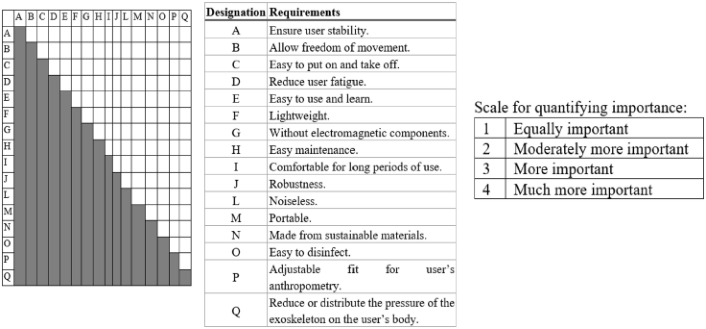
The Mudge diagram enables pairwise comparison of the requirements’ relative importance using a 4-point importance scale (Ibusuki & Kaminski, 2007; Nickel et al., 2010).
The Kano model evaluates user satisfaction with the presence and absence of each requirement using a five-point scale (Mikulić & Prebežac, 2011).
APPLICATION OF THE QUESTIONNAIRES Six orthopedic surgeons completed the Mudge diagram questionnaire (5 male, 1 female; mean age = 31.3 ± 3.5 years). Seven surgeons completed the Kano questionnaire (6 male, 1 female; mean age = 31.0 ± 3.3 years). Questionnaires were distributed via email, with in-person clarification when needed.
Data Analysis For the Mudge Diagram, paired-comparison scores were aggregated to produce weighted priority rankings. Descriptive statistics, namely mean and standard deviation (SD), summarized the central tendencies and variability of the responses.
Kano data were analyzed using a standard evaluation matrix, as shown in Table 1. Each requirement was classified into one of the following categories (Matzler & Hinterhuber, 1998): Must-be (M)- essential features; absence causes dissatisfaction; One-dimensional (O)- satisfaction increases proportionally with performance; Attractive (A)- unexpected features that enhance satisfaction; Indifferent (I); Reverse (R); or Questionable (Q) where applicable.
Table 1: The evaluation of the Kano model quality attributes. Legend: M-must-be needs; A-attractive needs; O-performance or one-dimensional needs; I-indifferent; Q-questionable; R-reverse.
Table available in the original PDF paper.
Dysfunctional
Requirements
1. Like it 2. Must be 3. Neutral 4. Live with 5. Dislike Functional 1. Like it Q A A A O
2. Must be R I I I M
3. Neutral R I I I M
4. Live with R I I I M
5. Dislike R R R R Q
To combine the responses from surgeons, the frequency of responses within each Kano category was calculated. In ambiguous cases, where a requirement received similar response frequencies across multiple categories, a hierarchical rule (M > O > A > I) determined the predominant category. This rule prioritizes the requirements that most influence perceived quality from the surgeon’s point of view.
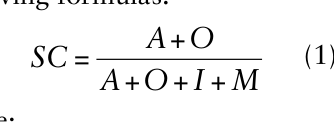
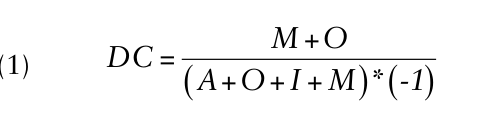
To quantitatively evaluate the impact of each requirement, satisfaction coefficient (SC) and dissatisfaction coefficient (DC) were calculated using the following formulas: (2)
(1)
Equation reproduced from the original PDF.Equation reproduced from the original PDF.
The difference between these coefficients, known as the Total Satisfaction Index (TSI), was used to rank the requirements according to their impact on satisfaction, with negative TSI values indicating that non-fulfillment causes dissatisfaction and positive values indicating satisfaction. In addition, higher values have more influence on the satisfaction rate.
To ensure the reliability and internal consistency of the questionnaire data, Cronbach’s alpha was computed, with values of 0.65 or higher considered acceptable (Cortina, 1993; Hashim & Dawal, 2012; Wasserman & Bracken, 2003). This statistical measure verifies whether the analyzed data exhibits sufficient coherence and compatibility, thereby ensuring its trustworthiness and reliability.
RESULTS
The Mudge diagram results, presented in Table 2, provide valuable insights into the relative importance of the requirements for the development of a lower limb exoskeleton. User stability emerged as the most important requirement, with a mean relative weight of 13.31% and moderate variability
Lower Limb Exoskeletons for Orthopedic Surgeons 11 among participants. Closely following was freedom of movement, with a mean of 12.68% and relatively low variability, indicating strong consensus. Comfort during extended use was also highly ranked, with a mean of 10.13%. Together, these findings demonstrate that surgeons view postural stability, dynamic mobility, and sustained comfort as foundational requirements of a lower limb exoskeleton.
Requirements of moderate priority included fatigue reduction, features related to anatomical adjustability and pressure distribution, ease of putting on and taking off, and lightweight construction. These attributes were considered beneficial for enhancing usability and personalization but were secondary to the core functional triad of stability, mobility, and comfort. Lower-priority attributes, which received mean ratings below 3%, included ease of disinfection and maintenance, sustainability of materials, robustness, and absence of electromagnetic components. Although relevant, these were viewed as less critical to immediate surgical performance.
Table 2: Relative importance of the requirements ranked by surgeons.
Table available in the original PDF paper.
Requirements Mean SD Ensure user stability 13.31% 5.19%
Allow freedom of movement 12.68% 2.63% Comfortable for long periods of use 10.13% 3.20%
Reduce user fatigue 8.36% 3.05% Adjustable fit for user’s anthropometry 8.35% 3.29%
Reduce or distribute the pressure of the exoskeleton on the user’s body 8.05% 2.47% Easy to put on and take off 7.33% 3.86%
Lightweight 7.20% 3.07% Easy to use and learn 6.60% 2.85%
Noiseless 4.47% 4.29% Portable 3.25% 1.77%
Easy to disinfect 2.55% 2.95% Easy maintenance 2.35% 0.69%
Robustness 2.23% 2.45% Made from sustainable materials 1.72% 1.82%
Without electromagnetic components 1.40% 1.34% The Kano model results, presented in Table 3, provided further insight into the structure of user expectations. User stability, freedom of movement, pressure distribution, adjustable fit, and long-term comfort were classified primarily as must-be requirements. Their absence would generate strong dissatisfaction, even if their presence does not necessarily increase satisfaction beyond neutrality. This interpretation is supported by negative TSI values, particularly for stability, which had the most pronounced dissatisfaction impact (TSI = –0.71). Pressure distribution also demonstrated substantial dissatisfaction potential (TSI = –0.57).
In contrast, features such as ease of donning and doffing, easy to use and learn, lightweight design, portability, and ease of disinfection were classified as one-dimensional attributes, indicating a proportional relationship between performance and satisfaction. Improvements in these features would directly enhance user experience, but their absence would not provoke dissatisfaction to the same degree as must-be attributes.
Attractive attributes included fatigue reduction, noiseless operation, and the use of sustainable materials. These features were not explicitly expected by surgeons but generated positive satisfaction when present. Notably, sustainable materials and long-term comfort both achieved a positive TSI of 0.57, suggesting that these design requirements can meaningfully enhance acceptance when incorporated effectively. Cronbach’s alpha values of 0.80 for the functional form and 0.66 for the dysfunctional form confirmed acceptable internal consistency of the data.
Table 3: Classifications based on the Kano model and the TSI index per requirement.
Table available in the original PDF paper.
Requirements Category TSI Ensure user stability M –0.71
Allow freedom of movement M –0.29 Easy to put on and take off O –0.14
Reduce user fatigue A 0.14 Easy to use and learn O 0.00
Lightweight O 0.14 Without electromagnetic components I 0.00
Easy maintenance I 0.29 Comfortable for long periods of use M 0.57
Robustness I 0.17 Noiseless A 0.29
Portable O –0.14 Made from sustainable materials A 0.57
Easy to disinfect O 0.14 Adjustable fit for user’s anthropometry M –0.29
Reduce or distribute the pressure of the exoskeleton on the user’s body M –0.57
DISCUSSION
The integrated analysis of Mudge and Kano results reveals three central themes that should guide the development of a lower limb exoskeleton for orthopedic surgeons: the necessity of balancing stability and mobility, the centrality of comfort and anthropometric adaptability, and the hierarchical structure of user expectations.
Stability was identified as the most indispensable requirement, with the highest dissatisfaction when unmet. Surgeons perceive it as fundamental not only to personal safety but also to maintaining surgical precision. However, the nearly equivalent priority assigned to freedom of movement highlights a critical design requirement. Excessive rigidity may enhance static support but compromise dynamic agility, while overly compliant systems may fail
Lower Limb Exoskeletons for Orthopedic Surgeons 13 to provide adequate postural assistance. This balance reflects a broader challenge in exoskeleton design: achieving sufficient mechanical support without impairing natural movement patterns.
Previous studies regarding lower limb exoskeletons reinforce this trade- off. Passive systems incorporating gravity-balancing or compliant elements have been shown to preserve joint mobility while maintaining postural control, suggesting advantages for tasks requiring prolonged standing postures (Agrawal et al., 2007; Näf et al., 2018). Active human-in-the-loop systems further demonstrate that adaptive torque assistance can enable stable locomotion and smooth transitions between human and machine control (Li et al., 2021). Conversely, certain pneumatic-powered or overly rigid knee designs have been observed to restrict joint flexion, produce stiffer landing mechanics, or impair dynamic reactive balance (Nagai et al., 2025; Ringhof et al., 2019). Additional findings indicate that excessive mechanical stiffness may increase fall risk during unexpected perturbations (Steinhilber et al., 2020). Together, these findings suggest that an optimal exoskeleton should integrate hybrid mechanical structures or adaptive torque control capable of stabilizing without impeding coordinated movement.
Comfort during extended use also emerged as a central determinant of acceptance. Long surgical procedures require materials and structural designs that minimize localized pressure and allow for dynamic adjustments during use. Modular interfaces, distributed padding systems, and adaptive load- sharing mechanisms may enhance personalization and reduce discomfort over time.
The Kano classification clarifies that stability, mobility, comfort, adjustability, and pressure distribution function as threshold requirements. Their absence undermines acceptance, whereas their presence merely establishes adequacy. In contrast, one-dimensional attributes such as lightweight construction and ease of use contribute incrementally to satisfaction, while attractive features differentiate high-quality designs. The positive TSI index for sustainable materials suggests a growing awareness among orthopedic surgeons regarding environmental responsibility in technology.
The combination of the Mudge diagram and Kano model proved valuable in translating surgeon’s perceptions into structured, quantifiable priorities within an assistive technology framework. The study provides a structured map that can guide manufacturers in aligning mechanical design with surgeon expectations. Nevertheless, the study is limited by its small, single-institution sample. Although sufficient for exploratory analysis, broader validation across institutions and surgical specialties is necessary. Future research should include prototype testing in simulated operating environments and longitudinal studies to assess adaptation, trust, and performance outcomes.
CONCLUSION
This study provides a structured framework for developing a lower limb exoskeleton tailored for orthopedic surgeons. The findings identify stability, freedom of movement, and long-term comfort as fundamental design requirements, while highlighting pressure distribution and anthropometric
adjustability as critical determinants of user acceptance. Usability-related attributes, such as lightweight construction and intuitive operation, contribute proportionally to user satisfaction, whereas features such as noiseless performance and sustainable materials serve as differentiating factors that further enhance the overall experience.
By integrating systematic prioritization with satisfaction modeling, the study provides actionable guidance for subsequent prototype development. Effective exoskeleton systems for orthopedic surgeons must balance biomechanical support and dynamic mobility, ensuring sustained postural assistance without compromising surgical precision or workflow integration. Through such a human-centered design approach, lower limb exoskeletons may contribute meaningfully to lower limb WRMSD prevention while preserving operative performance in the context of orthopedic surgery.
ACKNOWLEDGMENT
The authors acknowledge Fundação Ciência e a Tecnologia (FCT-MCTES) for its financial support via the project UIDP/00667/2020, UIDB/00667/2020 (UNIDEMI) and DOI 10.54499/UIDB/04559/2020 (LIBPhys-UNL).
REFERENCES
Agrawal, S. K., Banala, S. K., Fattah, A., Scholz, J. P., Krishnamoorthy, V., & Hsu, W.
L. (2007). A gravity balancing passive exoskeleton for the human leg. Robotics: Science and Systems, 2, 185–189. Bär, M., Steinhilber, B., Rieger, M. A., & Luger, T. (2021). The influence of using exoskeletons during occupational tasks on acute physical stress and strain compared to no exoskeleton – A systematic review and meta-analysis. Applied Ergonomics, 94. Cortina, J. M. (1993). What Is Coefficient Alpha? An Examination of Theory and
Applications. Journal of Applied Psychology, 78(1), 98–104. Hashim, A. M., & Dawal, S. Z. M. (2012). Kano Model and QFD integration approach for Ergonomic Design Improvement. Procedia - Social and Behavioral Sciences, 57(5–8), 22–32. Ibusuki, U., & Kaminski, P. C. (2007). Product development process with focus on
value engineering and target-costing: A case study in an automotive company. International Journal of Production Economics, 105(2), 459–474. Kawahira, H., Nakamura, R., Shimomura, Y., Oshiro, T., & Okazumi, S. (2018).
Clinical Use of a Wearable Lower Limb Support Device for Surgeries Involving Long Periods of Standing. Journal of Japan Society of Computer Aided Surgery, 20, 121–125. Lester, J. D., Hsu, S., & Ahmad, C. S. (2012). Occupational hazards facing orthopedic surgeons. American Journal of Orthopedics (Belle Mead, N.J.), 41(3), 132–139. Li, Z., Zhao, K., Zhang, L., Wu, X., Zhang, T., Li, Q., Li, X., & Su, C. Y. (2021).
Human-in-the-Loop Control of a Wearable Lower Limb Exoskeleton for Stable Dynamic Walking. IEEE/ASME Transactions on Mechatronics, 26(5), 2700– 2711. Lunde, L.-K., Koch, M., Knardahl, S., Wærsted, M., Mathiassen, S. E., Forsman, M., Holtermann, A., & Veiersted, K. B. (2014). Musculoskeletal health and work ability in physically demanding occupations: study protocol for a prospective field study on construction and health care workers. BMC Public Health, 14, 1075.
Lower Limb Exoskeletons for Orthopedic Surgeons 15 Matzler, K., & Hinterhuber, H. H. (1998). How to make product development
projects more successful by integrating Kano’s model of customer satisfaction into quality function deployment. Technovation, 18(1), 25–38. Mikulić, J., & Prebežac, D. (2011). A critical review of techniques for classifying quality attributes in the Kano model. Managing Service Quality, 21(1), 46–66. Näf, M. B., Koopman, A. S., Baltrusch, S., Rodriguez-Guerrero, C., Vanderborght,
B., & Lefeber, D. (2018). Passive back support exoskeleton improves range of motion using flexible beams. Frontiers Robotics AI, 5(JUN), 72. Nagai, T., Zeppetelli, D. J., Sarantos, L. C., Johnson, C. D., Borden, C. J. B., Dempsey, C. A., & Ramirez, V. (2025). Balance, Landing Biomechanics, and Functional Movement Screen Characteristics With and Without Knee Exoskeleton in Military Soldiers. Military Medicine, 190(1–2), 228–234. Nickel, E. M., Ferreira, M. G. G., Forcellini, F. A., Dos Santos, C. T., & Silva, R. A.
Á. (2010). Multicriteria model as a reference in the Informational Design stage of the Product Development Process. Gestao e Producao, 17(4), 707–720. Ringhof, S., Patzer, I., Beil, J., Asfour, T., & Stein, T. (2019). Does a Passive Unilateral Lower Limb Exoskeleton Affect Human Static and Dynamic Balance Control? Frontiers in Sports and Active Living, 1, 22. Santos, C., Gabriel, A., Quaresma, C., & Nunes, I. (2023). The use of lower limb
exoskeletons to reduce load during orthopedic surgeries. Human Factors and Systems Interaction, 84, 112–122. Steinhilber, B., Seibt, R., Rieger, M. A., & Luger, T. (2020). Postural Control When Using an Industrial Lower Limb Exoskeleton: Impact of Reaching for a Working Tool and External Perturbation. Human Factors, 64(4), 635. Swank, K. R., Furness, J. E., Baker, E., Gehrke, C. K., & Rohde, R. (2022). A Survey
of Musculoskeletal Disorders in the Orthopaedic Surgeon: Identifying Injuries, Exacerbating Workplace Factors, and Treatment Patterns in the Orthopaedic Community. Journal of the American Academy of Orthopaedic Surgeons. Global Research & Reviews, 6(5). Wasserman, J. D., & Bracken, B. A. (2003). Psychometric Characteristics of Assessment Procedures. Handbook of Psychology, 43–66. Yakkanti, R. R., Sedani, A. B., Syros, A., Aiyer, A. A., D’Apuzzo, M. R., & Hernandez,
V. H. (2023). Prevalence and Spectrum of Occupational Injury Among Orthopaedic Surgeons: A Cross-Sectional Study. JBJS Open Access, 8(1).
APPENDIX 1 Mudge Diagram: Complete the comparison matrix using the provided scale.
Figure 1. 1: Mudge diagram.
Kano Model: Select the option that describes your preference.
Table 1. 1: Kano model.
Table available in the original PDF paper.
How do you feel if the exoskeleton: I like it It must be Neutral I can live with it I dislike it ensure user stability during use?
creates instability during use?
allows freedom of movement?
restricts freedom of movement?
is easy to put on and take off?
is not easy to put on and take off?
reduce user fatigue?
does not reduce user fatigue?
is easy to use and learn?
is not easy to use and learn?
is lightweight?
is not lightweight?
does not have electromagnetic components?
has some electromagnetic components?
requires minimal maintenance?
requires periodic maintenance?
is comfortable for long periods of use?
causes discomfort when used for long periods?
is robust?
is not robust?
is noiseless during use?
produces noise during use?
is portable?
is not easy to transport?
is made from sustainable materials?
is not made from sustainable materials?
is easy to disinfect?
is not easy to disinfect?
is adjustable to fit the anthropometry of each user?
does not fit perfectly to the anthropometry of each user?
(Continued)
Table 1. 1: Continued.
Table available in the original PDF paper.
How do you feel if the exoskeleton: I like it It must be Neutral I can live with it I dislike it reduce or distribute the pressure of the exoskeleton on the user’s body?
does not reduce or distribute the pressure of the exoskeleton on the user’s body?
LISTED IN THE AHFE DIGITAL BOOKSTORE CATALOGUE
Explore the complete digital volume
Human Factors and Systems Interaction
Read this individual research paper free through the original publisher, or explore the full digital proceedings book.
ISBN 979-8-950676-06-2
Explore this ISBN in the AHFE Bookstore ↗Listed in the July 2026 bookstore catalogue; search by ISBN to confirm current availability · Digital book purchase optional