Ozlem Ozden Tunca, Alp Giray Kaya, Ayca Cikrikci, Cetin Kılıc, Havvane Sama Cicek, Turker Cevher, Esra Betul Ergul (2026). Preventing Violence in Schools: A Psychoeducation Program Examining the Effects on Teachers Perceptions and Attitudes Toward Violence and Bullying. In: Intelligent Human Systems Integration (IHSI 2026): Disruptive and Innovative Technologies. AHFE Open Access, vol. 200, pp. 525–536. https://doi.org/10.54941/ahfe1007111
Violence is a phenomenon as old as human history and has become one of the fundamental issues threatening both societal life and individual well-being in recent years. Schools institutions in which individuals experience their first socialization processes after the family are among the environments where incidents of violence occur most frequently in modern society. In educational settings, peer bullying, defined as intentional and repetitive behaviors based on a power imbalance among children, has significant physical, psychological, social, and academic adverse effects, particularly on children and adolescents. In efforts to prevent violence and peer bullying, teachers and school counseling (SC) professionals carry substantial responsibility. The existing literature shows that studies involving teachers and other school personnel, who play a critical role in intervening in bullying incidents, are largely descriptive. Psychoeducational programs designed to modify the perceptions and attitudes necessary for effective intervention remain limited. In light of this information, the present study experimentally examined changes in the perceptions and attitudes of teachers and SC professionals regarding incidents of violence and peer bullying through the psychoeducational program titled “Preventing Violence in Schools: Where Do I Stand?”, developed by the researchers.In this study, an explanatory sequential mixed-methods design was employed. Following the collection of quantitative data addressing the research question, the results were examined using a phenomenological design, one of the qualitative research approaches. The sample consisted of 36 participants—20 school counseling (SC) professionals and 16 subject-area teachers from public schools in Istanbul, Türkiye—selected through stratified random sampling. For program evaluation, participants were assigned to two groups with distributions parallel to the SC sample. Prior to the experimental intervention, all participants completed a personal information form and the “Teacher Attitudes Toward School Bullying Scale,” developed by Yeşilyaprak and Dursun Balanuye (2012), as a pre-test measure. Following the eight-week psychoeducational program, the same scale was administered again as a post-test. Additionally, qualitative data were collected using the “Interview Form on Perceptions of Bullying and Violence,” which consisted of open-ended questions aimed at obtaining a deeper understanding of participant views.According to the results of the study, no statistically significant differences were found between pre-test and post-test scores across the subdimensions. The variables of professional seniority and age showed statistically significant positive correlations with the “harsh attitude” subdimension. When SC professionals and subject-area teachers were compared, “harsh attitude” scores differed significantly in both the pre-test and post-test, with subject-area teachers scoring higher in both measurements. The number of children participants had was positively correlated with the “indifference attitude” subdimension in both pre- and post-test assessments at a statistically significant level.Qualitative findings showed that both groups viewed bullying as a power-driven and repetitive pattern. Subject-area teachers linked gaps in prevention to systemic and administrative issues, while SC professionals emphasized limited stakeholder cooperation. Regarding intervention, teachers prioritized disciplinary procedures and coordination with the counseling service, whereas SC professionals favored child-centered and team-based consultation practices. In case analyses, both groups underscored the importance of victim safety, emotional support, collaboration, and a holistic response.
Violence, although an enduring phenomenon throughout human history, has in recent years become a fundamental problem that threatens social life and individual well-being (Aksoy, 2019). In modern social life, the
phenomenon of violence is regarded not only as a judicial matter but also as an educational and public health issue that must be prevented and addressed. Schools, which are among the key institutions of modern social life and the primary environments in which individuals begin to socialize, are the settings where manifestation of the cycle of violence are most frequently observed (Yavuzer, 2011). Violence is defined as “an individual or group causing or threatening to cause physical, psychological, social, verbal, or virtual (cyber) harm to another individual or group” (Zhang & Jiang, 2021; Hammaren, 2022). In particular, there has been a noticeable increase in cases of violence manifested as peer bullying in school settings (Pehlivan, 2020). Although peer bullying is a form of violence, its definition includes several distinctions. According to Olweus (1994), who conducted the first scientific studies on peer bullying, it is defined as “the intentional and repeated negative actions of one or more students toward another student who is substantially weaker.” Unlike general violence, peer bullying involves intentional, repetitive behaviors based on a power imbalance. These behaviors which can be observed in various form such as physical, verbal, social, psychological and cyberbullying, may create adverse effects on children and adolescents (Ersümer, 2022). Because bullying behavior is repetitive in nature, it can lead to more lasting and destructive consequences for those who are exposed to it. Research indicates that students who are subjected to bullying exhibit negative outcomes such as higher rates of depression, low self-esteem, and increased suicide risk (Hunter et al., 2007; Söderberg & Björkqvist, 2020; Bordin & Handegard, 2023). Teachers’ ability to recognize incidents of violence and bullying, their perceptions of these behaviors, and their attitudes toward such events directly influence the success of school-based prevention efforts (Kafalı, 2024). Studies show that teacher attitudes that fail to take violence and bullying seriously or that normalize such behaviors encourage the persistence of these negative actions (Şen and Doğan, 2021).
In the literature, psychoeducational studies aimed at preventing violence and peer bullying in school environments have predominantly been conducted with students (Uysal Toraman et al., 2021). Studies targeting teachers and school staff—who play a significant role in intervening in bullying incidents—remain largely descriptive in nature (Aksoy, 2019). Psychoeducational programs designed for teachers to change the perceptions and attitudes necessary for effective intervention are limited (Yıldız, 2022). In light of this information, the aim of the present study is to experimentally examine the changes in teachers’ and school counselors’ perceptions and attitudes regarding incidents of violence and peer bullying through the “Preventing Violence in Schools: Where Do I Stand?” psychoeducational program that was developed. Within this scope, the study seeks to answer the following questions: What are the differences in teachers’ attitudes toward bullying based on certain demographic variables, and how do
Preventing Violence in Schools: A Psychoeducation Program Examining the Effects 527 teachers perceive the concepts of bullying and violence as well as their perceived ability to intervene in bullying and violence situations at school?
METHOD
Research Design In this study, an explanatory sequential design—one of the mixed-methods approaches—was used. Mixed methods refer to the use of both quantitative and qualitative approaches together to examine the research problem in greater depth and to achieve a better understanding (Creswell, 2006). Explanatory sequential design, which is one of the mixed-methods research designs, is used for the purpose of providing an in-depth explanation of the quantitative results through qualitative data collected after the quantitative data related to the research question have been obtained (Creswell & Clark, 2015).In the first phase of the study, a one-group pretest–posttest experimental design, which is one of the quantitative research methods, will be used. In a one-group pretest–posttest experimental design, the independent variable is applied to the group, and tests are administered before and after the intervention. The difference in scores between the pretest and posttest indicates the effect of the dependent variable on the group (Cohen & Manion, 1997). In the second phase of the study, a phenomenological design, which is one of the qualitative research methods, will be used. Qualitative research can provide practitioners in the field with different perspectives, as it reveals experiences, opinions, and case examples. Phenomenological design “focuses on phenomena of which we are aware but do not have an in-depth and detailed understanding” (Yıldırım & Şimşek, 2011). In a phenomenological design, the phenomenon is examined from the perspective of individuals who experience the event directly rather than indirectly, exploring in depth how individuals perceive, experience, interpret, and feel about the event (Patton, 2018).
Study Group The study group of this research consists of a total of 36 participants, including 20 school counselors/guidance counselors and 16 subject teachers working at different grade levels in public schools in Istanbul, Türkiye, selected randomly through a stratified sampling method. One group of the sample was selected from school counselors in order to enable the dissemination of the developed psychoeducation program. However, it is assumed that, based on their field knowledge and the nature of their professional duties, they possess certain knowledge and skills regarding violence and bullying. To test the effectiveness of the psychoeducation program, the sample was divided into two groups, and a second group composed of subject teachers— who were distributed similarly to the counselors—was included in the study. Information regarding the study group is presented in Table 1.
Table 1: Demographic information.
Table available in the original PDF paper.
Variables Group f Percentage Gender Female 31 86
Male 5 14 Educational level Bachelor’s Degree 25 69
Master’s Degree 10 28 Doctorate 1 3
0-5 Years 2 5 6-10 Years 6 17
Years of professional experience
11-15 Years 14 39
16 Years and Above 14 39
Primary School 4 11 Middle School 14 39
High School 18 50 Number of children 0 (No Children) 14 39
1 Child 14 39
2 Children 6 17
3 Children 2 5
Data Collection Method and Instruments In this research, a mixed-methods approach was employed, and the data of the study were obtained through a scale and an interview form. Before the experimental intervention, all participants were administered a personal information form and, as a pre-test, the “Teacher Attitudes Toward School Bullying Scale,” developed by Yeşilyaprak and Dursun Balanuye (2012). Following the 8-week psychoeducational program, the same scale was administered as a post-test, and qualitative data were collected in written form through the “Interview Form on Perceptions of Bullying and Violence,” which consists of open-ended questions, in order to examine participants’ views in greater depth. The data collection instruments used are explained in detail below.
1. Personal Information Form: This form, developed by the researchers, was used to collect demographic information such as participants’ gender, school type, and years of professional experience. 2. Teacher Attitudes Toward School Bullying Scale: The scale was developed in Turkish by Yeşilyaprak and Dursun Balanuye in 2012 to assess teachers’ attitudes toward bullying. The scale consists of 25 items rated on a five-point Likert scale. It includes four sub-dimensions: “indifferent attitude, humanistic attitude, disciplinary attitude, and ruthless attitude”. The Cronbach’s alpha reliability coefficient of the subscales were
Preventing Violence in Schools: A Psychoeducation Program Examining the Effects 529 calculated as .72, .70, .63 and .55 respectively, and for the total scale as .78 (Yeşilyaprak and Dursun Balanuye, 2012). 3. Interview Form on Perceptions of Bullying and Violence: Developed by the researchers through a review of the relevant literature to gain a deeper understanding of participants’ perceptions of bullying and violence, this interview form consists of seven open-ended questions. It aims to understand how the concepts of bullying and violence are individually defined, where teachers see themselves in the intervention process, what preventive and intervention approaches they employ, and how they respond to sample cases.
Data Analysis The quantitative data of the study were analyzed with Pearson correlation and t-test analyis using the SPSS 26 statistical software package. The qualitative data of the study, obtained through written responses to the interview form consisting of open-ended questions, were analyzed using the content analysis method. The aim of the content analysis method is to derive concepts that can explain the data through an in-depth processing of the collected information (Yıldırım & Şimşek, 2011). The participants’ responses were read separately and repeatedly by the researchers, important statements were identified, and codes were generated. After coding, similar statements were grouped under common themes. Once all responses had been coded, the researchers convened and discussed the coding process to establish the final codes and themes. In the content analysis process, version 24.7.0 of the MAXQDA software program was used.
FINDINGS In this section, the focus is on the awareness and intervention-related perceptions and attitudes of subject teachers and school counselors/guidance counselors working in schools regarding incidents of violence and bullying within educational institutions. In the quantitative phase of the study, the “Teacher Attitudes Toward School Bullying Scale” was used as a pretest– posttest instrument to evaluate the effectiveness of the psychoeducational program. Through this scale, teachers’ attitudes toward bullying situations encountered in schools were measured. In the qualitative phase, which aims to examine in detail teachers’ perceptions and attitudes regarding where they position themselves in preventive efforts against violence and bullying, as well as how they evaluate themselves in terms of intervention when confronted with violent situations, participants’ views were gathered through open- ended questions. To achieve these aims, a mixed-methods methodology was employed, accompanied by qualitative inquiry, to enable an in-depth investigation of perceptions and attitudes that could not be fully explained by the quantitative data alone. Below, the quantitative and qualitative findings related to the research questions are presented in two sections. Responses
from subject teachers are abbreviated as B, while responses from school counselors/guidance counselors are abbreviated as PCG.
Findings Related to Quantitative Research Questions The Teacher Attitudes Towards School Bullying Scale was applied to 20 PCG and 16 branch teachers. Cronbach-Alpha reliability values for the subscales were .78 in the “Indifferent Attitude” dimension, .32 in the “Humanistic Attitude” dimension, .63 in the “Disciplinarian Attitude” dimension, and .72 in the “Ruthless Attitude” dimension. Due to the low reliability value in the Humanistic Attitude dimension, this dimension was not included in the following analysis. In order to test the effect of the education provided, the scale was applied before and after a provided training on bullying awareness. According to the results of the t-test analysis, no statistically significant difference was found between pre-test and post-test applications on any of the subscale scores (all p’s >.05). Relations between demographic characteristics of the teachers and scores of the subscales were investigated with Pearson correlation analysis. Results showed that the scores obtained from the ruthless attitude sub-scale were positively correlated with the age (r = .56) and professional years (r = .60) of the teachers. Finally, when the attitudes of branch teachers and PCG teachers towards bullying were compared with a t-test, it was seen that the scores obtained from the ruthless attitude dimension showed a statistically significant difference. The ruthless attitude dimension scores of the branch teachers (mean = 8.94, sd = 2.35) were statistically significantly higher than the scores of the PCG teachers (mean = 6.25, sd = 2.07) (t(34) = −3.64, p<.01, d = 1.21).
Table 2: Correlations between age, professional year and scale dimensions.
Table available in the original PDF paper.
Variables N Indifferent Disciplinarian Ruthless
1. Age 36 .13 .06 .56*
2. Professional Years 36 .08 .16 .60* *p<.001
Findings Related to Qualitative Research Questions In the qualitative phase of the study, the categories and themes obtained from the responses of subject teachers and school counselors/guidance counselors are presented below.Based on the responses received from teachers regarding their definitions of the concepts and actors of violence and bullying, as well as their awareness of these concepts and practices related to violent incidents
Preventing Violence in Schools: A Psychoeducation Program Examining the Effects 531 in schools, the category “Exploring the Level of Conceptual and Practice- Oriented Knowledge and Awareness” was created. The sub-themes and frequency information belonging to this category are presented in Figure 1.
Figure 1: Themes belonging to the category of exploring the level of conceptual and practice-oriented knowledge and awareness among subject teachers and school counselors/psychological counselors.
Figure available in the original PDF paper.
When Figure 1 is examined, the themes identified under the category of subject teachers’ conceptual and practice-oriented knowledge and awareness regarding bullying and violence include behavior and violence patterns, power, boundaries and roles, institutional and systemic dimensions, and awareness and education. For school counselors/psychological counselors, the themes identified include behavioral and power dynamics, roles and participant dynamics, school structure and administrative dynamics, and awareness and developmental approach. When the themes obtained from the two groups are compared, it is observed that teachers perceive the concepts of violence and bullying as a pattern and a power dynamic. When the practice-oriented knowledge and awareness levels are evaluated, subject teachers emphasized deficiencies in the training provided to students on violence and bullying, that incidents of violence and bullying are not sufficiently addressed, and systemic shortcomings such as the lack of preventive and corrective measures. School counselors/psychological counselors, on the other hand, stated that there is a lack of adequate awareness training not only for students but also for teachers, that early intervention mechanisms are weak, that there is a lack of communication channels through which students can take an active role, and that there is no clear school-level protocol for combating violence and bullying. Another notable finding in this research question, which evaluates practice-oriented perceptions, is that subject teachers stated that school counselors/psychological counselors and school administrators should take a more active role in the stages of informing and prevention. The findings obtained from the practice-oriented perceptions of school counselors/ psychological counselors indicate that difficulties in establishing a shared roadmap with school administrators and teachers, teachers’ unwillingness to collaborate, and stakeholders such as teachers and families ignoring incidents of violence create significant challenges in the field. Within the scope of the second research question of the qualitative phase, the study
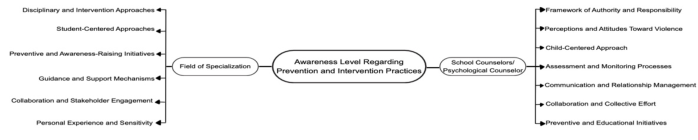
examined where both groups positioned themselves in terms of prevention and intervention, and their perceptions regarding existing interventions. Based on the responses obtained from participants, the category “Awareness Level Regarding Prevention and Intervention Practices” was created. The themes belonging to this category are presented in Figure 2.
Figure 2: Themes belonging to the category of awareness level regarding prevention and intervention practices among subject teachers and school counselors/ psychological counselors.
When Figure 2 is examined, the sub-themes identified under the category of subject teachers’ awareness level regarding prevention and intervention practices include: disciplinary and intervention approaches, student-oriented approaches, preventive and awareness activities, guidance and support mechanisms, cooperation and stakeholder participation, and personal experience and sensitivity. For school counselors/psychological counselors, the identified themes include: scope of authority and responsibility, perception of violence and attitudes, child-centered approach, assessment and follow-up processes, communication and relationship management, cooperation and collective effort, and preventive and awareness-raising activities. Subject teachers stated that preventive practices can be carried out through cooperating with school administration and the guidance service, ensuring the functionality of the disciplinary system, observing students, being aware of violence and maintaining a measured stance against it, and creating a nonviolent environment through rules and responsibilities. According to school counselors/psychological counselors, preventive practices involve teamwork and must be child-centered; they also include guidance activities that aim to raise awareness and provide preventive strategies to school administration, teachers, and parents through their consultative role. To understand teachers’ perceptions and attitudes regarding intervention practices for violence and bullying in schools, four sample scenarios were presented to them, and they were asked how they would respond in these situations. Based on the responses to the sample cases, subject teachers stated that it is necessary to ensure the safety of the victim, provide emotional support, raise awareness about violence and bullying at the classroom level, facilitate cooperation and refer students to the guidance service, explain rights and boundaries, attempt to understand the underlying reasons for the behavior, observe students, and adopt a holistic approach through school–family cooperation. Similarly, school counselors/psychological
Preventing Violence in Schools: A Psychoeducation Program Examining the Effects 533 counselors emphasized the importance of cooperation, ensuring the safety of the victim, providing emotional support, conducting individual interviews with all parties involved in the violence or bullying incident, examining and monitoring the case, carrying out awareness-raising activities at the school level, working with students on the distinction between violence and conflict, and implementing a holistic approach during the intervention process.
DISCUSSION
In this study, the effects of the psychoeducation program implemented to evaluate teachers’ perceptions and attitudes toward violence and peer bullying were discussed by jointly considering quantitative and qualitative findings. Quantitative analyses showed that there was no significant difference between pre-test and post-test scores in the three sub-dimensions of the scale. This finding is parallel to previous studies indicating that short-term programs may have limited effects in creating attitude change (Bradshaw, 2015; Gaffney et al., 2021). The low reliability observed in the “Humanistic Attitude” sub-dimension, on the other hand, points to the possibility that the small sample size and potential misinterpretation of items may have contributed to this result, and is consistent with the literature emphasizing the importance of cultural and contextual adaptation in scales measuring teacher attitudes (Cornell & Limber, 2015).On the other hand, the finding that age and professional seniority were positively associated only with the “harsh attitude” sub-dimension suggests that, as experience increases, teachers may be inclined to adopt more disciplinary or punishment-based approaches. This is in line with studies showing that experienced teachers develop more authoritarian attitudes due to classroom management pressures (Bauman & Hurley, 2021). The fact that subject-matter teachers scored higher on harsh attitudes compared to school counselors also reflects the professional difference between classroom management responsibilities and psychosocial support roles. Additionally, the association between having children and indifferent attitudes is similar to findings suggesting that teachers who are parents may be more tolerant of risk behaviors (Rigby, 2014). The qualitative findings, on the other hand, shed light on important contextual factors explaining the limited change in attitudes. Although participants correctly defined violence and bullying based on power imbalance and repeated patterns of behavior, systemic issues such as ambiguity in school protocols, inconsistent approaches by administration, insufficient guidance services, and lack of collaboration among stakeholders weakened intervention practices. The literature likewise emphasizes that individual attitude change alone is not sufficient in combating bullying, and that strengthening school climate and implementing multi-actor models are required (Espelage & Swearer, 2009; Volk, Veenstra & Espelage, 2017). From this perspective, the limited impact of the psychoeducation program may stem not from the nature of the program itself, but from the school ecosystem’s need for a holistic intervention. Implementing the program over a longer duration, with practice-oriented components, and in a coordinated
manner among administrators, teachers, and school counselors would align with the multi-layered approaches recommended in the literature.
CONCLUSION AND RECOMMENDATIONS In this study, the effectiveness of the psychoeducational program implemented to assess teachers’ perceptions and attitudes toward violence and peer bullying was discussed by considering the quantitative and qualitative findings together. The quantitative analyses showed that there was no significant difference between the pretest and posttest in three sub-dimensions of the scale. This finding is consistent with previous studies indicating that short-term programs may have limited effects on changing attitudes (Bradshaw, 2015; Gaffney et al., 2021). The low reliability of the “Humanitarian Attitude” sub- dimension, on the other hand, suggests the possibility of a small sample size and the items being misunderstood, aligning with the literature emphasizing the importance of cultural and contextual adaptation in scales measuring teacher attitudes (Cornell & Limber, 2015). On the other hand, the finding that age and professional seniority were positively associated only with the “Harsh Attitude” sub-dimension suggests that as experience increases, teachers may be more inclined toward disciplinary or punishment-oriented approaches. This is consistent with studies indicating that experienced teachers may develop more authoritarian attitudes due to classroom management pressures (Bauman & Hurley, 2021). The fact that subject teachers had higher harsh attitude scores compared to PCG specialists also reflects the professional difference between classroom management demands and psychosocial support roles. Additionally, the finding that having children was associated with indifferent attitudes parallels evidence suggesting that teachers who are parents may be more tolerant of risk behaviors (Rigby, 2014). The qualitative findings shed light on important contextual factors that explain the limited change in attitudes. Although participants correctly defined violence and bullying in terms of power imbalance and repeated behavioral patterns, systemic problems—such as the ambiguity of in-school protocols, inconsistent administrative approaches, insufficient guidance services, and lack of collaboration among stakeholders—weaken intervention practices. The literature emphasizes that individual attitude change alone is not sufficient in combating bullying and that strengthening school climate and implementing multi-actor models are necessary (Espelage & Swearer, 2009; Volk, Veenstra & Espelage, 2017). From this perspective, the limited effectiveness of the psychoeducational program may stem not from the nature of the program itself but from the need of the school ecosystem for a more holistic intervention. Implementing the program over a longer period, with a stronger emphasis on practice, and in coordinated collaboration among administration–teachers–school counselors (PCG) would be consistent with the multi-tiered approaches recommended in the literature.
REFERENCES
Aksoy, G. (2019). Okullarda yaşanan akran zorbalığının nedenlerine ve müdahale yöntemlerine ilişkin okul yöneticileri ve öğretmenlerin görüşleri (Master’s thesis, Marmara Universitesi (Turkey). Bauman, S., & Hurley, C. (2021). Teacher responses to bullying: A review of the
literature. Children and Youth Services Review, 121, 105860. Bordin, I. A., & Handegård, B. H. (2023). Factors associated with peer victimization among Brazilian low-income adolescents. Journal of Aggression, Maltreatment & Trauma, 32(11), 1511–1530. Bradshaw, C. P. (2015). Translating research to practice in bullying prevention. American Psychologist, 70(4), 322. Cohen, L., Manion, L., & Morrison, K. (2002). Research methods in education.
routledge. Cornell, D., & Limber, S. P. (2015). Law and policy on the concept of bullying at school. American Psychologist, 70(4), 333. Creswell, J.W. (2006) Qualitative Inquiry and Research Design: Choosing among Five Approaches. Sage Publications, Thousand Oaks. Creswell, J. W., & Clark, V. L. P. (2015). Karma yöntem araştırmaları: Tasarımı ve
yürütülmesi (Aydın, E.,Bukova Güzel, E., Bursal, M., Çorlu, S., Dede, Y., Delice, A., Demir, S. B., Güngör, F., Köksal, M. S.,Kula, S., Peker ve M., Yaman, S. Çev.). Ankara: Anı Yayıncılık. Espelage, D. L., & Swearer, S. M. (2009). A social-ecological model for bullying prevention and intervention: Understanding the impact of adults in the social ecology of youngsters. In Handbook of bullying in schools (pp. 61–71). Routledge. Ersümer, O. (2022). Kieslowski’nin dekalog II filminin varoluşsal kaygı çerçevesinde
felsefi eleştirisi. Yedi, (29), 13–26. Gaffney, H., Ttofi, M. M., & Farrington, D. P. (2021). Effectiveness of schoolbased programs to reduce bullying perpetration and victimization: An updated systematic review and meta-analysis. Campbell systematic reviews, 17(2), e1143. Hammarén, N. (2022). Are bullying and reproduction of educational inequality the
same thing? Towards a multifaceted understanding of school violence. Power and education, 14(1), 35–49. Hunter, S., Boyle, J., & Warden, D. (2007). Perceptions and correlates of peervictimization and bullying.. The British journal of educational psychology, 77 Pt 4, 797-810 . https://doi.org/10.1348/000709906x171046. Kafalı, O. (2024). Examining the Relationship Between Teachers’ School Climate
and Their Attitudes Towards School Bullying. Journal of Management and Educational Sciences, 3(4), 370–379. Olweus, D. (1994). Bullying at school: basic facts and effects of a school based intervention program. Journal of child psychology and psychiatry, 35(7), 1171–1190. Patton, M.Q. (2018). Nitel Araştırma ve Değerlendirme Yöntemleri (3. Baskıdan
Çeviri, Çev: M. Bütün ve S. B Demir). Ankara: Pegem. Pehlivan, B. M. (2020). Medya ve toplumsal cinsiyet üzerine tartışmalar. (1. Baskı), Hiperyayın: İstanbul. Rigby, K. (2014). How teachers address cases of bullying in schools: A comparison
of five reactive approaches. Educational psychology in practice, 30(4), 409–419. Sen, Z., & Dogan, A. (2021). Ögretmenlerin Akran Zorbaligina Iliskin Tutumlarinin, Akran Zorbaligi ile Bas Etme Stratejilerinin ve Algiladiklari Okul Ikliminin Incelenmesi. Education and Science, 46(207), 43–63. Shea, M., Wang, C., Shi, W., Gonzalez, V., & Espelage, D. (2016). Parents and
teachers’ perspectives on school bullying among elementary school-aged Asian and Latino immigrant children. Asian American Journal of Psychology, 7(2), 83.
Söderberg, P., & Björkqvist, K. (2020). Victimization from peer aggression and/ or bullying: Prevalence, overlap, and psychosocial characteristics. Journal of Aggression, Maltreatment & Trauma, 29(2), 131–147. Taneri, P. O., Özbek, Ö. Y., & Akduman, N. (2021). In-Service Teacher Training
Program Development Study to Prevent Peer Bullying. International Journal of Curriculum and Instructional Studies, 11(2), 147–166. Uysal Toraman, A., Dağhan, Ş., & Kısa, Ö. (2021). Akran zorbalığını önlemede okul tabanlı müdahale programları: Sistematik derleme. Humanistic Perspective, 3(2), 359–399. Volk, A. A., Veenstra, R., & Espelage, D. L. (2017). So you want to study bullying?
Recommendations to enhance the validity, transparency, and compatibility of bullying research. Aggression and violent behavior, 36, 34–43. Yavuzer, Y. (2011). Okullarda saldirganlik/şiddet: Okul ve öğretmenle ilgili risk faktörleri ve önleme stratejileri. Milli Eğitim Dergisi, 41(192), 43–61. Yeşilyaprak, B., ve Balanuye, I.D. (2012). Okul Zorbalığına İlişkin Öğretmen
Tutumları Ölçeği. Turkish Psychological Counseling & Guidance Journal, 4(37), 38–48. Yıldırım, A., & Simsek, H. (1999). Sosyal bilimlerde nitel araştırma yöntemleri (11 baski: 1999–2018). Zhang, H., & Jiang, Y. (2021). A systematic review of research on school bullying/
violence in mainland China: prevalence and correlates. Journal of school violence, 21(1), 48–59.
LISTED IN THE AHFE DIGITAL BOOKSTORE CATALOGUE
Explore the complete digital volume
Intelligent Human Systems Integration (IHSI 2026): Disruptive and Innovative Technologies
Read this individual research paper free through the original publisher, or explore the full digital proceedings book.
ISBN 978-1-964867-76-2
Explore this ISBN in the AHFE Bookstore ↗Listed in the July 2026 bookstore catalogue; search by ISBN to confirm current availability · Digital book purchase optional