Yang Cai, Mel Siegel (2024). Field-of-View in Stereo Interaction. In: Human Factors in Communication of Design. AHFE Open Access, vol. 136, pp. 1–6. https://doi.org/10.54941/ahfe1004963
Rapidly growing extended reality technologies brought us more stereo interfaces and the costs became more affordable. We anticipated a rapid adaptation of the stereo display in everyday life and professional practice. Unfortunately, similar to 3D TVs, stereo displays have not been widely used in real-time. In this study, we want to know how the users interact with the stereo display systems, say, “stereo interaction.” We focus on the factors of field-of-view and distance to the screen. We found the field of view of many well-known stereo displays is very limited. For certain devices, only one location is for the user, not for the team to view the 3D effects. We also studied the stability of the 3D image in different lighting, poses, and motion. Finally, we zoom into the laparoscopic surgery training and summarize our findings.
Stereo display systems have been around for decades. Rapidly growing extended reality technologies brought us more stereo interfaces and their costs became more affordable. We anticipated a rapid adaptation of stereo displays in everyday life and professional practices. There are many studies about high-fidelity and ergonimcs to optimize users’ immersive experiences. However, similar to 3D TVs, stereo displays have not been widely used in real-time applications such as stereo broadcasting and live stereo display for minimally invasive surgeries (MIS).
Laparoscopic surgeries are increasingly popular in recent years. In com- parison to open surgery, laparoscopic surgery is highly advantageous for the patient due to its minimally invasive nature. However, it requires a high degree of surgical skill to operate through a “keyhole.”It is extremely difficult for novice surgeons. These “counter-intuitive” difficulties include impair- ments in spatial and haptic perceptions, in the ability to perceive depth, to sense the difference in tissues, to develop mental models of the anatomical environments in perceptual-motor coordination, and to make decisions in response to adverse situations (Lin and Chen, 2013; Matern et al., 2005).
Spatial perception is a major cognitive problem in laparoscopic surgery due to the limitations of the imaging and display technologies, which is extremely hard for novices. When the field-of-view (FoV), depth information, and scope movement are impoverished, operators have to “fill in”the missing
information by developing spatial reasoning models of the three-dimensional space from the images (Chung and Sackier, 1998). They also must perform mental operations on these mental models (e.g., mental rotations of a 3D organ tissue) that can contribute to response delays, errors, and cognitive workload (Wickens, 1999).
There are actually two related but distinct concepts in play here: field-of- view and the existence of “correct stereoscopic viewing zones”, which might be quite small in angular terms (Siegel, 2001). In this study, we select the smallest viewing zones as the field-of-view because in many cases, the view- able areas are relatively small, with not only no stereo effect, but also no image at all.
The 3D displays show a great potential for training novices. A 3D dis- play enables primary depth perception that is critical in operations such as navigating, fetching, cutting, and stitching. Novices demonstrate superior performance (i.e. faster completion times and fewer errors) in laparoscopic skills training using a 3D viewing mode compared to a 2D view mode (Beattie et al., 2021). In contrast, the traditional 2D view on the flat-screen laparoscopy forces trainees to rely upon secondary depth cues (e.g. shad- ows, object occlusion, image size, and changes with motion to overcome the perceptual constraints).
In this study, we explore virtualized reality methods to create a 3D model from CT data, live video, or 3D laparoscope so that the trainee can have depth perception and a 360-degree view of the targeted area (Sinha et al., 2022). Studies showed that stereo laparoscopy can increase the training speed by 20% and reduce errors by 20%. We anticipate that the virtualized reality 3D modeling system would further improve the quality of depth perception and manipulation, e.g. avoiding the artery in the area (Du et al., 2022). The 3D high-definition view with great depth perception and tactile feedback makes laparoscopic surgery more acceptable, safe, and cost-effective. It improves surgical precision and hand-eye coordination.
In this study, we want to study how the users interact with the stereo display systems in “stereo interaction.” We focus on the factors of field- of-view and distance to the screen. We found the field-of-view of many well-known stereo displays is very limited. For certain devices, only one location is for the user, not for the team to view the 3D effects. We also studied the stability of the 3D image in different lighting, poses, and motion. Finally, we zoom into the laparoscopic surgery training and summarize our findings.
STEREO INTERACTION Stereo interaction includes two levels: personal and social. At the personal level, a user can move around in front of the stereo display and find the opti- mal location and angle to see the 3D scene. At the social level, a group of people watch the stereo display with social activities, including gazing, han- dover tools, and synchronizing movements. Many VR devices are designed for individuals. Some AR goggles enable social interaction such as Google Glass, Apple’s Vision Pro with a superimposed face up front.
Field-of-View in Stereo Interaction 3
We can divide stereo interaction into three groups: open stereo, closed stereo, and synchronized stereo. Open Stereo allows multiple users to see the same screen with their perspective on the screen; Closed Stereo only allows a single user to view the screen; Synchronized Stereo enables users to view the synchronized stereo video from their individual screens remotely.
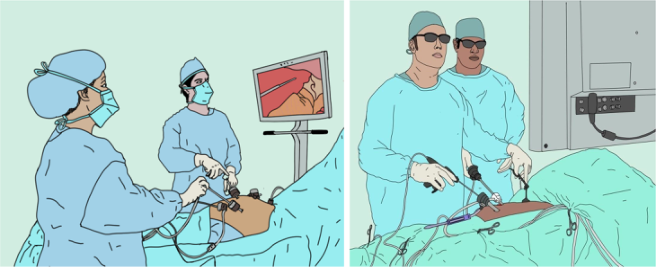
In many cases, stereo interaction happens in professional activities, such as laparoscopic surgery, in which the stereo screen is in front of surgeons and nurses. They wear polarized glasses or shutter glasses to see the 3D objects on the screen. They can see through the glasses to exchange eye gazes. Group viewing often causes problems in stereo interaction, for example, the stereo vision would be impaired or even disappear for the user who stands in the wrong position. Figure 1 shows the conventional 2D laparoscopic surgery display versus the 3D display panel with polarized glasses.
Figure 1: Conventional 2D laparoscopic surgery display (left) versus 3D (right).
Stereo interaction can be social in many data sharing applications, for example, a physician explains the 3D diagnostic model to a patient with a 3D tablet in a clinic office. In this case, it is the open stereo interaction like using a regular tablet. In some rare cases, open stereo can be implemented on phones with the foldable stereoscope clipped on the phone. The user has to hold the stereoscope closely like a microscope, which has been around for over a hundred years. For decades, people have been looking for open stereo interfaces for sharing 3D data naturally in professional and entertainment environments.
STEREO DISPLAY DEVICES There are many 3D display systems. First, we look into the closed stereo VR headsets such as Google Cardboard and Oculus Quest 2 that can provide sufficient stereo display solutions. Second, we test the open stereo display, the 32 inch glass-free stereo display Looking Glass. Third, we test the light- field-based glass-free 3D tablet such as Leia’s Lume Pad 2, a 10.8-inch screen with 2,560 × 1,600 resolution at 60Hz fps. Finally, we test the home-made 3D projector based on two regular office data projectors, the polarized light reflective screen, and polarized glasses, which is light-weight and has been
4 Cai and Siegel
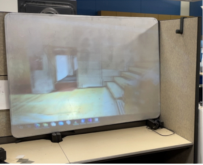
applied in exoscopic neurosurgeries. Figure 2 shows the open stereo displays: stereo projector, Looking Glass, and the 3D tablet Lume Pad 2.
Figure 2: Open stereo displays (stereo projector, Looking Glass, and Lume Pad 2).
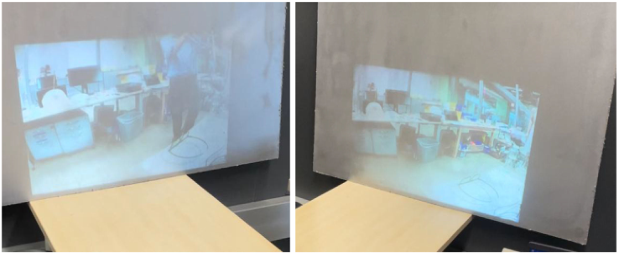
FIELD-OF-VIEW EXPERIMENTS In this study, we focus on three Open Stereo platforms, including polarized stereo projection, glassfree stereo monitor, and stereo tablet. The diameter of the polarized stereo projection is 40 inches. The glassfree stereo display is 32 inch. The stereo tablet is 12.4 inch. We define the field-of-view in terms of viewing angle and distance. We found that the polarized stereo projection has the widest range, around 120 degree viewing angle. Its viewing distance can be as long as a movie theater screen. However, we found the stereo image on the screen is slightly different when the viewpoint changes. Figure 3 shows the screen of the polarized stereo projection screen from a different angle. This phenomenon may be caused by two possible factors: the angled two projectors and the reflection of the polarized light from different angles.
Figure 3: The polarized stereo projection screen viewed from different angle.
We then tested the glassfree stereo monitor (Looking Glass) by moving around. We found the monitor has a narrow field-of-view. It only has around a 40 degree viewing angle and 20 cm–100 cm viewing distance. The limitation may come from the light-field stereo design. When the user leaves the field- of-view, the stereo image might disappear. Furthermore, the screen can turn dark outside of the field-of-view.
Field-of-View in Stereo Interaction 5
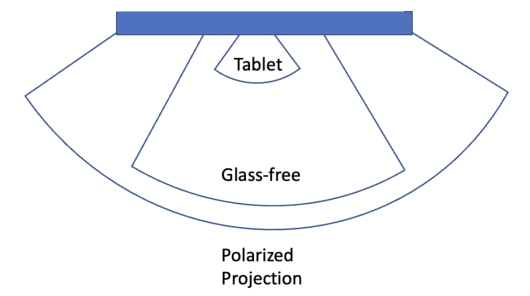
Finally, we tested the stereo tablet (Lume Pad 2). It is also a light-field stereo design. It has a limited field-of-view as well, around 60 degrees and 12 cm–50 cm. When the user leaves the field-of-view, the stereo effect dis- appears, or bounces between the two modes. The new edition of the tablet incorporates face tracking so that it can locate the head and eyes of the user to enhance the 3D effects, for example, the object rotates as the user moves. This computer vision is sensitive to the lighting conditions. When the light is too low, the stereo effect disappears, which is independent of the field-of- view. The computer would think the user is not in front of the screen. For more stable stereo interaction, we have to adjust the lighting and viewing position. In some cases, we might just turn off the face tracking function. Figure 4 shows the diagram of the field-of-view of the three devices. Polar- ized projection has the widest field-of-view, the glassfree monitor and stereo tablet have limited field-of-view.
Closed or synchronized stereo displays on the other hand, have almost unlimited field-of-view because the user can walk into the 3D virtual world at any direction and at any distance. However, those goggles lack eye gazing interaction unless a synchronization function is available. Table 1 summa- rizes the test results in comparison with the closed or synchronized stereo displays.
Figure 4: Field-of-view of the open stereo platforms.Table 1. Field-of-view and distance measurements.
Table available in the original PDF paper.
Stereo Displays F.O.V. Distance Gaze Polarized 3D Projection (home-made) 120 deg N/A Moderate Glassfree 3D Monitor (Looking Glass) 40 deg 20–100 cm Yes Stereo Tablet (Lume Pad 2) 60 deg 12 - 50 cm Yes Google Cardboard 360 deg N/A No VR Goggle (Oculus Quest 2) 360 deg N/A No AR Goggle (HoloLens 2) 360 deg N/A Moderate
6 Cai and Siegel
CONCLUSION
In this study, we explore how the users interact with the stereo display systems in “stereo interaction.” We focus on the factors of field-of-view and distance to the screen. We found the field-of-view of many well-known stereo displays is very limited. For certain devices, only one location is good for the user, not for the team to view the 3D effects. We also studied the stability of the 3D image in different lighting, poses, and motion.
We found that the polarized stereo projection has the widest range, around 120 degree viewing angle. The glassfree stereo monitor has a narrow field- of-view, similar to the stereo tablet. When the user leaves the field-of-view, the stereo effect disappears, or bounces between the two modes.
Closed stereo or synchronized stereo displays on the other hand, have almost unlimited field-of-view because the user can walk into the 3D vir- tual world at any direction and at any distance. However, those goggles lack eye gazing interaction unless a synchronization function is available.
ACKNOWLEDGMENT
The authors would like to thank the support of the Wellcome Leap SAVE Program and the NIST PSCR Program. The authors would like to thank the artist Maria Agustina for her medical illustrations.
REFERENCES
Beattie, K. L., Hill, A., Horswill, M. S. et al. (2021). Laparoscopic skills training: the effects of viewing mode (2D vs. 3D) on skill acquisition and transfer. Surg Endosc 35, 4332–4344 (2021). https://doi.org/10.1007/s00464-020-07923-8 Chung, J. Y. and Sackier, J. M. (1998) A method of objectively evaluating improve-
ments in laparoscopic skills, Surgical Endoscopy, vol. 12, no. 9, pp. 1111–1116, 1998. Du, C., Li, J., Zhang, B. et al. (2022) Intraoperative navigation system with a multi-modality fusion of 3D virtual model and laparoscopic real-time images in laparoscopic pancreatic surgery: a preclinical study. BMC Surg 22, 139 (2022). https://doi.org/10.1186/s12893-022-01585-0 Lin, C. J. Chen, H. J. (2013). The Investigation of Laparoscopic Instrument Move-
ment Control and Learning Effect, BioMed Research International, vol. 2013, Article ID 349825, 16 pages, 2013. https://doi.org/10.1155/2013/349825 Matern, U. Koneczny, S. Tedeus, M. Dietz, K. and Buess, G. (2005) Ergonomic testing of two different types of handles via virtual reality simulation, Surgical Endoscopy and Other Interventional Techniques, vol. 19, no. 8, pp. 1147–1150, 2005. Siegel, Mel. (2001). Perceptions of crosstalk and the possibility of a zoneless
autostereoscopic display. Proc SPIE. 4297. 10.1117/12.430852 Sinha RY, Raje SR, Rao GA. (2022). Three-dimensional laparoscopy: Principles and practice. J Min Access Surg [serial online] 2017 [cited 2022 Oct 10]; 13: 165–9. Available from: https://www.journalofmas.com/text.asp?2017/13/3/165/181761 Wickens, C. D. (1999). Frames of reference for navigation, in Attention and Per-
formance XVII: Cognitive Regulation of Performance, Interaction of Theory and Application, D. Gopher and A. Koriat, Eds., pp. 113–144, The MIT Press, Cambridge, Mass, USA, 1999.
LISTED IN THE AHFE DIGITAL BOOKSTORE CATALOGUE
Explore the complete digital volume
Human Factors in Communication of Design
Read this individual research paper free through the original publisher, or explore the full digital proceedings book.
ISBN 978-1-964867-12-0
Explore this ISBN in the AHFE Bookstore ↗Listed in the July 2026 bookstore catalogue; search by ISBN to confirm current availability · Digital book purchase optional