Haitang Zhang (2024). Reinventing the Virtual Museum Post-Pandemic: An Audience-Centric Approach to Enhancing Virtual Exhibitions of Intangible Cultural Heritage. In: Human Factors in Communication of Design. AHFE Open Access, vol. 136, pp. 7–18. https://doi.org/10.54941/ahfe1004964
Virtual environments have been extensively utilized in museums. During the COVID-19 pandemic, museums in China, both primary and secondary, organized virtual exhibition halls and digital collection retrieval functions. These efforts played a crucial role in facilitating public engagement with traditional culture. However, post-pandemic, public interest in online museums has significantly waned, highlighting the limitations of virtual museums in representing intangible cultural heritage.This study introduces an audience-centered approach to virtual museum design, specifically tailored to the features of intangible cultural heritage such as folk songs and dances. It incorporates Kano, AHP and AD design theories to develop the museum's virtual exhibition method. The process began with identifying 207 audience needs through research, which were then classified using the Kano model. The AHP method was employed to determine the relative importance of various user needs, emphasizing information collection, preservation, display and viewing modes, visual aesthetics, entertainment, public education, and social attributes in virtual museums. To align the design parameters of the virtual museum, the study established a mapping between the museum's functional domain and the design domain, guided by the AD theory's principle of independence. This facilitated a step-by-step evaluation of perceptual and rational solutions through a matrix, clarifying the functional scope and design methods for the virtual museum. This research offers valuable insights for virtual museum design and development, providing a reference for future virtual space projects and enhancing the representation of intangible cultural heritage in digital formats.
The development of virtual museums is heavily reliant on technology (Styliani et al., 2009) and the commercial environment (Parry, 2013). Compared to the proliferation of digital imagery, the public finds itself in a perplexing situa- tion when it comes to embracing and accepting them (Mitchell, 1994). While experts from various fields are enthusiastic about discussing the possibilities
for the future of museums and virtual museums, there is a prevailing desire among people to connect more directly and seriously with nature and each other. Some scholars argue that technology could serve as an additional means for people to engage with and feel the world (Petit et al., 2019), yet on the other hand, it also creates a formidable barrier that isolates them from fac- ing real-world challenges (Morahan and Schumacher, 2003). It’s challenging to determine whether people truly benefit from technology.
The boom in virtual museum development during the COVID-19 period, despite technological advancements predating this era, has made it diffi- cult for people to imagine how to evolve online and digitally connect. This presents an opportunity to discuss how people can collaborate with virtual technology and maximize its benefits. In this research, I aim to employ both quantitative and qualitative research methodologies to consider the museum audience’s perspective and explore how to translate intangible heritage to protect its aura (Benjamin, 1999), especially in virtual museums.
Currently, research on virtual museums is centered around technology development, user experience, and educational applications. Technical inves- tigations are aimed at enhancing the realism and interactivity of virtual exhibitions (Sylaiou et al., 2010), while studies on user experience seek to design interfaces and interactions that cater to the diverse needs of audiences (Roussou, 2002). Furthermore, research on educational applications exam- ines how virtual museums can function as educational resources to facilitate learning and promote cultural heritage (Ott and Pozzi, 2011).
Construction of a Virtual Museum Design Methodology Combining Kano, AHP, and AD Research Models The Kano model, Analytic Hierarchy Process (AHP), and Axiomatic Design (AD) models have been extensively applied in various fields but remain innovative in the study of virtual museums. The Kano model is useful for identifying and categorizing user needs to enhance satisfaction (Kano et al., 1984). The AHP model assists researchers in conducting quantitative anal- ysis and prioritization within the design decision-making process (Saaty & Vargas, 1980), whereas the AD model offers a systematic design approach to ensure the efficiency of the design process and satisfaction with the design outcomes (Suh, 1998).
Consequently, this study delves into the subjective needs of visitors within the context of virtual museums. By examining the participants’ responses, a conceptual model of the virtual museum is derived. Initially, by analyzing museums and virtual media, the potential demand for virtual museums is confirmed. The Kano model can intuitively display the relationship between various user needs and product satisfaction. However, it does not clearly indicate the weight of different user needs. Demand weight is a critical fac- tor in determining the focal points of design and decision-making, with the accuracy of user demand weight directly influencing the focus of the design approach. Traditionally, weight calculation methods in Kano’s applied research have included the Delphi method, entropy method, and the Better- Worse satisfaction index analysis method, but these approaches suffer from
Reinventing the Virtual Museum Post-Pandemic: An Audience-Centric Approach 9
issues of varying evaluation standards, strong subjectivity, and a lack of qualitative robustness.
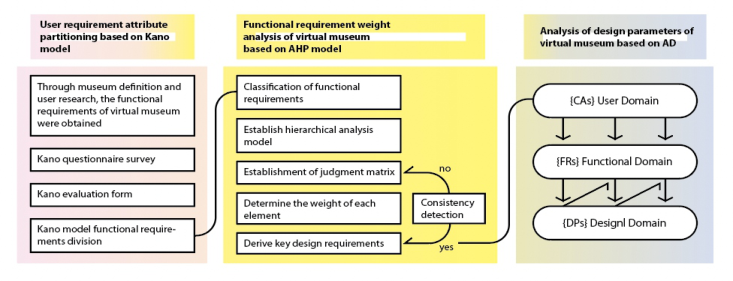
In this study, the AHP model is employed for the weight analysis of Kano analysis results. AHP is primarily utilized for the weight decision-making of evaluation indicators and boasts objectivity, scientific integrity, simplicity, and practicality. Applying AHP to determine the weights of various demands after Kano analysis significantly compensates for the shortcomings of tradi- tional weight calculation methods, enhancing the accuracy of user demand weights. By utilizing the attribute categories of the Kano model to construct the analytic hierarchy model within AHP, the scientific and rational aspects of the analytic hierarchy method are bolstered. Finally, user requirements in virtual museum design, based on AD theory, are mapped to corresponding design parameters, as depicted in Figure 1.
Figure 1: Application flow chart of integrated Kano_AHP_AD.
The Attributes of Virtual Museums Are Categorized According to the Kano Model With the enrichment of mass cultural life, the design of virtual museums has garnered widespread attention. Currently, virtual museums on the market primarily rely on technological development and the information released by the original virtual platform, without fully considering the definition of a virtual museum and the audience’s needs. This oversight leads to virtual museum designs that fail to align with user behavior, resulting in functional losses or irrational planning. Moreover, the process of translating demands into technical parameters lacks scientific theoretical support, hindering the effective conceptualization of virtual museums and leading to the wasteful use of materials, resources, and technology.
Firstly, according to the latest definition by the International Council of Museums (ICOM) in 2022: “A museum is a not-for-profit, permanent insti- tution in the service of society that researches, collects, conserves, interprets, and exhibits tangible and intangible heritage. Open to the public, accessible, and inclusive, museums foster diversity and sustainability. They operate and communicate ethically, professionally, and with community participation,
10 Zhang
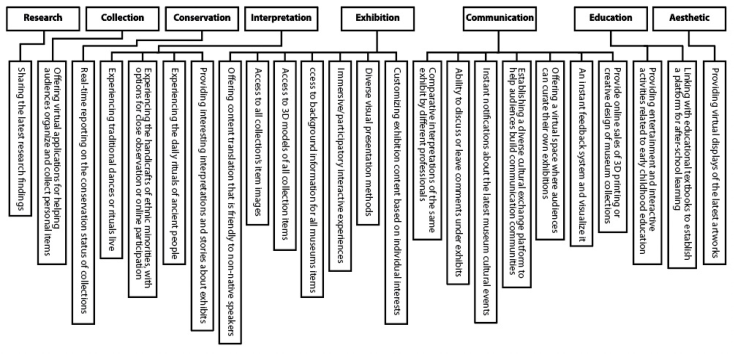
offering varied experiences for education, enjoyment, reflection, and knowl- edge sharing.” Traditional museums are non-profit organizations centered around the research, collection, conservation, interpretation, exhibition, communication, education, and artistic functions of collections. Drawing upon the characteristics of tangible and intangible cultural heritage, as well as the media attributes of virtual museums, this study analyzed 24 potential functional attributes of virtual museums through user research and brain- storming (Figure 2). It then categorized user need attributes according to the Kano model and developed and distributed a Kano questionnaire. A total of 207 valid questionnaires were distributed and collected in Beijing, China. The analysis of Kano results is utilized to classify user requirements.
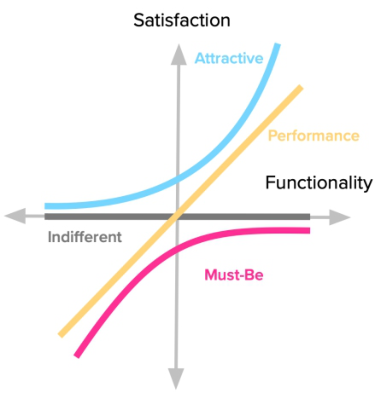
Figure 2: Potential functions of virtual museums.Figure 3: Kano model.
Reinventing the Virtual Museum Post-Pandemic: An Audience-Centric Approach 11
Table 1. Kano model analysis result.
Table available in the original PDF paper.
Potential Functions of Virtual Museums A O M I R Q Result Better Worse 2.00% 15.00% 58.00% 13.00% 6.00% 6.00% M 19.32% -82.95% Offering content translations that are friendly to multiple languages_If this feature is available & If this feature is unavailable:
3.00% 2.00% 62.00% 24.00% 8.00% 1.00% M 5.49% -70.33%
Access to images_If this feature is available & If this feature is unavailable:
3.00% 5.00% 61.00% 19.00% 12.00% 0.00% M 9.09% -75.00%
Access to 3D models_If this feature is available & If this feature is unavailable:
1.00% 11.00% 61.00% 13.00% 5.00% 9.00% M 13.95% -83.72%
Access to background information_If this feature is available & If this feature is unavailable:
64.00% 9.00% 3.00% 13.00% 7.00% 4.00% A 82.02% -13.48%
Immersive/participatory interactive experiences_If this feature is available & If this feature is unavailable:
1.00% 5.00% 17.00% 71.00% 6.00% 0.00% I 6.38% -23.40%
Diverse visual presentation methods_If this feature is available & If this feature is unavailable:
7.00% 2.00% 13.00% 62.00% 15.00% 1.00% I 10.71% -17.86%
Customizing exhibition content based on individual interests_If this feature is available & If this feature is unavailable:
53.00% 14.00% 6.00% 15.00% 10.00% 2.00% A 76.14% -22.73%
Experiencing traditional dances or rituals live_If this feature is available & If this feature is unavailable:
51.00% 14.00% 5.00% 13.00% 12.00% 5.00% A 78.31% -22.89%
Experiencing the handicrafts of ethnic minorities, with options for close observation or online participation_If this feature is available & If this feature is unavailable:
42.00% 16.00% 4.00% 18.00% 10.00% 10.00% A 72.50% -25.00%
Experiencing the daily rituals of ancient people_If this feature is available & If this feature is unavailable:
1.00% 20.00% 51.00% 13.00% 10.00% 5.00% M 24.71% -83.53%
Providing interesting interpretations and stories of exhibits_If this feature is available & If this feature is unavailable:
5.00% 7.00% 10.00% 63.00% 13.00% 2.00% I 14.12% -20.00%
Comparative interpretations of the same exhibit by different professionals_If this feature is available & If this feature is unavailable:
10.00% 62.00% 12.00% 5.00% 3.00% 8.00% O 80.90% -83.15%
Ability to discuss or leave comments under exhibits_If this feature is available & If this feature is unavailable:
14.00% 61.00% 8.00% 4.00% 3.00% 10.00% O 86.21% -79.31%
Instant notifications about the latest museum cultural events_If this feature is available & If this feature is unavailable:
6.00% 53.00% 16.00% 4.00% 7.00% 14.00% O 74.68% -87.34%
Establishing a diverse cultural exchange platform to help audiences build communication communities_If this feature is available & If this feature is unavailable:
2.00% 0.00% 19.00% 67.00% 11.00% 1.00% I 2.27% -21.59%
Offering a virtual space where audiences can curate their own exhibitions_If this feature is available & If this feature is unavailable:
8.00% 53.00% 19.00% 9.00% 3.00% 8.00% O 68.54% -80.90%
An instant feedback system and visualization_If this feature is available & If this feature is unavailable:
11.00% 8.00% 10.00% 57.00% 14.00% 0.00% I 22.09% -20.93%
Offering online sales of 3D printed museum artifacts or cultural and creative designs_If this feature is available & If this feature is unavailable:
8.00% 6.00% 11.00% 58.00% 15.00% 2.00% I 16.87% -20.48%
Sharing the latest research findings_If this feature is available & If this feature is unavailable:
7.00% 8.00% 8.00% 63.00% 12.00% 2.00% I 17.44% -18.60%
Offering online products related to early childhood education_If this feature is available & If this feature is unavailable:
6.00% 60.00% 14.00% 6.00% 6.00% 8.00% O 76.74% -86.05%
Linking with educational textbooks to establish an after-school learning platform_If this feature is available & If this feature is unavailable:
6.00% 57.00% 14.00% 2.00% 7.00% 14.00% O 79.75% -89.87%
Providing virtual displays of the latest artworks_If this feature is available & If this feature is unavailable:
2.00% 9.00% 57.00% 11.00% 10.00% 11.00% M 13.92% -83.54%
Real-time reporting on the conservation status of exhibits_If this feature is available & If this feature is unavailable:
2.00% 3.00% 10.00% 70.00% 14.00% 1.00% I 5.88% -15.29%
Offering virtual applications to help audiences organize and collect personal items_If this feature is available & If this feature is unavailable: A: Charm attribute, O: Expected attribute, M: Necessary attribute, I: Indifference attribute, R: Reverse attribute, Q: Suspicious attribute
12 Zhang
As illustrated in Table 1, sharing the latest research findings, providing virtual application packages to assist the audience in organizing and so on. According to the Kano model function illustrated in Figure 3, the indiffer- ent attribute indicates that user satisfaction remains unaffected regardless of whether the product or service possesses this attribute. Consequently, these needs should not be prioritized.
Providing language-friendly content translations, access to pictures of all exhibits, dioramas of all exhibits and so on. The absence of these features will lead to a decrease in user satisfaction. However, optimizing these needs does not enhance the user experience. Thus, while these elements must be satisfied in the virtual museum design process, they are not considered for optimization.
Instant notifications about the latest museum cultural activities, the cre- ation of a diverse cultural exchange platform to facilitate community building among audiences and so on. The inclusion of these attributes in virtual museum applications will increase user satisfaction. Therefore, in designing virtual museums, it is necessary to meet and focus on analyzing and designing these attributes to enhance user satisfaction.
Visiting traditional dance or ritual sites, experiencing minority handicrafts and so on. These unexpected features in the application of existing virtual museums do not decrease user satisfaction if unmet. However, incorporating these attributes can significantly increase user satisfaction. After a compre- hensive analysis using the Kano model, the essence of virtual museums should consider the staged and interactive display attributes of cultural heritage, based on fully open information and enhanced public communication and education. This approach will upgrade the user experience and definition of virtual museums, transform their application scenarios, and improve public acceptance of virtual museums.
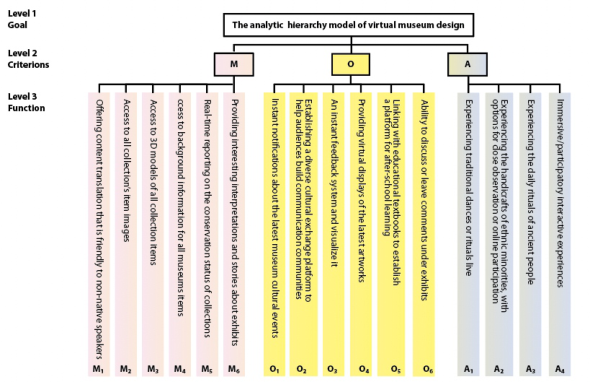
The Weight of User Demand Is Determined Using the Analytic Hierarchy Process (AHP) Model After categorizing the user demands for virtual museums, the significance of each demand cannot be clearly discerned from Kano’s conclusions. To bet- ter elucidate the importance of each element in the design process of virtual museums, Kano and AHP are integrated to calculate the weight of each user’s demand. Professionals from various fields are selected for mutual discus- sion and communication to accurately determine the priority levels of virtual museum needs. Initially, the necessary attributes (M), expected attributes (O), and attractive attributes (A) from the Kano model are considered as the criterion layer in the AHP research model, with the function of each attribute forming the sub-criterion layer. Utilizing the foundational concepts of AHP, a hierarchical analysis model for the optimal virtual museum model is constructed (Figure 4).
Reinventing the Virtual Museum Post-Pandemic: An Audience-Centric Approach 13
Figure 4: AHP model
To ensure the reliability of the weight calculation results, a total of six cross-industry experts were invited to engage in discussions and com- plete a questionnaire alongside museum designers. In this questionnaire, the demands at each level are compared and scored on a scale of 1 to 9, with the average score serving as the foundation for weight calculation to derive the hierarchical judgment matrix. Subsequently, the geometric mean algorithm is employed to calculate the weight value of each function’s demand in the virtual museum. The calculation process is as follows, and the results are presented in Tables 2–4.
Finally, to ensure consistent thinking among evaluators when judging the matrix, a consistency test is performed on the calculation results. The test is passed if the Consistency Ratio (CR) is less than or equal to 0.1; however, it fails if CR is greater than 0.1. The calculated CR values were all found to be less than 0.1, as indicated in Table 5.
Table 5. Consistency check result.
Table available in the original PDF paper.
Project M O A λmax 6.388 6.199 4.004 ICI 0.078 0.04 0.001 IRI 1.26 1.26 0.89 ICR 0.062 0.032 0.001
According to the AHP model, the three attributes of the charm area (experiencing traditional dance or ceremonies), the expectation attribute (notification to participate in the latest cultural activities), and the essential attribute (providing engaging interpretations and stories) significantly con- tribute to audience satisfaction with the virtual museum experience. These attributes highlight that providing interpretation, interpretation, and expres- sive staging beyond the exhibits are critical to drawing visitors into the virtual museum. This aligns with Peter Rubin’s assertion that culture is an experience that can be deeply communicated (2018). Museums, in safeguarding cultural artifacts and traditions, explore ways to represent and translate these cultural elements. The integration of VR and stage performance has demonstrated remarkable potential in research. Audiences do not merely receive informa- tion passively or exchange information bidirectionally when viewing cultural products. They seek to be understood, recognized, and accepted during their museum experience. This self-intimacy experience, challenging to achieve in a physical museum due to uncontrollable environmental factors and external disturbances, is facilitated within the virtual museum medium, releasing the audience’s desire to participate in rather than merely visit the museum.
The insights derived from this study encourage future contemplation of vir- tual museums. Drawing on these data and employing the axiomatic design process—user needs-driven interdomain mapping expressed through judg- ment matrices and evaluated using independence and information axioms— we can approach rational and optimal design solutions and progressively identify optimal design parameters for user needs. In virtual museum appli- cation research and development, aligning user needs with actual scenarios
Reinventing the Virtual Museum Post-Pandemic: An Audience-Centric Approach 15
and UI design, and ensuring a logical structure and layout are essential. AD theory adeptly addresses this challenge, providing technical parameters for virtual museum presentations and forming the foundation of a virtual museum design methodology. By integrating AHP model analysis data with AD theory principles and virtual museum design features, CA is transformed into FR, outlining the functional requirements reasonably. Incorporating the museum and virtual museum characteristics, along with technological ele- ments like network platforms, virtual reality, and 3D scanning technology, the virtual museum is thoroughly analyzed using the information axiom. Design parameters corresponding to functional requirements are proposed, as shown in Table 6.
Table 6. Comparison of important user needs and functional needs of virtual museum.
Table available in the original PDF paper.
Functions Require FRn Design Parameter DPn
The Needs of Audience CAn Language friendly CA1
The virtual museum will change the language system according to the user’s speech habits. FR1
Implement a content management system with multi-language support that can automatically detect the user’s preferred language and provide content translation accordingly. DP1 Narrative the exhibition CA2
Develop a storytelling engine for creating and presenting multi-dimensional narratives based on exhibits, including timelines, cultural backgrounds, and related stories. DP2
The virtual museum is dominated by intangible heritage content, which brings the audience into the museum exhibition by planning different narratives of background information. FR2
3D vision of museum collections CA3
Relevant museum exhibits will display their 3D modeling information. FR3
Use 3D modeling and rendering technology to create high-quality 3D models of exhibits that support interactive browsing, including zoom, rotate, and detail viewing. DP3 Interactive with audience CA4
3D modeling can be zoomed in and rotated to see the details of the exhibits. FR4
Develop interactive modules that allow audiences to interact with the exhibition through virtual gestures, voice commands, etc., such as virtual try-on, exhibit operation. DP4 Feedback and communication below collections CA5
Clicking on the exhibits triggers a message and chat interface. Creating different cultural communities. FR5
Integrate a social interaction platform, including instant messaging, forums, and cultural communities, to facilitate communication and exchange among audiences. DP5 (Continued)
16 Zhang
Table 6. Continued
Table available in the original PDF paper.
Functions Require FRn Design Parameter DPn
The Needs of Audience CAn Linking with educational textbooks CA6
Through the educational content ranking, the information of the exhibits suitable for different age learning can be listed. FR6
Build an educational resource linkage system, integrated with mainstream educational textbooks and online education platforms, to provide age-tiered learning resources and exhibit recommendations. DP6 Reporting on the museum collection status CA7
Museum exhibits quantity, size, inspection, maintenance information update. FR7
Implement an exhibit management and status monitoring system to update and display real-time information on the quantity, condition, and maintenance records of the exhibits. DP7
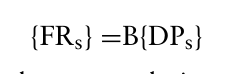
Based on the independence axiom of Axiomatic Design (AD) theory, the functional requirements (FRs) of virtual museums and their corresponding design parameters (DPs) are interrelated within distinct domains, with this relationship succinctly represented as:
Equation reproduced from the original PDF.
In the formula: B is the virtual museum design matrix; FRs is a set of design functional requirements; DPs is the design parameter set.
Where {FRs}= {FR1, FR2, FR3,..., FRm}, {DPs}= {DP1, DP2, DP3,..., DPn}, which can be specifically described as:
[Equation or mathematical symbol available in the original paper PDF]
[Equation or mathematical symbol available in the original paper PDF]
[Equation or mathematical symbol available in the original paper PDF]
[Equation or mathematical symbol available in the original paper PDF]
[Equation or mathematical symbol available in the original paper PDF]
[Equation or mathematical symbol available in the original paper PDF]
FR1 FR2
DP1 DP2
Equations and mathematical formulas are available in the original paper PDF.
... FRn
... DPn
... bn1 bn2 · · · bnn
In the formula, bij is the degree of correlation between the corresponding virtual museum design elements.
The functional requirements and design parameters of the bedside table are brought into the formula for calculation, and the following matrix is obtained: [Equation or mathematical symbol available in the original paper PDF]
[Equation or mathematical symbol available in the original paper PDF]
[Equation or mathematical symbol available in the original paper PDF]
[Equation or mathematical symbol available in the original paper PDF]
[Equation or mathematical symbol available in the original paper PDF]
[Equation or mathematical symbol available in the original paper PDF]
=
(2)
Equations and mathematical formulas are available in the original paper PDF.
X O O O O O O O O O X O O O O O O O O O X O O O O O O O O O X O O O O O O O O O X O O O O O O O O O X O O O O O O O O O X O O O O O O O O O X O O O O O O O O O X
FR1 FR2 FR3 FR4 FR5 FR6 FR7 FR8 FR9
DP1 DP2 DP3 DP4 DP5 DP6 DP7 DP8 DP9
Reinventing the Virtual Museum Post-Pandemic: An Audience-Centric Approach 17
In the matrix, “X” indicates a strong correlation, and “O” signifies a pos- sible correlation. When the design matrix is either a diagonal or a triangular matrix, it suggests that the design is acceptable. If the matrix is a general matrix, it implies that the design parameters are contradictory and do not satisfy the independence axiom; thus, the matrix requires decoupling. By comparing the types of design matrices, it can be observed that the design matrix for the virtual museum is a diagonal matrix, which conforms to an uncoupled design and satisfies the independence axiom of Axiomatic Design (AD) theory. This indicates that the design parameters are viable.
CONCLUSION
The development and design methodologies of future virtual museums will prioritize user experience, interactivity, and educational value, employing a variety of technological approaches and innovative content strategies to cater to diverse audience needs.
In conclusion, the design and development of future virtual museums will concentrate on enriching user experience, bolstering interaction and participation, broadening educational horizons, and embracing advanced technologies and sustainable design practices. By following this trajectory, virtual museums will not only serve as pivotal platforms for cultural heritage display but also emerge as innovative spaces for global audiences to learn, interact, and explore.
ACKNOWLEDGMENT
The authors wish to express their sincere gratitude to all those who con- tributed to the development of this study and the preparation of this manuscript. I am especially thankful to my classmates at Glasgow School of Art for their invaluable feedback and support throughout the research process.
Special thanks go to my professors, Helen, Mairi and Dave, whose guid- ance and insight were instrumental in shaping both the research and this paper. I also extend our appreciation to Youjie Jia, Liyu Jia and Toby Mao for their collaborative efforts and contributions to the data collection and discussion.
My gratitude is also owed to the participants of my study, without whom this research would not have been possible.
Finally, I thank our families and friends for their patience, encouragement, and understanding during the course of this work.
REFERENCES
Kano, N., Seraku, N., Takahashi, F., & Tsuji, S. (1984). Attractive quality and mustbe quality. Journal of the Japanese Society for Quality Control, 14(2), 39–48. Mitchell, W. J. 1994. The reconfigured eye: visual truth in the post-photographic era.
Cambridge, Mass. London: MIT Press. Morahan-Martin, J. and Schumacher, P. 2003. Loneliness and social uses of the Internet. Computers in Human Behavior. 19(6), pp. 659–671.
18 Zhang
Ott, M. and Pozzi, F. 2011. Towards a new era for Cultural Heritage Education: Discussing the role of ICT. Computers in Human Behavior. 27(4), pp. 1365–1371. Parry Ross. 2013. Museums in a digital age. London: Routledge. Petit, O., Velasco, C. and Spence, C. 2019. Digital Sensory Marketing: Integrating
New Technologies Into Multisensory Online Experience. Journal of Interactive Marketing. 45, pp. 42–61. Roussou, M. (2002). Immersive Interactive Virtual Reality in the Museum. Proceedings of the 2002 conference on Virtual reality, archeology, and cultural heritage, 271–279. Rubin, P. 2018. Future presence: how virtual reality is changing human connection,
intimacy, and the limits of ordinary life First edition. York, NY: HarperOne, an imprint of HarperCollinsPublishers. Saaty, T. L. and Vargas, L. G. 1980. Hierarchical analysis of behavior in competition: Prediction in chess. Behavioral Science. 25(3), pp. 180–191. Styliani, S., Fotis, L., Kostas, K. and Petros, P. 2009. Virtual museums, a survey and
some issues for consideration. Journal of Cultural Heritage. 10(4), pp. 520–528. Suh p. Nam. 1980. Axiomatic Design Theory for Systems. Research in Engineering Design. Volume 10, pp. 189–209. Sylaiou, S., Mania, K., Karoulis, A. and White, M. 2010. Exploring the relationship
between presence and enjoyment in a virtual museum. International Journal of Human-Computer Studies. 68(5), pp. 243–253.
LISTED IN THE AHFE DIGITAL BOOKSTORE CATALOGUE
Explore the complete digital volume
Human Factors in Communication of Design
Read this individual research paper free through the original publisher, or explore the full digital proceedings book.
ISBN 978-1-964867-12-0
Explore this ISBN in the AHFE Bookstore ↗Listed in the July 2026 bookstore catalogue; search by ISBN to confirm current availability · Digital book purchase optional