Sedef Süner Pla Cerdà, Batuhan Şahin, Kutluk Bilge Arıkan (2024). Formative Usability Assessment of a Rehabilitative Hand Exoskeleton – Directions for User-Friendly Physical Interfaces. In: Human Interaction and Emerging Technologies (IHIET 2024). AHFE Open Access, vol. 157, pp. 355–365. https://doi.org/10.54941/ahfe1005495
1 Department of Industrial Design, TED University, Ankara 06420, Türkiye ↗
2 Department of Industrial Design, TED University, Ankara 06420, Türkiye; Department of Biomedical Engineering, Neurotechnology Center of Excellence (NÖROM), Ankara University, Ankara 06560, Türkiye ↗
Robotic training with exoskeletons has shown promise in the recovery of motor functions within clinical rehabilitation settings [1]. Hand exoskeletons, which is a sub-category of such wearable robotic devices, aim to aid patients in regaining their motor functions. These robotic devices are designed to manipulate the joints of the fingers, primarily for the purposes of rehabilitation and/or interaction. Current hand exoskeleton systems pose numerous usability issues due to challenges stemming from the system complications dictated by the complexity of hand kinematics. Size, bulk and weight are among those complications governing most rigid exoskeletons, negatively affecting the devices' comfort, adjustability, portability and wearability [2]. Many systems have low technology readiness levels, posing challenges for acceptability, marketability and home deployment [3].This paper presents a formative usability test study involving eight healthy individuals to identify user-centred criteria and directions for improving the usability of a hand exoskeleton system. Early identification of potential usability issues is crucial in eliminating those problems during design iterations. The proposed robotic exoskeleton is a two-degree-of-freedom, fully actuated system. It is designed for the index finger using an optimization technique that minimises a cost function which is composed of the isotropy measure and the required actuator torque. It is controlled by an admittance-based control system. The formative usability test was applied as a procedure accompanying the motor learning tests for system validation. The test adopted a qualitative approach combining structured observations during exoskeleton use to complete motor control tasks as they interact with a virtual dynamical system in a leader-follower modality. The observations were followed by semi-structured interviews immediately after use. All sessions were video recorded for thematic analysis.Qualitative findings from the formative usability tests revealed issues related to use comfort, wearability, simplicity and perceived safety of the proposed exoskeleton system. Based on these findings, practical design recommendations will be provided to enhance the donning and doffing of the device, adjustability of finger connections to accommodate anthropometric ranges, material selection and component layout for improved physical comfort. The outcomes of this study are expected to contribute to both the usability improvements of the current system and serve as a reference to the research community in general while developing user-friendly physical interfaces for wearable robotics.[1] Prange GB, Jannink MJA, Groothuis-Oudshoorn CGM, et al. Systematic review of the effect of robot-aided therapy on recovery of the hemiparetic arm after stroke. J Rehabil Res Dev. 2006; 171–183.[2] Ferguson PW, Shen Y, Rosen J. Hand Exoskeleton Systems—Overview. Wearable Robotics: Systems and Applications. 2020; 149–175.[3] Martinez-Hernandez U, Metcalfe B, Assaf T, et al. Wearable Assistive Robotics: A Perspective on Current Challenges and Future Trends. Sensors. 2021, Vol 21; 6751.
Stroke ranks as the second most common cause of mortality worldwide and the third most common cause of disability. In Europe, stroke affects 1.1 million individuals and results in 440,000 fatalities annually (Béjot et al., 2016). It is believed that current strategies will be ineffective in lowering these rates in the next years. The major factor is the increasingly ageing population. The number of stroke incidents is predicted to approach 1.5 million by 2025, with the number of persons affected by stroke increasing by 27% between 2017 and 2047 (Wafa et al., 2020). Despite recent major pharmacological advances in stroke treatment, there is no feasible, successful, or permanent
medical treatment for stroke. Post-stroke rehabilitation interventions are commonly used in stroke therapy and research is increasingly focusing on the rehabilitation process. The objective of rehabilitation is to improve impaired function and attain the best level of independence feasible within the constraints of chronic stroke-related impairments. Post-stroke physical therapy is a prolonged treatment that requires the involvement of a therapist.
Robot-assisted training is a modern neurorehabilitation approach that has shown efficacy in stroke patients. Robots are commonly utilised by clinicians in stroke rehabilitation because they allow the user to carry out highly repetitive actions precisely. Robotic training with exoskeletons has shown promise in the recovery of motor functions within clinical rehabilitation settings (Prange et al., 2006). Hand exoskeletons, a sub-category of such wearable robotic devices, aim to aid patients in regaining their motor functions. These robotic devices are designed to manipulate the joints of the fingers, primarily for rehabilitation and/or interaction.
Current hand exoskeleton systems pose numerous usability issues due to challenges stemming from the system complications dictated by the complexity of hand kinematics and the diverse tasks it performs (Almanera et al., 2017; Zhu et al., 2022). Size, bulk and weight are among those complications governing most rigid exoskeletons, negatively affecting the devices’ comfort, adjustability, portability and wearability (Ferguson et al., 2019). Many systems have low technology readiness levels, posing challenges to acceptability, marketability and home deployment (Martinez-Hernandez et al., 2021).
Engineers encounter difficulties in selecting suitable components and designing control systems to address kinematic complexities, adaptability to various hand sizes, and the need to support different movements and tasks. These exoskeletons require various actuators such as pneumatic, ultrasonic, and DC motors, with considerations for torque, power requirements, and control system design (Kabir et al., 2022). Moreover, post-stroke rehabilitation efforts emphasise functional recovery through motor re- learning, highlighting the importance of effective control mechanisms in robotic rehabilitation (Agarwal & Deshpande, 2015; Levin & Demers, 2020; Marchal-Crespo & Reinkensmeyer, 2009; Sans-Muntadas et al., 2014; Washabaugh et al., 2018).
Despite the technical advancements, the commercial availability of hand exoskeletons remains limited, with most systems at prototype levels. User involvement in the development process is crucial to ensure better usability, satisfaction, and acceptance of such technologies. However, understanding primary user requirements and end-user involvement in the design process is limited (Hill et al., 2017; Kobbelgaard et al., 2021). Issues related to physical ergonomics such as comfort, portability, and wearability are recognised concerns (see, for example, Almanera et al., 2017; Ambrosini et al., 2014; Baltrusch et al., 2020; Majidi Fard Vatan et al., 2021; Martinez-Hernandez et al., 2021), but subjective user perceptions on these aspects and other design requirements are often overlooked.
This paper focuses on identifying user-centred criteria and directions for improving the usability of a rehabilitative hand exoskeleton system. The proposed robotic exoskeleton is a two-degree-of-freedom, fully actuated
Formative Usability Assessment of a Rehabilitative Hand Exoskeleton 357
system. It is designed for the index finger using an optimisation technique that minimises a cost function which is composed of the isotropy measure and the required actuator torque. The rest of the paper introduces the system design and methodology of the formative user evaluation. Recommendations are made to improve the usability of the system design from a user-centred perspective.
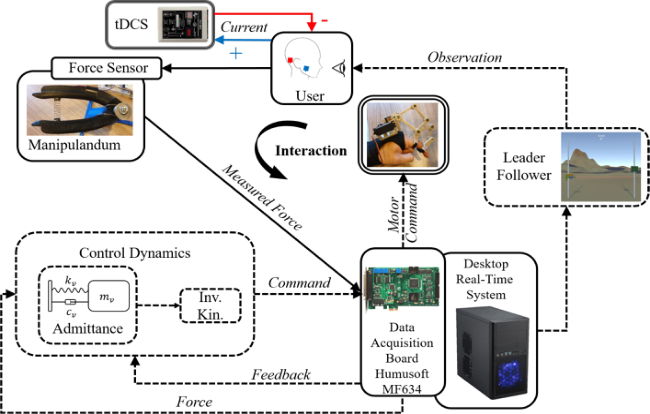
SYSTEM DESIGN Our project focuses on designing an exoskeleton robot specifically for rehabilitating the pinching action by index finger and thumb, which is particularly challenging to regain after a stroke. The design seeks to facilitate the process of motor relearning by implementing a control system strategy and a specific actuation type in the exoskeleton mechanism. We hypothesise that the patient needs various forms of interaction with the robotic exoskeleton during the whole rehabilitation period to maximise motor relearning. The control system can implement kinematic control, interaction-based control, and force control, which may be applied as either an assistive or resistive technique. The exoskeleton can be fully or under- actuated. The under-actuated form facilitates motor variability, which is essential for motor learning. In this study, the exoskeleton is used in the fully actuated form and the control is the admittance type of interaction control. The overall system architecture is presented in Figure 1.
Figure 1: System architecture.
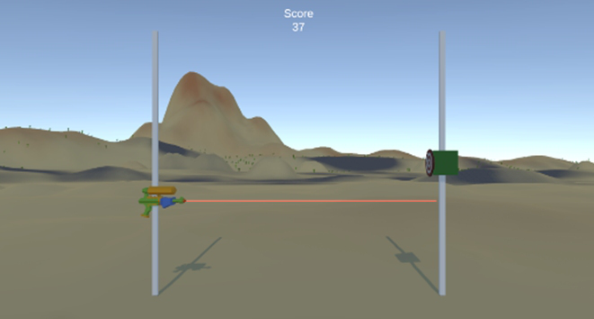
The leader-follower game is the main element of the system. Users produce an upward force in this game by pinching the elastic interface, generating an interaction force. This force drives the avatar of the follower in the upward direction. Likewise, when users let off the interface, a simulated gravitational force causes their avatar to go downward. Users attempt to
strike the vertically oscillating target that follows a predetermined pattern. The pattern is composed of the cumulative sum of three distinct frequency harmonics: 0.07 Hz, 0.2 Hz, and 0.25 Hz. The game interface, created using Unity (Unity Technologies, US), is seen in Figure 2.
Figure 2: Leader-follower game in unity: the left avatar is the follower, and the right avatar is the leader.
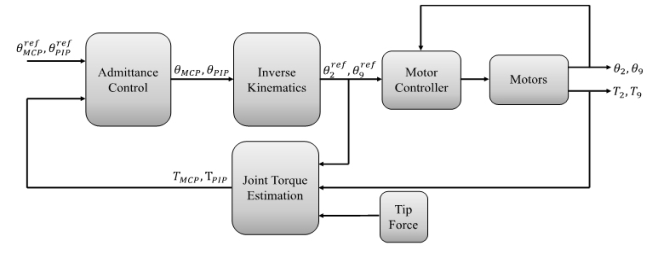
The elastic pinching interface (see Figure 4) connects the user and the game. The device uses a force sensor that quantifies the exerted force by the user’s index finger at the tip. The force signal is sampled at 2 kHz and sent to a desktop computer running Simulink® Desktop Real-Time 2021b simulation via a data acquisition device (DAQ) (Humusoft MF634). The exoskeleton controls the metacarpophalangeal (MCP) and proximal interphalangeal (PIP) joints of the index finger. The controller uses an admittance-based interaction control. The controller operates to follow the voluntary finger motions of the participant and uses virtual elastic, damping and inertial forces to restore the finger to its normal position. This system may simply be converted into an assistive or resistive strategy. The control system architecture is given in Figure 3.
Figure 3: Admittance type control system.
Formative Usability Assessment of a Rehabilitative Hand Exoskeleton 359
METHODOLOGY
A preliminary user evaluation study was designed to test the current exoskeleton developed for system validation. We planned a user feedback protocol to test the current version of the system with healthy users and evaluate it in terms of ease of use, comfort and perception, and to plan a design revision based on these evaluations. Eight healthy individuals, all sophomore undergraduate students at TED University in Ankara, Turkey, volunteered to participate in the study. All participants signed an informed consent form before the test.
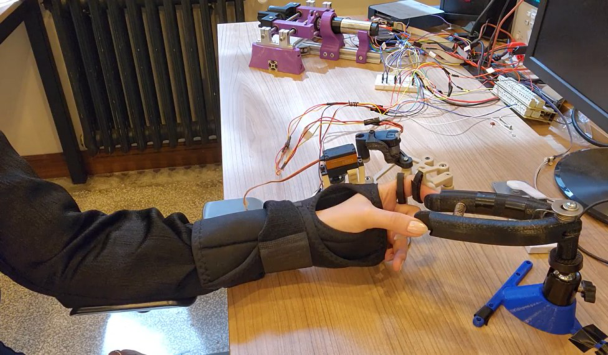
Figure 4: Test setup and video-recording angle.
Test Protocol User evaluations included observing the participants using the exoskeleton for approximately 15–20 minutes, followed by a short post-test interview. Each test lasted approximately 30–40 minutes including preparation, use and interview. Use and interview sections were video-recorded. Test setup and video recording angle are shown in Figure 4. The post-interview questions were based on the literature review conducted before the tests, which involved four key user dimensions: comfort in use, wearability, simplicity, and perceived safety. Further observations are made for adjustability. Detailed test procedure is presented in Table 1.
FINDINGS Three hours of videos were recorded during the use and interview phases of the eight test sessions. These recordings were watched by one researcher (industrial designer specialised in user research) to identify and document the usability issues observed and stated by the participants. This section presents the identified issues regarding comfort in use, wearability, simplicity, and perceived safety.
Table 1. Test procedure.
Table available in the original PDF paper.
Test phase Duration Activities Preparation 5–10 minutes
1. Participant reads and signs the consent form. 2. Participant is introduced to the setup and the test procedure as follows: where and how to sit, introduction and a short demo of the game. 3. Participant’s arm is placed on the elbow rest and the placement and the controller are adjusted. Use and observation
15–20 minutes
4. Participant plays the game without the exoskeleton. 5. Researcher helps wear the exoskeleton, and the participant plays the same game with it. 6. Participant is asked to take off the exoskeleton without help. Observed interactions: Difficulties when donning and doffing; Placement of the fingers and wrist inside the device; Stability of the device and if the participant wants to fix it; If the device affects the hand posture; Difficulties while taking the device off alone Post-interview 5–10 minutes
7. Open-ended questions are asked of the participant. Interview questions: How did you feel using the exoskeleton, and why? What are your comments on its comfort in use? Have you encountered any difficulties while taking it off, can you show it on the device? What are your comments on its general look and structure? Do you think it is safe to use it, and why? Do you have additional comments or suggestions? 8. The participant plays the game one last time without the exoskeleton to complete the performance test, and the procedure is concluded.
Comfort in Use and Wearability The vast majority of the findings point out issues with use comfort, including the method for placing and fastening the finger pieces, weight and balance of the exoskeleton, and the material.
The current design utilises a standard-size, 3D-printed finger placement form. These finger pieces are fastened to the middle and proximal phalanges via Velcro straps attached to two protrusions on semi-rings. During use, these protrusions are observed to be rubbing against the middle finger, causing physical discomfort and limiting the movement of the user.
The design of the finger piece does not accommodate the anthropometric variety in finger size. This issue is tried to be overcome by fastening with the Velcro straps, but the lack of a firm finger grip creates gaps between the phalanges and the finger pieces. These gaps were filled with foam pieces, which frequently came loose, disrupting the testing procedure.
The pulling force on the middle phalanx led to discomfort and redness on the skin. This was also expected to be prevented with an additional foam layering between the finger and finger piece.
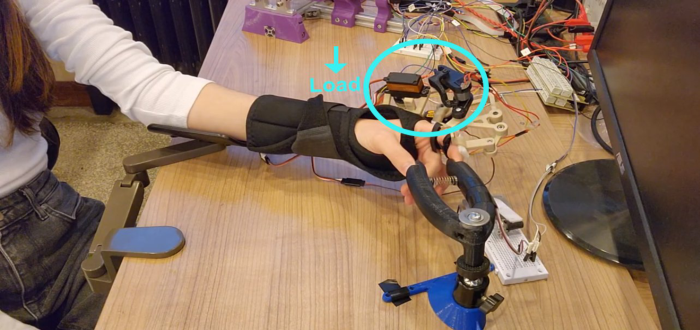
The skeleton part of the device is lightweight since it is made of 3D- printed plastics. However, the motor and actuator mechanism creates load
Formative Usability Assessment of a Rehabilitative Hand Exoskeleton 361
and discomfort on the wrist and arm during use (Figure 5). Half of the participants expressed discomfort after nearly 15 minutes of use. Although they didn’t think the pain and fatigue were unbearable, the impact could be worse for patients during longer rehabilitation sessions.
Since comfort was not a priority in the current design, the robotic mechanism was attached to a standard wrist splint. Although it is easy to put on the splint, fastening it requires rotating the hand and wrist around their own axis. Some participants found this uncomfortable due to the weight of the mechanism. Additionally, some reported that the synthetic material of the splint causes sweating after use.
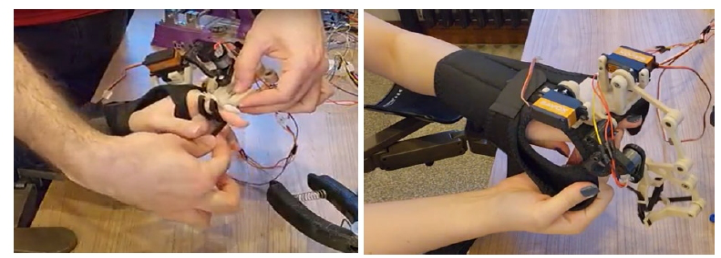
During the tests, a researcher helped don the device, and the participants were asked to take it off themselves. Although doffing the device is relatively easy, correct placement and fastening of the finger pieces took time and effort during donning the device (Figure 6).
Wearability is related to comfort in longer use as much as it does to ease of donning and doffing the device. The above-mentioned issues with weight balance, material and form are factors affecting wearability.
Figure 5: The weight of the motor and actuator creating load on the wrist and arm.Figure 6: Donning with help (left) and doffing without help.
Simplicity and Perceived Safety Other issues identified are related to the perception of the device rather than physical interaction:
Participants drew attention to the visual issues, particularly the fully open structure of the skeleton, motor and actuator mechanism, and the fact that the cable connections are disorganised. Some of the phrases they used to describe the visual language of the setup are: “too mechanical”, “messy”, “exposed”, and “difficult to understand”.
Some participants emphasised the disorderly look of the protrusions of the finger pieces to fasten the Velcro straps.
Despite the critique of the look, some participants stated that these were their first impressions, and it did not matter as much while using it because they discovered that it was not as scary as it looked and while playing the game they no longer looked at the skeleton.
A few participants stated that the sudden finger pull of the skeleton at the beginning of the test felt unsafe. Although it is not part of the exoskeleton design, it has an impact on the user experience.
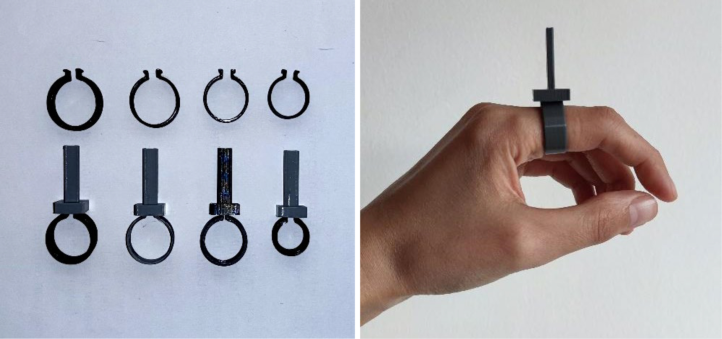
ACTIONS FOR IMPROVEMENT Focusing on comfort and wearability, we prioritised the development of a ring system for easy donning and doffing, secure fastening, and preventing discomfort. The system consists of individual rings worn in fingers, inserted in the nests located on the skeleton by leveraging material flexibility and interlocking tabs (Figure 7). We have completed first iterations and currently adapting the nesting piece to the exoskeleton.
Figure 7: First iterations of the ring system design.
As adjustability to various hand sizes is vital, the following steps will include designing a set of ring components based on an existing data set for hand anthropometry (Cakit et al., 2012). The data set will be used to develop an ergonomic design approach combining ‘design for extremes’
Formative Usability Assessment of a Rehabilitative Hand Exoskeleton 363
(5th percentile female and 95th percentile male) and ‘design for adjustable range’ strategies to accommodate the largest possible population (McCauley, 2012). Further improvements can be made for a balanced distribution of the weight of the robotic setup to mitigate the load and discomfort on the wrist and arm. In addition to relocating the motor and actuator mechanism without obstructing the proper functioning, it is possible to place an adjustable base to the setup to support the wrist and minimise the load of the exoskeleton.
The standard wrist splint will be replaced by a custom-designed, fingerless guard glove to mitigate sweating and weight-pulling. A breathable material such as knitted polyester can be used as the main material, supported by 3D- printed attachments to fasten the exoskeleton. Polyester is widely preferred in sports gear due to its ability to facilitate sweat dispersion.
Visual simplicity and acceptability are important concerns raised by rigid exoskeletons as also emphasised in the literature. Being a rehabilitation device, system performance is naturally prioritised in the design and development of wearable rehabilitation robots, therefore device form is often overlooked. Although the skeleton structure cannot be interfered with simply based on visual concerns, disguising, collecting and orderly connecting the cables to the system components and power source can significantly contribute to the visual simplicity. Finally, replacing the current finger pieces with the newly developed ring system design is expected to improve the aesthetic perception of the device.
CONCLUSION
This paper presents our findings of the formative usability assessment of a fully actuated rehabilitative hand exoskeleton. The user evaluations were conducted simultaneously with the motor tests carried out with an initial setup. Early involvement of users helped identify major usability problems that can be solved and integrated into the upcoming system revisions. This required the collaboration of a team of engineers and industrial designers, creating opportunities for the improvement of the user-friendliness of the device without compromising its performance. Future work will include integrating the planned changes into the new prototype iterations, and structured usability tests to assess comfort, wearability and perception of the device.
ACKNOWLEDGMENT
This research was funded by the Scientific and Technological Research Council of Türkiye (TÜB˙ITAK), grant number 121E107. The authors would like to thank Amr Okasha for his contributions to the testing procedure.
REFERENCES
Agarwal, P. & Deshpande, A. D. (2015). Impedance and force-field control of the index finger module of a hand exoskeleton for rehabilitation. Proceedings of IEEE International Conference on Rehabilitation Robotics, 85–90. Almenara, M., Cempini, M., Gómez, C., Cortese, M., Martín, C., Medina, J., Vitiello,
N., & Opisso, E. (2017). Usability test of a hand exoskeleton for activities of daily living: an example of user-centered design. Disability and rehabilitation: Assistive technology, 12(1), 84–96. Ambrosini, E., Ferrante, S., Rossini, M., Molteni, F., Gföhler, M., Reichenfelser, W., … Pedrocchi, A. (2014). Functional and usability assessment of a robotic exoskeleton arm to support activities of daily life. Robotica, 32(8), 1213–1224. Baltrusch, S. J., Houdijk, H., van Dieën, J. H., van Bennekom, C. A. M., & de Kruif,
A. J. T. C. M. (2020). Perspectives of End Users on the Potential Use of Trunk Exoskeletons for People with Low-Back Pain: A Focus Group Study. Human Factors, 62(3), 365–376. Béjot, Y., Bailly, H., Durier, J. & Giroud, M. (2016). Epidemiology of stroke in Europe and trends for the 21st century. Presse Medicale, 45(12), 391–398. Cakit, E., Durgun, B., Cetik, O., & Yoldas, O. (2012). A Survey of Hand
Anthropometry and Biomechanical Measurements of Dentistry Students in Turkey. Human Factors and Ergonomics in Manufacturing & Service Industries, 24(6), 739–753. Ferguson P. W., Shen, Y. & Rosen, J. (2019). Hand Exoskeleton Systems—Overview.
In Jacob Rosen & Peter Walker Ferguson (eds.), Wearable Robotics: Systems and Applications (pp. 149–175). Elsevier Academic Press. Hill, D., Holloway, C. S., Morgado Ramirez, D. Z., Smitham, P., & Pappas, Y.
(2017). What are user perspectives of exoskeleton technology? A literature review. International Journal of Technology Assessment in Health Care, 33(2), 160–167. Kabir, R., Sunny, M. S. H., Ahmed, H. U. & Rahman, M. H. (2022). Hand Rehabilitation Devices: A Comprehensive Systematic Review. Micromachines, 13(7):1033. Kobbelgaard, F. V., Kanstrup, A. M., & Struijk, L. N. S. A. (2021). Exploring User
Requirements for an Exoskeleton Arm Insights from a User-Centered Study with People Living with Severe Paralysis. In C. Ardito, R. Lanzilotti, A. Malizia, A. Malizia, H. Petrie, A. Piccinno, G. Desolda, & K. Inkpen (Eds.), Proceedings of the Human-Computer Interaction – INTERACT 2021, Part I (pp.312–320). Springer. Levin, M. F. & Demers, M. (2020). Motor learning in neurological rehabilitation.
Disability and Rehabilitation, 43(24): 3445–3453. Majidi Fard Vatan, H., Nefti-Meziani, S., Davis, S., Saffari, Z. & El-Hussieny, H. (2021). A review: A Comprehensive Review of Soft and Rigid Wearable Rehabilitation and Assistive Devices with a Focus on the Shoulder Joint. Journal of Intelligent & Robotic Systems, 102:1–24. Marchal-Crespo L, Reinkensmeyer DJ. Review of control strategies for robotic
movement training after neurologic injury. NeuroEngineering and Rehabilitation, 6: 1–15. Martinez-Hernandez, U., Metcalfe, B., Assaf, T., Jabban, L., Male, J., & Zhang, D.
(2021). Wearable Assistive Robotics: A Perspective on Current Challenges and Future Trends. Sensors, 21(20), 6751. McCauley, P. (2012). Ergonomics: Foundational Principles, Applications, and Technologies. CRC Press. Prange, G. B., Jannink, M. J., Groothuis-Oudshoorn, C. G., Hermens, H. J., &
Ijzerman, M. J. (2006). Systematic review of the effect of robot-aided therapy on recovery of the hemiparetic arm after stroke. Journal of rehabilitation research and development, 43(2), 171–184.
Formative Usability Assessment of a Rehabilitative Hand Exoskeleton 365
Sans-Muntadas, A., Duarte, J. E., & Reinkensmeyer, D. J. (2014). Robot-assisted motor training: assistance decreases exploration during reinforcement learning. In Proceedings of the International Conference of the IEEE Engineering in Medicine and Biology Society (pp. 3516–3520). Wafa, H. A., Wolfe, C. D. A., Emmett, E., Roth, G. A., Johnson, C. O., & Wang,
Y. (2020). Burden of Stroke in Europe: Thirty-Year Projections of Incidence, Prevalence, Deaths, and Disability-Adjusted Life Years. Stroke, 51(8), 2418–2427. Washabaugh, E. P., Treadway, E., Gillespie, R. B., Remy, C. D., & Krishnan, C.
(2018). Self-powered robots to reduce motor slacking during upper-extremity rehabilitation: A proof of concept study. Restorative neurology and neuroscience, 36(6), 693–708. Zhu M, Biswas S, Dinulescu SI, et al. Soft, Wearable Robotics and Haptics: Technologies, Trends, and Emerging Applications. Proceedings of the IEEE (pp. 246–272).
LISTED IN THE AHFE DIGITAL BOOKSTORE CATALOGUE
Explore the complete digital volume
Human Interaction and Emerging Technologies (IHIET 2024)
Read this individual research paper free through the original publisher, or explore the full digital proceedings book.
ISBN 978-1-964867-33-5
Explore this ISBN in the AHFE Bookstore ↗Listed in the July 2026 bookstore catalogue; search by ISBN to confirm current availability · Digital book purchase optional