Poliana Vilar Torres Ferreira, Angélica De Souza Galdino Acioly (2025). The Activity of The Ultrasound Physician – Comparative Analysis Between Procedures Using Transducers In Abdominal Examinations And Their Repercussions. In: Ergonomics In Design and Kansai Engineering. AHFE Open Access, vol. 170, pp. 157–163. https://doi.org/10.54941/ahfe1006177
The advancement of new technologies has significantly enhanced the design of ultrasound transducers, improving the usability of these devices by healthcare professionals. Despite these developments, sonographers remain among the professional groups most affected by work-related musculoskeletal disorders. This study investigates the ergonomic and usability aspects of ultrasound transducers, particularly focusing on the interface between users and devices, including the application of ergonomic accessories for ultrasound cables. The research aims to propose practical guidelines for the proper handling of transducers during abdominal examinations, based on physical complaints reported by ultrasound professionals at the Hospital das Clínicas, Federal University of Pernambuco (UFPE). This is a bibliographic, documentary, and field-based study with a descriptive, qualitative, and quantitative approach. Comparative analyses and systematic user observations were conducted. Usability tests were applied, and biomechanical assessments were carried out using the Rapid Upper Limb Assessment (RULA) method. Environmental factors such as temperature, lighting, and noise levels were also measured using specialized equipment. The findings highlight the presence of ergonomic risks and reinforce the need for targeted occupational health interventions to improve working conditions and ensure user safety.
Until the 20th century, product design primarily focused on technical and functional aspects (Iida & Guimarães, 2016). With industrial development, there was increased investment in ergonomics and design, including emotional and usability factors. The design of products includes methods that vary according to technological evolution and human needs. In recent decades, ergonomic aspects and production design have gained preference among users, maximizing safety, functionality, and usability. However, many products, including medical equipment, are still produced without proper consideration (Paschoarelli, 2016). In this context, usability represents
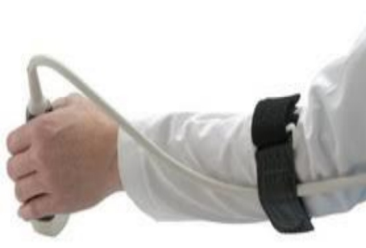
the ability of a product or system, in functional and human terms, to be used easily, effectively, and efficiently by a specific group of users. Therefore, one of the advantages of studying usability is the reduction of users’ cognitive overload, helping them understand what is happening with the system and minimizing errors (Santa Rosa, 2008). From this perspective, a product that does not meet users’ needs by failing to satisfy aesthetic preferences regarding shape, size, and weight, or by being too rigid may lack essential ergonomic ease of use and thus present a serious potential for user disinterest. The complexity involved in using a product can lead to low usability. One example is the association between the work of ultrasonographers and musculoskeletal disorders, especially due to the handling of the main component of the ultrasound equipment, the transducers which are responsible for capturing images. In medicine, various diagnostic tools such as ultrasonography underwent significant redesigns. USG is an accessible, low-cost imaging method widely used to detect diseases, including cancer. However, increased complexity in using such tools can reduce usability and lead to musculoskeletal disorders (MSDs) among practitioners. In particular, abdominal exams due to higher repetition are associated with a greater incidence of these conditions. The main ergonomic constraint in ultrasonography involves the transducers, whose prolonged use can result in wrist, shoulder, and back pain. Studies suggest solutions such as ergonomic posture adjustments and transducer support devices.
Figure 1: Transducer support devices (Smart sonographer, 2015).
This research aims to comparatively analyze the procedures involved in the use of transducers during abdominal examinations, focusing on the adoption of support devices and their possible effects on the discomfort, pain, and performance experienced by professionals during the activity. It is worth noting that resources like these, although readily available on the market in countries such as Canada and the United States, are still relatively underutilized in sectors of this nature, especially in the public sector (Peterson, 2017). Hence the need to conduct a comparative analysis of the procedures in order to assess the actual efficiency and effectiveness of the product, as well as to determine whether its use is related to improved performance and well-being of physicians during examinations.
The Activity of the Ultrasound Physician – Comparative Analysis 159
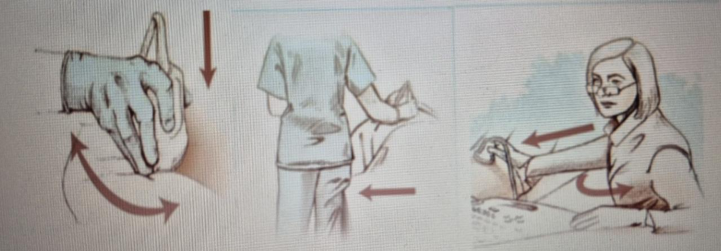
RISKS OF ULTRASOUND ACTIVITY Among the existing occupational risks, in general terms, the ultrasound (US) professional is primarily exposed to ergonomic risk, especially regarding sustained and awkward postures. In ultrasound practice, there is a series of movements that pose physical risks, as illustrated in the figure below.
Figure 2: Murphey (2017) refers to such risks as physical: force, repetition, awkward or sustained postures, and contact pressure. Left to right: excessive force applied to the transducer, friction contact between a body, awkward postures and an external object.
Among the risks mentioned so far, it is essential to highlight the worker’s exposure to certain conditions. Among the ergonomic parameters, some criteria in the work environment stand out: temperature: according to Iida (2016), when a person is forced to endure high temperatures, their performance declines. Work speed decreases, breaks become longer and more frequent, the level of concentration drops, and the frequency of errors and accidents tends to increase significantly, especially above 30
C. Noise: According to NBR 10.152, which addresses noise levels for acoustic comfort, acceptable noise levels are established for various environments. For hospitals, the recommended levels range from 35 to 45 dB. The lower end of the range represents the sound level for comfort, while the upper end indicates the maximum acceptable level for the intended purpose.Lighting: According to NBR 5413, illuminance levels of 150, 200, and 300 lux are recommended for diagnostic rooms. It was observed that in many workrooms with computers, when luminance levels exceeded 500 lux, operators themselves had removed some of the light bulbs to reduce ambient lighting to levels between 200 and 300 lux. This is likely due to the discomfort caused by the high contrast with the dark background of the monitors (IIDA, 2016). Regarding workstation dimensions, approximately 4.2 m2 per person is necessary. The ideal distance between work surfaces should be between 1.20 and 1.50 meters (IIDA, 2016).
The present study was conducted in accordance with the ethical principles established by the Brazilian National Health Council and was approved by the Research Ethics Committee for human subjects at the research site.
About Methodology type: descriptive, exploratory, qualitative, and quantitative research based on systematic observations. The study was
160 Ferreira and Acioly
conducted in the ultrasound sector of the Hospital das Clínicas (HC/UFPE). Participants included five physicians from a team of seven who regularly perform abdominal exams, selected based on availability. The devices used were two convex transducers GE C5-1 and Philips C5-2 and a transducer cable support manufactured by Soundergonomics. Data collection followed several stages: (1) context mapping, which involved evaluating transducer usage scenarios; (2) participant recruitment, carried out through personal invitations and project presentations; and (3) testing, which was divided into three parts, Part 1: evaluation of efficiency and effectiveness with and without the support device; Part 2: assessment of user satisfaction using the System Usability Scale (SUS); and Part 3: analysis of pain and discomfort through Corlett’s Pain Diagram and biomechanical assessment using the RULA method. Additionally, the environmental conditions such as sound, lighting, and temperature—were measured using appropriate instruments in accordance with NBR and NHO-11 standards.
Participants were aged 30–39, most worked 40+ hours per week, and had over 10 years of USG experience. None reported existing work- related injuries. All completed the tasks without difficulty and reported high usability for both transducer models SUS scores were above 70 for all setups, with slightly lower satisfaction for the support device. 80% reported improved comfort with the support device, though 20% needed assistance to put it on.
Table 1: Average product satisfaction values per participant (SUS).
Table available in the original PDF paper.
Transducer Model A Transducer Model B Transducer
Participants Transducer
Transducer With Support
Transducer With Support Without Without Support Support
According to the analysis of the responses regarding user satisfaction, it was observed that all participants reported no significant differences between transducer models A and B. Based on the findings, both models were deemed suitable for use. Although the support device received slightly lower scores compared to the transducers used alone, it still achieved a rating that indicates good usability. From the analysis, it was found that 80% of participants would like to use the products frequently, and all stated that the products are very easy to use. However, 20% felt that assistance from another person would be necessary to help position the support device. All participants agreed that the usability testing serves as a useful tool for promoting, visualizing, and evaluating the products, which they found appropriate for their target audience. Nonetheless, no preference was expressed for a specific
The Activity of the Ultrasound Physician – Comparative Analysis 161
transducer model, as both were perceived similarly in the context of the tests conducted.
It was found that both models are recommended for use, scoring more than 70 points in the usability assessment, although the use of the support device has a lower score than the use of the transducers alone, it still offers a score that indicates good usability and product recommendation. Comparison of Transducers: there is no preference for a particular transducer, they are easy to use.
Use of Support Devices: Devices such as wrist rests and articulated arms tested, reduction in muscle tension and greater movement control, Increased comfort and precision during prolonged exams.
The Research Environment Regarding the condition of the work environment in the examination rooms, in terms of climate control, acoustics, and lighting, the table below presents the measured values.
Table 2: Ergonomic analysis of the work environment/measurement of sound levels, lighting and temperature.
Table available in the original PDF paper.
Place Noise Intensity Temperature Lighting Room 01 58 dB 20,5
C 001 lux Room 02 51 dB 23
C 001 lux Room 03 59 dB 21,5
C 001 lux Room 04 56 dB 21
C 001 lux Room 05 58 dB 25
C 001 lux Typing room 68 dB 22
C 001 lux
The five exams rooms were evaluated in terms of temperature, illuminance, and humidity for future recommendations and adjustments. The temperature in Room 5, recorded at 25
C, exceeds the limits established by NR17/2018 and even those suggested by environmental comfort studies. It can also be observed that the illuminance value is well below the level recommended by NHO 11/2018(FUNDACENTRO, 2018). All rooms showed sound levels above the recommended limits.
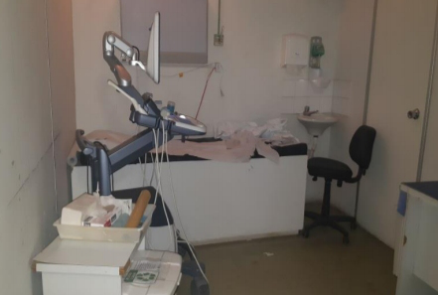
Figure 3: Fixed-height examination table without adjustment (Room 2).
162 Ferreira and Acioly
The examination table without height adjustment may force the professional to adopt poor posture in order to reach the examination area. As a result, since all the interviewed physicians preferred to perform the exams while standing, excessive trunk twisting may occur in order to reach the target area during the procedure.
No discomfort was reported in open questions. Pain diagram showed 80% with no discomfort; 20% reported pain in neck, cervical, pelvis, and right shoulder. RULA analysis indicated poor posture in 80% of participants. Ergonomic evaluation revealed inadequate furniture, poor lighting, and excessive noise levels.
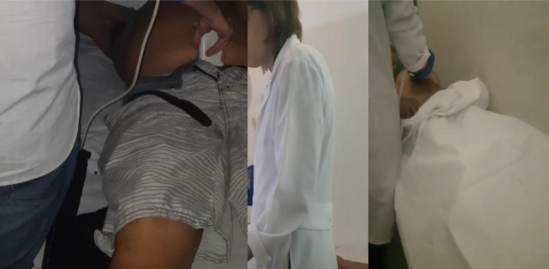
All interviewees perform abdominal examinations in a standing posture as an ergonomic resource, this collaborates with the research carried out by Peterson (2017), where it was shown that professionals who perform abdominal examinations in a standing position have fewer disorders regarding RSI/DORT resulting from the activity.
The pain regions are consistent with literature. Postural habits (e.g., standing exams) correlate with fewer MSDs. Both transducer models were efficient and effective, confirming that current technologies are lightweight and ergonomic.
Though usability scores were satisfactory, 20% reported difficulty fitting the support device, suggesting a need for design improvements. Environmental adjustments are essential to reduce ergonomic strain.
CONCLUSION
The analyzed products offer comfort and usability; however, ergonomic postures must be adopted to prevent health risks. Future biomechanical studies are recommended to evaluate long-term implications, especially for other types of USG exams. Preventive strategies based on ergonomic analysis should be implemented to reduce the risk of future disorders and optimize performance.
The Activity of the Ultrasound Physician – Comparative Analysis 163
REFERENCES
Corlett, E. Nigel. Evaluation of human work – A practical ergonomics methodology.
Taylor & Francis: Londres, 1995. pp. 663–713. Ferreira, P. V. T.; Santos, L. The evaluative image of ultrasound transducers: Diachrony vs synchrony in aesthetic preference. Brazilian Congress of Ergonomics - ABERGO, Curitiba, 2019. Fundacentro. Norma de higiene Ocupacional. Avaliação dos níveis de iluminamento
em ambientes internos de trabalho: Procedimento técnico. São Paulo: Fundacentro, 2018. Ilda, I.; Guimarães, L. Ergonomia: projeto e produção. 3.ed. São Paulo: Editora Blucher, 2016. 360p. ISO. International Standards Organization. ISO CDS9241-11: Guidelines for specifying and measuring usability, 2011. Jordan, P. W. Usability and Product Design. In: Karwowski, W. (ed). International
Encyclopedia of Ergonomics and Human Factors. 2nd ed. Boca Raton, FL: Taylor & Francis Group, 2006. Macruz, P. D. Ergonomic Study of the Workstation of Ultrasonography Physicians.
2017. 56 f. Monograph (Specialization in Occupational Safety Engineering - Federal Technological University of Paraná). Londrina, 2017. Murphey S. Work Related Musculoskeletal Disorders in Sonography. Journal of Diagnostic Medical Sonography. 2017;33(5): 354–369. Paschoarelli, L. C. et al. Ergonomic Design of Diagnostic Ultrasound Transducers:
Analysis, Redesign/Modeling. Advances in Cognitive Ergonomics, p. 307, 2016. Peterson, C. L., Evans, K. D.; Renee Axiotis, I. Sonographer Scanning Practices and Musculoskeletal Injury: Evaluation of an Occupational Health Issue Using the Health Belief Model. Journal of Diagnostic Medical Sonography, 33(5), 412–418, 2017. Santa Rosa, J. G. Avaliação e projeto no design de interfaces. 1. ed. Teresópolis, RJ:
2AB, 2008. Smart sonographer, Easier and less painful scanning with one simple item, 2015. Disponívelem: http://www.smartsonographer.com/blog/easier-and-less-pa inful-scanning-with-one-simple-item/.
LISTED IN THE AHFE DIGITAL BOOKSTORE CATALOGUE
Explore the complete digital volume
Ergonomics In Design and Kansai Engineering
Read this individual research paper free through the original publisher, or explore the full digital proceedings book.
ISBN 978-1-964867-46-5
Explore this ISBN in the AHFE Bookstore ↗Listed in the July 2026 bookstore catalogue; search by ISBN to confirm current availability · Digital book purchase optional