Daniel Feiser, Elena Dalinger, Nina Mundt (2025). A human-centered approach to support business process analysis. In: Human Factors in Design, Engineering, and Computing. AHFE Open Access, vol. 199, pp. 290–299. https://doi.org/10.54941/ahfe1006841
Business process analysis constitutes an essential prerequisite for business process optimization. Identifying problematic areas in a process and defining the optimization goals are important aspects of process analysis. This paper proposes a novel approach to process analysis that is suitable for both experts and novices. The novelty of the approach lies in the definition of a set of distinct, generic goals based on usability criteria, as well as the classification of problems that can occur in a process. The developed approach supports the identification and definition of problems concerning a business process, as well as the formulation of precise optimization goals. This in turn facilitates the finding of effective solutions and the achievement of goals.
According to the Business Process Management (BPM) lifecycle (Dumas et al., 2018), process analysis follows the process discovery phase, where the documentation of the as-is state of relevant processes takes place. Thus, in the process analysis phase, the previously created as-is process models are analyzed. Subsequently, issues and problems can be identified. Insights on these weaknesses serve as the basis for improving the processes in the following redesign phase, eventually resulting in optimized to-be process models that are ready for implementation.
This paper aims to contribute to the field of BPM by providing a systematic approach for process analysis that is suitable for both experts and novices. A process is more than just a series of activities. There are people who carry out activities, resources they need to perform tasks, and information that should be exchanged to successfully execute the activities. Business process problems can be caused by a variety of factors, such as a lack of suitable equipment, ineffective communication, or inadequate planning. To assist process analysts in identifying process problems, a set of problem sources was defined. The following five problem sources were identified: activity scheduling, use of work equipment, information generation, information exchange, and personnel deployment. Each problem source can have an impact that is identified as excessive, insufficient, or inappropriate. Therefore, a business process problem can be characterized by its source and its impact.
A Human-Centered Approach to Support Business Process Analysis 291
The developed approach also provides guidance for the formulation of precise optimization goals and the assignment of problem sources to them. A review of the relevant literature on business process optimization revealed a notable absence of a standardized definition of optimization goals. The goals are often not clearly and distinctly defined, which makes it difficult to allocate a problem to a specific goal. The novelty of the approach lies in the definition of a set of generic, distinct goals based on usability criteria, which helps to describe an optimization problem thoroughly. Within this set, satisfaction is introduced as a key goal for process optimization. Another aspect of the developed approach is considering the problem from two perspectives: that of the sender, whose output contributes to the problem, and that of the receiver, for whom the input becomes the problem. To help users apply the approach, a stencil was created to define a problem from either the sender or the receiver perspective, and to match it to a goal.
A series of workshops with process analysis and optimization experts were conducted in several interactive stages to validate the approach. An initial evaluation with users suggests that the developed approach can effectively support them in carrying out process analysis tasks. The findings of the research emphasize the importance of adopting a human-centered approach to work design in the context of business process optimization. The structured approach provides a new way of analyzing business processes that can be applied by both experienced and novice process analysts.
RELATED WORK
For process analysis, both qualitative and quantitative approaches exist. Examples of qualitative techniques are the identification of unnecessary activities in a process via value-added analysis (Conger, 2013) or, vice versa, via waste analysis (Modig and Ahlström, 2012). Both help to detect process inefficiencies. Stakeholders may be interviewed to collect process issues from multiple perspectives (Schwegmann and Laske, 2011). Identified process problems can be deeply investigated through root cause analyses (Conger, 2013). Quantitative process analysis provides performance measures like cycle time, waiting time, and labor cost. Techniques such as flow analysis and queueing theory (Laguna and Marklund, 2004) or simulation (van der Aalst, 2015) can be used, for example, to reveal issues relating to the process flow or bottleneck resources.
The goals pursued through process analysis and optimization are often described as cost savings, time reductions, quality improvements, and flexibility increases (Dumas et al., 2018; Reijers and Mansar, 2005). To indicate that the four dimensions of cost, time, quality, and flexibility can conflict with each other, they are also referred to as the “Devil’s Quadrangle”. Other optimization goals mentioned in the literature are for example improving competitiveness, increasing revenue, improving productivity, reducing service time, reducing production time, improving existing products, increasing transparency, managing risks, improving customer service, and improving customer satisfaction (Harmon and Garcia, 2020; Mansar et al., 2009; Zhou and Chen, 2003). Many of these goals are interconnected:
Reducing production time, for example, can also reduce costs and improve productivity. Another example is the goal of increasing process transparency. Transparency serves to improve the understanding of workflows. And this, in turn, serves to save time. Thus, transparency can be seen as a means to achieve the actual, underlying goal of time reduction. A standardized collection of possible goals could not be identified in the literature on business process optimization.
As Hofacker and Vetschera (2001) point out, there is no single optimal process design. Depending on which of the conflicting improvement goals and criteria are selected, the resulting to-be process can turn out differently. Consequently, specific goals are needed to guide the optimization process. Yet the goals described in the literature tend to be unspecific and not clearly defined.
To support process analysts in identifying and eliminating existing process weaknesses, the following sections address a classification of potential process problems and a definition of specific goals to guide process optimization efforts.
DEVELOPING AN APPROACH TO SUPPORT BUSINESS PROCESS ANALYSIS An important part of business process analysis is the definition of problems that arise in the process, which is essential for the identification of areas for improvement. A structured approach, described below, is based on the classification of problems and the definition of the corresponding goals. First, the classification of the problems is discussed, followed by the definition of the set of goals. Finally, a tool that supports the application of the approach is presented.
Problem Classification In order to describe problems in a process, the Theory of Inventive Problem Solving (TRIZ) is employed (Koltze and Souchkov, 2017). TRIZ is the result of studies based on worldwide patent research, which have led to the findings that many basic technical problems have already been solved before and that the principles applied can be used to solve similar problems. Though TRIZ methods were originally developed for engineering, they can be adapted to business process management (Souchkov, 2010; Souchkov, 2017; Mann, 2007; Ruchti and Livotov, 2001). One of the TRIZ methods, the 76 Standard Solutions for eliminating substance-field problems (Koltze and Souchkov, 2017), define negative effects, which can arise in technical systems. There could be a lack of effect, insufficient effect, or a harmful effect. In most cases, processes have no purely harmful effects. However, there are instances where the effect is beneficial and harmful simultaneously, or where a beneficial effect can be enhanced.
To develop the approach, a database of use cases, which address a range of optimization problems from different disciplinary fields and their respective solutions, was utilized. The use cases were derived from the cases documented in research projects conducted by the authors themselves. Some were sourced from case studies documented in the relevant academic literature.
A Human-Centered Approach to Support Business Process Analysis 293
The database was created for the purpose of finding solutions to problems that are similar to those of the user. Based on the use cases from the database, three abstract problem patterns were defined according to the effects that can occur in processes, as presented in Table 1.
Table 1: Problem patterns according to effects.
Table available in the original PDF paper.
Effects Problem Pattern Problem Example Lack of effect Element missing (too little) Actor does not receive relevant messages Simultaneous beneficial and harmful effect
Element superfluous (too much)
Actor receives superfluous messages (in addition to useful ones) Insufficient effect Element inappropriate Actor must wait for a message to be sent The problem patterns always relate to a certain process element. For the classification of relevant process elements, Business Process Modeling Notation (BPMN; OMG, 2013) was utilized. Actor (defined by the lane), activity (task), message, data object, and data store were deemed suitable. Message, data object, and data store were combined to the element “information”. Additionally, the element “work equipment”was introduced, which represents software and hardware. Eventually, the following elements, called problem sources, were selected for refining the problem patterns: actor (personnel), activity, information, and work equipment. These problem patterns were revised based on an analysis of the use cases in workshops with process analysis and optimization experts to ensure consensus. Finally, the following five problem sources were identified:
Personnel deployment – Allocation of actors to the activities of the process, considering qualitative and quantitative parameters. Personnel can either be missing, unsuitable, or unnecessary. Related question: Are there any problems in assigning the actors to the activities?
Activity scheduling – Planning and coordination of activities in a process, considering the temporal and spatial parameters. Activities can either be unplanned, poorly planned, or unnecessary. Related question: Are there any problems with how activities are planned and coordinated?
Information generation – Creation and utilization of information to enable collaboration between actors. The information can either be missing, incorrect, or unnecessary. Related question: Are there any problems with the creation or use of the information?
Information exchange – Data communication or the access to information. It encompasses the exchange and transfer of information between the actors, whereby the time aspect is also considered. There may be too little or no exchange of information, or the communication or communication channel may be inappropriate or unnecessary. Related question: Are there any problems with communication or access to information?
Use of work equipment – Consideration of the work equipment that is used to complete the tasks. The work equipment can either be missing,
unsuitable, or unnecessary. Related question: Are there any problems when using the work equipment?
Each problem source can have the problem characteristics “too little”, “inappropriate”, or “too much”. A resulting problem pattern is for example “too little personnel deployment”. It is noticeable that the aspects “time” and “costs”, which are frequently mentioned in the literature (e.g., Harmon and Garcia, 2020), are not explicitly mentioned in the problem patterns. However, these aspects are inherently present in all defined problem sources and, as a result, were not deemed suitable for classification.
Formulation of Distinct Goals for Business Process Analysis Initially, the goals pursued through business process optimization were analyzed. A comprehensive literature search was conducted, encompassing relevant studies (e.g., Reijers and Mansar, 2005; Dumas et al., 2018; Mansar et al., 2009; Harmon and Garcia, 2020), and the goals were compiled. A standardized collection of goals could not be identified in the literature on business process optimization. For the presented approach, however, it is necessary to be able to clearly assign a problem to a specific goal, so that process optimization actions can be taken in a goal-oriented manner. Therefore, clearly defined goals are required. In numerous iteration steps, six generic goals (see Table 2) were defined from the large number of goals identified in the above-mentioned literature analysis. Care was taken to ensure that these goals are clearly distinguishable from one another. All goals mentioned in the reviewed literature can be assigned to one of these six generic goals. Their selectivity also allows them to be clearly mapped to optimization problems.
Table 2: Distinct goals for business process optimization and their attributes.
Table available in the original PDF paper.
Perspective
Overarching Goal
Generic Goal Problem Impact Problem Characteristics Inappropriate Sender Efficiency Improving of efficacy/fit Incorrect allocation
Too much Sender
Efficiency Reduction of resource usage
Waste (abundance) Too little Sender Waste (potential) Effectiveness Increasing the quantity of results
Inadequacy Inappropriate Receiver
Effectiveness Improving the quality of results
Difficulty Too much Receiver
Satisfaction Reduction of the interaction effort
Dissatisfaction Too little Receiver
Satisfaction Increasing the satisfaction of needs
A Human-Centered Approach to Support Business Process Analysis 295
Process efficiency and effectiveness are overarching aspects that are often targeted by optimization efforts. Based on the definition of usability (ISO, 2020) from the field of software ergonomics, the six goals were assigned to the overarching goals “efficiency”, “effectiveness”, and “satisfaction” (see Table 2). Satisfaction is an additional important aspect that has not received enough attention to date and has therefore often been ignored in business process optimization. In the approach presented, satisfaction addresses the aspect of human-centered work design, and it is given the same priority as efficiency and effectiveness. Satisfaction is assigned the two goals of “reduction of interaction effort”and “satisfaction of needs”. The satisfaction of needs corresponds to Maslow’s hierarchy of needs (Maslow, 1943). The reduction of interaction effort is based on the interaction principles from ISO (2020), which, in the authors’ view, are also eligible for application to business processes: suitability for the user’s tasks, self-descriptiveness, conformity with user expectations, learnability, controllability, use error robustness, and user engagement.
During the testing phase of the method, certain issues with the assignment of goals were identified. For example, it became clear that two goals can be assigned to the problem “Employees have to wait for approval from superiors”. Approval should be given by supervisors at short notice, so that on the one hand the quantity of results is increased, but on the other hand the needs of the employees are also better met. After analyzing the issues, two findings emerged:
1. For the same problem, it is always possible to assign two goals.
2. The two goals that can be assigned to the same problem will always form a consistent pair of goals.
The two related goals were therefore defined as fixed “goal pairs” with the same problem characteristic (see Table 2). The analysis of the goal pairs revealed that a problem can always be viewed from two perspectives: from the sender perspective, who contributes to a problem due to an output, and from the receiver perspective, for whom an input becomes a problem. In the example, the supervisors (senders) provide too few approvals (output), while the employees’ (receivers’) need for satisfactory work is not met due to the excessively long waiting time for approval (input).
Having defined the generic optimization goals, the associated process problems and their impacts were examined in more detail. A series of workshops were conducted for the purpose of defining a problem impact for each goal. Finally, six problem impacts evolved (see Table 2). For example, the failure to achieve the goal of “increasing the quantity of results” is attributed to a waste of potential.
The three problem characteristics, which were identified as either excessive (too much), insufficient (too little), or inappropriate, were assigned to each goal, as can be seen in Table 2. For example, there can be too little of “something” to exploit the potential, making it desirable to increase the quantity of results. Or in other cases, dissatisfaction can be caused by having too little of “something”, with the goal of increasing the satisfaction of needs.
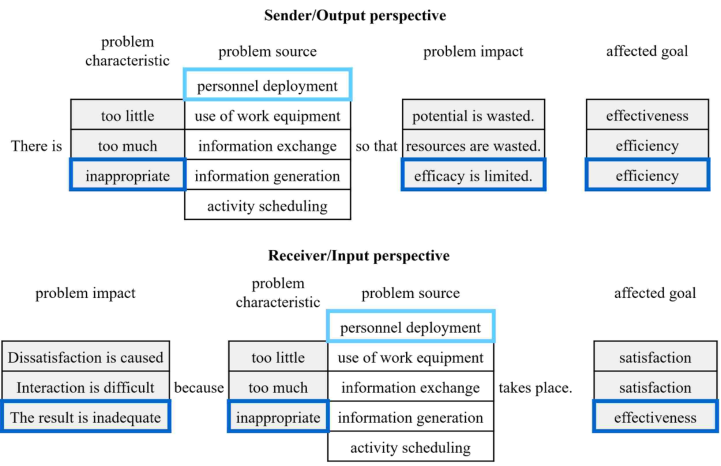
Stencil for Problem Definition Finally, all the aforementioned considerations were summarized in a stencil to assist users of the method. They can apply the stencil to define a problem from either the sender or receiver perspective and to match it to a goal (see Figure 1). The first step in defining a problem is to select a perspective. In the second step, two selections must be made in either order: the source of a problem and, depending on the understanding of the problem, either the problem characteristic, the problem impact, or the affected goal must be specified. The latter three are directly related, so that only one of these three elements needs to be selected. If, for example, “too little” is selected in the sender perspective, the problem impact of the waste of potential and the impairment of effectiveness are already defined in the same line. After selecting the two necessary options, two complete sentences are created that explain the problem. In the example problem “Employees have to wait for approval from superiors”, the two sentences depending on the selected perspective are (Figure 1):
Figure 1: Stencil for problem definition (parameter selection for the problem “Employees have to wait for approval from superiors”).
Sender perspective: “There is inappropriate personnel deployment, so that the efficacy is limited.” (impairment of efficiency)
Receiver perspective: “The result is inadequate because inappropriate personnel deployment takes place.” (impairment of effectiveness) The following example illustrates how the method is used by applying the stencil to specify a problem that was initially imprecisely defined. The problem can be described as such: “Several stakeholders from different
A Human-Centered Approach to Support Business Process Analysis 297
organizational units are involved in a process. The results are unsatisfactory, the process is not proceeding as expected, everyone blames each other.”
Starting from the receiver perspective, the initial hypothesis was that the result is inadequate (problem impact), and that this may be attributable to the individuals involved (problem source). Consequently, inappropriate personnel deployment as a problem pattern was selected (Figure 1). The affected goal is thus effectiveness: improving the quality of results. However, this goal was deemed to be unsuitable for addressing the identified issue: the staff were found to be suitable without exception.
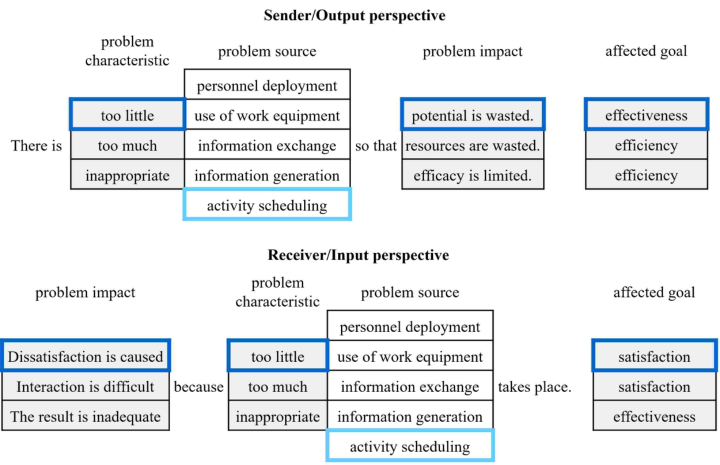
As the initial hypothesis was denied, a secondary assumption was proposed, namely that activity scheduling was a matching problem source, given its association with the planning and coordination of activities in the process. Due to the high level of dissatisfaction in the process, the problem impact “dissatisfaction is caused” in the stencil was then selected, which is equivalent to the problem pattern “too little activity scheduling” (Figure 2). This problem definition was found to be suitable. In addition, the corresponding selection in the sender perspective showed that “waste of potential”, which limits effectiveness, is also an appropriate description. This example illustrates how the method can be applied and demonstrates that the stencil can be an aid to define a problem, even if the problem definition was imprecise at the outset.
Figure 2: Stencil for problem definition (parameter selection for the problem “The process is not proceeding as expected”).
The stencil was implemented in the database of use cases addressing optimization problems and solutions. The cases were then classified according to the stencil. Thus, when analyzing a given process, the stencil can be used as a filter to search for cases with similar problem descriptions.
A preliminary qualitative evaluation of the stencil was conducted during the evaluation of the optimization database. Thereby, the stencil’s potential for defining a problem in order to identify use cases with similar problems in the database was investigated. The evaluation methods used were observation, think aloud technique, and structured interview. Six subjects participated, three of whom were experts in process optimization and three of whom were novices in this field. The participants were provided with a brief overview of the approach. Thereafter, the task instructions were provided to them. The tasks were to identify problems in two excerpts from a business process. At first, the subjects completed one of the tasks without the stencil, then completed the other task using the stencil.
The results indicate that the stencil can successfully support users, both experts and novices, in defining problems. Reported difficulties concerned understanding some of the terminology, e.g., the distinction between the sender and receiver perspectives. It was noted that more precise descriptions and explanations of the individual entries in the stencil, as well as additional practice, were required to overcome these issues. As the explanation of the approach at the beginning of the trials was brief, this was an expected outcome. However, observations showed that users could successfully utilize the stencil after one attempt, guided by an investigator. The stencil received positive feedback for being easy to learn, with users being able to apply it after a brief period of familiarization. Overall, participants stated that the method made them more aware of the process problems.
CONCLUSION
The research work presented is intended to expand the current state of the art in the field of process analysis, with the objective of developing a novel approach. Foundational scientific work was completed through a series of iterative steps and provided a solid basis for designing a comprehensive approach to process analysis. Further, a review of the relevant literature on business process optimization revealed a notable absence of a standardized definition of optimization goals. The necessity of formulating distinct goals resulted in the definition of a set of goals based on usability criteria. The novelty of this approach lies in its introduction of satisfaction as a goal for process optimization, which includes the human component in process optimization. The set of distinct optimization goals aims to encourage researchers and practitioners to consider more than just efficiency and effectiveness when optimizing business processes. Soft factors such as motivation, health, satisfaction, etc. play a major role and are closely linked to efficiency and effectiveness. The overarching goal of satisfaction should therefore be given equal consideration. The findings of the research emphasize the importance of adopting a human-centered approach to work design in the context of business process analysis. Although care must be taken to generalize the results of the preliminary empirical evaluation of the method, the results suggest that the method can support both novices and experts in identifying problems in a process. Nevertheless, the method developed needs to be further examined in future research by applying it to real-world tasks.
A Human-Centered Approach to Support Business Process Analysis 299
REFERENCES
Conger, S. (2015). Six sigma and business process management, in Handbook of Business Process Management 1, ed. by J. vom Brocke, M. Rosemann (Springer, Berlin), pp. 127–146. Dumas, M., Rosa, L. M., Mendling, J., Reijers, A. H. (2018). Fundamentals of
business process management. 2nd edn. Springer-Verlag. Harmon, P., Garcia, J. (2020). Business Process Trends, Report 2020, p. 18. Hofacker, I., & Vetschera, R. (2001). Algorithmical approaches to business process design. Computers & Operations Research, 28(13), 1253–1275. ISO (2020). ISO 9241–110:2020: Ergonomics of human-system interaction — Part
110: Interaction principles. Koltze, K., Souchkov, V. (2017). Systematische Innovation: TRIZ-Anwendung in der Produkt- und Prozessentwicklung. Carl Hanser Verlag, München. Laguna, M., Marklund, J. (2004). Business Process Modeling, Simulation and Design
(Prentice Hall, New York, 2004). Mann, D. (2007). Hands on Systematic Innovation: for business and management.
IFR Press. Mansar, S. L., Reijers, H. A., Ounnar, F. (2009). Development of a decision-making strategy to improve the efficiency of BPR. Expert Systems with Applications 36(2), 3248–3262. Maslow, A. H. (1943). A theory of human motivation. Psychological Review 50(4),
370–396. Modig, N., Ahlström, P. (2012). This Is Lean: Resolving the Efficiency Paradox (Rheologica, Stockholm). OMG (2013). Business Process Model and Notation (BPMN), Specification Version
2.0.2. Object Management Group (OMG), Specification. Reijers, H. A., Mansar, S. L. (2005). Best practices in business process redesign: an overview and qualitative evaluation of successful redesign heuristics. Omega 33(4), 283–306. Ruchti, B., Livotov, P. (2001). TRIZ-based Innovation Principles and a Process for Problem Solving in Business and Management. The TRIZ Journal, https://the-trizjournal.com/triz-based-innovation-principles- process-problem-solving-business-management/, last accessed 2025/02/ 25. Schwegmann, A., Laske, M. (2011). As-is modeling and process analysis, in Process
Management: A Guide for the Design of Business Processes, ed. by J. Becker, M. Kugeler, M. Rosemann (Springer, Berlin), pp. 133–156. Souchkov, V. (2010). TRIZ and Systematic Business Model Innovation. In: Proceedings of the 10th ETRIA World TRIZ Future Conference. Souchkov, V. (2017). Breakthrough Thinking with TRIZ for Business and Management: an Overview. http://www.xtriz.com/TRIZforBusinessAndManage ment.pdf, last accessed 2020/03/17. van der Aalst, W. M. P. (2015). Business process simulation survival guide, in Handbook of Business Process Management 1, ed. by J. vom Brocke, M. Rosemann (Springer, Berlin), pp. 337–370. Zhou, Y., & Chen, Y. (2003, October). Project-oriented business process performance optimization. In SMC’03 Conference Proceedings. 2003 IEEE International Conference on Systems, Man and Cybernetics. Conference Theme- System Security and Assurance (Cat. No. 03CH37483) (Vol. 5, pp. 4079–4084). IEEE.
LISTED IN THE AHFE DIGITAL BOOKSTORE CATALOGUE
Explore the complete digital volume
Human Factors in Design, Engineering, and Computing
Read this individual research paper free through the original publisher, or explore the full digital proceedings book.
ISBN 978-1-964867-75-5
Explore this ISBN in the AHFE Bookstore ↗Listed in the July 2026 bookstore catalogue; search by ISBN to confirm current availability · Digital book purchase optional