Matthia Leyendecker, Christian Zagel, Alexander Piazza (2023). ErgoMate: Concept and Prototype of an Automated Ergonomic Workpace System for Office Environments. In: The Human Side of Service Engineering. AHFE Open Access, vol. 108, pp. 254–263. https://doi.org/10.54941/ahfe1003127
In the past decade, globalization and digitization have not only changed the way we work, but also the environment in which we work. More and more companies are introducing desk sharing office concepts in which employees must share a workstation. However, this poses challenges for ergonomic workplace design as constant and ergonomically correct workstation settings can hardly be guaranteed. Neglecting ergonomics at workplace, though, can cause musculoskeletal disorders. Therefore, a concept and prototype for a system are proposed which automatically adjusts the workstation to the individual's anthropometric characteristics. A setup of different mechanical and electronical components using microcontrollers, ultrasonic distance sensors and linear actuators assures an automatic adjustment where users only must sign in with their ID. An initial field study shows that the system can achieve high user acceptance. Simplicity, speed, and convenience are seen as added value of the system. The results have potential for future studies.
Increasing globalization and digitization as well as the COVID-19 pandemic have significantly changed the way we work (Schwahn et al., 2018). Instead of in-office work hybrid work has become the standard. This massively influ- enced work environments in the office and home office context. More and more companies provide non-territorial offices, which are based on the desk sharing principle (DGUV 2016). In desk sharing employees have an assigned workplace but must share it sequentially with at least one other person. With the concept of non-territorial offices, however, the personal assignment of workplaces is completely abolished and workplace organization systems like so-called desk hoteling or hot desking become present (Duffy, 1992; Fawcett and Rigby, 2009; Schmalzl et al., 2004).
Ergonomic workplace design for each individual user is an essential cri- terion to prevent musculoskeletal pain and disorders (Ayanniyi et al., 2010; Bergqvist et al., 1995; Borhany et al., 2018). The ergonomic setup of a work- place includes, among other things, the adjustment of the desk height, office
ErgoMate: Concept and Prototype of an Automated Ergonomic Workpace System 255
chair and armrest height, the height and positioning of the monitors as well as the positioning of the overall work equipment (e.g., mouse, keyboard, telephone) with respect to the individual characteristics of the user.
While ensuring ergonomics in the context of classic office concepts with permanently assigned workplaces is already a challenge, it becomes more complex in the context of non-territorial office concepts and flexible work- places. The consequence: The individual characteristics and needs of indi- vidual employees are usually not considered in the context of desk sharing concepts. The ergonomics of the workplace and thus a healthy performance of activities can no longer be guaranteed (Burton, 1984; Grandjean et al., 1983). The aim of this work is to design a concept and prototype for an ergonomic workplace that automatically adjusts to the individual anthropometric cha- racteristics of the user. As an essential aspect of ergonomics, anthropometry aims at the geometric setting and alignment of workplace equipment based on the body dimensions of the user (Schmidt and Luczak, 2015). Following a human-centered approach, the goal of this concept is a solution where the user does not have to adapt to the workplace, but the workplace adapts to the respective user.
We apply the Design Science Research (DSR) research paradigm, which aims to create and evaluate new solutions in the form of artifacts, such as methods, models, instances, or products, in order to solve real-world pro- blems. DSR is a problem-solving paradigm and the goal is to develop new outcomes, so-called artifacts, through a practical research approach. Hevner and Chatterjee have developed a model that consists of three cycles: the Rele- vance Cycle, the Design Cycle and the Rigor Cycle. The Relevance Cycle aims to identify the relevance of the topic and all related requirements in order to outline and specify the context of use and the problem itself. The Rigor Cycle focuses on maintaining a certain level of research rigor by applying scienti- fic methods and consistently integrating existing knowledge into the design process. The Design Cycle includes the development of the design solution in the form of artifacts as well as the evaluation of these artifacts. All three cycles are thus interdependent and form an iterative process in which each cycle contributes to the improvement and refinement of the design solution.
THEORY AND RELEVANCE Non-territorial offices based on desk sharing principles have become popu- lar, allowing a flexible use of workplaces on the one hand, but neglecting the individual needs and occupational health on the other hand. Many stu- dies deal with so-called work-related diseases that can be caused by a variety of risk factors at work. Especially musculoskeletal disorders (MSD) are very common in the context of occupational work (Anderson et al., 1997; Arda- han and Simsek, 2016; Bauer et al., 2016). According to the World Health Organization (WHO), approximately 1.71 billion people worldwide are affe- cted by MSD, with lower back pain accounting for the largest proportion of prevalence (Cieza et al., 2020). Not only worldwide, but also within Europe and particularly in Germany, MSD are among the most common diseases
(Horlemann, 2022). According to statistics from a German health insura- nce regarding the reasons for incapacity of work, MSD are the second most common cause of employee absence after respiratory diseases. In terms of the duration of absenteeism, MSD are even leading (Schumann et al., 2022). Particularly back pain is the most common cause of absenteeism and work disability and for making use of the German healthcare system (Andersohn and Walker, 2016).
While this data refers to the correlation of occupational work and MSD in general, there are many studies which particularly explore the correla- tion of white-collar work and MSD. Most of these epidemiological studies show that there is a positive correlation between computer work and muscu- loskeletal complaints (Ayanniyi et al., 2010; Borhany et al., 2018; Cagnie et al., 2007; Eltayeb et al., 2007; Feuerstein et al., 1997; Jensen, 2003; Wærsted et al., 2010;). Especially the lack of workplace adjustment in rela- tion to the individual anthropometry of the user has been identified as a major cause. It has been shown that the correct adjustment of each work- place component is essential to prevent MSD. For example, there is strong evidence that both vertical and horizontal monitor orientation are major triggers of MSD symptoms, as they influence neck posture (Cagnie et al., 2007; Pillastrini et al., 2010; Straker and Mekhora, 2000). Similar findings have been obtained in relation to the adjustment possibilities of office chairs (Faucett and Rempel, 1994; Wærsted et al., 2010). For example, Delle- mann and Berndsen (2002) studied the interdependence between monitor and office chair settings with posture and occurring muscle strain. Straker et al. (2008) also found that the matching of monitor and desk height is crucial for minimizing the risk of MSD, as they significantly influence head and arm posture. Furthermore, they emphasized the general importance of a properly adjusted workstation as a prerequisite for an ergonomic working posture.
Due to the scientifically proven negative effects of office and computer work on human body, there is a need for health-promoting measures to pre- vent and reduce MSD and other health issues. Both behavioural prevention and situational prevention are important components in ensuring ergono- mics. An ergonomic equipment of the workplace is ineffective if the user is left to set it up himself. On the other hand, interventions such as ergonomic training or instructions on an ergonomic workstation setup are ineffective if there is a lack of ergonomic adjustment options of the workplace compo- nents. Individual workstation adjustments by experts or training on proper adjustment are also expensive and impractical, especially in the context flexi- ble workplace and time models. Furthermore, these usually only reach a small part of the employees and do not ensure that the final adjustments made by the employee are correct and consistently maintained. Existing solutions such as online tools or solutions from the office furniture industry that calculate the correct workstation settings based on body height are inaccurate because they are based on an incorrect calculation approach and thus cannot ensure individual ergonomics. Currently, there is a lack of preventive measures that effectively and sustainably ensure individual ergonomics. A holistic solution is needed that considers the individual anthropometry for the adjustment
ErgoMate: Concept and Prototype of an Automated Ergonomic Workpace System 257
of each workstation component and permanently ensures ergonomics in the workplace.
By automating the adjustment of workstation components in depende- nce on individual anthropometric measurements, aspects of behavioural prevention as well as situational prevention are considered, and indivi- dual ergonomics can be effectively ensured even in the context of non- territorial based offices. This approach has not yet been pursued in research.
CONCEPT AND PROTOTYPE The focus of the solution approach is the adaptive adjustment of the chair, desk and monitor height with regard to the respective user. Essential compo- nents and functions were identified that are necessary to design and build an automated self-adjusting workplace. These include the acquisition of the required anthropometric measurements (popliteal height, elbow height, elbow rest height, eye height sitting, eye height standing), the determination of the corresponding heights based on the measured body dimensions, as well as the user-specific setup of the workstation. Furthermore, appropriate motors and drive technology, a control system as well as data storage and transmission are required. So that the workstation components adopt a spe- cific setting value, they need to know the current motor position to be able to move into the right direction in relation to the target value. A final impor- tant aspect lies in the interaction design. Even if automated systems relieve the user of the tasks required to achieve the goal, some form of interaction is still required so that a user can use the system effectively and control it to a certain degree. A user interface is an important component to ensure the usability of a system and thus one of the four essential basic concepts of ergo- nomics (Stowasser, 2012). For this purpose, the system must be simple and understandable and must provide the user with information on the system status and feedback on the actions performed (DIN EN ISO 9241-11, 2018; Nielsen, 1994).
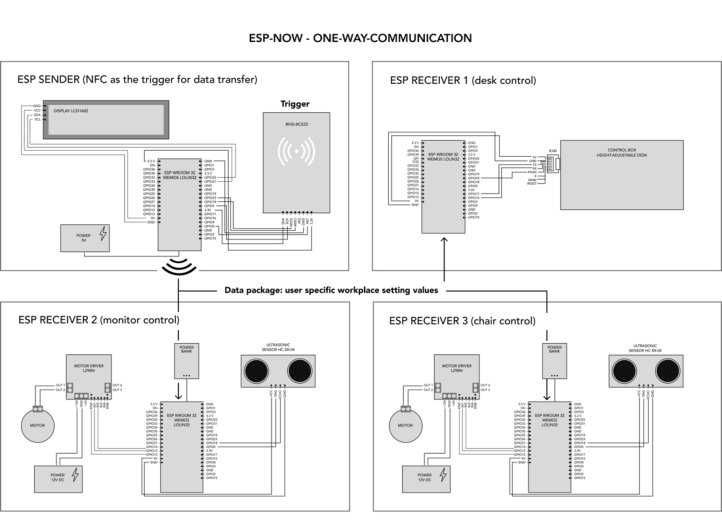
A possible solution considering the previous requirements was designed as follows: The required anthropometric measurements of the employee are taken once using an anthropometric chair. The corresponding heights of the workstation components are derived from these measurements applying DIN EN ISO 9241–5 (1999). The prototype itself is realized with the Arduino Inte- grated Development Environment (IDE). Each workstation is equipped with a module which includes a NFC-reader and a graphical user interface using a LCD and acts as the central control unit. Once the user has been identified via his NFC-based ID card, the corresponding setting parameters are called up and transmitted to the electrically adjustable workstation components (table, chair, monitor), which are also equipped with a microcontroller. The system uses the ESP-NOW communication technology to transmit the data. In this case one sender and three receivers for ESP-NOW communication are regi- stered. The table receiver is connected to a third-party unit which controls the motors of the height-adjustable desk, the monitor receiver is connected to a linear actuator which replaces a usual monitor mount and the chair receiver
Figure 1: System setup using ESP microcontrollers.
is also connected to a linear actuator which replaces the usual gas spring. The respective setup is shown in Figure 1.
While the table receiver uses the integrated height measurement of the third-party hardware, the other receivers are connected to ultrasonic distance sensors. All three compare their current height read by the sensors with the target height sent by the user interface component and automatically move to the ergonomically correct position of the user.
EVALUATION A field study was conducted to evaluate the system. Therefore, we instal- led and calibrated the system in a public coworking environment. Twelve participants, aged 29 to 42 years, randomly acquired in the respective wor- king area, took part in the evaluation. All are employed, have an office job and the opportunity of mobile work, e.g., in the home office, in the cowor- king space or at other locations. Eleven people use this option. Most of the participants work most frequently in the home office or at the company’s intended workplace. Six participants spend 50 to 74 percent of their wor- king hours at their desks. When being asked whether they work at their own, permanently assigned workplace or whether they must share it with other people, five stated that they had their own workplace. Four of them must sequentially share a specific workplace with other colleagues and three people find non-territorial office space in their company where there are no assigned workplaces.
ErgoMate: Concept and Prototype of an Automated Ergonomic Workpace System 259
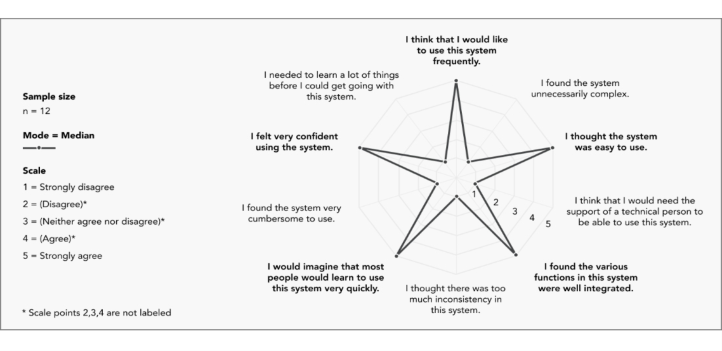
We used the System Usability Scale (SUS) questionnaire (Brooke, 1995) to evaluate the prototype. The SUS is a widely used, technology-independent questionnaire for the quantitative assessment of the usability of a system. The questionnaire contains ten items, each based on a five-point Likert-type scale from “Strongly disagree” (1) to “Strongly agree” (5), where only the two extreme points are labeled. Eight of these statements refer to the perceived ease of use. The other two items relate to the perceived learnability of the system (Lewis and Sauro, 2009, p. 9).
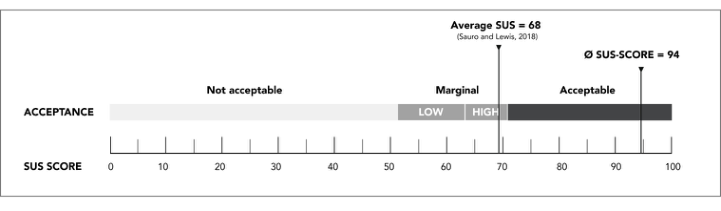
The evaluation results show that both attributes, usability, and learnabi- lity, are both high (see Figure 2). The SUS score, which is the average of the scores of all twelve participants, is 94 (see Figure 3). Based on the acceptabi- lity ranges, this corresponds to a high level of acceptance. However, the value should be viewed critically. The SUS score does not reveal any obstacles users may encounter while using the system. So despite the high score, negative usability problems can be present. On the other hand, the comparison with a benchmark such as the average score of 68 determined by Sauro and Lewis (2018) should always be made regarding the examined system or product and its context of use. Since no further data is available here, no statement can be made in comparison to similar systems.
Figure 2: Item-based evaluation SUS questionnaire.Figure 3: SUS score results.
CONCLUSION
The study aimed to implement a system for self-adjusting office workstations that ensure individual ergonomics. It emphasized the importance of ergo- nomics and its theoretical fundamentals and anthropometry as an essential subfield. The study also highlighted the potential health consequences of dis- regarding the necessary requirements for an ergonomically correct workplace adjustment. The examination of existing solutions in research and practice has shown that there currently is no solution that can effectively and sustai- nably ensure individual ergonomics. The study explored the automation of the workplace setup as a possible solution, especially in desk sharing conce- pts. A prototype was developed that focuses on the height adjustment of the three workstation components: table, chair, and monitor. Combining microcontrollers, linear actuators, ultrasonic distance sensors and NFC tech- nology with the Arduino IDE, the workstation components adapt to each user individually based on their body measurements.
A formative evaluation showed that the system was generally well- accepted, with users finding the interaction via NFC simple, fast, and a low-threshold solution. Automation itself was considered a benefit and, therefore, a core feature of the solution because it ensures a quick and uncom- plicated setup. Moreover, it provides a feeling of security and well-being by preventing an incorrect workplace adjustment. Regarding the settings based on anthropometric measurements, the study found that the determined tar- get settings were mostly accepted. Only a few participants wanted to make minimal adjustments to the settings. Generally, the desire for greater con- trol over the system emerged, which allows subsequent changes to target values and manual adjustment or storing of different heights, arising from the need for more relaxed settings throughout the day. Overall, the study demonstrates the feasibility and potential benefits of an automated system for workstation adjustment according to individual ergonomic requirements. It provides a solution to the lack of sustainable and effective systems for ensuring individual ergonomics in the workplace.
Nonetheless, the study is also bound to some limitations. The text discus- ses the application of anthropometric measurements in order to determine the correct setting values. Anthropometric measurements are taken in a refere- nce body posture to ensure data comparability (DGUV, 2019; DIN 33402-1, 2008; DIN EN ISO 9241-5, 1999). However, body dimensions measured in the reference posture can deviate from a comfortable (physiological) posture by approximately 1 to 1.5 percent. Therefore, measurements that depend on the extension of the spine (e.g., body height, eye height in sitting and standing, elbow height in sitting and standing) are usually smaller in practice than in standard measurements (DIN 33402-2, 2020). The adjustment values calcu- lated from the anthropometric measurements cannot guarantee one hundred percent accuracy and are therefore only an approximation. Furthermore, these reference postures do not correspond to a recommended posture that should be adopted over a longer period of time. Current occupational rese- arch recommends a dynamic posture characterized by alternating between different postures while sitting (leaning back, leaning forward) as well as
ErgoMate: Concept and Prototype of an Automated Ergonomic Workpace System 261
regular alternation between sitting and standing position (Buckley et al., 2014; Chastin & Granat, 2010; DGUV, 2019; European Agency for Safety and Health at Work, 2021; Levine, 2004; Pynt et al., 2001). A balanced sit- stand ratio and generally sufficient movement are therefore equally important factors to consider in the context of ensuring individual ergonomics.
Another limitation lies within the variation of clothing. Participants were measured wearing clothes. In practice, though, the worn clothes and especially the worn shoes vary from day to day.
REFERENCES
Andersohn, F. and Walker, J. (2016) Faktencheck Rücken. Ausmaß und regionale Variationen von Behandlungsfällen bildgebender Diagnostik. Gütersloh: Bertelsmann. Anderson, V., Bernard, B., Burt, S. E., Cole, L. L., Estill, C., Fine, L., Grant, K.,
Gjessing, C., Jenkins, L., Hurrell, J. J., Nelson, N., Pfirman, D., Roberts, R., Stetson, D., Haring-Sweeney, M., Tanaka, S. (1997) Musculoskeletal Disorders and Workplace Factors: A Critical Review of Epidemiologic Evidence for Work- Related Musculoskeletal Disorders of the Neck, Upper Extremity, and Low Back. Cincinnati: National Institute for Occupational Safety and Health. Ardahan, M., Simsek, H. (2016). Analyzing musculoskeletal system discomforts and risk factors in computer-using office workers. Pakistan Journal of Medical Sciences, 32(6). Ayanniyi, O., Ukpai, B. and Adeniyi, A. (2010) ‘Differences in prevalence of self-
reported musculoskeletal symptoms among computer and non-computer users in a Nigerian population: a cross-sectional study’, BMC Musculoskeletal Disorders, 11(1), p. 177. Bauer, J., Hennefarth, K.-S. and Ohlendorf, D. (2016) ‘Muskel-Skelett-Erkrankungen in der Arbeitswelt’, Zentralblatt für Arbeitsmedizin, Arbeitsschutz und Ergono- mie, 66(4), pp. 202–204. Bergqvist, U. et al. (1995) ‘Musculoskeletal disorders among visual display terminal
workers: individual, ergonomic, and work organizational factors’, Ergonomics, 38(4), pp. 763–776. Borhany, T. et al. (2018) ‘Musculoskeletal problems in frequent computer and internet users’, Journal of Family Medicine and Primary Care, 7(2), p. 337. Brooke, J. (1995) ‘SUS: A quick and dirty usability scale’, Usability Eval. Ind., 189. Burton, A. K. (1984) ‘Electromyography and office-chair design; a pilot study’,
Behaviour & Information Technology, 3(4), pp. 353–357. Cagnie, B., Danneels, L., Van Tiggelen, D., De Loose, V., Cambier, D. (2007) ‘Individual and work related risk factors for neck pain among office workers: a cross sectional study’, European Spine Journal, 16(5), pp. 679–686. Cieza, A., Causey, K., Kamenov, K., Hanson, S. W., Chatterji, S., Vos, T. (2020)
‘Global estimates of the need for rehabilitation based on the Global Burden of Disease study 2019: a systematic analysis for the Global Burden of Disease Study 2019’, The Lancet, 396(10267), pp. 2006–2017. Delleman, N. J. and Berndsen, M. B. (2002) ‘Touch-typing VDU operation: workstation adjustment, working posture and workers’ perceptions’, Ergonomics, 45(7), pp. 514–535. DIN EN ISO 9241-5:1999, Ergonomische Anforderungen für Bürotätigkeiten mit
Bildschirmgeräten_- Teil_5: Anforderungen an Arbeitsplatzgestaltung und Kör- perhaltung (ISO_9241-5:1998); Deutsche Fassung EN_ISO_9241-5:1999 (1999). Beuth Verlag GmbH.
DIN EN ISO 9241-11:2018-11, Ergonomie der Mensch-System-Interaktion_- Teil_11: Gebrauchstauglichkeit: Begriffe und Konzepte (ISO_9241-11:2018); Deutsche Fassung EN_ISO_9241-11:2018 (2018). Beuth Verlag GmbH. DGUV (2016) ‘DGUV Information 215-441: Büroraumplanung - Hilfen für das systematische Planen und Gestalten von Büros’. Duffy, F. (1999) ‘New ways of working: a vision of the future’, in Creating the
Productive Workplace. 0 edn. London: CRC Press. Eltayeb, S., Staal, J. B., Kennes, J., Lamberts, P. H., de Bie, R. A. (2007) ‘Prevalence of complaints of arm, neck and shoulder among computer office workers and psychometric evaluation of a risk factor questionnaire’, BMC Musculoskeletal Disorders, 8(1), p. 68. Faucett, J. and Rempel, D. (1994) ‘VDT-related musculoskeletal symptoms: Intera-
ctions between work posture and psychosocial work factors’, American Journal of Industrial Medicine, 26(5), pp. 597–612. Fawcett, W. and Rigby, D. (2009) ‘The interaction of activity, space and cost variables in office workstation sharing’, Journal of Corporate Real Estate. Edited by B. P. Haynes, 11(1), pp. 38–51. Feuerstein, M., Armstrong, T., Hickey, P., Lincoln, A. (1997) ‘Computer Keyboard
Force and Upper Extremity Symptoms’, Journal of Occupational & Environmen- tal Medicine, 39(12), pp. 1144–1153. Grandjean, E., Hünting, W., Pidermann, M. (1983) ‘VDT Workstation Design: Preferred Settings and Their Effects’, Human Factors: The Journal of the Human Factors and Ergonomics Society, 25(2), pp. 161–175. Horlemann, J. (2022) ‘Rückenschmerz - in Deutschland Volkskrankheit Nr. 1’,
Schmerzmedizin, 38(2), pp. 35–36. Jensen, C. (2003) ‘Development of neck and hand-wrist symptoms in relation to duration of computer use at work’, Scandinavian Journal of Work, Environment & Health, 29(3), pp. 197–205. Lewis, J. R. and Sauro, J. (2009) ‘The Factor Structure of the System Usability Scale’,
in M. Kurosu (ed.) Human Centered Design. Berlin, Heidelberg: Springer Berlin Heidelberg (Lecture Notes in Computer Science), pp. 94–103. Lewis, J. and Sauro, J. (2018) ‘Item Benchmarks for the System Usability Scale’, 13, pp. 158–167. Nielsen, J. (November 15, 2020) 10 Usability Heuristics for User Interface Design.
The Nielsen Norman Group Website: https://www.nngroup.com/articles/ten-usa bility-heuristics/. Pillastrini, P., Mugnai, R., Bertozzi, L., Costi, S., Curti, S., Guccione, A., Mattioli, S., Violante, F. S. (2010) ‘Effectiveness of an ergonomic intervention on work-related posture and low back pain in video display terminal operators: A 3 year cross-over trial’, Applied Ergonomics, 41(3), pp. 436–443. Sauro, J. and Lewis, J. R. (2016) Quantifying the user experience: practical statistics
for user research. 2nd edition. Amsterdam Boston Heidelberg: Elsevier, Morgan Kaufmann. Schmalzl, B., Imbery, H. and Merkl, A. (2004) ‘Flexible Office, Desk Sharing und Hoteling - Hotelservice auch im Büro’, in B. Schmalzl (ed.) Arbeit und elektroni- sche Kommunikation der Zukunft. Berlin, Heidelberg: Springer Berlin Heidelberg, pp. 265–284. Schmidt, L. and Luczak, H. (2015) ‘Gestaltung von Arbeitssystemen nach ergono-
mischen und gesundheitsförderlichen Prinzipien’, in D. Spath and E. Westkämper (eds) Handbuch Unternehmensorganisation. Berlin, Heidelberg: Springer Berlin Heidelberg, pp. 1–41.
ErgoMate: Concept and Prototype of an Automated Ergonomic Workpace System 263
Schumann, M., Marschall, J., Hildebrandt-Heene, S., Nolting, H.-D. (2022) Gesundheitsreport 2022. Analyse der Arbeitsunfähigkeitsdaten: Risiko Psyche: wie Depressionen, Ängste und Stress das Herz belasten. Edited by A. Storm. Heidel- berg: medhochzwei (Gesundheitsreport, 2022). Schwahn, F., Mai, C.-M. and Braig, M. (2018) ‘Arbeitsmarkt im Wandel – Wirtsch-
aftsstrukturen, Erwerbsformen und Digitalisierung’, (03), pp. 24–40. Stowasser, S. (2012) ‘Die neue Ergonomie-Grundnorm DIN EN ISO 26800’, KAN- Brief - Kommission Arbeitschutz und Normung, 12(2). Straker, L., Burgess-Limerick, R., Pollock, C., Murray, K., Netto, K., Coleman, J.,
Skoss, R. (2008) ‘The impact of computer display height and desk design on 3D posture during information technology work by young adults’, Journal of Electromyography and Kinesiology, 18(2), pp. 336–349. Straker, L. and Mekhora, K. (2000) ‘An evaluation of visual display unit placement by electromyography, posture, discomfort and preference’, International Journal of Industrial Ergonomics, 26(3), pp. 389–398. Wærsted, M., Hanvold, T. N. and Veiersted, K. B. (2010) ‘Computer work and
musculoskeletal disorders of the neck and upper extremity: A systematic review’, BMC Musculoskeletal Disorders, 11(1), p. 79.
LISTED IN THE AHFE DIGITAL BOOKSTORE CATALOGUE
Explore the complete digital volume
The Human Side of Service Engineering
Read this individual research paper free through the original publisher, or explore the full digital proceedings book.
ISBN 978-1-958651-84-1
Explore this ISBN in the AHFE Bookstore ↗Listed in the July 2026 bookstore catalogue; search by ISBN to confirm current availability · Digital book purchase optional