Özge Coşkun, Mahmut Ekşioğlu (2026). Handgrip Strength and Anthropometric Characteristics of Children and Adolescents in Türkiye. In: Healthcare and Medical Devices. AHFE Open Access, vol. 211, pp. 222–229. https://doi.org/10.54941/ahfe1007485
Muscle strength capacity and anthropometric characteristics vary across populations, limiting the direct applicability of global ergonomic design standards to local user groups. This study aimed to establish normative reference values for maximal handgrip strength (HGS) and selected anthropometric measures in Turkish children and adolescents aged 6-17 years. A pilot study involving 120 participants was conducted to determine the required sample size for the main cross-sectional study, which included 459 healthy volunteers (232 girls and 227 boys) residing in İstanbul. HGS was measured for both dominant and non-dominant hands using a calibrated digital Jamar dynamometer in accordance with the American Society of Hand Therapists protocol. Height, body mass, hand length, and hand width were also recorded. Statistical analyses (ANOVA, t-tests, and correlation analysis) showed that HGS increased with age in both genders, with boys demonstrating higher strength values across all age groups, except 12-year age group. Grip strength was also strongly associated with height, body mass, and hand dimensions. These findings provide population-specific reference values that can support the ergonomic design of products and environments intended for children and adolescents in Türkiye.
Hand grip strength is a widely accepted and critical parameter in ergonomics, serving as a critical indicator for musculoskeletal development and a key parameter for the safe and usable design of products intended for children and adolescents. From school equipment to playground safety mechanisms, accurate strength data is essential to ensure usability and prevent injuries. Ideally, product design should be based on the anthropometric and biomechanical characteristics of the target user population. However, muscle strength capacity and anthropometric characteristics are known to vary significantly across populations due to a complex interplay of geographical, genetic, nutritional, and environmental factors. Consequently, relying solely on the norms of other countries (such as those from the USA or Western Europe) may not meet the specific ergonomic requirements of the local population. Although numerous studies have established normative values
Handgrip Strength and Anthropometric Characteristics of Children 223 for children in various countries (e.g., Alqahtani et al., 2023; Rostamzadeh et al, 2021; Trajković et al., 2020; Omar et al., 2015; McQuiddy et al., 2015; Häger-Ross & Rösblad, 2002; Mathiowetz et al., 1986), there is a significant gap in comprehensive, up-to-date, and methodologically standardized normative data for the young population of Türkiye. Previous local studies have often been limited by small sample sizes, narrow age ranges, or lack of adherence to international measurement protocols (e.g., Dağ and Erdoğan, 2020; Cetin et al., 2013). This study addresses this gap by establishing normative reference values for HGS in children and adolescents of Türkiye aged 6–17 years. Furthermore, this study aims to investigate the effects of age, gender, and somatic growth parameters (height, body mass, hand length and hand width) on grip strength to provide a reliable basis for ergonomic design and clinical assessment in Türkiye.
METHODS
Sampling and Participants Volunteer boys and girls aged 6-17 years were recruited from İstanbul and its surrounding areas with parental consent and the necessary institutional permissions. A pilot study was conducted with 60 boys and 60 girls to ensure the statistical reliability of the normative data. The pilot sample included five participants from each age group. The mean and standard deviation values obtained from this group were used to determine the required sample size for the main study.
Following the sample size calculation, in reference to ISO 15535 (2006), the main study was carried out with 459 healthy volunteers (232 girls and 227 boys) aged between 6 and 17 years residing in İstanbul. To enhance sample diversity, participants were recruited from families originating from all seven geographical regions of Türkiye. Individuals with neuromuscular disorders, upper extremity injuries, or a history of upper limb surgery were excluded from the study.
Instrumentation and Measurement Protocol HGS was measured using a calibrated digital Jamar Smart Hand Dynamometer (JLW Instruments, Inc., Chicago, IL 60607), which is widely recognized as a standard tool for assessing isometric grip strength (e.g., Ekşioğlu, 2016; Mathiowetz et al,1986). Anthropometric measurements (height, body mass, hand length, and hand width) were taken using a wall- mounted anthropometer, a digital scale, and a digital calliper, respectively.
The dynamometer handle position was set individually for each participant’s preferred span width, determined after several trials: 6-year- old participants used the first setting, some 17-year-old boys preferred the third setting, and the rest preferred the second setting. This approach is consistent with previous studies (e.g., Ekşioğlu, 2016; Firrell & Crain, 1996; Mathiowetz et al., 1986).
HGS was measured using the Caldwell Protocol (Caldwell et al., 1974), in accordance with the recommendations of the American Society of Hand
224 Coşkun and Ekşioğlu Therapists (ASHT, 2015). Participants were tested in a standing position with the elbow flexed at 90° and the forearm aligned with the wrist in a neutral position. Both hands were tested using a 5-second maximal squeeze without jerking. To minimize fatigue, a rest period of at least 2 minutes was provided between trials. The highest value from at least two trials (with <10% variation) was accepted as the participant’s HGS. Statistical analyses were performed using Minitab (21.4.3.0) and IBM SPSS (29.0.2.0 (20)).
Statistical analysis All statistical analyses were performed using SPSS. Descriptive statistics of the collected HGS data were calculated by gender, age group, and hand (dominant and non-dominant). Pearson product-moment correlation coefficients were used to examine the linear relationships between HGS and selected variables, including age, height, body mass, hand length, and hand width.
After verifying the assumptions of normality, homogeneity of variance, and independence, a parametric analysis of variance (ANOVA) was conducted to investigate the effect of age group on HGS. Age was categorized into four groups: 6–8 years, 9–11 years, 12–14 years, and 15–17 years. Independent samples t-tests were used to examine the effects of gender and hand dominance on HGS. Post-hoc pairwise comparisons were conducted using the Games- Howell test (Field, 2009).
RESULTS
Descriptive Statistics of Anthropometric Measures Height, body mass, hand length and hand width of participants were measured for the purpose of the study. All four measurements increase steadily with age in both genders. The results are summarized below:
From ages 6–10, boys and girls show relatively similar average values, with only small differences in height, weight, and hand dimensions.
Beginning around ages 11–13, males start to show noticeably greater increases in height and body mass, reflecting adolescent growth.
By age 17, the gap becomes substantial: ∘ Males average about 181 cm in height and 77.9 kg in body mass, ∘ Females average roughly 166 cm and 55.1 kg. ∘ Males also have larger dominant hand dimensions (~18.9 cm length and 8.53 cm width) compared to females (~16.9 cm and 7.38 cm).
Looking at the overall totals across all ages:
Males have higher mean values in every category: ∘ Height: ~158.2 cm (males) vs 151.1 cm (females) ∘ Body mass: ~53.9 kg vs 45.1 kg ∘ Hand length: ~16.8 cm vs 16.1 cm ∘ Hand width: ~7.56 cm vs 7.11 cm
Handgrip Strength and Anthropometric Characteristics of Children 225 In summary, both genders grow progressively with age, but males exhibit larger average body size and hand dimensions by mid-to-late adolescence, with differences becoming most pronounced after puberty.
Descriptive Statistics of HGS by Gender and Age The mean and standard deviation values of HGS for different age groups and genders, along with the corresponding sample sizes, are presented in Table 1.
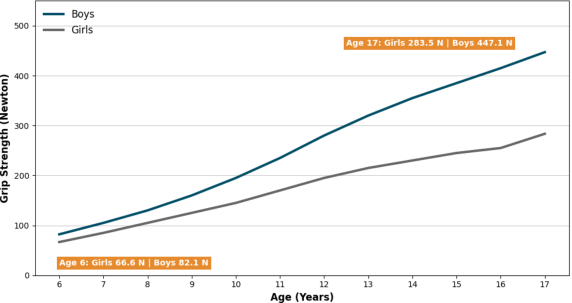
Average dominant hand grip strength in girls increased from 67 N at age 6 to 283 N at age 17, while boys exhibited a steeper increase from 82 N to 447 N over the same age range. For both genders, dominant hand grip strength values were consistently higher than those of the non-dominant hand. Across all age groups, except the 12-year group, boys demonstrated higher average HGS values than girls.
Table 1: Descriptive statistics of HGS (N) by age and gender for dominant and non-dominant hands.
Table available in the original PDF paper.
Females Males
Age (years) Dominant Non-Dominant
Dominant Non-Dominant
n
n
Mean ± SD Mean ± SD Mean ± SD Mean ± SD All 232 212.23 ± 81.56 195.55 ± 75.28 227 292.55 ± 140.03 271.15 ± 129.44 6 13 66.63 ± 11.96 58.63 ± 12.09 15 82.14 ± 13.98 72.14 ± 12.25
Figure 1: Dominant hand grip strength vs. age and gender.
Figure 1 graphically shows the relative increase of HGS with respect to age and gender. It seems there is a near-linear increase in handgrip strength with age in both girls and boys during early childhood (ages 6-10). However, a significant divergence in strength development between genders became evident at the onset of puberty. While girls continued to show a steady increase, boys showed a much steeper acceleration in strength acquisition from ages 12-13. By age 17, the mean grip strength for boys was significantly higher than that of girls.
Effects of Gender and Age on HGS A two-sample t-test showed a statistically significant difference between females and males (t = −7.50, p < 0.001). Males, on average, are significantly stronger than females. ANOVA showed a statistically significant difference among age groups (p < 0.001). The Games-Howell post-hoc analysis showed clear age-based group differences in dominant hand grip strength for both females and males. In females, three distinct groups were identified. The two oldest age groups formed the highest strength groups with no significant difference between them, followed by a middle group with significantly lower values, while the youngest age group showed the lowest grip strength and differed significantly from all others. In males, four distinct age groups were observed, with grip strength decreasing significantly from the oldest to the youngest group.
Effect of Hand Dominance on HGS For both male and female participants, the grip strength in the dominant hand was consistently higher than in the non-dominant hand. However, the magnitude of this difference varied. The difference was negligible in the 6 to 8-year group, which may be associated with the ongoing development of motor skills. The dominance effect was statistically significant and more consistent in adolescents. A paired t-test was conducted to compare grip strength between the dominant and non-dominant hands. The results showed statistically significant differences between the two hands in all groups (p < 0.001). The dominant hand was stronger than the non-dominant hand in all groups, with mean differences of 16.67 N in females, 21.40 N in males, and 19.01 N in the overall sample. These findings imply that males have a larger disparity, possibly due to differences in muscle growth or usage habits.
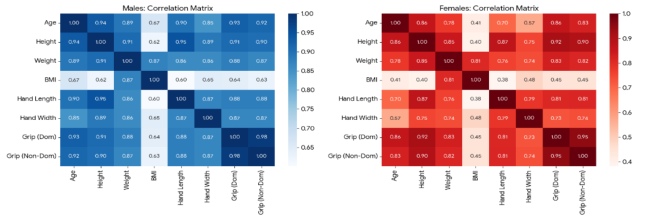
Correlation Analysis A correlation analysis (Pearson product-moment correlations) was performed to determine the strength of linear relationships for HGS, age, height, body mass and hand (dominant and nondominant), hand length and hand width (Figure 2).
Height, body mass, hand length, and hand width were all positively correlated with both dominant and non-dominant HGS, indicating that grip strength increased with these anthropometric variables. Dominant HGS showed strong correlations with height (females: r = 0.917; males: r = 0.911) and body mass (females: r = 0.832; males: r = 0.880). Hand length was
Handgrip Strength and Anthropometric Characteristics of Children 227 also strongly associated with dominant HGS (females: r = 0.814; males: r = 0.880), whereas hand width demonstrated moderate to strong correlations (females: r = 0.729; males: r = 0.869).
These associations suggest that anthropometric characteristics substantially influence strength capacity in developing children. In particular, the positive relationships between hand dimensions (length and width) and grip strength indicate that children with larger hand spans may be biomechanically advantaged in generating higher grip forces.
Figure 2: Correlation matrix of HGS and anthropometric measures for both genders.
DISCUSSION
This study provides normative static handgrip strength values for Turkish children and adolescents and shows that strength development cannot be explained by age alone. Although grip strength increased steadily with age in both girls and boys, the pattern changed noticeably during early adolescence. From this point onward, boys showed a much steeper increase in strength, while girls continued to develop more gradually. This divergence is consistent with known differences in biological maturation and highlights why chronological age becomes a less reliable indicator of strength during adolescence. Notably, the 12-year age group represents a transitional period in which maturation timing differs markedly between genders. In 12 year age group girls’ biological age (maturation status) is temporarily ahead of boys, allowing strength measures such as HGS to equalize or even overlap (Melina et al., 2004)).
Hand dominance played a limited role in younger children but became more evident with increasing age. The growing strength difference between dominant and non-dominant hands in adolescents likely reflects greater motor specialization and habitual hand use. For ergonomic applications, this suggests that assuming symmetrical strength in older children and adolescents may overlook meaningful functional differences.
Anthropometric characteristics were strongly related to grip strength across all ages. Measures reflecting overall body size and hand dimensions showed particularly strong associations, indicating that physical growth provides a clearer picture of strength capacity than age alone. Children with larger hands and greater body size were able to generate higher grip forces, reinforcing the importance of considering hand-specific dimensions when designing products that require gripping or force application.
228 Coşkun and Ekşioğlu While the overall trends observed in this study are in line with findings from other populations, the results also underline the value of population- specific reference data. One limitation of the study is that participants were recruited from Istanbul, which may limit national representativeness. Future research, including geographically diverse samples and longitudinal designs, would help establish more comprehensive national reference values.
Ergonomic Implications for Design The normative data presented in this study provide a practical basis for designing products and environments intended for children and adolescents in Türkiye.
For everyday items used in educational and household settings such as door handles, scissors, staplers, water bottle caps, and toys, the required actuation force should not exceed the capabilities of the weakest users. In general, the maximum force requirement should be set at or below the 5th percentile grip strength of the youngest target age group (e.g., 6-year-olds) to avoid exclusion or excessive strain.
Conversely, for safety-critical devices designed to restrict children’s access (such as child-resistant packaging), the required force should exceed the 95th percentile grip strength of the oldest children within the at-risk age group.
The results also show a noticeable strength difference between boys and girls beginning around age 12. This suggests that a single “unisex” design approach may not be appropriate for adolescents. For the 12-17 age group, adjustable or size-specific designs are preferable to one-size-fits-all solutions.
CONCLUSION
This study provides normative reference data for static grip strength in Turkish children and adolescents, filling a critical void in the national ergonomic literature. The findings show that grip strength development is shaped by gender-related maturation, hand dominance, and anthropometric growth, particularly hand dimensions, rather than age alone.
For designers, engineers, and healthcare professionals in Türkiye, these results provide practical, population-specific benchmarks that can support safer and more effective ergonomic design and assessment. Utilizing this population-specific data, rather than relying on international standards, is essential for designing safer educational environments and consumer products tailored specifically to the physical attributes of children and adolescents in Türkiye.
The established dataset is more suitable for the urban population since the participants were from İstanbul. Future research should extend this work through geographically stratified sampling to develop nationally representative reference values.
ACKNOWLEDGMENTS
The authors would like to acknowledge all participating children and adolescents of Türkiye and their parents and teachers.
REFERENCES
Alqahtani, B. A., A. M. Alenazi, R. K. Elnaggar, M. M. Alshehri, A. Alhowimel, A.
A. Najmi, M. Alasraj, and M. Alghadeir, 2023, “Normative Values for Hand Grip and Pinch Strength for 6 to 18 year-olds in Saudi Arabia”, BMC Musculoskeletal Disorders, Vol. 24, No. 1, p. 96. American Society of Hand Therapists (ASHT, 2015). Clinical Assessment Recommendations, 3rd edition. Caldwell, L. S., D. B. Chaffin, F. N. Dukes-Dobos, K. H. E. Kroemer, L. L. Laubach, S.
H.Snook, and D. E. Wasserman, 1974, “A Proposed Standard Procedure for Static Muscle Strength Testing”, American Industrial Hygiene Association Journal, Vol. 35, No. 4, pp. 201–206. Cetin, A., Genc, M., Sevil, S., & Coban, Y. K. (2013). Prevalence of the palmaris longus muscle and its relationship with grip and pinch strength: A study in a Turkish pediatric population. Hand (New York, N.Y.), 8(2), 215–220. Dağ, F. and Erdoğan, A.T., 2020, “Gender and age differences in absolute and relative
hand grip strength of the Turkish population aged 8–27 years”, Hand Surgery and Rehabilitation, 39, 556–563. Ekşioğlu, M., 2016, “Normative static grip strength of population of Turkey, effects of various factors and a comparison with international norms”, Applied Ergonomics, 52, 8–17. Field, A., 2009, Discovering Statistics Using SPSS, SAGE, London Firrell, J. C., and G. M. Crain, 1996, “Which Setting of the Dynamometer Provides
Maximal Grip Strength?”, The Journal of Hand Surgery, Vol. 21, No. 3, pp. 397–401. Häger-Ross, C., and B. Rösblad, 2002, “Norms for Grip Strength in Children Aged 4-16 years” Acta Paediatrica, Oslo, Norway, Vol. 91, No. 6, pp. 617–625. ISO 15535, 2006. General Requirements for Establishing Anthropometric Databases. Malina, R. M., Bouchard, C., & Bar-Or, O. (2004). Growth, Maturation, and
Physical Activity (2nd edition). Champaign, IL: Human Kinetics. Mathiowetz, V., D. M. Wiemer, and S. M. Federman, 1986, “Grip and Pinch Strength: Norms for 6- to 19-year-olds” The American Journal of Occupational Therapy, Vol. 40, No. 10, pp. 705–711. McQuiddy, V. A., Scheerer, C. R., Lavalley, R., McGrath, T., and Lin, L. (2015).
Normative Values for Grip and Pinch Strength for 6- to 19-Year-Olds. Archives of Physical Medicine and Rehabilitation, 96(9), 1627–1633. Omar, M. T., A. Alghadir, and S. Al Baker, 2015, “Norms for Hand Grip Strength in Children Aged 6-12 years in Saudi Arabia”, Developmental Neurorehabilitation, Vol. 18, No. 1, pp. 59–64. Rostamzadeh, S., M. Saremi, A. Abouhossein, S. Vosoughi, and J. F. M. Molenbroek,
2021, “Normative Data for Handgrip Strength in Iranian Healthy Children and Adolescents aged 7-18 years: Comparison with International Norms”, Italian Journal of Pediatrics, Vol. 47, No. 1, p. 164. Trajković, N., D. Radanović, D. Madić, S. Andrašić, C. Cadenas-Sanchez, D. Mačak, and B. Popović, 2020, “Normative Data for Handgrip Strength in Serbian Children Measured with a Bulb Dynamometer”, Journal of Hand Therapy, pp. 1–8.
LISTED IN THE AHFE DIGITAL BOOKSTORE CATALOGUE
Explore the complete digital volume
Healthcare and Medical Devices
Read this individual research paper free through the original publisher, or explore the full digital proceedings book.
ISBN 978-1-964867-87-8
Explore this ISBN in the AHFE Bookstore ↗Listed in the July 2026 bookstore catalogue; search by ISBN to confirm current availability · Digital book purchase optional