Upb- Julián García, Sebastian Munoz Pelaez, Pablo Alvarado (2023). Ergonomic evaluation involved in an eVTOL vehicle design process for the application of future transport operations in urban ecosystems. In: Human Factors in Transportation. AHFE Open Access, vol. 95, pp. 645–655. https://doi.org/10.54941/ahfe1003850
As the global population grows every year, urban terrestrial transportation is becoming severely challenged by mobility problems. Because of this phenomenon, an increased interest in electric aerial vehicles adapted for operation in urban environments presents itself as one of the best solutions among urban developers and big aerospace companies. This trend represents a considerable solution to increased congestion, delays, accidents, and environmental problems. With the foreseen apparition of said vehicles in the global market and the development of concepts of operation that promote the emergence of urban air mobility (UAM) ecosystems, there arises a need to study the design factors associated with electrical Vertical Takeoff and Landing (eVTOL) aircraft. In this process, ergonomics plays a significant role in the daily use of the vehicle and its interfaces with the end user. This study aims to evaluate what a proper cockpit arrangement would be for a personal eVTOL aircraft from an ergonomics standpoint. It achieves this by identifying several factors regarding pilot posture, comfort, safety, and general interaction with the vehicle (flight controls and instrument panel) and, with the design and construction of a testing rig, to recreate a single-seat eVTOL aircraft cockpit. Known methodologies based on postural analysis methods are used to determine how this affects pilot performance and flight safety and define the preliminary cockpit geometries before subject trials. Testing is conducted on the model with the use of test subjects with varied anthropometric measurements spanning the expected percentile range for the operation, and with this performing a validation of the human joints’ comfortable angles biases digital human models with computer simulation software. Additionally, a modified Cornell Musculoskeletal Discomfort Questionnaire (CMDQ) was conducted to suit operating conditions in these vehicles better, and the results obtained were used as constant feedback from the test subjects to adjust the testing rig properly. The outcome of this is a proposed arrangement for a single-seat cockpit for an eVTOL aircraft with specific dimensions, which can accommodate a considerable range of differently sized people to make the vehicles as accessible, comfortable, and safe as possible from an ergonomics perspective.
Over the past few years, the aircraft and technology industries have made significant leaps in structural design, electric and distributed propulsion, advanced automation, and control systems, among other disruptive inno- vations (Garrow, et al., 2020; Polaczyk, et al., 2019). This exponential growth in technological advances, coupled with the accelerated development of complex airspace ecosystems over urban areas (Thipphavong, et al., 2018), represents the ideal scenario for the evolution towards novel urban-centered air transportation modes. To achieve this, several companies are proposing different, more efficient, and effective air mobility solutions with the develo- pment of new personal air vehicles (PAV) for UAM-based passenger transport (Pons-Prats, et al., 2022).
A key enabler to cope with the operational and environmental require- ments in and over densely populated areas has been the widespread adoption of eVTOL capabilities as a common baseline for the development of diffe- rent configurations (Bacchini & Cestino, 2019). Although the list of known eVTOL designs under development, mainly prototypes, is extensive and continuously changing (Electric VTOL News™, 2023), all appear to be con- strained by the same market feasibility barriers to more reliable, safer, quieter, and less expensive aircraft and operations (UBER Elevate, 2016). All this, moreover, is immersed in complex UAM transport systems that, depending on their level of maturity (Goodrich & Theodore, 2021)and the existing regula- tion, are transforming the way people move within urban areas (Schuchardt, et al., 2023).
It becomes of great importance to properly evaluate the ergonomics and human factors implied in the operation of these vehicles.
DESIGN REQUIREMENTS FOR A SINGLE-SEAT OPEN COCKPIT EVTOL AIRCRAFT Certain design requirements must be established to determine this specific type of aircraft’s ergonomic implications and human factors to be considered. The aircraft selected to be evaluated in this study is a single-seat open cock- pit eVTOL aircraft, a compact aircraft that must be lightweight to be more energetically efficient. The aircraft is projected to have a truss structure, like the ones used in ultra-light aircraft. This type of structure eases the airframe’s manufacturing process, and its design optimized for weight reduction aids in aircraft performance.
Some safety requirements are also established. The fuselage must be rigid to ensure its integrity in a catastrophic collision. Additional moving compo- nents, such as doors or hatches, are not to be included to avoid weakening the structure’s overall strength. Some pilot protection elements are included as part of the fuselage: A roll bar to protect the pilot’s head in case of rol- lover and a halo-style structure to protect from bird strikes or other objects impacting head-on.
The open cockpit also becomes a safety requirement. In case of a crash or emergency landing, the pilot will have to exit the aircraft without much restri- ction and hastily. A harness with a quick-release system is chosen as the pilot
Ergonomic Evaluation Involved in an eVTOL Vehicle Design Process 647
fastening device to fulfill this requirement. Correspondingly, seating compa- tible with the previously mentioned systems becomes imperative, preferably commercially available automotive racing seats, which are manufactured with a high safety standard.
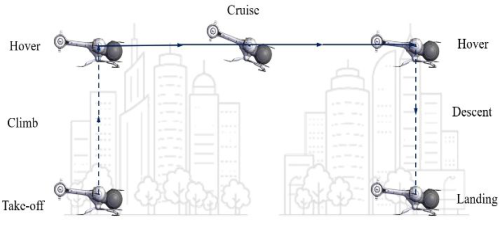
Also, to aid in aircraft performance, efforts must be made to adopt the smallest possible front-facing projected area. To do so, the aircraft must adopt a low profile but at the same time keep a design that appears familiar to the user, and to ensure user compatibility, the vehicle’s structure should be ada- ptable to different-sized people, ranging from the 5th to the 95th percentile. Concerning pilot posture, these considerations are best met in the establish- ment of a reclined seating position, like that of high-performance race cars. With the previous constraints arises the need to find the best position in which satisfactory performance is obtained, safety standards are met, and the com- fort of the pilot is ensured throughout all stages of a flight cycle. The mission profile is divided into the flight phases of takeoff, hovering, cruise, hovering, and landing, as shown in Figure 1.
The aircraft is expected to spend a maximum of 5 minutes during takeoff, hover, and landing at a pitching angle of 0 and a maximum of 20 minutes in cruise flight at 13 degrees.
Figure 1: eVTOL flight phases.
ERGONOMIC RESEARCH METHODOLOGY Research Design
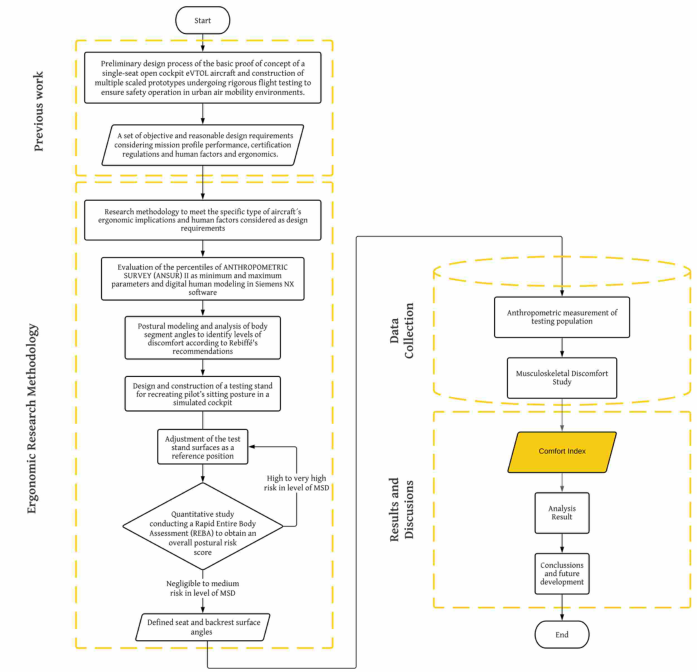
The strategy and research methods used to approximate the characteristics of the vehicle’s cockpit to a comfortable driving position for the operation are based on the idea of a set of tasks organized to obtain a comfort index on which a series of analyses and discussions are carried out (see Figure 2).
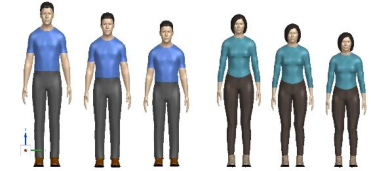
To begin with, the database of percentiles from the ANTHROPOMETRIC SURVEY (ANSUR) II (Paquette, et al., 2009) was explored to create, with a digital human modeling (DHM) technique, a manikin representation of the 95th percentile limits for men and the 5th percentile for women. The computer-aided engineering (CAE) software Siemens NX is used for this purpose (see Figure 3).
The body posture is simulated by adjusting the relative orientations of the various articulated segments that make up the body coupling (Reed, 2000).
Figure 2: Flowchart of the research methodology process and the ergonomic asses- sment module.Figure 3: Design of human models of male a female percentile from ANTHROPOME- TRIC SURVEY (ANSUR) II.
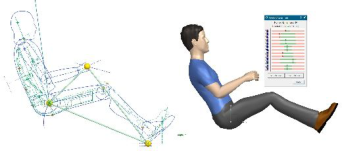
Then, using the Comfort Evaluation Tool of the Siemens NX software, the reference position is adjusted to the acceptable range for each body part (see Figure 4). According to Rebiffé’s summary of recommendations for the angles of the body segments (Rebiffé, 1969).
Finally, the REBA (Rapid Entire Body Assessment) (Hignett & McAtamney, 2000) process is used to identify biomechanical risk factors associated with the reference posture and vehicle operating scenario. At this point, an iterative process to define the optimal angles for the seat and the
Ergonomic Evaluation Involved in an eVTOL Vehicle Design Process 649
Figure 4: Definition of body segment angles and comfort analysis according to Rebiffé.Figure 5: Test rig in horizontal position.
backrest of the test rig begins, seeking to obtain a negligible to medium ove- rall postural risk score in the level of MSD. Score is to be improved by further investigation in the next steps of the methodology.
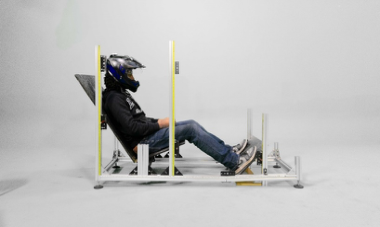
Ergonomics Test Rig The inclusion of an experimental module in this study calls for the design of a test rig capable of recreating approximately the pilot’s sitting posture in a simulated cockpit. In its design, the consideration of having the ability to recreate flight conditions as faithfully as possible must be made. The decision is made then to design it as one single rigid structure with the capability forwards or backwards to reproduce different flight inclinations.
The test rig consists of three adjustable surfaces over which the test subjects rest. Two of them, the seat and the back, joined together by a hinge point forming the chair. The chair is held up by a wooden beam, which can slide vertically up and down. It stands between four columns holding 2 rods that allow for angle adjustment of the two surfaces. All can slide horizontally backward and forwards over the test rig’s base. The third surface acts as a footrest, screwed by its hinge point to a wooden sheet. In turn, the sheet is bolted to the two columns on which slides the rod that controls the footrest’s angle. The columns hold the section together and can slide backward and forwards for adjustment.
This design aims to make the test rig adjustable for different-sized peo- ple. The anthropometric variable to affect comfort the most at the specified posture is thought to be leg length. The test rig will allow to corroborate if
various percentiles can be accommodated on the rig by only adjusting one leg length relevant distance, simplifying the proposed vehicle’s design.
Four adjustable legs hold the base structure with leveling feet at their ends. They will allow for calibrating to find complete horizontality. They also ensure good support for the rig when inclined at 13 degrees supported over external elements.
DATA COLLECTION Two tests are devised to simulate the different postures the pilot would adopt during flight. The first test is performed at an angle of inclination of 0 with a 5-minute timeframe from the moment the subject is adequately seated to simulate the added expected time on the ground, takeoff, hovering, and landing. For the second test, the rig is inclined 13 degrees by placing it over external supports with a 20-minute timeframe to simulate the aircraft’s cruising stage.
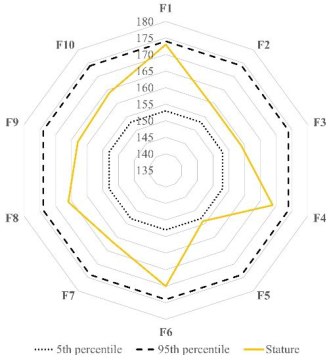
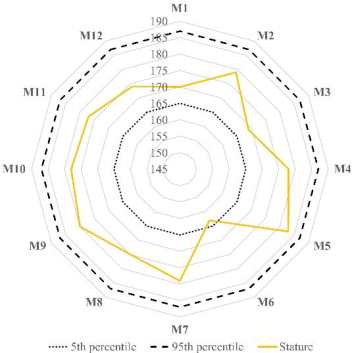
A testing population of 22 subjects with varied ages, heights, weights, and general dimensions is defined to sit on the test rig; a comparison of the test subjects with the population percentiles can be seen in Figure 6 and Figure 7. The inclusion of these to identify if their variability has a linear relation with comfort. The population is equally split between male and female subjects to easily identify if the difference in gender influences overall comfort during the test.
The decision is made to fix the seat’s angle of recline. This is to validate whether the cockpit could be simplified to reduce weight by only having a quick adjustment setting for footrest position and angle and not the whole seat. Special software was created for the test, which processes the subjects’ relevant anthropometric measures (such as upper and lower leg lengths, thi- ghs greater radius, torso height, distance from ankle to the ground, and feet length) as input data and produces footrest position and inclination specific to the subject as an output. The program aims for the subject to maintain
Figure 6: Female subjects compared to height percentiles.
Ergonomic Evaluation Involved in an eVTOL Vehicle Design Process 651
Figure 7: Male subjects compared to height percentiles.
specific joint angles defined to be within the realm of comfort and safety previously obtained by the composed theoretical evaluation.
The subjects are instructed to adopt a proper position on the rig where the center and lower back are adequately supported, their buttocks and ham- strings have complete contact with the seat surface, and their feet are planted over the footrest area. Considerations are given regarding head inclination, not to fatigue the neck, shoulder, and upper back. They are to maintain the head level and occasionally performing natural, wide, and slow movements, simulating expected conditions while operating the vehicle when looking around the aircraft or at flight instruments.
Once the time for each of the two tests is concluded, the test subjects are given a simple questionnaire composed of three questions regarding their level of comfort in specific zones of the body and their subjective opinion on its effect on flight capabilities. The questionnaire is a modified version of the CMDQ (Hedge, 2023), developed by Cornell University and specially adapted to fit the test requirements.
The answers to the questionnaire are assigned linear numerical values, equivalent to the ones shared with the test subjects, generating scores for each test where lower scores indicate lower discomfort felt. A general com- fort index specific to this test is formed to help assess and compare the results among themselves. It is obtained by subtracting a specific test’s score from the maximum possible one. The index is then created by normalizing the pre- vious operation’s result, meaning that it ranges between the values of 0 and 1, with 0 being the maximum possible discomfort and 1 being the maximum possible comfort.
RESULTS AND APPLICATIONS A first comparison reveals a significant difference between the 5-minute test and 20-minute test results (see Table 1). A difference of 0.0231 separates the 5-minute test from the 20-minute one, which roughly equals an additional
Table 1. Test comfort index.
Table available in the original PDF paper.
Index Index value 5-minute test average index 0.9715 20-minute test average index 0.9484 Overall average index 0.9599
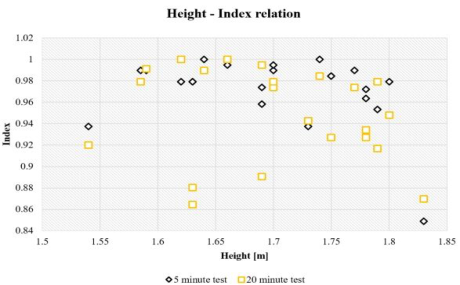
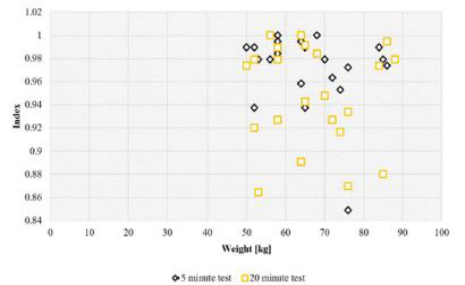
body part being moderately uncomfortable. This is not a significant differe- nce, but still is relevant for understanding the discomfort-inducing nature of the stages of flight. Overall, the index shows a promising result for the whole seating arrangement. Though, room for improvement still exists to get to the 0.98 target. Further examination of the results is conducted by comparing index results to the weight and height of the respective test subjects (see Figures 8 and 9). Although some minor tendency could have been extracted visually for index up-most values to decrease at heights past 1.75 meters, more significance is needed, and conclusions are not drawn from this. Overall, no proper linear or exponential adjustment could be made to confirm a dependence between the subject’s height and weight and the comfort index.
Ergonomic Evaluation Involved in an eVTOL Vehicle Design Process 653
The difference in overall index results between male and female subjects is found to be non-significant and no conclusions are drawn from it.
Specific zones where discomfort was felt were recorded and summed toge- ther to identify the most sensitive areas. Results were adjusted to a relative scale instead of an absolute scale to identify with greater ease key areas where comfort could be improved more easily.
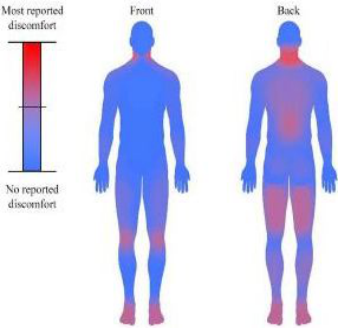
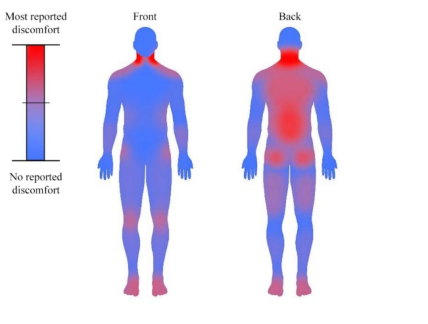
Results displayed on Figures 10 and 11 do not account for general discom- fort but rather for areas where the most discomfort was felt. Immediately, it is identified that the most critical area are the neck muscles, an area in which its wellness is imperative for assurance of the pilot’s flying capabili- ties. Other key areas, specially recognized by the 20-minute test, are the upper back, lower back, and buttocks regions. Possibly pointing to an indicative of vertical overload in the whole back causing muscle fatigue.
Other indications of discomfort, such as hamstrings, knees and feet are noted. Although, based on subject comments, these are all expected to be reduced in future evolutions of the test.
Figure 10: Discomfort reported for 5-minute test.Figure 11: Discomfort reported for 20-minute test.
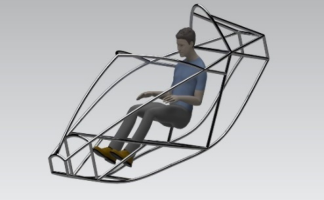
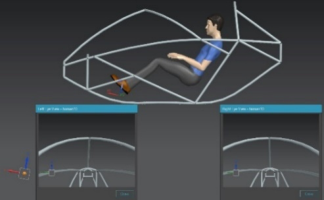
APPLICATIONS With results obtained, an initial positional evaluation was made, placing a virtual test dummy, with measurements within the 95th percentile, inside a proposed cockpit structure. Also, field of view angles were verified with FPV systems (see Figures 12 and 13).
Figure 12: Simulation of the position in the cockpit in the overall structure assembly.Figure 13: Visual angles from the cockpit simulating a real operation.
CONCLUSION AND FUTURE WORK The proposal for the pilot’s reclined posture is proven to be viable for usage on this particular type of compact eVTOL vehicles. Although, adju- stments must be made to further improve comfort to reach the target index. It should be noted that with the proposed cockpit it is possible to ensure the most ergonomic position based on the anthropometric measure- ments of any pilot with body dimensions between the extreme percentiles. This is if a variation mechanism is enabled for the footrest position and angle.
Evolutions of the test rig are set to be added to more faithfully obtain data related to pilot-vehicle interfaces. Most relevant interfaces programmed to be introduced are the flight control systems which will also allow for the evalu- ation of the effect ergonomics have on simulated flight mission performance. Other interfaces, such as the actual seat, are expected to be used and safety systems are set to be introduced. Plans are drawn to study how adjustment for varied anthropometrics may influence aircraft’s weight and balance and handling qualities.
Ergonomic Evaluation Involved in an eVTOL Vehicle Design Process 655
REFERENCES
Bacchini, A. & Cestino, E., 2019. Electric VTOL Configurations Comparison.
Aerospace. Aerospace, 6(26). Electric VTOL News™, 2023. eVTOL Aircraft Directory. [En línea] Available at: https://evtol.news/aircraft [Último acceso: 2023]. Garrow, L. A., German, B. J. & Leonard, C. E., 2020. Urban air mobility: A compre-
hensive review and comparative analysis with autonomous and electric ground transportation for informing future research. Transportation Research Part C: Emerging Technologies, 132(103377), pp. 11–15. Goodrich, K. H. & Theodore, C. R., 2021. Description of the NASA Urban Air Mobility Maturity Level (UML) Scale. AIAA SciTech Forum. Hedge, A., 2023. Cornell Musculoskeletal Discomfort Questionnaires (CMDQ).
Cornell University Ergonomics Web. [En línea] [Último acceso: 2023]. Hignett,. S. & McAtamney, L., 2000. Rapid entire body assessment (REBA). Applied Ergonomics, Volume. 31. Paquette, S., Gordon, C. & Gordon, C., 2009. ANTHROPOMETRIC SURVEY
(ANSUR) II. PILOT STUDY: METHODS AND SUMMARY STATISTICS, Natick, Massachusetts: U. S. Army Natick Soldier Research, Development and Engineering Center. Polaczyk, N., Trombino, E., Wei, P. & Mitici, M., 2019. A Review of Current Technology and Research in Urban On-Demand Air Mobility Applications. 8th Biennial Autonomous VTOL Technical Meeting & 6th Annual Electric VTOL Symposium. Vertical Flight Society, pp. 333–343. Pons-Prats, J., Živojinovi´c, T. & Kuljanin, J., 2022. On the understanding of the
current status of urban air mobility development and its future prospects: Com- muting in a flying vehicle as a new paradigm. Transportation Research Part E: Logistics and Transportation Review, Volumen 166, pp. 17–18. Rebiffé, R., 1969. The driving seat. Its adaptation to functional and anthropometric requirements. In E. Grandjean (ed.), Proceedings of the Symposium on Sitting Posture. London: Taylor and Francis, Ltd. Reed, M. P., 2000. Survey of auto seat design recommendations for improved
comfort. Schuchardt, B. y otros, 2023. Air Traffic Management as a Vital Part of Urban Air Mobility—A Review of DLR’s Research Work from 1995 to 2022. Aerospace. MPDI, 10(81). Thipphavong, D. P. y otros, 2018. Urban Air Mobility Airspace Integration Concepts
and. AIAA Aviation Forum (Aviation 2018). UBER Elevate, 2016. Fast-Forwarding to a Future of On-Demand Urban Air Transportation. s.l.: s.n.
LISTED IN THE AHFE DIGITAL BOOKSTORE CATALOGUE
Explore the complete digital volume
Human Factors in Transportation
Read this individual research paper free through the original publisher, or explore the full digital proceedings book.
ISBN 978-1-958651-71-1
Explore this ISBN in the AHFE Bookstore ↗Listed in the July 2026 bookstore catalogue; search by ISBN to confirm current availability · Digital book purchase optional