Léa Corsini, Steve Vezeau (2025). Simulations for Optimizing Bulletproof Vest Design With Molle System for Police: A User-Centered Approach to Assess Vest Suitability. In: Ergonomics In Design and Kansai Engineering. AHFE Open Access, vol. 170, pp. 1–11. https://doi.org/10.54941/ahfe1006162
We conducted simulations to assess the design of a bulletproof vest integrating a Modular Lightweight Load-carrying Equipment (MOLLE) system and its compatibility with police patrol activities. By combining design and ergonomics, our study highlights key improvements in mobility, comfort, and equipment organization. Fifteen officers with diverse body types tested these vests in a controlled environment, performing tasks such as entering and exiting vehicles, competing a report, as well as handling various pieces of equipment. The results indicate positive feedback regarding safety, the modularity of the MOLLE system, and the vest’s aesthetics. However, several shortcomings were identified: improper equipment positioning hindering accessibility and comfort, rigid ballistic panel edges restricting mobility, and the attachment system and excessive bulk at the front of the vest complicate tool handling and increase physical strain. Our findings emphasize the need to redistribute equipment weight, optimize tool placement, and adapt the load to officers’ body sizes. By incorporating feedback from patrol officers and collaborating with manufacturers, we aim to refine the vest’s design to enhance both performance and user well-being.
PROBLEM STATEMENT Protective garments, with a variety on the market, or personal protective equipment (PPE) differ in constituent materials (fabrics, knits, non-wovens, coated textiles, leather, polymer films), design, and protective elements. According to INRS (2024), they protect against nine major risks: climate, visibility, mechanical, chemical, biological, thermal, electrostatic, electrical, and radioactive contamination. This article focuses on mechanical risk, specifically bulletproof vests (BPVs) that protect against projectile attacks.
According to Chabanne (2024), poorly designed protective garments can restrict movement, increase effort, trap heat, cause physical strain, alter environmental perception, and lead to skin issues like dermatitis and allergic reactions. Marsot and Atain-Kouadio (2017) note that ill-fitting PPE raises the risk of musculoskeletal disorders (MSDs). Early design intervention is key to prevention.
Selecting PPE requires analyzing professional risks, work constraints, tasks, environment, and user characteristics, including morphology. Psychological and social factors, like aesthetics and public image, also matter. Involving users in the design process and selection is crucial, as they best understand their needs, wear duration, equipment use, and job- related risks. The FD CEN/TR 15321 guide outlines key selection factors, emphasizing material performance, comfort, ergonomics, and relevant standards. According to Chabanne (2024), PPE selection goes beyond tender criteria, requiring a “wearing test” in real work conditions to assess activity constraints, morphology variations, and posture issues. The process should also determine reception modalities, distribution, maintenance, and storage. This interdisciplinary approach, combining design and ergonomics, is part of a broader research effort to improve PPE.
The effectiveness of protection provided by a bulletproof vest during an armed attack has been repeatedly demonstrated (Taylor, Kubu, & Kappleman, 2009; LaTourrette, 2010; Dunn, 2010; Ashcroft et al., 2001). In certain circumstances, it has been found that wearing a bulletproof vest increases thermal strain and restricts the postures and movements necessary for the execution of police work (Fowler, 2007; Zehner, 1987). In her study with Quebec police officers, Budico (2012) shows that the mobility restrictions associated with wearing a BPV lead to discomfort, pressure points, and localized pain at the neck, front shoulders, and waist. These issues occur during movements related to tasks such as driving a vehicle, writing reports on board, or checking tires on the road. Shoulder pressure mainly results from the weight of the ballistic panels and tools worn on the vest. Difficulties accessing and distributing tools (pen, flashlight, radio) on the vest and the duty belt have also been observed. Dempsey (2013) highlighted that wearing equipment significantly affects police officers’ balance and physical agility, while slowing their vehicle exit speed. A more recent study by Vezeau, Comtois, and Budico (2021) conducted with motorcycle police officers reveals that BPVs hinder their mobility, thermal comfort, and overall performance. The study emphasizes the importance of a user-centered approach to analyze and address the specific needs of police officers.
Versatile Molle (Modular Lightweight Load-carrying Equipment) vests have recently emerged on the market to improve comfort and load distribution, However, few studies explore their use in police settings or the ergonomic challenges they pose. At the request of a Quebec police organization, an ergonomic analysis was conducted to assess the impact of MOLLE BPVs on posture, movement, and equipment distribution. Similarly to Vezeau, Comtois, and Budico (2021), the study used a user-centered approach, including field observations and interviews to identify constraints, simulations in a police garage to assess BPV impact on comfort, mobility, and efficiency during uniform usage and co-design sessions where officers provided feedback on design movement.
This article presents a preliminary simulation conducted under a standardized protocol, documenting the initial constraints of the new MOLLE BPV through a comparison of vest characteristics, participant morphology, and equipment distribution.
Simulations for Optimizing Bulletproof Vest Design With Molle System for Police 3
METHODOLOGY
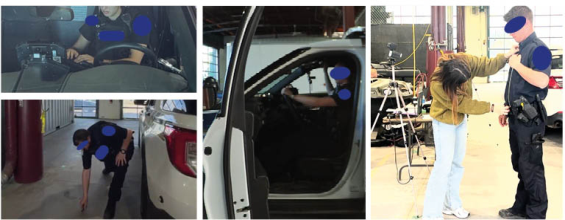
The simulations conducted in a police garage ensured uniform evaluation conditions. This setting allowed for the realistic recreation of work contexts. Figure 1 shows the setup. The simulations consisted of recording the patrollers body dimensions, identifying their BPV model, and mapping out their equipment distribution patterns. The participants then performed gestures and postures according to different usage scenarios. Inside patrol vehicles (car and SUV), they simulated situations such as driving. Outdoors, they tested actions like running. They also verbalized any discomfort or difficulties they experienced. A specific protocol for tool handling was then carried out. Finally, they completed a directed questionnaire about adding equipment to the BPV and the perceived benefits. The police officers conducted the session with their own vest and usual equipment distribution.
Figure 1: Photographic documentation of the simulations.
Participants Fifteen participants, including eight women and seven men, representing diverse profiles, were recruited voluntarily after providing informed consent. Table 1 summarizes their characteristics.
Table 1: Characteristics of participants in the simulation.
Table available in the original PDF paper.
P Gender Ages Experience
Dominant Weight
Time With
MOLLE
(Years) Hand
Height (Meters) (kg)
Chest Width
Thoracic Length
Vest Model System
(Years/ Months)
(cm) (cm)
New Vest (Months) Rows; Columns P1 F 28 4 years Right 1,72 63,5 29 43 12 months F 3r; 5c P2 F 23 8 months Right 1,70 70 29 39 3 months F 3r; 5c P3 F 22 1 year Right 1,72m 65 28 42 5 months F 3r; 5c P4 F 31 9 years Right 1,70 65 30 38,5 3 months F 3r; 5c P5 F 24 1 year Right 1,60 70 33 41 5 months F 3r; 6c P6 F 29 8 years Right 1,60 63,5 29 42 12 months F 3r; 5c P7 F 29 6 years Right 1,65 59 30 39 12 months U 3r; 5c P8 F 27 6 years Left 1,67 68 30 43 12 months F 3r; 5c P9 M 39 12 years Right 1,78 102 34 51 4 months U 4r; 6c P10 M 29 6 years Right 1,67 62 30 44 1 month U 3r; 5c P11 M 28 6 years Right 1,80 72,5 31 52 12 months U 4r; 5c P12 M 29 5 years Right 1,72 79 31 54 3 months U 4r; 5c P13 M 32 10 years Right 1,80 88,5 38 49 3 months U 4r; 6c P14 M 49 19 years Right 1,73 88,5 36 47 12 months U 4r; 6c P15 M 26 6 years Right 1,83 98 38 50 2 months U 4r; 6c
4 Corsini and Vezeau
Their ages ranged from 22 to 49 years, and their professional experience varied from 8 months to 19 years. The length of time each participant has been wearing their recently introduced bulletproof vests ranges from 1.5 months to 12 months. Fourteen participants were right-handed, while one was left-handed, a factor influencing the positioning of their weapons. Each patrol officer’s type of duty belt affected the perceived comfort: nine participants wore standard belts provided by the service, four used “ergonomic” models, and two had personal belts. Two distinct MOLLE BPV models were in use: a “unisex” model, based on a traditional ballistic panel, and a female model, with a panel featuring cups that provide space for the breasts, specifically designed to improve comfort and safety for female officers. Of the eight women, one chose the “unisex” model, adjusted to her body shape due to a less pronounced chest. Participant height ranged from 1.60 m to 1.82 m, and weight ranged from 59 kg to 98 kg.
Procedure During their work shifts, the officers came to the garage one at a time. They removed their vests for measurements, which were then related with the observed constraints. In addition to height (in meters) and weight (in kilograms), body measurements taken using a tailor’s tape (±1 mm) included: chest circumference (arms at the sides), waist circumference, torso width, thoracic width while standing, thoracic width while seated, and back width. For women, bust circumference and cup size were also measured. The selection of measurements was based on the BPV manufacturer’s measurement protocol. The largest thoracic length was 54 cm, the smallest was 38.5 cm, the largest chest width was 38 cm, and the smallest was 28 cm. Morphologically, the participants’ body measurements play a central role in the design of the vests. Five different configurations were observed:
Figure 2: Different MOLLE BPV models used.
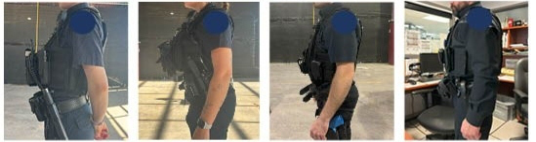
Four men wore the model with four rows and five columns. Two men wore the model with four rows and five columns. One woman wore the model with three rows and six columns. Seven women and one man wore the model with three rows and five columns. Finally, the model with two rows and five columns remained unobserved during the simulation. We collected the participants’ verbal feedback on their tool selection, placement preferences, and opinions on these choices. The data created diagrams documenting the distribution of equipment (Fig. 3). This figure enabled the calculation of
Simulations for Optimizing Bulletproof Vest Design With Molle System for Police 5
weight carried by each participant’s vest and duty belt, using the weights of each tool measured beforehand.
Figure 3: Equipment distribution diagrams of participants.
Scenario Inside and Outside Vehicles Participants carried out the proposed scenarios with their vests and tools. Visual and tactile analyses were used to identify sources of discomfort or restriction. The officer indicated areas where pressure, restriction, or any other discomfort was felt by marking the spot with a finger. A masking tape was then placed on the designated area. Afterward, the officer rated the intensity of the perceived pressure or restriction using a Likert scale from 0 to 10, where 0 meant no sensation, and 10 indicated pain or the inability to perform the movement without modification.
Inside the vehicles, each participant performed simulated tasks identified during field observations. They were asked to enter the vehicle (car and SUV), drive the vehicle (pedal/steering wheel), write a report, reach for controls, and perform a speedometer operation. Outside the vehicle, they carried out scenarios encountered in their work, such as picking up an object from the ground, assuming a shooting stance with a firearm, managing traffic while standing (both static and dynamic), walking three round trips, and running two round trips. After the running task, character diagrams of individuals wearing a BPV were presented to the participants to help them verbalize and identify the areas of pressure or thermal discomfort experienced.
Equipment Manipulations The officers moved to a specific location in front of the camera to perform a specific protocol for tool manipulations, including retrieving the notebook, two pairs of handcuffs, flashlight, baton, firearm, pepper spray, Taser, and, for those authorized, the rifle (with a training version to test response speed with the MOLLE vest). Each item was handled three times to validate accessibility and manipulation efficiency and to engage participant in the simulation, not for statistical purpose. The time taken for each action was measured in seconds to evaluate potential improvements due to repetition and learning. Averages were then calculated for each participant. Simultaneously, the officers verbalized the constraints encountered when
6 Corsini and Vezeau
reaching each item, which allowed us to identify patterns that facilitated or hindered accessibility. At the end of the session, participants responded to a series of questions about the additional equipment added to the vest, the perceived benefits of these modifications, and any feedback they wished to make.
Data Analysis The videos were broken down into sequences, and screenshots were taken using VLC software to document the postures adopted with the MOLLE vest in the various simulated scenarios. Restrictions and range of motion were noted, as well as areas of comfort and reachability. The analysis was conducted by slowing down the video playback to capture key gestures and postures. The data was then organized into Excel tables. The pressures and restrictions reported by the officers were grouped by body areas: shoulders, shoulder creases and armpits, chest, neck, abdomen, sides, and back.
RESULT
Appreciation of the New Vest: Enhanced Safety and Comfort for Women The results show that the new vest is widely appreciated by participants, especially for its safety improvement. Both the results and the officers’ experiences indicate that the ballistic panel provides better protection on the sides and neck. Women emphasized the advantage of being able to choose between a female-specific or unisex model. Among the eight female participants, seven using the female-specific model reported a noticeable improvement in chest comfort, highlighting the morphological adaptation as a key factor for satisfaction. This vest represents an advancement in equipment for the service, but some limitations in its design and equipment placement were observed.
Influence of Body Characteristics on Optimizing MOLLE System Space Analysis of the participants’ body dimensions made very clear that the space available for the MOLLE system is directly influenced by their body characteristics. Although the manufacturer of the vests did not provide exact design specifications, the results show that the length and width of the thorax directly impact the vest configuration. Participants with a thorax length of less than 45 cm wear a 3-row vest, while those with a thorax longer than 45 cm wear a 4-row vest. Regarding columns, participants with a thorax width of less than 33 cm wear a vest with five columns, while those with a thorax width greater than 33 cm wear a vest with six columns. This unequal distribution of space directly limits the number of rows and columns that can be integrated into the MOLLE system, which also influences the equipment placement patterns. This disparity creates difficulties for smaller individuals in organizing a certain number of tools due to the limited number of columns
Simulations for Optimizing Bulletproof Vest Design With Molle System for Police 7
and rows available. This was mainly observed in officers wearing vests with two or three MOLLE rows.
Weight of Equipment and Load Imbalance Although there is a mandatory list of equipment imposed by the police service, introducing the MOLLE system has added a level of customization, encouraging officers to add items and adapt their equipment based on their preferences, experiences, and capabilities. The analysis of the equipment weight attached to the vest shows considerable variation among participants. For example, Participant P12 adds 757 g to their vest, while Participant P6 adds 1,907 g. When comparing their physiques, it is observed that the person carrying the heaviest load (P6) is a woman, 1.60 m tall and weighing 63.5 kg, with the load representing 3.00% of her body weight. In comparison, the lightest load is carried by a man (P12) who is 1.72 m tall and weighs 79 kg, representing only 0.95% of his body weight, a ratio difference of 3:1. The disproportionate weight of the vest caused discomfort for P6, given her smaller build. Overall, most participants added more than 1,000 g to their vests, with only three of them adding less than this threshold. An inverse relationship was observed between the weight carried on the vest and the weight of the duty belt: a heavier load on the vest corresponds to a reduction in weight on the belt, and vice versa. These results highlight the need for better balancing of load distribution to reduce the physical strain on users.
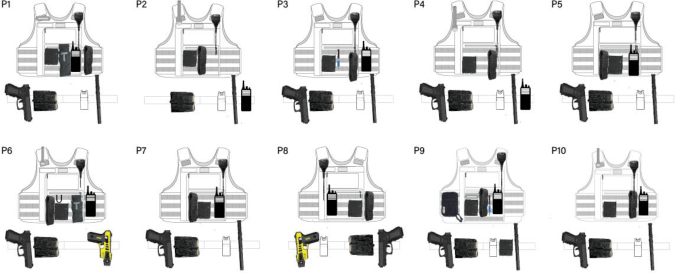
Impact of Front Volume on Police Mobility and Comfort Although the system is appreciated for its customization capabilities, the circumference of the wearer’s front, regardless of the weight of the tools, increases significantly as soon as a radio and a double handcuff case are attached, which generates notable discomfort. This increase in volume occurs more notably in vests with two or three rows of MOLLE due to the limited space. Depending on the placement of the equipment, the thickness of the chest or abdomen increases considerably. While P6 has a waist circumference of 89 cm, it is observed that the front circumference at the abdomen increases to 124 cm with her equipment and vest, nearly 40% larger. This bulkiness constitutes a constraint for activities requiring broad and dynamic movements, such as running, with 10 out of 15 participants reporting discomfort due to the volume at the front of the vest. The analyses show that the weight attached to the bulletproof vest generates unwanted movements and exerts moderate pressure on the abdomen of 5 participants. Some even developed the habit of holding their equipment with one hand to limit its movement and reduce discomfort caused by these oscillations. Due to the impact of the front volume, several officers choose to reduce the number of items attached to their vests, questioning the effectiveness of the MOLLE system. Unexpectedly, even officers with larger vests (men) prefer to limit front volume by placing more equipment on their duty belts. Conversely, women, often limited by the lack of space on their duty belts, turn to the vest to store their equipment. While this solution allows them to adjust their load, it can also restrict their mobility.
8 Corsini and Vezeau
Figure 4: Impact of equipment addition on frontal volume increase.
Impact of Front Volume on Accessibility This constraint related to the front volume also disrupts movements in adduction, such as retrieving tools from the duty belt. The results show that certain distribution patterns with significant front volume slow down access to equipment, thereby affecting the speed and efficiency of movements. Each operation was timed in seconds—not to assess performance, but to recreate a realistic context and identify the most difficult-to-reach tools. The data shows that items placed on the duty belt generally require the most time to be retrieved, suggesting that their position significantly influences accessibility.
Table 2: Equipment recovery time (sec) - 3 trials per participant.
Legend: P = participants; Red box = long duration; X = does not wear the tool Average durations: Handcuffs = 2.26 s; Firearm = 2 s; Baton = 3.01 s.
The trials reveal a learning effect, particularly regarding participants’ difficulties in locating relocated equipment. Although manipulation times sometimes appear variable, they indicate that progressive improvement occurs as gestures are repeated. These observations highlight the importance of maintaining consistency in equipment placement to facilitate their identification. While the MOLLE system offers flexibility in moving equipment, it is essential to note that their consistent distribution on the body promotes user habituation. Conversely, frequent relocations increase the risk of confusion. Although our protocol did not allow for precise measurement of these phenomena, their existence is evident and was verbally reported by several officers during the trials. A laboratory study would be necessary to examine these aspects more thoroughly.
The analysis of retrieval times shows that certain items, such as handcuffs or firearms, are typically retrieved in about 2 seconds on average. However, other equipment, such as the telescopic baton and pepper spray, require more time due to specific constraints: physical obstacles (front volume), collisions with other tools, or holsters limiting access, leading to uncomfortable postures. Among the 15 participants, 10 struggled to retrieve the baton. These difficulties do not consistently translate into longer retrieval times, but they were observed through the postural adjustments adopted: pronounced twisting of the torso to compensate for a lack of arm range, leaning backward
Simulations for Optimizing Bulletproof Vest Design With Molle System for Police 9
to create the necessary space for drawing, and raising the elbow, as illustrated in Figure 3. For 2 participants equipped with a Taser, the recommended gesture became impossible, forcing them to retrieve the baton with their non-dominant hand, an adaptation that is not recommended.
Figure 5: Baton retrieval sequence by a police officer – constraining postures.Figure 6: Movement axes and equipment accessibility.
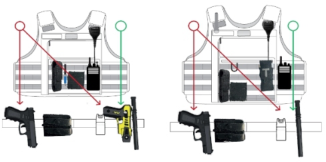
The retrieval of pepper spray presents comparable constraints: 9 participants experienced difficulties, adopting similar restrictive postures to reach it. The arrangement of the MOLLE system determines the placement space for accessories on the vest, with each position directly influencing the accessibility of the equipment. As illustrated in Figure 4, the front volume of the accessories attached to the vest reduces the range of motion, particularly limiting arm adduction movements and complicating access to tools on the duty belt. The belt, which mainly holds intermediate weapons (firearm, pepper spray, baton, Taser), requires quick and efficient handling in dangerous situations. This constraint is more pronounced on the dominant arm, which has two axes of action (marked in red in the Figure 4), than on the non-dominant arm with one axis (marked in green for right-handed individuals). When the arm has an unobstructed path along all three axes, participants can access tools on the belt more easily.
CONCLUSION
These simulations revealed high satisfaction and identified key design factors of MOLLE BPVs impacting comfort, mobility, and tool accessibility based on officers’ anthropometric characteristics. The MOLLE system’s variable configuration, influenced by body size, creates disparities in equipment storage space. Officers with smaller chests have fewer rows and columns, limiting their ability to carry a full set of well-distributed gear. This affects all officers in terms of practicality and accessibility. Poor distribution patterns–such as excess tools, poor load balance, front arm congestion, and bulky volumes near the abdomen or duty belt– cause discomfort
10 Corsini and Vezeau
and hinder quick access to essential tools like batons, pepper spray, and tasers. The simulations identified key principles for optimizing vest design: minimizing frontal volume to improve mobility and tool access; spacing and repositioning equipment—especially away from the duty belt—to avoid collisions and physical constraints; evenly distributing weight on both sides of the sagittal plane to reduce strain; and adjusting equipment quantity based on body weight for better performance and well-being. These principles will guide future design solutions tailored to operational needs. Rethinking the MOLLE system is essential for better adaptability and comfort for all officers. Additionally, activities like driving, report writing, and shooting revealed limitations in armholes, restricting movement and increasing discomfort. Additionally, the rigidity of the ballistic panel, especially during arm adduction, caused pressure points and restricted motion. The vest’s ventilation fabric failed to provide sufficient airflow, leading to heat buildup during physical activities or hot weather. These issues must be addressed to improve officer comfort and mobility.
Some methodological limitations must be noted. The first-phase simulations didn’t fully assess the impact of equipment distribution on movement and postural constraints. A second series of simulations will be needed to refine the analysis, focusing on object placement, accessibility, mobility, and load distribution, especially in scenarios with significant constraints. In fact, beyond the scope of this article, the project included an extensive iterative prototyping phase conducted in collaboration with the manufacturer. This co-design process ran alongside user testing, enabling continuous adjustments informed by real-world feedback and ensuring that design solutions accommodated the morphological diversity of the participants.
To conclude, this study highlights the importance of equipment distribution in the MOLLE system and ballistic panel rigidity on mobility. These findings will guide our future analysis, where we will dive deeper into these issues and propose improvements for protective equipment.
ACKNOWLEDGMENT
The authors sincerely thank the participating officers, the Police Organization, the Fraternity of Police Officers for their support and field access, and MITACS for funding.
Standards: FD CEN/TR 15321 ≪Guide de sélection, d’utilisation, d’entretien et de maintenance des vêtements de protection≫listent les éléments à considérer lors du choix tout type de vêtement de protection.
REFERENCES
Ashcroft, J., Daniels, D. J. et Hart, S. V. (2001). Selection and application guide to personal body armor (Guide no 100-01). Washington, DC: National Institute of Justice. Budico, V. (2012). Rapport final de l’intervention ergonomique: Révision de la veste
pare-balles niveau II (Rapport de stage, UQAM, Montréal, QC).
Simulations for Optimizing Bulletproof Vest Design With Molle System for Police 11
Chabanne, N., (2024). Les vêtements de protection: Choix et utilisation. Équipements de protection collective et individuelle. Coll. Moyens de prévention. N
ED 6546. INRS. 56p. Dempsey, P. C., Handcock, P. J. et Rehrer, N. J. (2013). Impact of police body armour and equipment on mobility. Applied Ergonomics, 44(6), 957–961. Dunn, S. (2010). Les policiers tués dans l’exercice de leurs fonctions, 1961 à 2009.
Ottawa, ON : Statistique Canada. Tiré de http://www.statcan.gc.ca/pub/85-002- x/2010003/article/11354-fra.htm. Fowler, J. F. (2007). ≪Comfort perceptions of police officers toward ballistic vests≫.
Unpublished doctoral thesis. Florida State University. Tallahassee, FL, USA. Tiré de http://diginole.lib.fsu.edu/islandora/object/fsu%3A175649. LaTourrette, T. (2010). The life-saving effectiveness of body armor for police officers.
Journal of Occupational and Environmental Hygiene, 7(10), 557–562. Marsot, J., & Atain-Kouadio, J.-J. (2017). Conception des équipements de travail et prévention des TMS: Complémentarités et points d’ancrage des démarches. Perspectives interdisciplinaires sur le travail et la santé, 19(2), 45–67. Taylor, B., Kubu, B., Kappleman, K, Gunaratne, H., Ballard, N. et Martinez, M.
(2009). The BJA/PERF body armor national survey: Protecting the nation’s law enforcement officers: Phase II: Final report. Washington, DC: U.S. Department of Justice. Vezeau, S., Comtois, A. S. et Budico, V. (2021). Confort thermique et mobilité des policiers motards lors du port du gilet pare-balles: Une analyse ergonomique (Rapport n
R-1115). IRSST. Zehner, G. F., Ervin, C., Robinette, K. M. et Daziens, P. (1987). Fit evaluation of female bodyarmor. Tiré de https://apps.dtic.mil/sti/pdfs/ADA188721.pdf
LISTED IN THE AHFE DIGITAL BOOKSTORE CATALOGUE
Explore the complete digital volume
Ergonomics In Design and Kansai Engineering
Read this individual research paper free through the original publisher, or explore the full digital proceedings book.
ISBN 978-1-964867-46-5
Explore this ISBN in the AHFE Bookstore ↗Listed in the July 2026 bookstore catalogue; search by ISBN to confirm current availability · Digital book purchase optional