Qi Wang, Haining Wang (2025). Design and Development of a Modular OPM-MEG Device Based on 3D Chinese Head Anthropometry. In: Ergonomics In Design and Kansai Engineering. AHFE Open Access, vol. 170, pp. 75–84. https://doi.org/10.54941/ahfe1006169
Magnetoencephalography (MEG) has emerged as a critical non-invasive neuroimaging modality in both clinical and research domains, owing to its exceptional spatiotemporal resolution and absence of ionizing radiation. Conventional MEG systems utilizing superconducting quantum interference devices (SQUIDs) are constrained by the necessity for cryogenic cooling, resulting in substantial operational complexity and maintenance costs. While optically pumped magnetometer (OPM) technology has enabled room-temperature operation, contemporary helmet designs present significant adaptability limitations - 3D-printed customized helmets incur prohibitive production expenses, while flexible alternatives suffer from compromised sensor positioning accuracy.This investigation proposes an innovative modular OPM-MEG system architecture that incorporates 3D cephalometric characteristics of Chinese populations with advanced electromagnetic shielding technology. The developed system incorporates an auto-adaptive sensor array featuring revolutionary mechanical configurations and optimized spatial arrangements, achieving remarkable improvements in device adaptability while maintaining superior measurement fidelity. Comprehensive theoretical modeling and computational simulations have substantiated the design's viability, yielding a pragmatic solution for clinical MEG applications. This advancement represents a significant contribution to the evolution of neuroimaging technologies and possesses profound implications for neuroscience research.
Magnetoencephalography (MEG) is a non-invasive brain imaging technique capable of directly measuring the weak magnetic fields generated by neural activity, with millisecond temporal resolution and spatial precision of 2–5 mm. By integrating cryogenic superconductivity, bioengineering, and medical technology, MEG is radiation-free and does not require contrast agents, making it suitable for special populations, such as children, pregnant women, and the elderly. MEG allows for precise localization of brain activity and is widely used in sensory, motor, language, and memory research. Clinically, MEG serves as a vital tool in neurosurgery, assisting in the treatment of epilepsy, brain tumors, and Parkinson’s disease by enabling the precise localization of functional areas and lesions for surgical planning.
Additionally, MEG plays a significant role in diagnosing cerebrovascular and psychiatric disorders, as well as in preoperative functional mapping.
Despite its considerable advantages, MEG technology has notable limitations. Conventional MEG systems rely on superconducting quantum interference devices (SQUIDs), which, although sufficiently sensitive for brain magnetic field measurements, face practical challenges. First, since magnetic field strength decreases with the square of the distance, sensors must be placed close to the scalp for optimal signal quality. However, SQUIDs require liquid helium cooling, necessitating a fixed sensor array within a “universal” helmet, with a 1.5 to 2 cm gap from the scalp, which compromises signal quality. Additionally, the rigid sensor array cannot accommodate varying head shapes and sizes, further limiting performance. Second, SQUID magnetometers consume large amounts of liquid helium for low-temperature operation, resulting in annual operating costs exceeding hundreds of thousands of dollars for commercial multi-channel systems. These factors have hindered the widespread adoption and application of MEG technology.
In recent years, optically pumped magnetometers (OPMs) have emerged as a promising alternative to traditional SQUID-based MEG systems. Developed by the Romalis team at Princeton University in 2003, OPMs achieve femtotesla-level sensitivity without the need for cryogenic cooling. Their compact size, lightweight design, and flexible installation represent a significant advancement over SQUIDs. A key feature of OPMs is their customizable sensor array design, made possible by 3D printing technology, which allows for precise fitting to individual head shapes, ensuring accurate sensor positioning and orientation (Boto et al., 2018). This is particularly beneficial for clinical applications, as helmets can be removed and reinstalled while maintaining consistent sensor placement. However, the high cost, long production cycles, and low utilization rates of custom helmets have hindered widespread adoption. To improve adaptability, flexible helmet designs have been proposed (Hill et al., 2020), similar to EEG caps, to accommodate various head shapes. However, sensor movement during scanning can reduce measurement accuracy, and the need for sensor position registration increases complexity. A compromise solution involves using rigid helmets in multiple sizes (Seedat et al., 2024), combining the precision of custom designs with greater adaptability. Yet, challenges remain in ensuring optimal sensor contact and signal quality. Currently, most commercial OPM-MEG systems in China use fixed-size rigid helmets (Wang et al., 2024), providing high measurement quality but with limited adaptability for diverse populations. The future of OPM-MEG technology lies in optimizing helmet designs to balance measurement accuracy, cost-effectiveness, and adaptability.
In this study, a modular OPM-MEG device design is proposed, aiming to enhance adaptability, measurement efficiency, and accuracy. The design optimizes the OPM sensor array by integrating physiological anatomy and EEG measurement point distribution, referencing big data from Chinese head models. A helmet curve adapted to most Chinese head shapes is developed to ensure that sensor modules fit various head types while maintaining a stable position on a module-by-module basis, thereby improving measurement
Design and Development of a Modular OPM-MEG Device 77
accuracy and efficiency. This study presents new insights into the adaptability and commercial application of OPM-MEG devices and is expected to contribute to their widespread use in medicine and brain science, particularly in the early diagnosis of brain diseases and brain function research.
OPM-MEG MODULAR DESIGN Digital Headforms
Due to the inverse square relationship between MEG signals and distance, halving the distance between the scalp and the sensor results in a fourfold increase in the amplitude of the measured brain magnetic field signal. Therefore, sensors should be positioned as close as possible to the scalp surface of the target brain region to obtain higher-quality signal values. Utilizing a representative big data database of Chinese head models can aid in the design of MEG helmets. Since OPM sensors do not require cooling during operation, they can directly contact the scalp surface without causing any risk or discomfort. Thus, incorporating representative head models into MEG helmet design can enhance the fit between the helmet and the participant’s head, minimizing the distance between the scalp and the sensors, ultimately acquiring more accurate and effective signal values.
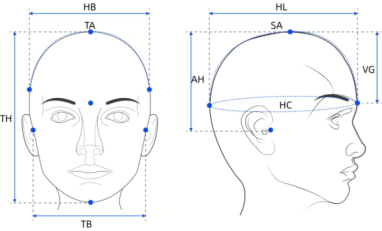
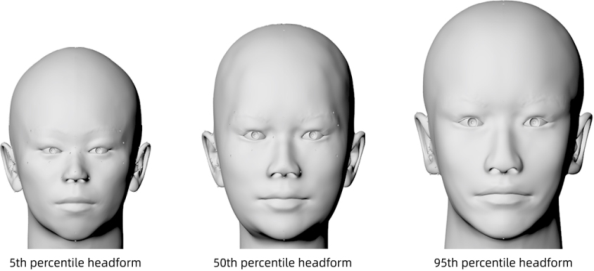
Using high-precision 3D scanning technology, a large database of Chinese head models was established based on data from 2,200 individuals across seven representative cities in China (Wang et al., 2018). Five head size types (small, medium, large, long/narrow, short/wide) were constructed based on PCA analysis. Dimensionality reduction was performed using head feature dimensions relevant to head-mounted product design (Li et al., 2021), including head circumference (HC), head length (HL), head breadth (HB), total head height (TH), sagittal arc length (SA), coronal arc length (TA), tragion-to-tragion distance (TB), auricular height (AH), and vertex-to- glabella distance (VG). In accordance with ISO/TS 16976-2:2015, all head model data were fitted to human head dimensions, resulting in three size categories: the 5th percentile, the 50th percentile, and the 95th percentile, as shown in Figure 2.
Figure 1: 9 head and face dimensions.
78 Wang and Wang
Figure 2: Three size headforms.
Sensor Arrays In this study, the SERF Magnetometer (X·MAGTECH Ltd.) was used as an example. The dimensions of its sensor probe and controller are 13 × 20 × 40 mm3 and 35 × 240 × 350 mm3, respectively. The sensitivity can reach 10−15 fT/Hz1/2, and the digital output can be expanded to 128 channels. A “whole-head” (50-channel) wearable OPM-MEG system, constructed with 50 second-generation zero-field magnetometers produced by QuSpin Inc., has been experimentally validated to exhibit performance comparable to traditional SQUID-MEG systems (Hill et al., 2020). Therefore, this study adopts a 50-channel OPM-MEG system composed of 50 OPM sensors.
To fully leverage the flexibility of OPM-MEG, optimizing the sensor array design is a crucial step. Researchers have evaluated the performance of OPM arrays at both the sensor and source levels, comparing them with commercial SQUID-MEG arrays. For sensor array design, it has been demonstrated that using a general electroencephalography (EEG) layout as a candidate sensor array (CSA) provides a scientifically grounded approach based on well-established EEG measurement methodologies (Beltrachini et al.). Additionally, with the evolving sensor sizes, some scholars have proposed a sensor array optimization method based on sensor volume constraints (SOSVC) (Wang et al., 2024). This study integrates both approaches for the sensor array layout design. Furthermore, a multi-channel whole-head OPM system that measures the magnetic field component perpendicular to the local scalp surface can increase sensitivity by a factor of five, and this requirement will also be considered in the current design.
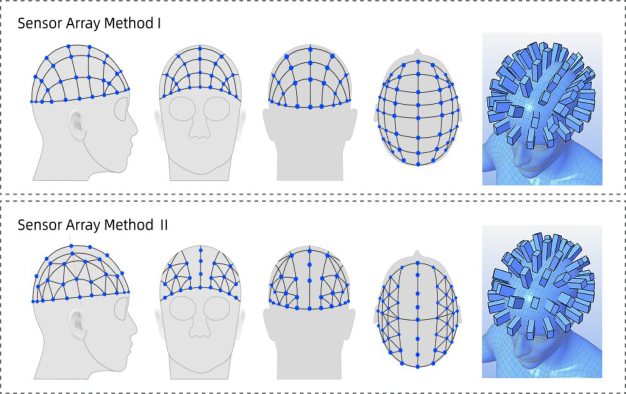
First, based on the EEG electrode placement layout, an initial attempt (Method I) was made to arrange the 50 OPM sensor measurement points, as shown in Figure 3. This layout was imported into 3D software, and the 50th percentile head model was used as the test basis for sensor array visualization. Since the inter-sensor spacing or OPM channel density significantly impacts OPM-MEG connectivity, studies have shown that a 30 mm gap array yields higher signal quality and greater effectiveness in OPM-MEG source reconstruction (Qi et al., 2025). However, Method I
Design and Development of a Modular OPM-MEG Device 79
could not satisfy the 30 mm gap requirement for all sensors. Therefore, an improved attempt (Method II) was made by combining Method I with the LASA layout approach based on SOSVC. The resulting OPM sensor array was imported into 3D software, and the 50th percentile head model was used for visualization, as shown in Figure 3. After measurement verification, the 50-sensor array in Method II satisfies the 30 mm gap requirement and is theoretically capable of acquiring higher-quality signals.
Figure 3: Sensor array method.
Modular Zoning In clinical PET scanning, the desire to obtain high-resolution reconstructed images in shorter scanning durations has prompted scholars to design a new helmet-mounted PET scanner, which consists of five sections (bottom, face, forehead, head, and top) (Wang et al., 2020). In order to reduce the distance between the sensors and the scalp and improve the OPM-MEG helmet fit, the OPM array can be optimized by cropping and partitioning it into a modular design.
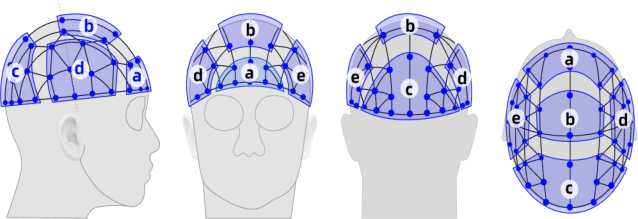
To enhance the OPM-MEG’s capture of brain signals, this design refers to the individual anatomical Brodmann Atlas, which shows that there are four functional subdivisions in the brain. By combining these four brain functional partitions with the distribution of EEG electrode locations, we divided the sensor array of 50 OPMs into five modular regions corresponding to: a) Frontal lobe: thinking functional region b) Parietal lobe: somatosensory functional region c) Occipital lobe: visual functional region d) Temporal lobe: right-side auditory functional region e) Temporal lobe: left-side auditory functional region.
80 Wang and Wang
Figure 4: Sensor module partition.
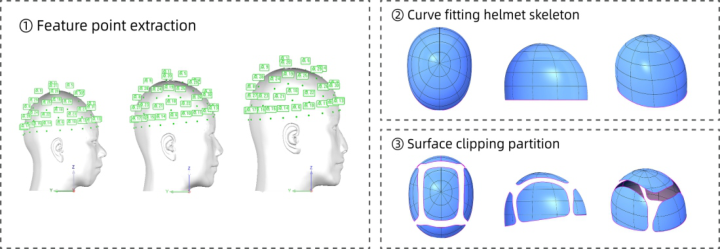
Helmet Shape Design To design the curved shape of each sensor module liner to fit the scalp surface of most Chinese individuals, Geomagic software was used to extract the point positions and process the data for output. The specific operation steps are as follows: first, extract the sensor array point positions for the “5th percentile,” “50th percentile,” and “95th percentile” head molds, and calculate and output the three-dimensional spatial coordinate values. These coordinates represent the exact positions of the sensor arrays on the head model at different percentiles, providing accurate spatial data. Next, the sensor array point locations intersecting with the key curves of the helmet design were selected for further analysis. The helmet skeleton was constructed by curve fitting these key point locations. By fitting the obtained skeleton curves, we generated the helmet liner surface, which accurately reflects the geometry of the sensor assembly skeleton. Based on this surface, we partitioned the surface using the previously derived sensor module partitions, which led to the corresponding five module partition surfaces. This will serve as the key reference for subsequent OPM-MEG modeling design.
Figure 5: Helmet curve design process.
Virtual Fit Assessment Virtual Fitting Assessment (VFA) is a computer-aided design (CAD)-based technology that evaluates the fit of product components by simulating
Design and Development of a Modular OPM-MEG Device 81
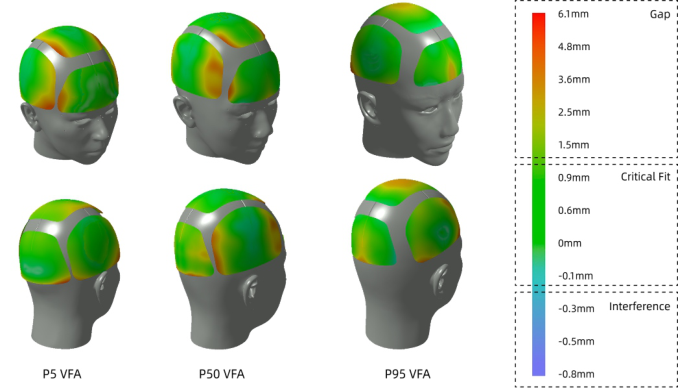
the interaction between components and three-dimensional head models in a virtual environment. For helmet design, researchers have proposed a novel method for studying and comparing helmet fit accuracy using 3D anthropometry, reverse engineering, and computational analysis (Ellena et al., 2016). Using VFA, three conditions for the interaction between human and product wear models are defined: gap state, interference state, and critical fit state (Wang et al., 2021). In this study, CATIA V5 6R2018 was used to analyze the interaction between the five modular OPM-MEG helmet designs and three head models representing the 5th, 50th, and 95th percentiles. Deviation analysis was conducted to assess helmet fit performance. A gap distance < 0 mm indicates interference, a gap distance > 0 mm represents a gap, and a gap distance = 0 mm signifies a perfect match between the two surfaces. A smaller gap distance implies a closer proximity between the scalp and sensors, theoretically enabling the acquisition of more accurate and effective signal values.
First, the five modular partition surfaces obtained above were aligned with the 5th, 50th, and 95th percentile headforms using the n-point manual registration and global registration algorithms in Geomagic Studio 12. The aligned headforms and helmet partition files were then imported into CATIA for deviation and interference analysis. As shown in Figure 6, the red regions indicate a gap state (> 0.6 mm), the blue regions represent an interference state (< −0.2 mm), and the green regions denote a critical fit state (−0.2 mm to 0.6 mm). The deviation analysis reveals that the OPM- MEG modular helmet exhibits predominantly green regions across the three headforms, with minimal red and blue regions, indicating a well-fitted and uniformly distributed overall performance.
Figure 6: Deviation analysis texture maps.
Furthermore, the gap distribution between the head mesh and the helmet interior was calculated, defining two key parameters: (1) the Spacing Distance (SOD), the average minimum distance between the head shape and the inner
82 Wang and Wang
lining mesh points, and (2) the Gap Uniformity (GU), the standard deviation of the gap distribution, reflecting the degree of dispersion. A smaller SOD indicates better helmet fit, while a GU closer to zero suggests more uniform gap distribution, signifying an optimized fit that facilitates the acquisition of stable and balanced whole-head signals. As shown in Table 1, the SOD for the P95 headform performs the best, with all SOD values below 3 mm, indicating a small gap distance. Additionally, all GU values are controlled within 2 mm, demonstrating uniform gap distribution. These results suggest that the OPM-MEG modular helmet can effectively fit the 5th, 50th, and 95th percentile headforms, theoretically accommodating most Chinese head sizes and enabling the acquisition of more precise and reliable brain signals during measurements.
a 1.81 1.53 2.36 1.28 1.03 0.571 b 1.89 1.14 0.938 0.509 2.84 1.42 c 1.61 0.921 1.04 0.282 1.26 0.592 d 2.28 1.48 2.29 1.3 2.21 1.04 e 2.31 1.48 2.4 1.3 2.07 1.37
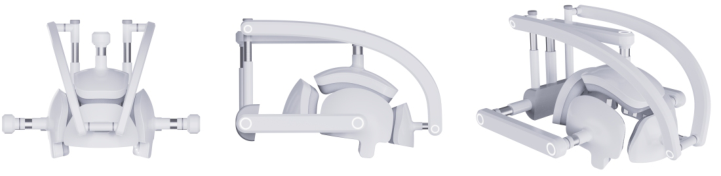
Overall Design Introduction Based on the modular partition design, this study optimized the overall OPM-MEG system, significantly enhancing the device’s comfort, fit, and measurement efficiency (as shown in Figure 7). The design integrates ergonomic and technical requirements to ensure practicality and efficiency in real-world use. The skin-contact components of the device are made from soft, breathable silicone material, which not only improves wearing comfort but also reduces discomfort during prolonged use, effectively preventing overheating and moisture buildup.
Figure 7: OPM-MEG modular device design concepts.
The upper part of the device uses lightweight materials, significantly reducing the overall weight and minimizing the burden on the subject’s head. While ensuring structural stability, this design further enhances long-term wearing comfort, thereby improving participant comfort and data reliability in experimental settings.
Design and Development of a Modular OPM-MEG Device 83
From a structural design perspective, the device’s five modules incorporate a dynamic arm mechanism with multi-angle adjustments, allowing for flexible adaptation to individual head shapes. This ensures a secure fit between the MEG helmet and the head. By reducing the distance between the scalp and sensors, the design enhances signal acquisition accuracy and minimizes errors caused by poor contact or positional deviations.
Additionally, the five fixed modules ensure stable relative positioning among the sensors (relative displacement) and maintain a fixed positional relationship between the sensors and the brain’s anatomical structures (absolute displacement), thus improving measurement precision. The modular design significantly reduces co-registration time and enhances overall measurement efficiency, enabling faster and more efficient brain function detection.
CONCLUSION
The modular OPM-MEG design scheme proposed in this study effectively addresses key challenges related to adaptability, measurement accuracy, and operational convenience that exist in current MEG devices. Traditional MEG devices suffer from poor adaptability, structural complexity, and high costs. While customized 3D-printed or flexible helmets offer partial improvements, they still face issues such as long production cycles, limited adaptability across populations, and unstable sensor positioning. This study optimizes the sensor layout by incorporating physiological anatomy and EEG measurement point distribution. By leveraging big data from Chinese head models, a helmet curve suitable for most Chinese head shapes was designed. Virtual fitting assessments confirmed its effectiveness, ensuring stable contact between sensor modules and the head, significantly improving measurement accuracy and efficiency.
The design also features a dynamic arm mechanism with multi-angle adjustments for each partition, allowing flexible adaptation of sensor modules to individual head shapes. This enhances the device’s fit, reduces the distance between the scalp and sensors, improves MEG signal acquisition accuracy, and minimizes errors caused by poor contact or positional deviations.
In terms of comfort and usability, the device includes skin-contact components made of soft, breathable silicone to enhance wearing comfort. Additionally, the lightweight upper section reduces overall weight and minimizes user burden. The modular design simplifies device use and maintenance, and its adjustability significantly shortens measurement preparation time, improving work efficiency, particularly for clinical and research applications.
This design not only offers innovative solutions to improve the adaptability and measurement accuracy of OPM-MEG devices but also paves the way for their commercialization. The modular design greatly enhances system flexibility and adaptability, positioning the device to play a crucial role in the early diagnosis of brain diseases, brain function research, and clinical treatment. As the technology matures and becomes more widely adopted,
84 Wang and Wang
OPM-MEG is expected to become an indispensable tool in medicine and brain science, driving the widespread application of brain function imaging technology and offering more precise and efficient technical support for the diagnosis and treatment of brain disorders.
REFERENCES
Beltrachini, L., von Ellenrieder, N., Eichardt, R., Haueisen, J., 2021. Optimal design of on-scalp electromagnetic sensor arrays for brain source localisation. Human Brain Mapping, 42(15), pp. 4869–4879. Boto, E., Holmes, N., Leggett, J. et al., 2018. Moving magnetoencephalography
towards real-world applications with a wearable system. Nature, 555, pp. 657–661. Ellena, T., Subic, A., Mustafa, H., Toh Yen Pang, 2016. The Helmet Fit Index – An intelligent tool for fit assessment and design customisation. Applied Ergonomics, 55, pp. 194–207. Hill, R. M., Boto, E., Rea, M., Holmes, N., Leggett, J., Coles, L. A., Papastavrou,
M., Everton, S. K., Hunt, B. A. E., Sims, D., Osborne, J., Shah, V., Bowtell, R., Brookes, M. J., 2020. Multi-channel whole-head OPM-MEG: Helmet design and a comparison with a conventional system. NeuroImage, 219, ISSN 1053–8119. ISO/TS 16976 2: 2015. Respiratory Protective Devices: Human Factors-Part 2. Li, Z., Zhang, K., Zhu, Z., 2021. Research on 3D Head Model Collection and Measurement for Helmet Design. Development & Innovation of Machinery & Electrical Products, 34 (05), pp. 57–59. Livanainen, J., Stenroos, M., Parkkonen, L., 2017. Measuring MEG closer to the
brain: Performance of on-scalp sensor arrays. NeuroImage, 147, pp. 542–553. Qi, S., Song, X., Jia, L., Cui, H., Suo, Y., Long, T., Wu, Z., Ning, X., 2025. The impact of channel density, inverse solutions, connectivity metrics and calibration errors on OPM-MEG connectivity analysis: A simulation study. NeuroImage, 308, ISSN 1053–8119. Seedat, Z. A., Pier, K. St., Holmes, N., Rea, M. et al. 2024. Simultaneous
whole-head electrophysiological recordings using EEG and OPM-MEG. Imaging Neuroscience, 2, pp. 1–15. Wang X, Teng P, Meng Q, Jiang Y, Wu J, Li T, Wang M, Guan Y, Zhou J, Sheng J, Gao JH, Luan G, 2024. Performance of optically pumped magnetometer magnetoen- cephalography: Validation in large samples and multiple tasks. J Neural Eng, Dec 19; 21(6). Wang, H., Chen, W., Li, Y, Yu, Y., Yang, W., Ball, R., 2018. A 3D head model fitting
methodusing Chinese head anthropometric data. Springer, Cham. In: Rau, P.-L. (ed.) CCD. LNCS, vol. 10911, pp. 203–215. Wang, H., Chi, 2021. Fit test method study of wearable products by combining virtuality and reality. Packag. Eng, 42(12), pp. 84–90. Wang, H., Yu, Y., Chen, W., Yang, W., Ball, R., 2018. Responsive web design for
Chinese head and facial database. Springer Cham. In: Rau, P-LP. (ed,) CCD. LNCS, vol. 10911, pp. 216–231. Wang, T., Niu, M., Huang, C., Li, Y., Yin, Y., Chen, X., 2020. Design and simulation of a helmet brain PET system, Nuclear Instruments and Methods in Physics Research Section A: Accelerators, Spectrometers, Detectors and Associated Equipment, 978, ISSN 0168–9002. Wang, W., Cao, F., An, N., Li, W., Xu, W., Wang, C., Gao, Z., Yu, D., Gao, Y., Ning,
X., 2024. Design of locally arranged sensor arrays in wearable OPM-MEG based on sensor volume constraints. Measurement, 229, ISSN 0263–2241.
LISTED IN THE AHFE DIGITAL BOOKSTORE CATALOGUE
Explore the complete digital volume
Ergonomics In Design and Kansai Engineering
Read this individual research paper free through the original publisher, or explore the full digital proceedings book.
ISBN 978-1-964867-46-5
Explore this ISBN in the AHFE Bookstore ↗Listed in the July 2026 bookstore catalogue; search by ISBN to confirm current availability · Digital book purchase optional