Baoruo Zhang, Kexiang Liu, Ke Zeng, Yan Yan, Haining Wang (2025). Designing for Comfort: OWS Earphone Design Based on External Ear Anthropometry and Comfort Analysis. In: Ergonomics In Design and Kansai Engineering. AHFE Open Access, vol. 170, pp. 95–105. https://doi.org/10.54941/ahfe1006171
Open wearable stereo earphones (OWS), as an emerging wearable audio device, have gained significant attention due to their non-intrusive design and environmental awareness dimensions. However, issues such as pressure concentration and dynamic slippage caused by insufficient ear fit in the open structure hinder the user experience. This paper focuses on ear-hook type OWS earphones and proposes a systematic design framework based on the 'black box model - ear measurement - experimental validation'. First, key design parameters of the acoustic module, contact module, and structural module are extracted by decoupling the earphone components based on reverse engineering theory. Then, a mapping model between ear characteristics and earphone design parameters is constructed using a 3D ear database of 110 Chinese adults. Finally, the feasibility of the design solution is validated through orthogonal experiments and multi-scenario wearing tests. This study fills the gap in the systematic design theory of OWS earphones, establishes a data-driven paradigm for personalized fitting, and provides theoretical support and practical references for ergonomic optimization of wearable devices.
Open wearable stereo earphones (OWS), as an emerging form of wearable audio devices, are expected to achieve a compound annual growth rate of 8.3% in the global market from 2024 to 2030 (QYResearch, 2024) due to their non-intrusive design and environmental awareness dimensions. However, there is a significant contradiction between their open structure and ear fit: existing products suffer from issues such as pressure concentration and dynamic slippage (Home Theater Technology, 2024) due to inadequate ear fit, resulting in unsatisfactory user experiences. Traditional TWS earphone design theories cannot be directly applied which creates an urgent need to establish a human-machine adaptation design method specifically for OWS.
OWS earphones are mainly divided into ear-hook and ear-clip types. This study selects ear-clip earphones as the research object and proposes a “black box model - ear measurement science - experimental validation”
research framework: First, based on reverse engineering theory (Otto & Wood, 1998), the functional system of OWS is decoupled to extract key design parameters. Next, based on anthropometric theory, a mapping model between ear characteristics and design parameters is constructed, utilizing a 3D ear database of 110 Chinese adults to obtain ear measurement data. Finally, the feasibility of the method is validated through earphone design, 3D printing, and wearing tests. This study fills the gap in the systematic design theory of OWS and provides a data-driven paradigm for the development of personalized wearable devices.
ACQUISITION OF KEY DESIGN DIMENSIONS Construction of the Black Box Model and Functional Decoupling
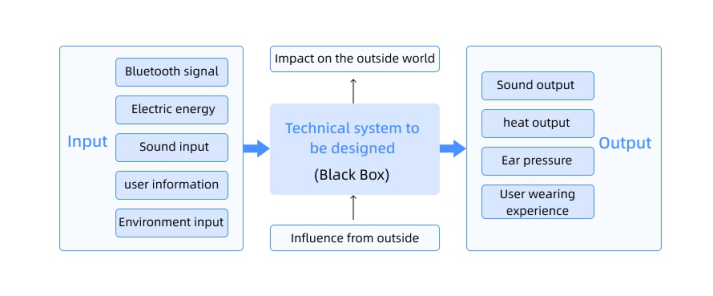
This study establishes a black box model framework for the OWS earphone system (Figure 1) and defines the core input and output parameters. The global function is to provide stable stereo audio output through an open-ear design while ensuring long-term comfort and stability during wear.
The input vector includes Bluetooth signals, power input, audio input, user information input, and environmental input. User information input refers to personal parameters or preferences of the wearer, including ear shape, wearing scenario, and wear preferences. Environmental input refers to the external factors affecting the earphones, such as external noise, temperature, humidity, and other conditions.
The output vector includes ear pressure, sound output, heat output, and user wearing experience. Ear pressure refers to the pressure applied to the ears by the earphones during wear. Heat output refers to the heat generated by the device and the thermal conduction to the skin. User wearing experience refers to the comprehensive output, describing the overall experience of the wearer, including comfort, stability, pressure on the ears, sound quality, and convenience of interaction with the user.
Figure 1: Black box model framework for OWS earphone system.
Designing for Comfort: OWS Earphone Design 97
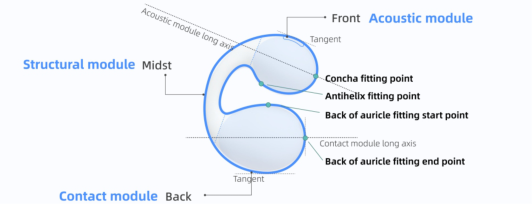
Functional Subsystem Decoupling Based on the modular naming system of Huawei FreeClip (Comfort Sphere, Listening Sphere, C-Bridge), this study decouples the earphone system into functional subsystems and identifies the contact points with the ear through wearing methods, briefly illustrating their morphological structure (Figure 2). Specifically, the earphone system is divided into three major functional subsystems:
Acoustic Module (Listening Sphere): Includes a miniature dynamic driver, waveguide structure, and leakage compensation algorithm, designed to achieve directional sound field control.
Contact Module (Comfort Sphere): As the core component, it houses a lithium-polymer battery for power supply, a main control chip for audio signal processing, and circuit designs for energy management and data processing to ensure proper operation of the earphones.
Structural Module (C-Bridge): Connects the acoustic module and the contact module, with built-in signal transmission lines, considering both wearing comfort and the stability of audio signal transmission.
This decoupling approach allows for clearer identification and optimization of the earphone’s functional modules, facilitating modular adjustments and functional improvements in future earphone designs.
Figure 2: Modular naming diagram of ear-clip OWS earphones.
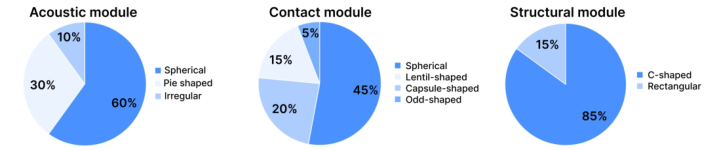
Morphological Dimensions and Design Semantics Analysis This study systematically investigates 21 commercially available ear-clip OWS models, covering products from both mainstream brands and emerging manufacturers. Using morphological classification and design semantics analysis, the study focuses on three core components: the acoustic module, the contact module, and the structural module, summarizing their morphological dimensions (Figure 3) and design semantics to provide a basis for refining key design dimensions.
Acoustic Module Design: Spherical designs (60%) convey the semantics of “perfect harmony” and “universal applicability” through spherical or elliptical shapes. Disc-shaped designs (30%) use a flattened, compact layout to evoke feelings of “small size” and “privacy.” Irregular designs (10%) dimension streamlined or geometric cuts to express “innovation” and “technological feel,” typically used in differentiated product designs. The
design trends show that standardized spherical shapes remain dominant, but the proportion of irregular designs is increasing, reflecting the balance between acoustic performance and personalized demands.
Contact Module Design: Spherical designs (45%) convey “concealment” and “integration” through minimalistic presence. Capsule shapes (20%) emphasize “long contact surface” and “high stability” with an elongated axis. Lenticular designs (15%) fit the back of the ear with a hyperbolic design, expressing “ergonomics” and “high adaptability.” Irregular designs (5%) convey the emotional value of “customization,” meeting users’ needs for personalization and uniqueness. The design trend shows that the contact module’s form is evolving from simple geometric shapes to biomimetic curves, with curvature radius and contact area becoming key design parameters.
Structural Module Design: C-shaped designs (85%) naturally fit the ear contour, conveying feelings of “nature” and “flexibility,” providing a more comfortable and smooth tactile experience during wear. Rectangular designs (15%) convey “technology” and “modularity” through angular shapes, commonly seen in minimalist style products. The design trend shows that C-shaped structures dominate the market, with key design parameters focusing on opening width and elastic deformation to ensure a balance between clamping force and comfort.
Figure 3: Analysis of the proportion of modeling dimensions of each module.
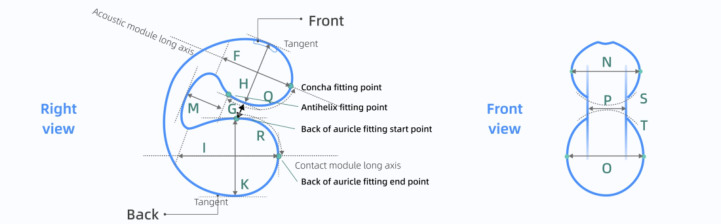
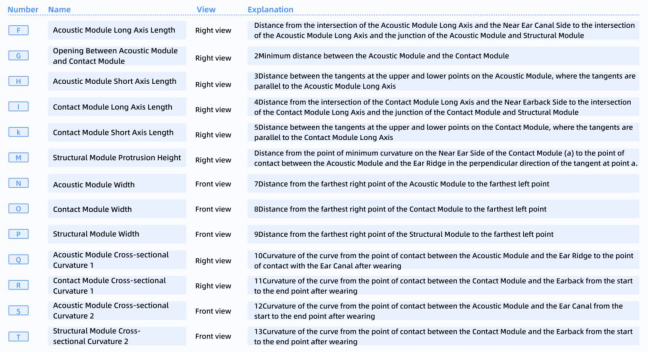
Definition of Key Design Dimensions Based on the analysis of the correlation between morphological dimensions and user needs, the core dimensional parameters influencing the performance of OWS earphones have been identified (Figure 4, Figure 5), totaling 13.
Figure 4: OWS earphone key design dimensions.
Designing for Comfort: OWS Earphone Design 99
Figure 5: Definition table of ear clip type OWS earphone design parameters.
ANALYSIS OF ANTHROPOMETRIC CHARACTERISTICS Definition of Key Ear Dimensions and Values
3D scanning technology of the outer ear plays a crucial role in OWS earphone design, as it provides accurate measurements for determining the sizes required for the earphones. The structure of the outer ear mainly includes the auricle, ear canal, and external auditory meatus. Previous studies have confirmed the effectiveness of outer ear measurements in earphone design (Ji et al., 2017), and detailed definitions of the key ear landmarks and measurements required for earphone design have been provided (Lee et al., 2016; Wang et al., 2011). However, research related to OWS earphones, a new type of product, is relatively limited, with most existing literature focusing on TWS earphones and lacking specific ear dimension definitions for OWS earphones. Therefore, this study, through literature review and expert discussions, selects ear dimensions relevant to the design of ear-clip type OWS earphones to guide their development.
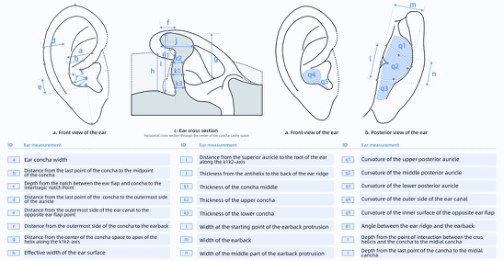
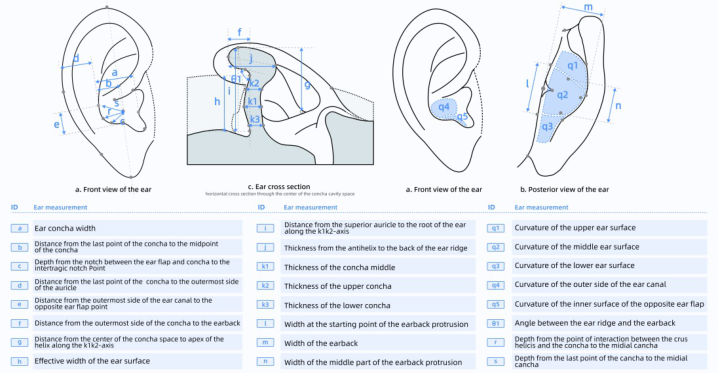
Figure 6: Ear landmarks (related to the design of ear clip-on OWS earphones).
The selection of key ear landmarks and measurements in this study is based on the national standard for nomenclature and location of auricular points (GB/T 13734-2008) and ergonomics literature related to earphone design (Lee et al., 2018; Liu, 2009; Lee et al., 2016; Wang et al., 2011). Additionally, the contact areas of OWS earphones, including the helix, earback, and crus helicis, are considered for optimization. New parameters such as curvature of the posterior auricle (q1–q3) and thickness of the concha (K1–K3) are added (Figure 6, Figure 7) to address the fitting issues of OWS earphones.
Figure 7: Ear measurements (related to the design of ear clip-on OWS earphones).
Ear Dimension Size Data Collection To measure ear dimensions, many studies have employed traditional measurement techniques, such as obtaining ear dimensions from 2D image data (Liu, Tseng, & Chia, 2010; Ozioko et al., 2020) or using calipers (Kumar & Selvi, 2016). However, these methods have certain limitations in measurement accuracy. With the development of 3D scanning technology, more accurate data can be obtained even when dealing with complex ear structures (Yu et al., 2015; Fu et al., 2018). Based on this, this study used 3D scanning data to extract ear dimensions. The scanning data were extracted from the Chinese Headbase established by Wang et al. (2018) using 3D scanning technology.
Using 3D scanning technology, high-precision models of the external ears of 110 Chinese adult subjects (ages 18–65) were created. Anatomical dimension points (Table 1) and 24 key dimensional parameters (Table 4) were extracted using reverse engineering software (the Geomagic Wrap, 2023).
Mapping Relationship Between Ear Measurements and Earphone Design Based on the principle of adaptability (Singleton & World Health Organization, 1972), this study establishes the mapping relationship between ear measurements and OWS earphone design dimensions (Table 2).
Table 2: The mapping relationship between ear measurements and earphone design.
Table available in the original PDF paper.
Design Dimensions G H F I M N Ear measurements k1/k2/k3 a/b c/r/s m/h d/i/g/h e Design dimensions O Q R S T Ear measurements l/n q4/q5 f/q1/q2/q3 q4/q5 q1/q2/q3
DESIGN VERIFICATION Experimental Design
Due to the deformation characteristics of ear soft tissue and individual perceptual differences, it is not possible to determine the optimal design values solely based on dimensional parameters. This requires the introduction of experimental validation to complete the design
feedback loop. Many studies use finite element simulation technology for verification (Ran et al., 2015), but since finite element simulations cannot fully simulate individual differences and subjective perception, this study ultimately chooses wear experiments (Wang et al., 2024) to verify the design dimensions, ensuring that the design is more aligned with real wearing experiences while considering individual comfort differences.
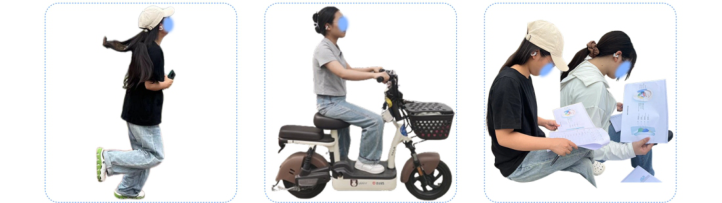
To verify the effectiveness of the design parameters, this study employs a four-factor, three-level orthogonal experimental design (L9(3ˆ4)), selecting the short axis length of the acoustic module (12.24–14.5mm), the curvature radius of the structural module (15–21mm), and the spacing of the contact module (3.67–5.72mm) as independent variables, with overall comfort score as the dependent variable. Eight subjects (1:1 male-to-female ratio, ear shapes covering the P5–P95 range) completed multi-scenario tests in a standardized environment (temperature 25±1
C, humidity 50±5%) under three conditions: static (10 minutes), outdoor running (10 minutes), and outdoor cycling (10 minutes) (Figure 8). A double-blind method was used to eliminate subjective bias.
Figure 8: Wearing experiment: running scene (left), cycling scene (middle), stationary scene (right).
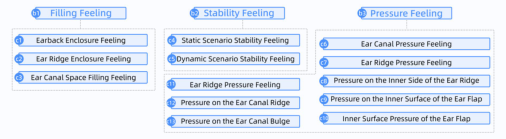
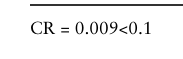
Construction of a Multidimensional Comfort Evaluation System A three-level evaluation system (Figure 9) was established based on the Analytic Hierarchy Process (AHP), with indicator weights determined through expert interviews and bibliometric analysis. The weight allocation was finalized after two rounds of expert consultations (CR = 0.009<0.1) (Table 3), resulting in a comfort evaluation framework for ear-clip OWS earphones, which includes 3 primary indicators and 13 secondary indicators.
Figure 9: Comfort evaluation framework for ear clip-on ows earphones.
Designing for Comfort: OWS Earphone Design 103
Table 3: Secondary indicator weight under “sense of oppression”.
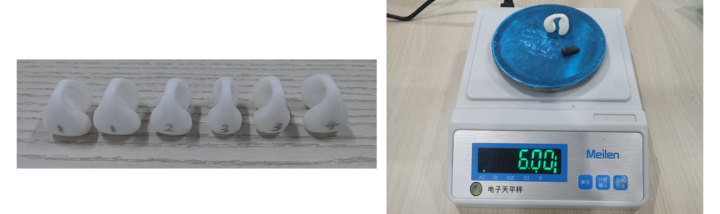
Four sets of differentiated prototypes were fabricated using SLS 3D printing technology (Figure 10). To simulate real earphone wear, tungsten clay was used for weight balancing, with each earphone maintaining a weight of 6.00±0.02 g (Figure 10). This study selected four key variables: the short axis length of the acoustic module, the height of the structural module, the gap between the acoustic module and the contact module, and the width of the contact module (Table 4).
Table 4: Comparison table of dimensions of various parts of four models.
Table available in the original PDF paper.
EP-01 EP-02 EP-03 EP-04 H 14.50 13.10 12.24 13.10 M 20.90 19.92 19.92 20.90 G 3.67 4.23 5.72 4.23 O 20.04 18.28 15.55 18.28
Figure 10: 3D printing of four prototypes (left), and earphone counterweight (right).
Determination of the Optimal Solution The results showed that the comprehensive optimal solution was the EP-02 prototype (H = 13.1mm, R = 19.92mm, G = 4.23mm, O = 18.28mm), which scored 4.346 in the cycling scenario (total score 4.38) (Table 5), significantly outperforming the competing products (p<0.01). The final design of the earphone was completed.
Table 5: Comfort ratings of the four prototypes after wearing tests.
Table available in the original PDF paper.
EP-01 EP-02 EP-03 EP-04 Score 4.17 4.38 3.65 3.72
CONCLUSION
1. The black box model was used to decouple the three main functional subsystems of OWS, revealing key design variables such as the short axis length of the acoustic module short axis length (H) and the contact module cross-sectional curvature (R); 2. A Chinese adult ear dimension database was established, and mapping rules for driving parametric design, such as ear concha width (a) and angle between the ear ridge and the earback (θ1), were proposed; 3. Experiments demonstrated that the EP-02 prototype provided the best comfort across multiple scenarios. However, due to the limited sample size, it is difficult to precisely and comprehensively quantify the impact of design dimension changes on comfort or stability.
Limitations and Future Outlook The sample size is small; multiple iterations of experiments were not conducted, and long-term wear biocompatibility was not considered. It is recommended to deepen research by integrating fatigue injury models. Furthermore, exploring generative design (e.g., GAN-based ear shape-earphone pairing) for fully automated personalized production should be considered. Finally, future studies could explore cross- population comparisons through standardized frameworks to enhance global applicability.
REFERENCES
Editorial Department. (2024). Revisiting OWS open-ear earphones: More comfortable, without insertion. Home Cinema Technology, (11), 58–65. Fu, F., Luximon, Y., & Shah, P. (2018). A growth study of Chinese ears using 3D scanning. In Lecture Notes in Computer Science (Vol. 10917, pp. 54–63). Springer. Ji, X., Zhu, Z., Gao, Z., Bai, X., & Hu, G. (2018). Anthropometry and classification
of auricular concha for the ergonomic design of earphones. Human Factors and Ergonomics in Manufacturing & Service Industries, 28(2), 90–99. Kumar, B. S., & Selvi, G. P. (2016). Morphometry of ear pinna in sex determination. Int J Anat Res, 4(2), 2480–2484. Lee, W., Jung, H., Bok, I., Kim, C., Kwon, O., Choi, T., & You, H. (2016, September). Measurement and application of 3D ear images for earphone design. In Proceedings of the Human Factors and Ergonomics Society Annual Meeting (Vol. 60, No. 1, pp. 1053–1057). Sage CA: Los Angeles, CA: SAGE Publications. Lee, W., Yang, X., Jung, H., Bok, I., Kim, C., Kwon, O., & You, H. (2018).
Anthropometric analysis of 3D ear scans of Koreans and Caucasians for ear product design. Ergonomics, 61(11), 1480–1495.
Designing for Comfort: OWS Earphone Design 105
Liu, B. S., Tseng, H. Y., & Chia, T. C. (2010). Reliability of external ear measurements obtained by direct, photocopier scanning and photo anthropometry. IEMS, 9(1), 20–27. Liu, S. S. (2009). A literature study on the standardization of auricular point names
and locations. Chinese Journal of Traditional Chinese Medicine and Pharmacy, 24(1), 2009. Luximon, Y., Martin, N. J., Ball, R., & Zhang, M. (2016). Merging the point clouds of the head and ear by using the iterative closest point method. International Journal of the Digital Human, 1(3), 305–317. Otto, K. N., & Wood, K. L. (1998). Product evolution: A reverse engineering and
redesign methodology. Research in engineering design, 10, 226–243. Ozioko, O. M., Egwu, O. A., Ozioko, U. S., Egwuatu, I. A., & Ameh, M. (2020).
Photogrammetric auricular analysis in a Nigerian population. World Journal of Pharmaceutical Research, 9(6), 143–157. QYResearch. (2024). 2024–2030 Global and China OWS Open Ear earphones Industry Research and 15th Five Year Plan Analysis Report. Retrieved from https://www.qyresearch.com/reports/3135785/ows-open-ear-earphones. Ran, L., Wang, W., Ding, R., & LI, C. (2015). The Optimization of Comfortable
Earphone Designed by the Method of Semi-parametric. Journal of Audiology and Speech Pathology, 646–650. Singleton, W. T., & World Health Organization. (1972). Introduction to ergonomics. Wang, B., Dong, Y., Zhao, Y., Bai, S., & Wu, G. (2011). Computed tomography measurement of the auricle in Han population of north China. Journal of plastic, reconstructive & aesthetic surgery, 64(1), 34–40. Wang, H., Yang, W., Yu, Y., Chen, W., and Ball, R. (2018). 3D digital anthropometric
study on Chinese head and face. In Proceedings of 3DBODY. TECH 2018–9th Int. Conference and Exhibition on 3D Body Scanning and Processing Technologies, pp. 287–295. Wang, T., Wang, Y., Yu, G., Chen, Z., & Li, Z. (2024, June). Analysis and Validation on Multi-dimensional Assessment for Comfort of In-Ear earphones. In International Conference on Human-Computer Interaction (pp. 135–149). Cham: Springer Nature Switzerland. Yu, J. F., Lee, K. C., Wang, R. H., Chen, Y. S., Fan, C. C., Peng, Y. C.,... &
Lin, K. Y. (2015). Anthropometry of external auditory canal by non-contactable measurement. Applied ergonomics, 50, 50–55.
LISTED IN THE AHFE DIGITAL BOOKSTORE CATALOGUE
Explore the complete digital volume
Ergonomics In Design and Kansai Engineering
Read this individual research paper free through the original publisher, or explore the full digital proceedings book.
ISBN 978-1-964867-46-5
Explore this ISBN in the AHFE Bookstore ↗Listed in the July 2026 bookstore catalogue; search by ISBN to confirm current availability · Digital book purchase optional