Walusimbi Peter, Hui Yi Chuan, Mengru Xue, Jecha S Jecha (2025). The Interaction Design of Registration Machines. In: Ergonomics In Design and Kansai Engineering. AHFE Open Access, vol. 170, pp. 146–156. https://doi.org/10.54941/ahfe1006176
The widespread adoption of Registration Self-Service Machines (RSSMs) across various sectors has enhanced convenience and streamlined processes for users. However, these systems often present substantial challenges for individuals with disabilities, necessitating additional accommodations to ensure accessibility. This study aims to bridge existing research gaps by providing actionable insights and recommendations for creating more inclusive and accessible registration machines, focusing on the needs of individuals with disabilities, such as those who are blind, visually impaired, or hearing impaired. A mixed-methods approach was employed, involving 26 participants from diverse locations. The results indicate a strong preference for self-service registration, particularly among middle-aged users (31-40 years old), although adoption rates vary across different age groups. The proposed design for a new self-registration machine integrates features to accommodate both disabled and non-disabled users, addressing the specific needs of deaf and blind individuals through visual cues, text-based instructions, audio feedback, and tactile interfaces. While the statistical analysis revealed no significant association between age groups and registration methods, the moderate effect size suggests a meaningful pattern that warrants further investigation. The findings highlight the need for continued research and development in creating more accessible and inclusive self-service technologies in healthcare settings. Future studies with larger sample sizes are recommended to validate these results and further improve the design and implementation of RSSMs to meet the diverse needs of all users.
Registration Self-Service Machines (RSSMs) are widely utilized across various sectors to enhance convenience, reduce labor costs, and streamline processes for users (Omari & Zachary, 2013). These machines encompass a diverse range of technologies, including school kiosks, petrol pumps, automated teller machines (ATMs), drive-through systems, and self-checkout terminals. By enabling users to manage their own ordering and payment processes, RSSMs offer significant operational efficiencies. However, despite their apparent convenience, these systems often present substantial challenges for individuals with disabilities, necessitating additional accommodations
The Interaction Design of Registration Machines 147
to ensure accessibility (Varma et al., 2015). The primary concerns revolve around physical interaction, which can vary depending on the user’s specific disability and the design of the RSSMs.
For instance, individuals with hearing impairments may face difficulties in healthcare drive-throughs, where they are unable to hear instructions or orders from staff (Chen et al., 2012). Similarly, menus displayed at drive- throughs are often problematic due to small fonts and their placement at a distance, making them difficult to read. This poses a significant barrier for individuals with visual impairments or those who struggle to focus on small text, forcing them to rely on prior knowledge or seek in-person assistance (Fuglerud, 2011). These challenges highlight the need for more inclusive design practices in the development of RSSMs. Addressing these issues is crucial to ensuring that all users, regardless of their abilities, can benefit from the convenience of self-service technologies.
The adoption of self-service technology, particularly in healthcare, has seen a significant increase in recent years (Hagen, 2010). The COVID-19 pandemic has further accelerated this trend, as healthcare providers seek to minimize physical contact and reduce transmission risks (Bae & Chang, 2021). According to a Grand View Research market report, the medical kiosk industry experienced a growth rate of 10.4% between 2020 and 2021, with the global market size estimated at 1.1 billion USD in 2021 (Aziz et al., 2020). This market is projected to expand at a compound annual growth rate of 14.8% from 2022 to 2030, reflecting the growing reliance on self-service solutions in healthcare settings. However, the widespread use of touch screens in RSSMs, particularly in hospital kiosks, presents significant accessibility challenges for individuals with disabilities (Sandnes et al., 2012).
Touch screens, while convenient for many users, can be particularly problematic for individuals with motor impairments or limited hand dexterity, who may struggle to physically interact with the interface (Kane et al., 2009). The small size of on-screen options often leads to input errors, such as selecting the wrong option or missing the intended target altogether (Duff et al., 2010). Additionally, the pressure sensitivity of touch screens can be a barrier for users who cannot apply a firm touch. These design flaws not only hinder usability but also exacerbate the exclusion of individuals with disabilities from accessing essential services. Addressing these issues requires a more thoughtful approach to interface design, ensuring that RSSMs are accessible to all users, regardless of their physical abilities.
Improper implementation of RSSMs for individuals with disabilities can also lead to significant privacy concerns. Many users who encounter difficulties with these machines are forced to seek external assistance, often revealing sensitive information in the process (The 7 Principles, National Disability Authority, 2016). For example, when using ATMs or hospital kiosks, users may need to disclose private information, such as debit card PINs, to assistants. Although some RSSMs incorporate speech-to- text features to mitigate these risks, users may still inadvertently share confidential information aloud, compromising their privacy. These privacy issues underscore the importance of designing RSSMs that are not only accessible but also secure for all users. Ensuring that individuals with
disabilities can use these systems independently and confidently is essential for protecting their privacy and dignity.
The integration of inclusive design principles in RSSMs is often hindered by organizational, technological, and societal constraints (Microsoft Design, 2016). Identifying and addressing these barriers is critical for stakeholders involved in the design, development, and deployment of self-service technologies (Maguire, 1999). This study aims to bridge existing research gaps by providing actionable insights and recommendations for creating more inclusive and accessible registration machines. By focusing on the needs of individuals with disabilities, such as those who are blind, visually impaired, or hearing impaired, this research seeks to promote equitable access to essential services. The ultimate goal is to enhance the overall user experience for individuals with disabilities, ensuring that they can fully benefit from the convenience and efficiency of self-service technologies.
METHODS
Participants
Figure 1 illustrates the distribution of the 26 participants engaged in the design process. At the outset, we divided the participants into three distinct user groups for the purposes of analysis and design: health professionals (physicians and nurses), patients, and designers (Marlow et al., 2023; Muinga et al., 2021). Health professionals included nurses and doctors who oversee the monitoring of patients (Jin et al., 2022). The design group was composed of interaction design researchers and students with backgrounds in visual communication, industrial design, and computer science (Groeneveld et al., 2018; Nakikj et al., 2023; Saparamadu et al., 2020).
Figure 1: Participants information.
The Interaction Design of Registration Machines 149
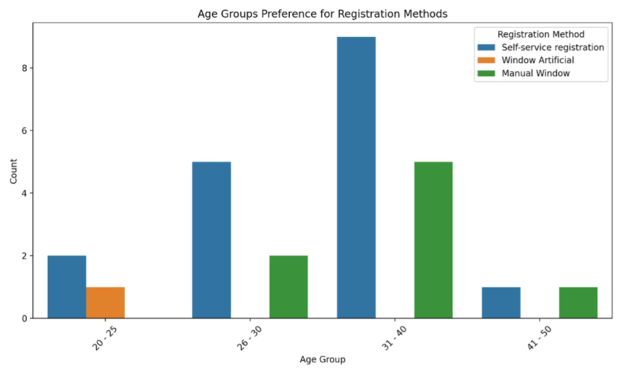
As shown in Table 1, the demographic characteristics of participants, specifically focusing on age and registration methods, reveal critical insights into user preferences and technological adoption patterns. The age distribution is segmented into categories to represent different generations, each with varying levels of digital literacy and comfort with technology (Choi et al., 2024; Krupa & Buszko, 2023).
Table 1: Cross-tabulation of age and registration methods.
Table available in the original PDF paper.
Age Manual Window Self-Service Registration Window Artificial
20–25 0 2 1 26–30 2 5 0 31–40 5 9 0 41–50 1 1 0
The results suggest that different age groups display diverse preferences regarding registration methods. Notably, individuals aged 31–40 exhibit a strong preference for self-service registration.
Research Process To methodically develop a software system that enhances self-service technology in healthcare, this research design focuses on addressing accessibility challenges faced by individuals with disabilities. The solution was generalized for public use, as RSSMs are intended for broad populations but optimized for individual needs before extrapolating to the wider population (Soltani et al., 2012). An inferential approach was employed to validate the generalized solution, ensuring it meets the diverse needs of users with physical and mobility impairments (Physical & Mobility Impairments, 2015). The system incorporates inclusive design principles, such as adjustable interfaces, voice commands, and tactile feedback, to improve usability for individuals with disabilities. By fostering inclusion and accessibility, this approach aims to create equitable healthcare experiences for all users.
Statistic An R data analysis was conducted on the collected data to evaluate the reliability and significance of the results. Cronbach’s alpha analysis was employed to assess the internal consistency of the questionnaires, with values ranging from 0.65 to 0.95 considered acceptable for reliability (Hashim & Dawal, 2012). Additionally, a Chi-Square test and proportion test were utilized to examine whether the proportion of successes in one group significantly differed from another or deviated from a known value. These statistical methods ensured the robustness and validity of the findings. The analysis aimed to provide insights into the effectiveness and inclusivity of the self-service technology in healthcare settings.
RESULTS
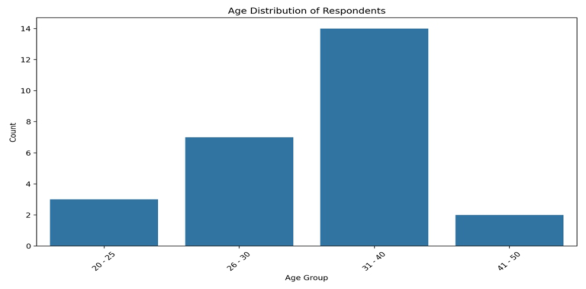
Participant Information The 31–40 years age group is the largest, as shown in Figure 2 above, representing more than half of the sample (53.85%). This suggests that
this age group is the most represented or influential in the dataset. while the 26–30 years age group is the second largest, making up 26.92% of the sample. Together, the 26–30 and 31–40 age groups account for 80.77% of the total sample, indicating a strong concentration of individuals in their late 20s to early 40s. And the 20–25 years and 41–50 years age groups are smaller in comparison, with 11.54% and 7.69% representation, respectively. This suggests that younger individuals (20–25) and older individuals (41–50) are less represented in the sample.
Figure 2: Age distribution of respondents.Table 2: Reliability analysis.
Table available in the original PDF paper.
Metric Value Cronbach’s Alpha 0.412 Number of Items 3 Sample Size 26
The reliability of the scale was assessed using Cronbach’s alpha, which measures the internal consistency of the items. The analysis yielded a Cronbach’s alpha value of 0.412 for the 3-item scale, based on a sample size of 26 participants. According to commonly accepted guidelines (Tavakol & Dennick, 2011), a Cronbach’s alpha value below 0.60 is generally considered to indicate poor internal consistency. This suggests that the items in the scale may not be reliably measuring the same underlying construct in the current sample.
Table 3: Statistical tests.
Table available in the original PDF paper.
Test Statistic P-Value Additional Info Chi-Square Test (Agee vs
Chi-square: Registration Method)
9.0672 0.1698 No significant
relationship Point-Biserial Correlation
Correlation
0.4028 Weak negative
correlation
(System Usage vs Necessity)
Coefficient: −0.1713
Continued
The Interaction Design of Registration Machines 151
Table 3: Continued Test Statistic P-Value Additional Info
Table available in the original PDF paper.
Effect Size (Cramer’s V for
Cramer’s V:
0.4176 N/A Moderate
Age vs Registration Method)
association strength Confidence Interval
Proportion: 0.58 N/A 95% CI: [0.39, 0.74]
(System Usage Proportion) The chi-square test revealed no statistically significant association between age groups and registration method (χ2 = 9.0672, p = 0.1698), though Cramer’s V indicated a moderate effect size (V = 0.4176), suggesting a meaningful pattern warranting further investigation (Cohen, 1988; McHugh, 2013). A point-biserial correlation showed a weak, non-significant negative relationship between system usage and perceived necessity (r = −0.1713, p = 0.4028), indicating little evidence of a meaningful association (Field, 2018). The proportion of system usage was estimated at 58%, with a 95% confidence interval of 39% to 74%, reflecting considerable uncertainty likely due to sample size or variability (Cumming & Finch, 2005). These findings underscore the importance of considering both statistical significance and effect sizes to fully interpret the data (Sullivan & Feinn, 2012). Further research with larger samples is recommended to validate these results.
Figure 3: System usage distribution by age group.
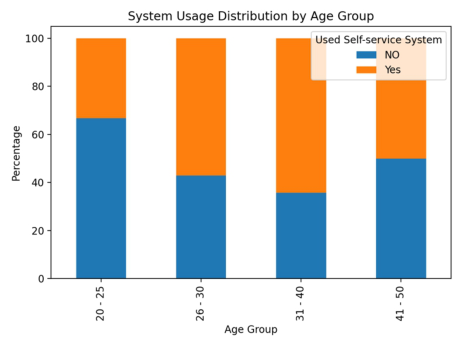
Figure 3 displays the distribution of system usage across age groups (20–25, 26–30, 31–40, and 41–50 years) using a percentage stacked bar chart, categorizing responses as “Yes” or “No” for system usage. The 31–40 years group shows the highest adoption rate, indicating greater likelihood of system use among individuals in their 30s. The 26–30 years group demonstrates moderate adoption, suggesting openness to the system but lower engagement compared to the 31–40 group. In contrast, the 20–25- and 41–50-years groups exhibit the lowest adoption rates, potentially due to younger individuals’ lack of familiarity or older individuals’
technological discomfort. These findings highlight age-related disparities in system adoption, emphasizing the need for targeted interventions to improve accessibility and engagement across all age groups.
Figure 4: System operation time.
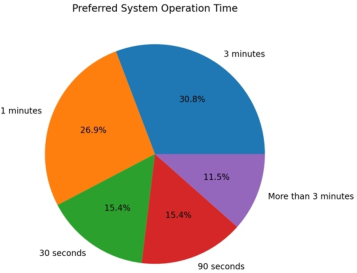
The analysis from Figure 4 reveals a strong preference for self-service registration, particularly among middle-aged users (31–40). There’s also a clear consensus about the necessity of such systems for elderly and special groups. The data suggests that the implementation of self-service systems is well-received by users across different age groups, though with varying degrees of adoption.
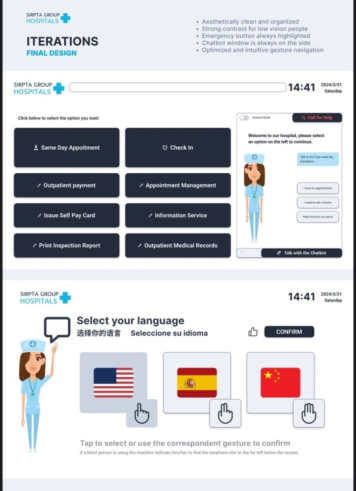
Figure 5: Newly proposed design for self-service registration machines.
The Interaction Design of Registration Machines 153
Proposed Design The newly designed self-registration machine for hospitals integrates features to accommodate both disabled and non-disabled users, ensuring inclusivity. For individuals with disabilities, the system specifically addresses the needs of deaf and blind users through specialized accessibility features. Deaf users can benefit from visual cues and text-based instructions, while blind users can utilize audio feedback and tactile interfaces. This design aims to create a seamless and equitable registration experience for all patients, regardless of their physical abilities. By incorporating these inclusive elements, the machine enhances accessibility and usability in healthcare settings.
CONCLUSION
This study highlights the importance of inclusive design in self-service registration machines (RSSMs) for healthcare settings. The results indicate a strong preference for self-service registration, particularly among middle- aged users (31–40 years old). However, the adoption rates vary across different age groups, suggesting the need for targeted interventions to improve accessibility and engagement. The proposed design for a new self- registration machine integrates features to accommodate both disabled and non-disabled users, addressing the specific needs of deaf and blind individuals through visual cues, text-based instructions, audio feedback, and tactile interfaces. This inclusive approach aims to create a seamless and equitable registration experience for all patients, regardless of their physical abilities.
While the statistical analysis revealed no significant association between age groups and registration methods, the moderate effect size suggests a meaningful pattern that warrants further investigation. The weak correlation between system usage and perceived necessity indicates that additional factors may influence adoption rates. In conclusion, this study underscores the importance of considering both statistical significance and effect sizes when interpreting data on RSSM usage and preferences. The findings highlight the need for continued research and development in creating more accessible and inclusive self-service technologies in healthcare settings. Future studies with larger sample sizes are recommended to validate these results and further improve the design and implementation of RSSMs to meet the diverse needs of all users.
ACKNOWLEDGMENT
The authors would like to thank all the subjects who participated in this study and gave their valuable opinions.
REFERENCES
Aziz, M. N. A., Lop, N. S., Kamar, I. F. M., Abdullah, L., Akhir, N. M.: Accessibility Analysis of Interactive Kiosk in National Music Museum. Int J Acad Res Bus Soc Sci 10(9), 1033–1046(2020). https://doi.org/10.6007/ijarbss/v10-i9/7983
Bae, S. Y., Chang, P. J.: The effect of coronavirus disease-19(COVID-19) risk perception on behavioral intention towards ‘untact’ tourism in South Korea during the first wave of the pandemic. Curr. Issue Tour. 24(7), 1017–1035 (2021). https://doi.org/10.1080/13683500.2020.1798895 Chen, K. et al. 2012. Touch screen performance by individuals with and without motor control disabilities. Accessed on 14.11. 2016. Retrieved https:// www.ncbi.nlm from f.nih.gov/pubmed/23021630. Choi, Y., Han, S., & Lee, C. (2024). Exploring Drivers of Fintech Adoption Among
Elderly Consumers. Technology in Society, 78, 102669. https://doi.org/10.1016/ j.techsoc.2024.102669 Cohen, J. (1988). Statistical power analysis for the behavioral sciences (2nd ed.).
Lawrence Erlbaum Associates. Cumming, G., & Finch, S. (2005). Inference by eye: Confidence intervals and how to read pictures of data. American Psychologist, 60(2), 170–180. https://doi.org/ 10.1037/0003-066X.60.2.170 Duff S. N., Irwin C. B., Skye J. L., Sesto M. E., Wiegmann D. A. (2010) The effect of
disability and approach on touch screen performance during a number entry task. In: Proceedings of the Human Factors and Ergonomics Society Annual Meeting, SAGE Publications, Los Angeles, 54(6):566–570. doi: https://doi.org/10.1177/ 154193121005400605. Field, A. (2018). Discovering statistics using IBM SPSS statistics (5th ed.). Sage. Fuglerud K. S. (2011). The barriers to and benefits of the use of ICT for people with visual impairment. In: International Conference on Universal Access in Human- Computer Interaction, Springer, Berlin, pp. 452–462. https://doi.org/10.1007/ 978-3-642-21672-5_49 Groeneveld, B. S., Dekkers, T., Boon, B., & D’Olivo, P. (2018). Challenges for design
researchers in healthcare. Design for Health, 2(2), 305. https://doi.org/10.1080/ 24735132.2018.1541699 Hagen, S., Sandnes, F. E. Towards Accessible Self-Service Kiosks through Intelligent User Interfaces. 2010. Article in Personal and Ubiquitous Computing. Accessed on 14.11.2016. Retrieved from https://www.researchgate.net/publication/22014 1775_Toward_accessible_selfservice_kiosks_through_intelligent_user_interfaces. Hashim, A. M., & Dawal, S. Z. M., 2012. Kano Model and QFD integration
approach for Ergonomic Design Improvement. Procedia - Social and Behavioral Sciences, 57, 22–32. http://doi.org/10.1016/j.sbspro.2012.09.1153 Jin, H.-Y., Gold, C., Cho, J., Marzban, F., & Lim, L. (2022). The Role of Healthcare Facility Design on the Mental Health of Healthcare Professionals: A Literature Review [Review of The Role of Healthcare Facility Design on the Mental Health of Healthcare Professionals: A Literature Review]. HERD Health Environments Research & Design Journal, 16(1), 270. SAGE Publishing. https:// doi.org/10.1177/19375867221118685 Jokisuu E., McKenna M., Smith A. W., Day P. (2015) Improving touchscreen
accessibility in self-service technology. In Universal Access in Human-Computer Interaction. Access to Interaction International Conference, UAHCI 2015, Held as Part of HCI International 2015, Los Angeles, CA, USA, August 2–7, 2015, Proceedings, Part II 9, pp. 103–113. Springer International Publishing. Kane S. K., Jayant C., Wobbrock J. O., Ladner R. E. (2009) Freedom to roam: A study of mobile device adoption and accessibility for people with visual and motor disabilities. In: Proceedings of the 11th international ACM SIGACCESS conference on Computer and Accessibility, New York, pp. 115–122. https:// doi.org/10.1145/1639642.1639663
The Interaction Design of Registration Machines 155
Kim, H. K., Park, J.: Examination of the protection offered by current accessibility acts and guidelines to people with disabilities in using information technology devices. Electronics9(5), 742 (2020). https://doi.org/10.3390/electronics9050742 Krupa, D., & Buszko, M. (2023). Age-dependent differences in using FinTech
products and services—Young customers versus other adults. PLoS ONE, 18(10). https://doi.org/10.1371/journal.pone.0293470 Maguire, M. C. 1999. A Review of User-Interface Design Guidelines for Public Information Kiosk Systems. International Journal of Human-Computer Studies. Vol. 50 (3). 263–286. Marlow, N., Eckert, M., Sharplin, G., Gwilt, I., & Carson-Chahhoud, K. (2023).
Graphical User Interface Development for a Hospital-Based Predictive Risk Tool: Protocol for a Co-Design Study. JMIR Research Protocols, 12. https://doi.org/ 10.2196/47717 McHugh, M. L. (2013). The chi-square test of independence. Biochemia Medica, 23(2), 143–149. https://doi.org/10.11613/BM.2013.018 Microsoft Design. 2016. Inclusive Design Toolkit Manual. Accessed on 10.3.2017. Retrieved from https://download.microsoft.com/download/B/0/D/ B0D4BF87-09CE4417-8F28. Muinga, N., Paton, C., Gicheha, E., Omoke, S., Abejirinde, I. O., Beˇnová, L.,
English, M., & Zweekhorst, M. (2021). Using a human-centred design approach to develop a comprehensive newborn monitoring chart for inpatient care in Kenya. BMC Health Services Research, 21(1). https://doi.org/10.1186/s12913- 021-07030-x Nakikj, D., Kreda, D., & Gehlenborg, N. (2023). Alerts and Collections for Automating Patients’ Sensemaking and Organizing of their Electronic Health Record Data for Reflection, Planning, and Clinical Visits: Qualitative Research- Through-Design Study. JMIR Human Factors, 10. https://doi.org/10.2196/41552 Omari, O. J., Zachary, O. B.: Investigating ATM system accessibility for people with
visual impairments. J Computer Eng15(5), 13–18 (2013). https://doi.org/10.9790/ 0661-1551318 Physical & Mobility Impairments. Defining the Meaning of Mobility Impairment.
2015. Disabled World. Accessed on 29.11. 2016. Retrieved from https:// www.disabled-world.com/disability/types/mobility/. Sandnes, F. E., Tan, T. B., Johansen, A., Sulic, E., Vesterhus, E., Iversen, E. R.: Making touch-based kiosks accessible to blind users through simple gestures. Univ. Access Inf. Soc. 11(4), 421–431 (2012). https://doi.org/10.1007/s10209-011-0258-4 Saparamadu, A. A. D. N. S., Fernando, P., Zeng, P., Teo, H., Goh, A., Lee, J. M. Y., &
Lam, C. W. (2020). User-Centered Design Process of an mHealth App for Health Professionals: Case Study. JMIR Mhealth and Uhealth, 9(3). https://doi.org/ 10.2196/18079 Soltani, S. H. K., Sham, M., Awang, M., Yaman, R.: Accessibility for disabled in public transportation terminal. Procedia-Soc Behav Sci 35, 89–96 (2012). https:// doi.org/10.1016/j.sbspro.2012.02.066 Sullivan, G. M., & Feinn, R. (2012). Using effect size—or why the p value is not
enough. Journal of Graduate Medical Education, 4(3), 279–282. https://doi.org/ 10.4300/JGME-D-12-00156.1 Tavakol, M., & Dennick, R. (2011). Making sense of Cronbach’s alpha. International Journal of Medical Education, 2, 53–55. https://doi.org/10.5116/ijme.4dfb.8dfd The 7 Principles. National Disability Authority. An article on the 7 principles
of universal design. Accessed on 22.11.2016. Retrieved from http:// universaldesign.ie/What-is-Universal-Design/The-7-Principles/.
Universal Design Principles and Guidelines. (2014). Retrieved March 21, 2021, from http://www.artbeyondsight.org/dic/module-4-museum-access-accessible/physical space/universal-design-principles-and-guidelines/. Varma, R., Vajaranant, T. S., Burkemper, B., Wu, S., Torres, M., Hsu, C.,
Choudhury, F., & McKean-Cowdin, R. (2016). Visual Impairment and Blindness in Adults in the United States: Demographic and Geographic Variations From 2015 to 2050. JAMA ophthalmology, 134(7), 802–809. https://doi.org/10.1001/ jamaophthalmol.2016.1284
LISTED IN THE AHFE DIGITAL BOOKSTORE CATALOGUE
Explore the complete digital volume
Ergonomics In Design and Kansai Engineering
Read this individual research paper free through the original publisher, or explore the full digital proceedings book.
ISBN 978-1-964867-46-5
Explore this ISBN in the AHFE Bookstore ↗Listed in the July 2026 bookstore catalogue; search by ISBN to confirm current availability · Digital book purchase optional