Sedef Süner Pla Cerda, Batuhan Şahin, Ecem Kumbasar (2025). Child-Friendly Human-AI Interaction: Designing Tangible User Interfaces for Preschool Children to Prompt Generative AI. In: Human Interaction and Emerging Technologies (IHIET-AI 2025): Artificial Intelligence and Future Applications. AHFE Open Access, vol. 161, pp. 141–150. https://doi.org/10.54941/ahfe1005905
Generative artificial intelligence (AI) encompasses advanced computational models that can generate coherent and high-quality content when prompted such as text, images, videos, tunes and codes, by leveraging the patterns and structures present in the data they have been trained with. Popular examples of commercial tools using such models are ChatGPT (text-to-text), Midjourney (text-to-image) and Vizcom (image-to-image). Current use cases are largely developed for general or professional use purposes, which are not suitable for child users due to unregulated content, lack of child-friendly use cases or age-appropriate interaction modalities. Therefore, we propose tangible user interfaces (TUIs) as a potentially suitable approach that bridges the physical and digital world by utilising physical interaction to engage with computers. Interaction with TUIs involves physically manipulating technologically augmented objects to control the digital output. Compared to graphical user interface (GUI) which relies on indirect manipulation via “windows, icons, menus, pointer” (WIMP), TUIs provide direct manipulation, hence are more straightforward. For these reasons, TUIs are considered developmentally appropriate for preschool children, who seek concrete interactions due to still-emerging abstract thinking and fine motor skills. This paper presents a case study, a six-week design project carried out in an undergraduate industrial design programme, during which students were expected to design tangibles to create child-friendly digital content. Throughout the project, students developed TUIs for prompting generative AI to create interactive experiences that are developmentally appropriate and engaging for preschool children. The outputs were conceptual designs that made use of TUIs for media generation such as composing songs, writing stories, creating artwork and virtual environments. In this paper, we present the educational frame and sample conceptual design outputs. We discuss potential design strategies to consider while developing child-friendly human-AI interactions, such as customisation scenarios, parental roles, and balancing physical and digital interactions. Our work contributes to the user-centred development of future technologies that offer meaningful, engaging and safe experiences for children.
Human-AI interaction (HAAI) is a growing field of research and design. Although AI systems have been around for a while, they have been dominating human-technology interactions in the past few years. This makes HAAI a novel human-computer interaction (HCI) paradigm due to increased machine agency in user interactions as algorithms impose decision- making through data-driven recommendation, automation or customisation options. It is this trade-off between machine agency and personal agency that makes HAAI a significant research field: on one hand, users celebrate reliability, customisation, automation and reduced cognitive load afforded by AI systems, while it brings increased concerns of privacy, security, trust, and lower self-efficacy (Sundar, 2020). These concerns can be addressed through transparent, relevant and reliable interactions that allow a balance between human and machine agencies, as scholars propose guidelines to support designers in developing meaningful human-AI interactions by tackling the challenges brought by the scope and novelty of the AI systems (e.g. Amershi et al., 2019; Yang et al., 2020).
While AI encompasses a broad spectrum of technologies that analyse data, recognize patterns, and make predictions or recommendations, generative artificial intelligence (genAI) specifically refers to AI models that utilise training data to produce seemingly new and meaningful content, including text, images, or audio (Feuerriegel et al., 2024). After learning the underlying patterns and structures within the training data, genAI employs this knowledge to generate outputs that resemble the original data. This process is typically facilitated by machine learning models such as Generative Adversarial Networks (GANs), which benefit from the estimated probability distribution of the data (Goodfellow et al., 2020), and transformer-based models like the Generative Pre-trained Transformer (GPT), which was initially trained on large volumes of text data and is capable of being fine- tuned for specific tasks like language generation, sentiment analysis, and language modelling (Yenduri et al., 2024). These models leverage a vast amount of data to learn intricate relationships and patterns, enabling them to produce outputs that are coherent, contextually relevant, and creative.
The recent commercialisation of generative AI has led to an increase in applications across multiple domains. Popular commercial tools have emerged, each excelling in different forms of media generation. For instance, OpenAI’s ChatGPT1 and Google’s Gemini2 have gained significant popularity as text-to-text models that can generate coherent responses, draft essays, and even engage in storytelling. Meanwhile, text-to-image models that interpret textual descriptions to produce highly detailed and contextually relevant images such as MidJourney3 and DALL-E4, are being adopted by practitioners from various creative fields. Similarly, audio-based
Child-Friendly Human-AI Interaction: Designing Tangible User Interfaces 143 generative examples like Suno5 and Udio6 are used to create music, which can be customised to fit various themes or moods. These tools illustrate the growing accessibility and versatility of genAI, enabling users to create content with just a few prompts. The shift from experimental technologies to mainstream commercial tools reflects a broader trend of integrating generative capabilities into everyday creative and professional workflows.
As genAI models started to proliferate, researchers have been prompted to investigate how children engage with these tools, and the impact of the interaction. For example, ethical aspects of child-genAI interaction, such as mitigating the biases inherent in the genAI models or awareness about deepfakes, led to efforts in building critical AI literacy among pupils (Ali et al., 2021; Sharma et al., 2023; Baines et al., 2024; Vartiainen et al., 2024). Others investigated the potential of AI-based image generation tools for creative expression (Han & Cai, 2023; Vartiainen et al., 2023; Newman et al., 2024). Child-genAI interaction studies largely focus on school-aged children, which is not surprising given the fact that current interaction modalities with genAI models are dominantly text-based and heavily depend on the traditional graphical user interface (GUI). As opposed to GUIs, tangible user interfaces (TUIs) provide direct manipulation, hence are more straightforward. By integrating representation and control, TUIs are characterised by the physical manipulation of tangible objects enriched to mediate the creation of digital representations (Ulmer & Ishii, 2000).
Despite limited empirical evidence on the benefits of tangibility (Zaman et al., 2012), TUIs have been extensively investigated for their potential as a child-friendly alternative to interacting with computers. Popular domains of child-TUI interaction include, but are not limited to; programming, problem- solving, science, storytelling, art and literacy (Rodic & Granic, 2022). The widely assumed benefits of TUIs (e.g. sensory engagement, spatial learning, trial and error, and playfulness) are linked to constructivist learning theories that emphasise the role of physical and sensory experiences in cognitive development (Liang et al., 2021). There are also successful commercial examples of educational TUIs, such as tablet PC-supported Osmo7 and no-screen Cubetto8.
In this research, we investigated the design potentials of TUIs to prompt genAI as a developmentally appropriate alternative interaction modal. For this purpose, we created a design protocol in an undergraduate level educational project with sophomore industrial design students. The project resulted in conceptual designs targeting preschool children that utilise physical manipulatives to create customised media, such as stories, songs and artworks. In the rest of the paper, we introduce the design procedure and present sample design concepts. Finally, we discuss design implications and future directions in terms of customisation scenarios, parental roles, and balancing physical and digital interactions.
DESIGN PROJECT The design project was carried out in a sophomore design studio course in the Department of Industrial Design at TED University, Ankara. The authors are the instructors of this course, the goal of which is to equip students with skills in research and design methods, focusing on product form and interaction in relation to function and communication with the user. It covers both the physical and cognitive aspects of user-product interaction, including ergonomics, product language, and ease of use, all within a user-centred design approach. This methodology is applied across three consecutive product design projects. The course is conducted for 10 hours over two weekly sessions (11 ECTS). The project presented here was the final design project for the 2023–24 Spring Semester, with 36 students enrolled.
In the project brief, students were instructed to develop AI-powered tangible user interfaces (TUIs) specifically designed for preschool children (around 4–6 years). The goal was to harness the power of generative AI, to create engaging, interactive experiences that are developmentally appropriate and engaging for young children. Students were free to define the themes and objectives, such as storytelling, art, music and animation. The goal was to (1) develop a meaningful interaction scenario, (2) design the tangibles and how they will be manipulated to generate digital content, and (3) specify the components and technologies required for the system to work.
The project consisted of background research on critical concepts to identify design requirements, development of the design concept and interaction scenarios, and detailing and low-fidelity prototyping of the final design concept. The design process lasted approximately six weeks, with additional time given to prepare for the jury presentations.
Background Research (One Week) The project started with a critical analysis and discussions around the project concepts. The student teams started with examining commercially available TUI-based products for entertainment or educational purposes targeting children. In consecutive steps, they conducted desk research about the developmental characteristics of preschool children and basic components used in TUIs such as sensors to pick up information, communication between system parts, energy sources and means of interaction. The instructors delivered a complementary lecture on the basics of AI and genAI, related key concepts (e.g. machine learning, neural networks, LLMs, GANs, diffusion models) and design considerations in user-centred HAAI.
Development of the Design Concept and Interaction Scenarios (Three Weeks) This phase was carried out through two structured ideation assignments and rounds of individual feedback sessions. The first assignment was a divergent ideation matrix coupling different media generation scenarios (animation, audio, artwork, 3D model, music) with diverse design requirements (modularity, adding themes, abstraction level, parental roles, varying input/output modalities). The resulting 30 sketches were synthesised in a
Child-Friendly Human-AI Interaction: Designing Tangible User Interfaces 145
second assignment for concept development. At this phase, students were asked to construct three diverse design concepts and present them with mockups, storyboards and system diagrams. The remaining course time was allocated to working on the selected design concepts and elaborating on the interaction scenarios in iterative steps, supported by the instructor feedback. Additionally, a peer feedback assignment was scheduled where students had the opportunity to critique and compare their projects with classmates’ works.
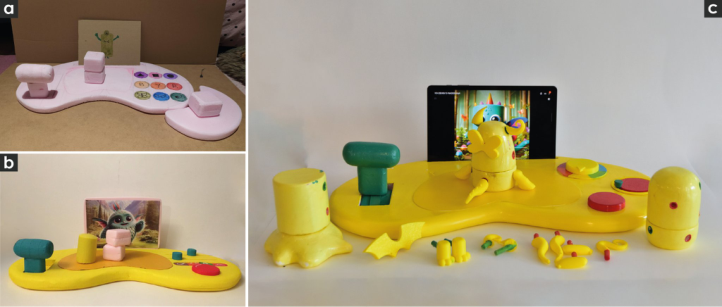
Detailing and Prototyping (Two Weeks) In the final phase, students continued individually with one selected concept and started on detailing the form, materials of the TUIs and finalising the components of the product set and the interaction scenarios. This phase involved intensive CAD modelling and 3D printing. Many students focused on character designs and created visual representations of physical manipulatives intended as ‘prompts’ that would be appealing and understandable to young children (see Figure 1 for sample design progression). Since the students did not have a background in coding or engineering design, they were asked to prepare visually realistic, low- fidelity prototypes (i.e. appearance models). Additionally, they experimented with commercially available AI-based generation tools to create samples of “digital prototypes” that can be generated as if they were prompted with working TUIs (e.g. songs, stories, animated characters). The outputs were presented and discussed in a final jury consisting of instructors from industrial design and early childhood education departments.
Figure 1: Design and development process of Monstify, an animated character generator concept, designed by Ay¸se Ece Liman. (a) Early ideation, (b) design improved based on feedback, (c) final model.
Design Concepts The project outputs largely concentrated on AI-based media generation concepts utilising physical manipulatives representing prompt combinations. The goal was to deconstruct the relevant media content (e.g. story, music,
image) into its constituents and assign them different physical representations to give controlled freedom when generating alternatives. For example, a song was broken into several components such as instruments, genre, tempo, and a theme for lyrics. Likewise, a story was deconstructed into one or a few main characters, a setting, and a theme. Similar procedures were followed for the generation of characters, animations, virtual worlds, and so on. This approach was used to replace the use of text prompts with tangible representations (i.e. tokens) to concretise the interaction and improve the usability of the system. Table 1 presents sample design concepts concentrating on different themes.
Table 1. Sample design concepts.
Table available in the original PDF paper.
Name: Animo Designer: Defne Güvendik Concept: Animated character generator Features: Creates custom animal characters with accessories and environment (e.g. a pirate squirrel playing guitar in the sea). The connected tablet displays the generated animated image, talking and singing about the customised context. TUI functions: Representing different animals, accessories, activities and environments.
Name: Robodamus Tales Designer: ˙Iris Arslankılıç Concept: Storyteller Features: Creates dynamic stories in the chosen setting and custom characters with three sets of tokens (face, body and legs), combining a feeling, an occupation, and a fictional personality. Robodamus guides the child while creating the character and the setting with voice commands, and narrates the generated story when prompted with the wand. Further parental control is given to save stories, filter words, and narrate stories from parents’ voices. TUI functions: Representing settings and characters by combining different emotions, occupations and fictional personalities, prompting story narration.
(Continued)
Child-Friendly Human-AI Interaction: Designing Tangible User Interfaces 147
Table 1. Continued
Table available in the original PDF paper.
Name: Record AI Designer: Miray Aktan Concept: Soundtrack composer Features: Composes soundtracks in a desired theme and with chosen instruments. Children place physical tokens representing themes and instruments on a wheel appearing as a pick-up player. The input is used as a prompt to compose a soundtrack based on kids’ choices. Recorded songs can be replayed through a mobile application with parental help. TUI functions: Representing different instruments and themes, adjusting the pace of the soundtrack, recording and replaying the song.
Name: Orbito Designer: ˙Ipek Yüksel Concept: 3D model generator Features: Creates a 3D virtual environment of an imaginary planet. The set consists of a hemispherical form to represent the planet with holes where the child pins the tokens into the holes and digitally customises their colours. The digital world can be viewed on a tablet, within which the child can navigate by using a joystick attached to the board. TUI functions: Representing different entities to be located and visualised in the virtual environment, changing between colour options, navigating in the 3D world.
Name: Cook Craft Designer: Eylül Deniz Concept: Animated recipe creator Features: Creates images of customised recipes with chosen ingredients. Following the accompanying app instructions, the kids can choose their animal character chefs, choose cooking equipment/method, and add ingredients by using tokens representing food. Stirring the meal prompts finalising the recipe and generating an image of the chosen chef with the food created. TUI functions: Representing chef characters, ingredients and cooking utensils, prompting image generation.
Along with tokens, numerous system features were explored to enrich the human-AI interaction. The instructors guided students to examine what kind of roles can be cast for parents, which resulted in a number of approaches from supervising content for safety to customising tokens to enhance the open-endedness of the generated output. Both ends usually involved adding a mobile application to the system which can only be used by the caretakers, with rare exceptions of children using the mobile device for streaming generated content. Further, mindful use of mobile devices was allowed to complement the interaction by presenting real-time digital responses of TUI-controlled inputs or guiding the users in their interaction by giving audio-visual instructions and feedback. This called for creating a careful balance between the digital and physical components of the system, with the aim that the latter creates added value to the experience.
DISCUSSIONS AND FUTURE DESIGN DIRECTIONS A few limitations can be listed regarding this project. First, the project was carried out as part of a sophomore industrial design studio course. All three course instructors also have industrial design backgrounds. Since the project was carried out mostly from an industrial design perspective, there lies a potential for an interdisciplinary approach which could further enrich the scope and outcomes of the project. Neither the students who carried out this project nor the instructors of the course have adequate engineering or coding knowledge. The final prototypes are appearance models and not working prototypes although the students did specify the components to be used in their designs based on their research. Therefore, the outcomes of this project can be considered rather conceptual. Real-world testing with working prototypes is necessary to assess the impact of the interactions and move towards commercialisation.
Another limitation is that the students had to make use of the available genAI tools to exemplify the generated outcomes of the prompts. Hence, students had to find generative AI tools that most closely served their purpose for their projects’ specifications. GenAI tools that are specially trained to create related outcomes with child-friendly language (visual style, vocal toning, etc.) can also add to the overall design experience. Therefore, this project also highlights the potential for developing child-oriented, built-in genAI models. Further, the students’ projects ended up focusing mostly on the entertainment and play themes due to time constraints, and the complexities of working with developmental and pedagogical design challenges that require expert contribution. With an elongated working calendar, and the involvement of interdisciplinary teams in the design process, the resulting projects can be further extended to explore the educational potential of the TUI-prompted genAI scenarios for pre-school children.
Some issues that could only be addressed partially present potential for future design and research directions. For example, the relationship between safety, privacy and parental control calls for a careful examination of how designers can ensure the generation of child-friendly content while empowering the caretakers in guiding, supervising and framing child-AI
Child-Friendly Human-AI Interaction: Designing Tangible User Interfaces 149
interaction. Creating opportunities for digital and physical customisation can be further explored as a mindful strategy to both give partial control to caretakers in generated content and expand the output variations by sustainably introducing new prompts and avoiding repetition. Designers should also focus on strategies for balancing the physical and digital components of the system to make the most of the best of both worlds, as is emphasised as a strength of tangible interfaces. Lastly, further research can investigate the implications of TUI-based AI interaction for child development and use cases in educational settings, which requires expanding the design concepts towards multi-user, multimodal system scenarios.
ACKNOWLEDGMENT
The authors would like to thank the Spring 2023–24 students of the ID202 Industrial Design II studio for their cooperation and efforts throughout the project, and are grateful for Ay¸se Ece Liman, Defne Güvendik, Eylül Deniz, ˙Ipek Yüksel, ˙Iris Arslankılıç and Miray Aktan for their contribution to this paper with their projects.
REFERENCES
Ali, S., DiPaola, D., Lee, I., Hong, J. & Breazeal, C. (2021). Exploring Generative Models with Middle School Students. In Proceedings of the 2021 CHI Conference on Human Factors in Computing Systems (CHI ‘21). ACM, New York, NY, USA, Article 678, 1–13. https://doi.org/10.1145/3411764.3445226 Amershi, S., Weld, D., Vorvoreanu, M., Fourney, A., Nushi, B., Collisson, P., Suh, J.,
Iqbal, S., Bennett, P. N., Inkpen, K., Teevan, J., Kikin-Gil, R., & Horvitz, E. (2019). Guidelines for Human-AI Interaction. In Proceedings of the 2019 CHI Conference on Human Factors in Computing Systems (CHI ‘19). ACM, New York, NY, USA, Paper 3, 1–13. https://doi.org/10.1145/3290605.3300233 Baines, A., Gruia, L., Collyer-Hoar, G. & Rubegni, E. (2024). Playgrounds and Prejudices: Exploring Biases in Generative AI For Children. In Proceedings of the 23rd Annual ACM Interaction Design and Children Conference (IDC ‘24). ACM, New York, NY, USA, 839–843. https://doi.org/10.1145/3628516.3659404 Feuerriegel, S., Hartmann, J., Janiesch, C., & Zschech, P. (2024). Generative
AI. Business and Information Systems Engineering, 66(1), 111–126. https://doi.org/10.1007/S12599-023-00834-7/TABLES/2 Goodfellow, I., Pouget-Abadie, J., Mirza, M., Xu, B., Warde-Farley, D., Ozair, S., Courville, A., & Bengio, Y. (2020). Generative adversarial networks. Communications of the ACM, 63(11), 139–144. https://doi.org/10.1145/3422622 Han, H. & Cai, Z. (2023). Design implications of generative AI systems for
visual storytelling for young learners. In Proceedings of the 22nd Annual ACM Interaction Design and Children Conference (IDC ‘23). ACM, New York, NY, USA, 470–474. https://doi.org/10.1145/3585088.3593867 Liang, M., Li, Y., Weber, T. & Hussmann, H. (2021). Tangible Interaction for Children’s Creative Learning: A Review. In Proceedings of the 13th Conference on Creativity and Cognition (C&C ‘21). ACM, New York, NY, USA, Article 14, 1–14. https://doi.org/10.1145/3450741.3465262
Newman, M., Sun, K., Gasperina, I. B. D., Shin, G. Y., Pedraja, M. K., Kanchi, R., Song, M. B., Li, R., Lee, J. H. & Yip, J. (2024). “I want it to talk like Darth Vader”: Helping Children Construct Creative Self-Efficacy with Generative AI. In Proceedings of the 2024 CHI Conference on Human Factors in Computing Systems (CHI ‘24). ACM, New York, NY, USA, Article 117, 1–18. https://doi.org/10.1145/3613904.3642492 Rodi´c, L. D. & Grani´c, A. (2022). Tangible interfaces in early years’ education:
a systematic review. Personal and Ubiquitous Computing, 26, 39–77. https://doi.org/10.1007/s00779-021-01556-x Sharma, S., White, E., Kinnula, M., Iivari, N. & Monga, C. (2024). Age against the machine: Exploring ethical AI design and use by, with, and for children. In Proceedings of the 4th African Human Computer Interaction Conference (AfriCHI ‘23). ACM, New York, NY, USA, 313–315. https://doi.org/10.1145/3628096.3629079 Sundar, S. S. (2020). Rise of Machine Agency: A Framework for Studying the Psychology of Human–AI Interaction (HAII). Journal of Computer-Mediated Communication, 25(1), 74–88. https://doi.org/10.1093/jcmc/zmz026 Ullmer, B. & Ishii, H. (2000). Emerging frameworks for tangible user interfaces. IBM
Systems Journal, 39(3.4), 915–931. https://doi.org/10.1147/sj.393.0915 Vartiainen, H., Tedre, M. & Jormanainen, I. (2023). Co-creating digital art with generative AI in K-9 education: Socio-material insights. International Journal of Education Through Art, 19(3), 405–23. https://doi.org/10.1386/eta_00143_1 Vartiainen, H., Kahila, J., Tedre, M., López-Pernas, S., & Pope, N. (2024). Enhancing children’s understanding of algorithmic biases in and with text-to-image generative AI. New Media & Society. https://doi.org/10.1177/14614448241252820 Yang, Q., Steinfeld, A., Rosé, C. & Zimmerman, J. (2020). Re-examining
Whether, Why, and How Human-AI Interaction Is Uniquely Difficult to Design. In Proceedings of the 2020 CHI Conference on Human Factors in Computing Systems (CHI ‘20). ACM, New York, NY, USA, 1–13. https://doi.org/10.1145/3313831.3376301 Yenduri, G., Ramalingam, M., Selvi, G. C., Supriya, Y., Srivastava, G., Maddikunta, P. K. R., Raj, G. D., Jhaveri, R. H., Prabadevi, B., Wang, W., Vasilakos, A. V., & Gadekallu, T. R. (2024). GPT (Generative Pre-Trained Transformer) - A Comprehensive Review on Enabling Technologies, Potential Applications, Emerging Challenges, and Future Directions. IEEE Access, 12, 54608–54649. https://doi.org/10.1109/ACCESS.2024.3389497 Zaman, B., Vanden Abeele, V., Markopoulos, P. & Marshall, P. (2012). Editorial: the evolving field of tangible interaction for children: the challenge of empirical validation. Personal and Ubiquitous Computing, 16, 367–378. https://doi.org/10.1007/s00779-011-0409-x
LISTED IN THE AHFE DIGITAL BOOKSTORE CATALOGUE
Explore the complete digital volume
Human Interaction and Emerging Technologies (IHIET-AI 2025): Artificial Intelligence and Future Applications
Read this individual research paper free through the original publisher, or explore the full digital proceedings book.
ISBN 978-1-964867-37-3
Explore this ISBN in the AHFE Bookstore ↗Listed in the July 2026 bookstore catalogue; search by ISBN to confirm current availability · Digital book purchase optional