Mahdis Smith, Luke Houghton, Carla Riverola, Ali Intezari (2024). Autonomy at the Crossroads: Knowledge Workers Teamed with Intelligent Machines: A Qualitative Systematic Review. In: Human Interaction and Emerging Technologies (IHIET 2024). AHFE Open Access, vol. 157, pp. 1–10. https://doi.org/10.54941/ahfe1005458
This study aims to identify risks in adopting artificial intelligence (AI) for organizational decision-making by examining empirical studies. AI, is increasingly applied to automate tasks and decisions which were traditionally made by humans, posing challenges to sense of autonomy. Design/methodology – A total of 28 empirical studies were selected using predefined inclusion and exclusion criteria. To this end, this research systematically explored the processes of inquiry, identification, selection, critical appraisal, and the synthesis of empirical studies. This study is undertaken to address the following primary inquiries: (1) What is the direction of the observed effect? (2) What is the magnitude of the effect within the inclusion criteria? (3) Does the effect exhibit a consistent pattern across the spectrum of studies encompassed in the analysis? (4) What is the level of evidentiary robustness underlying the discovered effect? Findings – This content analysis interpretated within task-technology fit (TTF) model revealed that AI adoption represents a promising outlook for the future of human-AI teams. Anchoring on reliable data, this qualitative systematic review informs knowledge workers and leaders on adoption of AI systems and how it positively influences their working processes. Contributions/value – This research conducted a structured analysis to reveal the gap between collective perception of AI adoption, and what leaders and knowledge workers have experienced in relying on AI systems. AI tools are becoming more autonomous therefore a true representation of human-AI team interaction must be displayed. By uncovering the diverse approaches of leaders and the reactions of knowledge workers to AI integration, this paper contributes to a deeper understanding of the evolving landscape of working in the age of AI. The provided insights can assist organizations in harnessing the potential of AI while maintaining a healthy balance of autonomy within their domain.KEYWORDS Leadership, AI-Driven Decisions, Problem-Solving, Digital Autonomy, Hybrid intelligence, Human-Machine Teams, Qualitative Systematic Literature Review.
Through a qualitative systematic review of peer-reviewed literature, it examines concerns about AI integration into decision-making and problem- solving, emphasizing the need to understand its implications thoroughly.
BACKGROUND
The ever-accelerating pace of technological advancement has left organizational leaders in a state of bewilderment (Dencik et al., 2023) as they wrestle with the consequences of embracing AI. AI is the system’s ability to decode data, learn from, and use that learning to accomplish defined tasks (Kaplan & Haenlein, 2019a). Various categories of AI, including neural networks, swarm intelligence, genetic algorithms, and fuzzy logic, are applicable in addressing diverse real-world problems (Autor, 2015).
On the one hand, AI systems are autonomously learning to improve processing data (Lange et al., 2012) and as they grow to become more autonomous, so is the gap in understanding how and where they are being used in driving organisational tasks and decisions (Booyse & Scheepers, 2023). On the other hand, freedom and autonomy are pillars of human’s liberal democracy, values, ethics, and dignity (Prunkl, 2022; Raz, 1986; Roessler, 2021). Anderson and Honneth reconceptualize autonomy, underscoring that individuals’ ability to live autonomously is influenced by their social interactions. They present a recognitional framework where autonomy arises from socially embedded capacities, emphasizing the significance of self-respect, self-trust, and self-esteem in enabling individuals to pursue fulfilling lives (Anderson & Honneth, 2005). To embark on an exploration of how leaders and knowledge workers engage with AI systems, it is imperative to comprehend the implications of their reliance on AI tools. To achieve this, task-technology fit (TTF) (Goodhue & Thompson, 1995) provides the capacity to recognize how elements weigh on adoption of AI technology. This theory provides a platform for conceptualizing the thematic findings of this review.
METHODS
Qualitative systematic reviews are conducted to detect, handpick, critically evaluate, and synthesize data from empirical studies, with the aim of addressing the following inquiries: “(1) What is the direction of the observed effect? (2) What is the magnitude of the effect within the inclusion criteria? (3) Does the effect exhibit a consistent pattern across the spectrum of studies encompassed in the analysis? (4) What is the level of evidentiary robustness underlying the discovered effect? (Higgins, 2008; Paré et al., 2015; Popay et al., 2006)” A typical technique for aggregating research findings within the framework of qualitative systematic reviews is narrative synthesis. Narrative synthesis applies a non-statistical narrative approach for summarizing the outcomes of studies during the synthesis process (Petticrew et al., 2009). Additionally PICO model (Population; Interest/Intervention; Comparison; Outcome) has exhibited utility in this investigation, not only as a search strategy tool but also in the formulation of search terms (Considine
Autonomy at the Crossroads: Knowledge Workers Teamed With Intelligent Machines 3
et al., 2017; Eriksen & Frandsen, 2018, p. 69). Within the scope of this investigation, the PICO framework has been defined as follows: (1) Population of leaders and knowledge workers, (2) Interest in adoption of AI systems (tasks/decisions); (3) Comparison of positive and negative impacts of relying on AI-driven tasks or decisions; and (4) Outcome of each individual record.
Table 1. Inclusion and exclusion criteria – (ProQuest and web of science).
Table available in the original PDF paper.
Inclusion Criteria Exclusion Criteria
Articles not responding to the research question. Journal article that does not relate to “Leadership”, AND “Decision-Make*”, AND “Decision Make*”, OR “Problem Solve*”, OR “Problem- Solve*”, AND “Artificial Intelligence”, OR “AI”. Book Papers, Conference papers, Thesis, dissertation, and non-academic material Non-English Documents, and academic papers
(1) “Leader*” AND “Artificial Intelligence”; (2) “Manage*” AND “Artificial Intelligence”; (3) “Autonomy*” AND “Artificial Intelligence”; (4) “Choice*” AND “Artificial Intelligence”; (5) “Custom* Instruct*” AND “Artificial Intelligence”. Academic Journals (Peer Reviewed), and Reviews English Years 2017 – 2022
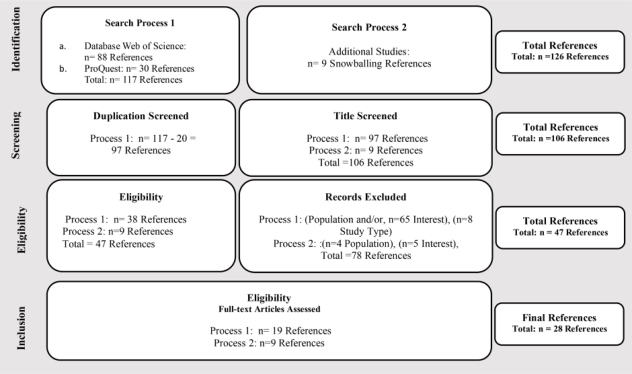
A systematic database search was executed in ProQuest and Web of Science, adhering to the predefined criteria (see Figure 1). This analysis yielded meaningful insights about the phenomenon (Elo & Kyngäs, 2008) demonstrated in detail (see the Appendix).
Figure 1: CCDAN PRISMA flowchart (Moher et al., 2009).
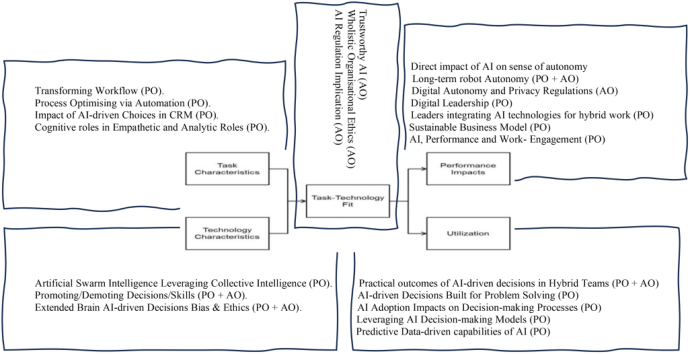
FINDINGS This qualitative systematic review presents a positive overarching outcome with a magnitude weight of 68% from the total included studies. Records reporting a positive outlook shown as (PO) in the Appendix endorses a future where human-AI collaborations shape sustainable business models, mount hybrid intelligence, and optimize workflows. As reflected in Figure 2, Nineteen records recognised AI tools as a catalyst for organizational development, provoking sustainable business models, and transforming workflow and work engagement. AI-driven decision models emphasize pragmatic outcomes through predictive data- driven capabilities, transforming organizational landscapes and optimizing efficiency. Integration of AI systems enhances cognitive abilities of knowledge workers, promoting organizational skills (Hao et al., 2020).
Despite the predominantly positive findings regarding AI integration in this review, 11% of the records exhibited diverse impacts. Organizational AI adoption yielded mixed effects, as indicated in the records. These effects, categorized as Positive Outlook (PO) and Alarming Outlook (AO) in the appendix.
Figure 2: Qualitative content analysis categorisation integrated with “task-technology- fit approach (Goodhue and Thompson, 1995, p. 220)”.
Despite the predominantly positive findings regarding AI integration in this review, 11% of the records exhibited diverse impacts. Organizational AI adoption yielded mixed effects, as indicated in the records. These effects, categorized as Positive Outlook (PO) and Alarming Outlook (AO) in the Appendix, highlighted themes suggesting that AI usage may lead to less authentic decision-making (Hao et al., 2020), where others such as Wang (2021) positively defined AI-driven decisions as an extension to brain. These studies emphasize the crucial need for organizations to maintain a balance between skill promotion and demotion. These findings underscore
Autonomy at the Crossroads: Knowledge Workers Teamed With Intelligent Machines 5
the emergence of a bidirectional human-AI autonomy interface, where AI systems can learn from human feedback and vice versa.
Floridi and Cowls (2019) link autonomy to humans’ inclination to delegate decisions to AI, while Wang (2021) explores how human moral judgment can enhance AI-assisted decision-making. Recognizing the significance of human-machine interdependence offers insights into decision-making AI systems, revealing critical challenges and opportunities. Independent analysis of records and exploration of emerging themes reveal discernible patterns, as depicted in Figure 2.
Remainder records, comprising 21% of reviewed studies, highlight structural deficiencies in organizational AI adoption. These studies scrutinize ethical regulations and autonomy balancing, emphasizing the intricate boundaries of AI adoption within organizational contexts. Negative impacts of AI adoption involves various dimensions, particularly concerning fear, trust, and communication within human-machine teams (Abbass, 2019; Baum, 2020). Establishing trustworthy AI is crucial for achieving sustainable autonomy balance (Jones, 2018). Organizational ethics regulations are pivotal in safeguarding digital autonomy and privacy (Baum, 2020; Dobbe et al., 2021). In the absence of regulated guidelines for digital autonomy, human privacy may be compromised (Jarrahi, 2018; Laacke et al., 2021).
DISCUSSION
Exploiting the depth of each study within the task-technology fit (TTF) model several themes were identified. Evidence is provided on the extent to which the observed magnitudes have continued through the scope of this review and beyond.
This narrative synthesis provides several key insights: first, leaders and knowledge workers exhibited predominantly positive workflow transformation and task optimization experiences. An imperative discovery was made that AI integration leads to an increase in workforce demand, as when it is utilized in original contributions it results in increased efficiency (i.e., speed and quality of task completion) Das and Granados (2022). Additionally, Hao’s research exhibited that Authentic leadership displays as an effective facilitator in progressing technological capabilities of followers (Hao et al., 2020). Change leadership played a positive moderating role in the relationship between AI adoption and employee work engagement (Wijayati et al., 2022).
Second prospect in the context of educational leadership was using AI systems as an extended brain during decision-making processes Wang (2021). However, according to (Jarrahi, 2018) if AI is to benefit humanity, it needs to respect human autonomy (Jarrahi, 2018). Furthermore, explains the effects of digital experiences on human autonomy are complex and inconsistent, leading to our third insight.
Advancements in replication of human cognitive abilities is continuing to enable autonomous agents to intercommunicate and exchange knowledge following certain protocols (Gonzalez-Rodriguez & Hernandez-Carrion, 2018). An imperative discovery that AI integration leads to an increase in
workforce demand, as when it is utilized in original contributions, it results in increased efficiency (i.e., speed and quality of task completion) (Das et al., 2022). Fourth, a five-year analysis of scientific advancements elucidates the absence of trust in the Human-AI relationship by comparing the interactions between human and artificial cognitive intelligence (Abbass, 2019). Baum (2020) confirms Abbass’s outcomes by adding three decision-making challenges in the design of AI systems based on social choice facets: 1) determining whose ethical views are included; 2) how to identify and measure these views; and 3) how to aggregate individual perspectives into a cohesive view that pilots AI conduct.
Our findings have implications for the following domains. Within the scope of this review, leaders and knowledge workers are faced with ongoing effects of AI adoption experiences. These experiences have complex and inconsistent impacts on their sense of autonomy (Jarrahi, 2018). Laacke et al. (2021), for instance, showcased the use of AI depression detectors (AIDDs) that can analyze data from social media to detect signs of mental disorders like depression. AIDDs can identify individuals who may be at risk of depression before they seek professional help. The ethical considerations of applying AIDDs on personal data of users posed challenges in extending this concept due to a breach of digital autonomy.
Overall, AI integrations have a predominantly positive impact on choices and workflow transformation. Concerns about AI’s effect on choice authenticity are countered by its efficiency gains and the synergy between human and AI decision-making capabilities. This synergy, termed “hybrid decision-making,” demonstrates the effective fusion of AI capabilities with human critical thinking, as evidenced by compelling cases. Hybrid decision- making, emphasized for its significance in achieving long-term autonomy balance, entails the integration of AI planning for task sequencing, daily task generation, and action prioritization (Kunze et al., 2018). Baum (2020) underscores the necessity for meticulous organizational decision-making during AI design, as delegating such decisions solely to AI is impractical.
APPENDIX
Content Assessment No. Study Content Validation
1 (Abbass, 2019) Human-Machine teams & Trustworthy AI Qualitative Australia AO 2 (Baum, 2020) Wholistic Organizational Ethics Regulation Qualitative UK AO 3 (Bilan et al., 2022) AI and Organizational Change Mixed Methods Lithuania PO 4 (Das et al., 2022) Impact of AI driven choices in CRM Quantitative PO India
Autonomy at the Crossroads: Knowledge Workers Teamed With Intelligent Machines 7
No. Study Content Validation 5 (Dobbe et al., 2021) Ethics Implication The Netherlands-USA AO 6 (Bankins & Formosa, 2021) Promote/Demote /Decisions/Skills Qualitative PO & AO Australia 7 (Fedorets et al., 2022) Direct impact of AI on Autonomy Germany PO 8 (Hao et al., 2020) AI adoption and Performance: Individuals vs Team Quantitative PO & AO Individuals –PO Teams– AO Phuket 9 (Jones, 2018) Long Term Autonomy Balance Qualitative USA AO 10 (Kunze et al., 2018) Long-term robot Autonomy Quantitative PO 11 (Sebastian Laacke et al., 2021) Digital autonomy and Privacy regulations Quantitative AO USA 12 (Lawless et al., 2019) Human Machine teams Quantitative PO USA 13 (Lin & Zhu, 2021) Leveraging AI decision-making models Qualitative China PO 14 (Pescetelli, 2021) Bias-proved Hybrid Intelligence Qualitative USA PO 15 (Ploug et al., 2021) Outcomes of AI-driven decisions in hybrid teams Mixed Methods Denmark PO 16 (Smith & Green, 2018) Digital Leadership Qualitative USA PO 17 (Unhelkar & Gonsalves, 2020) Predictive Data-driven capabilities of AI Qualitative USA PO 18 (Yinying Wang, 2021) (Extended Brain) AI driven Decisions biases & Ethics Qualitative USA PO & AO 19 (Wijayati et al., 2022) AI, Performance & Work Engagement Quantitative Indonesia PO 20 (Di Vaio et al., 2020) Sustainable Business model Malaysia PO 21 (Metcalf et al., 2019) Artificial swarm intelligence leveraging collective intelligence Qualitative USA PO 22 (Barro & Davenport, 2019) Transforming Workflow Qualitative UK PO 23 (Huang et al., 2019) Changing roles in Empathetic and Analytic roles Qualitative USA PO 24 (Kaplan & Haenlein, 2019b) Leaders integrating AI technologies for hybrid work Qualitative USA PO 25 (Haseeb et al., 2019) Process Optimising via Automation Quantitative Thailand PO
No. Study Content Validation 26 (Duan et al., 2019) Problem Solving use of AI- Decision making systems Qualitative UK PO 27 (Schneider & Leyer, 2019) AI Adoption Impacting Decision-making Processes Quantitative Germany PO 28 (Jarrahi, 2018) Autonomy in digital environments Qualitative USA AO
REFERENCES
Abbass, H. A. (2019). Social Integration of Artificial Intelligence: Functions, Automation Allocation Logic and Human-Autonomy Trust. Cognitive Computation, 11(2), 159–171. https://doi.org/10.1007/s12559-018-9619-0 Anderson, J. H., & Honneth, A. (2005). Autonomy, vulnerability, recognition, and
justice. Autor, D. H. (2015). Why are there still so many jobs? The history and future of workplace automation. Journal of Economic Perspectives, 29(3), 3–30. Bankins, S., & Formosa, P. (2021). Ethical AI at work: The social contract for
artificial intelligence and its implications for the workplace psychological contract. In Redefining the Psychological Contract in the Digital Era (pp. 55–72). Springer. Barro, S., & Davenport, T. H. (2019). People and machines: Partners in innovation.
MIT Sloan Management Review, 60(4), 22–28. Baum, S. D. (2020). Social choice ethics in artificial intelligence. In (Vol. 35, pp. 165–176): Springer London. Bilan, S., Šuleˇr, P., Skrynnyk, O., Krajˇnáková, E., & Vasilyeva, T. (2022). Systematic
bibliometric review of artificial intelligence technology in organizational management, development, change and culture [Article]. Business: Theory and Practice, 23(1), 1–13. https://doi.org/10.3846/btp.2022.13204 Booyse, D., & Scheepers, C. B. (2023). Barriers to adopting automated organisational decision-making through the use of artificial intelligence. Management Research Review. Considine, J., Shaban, R. Z., Fry, M., & Curtis, K. (2017). Evidence based emergency
nursing: designing a research question and searching the literature. International Emergency Nursing, 32, 78–82. Das, A. K., & Granados, C. (2022). FP-intuitionistic multi fuzzy N-soft set and its induced FP-Hesitant N soft set in decision-making [Article]. Decision Making: Applications in Management and Engineering, 5(1), 67–89. https://doi.org/10. 31181/dmame181221045d Das, P., Perera, S., Senaratne, S., & Osei-Kyei, R. (2022). Paving the way for industry
4.0 maturity of construction enterprises: A state of the art review. Engineering, Construction and Architectural Management (ahead-of-print). Dencik, J., Goehring, B., & Marshall, A. (2023). Managing the emerging role of generative AI in next-generation business. Strategy & Leadership, 51(6), 30–36. Di Vaio, A., Palladino, R., Hassan, R., & Escobar, O. (2020). Artificial intelligence and business models in the sustainable development goals perspective: A systematic literature review. Journal of Business Research, 121, 283–314. Dobbe, R., Thomas Krendl Gilbert, & Yonatan Mintz. (2021). Hard choices in
artificial intelligence. Artificial Intelligence. 300. https://doi.org/10.1016/j.artint .2021.103555 Duan, Y., Edwards, J. S., & Dwivedi, Y. K. (2019). Artificial intelligence for decision making in the era of Big Data – evolution, challenges and research agenda [Article]. International Journal of Information Management, 48, 63–71. https://doi.org/10. 1016/j.ijinfomgt.2019.01.021
Autonomy at the Crossroads: Knowledge Workers Teamed With Intelligent Machines 9
Elo, S., & Kyngäs, H. (2008). The qualitative content analysis process. Journal of advanced nursing, 62(1), 107–115. Eriksen, M. B., & Frandsen, T. F. (2018). The impact of patient, intervention,
comparison, outcome (PICO) as a search strategy tool on literature search quality: a systematic review. Journal of the Medical Library Association: JMLA, 106(4), 420. Fedorets, A., Kirchner, S., Adriaans, J., & Giering, O. (2022). Data on Digital Transformation in the German Socio-Economic Panel. Jahrbücher für Nationalökonomie und Statistik, 242(5–6), 691–705. https://doi.org/doi:10. 1515/jbnst-2021-0056 Floridi, L., & Cowls, J. (2019). A unified framework of five principles for AI in society. Harvard Data Sci Rev. In. Gonzalez-Rodriguez, D., & Hernandez-Carrion, J. R. (2018). Self-Organized
Linguistic Systems: From traditional AI to bottom-up generative processes. Futures, 103, 27–34. Goodhue, D. L., & Thompson, R. L. (1995). Task-Technology Fit and Individual Performance. MIS Quarterly, 19(2), 213–236. https://doi.org/10.2307/249689 Hao, M., Lv, W., & Du, B. (2020). The influence mechanism of authentic leadership
in artificial intelligence team on employees’ performance. Journal of Physics: Conference Series. Haseeb, M., Hussain, H. I., ´Slusarczyk, B., & Jermsittiparsert, K. (2019). Industry 4.0: A solution towards technology challenges of sustainable business performance. Social Sciences, 8(5), 154. Higgins, J. (2008). Cochrane Handbook for Systematic Reviews of Interventions 5.0. 0; Higgins J, Green S, editors. In: Chichester, UK: John Wiley & Sons Ltd. Huang, M.-H., Rust, R., & Maksimovic, V. (2019). The feeling economy: Managing
in the next generation of artificial intelligence (AI). California Management Review, 61(4), 43–65. Jarrahi, M. H. (2018). Artificial intelligence and the future of work: Human-AI symbiosis in organizational decision making [Article]. Business Horizons, 61(4), 577–586. https://doi.org/10.1016/j.bushor.2018.03.007 Jones, W. A. (2018). Artificial Intelligence And Leadership: A Few Thoughts, A Few
Questions. Journal of Leadership Studies, 12(3), 60–62. https://doi.org/10.1002/ jls.21597 Kaplan, A., & Haenlein, M. (2019a). A Brief History of Artificial Intelligence: On the Past, Present, and Future of Artificial Intelligence [Article]. California Management Review, 61(4), 5–14. https://doi.org/10.1177/0008125619864925 Kaplan, A., & Haenlein, M. (2019b). Siri, Siri, in my hand: Who’s the fairest
in the land? On the interpretations, illustrations, and implications of artificial intelligence. Business Horizons, 62(1), 15–25. Kunze, L., Hawes, N., Duckett, T., Hanheide, M., & Krajník, T. (2018). Artificial Intelligence for Long-Term Robot Autonomy: A Survey. IEEE Robotics and Automation Letters, 3(4), 4023–4030. https://doi.org/10.1109/lra.2018.2860628 Laacke, S., Mueller, R., Schomerus, G., & Salloch, S. (2021). Artificial Intelligence,
Social Media and Depression. A New Concept of Health-Related Digital Autonomy. American Journal of Bioethics, 21(7), 4–20. https://doi.org/10.1080/ 15265161.2020.1863515 Lawless, W. F., Mittu, R., Sofge, D., & Hiatt, L. (2019). Artificial intelligence, autonomy, and human-machine teams—interdependence, context, and explainable AI. Ai Magazine, 40(3), 5–13.
Lin, S., & Zhu, W. (2021). How subjective information with AI for digital revolution [Article]. Journal of Intelligent & Fuzzy Systems, 1–11. https://doi.org/10.3233/ji fs-211624 Metcalf, L., Askay, D. A., & Rosenberg, L. B. (2019). Keeping Humans in the Loop:
Pooling Knowledge through Artificial Swarm Intelligence to Improve Business Decision Making [Article]. California Management Review, 61(4), 84–109. https: //doi.org/10.1177/0008125619862256 Paré, G., Trudel, M.-C., Jaana, M., & Kitsiou, S. (2015). Synthesizing information systems knowledge: A typology of literature reviews. Information & Management, 52(2), 183–199. Pescetelli, N. (2021). A brief taxonomy of hybrid intelligence. Forecasting, 3(3), 633–643. Petticrew, M., Arai, L., Roberts, H., Britten, N., & Popay, J. (2009). Testing
methodological guidance on the conduct of narrative synthesis in systematic reviews. Evaluation, 15(1), 49–73. Ploug, T., Sundby, A., Moeslund, T. B., & Holm, S. (2021). Population preferences for performance and explainability of artificial intelligence in health care: choice- based conjoint survey. Journal of Medical Internet Research, 23(12), e26611. Popay, J., Roberts, H., Sowden, A., Petticrew, M., Arai, L., Rodgers, M., Britten,
N., Roen, K., & Duffy, S. (2006). Guidance on the conduct of narrative synthesis in systematic reviews. A product from the ESRC methods programme Version, 1(1), b92. Prunkl, C. (2022). Human autonomy in the age of artificial intelligence. Nature Machine Intelligence, 4(2), 99–101. Raz, J. (1986). The morality of freedom. Clarendon Press. Roessler, B. (2021). Autonomy: An Essay on the Life Well-Lived. John Wiley & Sons. Schneider, S., & Leyer, M. (2019). Me or information technology? Adoption of
artificial intelligence in the delegation of personal strategic decisions [Article]. Managerial & Decision Economics, 40(3), 223–231. https://doi.org/10.1002/md e.2982 Smith, A. M., & Green, M. (2018). Artificial intelligence and the role of leadership.
Journal of Leadership Studies, 12(3), 85–87. Unhelkar, B., & Gonsalves, T. (2020). Enhancing artificial intelligence decision making frameworks to support leadership during business disruptions. IT Professional, 22(6), 59–66. Wang, Y. (2021). Artificial intelligence in educational leadership: a symbiotic
role of human-artificial intelligence decision-making. Journal of Educational Administration, 59(3), 256–270. Wang, Y. (2021). Probabilistic Modeling of Information Dynamics in Networked Cyber-Physical-Social Systems [Article]. IEEE Internet of Things Journal, 8(19), 14934–14947. https://doi.org/10.1109/JIOT.2021.3072893 Wijayati, D. T., Rahman, Z., Fahrullah, A., Rahman, M. F. W., Arifah, I. D. C.,
& Kautsar, A. (2022). A study of artificial intelligence on employee performance and work engagement: The moderating role of change leadership. International Journal of Manpower, 43(2), 486–512. https://doi.org/10.1108/IJM-07-2021- 0423
LISTED IN THE AHFE DIGITAL BOOKSTORE CATALOGUE
Explore the complete digital volume
Human Interaction and Emerging Technologies (IHIET 2024)
Read this individual research paper free through the original publisher, or explore the full digital proceedings book.
ISBN 978-1-964867-33-5
Explore this ISBN in the AHFE Bookstore ↗Listed in the July 2026 bookstore catalogue; search by ISBN to confirm current availability · Digital book purchase optional