Shihan Tang, Qijun Ye, Wenjing Wei, Bowen Zhou (2024). The design of Generation Z camping car system based on Grounded Theory-AHP method. In: Human Interaction and Emerging Technologies (IHIET 2024). AHFE Open Access, vol. 157, pp. 136–146. https://doi.org/10.54941/ahfe1005472
Car camping industry has been developed for a long time in western countries, and the related research has been more mature. However, there are still differences in the field between China and the West due to economic development and national characteristics, so it is important to carry out targeted and systematic research on the car camping industry in China. Several researchers have found that young people of Generation Z, as one of the major consumer groups, have distinct preferences and consumption differences, such as tolerance of diversity, love of personalization, interest-driven consumption, etc. Because of this, they are more inclined to glamping, which is mainly manifested in higher requirements for camping scenes, recreational facilities, and equipment styles. It means that campers put their emphasis on the activity experience. Therefore, to improve the camping experience, exploring the needs of Generation Z people is one of the most important ways. In addition, Chinese people usually choose private cars as camping vehicles rather than an RV, but the basic functions of an ordinary private car are obviously unable to meet the users’ camping needs any more. Consequently, the fundamental purpose of this paper was to propose a design strategy for Generation Z user camping car systems by studying the scenario needs and preferences to improve the users experience.This paper proposed an innovative applied methodology for camping car system design. In order to ensure the accuracy of design and development, qualitative and quantitative methodologies was combined. Through this methodology, we successively output a needs model of the target population and the weight ranking of needs, and used it as a design strategy. The main processes were as follows:(1)Qualitative research sectionTwenty young men and women (1:1) were included in the study (n = 20, age 22±4 years, car camping enthusiasts). Participants were asked to take part in a semi-structured interview lasting approximately 30 minutes, which focused on user needs and preferences in the car camping scenario. The questions were based on five sections: user information, vehicle needs, scene accessory needs, experience descriptions, and desired needs. In this study, we will collect information on users' needs and preferences, which will serve as the raw material for the subsequent study. In the information analysis and processing, combined with the Grounded Theory method, the original interview data were analyzed and summarized through three levels of coding. After that, a three-level “User Requirements Model for Generation Z Camping Car System” was summarized upward, with the levels being: independent category, main category and core category.(2)Quantitative research sectionIn this paper, the AHP method will be used for quantitative research. Firstly, convert the demand model into a hierarchical recursive model. Secondly, the judgment matrix was constructed, and experts were invited to score. Finally, the scoring data are processed to derive the weights of the indices of user-specific requirements (independent category layer) and sequentially ranked to extract the key requirements and their priorities. In this research, car camping enthusiasts (n = 15) and car designers (n = 5) were invited as experts to compare the scoring of the requirement factors.(3)Design Strategies Application SectionSince the main categories and core categories were more abstract and cannot be implemented into the design, they were used as strategies to provide design guidance. Specific applications were below: the user requirement model was used as a strategy to construct the overall framework of the camping car system, and the extracted key requirements were used as the focus for planning the functions of the camping car system.The final camping car demand model output 3 core demand categories, 7 main demand categories and 30 independent categories (specific primary needs). Besides, 14 key demands were extracted from the category of independence. With that conclusion in view, this paper described the design strategy of a camping car centered on Generation Z users in detail. Based on it, a whole vehicle system was designed, which consisted of the interior and exterior of the vehicle body and the interaction screens inside the vehicle. The findings and design applications in this paper had the potential to provide design references for future product development of camping vehicle systems and could also be considered as a guide for research with similar objectives.
Outdoor recreation and close contact with nature have a positive impact on human emotions and interactions between social agents (Fagerholm et al., 2021). In the wake of the epidemic, an increasing number of people have realized the positive impact of outdoor activities, and as camping is the most natural way of outdoor recreation, the “car camping fever” has set off a trend in China. Literature searches can be found that car camping industry has been developed for a long time in western countries, and the related research has been more mature. However, there are still differences in the field between China and the West due to economic development and national characteristics, so it is important to carry out targeted and systematic research on the car camping industry in China. Several researchers have found that young people of Generation Z, as one of the major consumer groups, have distinct preferences and consumption differences (Canqun and Yongqi,
The Design of Generation Z Camping Car System Based on Grounded Theory-AHP Method 137
2023), such as tolerance of diversity, love of personalization, interest-driven consumption, etc. Because of this, they are more inclined to glamping, which is mainly manifested in higher requirements for camping scenes, recreational facilities, and equipment styles. It means that campers put their emphasis on the activity experience. In addition, Chinese people usually choose private cars as camping vehicles rather than an RV, but the basic functions of an ordinary private car are obviously unable to meet the users’ camping needs any more. Consequently, the fundamental purpose of this paper was to propose a design strategy for Generation Z user camping car systems by studying the scenario needs and preferences to improve the users experience.
CURRENT STATUS OF CAR CAMPING AND RELATED DEVELOPMENTS The term “car camping” refers to a range of activities in which ordinary vehicles, modified vehicles, campers, etc., stay in places where regular accommodation is not provided (Jung et al., 2022). This paper will mainly focus on the research under the characteristics of China’s national conditions, while analyzing the relevant research of foreign car camping for reference. The main status was as follows:
Development and differences in camping culture at domestic and overseas: The camping culture is still slightly varied from place to place due to differences in economic development and national conditions. The definitions of camping are obviously not the identical, for example, Frank et al. believe that camping tourism is a leisure activity with cultural attributes for social, leisure, educational and therapeutic purposes (Fu et al., 2013). Domestic scholars, such as Dawei Xu, believe that camping is a recreational activity in which tourists seek natural interest in the wilderness to satisfy their individual needs (Dawei, 1996). In addition, due to the development of camping culture, the term “Glamping” has become popular in recent years. Especially in Asian countries such as China, this style of camping has become the main pursuit of young people. In the West, the word means “stylish, special camping”, but after being introduced into China, this style of camping has gradually changed into the pursuit of rituals, with stronger leisure and social attributes, hoping to create a sense of ambience and sophistication of the leisure scene (Zhipeng et al., 2023).
Types and evolution of camping cars: Different from western countries, due to the more restrictive conditions of RV camping, Chinese campers are more willing to use a private car that meets both commuting and camping requirements. Therefore, this paper will focus on the study of camping vehicles using private cars as carriers. In the early days, when people pursued practical functions during camping, they often explored more space inside and outside the vehicle to support the storage space for equipment and rest space, such as carrying a tent on the roof and putting down the seats to increase the usable space. With the advancement of technology, more and more designs focused on user experience, so unique design language and intelligent technology are added to the design of camping car. For example, the “camping mode” of Ideal ONE and L9 is to adjust the temperature and air quality inside the car by giving instructions to the vehicle, so that users can be more comfortable in the car for a long time. Wuling Gameboy
captures the young people’s love of games and entertainment. Combined with related culture, the design language of games is very distinct on the exterior decoration.
To sum up, Chinese campers have higher requirements for camping scenes, entertainment facilities, and equipment styles, which means that campers will pay more attention to the experience of activities. Nowadays, more and more car designs have made a lot of efforts to improve the user’s camping experience, such as making the function intelligent, or giving a special design style. It is not difficult to see that improving user experience will be the main direction of future camping car design.
OVERVIEW OF THEORETICAL METHODS AND INNOVATIVE INTEGRATION Grounded theory is a complete and independent qualitative research method proposed by Barney G. laser and Anselm L. Strauss (Glaser et al., 1968), whose purpose is to establish theories on the basis of empirical data (Gleaser, 1967). First of all, the original materials were obtained through in-depth interviews. Secondly, according to the core idea of grounded theory, the original data are analyzed and summarized through three levels of coding: open coding, relational coding and selective coding (Mccallin, 2003), so as to obtain independent category, main category and core category. Finally, the theoretical model is obtained by combining the three categories.
AHP, proposed by American operations research scientist THOMAS LS in the 1970s, is a decision-making method that makes qualitative and quantitative analysis of research objects at the same time. It is comprehensive, concise and intuitive (Xue et al., 2012). This method needs to build a hierarchical structure model and transform the model into a judgment matrix. After that, experts need to be invited for pound-for-pair comparison, scoring and assigning values, and key elements can be obtained by calculating the weight value of the data and sorting in turn.
Both research methods have their own advantages, but also have limitations. A combination of methods is needed to overcome the shortcomings of a single approach. Grounded theory is a qualitative research method, which is based on the induction of dialogue information of the interviewer. This method can build a theoretical model through layers of coding and provide guidance for subsequent design practice. However, for some research with relatively large information data, the primary conceptual categories after coding will still show complex characteristics. Too much information will fail to present clear priorities for design guidance. In order to ensure that the design presents the transformation of the user’s key needs, it is necessary to involve quantitative analysis methods. As a quantitative research method, AHP can objectively output the weight value of each demand. By ordering the weight value, key requirements can be clearly obtained and the accuracy of design decisions can be improved. According to the literature search, there is no application of the grounded theory and AHP method to the user demand research of camping vehicles. Therefore, this paper will propose an innovative applied research method for the system design of camping vehicles. The main steps are as follows:
The Design of Generation Z Camping Car System Based on Grounded Theory-AHP Method 139
1. Target scene and crowd research. This part used ethnographic observation and semi-structured interview to sort out the whole process of self-driving camping trip. From this, we could get users’ basic problems about cars and camping equipment, pain points and contact points to prepare for in-depth interviews. 2. In-depth needs mining of users. Conduct in-depth interviews with users based on the interview outline obtained from preliminary interviews, and collect original needs. 3. User requirement model construction. Analyze and summarize the original data through three-level coding, in turn, summarize them into conceptual categories, scope categories and core categories, and come up with a user requirement model for the design of the Z-generation campervan system. 4. Key demand extraction. Transform the demand model into a hierarchical recursive model and construct a judgment matrix. Extract the key requirements by weighting the scores of experts to derive the ranking order of the requirements. 5. Application of design strategy. The user requirement model was used as a strategy to build the overall framework of the campervan system. The key requirements were focused on planning and polishing the functions of the camping car system.
RESEARCH ON GENERATION Z CAMPING CAR SYSTEM BASED ON GROUNDED THEORY-AHP METHOD Target Scene and Crowd Research
To avoid the influence of subjectivity on the interview questions, field research on camping scenarios and target users was conducted before the study. Before the formal study, the researchers invited some car camping enthusiasts to complete a car camping activity together. The location of activity was set in a park campground in Jiangsu Province, China, and the age limit of the enthusiasts was 22±4 years old. This activity was conducted both to allow the researchers to familiarize themselves with the car camping activity process and to be able to observe the behavior of the target users during the activity. At the end of this activity, the researchers conducted a simple interview with the participants, with the aim of initially collecting the needs and pain points of the users, which would be served as a reference guide for the in-depth interview afterwards.
In-Depth User Requirements Analysis and Model Establishment After the preliminary scene investigation and analysis, we constructed a more detailed semi-structured interview. Twenty young men and women (1:1) were included in the study (n = 20, age 22±4 years, car camping enthusiasts). Participants needed to join in a semi-structured interview lasting about 30 minutes. This interview mainly focused on the needs and preferences of users in the car camping scene. The content of the interview is divided into five sections: user information, car body needs, scene accessories needs,
experience statements and expected needs, with 2–3 questions in each section. In this study, users’ needs and preferences will be collected during the interview process as the original data for subsequent research.
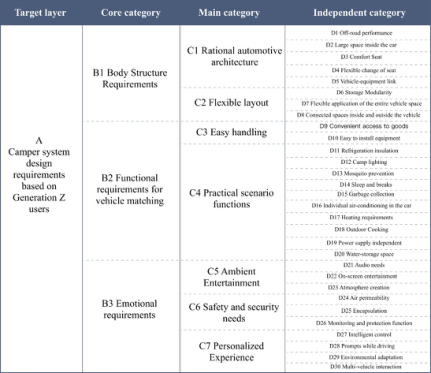
In the information analysis and processing, the research method of grounded theory was added. The original interview data was analyzed and summarized through three-level coding, and the three-level demand model was summarized upward. In this paper, Nvivo software was used to assist the coding analysis of the original data. In open coding (level 1 coding), the original interview sentences needed to be converted into conceptual vocabulary. In order to ensure the objectivity of the model, it was necessary to eliminate words with very low frequency. In this paper, 5 words with a frequency of 1 were eliminated. After that, 30 independent category genera were output (see Figure 1. D1–D30). In relational coding (level 2 coding), its main task was to compare different categories, dig deep connections among them, and integrate high-level category categories with internal logic. In this paper, 30 three-level independent genera were analyzed, and 7 main categories were obtained after summary (see Figure 1. C1–C7). In selective coding (level 3 coding), it was necessary to abstract more core categories from the categories and establish an organic relationship between core and main categories. Through the abstraction and induction of the main categories, 3 core categories were obtained in this paper (see Figure 1. B1–B3). After all the codes were finished, a “User Requirements Model for Generation Z Camping Car System” with user experience requirements was finally constructed through the series of the three levels of codes. In order to ensure the validity and reliability of the research results, five pre-reserved interview data were again tested for theoretical saturation according to the above three-level coding steps. After sorting and comparing and analyzing, no new concepts and categories were generated, which reached “theoretical saturation” in a sense (Shan et al., 2020).
Figure 1: Generation Z camping car system requirements hierarchy model (self-drawn by the authors).
The Design of Generation Z Camping Car System Based on Grounded Theory-AHP Method 141
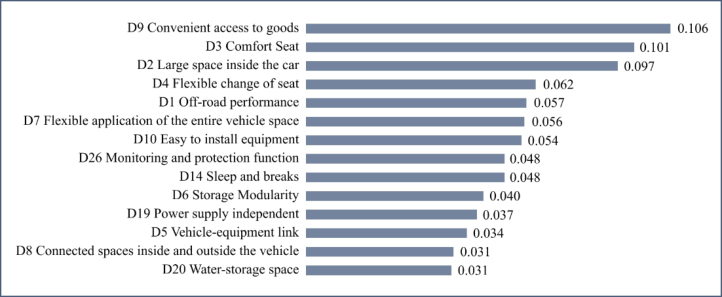
KEY DEMAND EXTRACTION In this paper, AHP method was used for quantitative research. The purpose was to overcome the defects of complex and unfocused requirements after a single qualitative study, so as to highlight the level of requirements to ensure the accuracy of design and development. Firstly, the requirement model was transformed into a hierarchical model. Secondly, the judgment matrix was constructed and experts are invited to score. In this paper, car campers (n = 15) and car designers (n = 5) were invited as experts to compare and rate a scale judgment matrix of 1–9 constructed from demand factors. After obtaining the results of each expert assignment, geometric mean values were selected to compare the total relative importance of the results. Finally, the scoring data was processed to obtain the index weights of the specific needs of users (independent category layer), and sorted in order to extract the key needs and their priorities. Finally, the first 14 items were selected as key functional requirements (see Figure 2).
It was essential to check the consistency of the final results in order to avoid the cognitive errors of the requirements judgment by different scoring experts, which led to the contradiction of scoring results. The final calculation results showed that the CR value of the core class layer was 0.039, which was less than 0.1. It indicated that the matrix of the core class layer was consistent, and the weight of each index in this level was reasonable and effective (see Table 1). Similarly, calculating the main categories layer and the independent categories layer in turn, the results showed that the CR value of each was also less than 0.1, which proved that the judgment matrix was consistent.
Table 1. Weights of core categories.
Table available in the original PDF paper.
Emotional requirements
Functional requirements for vehicle matching
Core category Body Structure Requirements Weight 0.480 0.394 0.126
Figure 2: Top 14 rankings and weights of independent categories (specific needs).
GENERATION Z CAMPING CAR SYSTEM DESIGN STRATEGY Body Structure Requirement
Rational automotive architecture. Considering the outdoor road conditions, it is recommended to choose a car with a higher chassis so as to avoid the accidental problem of scraping when driving on rough roads outdoors. In addition, for the environment of camping campsite, the vehicle may come into contact with grass, water or woods and other wet places, so the designer needs to consider the car grip performance to ensure the safety of outdoor driving. Finally, campers may carry a lot of professional camping equipment, so large-capacity storage space is essential for camping cars. In summary, according to the current situation of Chinese car camping carriers favoring private cars, this article recommends SUV or MPV models as the basis of the car architecture.
Flexible layout. Generation Z users have diversified camping needs, which requires that the space inside the vehicle can be flexibly changed. In order to meet the flexibility of the space system, modular design is proposed to be adopted, because this design method can freely combine multiple interchangeable modules to build different systems and products. For example, the Happier Camper HC1 travel trailer adopts a modular interior system in order to increase the flexibility of the interior layout. Users can simply put the components together like building blocks according to their needs, which not only improves the utilization of the caravan space, but also increases the user’s experience.
Functional Requirements for Vehicle Matching Easy handling. In the construction of camping equipment, more and more equipment tends to be automated, advocating “one-button construction”, in order to reduce the user’s learning and operating costs. It can be seen that the future design of camping cars will also tend to automate the operation, so as to make the campsite more convenient. For the storage of camping items, users need to take at any time, which requires designers to make reasonable planning for the car storage space to ensure that users can take convenient. For example, Xiaomi has designed a hollow center control storage structure, which is easy to access and expands the storage space.
Practical scenario functions. When users describe their camping experience, the following needs are collected: food preservation, power usage, sleep and rest, outdoor cooking, field lighting and field protection. Designers need to think about how to integrate the scenario function into the car, and innovatively add relevant design to solve the above problems to ensure the user’s experience while camping. experience.
Emotional Requirements Ambient Entertainment. China’s Generation Z group has higher requirements for the camping atmosphere, so designers can integrate the car and the camping environment to improve the user experience. The relevance dimension refers to the connection between the user’s personal emotion,
The Design of Generation Z Camping Car System Based on Grounded Theory-AHP Method 143
experience and the materia, surface of the facility (Zuo Hengfeng, 2010). Therefore, the material and style design of the car can better integrate the car into nature and enhance the user’s immersion experience. For example, Tesla’s simulated camping display uses a dancing bonfire to enhance the camping atmosphere.
Safety and security needs. Car rest and overnight may appear in the Car camping. It is vital to ensure that the car is closed and breathable to improve the user’s rest experience. In addition, considered the safety of the environment, the intelligent function of monitoring protection is also a guarantee for users. Such as tesla motors design mode of “the sentinel”, for the user to monitor activity around a vehicle, to ensure the safety of the vehicle environment.
Personalized Experience. Maslow’s hierarchy of needs theory holds that when the low-level needs are satisfied, people will pursue the higher-level needs (Liu Yonglin, 2024). In camping activities, some high level of social needs and the need for self-satisfaction can arise. If some basic functions are properly added in the design, the high-level emotional requirements also needs to be satisfied. With reference to the demand model studied in this paper, designers can consider adding functions such as intelligent control, driving prompts and vehicle interaction to meet the individual needs of users.
DESIGN PRACTICE Based on the design strategy derived from the user needs study, this paper starts with the 7 design directions above and focuses on planning the first 14 features for the system design of a camping car for the Generation Z.
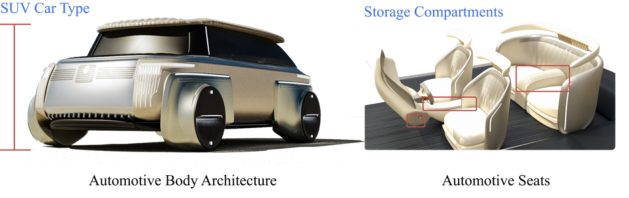
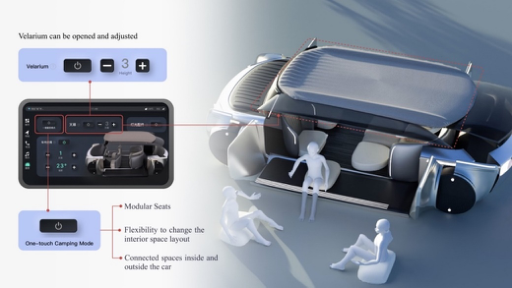
Design of Vehicle Structure and Space Planning In order to meet the off-road performance as well as the large space demand, we chose the SUV Tram as the model for this design. The design style of the car appearance combines naturalism with high-tech design language, so that the car can not only better integrate into nature, but also bring users a sense of security of science and technology. Modularized design of the car seat allows users to not only rotate and splice the seats, but also disassemble and drag the seats to the campsite to meet the diversified needs of users (see Figure 3). In the structure of the camping car, there are mainly the following functional designs: 1) adding intelligent control interaction, a key to expand the roof and sunroof as a camping velarium, to help users build a campsite conveniently; 2) adding door pedals connects the space of the car to nature and makes the car one with the natural environment; 3) in the layout of the interior, storage compartments are designed to meet the user’s needs for storage; 4)the front cover of the car is set up to store water and electricity to meet the user’s drinking and charging needs while camping (see Figure 4).
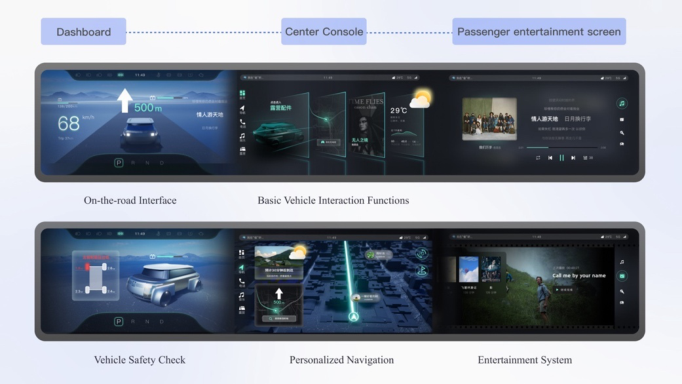
Automotive HMI Design The three-screen interactive interface is designed to let passengers enjoy the entertainment function, so that they will no longer feel bored on the road.
In the function design of intelligent interactive screen, the auto safety self- test function is added. By checking the function of the car itself, the function ensures that the user finds the problem of the vehicle in the first time. It will give the users a sense of security in the outdoors. In addition, based on intelligent navigation system, it adds a personalized experience. Users can mark quality camping spots or recommended scenery and upload it online to form their own camping map (see Figure 5).
Figure 3: Automotive interior and exterior (self-drawn by the authors).Figure 4: Human-machine diagrams and function profiles (self-drawn by the authors).
SUMMARY AND REFLECTION Based on the grounded theory-AHP method, this paper conducted in-depth research on the needs of Generation Z car camping users, and constructed the demand model and key functions. In the demand model, 3 core demand directions and 7 main demand categories were obtained, and then the design strategy of camping cars is summarized. Combined with the 14 key functions extracted, a set of camping car system design practice was output. This paper not only presents an innovative applied research method for camper system design, but also provide design reference for future product development of camping car system. The research mainly studies the demand under the development of China’s national conditions, but the findings could also be considered as a guide for research with similar objectives.
The Design of Generation Z Camping Car System Based on Grounded Theory-AHP Method 145
Figure 5: Automotive HMI high fidelity diagram (self-drawn by the authors).
Due to the length and conditions, this article also has some shortcomings: Limited data. Due to the small number of experienced car camping enthusiasts in China and the limited number of users who participated in the interviews in this study, the data is relatively subjective. Future related studies can increase the data range and number of studies on the basis of this paper to ensure the universality of samples.
System design presentation is incomplete. Since the design practice of this paper is based on the design strategy and key demand functions, only the design related to the research conclusion is shown. In addition, due to the subjectivity of design, the application of design strategies is not the optimal solution, and future researchers or designers can think about better design methods to make the user’s car camping experience more comfortable and pleasant.
REFERENCES
Deng Xue et al. (2012) Analysis of Hierarchical Analysis Weight Calculation Method and its Application Research, Mathematical practice and understanding, 24(7), p. 8. Fagerholm, N., Eilola, S. and Arki, V. (2021) Outdoor recreation and nature’s
contribution to well-being in a pandemic situation - Case Turku, Finland., Urban forestry & urban greening, 64, p. 127257. Fu, F.H., Guo, L. and Zang, Y. (2013) Camping and quality of life, Open Journal of Preventive Medicine, 03(3), pp. 263–274. Glaser, Barney, G., Strauss, & Anselm, L.. (1968). The discovery of grounded theory.
Weidenfeld and Nicolson. Gleaser. (1967). The discovery of grounded theory : Strategies for qualitative research /barney g. gleaser, aaselm l. strauss. He Canqun and Liang Yongqi (2023) Characterization of Generation Z and Design
Empowerment Discussion, Hunan Packaging, 38(6), pp. 8–12.
Hu Shan et al. (2020) Research on the Influence Factors of Satisfaction of Commercial Guide System Based on Grounded Theory, Journal of Graphics, 41(4), pp. 640–648. Jung, K.H. and Kim, H.-J. (2022) A Study on the Concept of Car Camping: Using
Literature Research and Delphi Research, , 34(1), pp. 491–505. Liu Yonglin (2024) Exploring the development of pure electric vehicles from the perspective of Maslow’s hierarchy of needs theory, Time Auto, (8), pp. 127–129. Mccallin, A.M. (2003) Designing a grounded theory study: Some practicalities,
Nursing in Critical Care, 8(5). Sun Zhipeng and Xu Jinxiu (2023) A Faraway Place in a Tent: A Cultural Perspective on the Rise of Youth “Exquisite Camping”Phenomenon, China Youth Studies, (6), pp. 103–111. Xu Dawei, Ye Zhenqi, Li Jiwu and Jin Jianwei (1996) Exploration of the concept of
forest parks, Journal of Northeast Forestry University, (6). Zuo Hengfeng (2010) Material Perception in Design, Wuhan University of Technology Journal, 32(1), pp. 1–7.
LISTED IN THE AHFE DIGITAL BOOKSTORE CATALOGUE
Explore the complete digital volume
Human Interaction and Emerging Technologies (IHIET 2024)
Read this individual research paper free through the original publisher, or explore the full digital proceedings book.
ISBN 978-1-964867-33-5
Explore this ISBN in the AHFE Bookstore ↗Listed in the July 2026 bookstore catalogue; search by ISBN to confirm current availability · Digital book purchase optional