Marc Sebastian Findeisen, Christian Niermann, Jari Küls, Thomas Hofmann (2023). User-centered design process for a high-risk future aerospace system. In: Human-Centered Aerospace Systems and Sustainability Applications. AHFE Open Access, vol. 98, pp. 12–22. https://doi.org/10.54941/ahfe1003915
This paper is one of two complimentary papers which describes the process from the designer’s point of view. The development process from the engineer’s point of view is described in Christian Niermann’s paper “Development processes of a remote co-pilot to support single pilot operation in the next generation air transportation system.”.In course of the automation of modern aircraft a large number of research projects are working on the topic of single-pilot operations. For their implementation and approval in civil aviation, additional safety measures have to be taken in the actual cockpit and in particular to provide additional support for the pilot flying. This could involve a remote co-pilot (RCP) who is working from a ground control station. Fundamentally, an RCP is a pilot monitoring who works in this new remote work environment. Instead of active flight interventions his primary task is monitoring and providing information for several aircraft at the same time. The single pilot can normally accomplish the flight alone. Consequently, an active collaboration between the RCP and the single pilot takes place only temporarily, for example in problem situations or situations of high workload. The paper highlights the design process for the development of this high-risk remote co-pilot aerospace system and shows the progress of this complex and interdisciplinary research task from the perspective of User Interface designers. The paper explains how the collaboration of engineering and design capabilities was integrated into the design process and positively influenced the quality of the final product.The goal of this project was to conceptualize a user-centered Human Machine Interface (HMI) prototype, for the work of a RCP, on which the Osnabrueck University of Applied Sciences and the German Aerospace Center worked in close coordination. The resulting interface contains aeronautical content that was developed for the implementation of remote aircraft support on the one hand. On the other hand, it includes the structures of information and design aspects for a user-centered high-risk HMI. For a basic requirement analysis, controllers, pilots, engineers and designers were highly involved in the design process from the beginning. For example, in workshops that lead to a creative exchange, wireframes formed the base for discussion. Those are a typical method for defining the fundamental framework of an HMI. Expert interviews were an elementary component in the project for validating HMI concepts, which were discussed and iterated with different functional departments from various points of view. It was finally possible to gain essential findings for the optimization of the interface from a wide variety of very different specialist areas. Those specialists interpreted issues from their unique perspectives and thereby served to optimize the resulting design. The HMI was discussed and validated from an aeronautical perspective as well as from an ergonomic and design perspective, in order to focus on the aspect of user-centered design. In order to benefit from the diversity of expertise, all project participants were involved in the creative process from an early stage of development. Therefore, it was possible to plan the characteristics of the HMI with a lot of content which improved the final product. A final product definitely benefits from the symbiosis of design and specialists’ technical expertise. To achieve this a coherent appearance and intuitive usability, paired with relevant and appropriate functionality is essential for a competitive product.This paper describes the design process of the high-risk interface, the findings on the benefits of designers and engineers working together and it provides an outlook of the developed remote co-pilot workstation design.
The Next Generation Intelligent Cockpit (NICo) project is pursuing the development of a user-centered human–machine interface (HMI) concept to support a single pilot remotely from a ground control station. In this context, a collaboration between designers from the University of Applied Science Osnabrueck and the German Aerospace Center (DLR) was established to develop this high-risk future aerospace system. Because this concept is novel, substantial empirical research was required. Integrating the extensive know- ledge of the DLR into the iterative design process for the HMI development promised to produce benefits from both domains.
Due to the ongoing automation of modern aircraft, various research pro- jects have addressed single-pilot operation (SPO). For implementation and approval in civil aviation, additional safety measures must be taken in the cockpit to provide additional support for the single pilot (SP) (Bilimoria et al., 2014). These measures may involve a remote co-pilot (RCP) working from a ground control station. Fundamentally, an RCP is a pilot monitoring wor- king in this new, remote operating environment. Rather than active flight
User-Centered Design Process for a High-Risk Future Aerospace System 13
intervention, their primary task is monitoring and providing information for several aircraft at the same time. The aim is to ensure the safety of SPO through monitoring (Martins et al., 2020). Under normal circumstances, a single pilot in the cockpit can complete a flight alone. Alternatively, the RCP can support high-workload situations, such as difficult departures, through active task sharing that is comparable to pilot monitoring in multi-pilot ope- rations (MPO). Consequently, active collaboration between the RCP and the SP occurs only temporarily. In an emergency situation, the SP is supported by a dedicated emergency remote co-pilot (ERCP), who switches the operating interface and exclusively supports the emergency flight (Findeisen, 2022). This situation may occur in highly stressful instances that require maximal flight support.
This project has focused on two related high-risk interfaces. One is meant to be operated by an RCP, and the second by an ERCP. The following report describes the development process for these HMIs and illustrates how a cre- ative design process performed by UI designers has benefitted from the early integration of DLR scientists and aviation professionals.
DEVELOPING A HIGH-RISK AEROSPACE SYSTEM Aviation is a highly sensitive sector in terms of security and potential risk. Misuse of flight settings or prescribed flight procedures can result in serious consequences. In addition, a remote workspace exhibits significant differe- nces in operation and location compared to the workspace of a pilot in an aircraft cockpit. Therefore, ensuring safe operation is an essential priority. Functionality and usability of the HMI must always be considered under these circumstances.
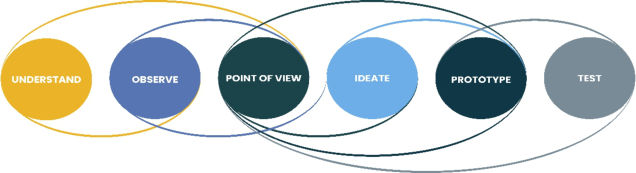
Developing an interface to support SPO from a ground control station is a very broad topic, and the procedures for SPO are currently being debated in research. These procedures are therefore not universally applicable, but they are unquestionably different from current workflows in MPO (DLR, 2020). Without such requirements for development, the integration of team members and researchers with aviation backgrounds becomes even more important to validate design approaches as well as contribute to the current state of research. To develop any HMI, a structured workflow is beneficial. A common design thinking model created by the Hasso Plattner Institute accomplishes this goal (Hasso Plattner Institut); it specifies an iterative pro- cess guiding the development of an HMI in six main steps (see Figure 1).
Figure 1: Six steps of design thinking.
This model was chosen because it helps to organize fundamental research, to obtain an understanding of context and to develop and implement ideas; multi-disciplinary teamwork and a user-centered focus builds the foundation.
The individual steps are not necessarily taken in chronological order; as development progresses, new insights are gained. These insights need to be re-evaluated through a design thinking process, leading to the start of a new, more detailed iteration. At the beginning, the main goal is to correctly understand the problem and to arrive at the first usable pro- totypes and mock-ups quickly and easily in order to gather user feed- back. As the iteration progresses, results become more detailed and more comprehensive.
The following sections discuss the integration of scientists into the design process for the development of an RCP-HMI. The six steps of the design thinking process are described, and advantages of collabora- tive work are presented. The focus is on methodologies that have had a positive influence on the collaboration and have helped the team mem- bers, who have been foreign to design thinking so far, to creatively enrich the process. This paper further describes why certain methodolo- gies were selected, how they were implemented and how they were realized collaboratively.
Understand The first main target is to identify the several dimensions of a specific topic, or the “design challenge.” Examples of these various dimensions are the current fundamental workflow between pilots or crew resource management.
This research aimed to acquire a comprehensive view of the topic. An open exchange with DLR scientists made this step efficient in revealing the most important themes and to gain the maximum amount of information regar- ding the relevant areas of operating an aircraft. Exchanges with different expert groups such as pilots, engineers or air traffic controllers were avai- lable. Each of these groups revealed valuable insights and made it easier to gain relevant information across the several dimensions of the design chal- lenge. In interviews, pilots often valued a maximum of available information to possess an extensive situational awareness at any time. Air traffic control (ATC), on the other hand, preferred a minimum of essential information. The analysis of related projects and topics represents a relevant point in this phase of the process; it showed that ATC already provide remote sup- port in current aviation and can therefore also contribute information that is valuable for the work of an RCP (Li et al., 2018). Furthermore, DLR has already provided research describing the RCP and their work in gene- ral (Laubner et al., 2022). This research helped to provide a consistent base for the beginning of the design process. During this phase, knowledge gaps were identified. Uncertainties regarding workload issues, such as how many aircraft an RCP can accommodate at the same time or how far an RCP should be able to intervene in the flight, were some of the undefined topics. Fur- ther research was planned to obtain a holistic perspective and to close these knowledge gaps.
User-Centered Design Process for a High-Risk Future Aerospace System 15
Observe The second phase of the design process aimed to understand the personal per- spective of relevant humans (potential users, pilots, researchers, experts, etc.) to recognize their needs, expectations and feelings. Qualitative methods such as interviews, focus groups or observations of users and experts were used for this purpose. These methods required realistic conditions to collect all insta- nces, processes and resulting issues. To gain a perspective regarding the status quo in aviation, interviews with pilots of various ages, flight experience and education levels led to an overall impression of piloting.
The research revealed important procedures and tactics, which validated the initial approaches from prior research regarding current workflows and tasks during a flight. Furthermore, the assumption that there are intervals during the flight with minor workload for the pilots was affirmed by obse- rving pilots during a flight. In contrast, problem situations that require an intense collaboration in cockpit, described as “sheer terror,” can also occur (Miller 2021, p. 14). Through these insights, it became clear which aspects of the design challenge seemed crucially important from the user and expert per- spectives, creating focus points for further research and for the development of the HMI. The imbalance of workload between individual flight phases in the cockpit strengthened the idea that one RCP can safely monitor multiple aircraft simultaneously and can provide more intensive support to a single aircraft in an abnormal situation, as well. True emergencies, however, would need to be addressed by an emergency remote co-pilot.
Based on the knowledge gained, the DLR conducted a simulation about the impact of physical separation of pilots. The designers had the opportunity to obtain important insights by joining the simulation on-site. Communication between the two pilots was limited to an audio connection and a one-way video feed. Both pilots’ feedback, as well as the close observation, revealed which features the HMI should contain. It became apparent that the segre- gated pilot who was outside the aircraft was less able to perform important crosschecks because they were not aware of every action the pilot in the cock- pit had performed. Later in the process, this awareness resulted in a “protocol widget” in the final design. This widget lists every action of the SP chro- nologically in real time and thus allows the RCP to build better situational awareness of the aircraft and its situation. These insights illustrated the dif- ficulties resulting from the separation of both pilots and the challenges the HMI would need to solve to allow secure SPO.
Due to the different observation methods used throughout the process, the mass of information is being translated into qualitative data and inputs to solve the design challenge. Through the expertise of scientists, these results can be placed in the overall context of previous research, either confirming or refuting their validity.
Point of View After observing the current habits and working processes of potential users and related jobs (such as ATC, pilots or drone operators) results were sum- marized, interpreted and prioritized to define a common perspective. The
task of the developers was to identify the goals and problems of the potential users based on the research. Within the framework of the design challenge, they derived requirements for the HMI. With this essential information, the designers’ expertise in user interfaces played a significant role in developing initial approaches for the HMI solution. In building this “point of view”, numerous methods could be used to visualize the potential user’s viewpoint and to make the gathered requirements apparent. One of these methods was to create a persona who was a fictitious typical user of the final product. To define the persona, it was necessary to build features around the core characteristics of a person (Alkadhi et al., 2020), for instance how knowled- geable they might be in terms of new technology or in which industry they might have worked originally. This information helped to establish determi- ning factors for the HMI requirements. This project required a potential user to have an aviation background, with pilot-like training. Therefore, the HMI could be planned as an “expert HMI,” allowing for a higher level of comple- xity. The persona showed that an RCP would have comparable work hours to an air traffic controller and thus would work with the interface several hours per day. The resulting ergonomic circumstances would influence hardware such as displays or usage concepts.
During development of the RCP-HMI, the DLR provided a use case for a flight from Frankfurt, Germany to Innsbruck, Austria (flight time of appro- ximately one hour and 10 minutes). This use case visualized the possible tasks of an RCP during flight. In this step, it was important to define the task sha- ring between both pilots (SP and RCP) in an appropriate way (Küls, 2022). The results indicated significant requirements for the contents of the HMI, although the distribution of tasks was not yet final in this iteration.
To define a common state of discussions, the team conducted a work- shop with all participants. The interdisciplinary team, along with designers, engineers and scientists, discussed the core research results and were able to validate vital questions. Because each department of experts offered indi- vidual experiences, the discussions within the team ensured that all results could be viewed from a wide variety of perspectives. In this way, the focus for the subsequent process could be sharpened. In addition, errors and false assumptions could be identified. This critical examination of previous resea- rch often leads to a modification of the original design challenge. At this point in the process, newly gained insights into the topic can be better classified and an adaptation of the initially described problem can occur (Kauer-Franz and Franz, 2022).
To guide the following creative process and to specify the direction of deve- lopment, it was crucial to set early boundaries for the specific solution area. The double diamond model, developed by the British Design Council, fol- lows a chronological flow that diverges during the first stage of research and converges when defining a point of view (McNabola et al., 2013). After elu- cidating the design challenge in the first two steps, the individual viewpoints regarding specific issues of the HMI became defined. Therefore, it was neces- sary to integrate all knowledge in order to restrict the following ideation purely to relevant information.
User-Centered Design Process for a High-Risk Future Aerospace System 17
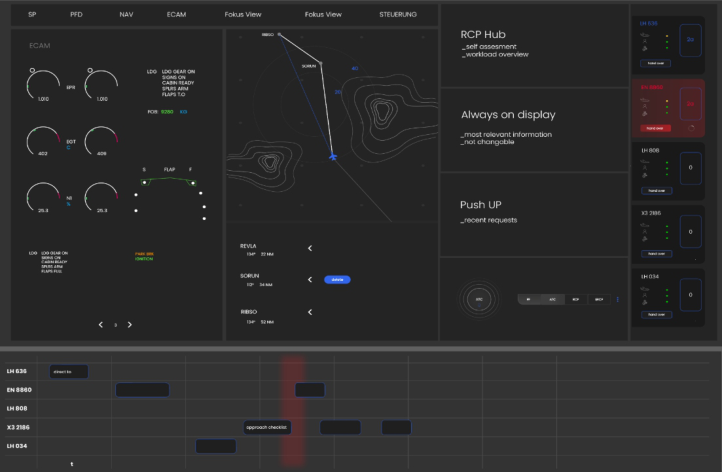
Ideation The ideation process searches for quantitative solutions to gain maximum diversity. The concept of “no bad ideas” is valuable advice in helping to think outside of conventions, especially for team members who have not yet come into contact with similar creative methods. This advice can even trigger unrealistic suggestions, which in turn can open the area of creative thinking and additionally reduce the fear of expressing false or absurd ideas (Wilson, 2013). For aviation-related product development, long development cycles and small-step developments of functions are normal; however, the development of a digital product as part of a research project requires bol- der approaches. In order to develop agile designs rapidly and to explore the novel subject of an RCP, progressive and creative thinking approaches were desired. To create an extensive solution space, lateral thinking can encourage many ideas. A common strategy to achieve this goal, also used in the NICo-project, is brainstorming. Brainstorming is a “widely used and designer-friendly method” (Kim et al., 2019, p. 253) that describes ideating from scratch to generate diverse ideas in a short time. Participation by desi- gners, engineers, researchers and pilots with different backgrounds ensured a wide variety of ideas and approaches to address the different dimensions of the design challenge. All ideas were then roughly clustered to generate a structured overview. In addition, following Edward de Bono’s “six thinking hats” method, which envisions the wearing of six imaginary hats, each with a different viewpoint on a certain topic, can enhance the diversity of ideas (Edward de Bono, 1985). This method follows an approach to avoid single- dimensional thinking. Such ideation can not only open various new ideas but can also strengthen previous ideas even more. For instance, the idea of wor- king with VR goggles arose. Due to ergonomic reasons such as weight and eye strain after long periods of use, the idea faded and in turn strengthened the ini- tial idea of control through a mouse and keyboard. Once a sufficiently large solution space has been created, ideas and concepts must be evaluated based on the previously defined point of view. This process can occur, for example, through an evaluation matrix. In early iterations (example in Figure 2), how- ever, it may not be possible to name all relevant evaluation criteria. Therefore, a simpler and more subjective method can be used, such as awarding points to identify the most promising ideas (Kauer-Franz and Franz, 2022). These ideas can be those with the easiest practicability (“quick win”), the most visi- onary ones (“moon shot”) or the strategically most feasible thoughts (“most promising”; Hasso Plattner Institut).
Prototyping In this phase, selected ideas are converted to prototypes or mock-ups. Pro- totypes are used to visualize an abstract idea, to perform intensive testing and to obtain feedback, especially regarding functionality. Mock-ups are less functional visualizations used to explore abstract ideas (Alperowitz et al., 2017). Both strategies were suitable for discussions with the team or for con- tacting potential users and experts (Friedrich, 2021). In the earlier phases of this project, mock-ups were predominantly used. A testing phase with
Figure 2: Early-stage concept for an RCP-HMI.
functional prototypes will occur during future development. Because the boundaries between mock-ups and prototypes are not always clearly drawn, only the term “prototype” has been used in the following description.
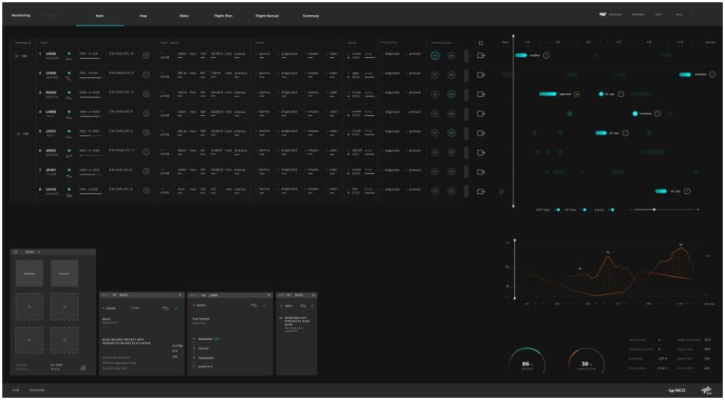
The implementation of ideas can vary between the fast, elementary conce- pts in earlier iteration stages and the complex functional visualizations from later in the process. To make concepts usable for the design thinking process, it is important for them to be experienced by potential users (Kauer-Franz and Franz, 2022). In addition, prototypes ease a common view and can make the core function of an idea visible for a development team. Consequently, prototypes that are evaluated by experts or by a development team can dif- fer from prototypes that are evaluated by potential users. Experience made it clear that it was not advisable to show rudimentary functional depende- ncies from wireframes to a pilot who might be considered as an RCP. It was more helpful to visualize the processes by using a “click dummy” in which an interaction between HMI and the potential user could actually occur. This strategy allowed pilots to communicate focused and differentiated feedback regarding actual usability in a realistic environment during later testing. Due to the extensive expertise of potential users, care was taken to ensure that the content of the mock-ups and prototypes was correct. During testing, pilots repeatedly provided feedback referring to inaccuracies in the content, such as an incorrect flight number or an incorrect amount of fuel. These details immediately caught the eye of the experts and influenced their feedback as well. To bring the new idea of an RCP to the more conservative aviation com- munity, the approach of creating a minimum viable product was taken (see Figure 3).
User-Centered Design Process for a High-Risk Future Aerospace System 19
Figure 3: Prototype of RCP-HMI – monitoring page.
In this context, many ideas were prototyped to generate a variety of agile designs. These designs showed different approaches to the task of supporting a single pilot from a ground control station. During the process, the prototy- pes further evolved through iterations to the final concept of the project. The various methods for the visualization of ideas helped to produce nuanced feedback in this multifactorial design challenge. The team had to identify the proper tools to derive the feedback they required for the next iteration and to make use of the interdisciplinary partnership.
Testing Different methods and complexities are associated with testing. In the earlier process, testing primarily indicates whether the design challenge is under- stood correctly. It shows whether the potential user can solve a task in any way using the prototype. In later iterations, the focus is directed more toward the user experience for a potential user. The interface must not leave any room for possible errors after the release, as such errors might have life-threatening consequences for flight members or passengers. The- refore, testing is a significant step to detect usability and functional errors in a risk-free test environment. In addition, the feedback gained from the testing shows which components or ideas have to be improved. It beco- mes apparent whether only details of the prototype require adaptation or if the basic interpretation of the topic needs to be redefined instead. To obtain open feedback from different experts, an interactive workshop was realized to test agile prototypes. Rudimentary prototypes of the interface were adapted immediately following the feedback from experts. This tech- nique provided an instant impression of changes and better engagement of participants.
For evaluation of feedback, it was important to recognize that the opi- nions of pilots might differ from those of ergonomic experts because their viewpoints could vary based on knowledge and experience. Information placed logically in an aviation context may not necessarily be the most user- centered placement in the context of user experience. Therefore, based on participant experience and relevance, important parameters were prioriti- zed. For example, safety issues related to improper colors or faulty mapping were prioritized highest, matching “safety-first” aviation standards. Later testing scenarios will involve the simulation of a scripted flight situation. The system will be tested in detail in a realistic usage environment; in addition, simulations will test the safety of this high-risk interface.
CONCLUSION
The central purpose of this paper is to communicate the value of the integra- tion of design and engineering skills throughout the development process of a high-risk aerospace interface in order to improve it collaboratively. Develo- pment of a product from a designer’s point of view commonly occurs through a creative thinking process. It was a noticeable enrichment to pair the DLR’s deep knowledge of aviation with the creative thinking processes of designers to increase the quality of this highly sensitive product.
The creative development approach, especially emphasizing workshops and interviews with aviation experts, inspired the scientists to contribute fur- ther creative ideas. The various methods helped to visualize the content and to increase common understanding.
Continual validation of newly created ideas – mainly by pilots and pro- ject members – ensured that the team remained focused on the project and its main goals. In addition, the dialogs with pilots and ATC revealed that aviation often contains unbalanced workloads for pilots. This knowledge influenced the HMI’s main construction of multiple, simultaneously obse- rved aircraft. Furthermore, the information emphasized the requirement of a second HMI for the ERCP should the workload rise to an emergency level.
Another essential finding involves the importance of specific prototypes that were needed for specific test persons. Pilot feedback worked best when the pilots could test interface concepts that had been populated with rea- listic data and resembled the familiar cockpit in central features such as color coding and functional layout. Indeed, this resulted in a challenge for the integration of revolutionary ideas in a conservative industry. To ove- rcome barriers in the early stages of development, it was a necessity to produce a broad range of agile concepts to represent multiple options for HMI approaches.
For further research and development for high-risk aerospace systems, it is recommended to choose specific creative methods that suit the demands of each individual project. Clearly, the efficiency of multiple teams wor- king closely together may even rise above the levels already demonstrated when restrictions for live, face-to-face events resulting from the COVID-19 pandemic no longer apply.
User-Centered Design Process for a High-Risk Future Aerospace System 21
REFERENCES
Alkadhi, B., Alnafisi, G., Aljowair, L., Alotaibi, L., Alduaifi, N. and Alhumood, R.
(2020) ‘Co-design of Augmented Reality Storybooks for Children with Autism Spectrum Disorder’, in Stephanidis, C., Antona, M., Gao, Q. and Zhou, J. (eds) Universal Access and Inclusive Design: 22nd HCI International Conference, HCII 2020, Copenhagen, Denmark, July 19–24, 2020, Proceedings, Cham, Springer International Publishing; Imprint Springer, pp. 3–13. Alperowitz, L., Weintraud, A. M., Kofler, S. C. and Bruegge, B. (2017) ‘Continuous Prototyping’, 2017 IEEE/ACM 3rd International Workshop on Rapid Conti- nuous Software Engineering (RCoSE). Buenos Aires, Argentina, 22.05.2017 - 22.05.2017, IEEE, pp. 36–42. Bilimoria, K. D., Johnson, W. W. and Schutte, P. C. (2014) ‘Conceptual framework for
single pilot operations’, Proceedings of the International Conference on Human- Computer Interaction in Aerospace. Santa Clara California, 30 07 2014 01 08 2014. New York, NY, USA, ACM, pp. 1–8. DLR (2020) ‘Institute of Flight Guidance - NICo (Next Generation Intelligent Cockpit)’ [Online]. Available at https://www.dlr.de/fl/en/desktopdefault.aspx/tabid- 1149/1737_read-69821/ (Accessed 7 February 2023). Edward de Bono (1985) Six Thinking Hats: Run better meetings, make faster
decisions (THE MULTI-MILLION-COPY BESTSELLER), Life. Findeisen, M. (2022) NICo Remote Pilot: Entwicklung eines, Remote Pilot’ HMI mit Fokus auf Notfallfernunterstützung des Flugverkehrs bei Linienflügen, Bach- elorarbeit, Osnabrück, Hochschule Osnabrück. Friedrich, M. (2021) ‘Human Machine Interface Design to Support Safety Risk
Monitoring of Autonomous Small Unmanned Aircraft Systems – Results from a Mock-Up Evaluation’, 2021 IEEE/AIAA 40th Digital Avionics Systems Con- ference (DASC). San Antonio, TX, USA, 03.10.2021 - 07.10.2021, IEEE, pp. 1–7. Hasso Plattner Institut ‘Die sechs Schritte im Design Thinking Innovationsprozess’ [Online]. Available at https://hpi.de/school-of-design-thinking/design- thinking/hintergrund/design-thinking-prozess.html (Accessed 7 February 2023). Kauer-Franz, M. and Franz, B. (2022) Usability und User Experience Design: Das
umfassende Handbuch, Bonn, Rheinwerk Verlag. Kim, T., McKay, A. and Thomas, B. (2019) ‘A Systematic Brainstorming Ideation Method for Novice Designers based on SECI Theory’, Proceedings of the Design Society: International Conference on Engineering Design, vol.1, no.1, p.251. Küls, J. (2022) NICo Remote Pilot: Entwicklung eines, Remote Pilot’ HMI mit
Fokus auf Kommunikation und Flugführung im Regelbetrieb von Linienflügen, Bachelorarbeit, Osnabrück, Hochschule Osnabrück. Laubner, M., Benders, S., Goormann, L., Lorenz, S., Pruter, I. and Rudolph, M.
(2022) ‘A Remote Test Pilot Control Station for Unmanned Research Aircraft’. Li, W.-C., Kearny, P., Braithwaite, G. and Lin, J. J. (2018) ‘How much is too much on monitoring tasks? Visual scan patterns of single air traffic controller performing multiple remote tower operations’. Martins, A. P. G., Lieb, T. J., Friedrich, M., Bonelli, S., Marcello, C., Bortoli,
A. de, Contissa, G., Godano, F., Sartor, G., Rogning, L., Capasso, P. J., Reis, R. J. N., Negrao, J. R. P., Triska, A., Boonsong, S. and Christiansson, M. (2020) ‘Toward single pilot operations: A conceptual framework to manage in-flight incapacitation’.
McNabola, A., Moseley, J., Reed, B., Bisgaard, T., Dorthe Jossiasen, A., Melander, C., Whicher, A., Hytönen, J. and Schultz, O. (2013) ‘Design for Public Good’, pp. 25–26. Miller, E. (2021) ‘Mindfulness Workshop for Airline Pilots’, p. 15. Niermann, C. A., Ebrecht, L., Küls, J., Findeisen, M. S. and Hofmann, T. (2023)
‘Development process of a remote co-pilot to support single pilot operation in the next generation air transportation system’. Wilson, C. (2013) Brainstorming and Beyound: A User-Centered Design Method, Morgan Kaufmann Elsevier.
LISTED IN THE AHFE DIGITAL BOOKSTORE CATALOGUE
Explore the complete digital volume
Human-Centered Aerospace Systems and Sustainability Applications
Read this individual research paper free through the original publisher, or explore the full digital proceedings book.
ISBN 978-1-958651-74-2
Explore this ISBN in the AHFE Bookstore ↗Listed in the July 2026 bookstore catalogue; search by ISBN to confirm current availability · Digital book purchase optional