The dispatch is the key to Civil aircraft flight work.Dispatch message is the equipment failure information that affects aircraft dispatch. It is mainly used to assist the crew or the maintenance personnel to carry out dispatch work more conveniently, and can also be used to remind the crew of aircraft failure status during flight. A good design of dispatch message interface can help the crew or maintenance personnel quickly identify aircraft failure and make dispatch decisions during dispatch, reduce the cognitive burden of people, and greatly improve the efficiency of dispatch.First of all, this paper introduces the dispatch process based on MEL,and then analyzes the functions of the dispatch message interface design according to the cognitive characteristics of the crew, based on the user's use and cognitive needs, analyze the functions of dispatch message interface design,put forward a task-based design method for the dispatch message display interface of civil aircraft cockpit from the aspects of the content, layout and display mode of the dispatch message display interface.
Dispatch is mainly responsible for organizing, arranging and ensuring the flight and operation management of aircraft, and plays an important role in the flight process. Especially as a civil aviation dispatch, how to effectively improve the efficiency of civil aviation dispatch has become the primary task of the dispatch work.
During the dispatch work, there is often the situation that allow the aircraft to be dispatched with inoperative equipment. Quickly locate and maintain the fault or make a decision to dispatch with inoperative equipment, which can improve the efficiency of dispatch work to a certain extent (Jipeng, 2014). However, when the current civil aviation aircraft is dispatching, the mainte- nance personnel need to go through more complicated inspections to locate specific faults, which greatly increases the workload of the maintenance personnel and reduces the efficiency of the aircraft dispatching.
The design of the dispatch message interface needs to consider the infor- mation layout and information display content of the interface, which are all derived from the use scenarios and requirements of the crew for the dispatch message.
RESEARCH ON DISPATCH PROCESS BASED ON MEL MEL Introduction (Airbus, 2005)
MEL (minimum equipment list) is an important document prepared by airli- nes to regulate aircraft airworthiness and improve aircraft release reliability. In MEL, it specifies various designs that conform to the approved model, and on the basis of maintenance, preventive maintenance and inspection car- ried out by qualified maintenance personnel, the aircraft can be allowed to carry out limited flight with non-working equipment according to certain restrictions and working procedures.
During the dispatch work, there is often the situation that allow the aircraft to be dispatched with inoperative equipment. Using MEL to release the aircraft with system function or equipment failure can avoid the operation interruption and ensure that the aircraft safety is not affected.
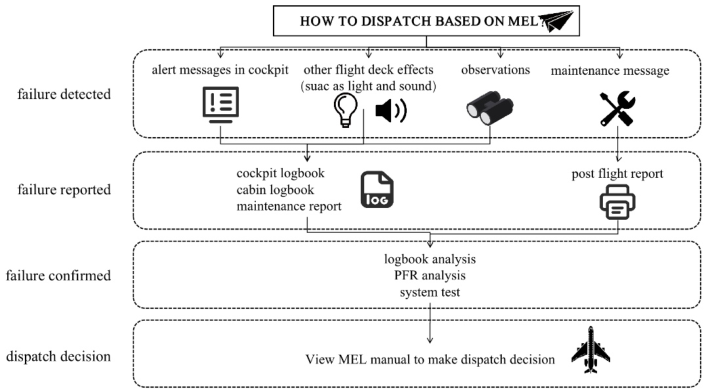
Introduction to MEL-Based Dispatch Process Identification Mode of Failure Failure detected by alert message Alert message provides the flight crews with information on the current state of abnormal system or flight status information in civil aviation cockpit.The alert information is usually displayed on the cockpit display interface in the form of text, such as the ECAM page for A series aircraft and the EICAS page for B series aircraft. In addition, some alert information can also be provi- ded on the main flight display interface, such as HUD and PFD. The crew or maintenance personnel can identify the current failure status of the aircraft through the cockpit alert information during the dispatch work.
Failure Detected by Other Flight Deck Effects Other cockpit indications include tactile, aural and visual indications.
Tactile indication provides failure indication for the crew by means of phy- sical touch, feedback rod force and vibration. For example, a shock rod is used for a certain A series aircraft to indicate the stall of the crew.
Aural indication refers to sound indication transmitted through cockpit loudspeaker. The crew can identify the failure through the audible indication in the cockpit.
Visual indication refers to other visual indications in the cockpit besides the crew alert information, such as control panel indicator light, rotary swi- tch indicator, failure flag and schematic page indicator.
Failure Detected by Observations Observations may be reported either by the flight crew, the cabin crew, or maintenance personnel.
This includes the failure found by the flight crew during the walk around inspection, and the failure not detected by the maintenance personnel during the planned or unplanned maintenance. For the A series aircraft, the main- tenance personnel can also identify the system faults by checking the main- tenance panel. For example, the maintenance personnel can obtain the faults through the fault indicator light or use this panel to perform the system
Task-Based Design Method of Civil Aircraft Cockpit Dispatch Message 57
test/system BITE test, and read the system status indicator.
Failure Detected by Maintenance Message For example, for A series aircraft, there is a centralized failure display system (CFDS) or central maintenance system (CMS) on the aircraft, which can report the failure on the aircraft, and the maintenance personnel can also report the system failure after testing the system.
Report Failure Cockpit/Cabin Logbook The flight/cabin crew makes a report in the aircraft logbook of any failures, and abnormal events that have had an effect on the cockpit/cabin, during the flight.
Maintenance Report Maintenance personnel issue a maintenance report during scheduled che- cks. The report includes any reported failures, and all the actions performed during the check. Otherwise, For aircraft with a Centralized Fault Data System (CFDS), or a Central Maintenance System (CMS), the Post Flight Report (PFR) may also be used to confirm a failure that has already been reported by the flight/cabin crew.
Failure Confirmed When MEL is used on ground, only after a failure has been confirmed. The flight crew or line maintenance team may confirm the failure by Consulting the logbook entry Analyzing the PFR. This involves correlating the effects in the cockpit with the PFR identifiers.
Dispatch Decision When the failure is confirmed, the dispatch decision can be made by viewing the MEL manual.
To sum up, the dispatch process based on MEL includes fault identifica- tion, fault report, failure confirmation and dispatch decision. The dispatch flow chart based on MEL is shown in the Figure 1.
RESEARCH ON DESIGN METHOD OF TASK-BASED DISPATCH MESSAGE DISPATCH MESSAGE DISPLAY INTERFACE According to the above introduction, there are many ways of failure iden- tification and failure confirmation when the locomotive or crew is carrying out the dispatch work. Therefore, it needs to spend a lot of time to iden- tify and confirm the fault before making the dispatch decision by checking the MEL manual. If an independent dispatch message display interface is set up, it can be used to display the monitored failure information for dispa- tch, so that the maintenance or crew can view the dispatch message page to understand the failure on the aircraft, and directly view the MEL manual for dispatch or maintenance, which can greatly improve the efficiency of dispatch work.
Figure 1: Dispatch flow chart based on MEL.
A good dispatch message display interface should consider the user’s use scenarios and requirements. Therefore, this chapter is based on the dispatch task, and analyzes the design criteria of the dispatch message display interface by introducing the use scenarios and requirements of the flight crew or the maintenance crew for the dispatch message display interface, forming a task- based cockpit dispatch message display interface design method (Zhi, 2014).
Analysis of Dispatch Message Usage Scenarios The use scenario of the dispatch message is mainly used during the ground dispatch release, which can assist the crew to understand the aircraft failure status information in the air. This paper mainly considers the use requi- rements of flight crew or locomotive for dispatch messages in ground use scenarios.
Dispatch Message Interface Design Requirements Analysis When the flight crew or the maintenance personnel carry out the in-flight dispatch release work on the ground, there is often the situation that the aircraft dispatch with inoperative equipment. The maintenance personnel need to understand the current faults on the aircraft that may affect the aircraft dispatch, and check the MEL manual to confirm whether the fault release can be retained or released after the maintenance and inspection pro- cedures are implemented. If the corresponding faults are not found in the manual, the aircraft cannot be released.
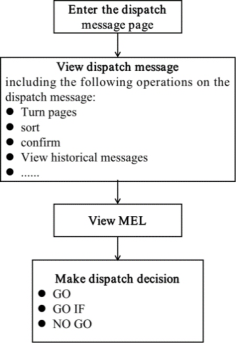
The process of obtaining the fault and confirming the dispatch result through the dispatch message page is shown in Figure 2 when the crew is carrying out the dispatch work.
To sum up, when the locomotive or crew use the dispatch message, the main requirements for the design of the dispatch message interface are:
Task-Based Design Method of Civil Aircraft Cockpit Dispatch Message 59
Figure 2: Dispatch flow chart based on dispatch message.
knowing the new dispatch message, viewing the dispatch message, and processing the dispatch message.
Design Function Analysis of Dispatch Message Interface Based on the demand analysis of the dispatch message interface design, the functions required for the dispatch message interface design are further analy- zed, and the demand-function correspondence table is obtained, as shown in Table 1.
Table 1. Design function analysis of dispatch message interface.
Table available in the original PDF paper.
Requirement Function
It shall have dispatch message notification function
Know the new dispatch information
The dispatch message display interface should have:
View the new dispatch information
a. Paging function of dispatch message b. Dispatch message sorting function c. Provide multiple sorting methods (such as sorting by ATA section or sorting by time) d. Dispatch message confirmation function e. View historical message function f. Dispatch message grouping function (group by ATA chapter, select ATA chapter number to view only the ATA chapter message) g. Dispatch message search function
Handle the dispatch message
a. It shall have the dispatch message confirmation function b. It should have the MEL function of dispatch mes- sage link
RESEARCH ON THE DESIGN OF DISPATCH MESSAGE INTERFACE Design Criteria for Man-Machine Interface of Civil Aircraft Cockpit
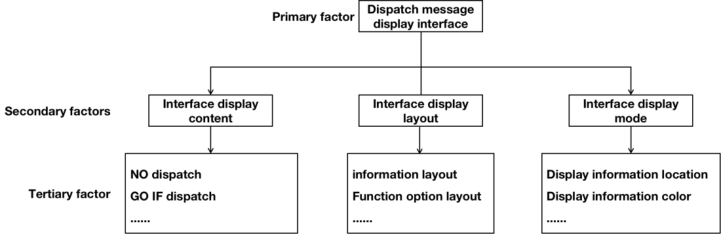
The design of the cockpit dispatch message display interface should first con- sider the use scenarios and needs of the dispatch message. The design of the interface should not only meet the needs of the crew and the crew for the use of the dispatch message, but also consider the MEL-based dispatch pro- cess to improve the efficiency of the dispatch work (Tianlong, 2021). Based on the use requirements of dispatch message, this paper analyzes the influe- ncing factors of cockpit dispatch message display interface design in depth, and divides the influencing factors into three levels. The influencing factors of each level are shown in Figure 3.
The factors affecting the design of dispatch message display interface include the interface display content, interface display layout, and interface information display mode in the human-computer display interface design. They are important indicator factors that have a greater impact on the use of dispatch message display interface for crew and maintenance. This paper will study the design preparation of cockpit dispatch message display interface from the perspective of these three secondary factors. Display Content Design Criteria The content of the cockpit dispatch message display page depends on the crew and maintenance’s demand for the use of the dispatch message and the functi- ons that the dispatch message page should have. According to the functional analysis of the design of the dispatch message interface, the display content of the dispatch message display interface should include: a. Identifier used to inform the crew or maintenance of the new dispatch message; b. Label used to switch to the dispatch message page; c. Fault messages affecting aircraft dispatch; d. Operate the function keys of dispatch message, such as sorting key, confirmation key, page turning function, etc.
Display Layout Design Criteria According to a large number of documents, AC25-11A (FAA, 2007) has relevant design criteria for the layout of information display content. The
Figure 3: Factors influencing the design of dispatch message display interface.
Task-Based Design Method of Civil Aircraft Cockpit Dispatch Message 61
display contents are classified in AC25-11A, and the principle of basic display information layout is proposed. Therefore, based on the use requirements of AC25-11A and the locomotive and crew for dispatch messages, the design criteria of “information display layout” are proposed as follows: a. The identifier to prompt the new message should be set on the cockpit display page, and when the aircraft is on the ground or in the air, different new message prompt methods should be set to remind the crew or the maintenance personnel of the new dispatch message; b. A label should be set at the top of the dispatch message page. Click the label to quickly enter the page; c. The new dispatch message and the confirmed dispatch message should be displayed separately. The display page can be divided into two parts. The new dispatch message is displayed in the upper half of the page, and the confirmed dispatch message is displayed in the lower half of the page; d. The dispatch message confirmation and sorting keys should be set at the top or bottom of the dispatch message page, and should not obscure the contents of the dispatch message; e. The page-turning function of dispatch messages can be set at the bot- tom or right of the page and displayed in the form of scroll bars. When the current page cannot be fully displayed due to the large number of dispatch messages, the crew or maintenance can view the hidden dispatch messages through the drop-down scroll bar.
Display Method Design Criteria For the design criteria of the character information display on the dispatch message page, this paper has consulted the relevant provisions and require- ments in AC25-11A, the requirements for character display in GJB2837-97 and the requirements for character display design in FAA: Human Factors Design Guide, among which the design requirements for characters in AC25- 11A and GJB2837-97 are relatively rough, FAA: 8.2.3 Characters and line length in the Human Factors Design Guide describes the design criteria for character information display completely and rigorously, so this paper adopts the relevant design requirements for information character display in FAA.
The objective of color standardization is to maintain the effectiveness of visual alerts by enabling the flight crew to readily distinguish between alert categories. AC25.1322-1 11 Color Standardization specifies the color of cockpit warning information: Visual alert indications must conform to the following color convention:
a. Red for warning-alert indications. b. Amber or yellow for caution-alert indications. c. Any color except red or green for advisory alert indications.
The dispatch message is for the crew and the maintenance personnel to actively view and assist in the dispatch decision. According to the definition in AC1322, the dispatch message can indicate the abnormal status of the aircraft to the crew or the maintenance personnel at the time of dispatch, without the need for the crew to immediately know and operate. It is not a warning and alert alarm, and can be colored according to the prompt alarm.
In this paper, the design criteria for the character color of the dispatch message interface in the cockpit are: a. Because there is no emergency requirement for the crew or maintenance personnel to use the dispatch message, it is recommended to use colors other than red, amber and green, and white can be used. b. The background color of the dispatch message display page should be consistent with the background color of other display pages in the cockpit. c. The label, display control and character of the dispatch message display page shall be displayed separately without affecting the readability. d. The color of the whole dispatch message page should be uniform to avoid that the unmatched color will cause the recognition information to take too long.
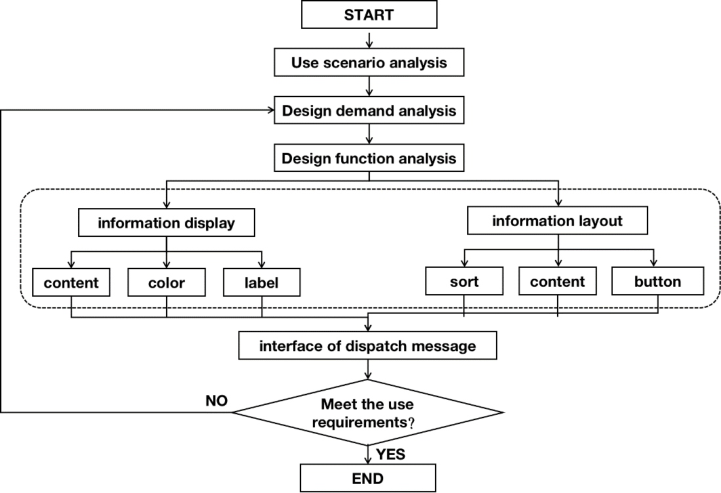
Task-Based Dispatch Message Interface Design Method Based on the task flow and use requirements of dispatch message, this paper forms a design method of cockpit dispatch message display interface, as shown in Figure 4.
Figure 4: Design process of dispatch message display interface.
CONCLUSION
This paper first analyzes the dispatch task flow based on MEL, and forms the dispatch task flow chart based on MEL. Then analyze the use scenarios and requirements of the dispatch message display page, and further obtain
Task-Based Design Method of Civil Aircraft Cockpit Dispatch Message 63
the functions that the dispatch message display interface should have. Finally, the design criteria of dispatch message display interface are analyzed, and a task-based design method of civil aircraft cockpit dispatch message display interface is formed.
REFERENCES
Airbus. (2005) Getting to Grips with MMEL and MEL[R]. BLAGNAC: Customer Services1. Chen Jipeng (2014). Analysis of ways to improve the efficiency of flight dispatch
Technology and Enterprise (13), 1. Ding Yulan. (2011) Ergonomics [M]. Beijing University of Technology Press. FAA, (2007) AC25-11A (ELECTRONIC FLIGHT DECK DISPLAYS). FAA.
2007/6/21. Federal Aviation Administration. U. S. Ma Zhi. (2014) Research on man-machine integration design method of aircraft cockpit [D]. Northwest University of Technology. Xiang Tianlong. (2021,) Research on demand management method in cockpit
human-computer interface design [J] China New Communications, 23 (3): 2.
LISTED IN THE AHFE DIGITAL BOOKSTORE CATALOGUE
Explore the complete digital volume
Human-Centered Aerospace Systems and Sustainability Applications
Read this individual research paper free through the original publisher, or explore the full digital proceedings book.
ISBN 978-1-958651-74-2
Explore this ISBN in the AHFE Bookstore ↗Listed in the July 2026 bookstore catalogue; search by ISBN to confirm current availability · Digital book purchase optional