Franziska Braun, Sebastian Stegmüller, Antonino Ardilio (2024). Enhancing the user experience of children in family vehicles. In: Human Systems Engineering and Design (IHSED2024): Future Trends and Applications. AHFE Open Access, vol. 158, pp. 134–143. https://doi.org/10.54941/ahfe1005537
The design of family-oriented vehicles is typically tailored to the needs of parents. Examining the current market for family vehicles reveals a primary focus on providing sufficient storage space, safety features and accessibility, particularly for the rear seat. The actual needs of children appear to be secondary to those of their parents. Aside from foldable tables, integrated screens or charging options for smartphones and tablets, there are only a few elements that enhance the passenger experience for children, especially on longer journeys. Furthermore, entertainment options are usually digital and provided as content at separate devices or integrated screens. According to the research report by the KFN University of Hannover, intensive media usage can lead to poor concentration, sleep disorders and a decrease in social contact which is contrary to a healthy child development. Particularly on long journeys by vehicle, media consumption has a counterproductive effect, making children restless, bored, and experiencing difficulties in calming down during night journeys. Since the onset of the Covid-19 pandemic, the car has become more appealing for longer holiday trips. According to a study by the German Federal Statistical Office, compared to 2019 10% more trips with at least one overnight stay were made by car in 2021. The heightened use of cars has raised customer expectations and requirements. Additionally, longer journey durations mean more stress for the children as passengers. The question arises: how can the driving experience for children be enhanced, especially on long distances? In collaboration with Hyundai Motor Company and Kia Motors Corporation, design recommendations were developed to improve the experience of children in family vehicles. This 6-month project involved expert interviews, user interviews, an early stage user experiment, prototyping of ideas and a final user tests with children. Two field of basic research were analysed. On the one hand the status quo in industrial- and product design regarding to child-oriented design patterns and on the other hand the cognitive, motor and sensory development stages of children in general. The latter serve to form meaningful user group clusters with appropriate abilities and needs. In addition to the literature research, interviews were conducted with experts and children to complete the knowledge base towards an application-oriented perspective. Product developers and designers from two leading international toy manufacturers, a designer from an international children's furniture company, an educationalist, and a child psychologist were interviewed regarding design principles, gender differences in children's toys, the influence of media on play behavior, and the changing needs of children as they get older. In addition to the experts' opinion, guerrilla testing with paper prototypes was carried out at the Science Festival in Stuttgart to gather the children's perspective. Eighteen children aged between 5 and 14 were asked about their favourite activities in the car and their likes and dislikes about being a passenger. Initial hypotheses were formed based on the findings from the literature review, the expert interviews, and the Guerrilla testing. On this basis, a further test phase was started with three children of different ages. Existing toys were clustered according to different characteristics of their sensory stimulation, such as auditory, visual, haptic, etc. The toys were allocated to the children and tested for their acceptance and play flow during day and night rides. Functional prototypes were built, to test the acceptance of the concepts in a final user study. FDM printing, maker tools such as Arduinos as well as existing toys such as plates for building blocks were used for the development of the prototypes that were integrated into the vehicle interior. For the final testing, 10 children between the ages of 6 and 10 from the 1st to 4th grade were invited to experience the prototypes within a user experiment. The concepts were tested both during the day and in simulated night-time driving. Furthermore, the test runs were carried out with single children as well as with children in pairs. Based on the testing results, 6 design principles were developed, each with 1-2 application examples. The study proposes a methodology, combining expert knowledge and experimental user testing for effective children-oriented design projects. However, it identifies a gap in theoretical and generic design principles specific to children's products, underscoring the need for guidelines in development projects and educational curricula for future designers and engineers.
Family vehicles typically prioritize the needs of parents, offering a selection of features and amenities specifically crafted to facilitate easier parenting. Examining the current market for family vehicles reveals a primary design focus on providing advanced safety features (advanced airbag systems, secure child seat anchors, etc.), sufficient storage space (e.g. big trunk, etc.), and accessibility (e.g. slide doors in vans, etc.), particularly for the rear seats.
The specific needs of children in context of their mobility experience appear to be secondary to those of their parents. Aside from features for adults which can also be used by children - such as foldable tables, integrated screens or charging features for smartphones and tablets - there are only a few elements that enhance the specific passenger experience for children. Furthermore, entertainment features are usually provided as digital content at separate devices or integrated screens. According to the research report by the KFN University of Hannover, intensive media usage among children can lead to poor concentration, sleep disorders and a decrease in social contact all of which are harmful to healthy child development (Eva M Bitzer, Paula Bleckmann, Thomas Mößle, 2014). Particularly during long vehicle
Enhancing the User Experience of Children in Family Vehicles 135
journeys, excessive media consumption can have a counterproductive effect, causing children to become restless, bored, and have trouble in settling down, especially during night trips.
Another relevant factor often overlooked in vehicle design, is the significance of age-appropriate mobility experiences. This oversight can lead to neglecting the comfort and safety requirements of passengers across various age groups. Children develop extremely quickly in the first 12 years of life, both physically and mentally. Not only their body size and motorical skills change, also their cognitive performance, understanding of things and their emotional understanding increases.
Considering the above-mentioned challenges, following research question arises: “How can the mobility experience for children be improved, particularly during long-distance journeys, while taking into account their age- appropriate needs?”.
In order to answer this question and close the research gap in the field of age-appropriate vehicle design, a study was set up to define overarching design recommendations for the development of products for children in the mobility context. The approach was evaluated together with the Hyundai Motor Company to improve children’s experiences in family vehicles in the future.
LITERATURE REVIEW
To gain a better understanding of the target group and the age-related development stages and to determine the status quo in child-friendly design, two areas were examined. On the one hand the current state of research in industrial design and product design regarding to child-oriented design patterns was analyzed. On the other hand, the cognitive, physical and sensory development stages of children in general were reflected. The latter serve to form meaningful user group clusters with appropriate abilities and needs.
Regarding to the design of products for children, it is noticeable that there are predominantly ergonomic recommendations. One of the best-known books in the field is “Design for Children: Play, Ride, Learn, Eat, Create, Sit, Sleep” by Kimberlie Birks (Birks, 2018). It deals with successful and less successful children’s products from the last few decades. The author and designer focus mainly on the story and the aesthetic of the toys but not on the special value for the children or the design principles behind it.
However, the overall literature does not contain any specific design recommendations that the designer can use as a guideline during an innovation project. It only points out which products have been successful but does not evaluate specific features of these products. The situation is not different regarding ergonomic design. There is an ergonomic data collection in which an ergonomic framework for children is specified (Lange and Windel, 2006). For example, it deals with children’s sizes and movement range to help designing physical products in optimal shapes. However, specific design patterns to enhance the satisfaction and the play flow of the children are not addressed.
The state of research is different for digital products. “Designing for the digital age” by Kim Goodwin (Goodwin, 2011) and “Design for Kids” by Debra Levin Gelman (Gelman, 2014) provide helpful recommendations for products for the digital world. The cognitive and motorical skills of children at different stages of development are considered which is also a helpful basis for physical products. Nevertheless, in the case of family vehicles, analog products are more relevant than digital ones and the design principles for digital products are not simply transferable to analogue products. Therefore, the aim of the study is to define design recommendations for physical products with a special focus on the “vehicle interior”application context. As children are still evolving cognitively and motorically, it is important to understand at what stage of development which skills and needs they have. Jean Piaget developed a theory of cognitive development which is used worldwide (Krehl, 2019). He classifies child development up to adulthood into 4 stages: 1st stage: Sensorimotor intelligence; 2nd stage: preoperational intelligence; 3rd stage: concrete-operational intelligence; 4th stage: Formal-operational intelligence. Each developmental stage defines typical behavior aspects in terms of social and learning behaviour, perception of the environment and oneself, motor and cognitive skills and special needs. Characteristics of the playing behaviour of children are not yet been taken into account. The development stages are used in the study to cluster the target group types and develop needs-based solution concepts.
METHODOLOGY
The project’s methodological approach is based on the design thinking approach and focuses on the user, and it’s needs. Literature research, expert interviews and lean testing with children form the knowledge base. In addition, the actual situation was analyzed in a pre-testing phase in which children were observed and interviewed in a simulated driving situation with existing entertainment options. Followed by a prototyping phase of various vehicle interior concepts which are evaluated in a user testing. The findings were evaluated in an interdisciplinary workshop and translated into overarching design principles.
Expert Interviews Elementary school teachers and child psychologists were interviewed to gain additional insights into the requirements and needs of children regarding playing and learning at different stages of development. The topics of “social behavior” and “dealing with digital media” were also investigated in greater depth. The insights were summarized in a table, clustered into the individual development stages and are used as framework in the later design process.
To better understand the design of child-friendly products, expert interviews with international toy manufacturers were conducted. The focus lay on internal design guidelines, best practices and dealing with the digitalization of products.
The interviews uncovered that toy manufacturers rely on the personal experiences of their employees and non-formal background knowledge
Enhancing the User Experience of Children in Family Vehicles 137
gained from the established designing and providing of toys, rather than adhering to a set of overarching design principles outlined in an (internal) catalogue. Only colors and product ergonomics are geared towards children’s sensorimotor skills. It was also noticeable, that the analyzed manufacturers categorize children differently. They usually differ in age, gender, and level of intelligence. Thus, the level of creativity and the need for social interaction are not considered. One of the manufacturers is considering how children are exposed to advertising and which functions of the toy can best be explained through commercials, for example. This means that intuitive operation is taught early on through learned instructions and not through playful experiences, which unfortunately takes some of the creativity out of the game.
Another interesting outcome was that gender-specific differences in toys only become significant for children starting from the age of 12. In the preceding years, both girls and boys equally enjoy playing with the same toys. According to experts, gender-specific distinctions are largely motivated by parents or advertisements up to the age of 12.
The manufacturers concur about the factor of getting into a play flow. To engage children into a self-determined prolonged play session, there is need for toys that foster maximum creativity, provide incentives to sustain engagement, and incorporate interfaces for social interaction.
In dialogue with an interviewed child psychologist and a teacher, it become apparent, that digital media are exerting an increasingly negative effect on children. They noted that children spending an extremely long time on their smartphones or tablets thereafter become restless and extremely unfocused. Especially in the car it becomes difficult for children to relax and fall asleep. They also underscored the importance of parental involvement in game, especially during the early years of a child’s development (< 5 years). Children are rarely self-motivated to play in the early years and therefore need support from parents (or siblings). Furthermore, playing together help them to learn self-reflection as well as empathy and thus strengthens the relationship and trust with parents.
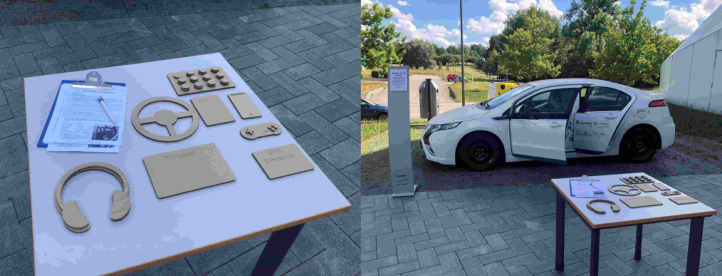
Pre-Testings To be able to identify needs and requirements in a direct exchange with children, a two-step approach was adopted. In the first step, a lean testing (Figure 1) was conducted in which children of different genders and ages were seated in a car and, supported by paper prototypes, were asked to tell what they like or dislike about car journeys The individual paper prototypes are replicas of existing toys with different stimulation focuses. For example, headphones for an auditory experience, figures for a haptic experience or a tablet for digital input. The simulated driving situation and the haptic elements without functionalities were intended to stimulate storytelling in a natural way without distracting the children too fall into playflow.
Figure 1: Set up of the Guerrilla testing with paper prototypes and test vehicle.
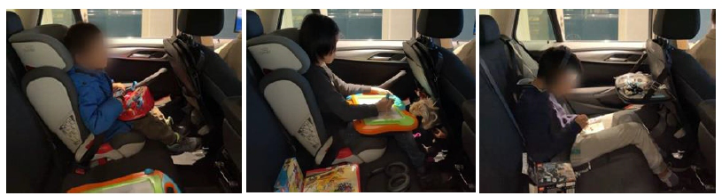
In the next step, the potential of getting into a play flow during a ride were analyzed. Therefore, three children of different age were placed into a car in different scenarios (Figure 2). Screens with driving scenes were placed around the vehicle to simulate driving on the highway and through a city, considering day and night times as well as short and long distances. The children get different conventional and non-automotive-related toys to play with during the rides and should gave feedback afterwards regarding their play-experience. At the same time, the areas in the vehicle that children of different ages can reach were monitored, to understand how the play radius can be defined according to the growth size of the children.
Figure 2: Impressions from the user testing with existing toys.
In the following, the primary findings are synthesized:
The integration of the driving environment into the game makes it easier to achieve a seamless gaming experience.
The presence of a storage surface, especially for small parts, roves effective in preventing toys from falling.
When driving at night, traffic lights and lights on the dashboard are perceived as annoying.
Nighttime journeys are often perceived as monotonous due to limited play options in the dark.
There is a lack of analogue games and entertainment options that can be used by a couple or group of children, when they are together in the car.
Enhancing the User Experience of Children in Family Vehicles 139
Younger children exhibit a preference for interaction with their parents during journeys, highlighting a need for non-distracting parent-child engagement opportunities.
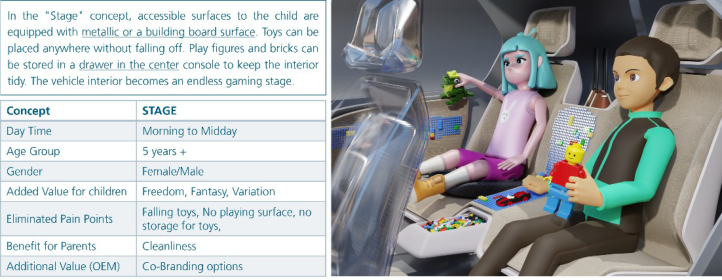
Prototyping Based on the findings of the interviews and the first test phase, four scalable concepts for different target group clusters and use cases were developed. The clusters are divided into different cognitive motorical development stages of the children and their gender. Both day and night scenarios as well as short and long-distance journeys were considered for the use cases. Each concept assumes the value for the child or children, the pain points that are eliminated, the benefits for the parents and the additional opportunities for the brand (Figure 3).
Figure 3: Example for the design concept description.
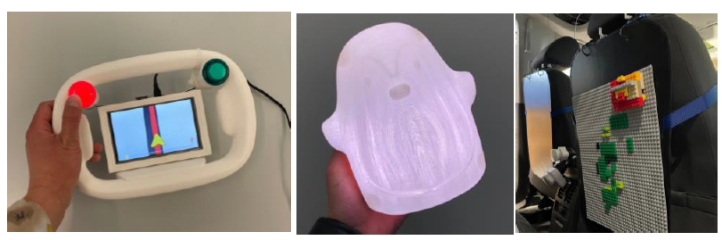
Functional prototypes were built, to test the attractiveness and acceptance of the concepts in a final user study. FDM printing, maker tools such as Arduinos as well as existing toys such as plates for building blocks were used for the development of the prototypes that were integrated into the vehicle interior.
Figure 4: Examples of the prototypes (from left to right): steering wheel connected to the navigation system; glowing night light penguin; playable surface on the back of the seats.
USER TESTING AND EVALUATION To make the testing as realistic as possible, a VW Caddy was prepared for the user study. Screens with various driving scenarios were set up in front of the car and on the sides to simulate a car ride. For the final testing, 10 children between the ages of 6 and 10, were invited to experience the prototypes within a user experiment. The concepts were tested both during daylight and in simulated night-time driving. Furthermore, the test runs were carried out with single children as well as with children in pairs. Attention has also been given to combine different genders and ages. The test rides took between 5 and 15 minutes. Before and after the ride, the children were interviewed and asked about the perceived quality of the play. In addition, the camera recordings were analysed for an objective evaluation.
Finally, the findings were reflected and optimised in a joint workshop with innovation experts of the automotive partners who had been able to observe the user testing through a camera based live stream during the experiment. The concepts were rated according to the level of satisfaction, time length of entertainment, functions, price performance and feasibility. Furthermore, strengths and weaknesses of the ideas were evaluated, complementary ideas were added, and pain points eliminated. The final concepts were summarized in the form of images with explanatory texts and the abstract principle behind them was determined and formulated as a design recommendation.
RESULTS
All in all, 6 design principles were derived that can be used as recommendations for the child-friendly interior design of family cars. The design principles and the derivation process are explained as follows.
Design for Individualization and Personalization “Offer the opportunity for children to creatively individualize and personalize their surrounding and its setting.”
During the user study, it became clear that children feel more comfortable when they can design their environment according to their wishes and needs. This leads to the recommendation to offer creative ways to customize the surfaces around the child seat.
Integrate Positive Impacts of Familiar Things “Benefit from the positive experiences that are already associated with a toy or game and integrate them in the in-car experience.”
In discussions with toy manufacturers and pedagogues, it has become apparent that today’s children like to use certain toys intensively. This may be due to trends or simply personal interest. By being able to integrate these toys into the vehicle environment in a meaningful way, the vehicle interior design benefit from the positive connotation of the child’s favourite toy.
Enhancing the User Experience of Children in Family Vehicles 141
Provide the Opportunity to Imitate the Activities of the Parents “Simplify driving activities of the parents and create interfaces between parents and children that invite them to communicate.”
Children under the age of 7 like to imitate the behaviour of adults and seek interaction with their parents. In the literature, but also in discussions with toy manufacturers, positive effects could be recognized when toys encourage communication options with the parents.
Eliminate Distractions “Keep the child in the play flow by creating a setting that helps to relax, focus and calm down.”
In the user study, it could be observed that during the night rides the children were distracted by the lights of the traffic and the dashboard. This interrupts the flow of the play and makes the child restless. It is therefore advisable to design the surroundings in such a way that the view outside and towards the dashboard is obscured, especially when driving at night.
Create a Cozy and Safe Place “Make the interior cosy and provide a feeling of security.”
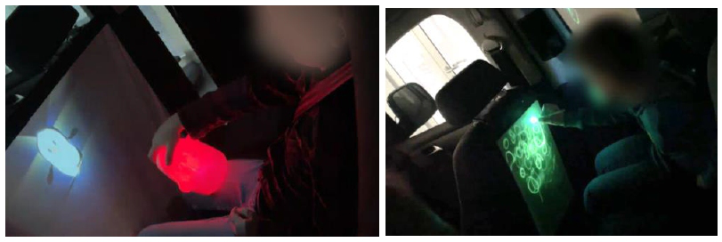
In the interviews with the children, it became clear that many of them are bored on night rides because they cannot play with their conventional toys. It also became apparent that it is difficult for children to calm down when they have nothing to do. Many children use smartphones or tablets at such times, but studies have shown that the bright blue light of the devices is counterproductive. Analog toys with a calming effect are therefore recommended. In the user study, two product concepts were tested which were very positively received by children. One is a luminous mascot in the shape of a penguin which acts as a kind of night light. The children became calmer and more relaxed. The other concept was a fluorescent surface that could be painted with the help of a glow pen. The children played creatively and calm (Figure 5).
Figure 5: (From left to right) child plays with luminous penguin during a night right scenario of the user study; child draws with glowing pencils during a night right scenario.
Define Solutions That Are Capable of Evolution “Offer adaptable solutions according to the child’s cognitive-motor developmental stages to keep ambition and curiosity high.”
The interviews and the user study have shown that children of the same age have different levels of motor and cognitive development. They also develop very quickly, which means that toys quickly become boring. It is therefore recommended to design the toys or play surfaces in such a way that they are scalable in order to constantly create new and challenging stimuli.
DISCUSSION
As the group of participants was quite small, no general validity of the results can be ensured. It has to be understood how similar or individual children in different age groups are, regarding to their playing behaviour, toy preferences and states of play flow. Thus, further research is needed on broader scale to allow the derivation and validation of generic design principles. Nevertheless, the used approach shows a way how children-oriented products can be developed in an experimental way. Regarding to this, the question occurs and have to be discussed how children can be integrated into the development processes of companies. While grown up participants are often used for user tests, particular care must be taken when handling children within an experiment. This shows the need and potential of generic design principles to allow an efficient and effective development of children-oriented products.
CONCLUSION
When it comes to human factors engineering and design principles, the study shows that children must be seen different than just as little adults. Not only physical questions related to ergonomics must be taken into account while designing innovations for children, but also their individual development stage as well as the special and powerful meaning of “playing”. Rational developers tend to overlook this factor when designing child- oriented products. Furthermore, not only a play-friendly design should be in the focus of the development process, but also the context of usage must be considered. The kind of playing that it supports must be understood and selected under consideration of the use case and hoped-for effect. Should a toy or playing environment support the creativity of a child? Or should it bring the child into a concentrated or calm mood? And how will children react when they have to end their playtime, e.g. because the trip with the family is finished and the destination reached? Is it desirable and expedient to bring children in the play flow within a certain use case and how to achieve and support this by the product design? Those questions show that a specified and holistic design approach is needed when children but not only their parents are seen within the user focus of a development project. The described approach, that is based on a combination of expert knowledge and experimental user testings, shows a general and easy to follow methodology for handling a children-oriented design project. Nevertheless, the authors
Enhancing the User Experience of Children in Family Vehicles 143
see a white spot for theoretical and generic design principles for children- oriented products, that serves as a guideline within development projects, and can be taught at universities to designers and engineers of and for the next generations.
ACKNOWLEDGMENT
The authors would like to acknowledge to Hyundai Motor Group as well as the participating experts and especially the children that participated at the user testing’s and shared their ideas and reflections with us.
REFERENCES
Birks, K. (2018) Design for children: Play, ride, learn, eat, create, sit, sleep, London, Phaidon Press. Eva M Bitzer, Paula Bleckmann, Thomas Mößle (2014) Prävention problematischer
und suchtartiger Bildschirmmediennutzung: Eine deutschlandweite Befragung von Praxiseinrichtungen und Experten (Forschungsbericht Nr. 125), Hannover, Kriminologisches Forschungsinstitut Niedersachsen e. V. Gelman, D. L. (2014) Design For Kids: Digital Products for Playing and Learning [Online], La Vergne, Rosenfeld Media. Available at https://ebookcentral.proquest.com/lib/kxp/detail.action?docID=5198109. Goodwin, K. (2011) Designing for the Digital Age: How to Create Human-Centered Products and Services [Online], Chichester, John Wiley & Sons. Available at http://gbv.eblib.com/patron/FullRecord.aspx?p=706506. Krehl, S. (2019) Die Theorie der kognitiven Entwicklung nach Jean Piaget. Grundlagen und Anwendungsmöglichkeiten in der Bildungsarbeit, München, GRIN Verlag. Lange, W. and Windel, A. (2006) Kleine ergonomische Datensammlung, 11th edn.,
Köln, TÜV-Media. Smith, J., & Jones, A. (2017). Behavioural and Autonomic Regulation of Response to Sensory Stimuli among Children: A Systematic Review of Relationship and Methodology. Journal of Pediatric Psychology, 42(3), 456–473. Statistisches Bundesamt (ed) (2022) Für 69 % der Reisen wurde 2021 das Auto als
Verkehrsmittel genutzt [Online], Destatis Statistisches Bundesamt, Statistisches Bundesamt. Available at https://www.destatis.de/DE/Presse/Pressemitteilungen/Z ahl-der-Woche/2022/PD22_42_p002.html.
LISTED IN THE AHFE DIGITAL BOOKSTORE CATALOGUE
Explore the complete digital volume
Human Systems Engineering and Design (IHSED2024): Future Trends and Applications
Read this individual research paper free through the original publisher, or explore the full digital proceedings book.
ISBN 978-1-964867-34-2
Explore this ISBN in the AHFE Bookstore ↗Listed in the July 2026 bookstore catalogue; search by ISBN to confirm current availability · Digital book purchase optional