Sebastian Stegmüller, Franziska Braun (2023). The Tetrahedron of Sustainability Design: A Three-Dimensional Framework for the Integral Discussion and Development of Circular Economy-Oriented Products. In: Human Systems Engineering and Design (IHSED 2023): Future Trends and Applications. AHFE Open Access, vol. 112, pp. 272–280. https://doi.org/10.54941/ahfe1004138
Publisher statistics will load when you open Metrics.
AHFE OPEN ACCESS OPEN ACCESS CONFERENCE PROCEEDINGS PAPER
The Tetrahedron of Sustainability Design: A Three-Dimensional Framework for the Integral Discussion and Development of Circular Economy-Oriented Products
Traditional product design follows three main directions that had to be thought and planned in an integrated way: Desirability, feasibility, and viability. Aspects from user research, technology development and business models must be weighed against each other and to be optimized as holistic concept. For future product design those three dimensions seems to be not sufficient any more as the sustainable impact from products regarding their production, usage and end of life, becomes an important factor in development processes. The so-called circular economy, that describes the goal of a most efficient use of resources and products in closed loops, brings with it totally new requirements for products and their development. Already the traditional innovation design should have been understood as a joint task of market researchers, engineers, business planers and designers, but the arising challenge of the development objectively sustainable products needs that interdisciplinary thinking even more. New frameworks, tools and method that allow the interdisciplinary exchange in an effective way to enable the creation of joint visions and concepts are needed. While the traditional three fields of product design as described by Tim Brown can be showed in two-dimensional frameworks as three overlapping circles, the addition of sustainability as fourth design field needs more complex visualization that brings the different aspects in relation to each other. For solving that task and for creating a new tool as core for interdisciplinary, circular economy oriented design projects, we developed and evaluated a three-dimensional framework – the tetrahedron of sustainability design. The critical aspect of integrating the circular economy as a decision parameter into innovation processes arises through the facts that target conflicts will come up that can not be solved in an easy way as product individual lifetimes must be taken into consideration. Therefore, the main goal of the framework is to motivate discussions of different disciplines and their decisions regarding to the effecting influence on other design fields. It is created as tangible three-dimensional object as anchor point for workshops and individual considerations. The tetrahedron of sustainability designs shows the four fields of future product design as equilateral pyramid with triangular bases, with each design field representing one of the bases. The corners of the pyramid, each closed by three of the design fields, are defined as four main levers of sustainable product concepts. At the top of the pyramid, the central value proposition that can be described as a set of abstract value elements that should be fulfilled by the product, must be thought by reflecting the customers (desirability), the business model (viability) as well as the sustainability effects (integrity). While those first three design fields open up the space of conceptualization, the field at the basement of the pyramid represents the technological realization (feasibility) of the products. It is enclosed by the following corners: The R-Strategies define how circular economy effect should be created, e.g. by recycling, reusing of parts or rethinking of the product functions. Beneath the technical realization. This corner is additionally affected by the understanding of the customer and the sustainability effects. The next corner, the life cycle consideration, describes how a product is produced, used, maintained and how its end of life can be shaped. As well as the technical realization, the design fields of the business model and the sustainability effects are relevant to that corner. The last corner is defined as the degree of servitization what is based on the understanding of innovations as solution-oriented product-service-systems. While the physical parts are described by the technical realization, the business model and the customer wishes affect what product aspects can be realized as additional value-added service or by innovative ownership-models. As last part of the framework six edges have been defined, each located between two design fields and two corners. Those six edges are formulated as concrete decision points and hints for the design process. Starting from the value proposition corner, every three edges of the space of conceptualization lead to one of the tree corners that surround the basement of realization and are influencing the determination of the abstract product concept. Against that, the three edges of the base of realization are formulated as guiding principles for the physical product design. The whole framework, its elements and the way of usage will be explained an defined more in detail in the paper. Furthermore, the framework will be shown and evaluated on an exemplary design project. As example the concrete design project of an electric scooter for young urban generations will be introduced and reflected regarding of the aspects of the framework.
The Tetrahedron of Sustainability Design: A Three-Dimensional Framework 273
INTRODUCTION
Traditional product design follows three main directions that had to be thought and planned in an integrated way: Desirability, feasibility, and viabil- ity (Brown, 2009). Aspects from user research, technology development and business model creation must be weighed against each other and to be opti- mized as a holistic concept. For future product design, those three dimensions seem to be not sufficient any more as the sustainable impact from products regarding their production, usage, and end of life, becomes an important factor in development processes. The so-called circular economy, with the goal of the most efficient use of resources and products in closed loops, demands new requirements for products and their development. Already the traditional innovation design should have been understood as a joint task of market researchers, engineers, business planers and designers, but the arising challenge of the development of objectively sustainable products needs that interdisciplinary thinking even more. New frameworks, tools and methods are needed that allow the interdisciplinary exchange in an effective way to enable the creation of joint visions and concepts. While the traditional three fields of product design as described by Tim Brown (2009) can be shown in two-dimensional frameworks as three overlapping circles, the addition of sustainability as the fourth design field needs different visualizations that brings the four areas in relation to each other. For solving this and for creat- ing a new tool as core for interdisciplinary, circular economy-oriented design projects, we developed and evaluated a three-dimensional framework – the tetrahedron of sustainability design.
THE TETRAHEDRON OF SUSTAINABILITY DESIGN AS THREE-DIMENSIONAL FRAMEWORK FOR DESIGN THINKING PROJECTS The tetrahedron of sustainability is inspired by the well-known double dia- mond process of design thinking. On the one hand side, design thinking is thought as a method that supports interdisciplinary work, as it is based on reflecting different aspects and points of view of the definition of suitable products. Beneath the production technologies, customer wishes, and busi- ness plans also sustainability must be considered to ensure a later successful product in the context of a circular economy. The exchange of different disci- plines like designers, engineers, market researchers and life cycle assessment experts already at early stages of the design and development process becomes a success factor for that. Secondly, for reducing the ecological impact of the product in a most objective way, the goal must be not only to produce in a sustainable way but also to foresee the p usage phase and the sustainability impacts that arise out of it. Thus, the design challenge becomes a complex problem that must be based on the empathizing of the later lifetime of the products. The suitability of design thinking becomes obvious, as it is orig- inally created as a method for solving complex, wicked problems in a user centred and stepwise way. Nevertheless, adding sustainability as a further, leading point of view in design thinking processes, needs additional support and tools for design thinking teams that can be used as orientation within
274 Stegmüller and Braun
the process. The tetrahedron of sustainability design is defined as a tool that shows complexity and relations in a structured but also playful way that is easy to understand and use.
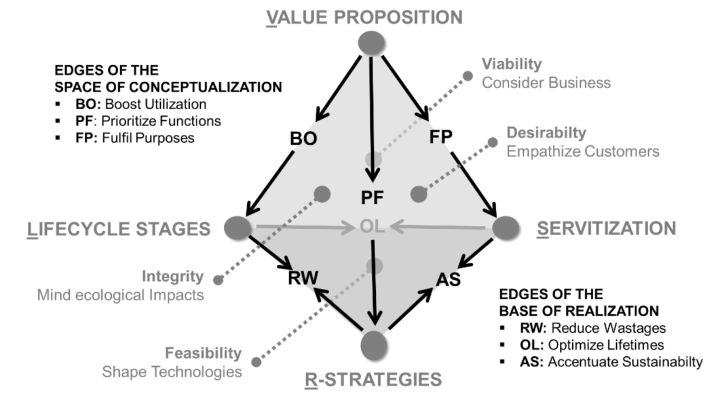
The original double diamond divides a design process in two main stages: the problem zone and the solution zone. Thus, also the tetrahedron of sus- tainability is divided into two zones that can help to accompany and support design thinking processes. The “Space of Conceptualization”, the “roof” of the tetrahedron, reflects the problem zone and proverbial the broad space of opportunities to define the concept. In addition, the solution zone is reflected by the “Base of Realisation”, the ground of the tetrahedron that proverbial underlines the need of bringing a product concept to a technological foun- dation. It also represents the traditional design field of “feasibility” of Tim Browns (2009) model. The other two, “viability” and “desirability” together with the new, forth field “integrity” (sustainable impact) build the sides of the space of conceptualization.
Figure 1: The tetrahedron of sustainability design (Fraunhofer IAO, 2023).
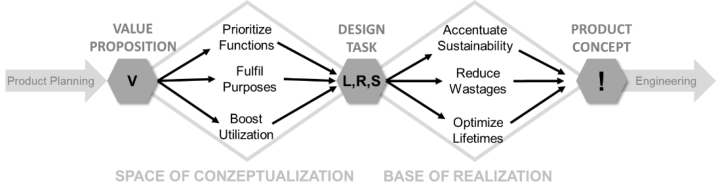
The four design fields are enclosed by four corners, the levers of sus- tainability (further also named LVRS), and six edges between those that are formulated as concrete decision points and design principles to provide guid- ance within the design process. Starting from the value proposition corner as the first of the four levers, every three edges of the space of conceptu- alization lead to one of the other three corners that surround the base of realization and are influencing the determination of the abstract product con- cept. Against that, the three edges of the base of realization are formulated as guiding principles for the physical product design. Reflecting the edges towards the generic design thinking process, it should be mentioned that three edges are located as design principles within the problem zone and three edges within the solution zone. Located at the tipping point of the diamonds, the edges will help to broaden up the perspectives in the divergent steps but also
The Tetrahedron of Sustainability Design: A Three-Dimensional Framework 275
serve as evaluation criteria within the convergent steps. Lewrick et al., (2017) point up the importance of those so-called groan zones for a successful design thinking process, those phases of the process as people often fail in changing the way of thinking from divergent to convergent thinking. Supporting this step by giving guidance through the design principles of the edges becomes a success factor for the execution of the design thinking process. Furthermore, the LVRS serve as anchor points at the beginning of the diamonds. While the value proposition (V) serves a central starting point and problem descrip- tion, the other three LVRS (Lifecycle Stages, R-Strategies, Servitization) give guidance at the critical and central process-step between the problem zone (space of conceptualization) and solution zone (base of realization) as they help to define the concrete problem and design task, that has to be solved in the solution zone.
Figure 2: The sustainability edges within the double diamond (Fraunhofer IAO, 2023).
Beneath the traditional design fields, “desirability”, “viability”, “feasibil- ity” plus “integrity” for sustainability impacts, the LVRS are four further main areas of consideration that have to be reflected in the design process of circular economy-oriented products. As the circular economy tries to opti- mize the use of materials and resources, products have to be tailored for certain use cases and market fields to impede non-value creating product features. For that, a clear understanding of an abstract value proposition (lever V) that should be fulfilled by the product, must be the starting point of the design thinking process. A “value proposition describes benefits a cus- tomer can expect from (..) products and services” (Osterwalder et al., 2014). A design briefing around a well-defined value proposition and the interdisci- plinary reflection of it can already be a first step of merging perspectives as market researchers and product planers have to explain their desired value proposition to the designers and engineers who have to realize it through the product design. While Osterwalder et al., (2014) structure their Value Proposition Canvas around customer jobs, and the customers’ pains and gains, a more detailed and analytical framework tool for supporting the def- inition of a value propositions was published by Almquist et al., (2016) with the Pyramid of Value Elements, that exists of 30 different and abstract ele- ments of value that reflect Maslow’s hierarchy of needs. Those elements can be understood as value criteria that is requested by the customers or as value that will be provided by the later product, which qualifies the framework as a tool for interdisciplinary discussions within the design briefing.
276 Stegmüller and Braun
While the value proposition is known as general criteria for product design, the other three LVRS are directly linked to the aspects of a circular economy. They become relevant within the decision point between the two diamonds and span up the base of realization. First, the so-called R-Strategies (lever R) are generic principles that give guidance to force the increasing resource effi- ciency and decreasing environmental impacts throughout value chains (EU 2020/1). The EU names nine different R-strategies: R1 Refuse, R2 Rethink, R3 Reduce, R4 Re-use, R5 Repair, R6 Refurbish, R7 Remanufacturing, R8 Repurpose, R9 Recycle. As the effectiveness of R-strategies is depending on the later use of the product (e.g. regarding to intensity of usage and life- time), the reflection of lifecycle stages becomes another lever (L). Gillai et al., (2022) gives an overview of how the R-strategies are linked to the differ- ent lifecycle stages along the whole value chain from sourcing to end-of-life. “Circular economy principles can be applied across the entire value chain and all stages of the product lifecycle. This section offers a wide variety of strategies that companies can adopt in an effort to reduce waste and pollution and keep products and materials in circulation.” (Gillai et al., 2022). By reflecting the value chain, the importance of the fourth lever, the servitization (S) of products, becomes obvious, what can be seen as the fulfilling of dedicated product features through service-components. Product- service-systems as combination of physical and service-oriented product features, are named as an important element for establishing a circular economy within the German “standardization roadmap circular economy” (DIN 2022). Also, the EU (2020/2) announced that within their legisla- tive initiative, beneath the establishment of the sustainability principles, service-oriented approaches will be seen as appropriate ways to reach a cir- cular economy. “Incentivizing product-as-a-service or other models where producers keep the ownership of the product or the responsibility for its performance throughout its lifecycle” is named as well as “mobilizing the potential of digitalization of product information, including solutions such as digital passports” or the “rewarding products based on their different sustainability performance, including by linking high performance levels to incentives.”
Located between the LVRS and on the border of the four main design fields, the edges of the tetrahedron are formulated as design principles, derived from the surrounding elements. With the function of spanning up the two dia- monds, the three edges of the space of conceptualization are formulated as conceptual guidelines while the three edges of the base of realization give already directions for the shaping of the product. Starting from the value proposition and leading to the R-strategies, the edge “prioritize functions” shall motivate to rethink the product concepts regarding customers’ wishes as well as to sustainability impacts to realize the most effective product. The weighing of those poles can help to prioritize and delete functions and fea- tures for focusing on the really needed aspects, which gives an important orientation to select the right R-strategies. E.g. the usage and showing of recycled materials or of reduced, lightweight components, or the decision between long lasting materials or refurbishing options, can lead to conflicting goals that can be solved by empathizing with the customer group. Located
The Tetrahedron of Sustainability Design: A Three-Dimensional Framework 277
between the design fields “integrity” and “viability”, the edge “boost uti- lization” along the value chain is leading from the value proposition to the L-lever lifecycle stages. It is formulated to ensure the reflection where and when resources can be used in a most efficient way, e.g. during the usage phase (e.g. attracting the product use through alternative use cases) but also during production (e.g. efficient use of production machines and waste heat) and end-of-life-recycling (e.g. utilizing of recycling processes through mono- materials). As orientation between effectiveness and efficiency the last edge of the space of conceptualization is formulated to ensure to “fulfill purpose”. Located between “desirability” and “viability” the purpose reflects as well the jobs that a customer wants to solve with the use of a product, as also the formulated purpose and core strategy of a company. Founded on a solution- oriented understanding of products, “fulfilling purpose” is an important point of view, helping to select the right degree and modes of ferritization concepts, e.g., through sharing or maintenance models.
While the three edges of the space of conceptualization are leading from the value proposition to the other three LVRS, the edges of the base of real- ization enclose the design field “feasibility” and define the shaping of the technology, based on the former definition of the levers LRS during the prob- lem zone. Inspired by the design field “integrity” and located between the selected R-strategies and the understanding of the lifecycle stages (lever L) the edge “reduce wastages” forces the designers and engineers to shape the product in a most material-efficient way. The edge “optimize lifetimes” aims at reflecting the lifecycle stages (lever L) under consideration of the servi- tization concept (lever S) and is depending on the understanding of the design field “viability” and the company’s business model. Especially the definition of maintenance or refurbishing opportunities as well as material requirements and modularization aspects of the product design, have to be defined under the consideration of optimized components and product life- times. As final edge and influenced by the empathizing of the later customer groups and located between the R-strategies and the servitization concept, the edge “accentuate sustainability” demands to generate an aesthetical product design that communicates the value of sustainability in a customer group oriented way. As example can be named the use of recycled materials within premium cars or car sharing vehicles which might be assessed in a different way by the relevant customer groups.
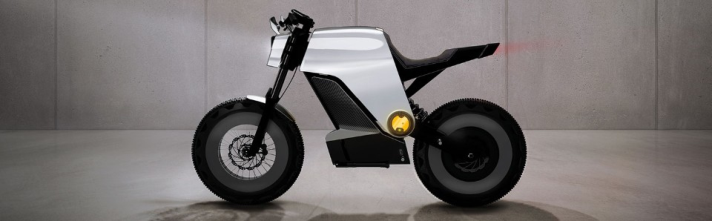
THE URBAN E-SCOOTER “CORE” AS AN EXAMPLE FOR HOLISTIC SUSTAINABLE PRODUCT DESIGN The applied use of the introduced framework will be shown within the fol- lowing chapter on the example of a catchy use case: the design of an e-scooter for young, urban people. Due to the limited space within that paper, the whole process cannot be explained in detail, but the concept will be char- acterized by a short description of the LVRS and the six edges that serve as main principles for sustainability design. As starting point, the value propo- sition of the product was defined as an urban and sustainable but individual mode of transport for young people (16-25 years old). Value elements such as
278 Stegmüller and Braun
“saves time”, “provides access” but also “fun and entertainment,”, “design” and “motivation” were worked out as important aspects. Based on the value proposition, the edge “fulfil purpose”was understood to create a vehicle con- cept that guarantees fast and unlimited urban mobility and the spontaneous reachability of multiple possible destinations, but has an attractive and con- spicuous visibility, as young people would like to show their use of sustainable e-mobility as a statement. The related ownership concept was defined as pri- vately owned or shared mobility option with easy and cheap maintenance options. On the one hand side such young people who are proud of own- ing an own e-scooter but who wanted to limit the maintenance costs should as well be a consumer group as those who are looking for a cheap sharing option with a huge urban availability, which also can be supported by an easy and fast maintenance model. The buyers of the scooter typically would not be young people, but parents or service providers who would be interested in a vehicle that attracts young people but can be used with low following own- ership costs. Thus, the prioritization of functions was focused on motorized, individual mobility in its mostly reduced core – the reduction of comfort func- tions (e.g., trunk for helmet, wind deflector, navigation and entertainment system) and irrelevant design-features (huge integrated lights, rocker panels) allowed the minimization of components and weight, what leads to reduced maintenance and energy costs. Since lightweight and material reduction is already fulfilled by the reduced concept, R-strategies could be focused on modularization and maintenance issues, like easy-to-repair and remanufac- ture opportunities, that also facilitate the recycling of separated components. As last edge of the problem zone the request to “boost utilization” is fulfilled in the usage phase as well as in the aftersales business. While the slim and reduced body allows multiple use cases as the scooter can nearly as easily be parked as a bicycle, the options for a cheap maintenance and for refur- bishment of the body covering enable a higher attractiveness while selling the scooter on the second-hand market. An important aspect as the users might grow out of the target group (young urban citizens) within a couple of years, while the scooter still can be used by others. Based on those edges of the problem zone and the derivation of the LRS levers, the edges for the base of realization can be defined. “Reduce wastage” is realized by shaping the scooter as a reduced and modularized vehicle concept. Body coverings are attached to the frame in a lean way and are covering only the most important parts which underlines the material reduction as well as the easy to maintain abilities in an attractive, noticeable way. This also favours the edge “optimize lifetimes” as the different parts and components of the scooter can easily be dismantled and changed due to their individual end-of-life. While the frame can be used for a long time, technical parts such as the battery, the engine or the lights can be exchanged easily when they are broken. The switchable body panels can be produced out of materials with reduced lifetime requirements, which enables the use of regrowing or recycled materials. Finally, the edge “accentuate sustainability” is directly visible through the reduced but youth- ful and progressive design that is additionally underlined by the “Core”, an illuminated yellow circle in the centre of the scooter that visualizes the use of electricity.
The Tetrahedron of Sustainability Design: A Three-Dimensional Framework 279
The tetrahedron of sustainable design was introduced as a framework for supporting design thinking processes towards a circular economy-oriented outcome. It tries to visualize and structure the complex system of design fields and their interrelations to motivate an integral reflection of the design process during conceptualization and realization. As it is oriented on the traditional and well-established double diamond it can easily be adapted to existing methods and tried out in well known processes. realized as a three- dimensional object, e.g., through 3d-printing or based on a paper model, the tetrahedron can be used as a haptic sculpture that helps to reflect the different aspects of an objective sustainable design concept in a playful way. Further research should be done on the question of abstraction of the defined design principles. They are formulated in a way that still leaves a broad field of interpretation to inspire the creativity of designers without restricting it too much. Deeper reflections and explanations of the 14 elements of the tetrahe- dron can be used as supporting information but must be prepared in a manner that the framework is still easy to use in an interdisciplinary way. If and how the tetrahedron can support and motivate interdisciplinary discussions about sustainability is another interesting aspect that should be researched on in an applied way.
REFERENCES
Almquist, E. Senior, J. Bloch, N. (September 2016) The Elements of Value. On the Harvard Business Review website: https://hbr.org/2016/09/the-elements-of-value Brown, Tim (2009) Change by design: how design thinking transforms organisations
and inspires innovation. New York: HarperCollins Publishers. DIN e. V. (Januar 2023) Deutsche Normungsroadmap Circular Economy. On the DIN Deutsches Institut für Normung website: https://www.din.de/resource/blob /892606/06b0b608640aaddd63e5dae105ca77d8/normungsroadmap-circular-e conomy-data.pdf European Commission (March 2020/1) Categorisation System for the Circular
Economy. On the website of the European Circular Economy Stakeholder Plat- form: https://circulareconomy.europa.eu/platform/sites/default/files/categorisatio n_system_for_the_ce.pdf European Commission (May 3rd 2020/2) A new Circular Economy Action Plan. The EUR-LEX website: EUR-Lex - 52020DC0098 - N - EUR-Lex (europa.eu)
280 Stegmüller and Braun
Gillai, B. Yuandi Ling, C. Lee, H (July 2022) The road toward a cir- cuölar value chain. On the Stanford Graduate School of Business Web- site: https://www.gsb.stanford.edu/sites/default/files/publication/pdfs/whitepaper -2022-jul-road-toward-circular-value-chain.pdf Lewrick, M. Link, P. Leifer, L. (2017) Das Design Thinking Playbook. München, Verlag Franz Vahlen. Osterwalder, A. Pigneur, Y. Bernada, G. Smith A. (2014) Value proposition design:
how to create products and services customers want. New Yersey, Wiley & Sons.
LISTED IN THE AHFE DIGITAL BOOKSTORE CATALOGUE
Explore the complete digital volume
Human Systems Engineering and Design (IHSED 2023): Future Trends and Applications
Read this individual research paper free through the original publisher, or explore the full digital proceedings book.
ISBN 978-1-958651-88-9
Explore this ISBN in the AHFE Bookstore ↗Listed in the July 2026 bookstore catalogue; search by ISBN to confirm current availability · Digital book purchase optional