Takako Nonaka, Tatsuro Inage, Shuji Takano, Yoshimi Miyata (2023). Design and Development of an Electric Power-assisted Quadricycle for Female Day-trippers Visiting the Shonan Area. In: Human Systems Engineering and Design (IHSED 2023): Future Trends and Applications. AHFE Open Access, vol. 112, pp. 91–97. https://doi.org/10.54941/ahfe1004117
In recent years, rental services such as e-bikes and electric kickboards are becoming popular for short-distance local transportation for tourists. However, since fully electric mobility requires a driver's license in Japan, it is difficult to say that anyone can easily ride such vehicles. Electric power-assisted bicycles, which can be driven without a driver's license, help people get around comfortably, but they are difficult to use in the rain. In addition, users are at risk of wobbling or falling when riding at low speeds or stopping because they are heavy.In this study, we designed and developed an electric power-assisted quadricycle that does not require a driving license and has no risk of tipping over as a secondary means of transportation targeting female tourists visiting the Shonan area for a day trip.
The Shonan area, where the authors’ institution is located, refers to the coastal region of Sagami Bay in Kanagawa Prefecture, Japan. It is home to tourist attractions such as Kamakura and Enoshima Island. In 2021, the total number of tourists in the Shonan area was 29.48 million, despite canceling some events due to COVID-19 control measures. Every year, Kanagawa Pre- fecture conducts questionnaire surveys of tourists and overnight visitors who have visited various destinations in Kanagawa to investigate and analyze the ratio of tourists from within and outside the prefecture, the purpose of their visits, their intentions to return, and their average spending per unit.
Thus, we first compared the FY2012 and FY2021 reports to under- stand the trends of tourists visiting the Shonan area. Then, we summarized the characteristics of the tourists that we should focus on. Then, an elec- tric power-assisted quadricycle (four-wheeled bicycle) was proposed as a secondary means of transportation suitable for the target users. Finally, a pro- totype based on the proposal was designed and developed, and its essential performance was verified.
TREND ANALYSIS OF TOURISTS VISITING THE SHONAN AREA
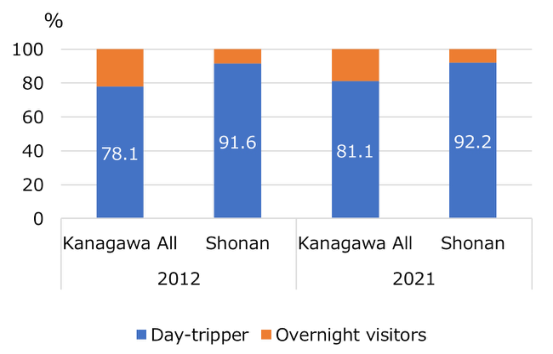
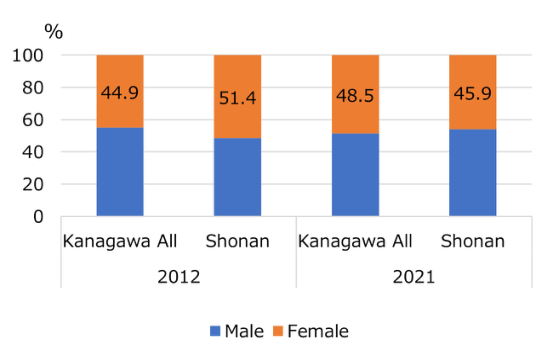
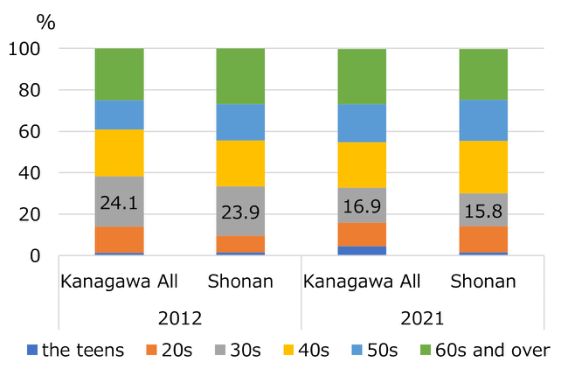
Figure 1 shows the day-trippers and overnight visitors ratio in FY2012 and FY2021, Figure 2 shows the male and female ratio in the day-trippers, and Figure 3 shows the breakdown of day-trippers by age group, respectively. In the figures, “Kanagawa All” means the total survey results for Kanagawa Prefecture, while “Shonan” means the results for the Shonan area.
Figure 1: Comparison of day-trippers and overnight visitors’ ratio in FY2012 and FY2021. (Adapted from Kanagawa Prefecture Survey Report of Tourist Spending Trends, etc., 2012, 2021.)Figure 2: Comparison of the ratio of males and females of day-trippers in FY2012 and FY2021. (Adapted from Kanagawa Prefecture Survey Report of Tourist Spending Trends, etc., 2012, 2021.)
Fig. 1 shows that the trend of more than 90% of Shonan visitors being day-trippers has not changed in both years.
Fig. 2 shows that the male/female ratio of day-trippers has reversed from FY2012 to FY2021, with the majority of male visitors in FY2021 compared to the majority of female visitors in FY2012.
Design and Development of an Electric Power-Assisted Quadricycle 93
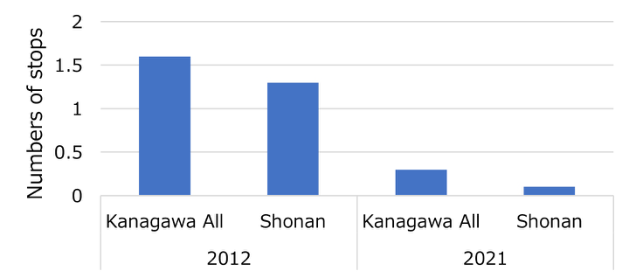
Figure 3: Breakdown of day-trippers by age group in FY2012 and FY2021. (Adapted from Kanagawa Prefecture Survey Report of Tourist Spending Trends, etc., 2012, 2021.)Figure 4: Numbers of stops of day-trippers in FY2012 and FY2021. (Adapted from Kanagawa Prefecture Survey Report of Tourist Spending Trends, etc., 2012, 2021.)
Fig. 3 shows that the number of tourists, especially those in their 30s, is decreasing from FY2012 to FY2021.
In Fig. 4, the number of stopping points for day-trippers has decreased throughout the prefecture, indicating that many visitors in the Shonan area “do not stop at destinations other than their destination. The reason for the Kanagawa prefecture-wide decline is thought to be self-control due to COVID-19, but the number of stopovers in the Shonan area was lower than in other areas in both years. This may be because the main roads in the Shonan area are congested during the holidays. In addition, the surveyed sites, such as the Enoshima Aquarium, the Daisen Cable Car, and the Oiso Shiroyama Park, are located quite far from each other, making it difficult to visit some of them on a one-day trip.
On the other side, the area around the Enoshima Aquarium is full of cafes and shops that are talked about on SNSs, so there is no shortage of places to visit. The low number of transit stops shows poor accessibility to these
points scattered throughout the city, narrow and complicated roads other than the main roads, and lack of parking. It is expected that there is a need for secondary transportation to make occasional stops at these points scattered throughout the city.
Shared bicycles are becoming increasingly popular as secondary means of transportation in tourist areas and are also well established in the Shonan area. Bicycles are excellent because they are “easy to get around” and “an efficient way to get around while experiencing nature,” making them a care- free way to experience transportation in scenic tourist areas. On the other hand, some problems remain, such as the risk of falling if the rider is not accustomed to riding, women’s clothing choices, and the difficulty of riding comfortably on rainy or sunny days.
To solve these problems, this study designed and developed an electric power-assisted quadricycle, a four-wheeled bicycle, as urban transportation for the 20s and 30s female day-trippers who are few and declining in the Shonan area. It is believed that attracting this young female clientele will help to revitalize tourist attractions in the Shonan area further.
DEFINITION OF TARGET USERS AND REQUIREMENTS Based on the above survey, we assumed the target users of this development to be Japanese women in their 20s to 30s who rent the quadricycle by the hour during day-trip sightseeing. The user’s body size was taken (Openshaw et al., 2006) from the Japan National Health and Nutrition Survey 2016, with the minimum height of the target user being 154 cm at the 25th percentile value and the maximum height being 167 cm at the 95th percentile value (NHNS, 2016). The maximum weight was set at the 95th percentile value of 74 kg, so the maximum load capacity was decided as 100 kg, including clothing and baggage.
Since there is a wide range in the expected height of users, a mechanism was implemented to change the seat position so that the pedals can be pressed down firmly regardless of the user’s height. In addition, the hip point height was set at 630 mm so that both feet can touch the ground in an emergency, even if the user is of short stature. Furthermore, the minimum ground clear- ance of the frame was set at 120 mm to prevent the frame from rubbing against the ground even when the road surface is slightly uneven.
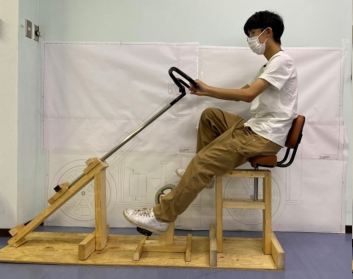
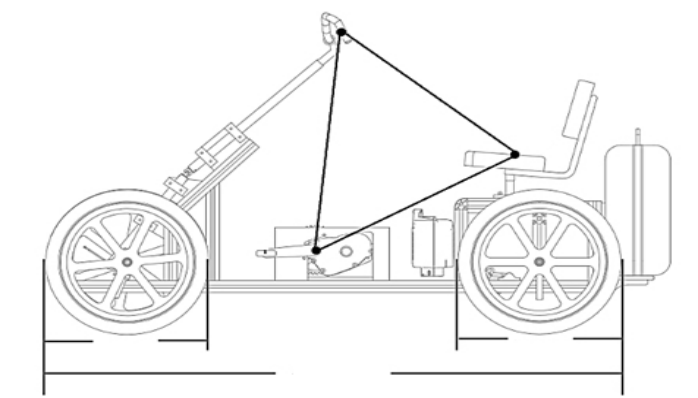
In addition, regarding motorcycle positioning (Cucinotta et al., 2019), the positioning relationship between the hip point (HP), handlebar center (HC), and pedal center (PC) was examined concerning ergonomics design to pre- vent knees from hitting the handlebar and toes from being caught in the front wheels. This study treated this as “the triangular zone for smooth pedaling” and experimentally verified the optimal positional relationship using a pos- ture validation model. Figure 5 shows examples of posture verifications, and Figure 6 shows the triangle zone for smooth pedaling.
Furthermore, to ensure safety on narrow streets, the quadricycle was designed to fit within the 1900 mm length and 600 mm width, which is allowed to ride on sidewalks, categorized as a “standard bicycle” in Japan.
Design and Development of an Electric Power-Assisted Quadricycle 95
Figure 5: Verification experiments of riding posture and triangle zone for pedaling.Figure 6: Triangle zone with HP – PC – HC for smooth pedaling.
DEVELOPMENT AND VERIFICATION
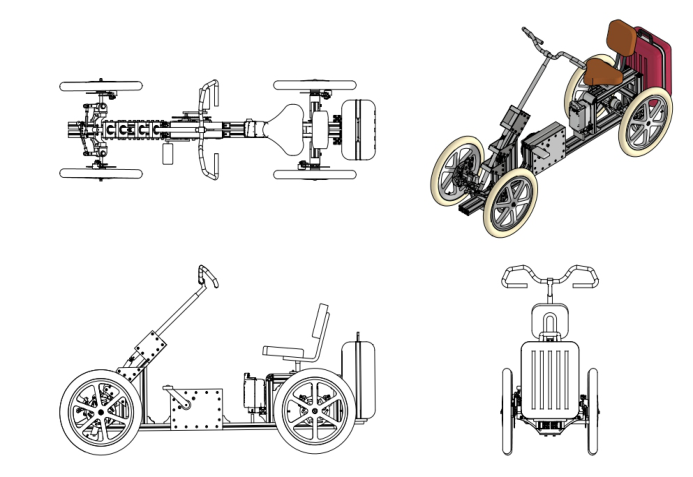
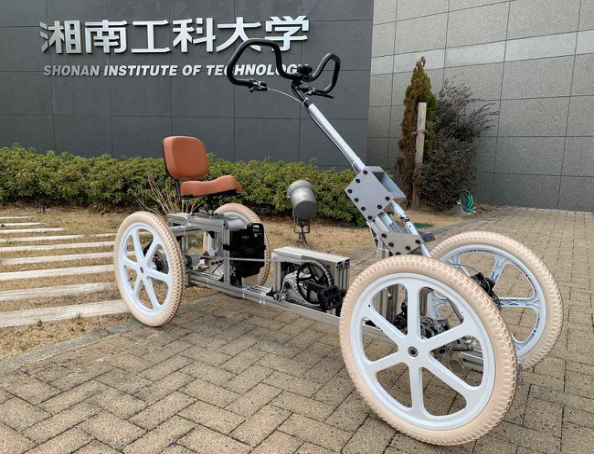
Figure 7 shows a three-sided drawing of a proposed quadricycle for women day-trippers in their 20s to 30s to the Shonan area (SQC-01), especially the underpart (mechanical part) only. Figure 8 shows the prototype appearance of the underpart. This quadricycle is rear-wheel drive with 20-inch wheels. At the rearmost position of the seat, the HC-PC distance is 731 mm, HC-HP is 777 mm, and PC-HP is 819 mm, respectively.
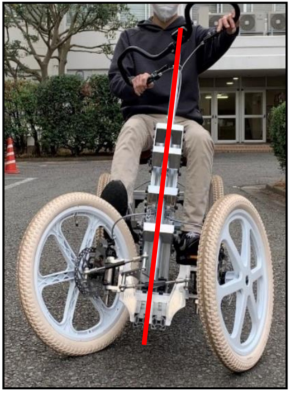
Using this prototype, essential performance, such as hill climbing per- formance and braking distance, was verified with a few users, and it was confirmed that any of the assumed target users could drive the vehicle. How- ever, as shown in Figure 9, the frame twists during steering wheel operation and this causes some issues with riding comfortability.
In the future, we aim to improve the design and functions by conduct- ing detailed experiments on usability and performance through test-riding by more users with the same profile as the target users and long-distance riding.
Figure 7: Proposed Quadricycle for their 20s to 30s women day-tripper to the Shonan area (SQC-01).Figure 8: Prototype of the underpart of Quadricycle for their 20s to 30s women day- tripper to the Shonan area (SQC-01).
Design and Development of an Electric Power-Assisted Quadricycle 97
Figure 9: Verification experiments using the prototype.
CONCLUSION
In this study, the tourist trends report in Kanagawa Prefecture in 2012 and 2021 were surveyed, and it was found that a license-free secondary trans- portation in the Shonan area that could be used to get around the city easily is needed. Therefore, we designed and developed the prototype of an elec- tric power-assisted quadricycle (four-wheel bicycle) for female day-trippers in their 20s and 30s who visit the Shonan area. The design requirements were set to cover the 95 percentiles of the target user’s body shape, and the dimensions were set to fit into the Japanese “standard bicycle” category. The results of a simple verification experiment using the prototype confirmed that the assumed target user could drive it, but it was found that riding comfort remained an issue. Detailed verification experiments will be conducted to modify the design and improve the functions.
REFERENCES
Kanagawa Prefecture Survey Report of Tourist Spending Trends, etc., (2012) and (2021), https://www.pref.kanagawa.jp/docs/b6m/cnt/f80022/p1185401.html (in Japanese). Cucinotta, Filippo. Guglielmino, Eugenio and Sfravara, Felice. (2019). “A CAE
Method for Ergonomic Assessment of Motorcycles’ Driver and Passenger,” International Journal on Interactive Design and Manufacturing (IJIDeM). 13. 10.1007/s12008-019-00555-w. Ministry of Health, Labour and Welfare (Japan), National Institute of Health and Nutrition (Japan). (2016). Japan National Health and Nutrition Survey 2016. Openshaw, Scott. Minder, Gailyn. Long, T. Ford, Marcus. Taylor, Erin. and
Witherow, Woody. (2006). Ergonomics and Design A Reference Guide. Allsteel Inc.
LISTED IN THE AHFE DIGITAL BOOKSTORE CATALOGUE
Explore the complete digital volume
Human Systems Engineering and Design (IHSED 2023): Future Trends and Applications
Read this individual research paper free through the original publisher, or explore the full digital proceedings book.
ISBN 978-1-958651-88-9
Explore this ISBN in the AHFE Bookstore ↗Listed in the July 2026 bookstore catalogue; search by ISBN to confirm current availability · Digital book purchase optional