Bingxin Sun, Danhua Zhao (2026). Task-Based AR-HUD in Autonomous Driving: Enhancing Driver Agency, Engagement, Attention, and Takeover Performance. In: Advances in Human Factors of Transportation. AHFE Open Access, vol. 224, pp. 367–377. https://doi.org/10.54941/ahfe1007865
In SAE Level 3 autonomous driving, prolonged passive monitoring presents the severe challenge of drivers falling 'out-of-the-loop'. To address this, we propose a 'task-based AR-HUD', an interface that transforms vehicle motion planning into actionable task opportunities requiring driver approval, thereby maintaining the driver's cognitive flow within the driving loop. This research investigates the psychological and cognitive impacts of such task-based interactions to enhance driver takeover performance. Utilising a high-fidelity driving simulator, we compared three progressive AR-HUD visual feedback modalities: linear, dynamic, and task-based. Subjective metrics concerning compliance, perceived control, comfort, and emotional experience were analysed. Results indicate that the task-based AR-HUD significantly enhances driver agency and engagement, effectively redirects attention to the road, and sustains the driver's 'in-the-loop' state. This study offers theoretical foundations and empirical evidence for future high-level autonomous driving human-machine collaborative designs that balance psychological needs with functional safety.
With the evolution of SAE Level 3 autonomous driving technology, motorways have emerged as its core application scenario (Tan & Zhang, 2022, n.d.). This is largely because drivers are more inclined to engage autonomous driving on roads with lower complexity; for instance, activating the system after navigating complex urban road networks to alleviate accumulated driving fatigue (Tomasevic et al., 2022; Vogelpohl et al., 2018). Due to this reduced road complexity, drivers often experience a ‘psychological release’ and subsequently exhibit pronounced compensatory behaviours, diverting their attention towards non-driving-related tasks (NDRTs) in pursuit of physical and mental relaxation (Cooper et al., 2023; Figalová et al., 2023). Within the human-machine co-driving paradigm, this engenders a core safety paradox: the driver transitions into a mere spectator of the driving task or detaches from it entirely. During prolonged periods of passive monitoring, a driver’s situational awareness deteriorates, manifesting in behaviours Received March 30, 2026; Revised April 29, 2026; Accepted May 17, 2026; Available online July 20, 2026
368 Sun and Zhao such as gaze deviation from the road and attentional shifts (Schnebelen et al., 2021). Consequently, upon the system’s transition to manual mode, the lack of updated real-time environmental information causes the driver to experience varying degrees of cognitive delay, thereby compromising takeover quality and driving safety (Melnicuk et al., 2021). Therefore, the design of autonomous driving systems must maintain the driver ‘in-the-loop’ whilst imposing a low cognitive load, ensuring safe takeovers in the event of sudden failures. Ultimately, identifying how to sustain the driver within the driving loop via low-load methods, without disrupting their relaxation experience, constitutes a critical challenge for current autonomous driving human-machine interaction (HMI) design.
To address this challenge, Augmented Reality Head-Up Display (AR-HUD) technology is regarded as a highly promising solution. By superimposing virtual guidance information onto the real-world road scene within the centre of the driver’s field of view via world-registered spatial alignment, it enhances drivers’ situational awareness (Gabbard et al., 2019). Furthermore, it optimises the allocation of attention by reducing off-road glance durations, thereby assisting drivers in demonstrating superior takeover performance when confronted with sudden takeover requests (Jing et al., 2022). During the autonomous driving takeover process, AR-HUDs can reduce takeover times whilst elevating driver trust and safety (Winkler & Soleimani, 2025). Risk visualisation based on AR-HUDs can significantly bolster a driver’s capacity to perceive potential hazards, particularly non-collision risks (Wei et al., 2025). Additionally, when coupled with an ‘interruption mechanism’, AR-HUDs can effectively prompt drivers to dynamically shift their attention between entertainment tasks and driving monitoring (A. et al., 2024).
Although the potential of AR-HUDs in providing functional assistance has been preliminarily validated, the majority of current research primarily focuses on the ‘takeover moment’, treating the AR-HUD merely as a supplementary information display tool during takeover requests (Feierle et al., 2021; Li et al., 2021; Wu et al., 2023). Consequently, scant attention is paid to the human driver’s inherent need for continuous feedback and participation (Hancock, 2018). A more profound issue is that modern autonomous driving systems often relegate the human to a redundant safety mechanism, completely neglecting the human brain’s requisite for a continuous ‘sense of purpose’ and ‘control feedback’ to remain active (Hancock, 2018). This severe lack of psychological participation results in drivers being unable to perceive the connection between their own decisions and the vehicle’s operational trajectory, thereby severely compromising their response efficacy during takeovers (Wen et al., 2017, 2019).
This study designs and validates an innovative task-based AR-HUD interaction modality: maintaining the driver’s system engagement via a low- load approach without disrupting their relaxation experience. By utilising effective world-registered visual elements, the vehicle’s planned trajectory is transformed into real-time tasks available for driver approval and active execution. Through empirical experimentation, this research explores the psychological and cognitive impacts of task-based interaction, verifying its efficacy in enabling drivers to regain a sense of engagement with vehicle
Task-Based AR-HUD in Autonomous Driving 369 behaviours. Concurrently, it systematically analyses the long-term quantitative outcomes of varying levels of driver engagement on attention maintenance. Ultimately, this study provides theoretical and empirical foundations for high-level autonomous driving human-machine collaborative designs that balance psychological needs with functional safety.
Interaction Strategies for Maintaining the Driver ‘In-the-Loop’ Currently, academia has conducted extensive exploration into interaction strategies for maintaining drivers ‘in-the-loop’. The most traditional and widely applied amongst these is the alert mechanism based on takeover requests. This mechanism primarily relies upon visual cues (e.g., dashboard flashing), auditory warnings, or multimodal fused interventions to forcibly recall the driver’s attention (Hong & Yang, 2022). However, this is fundamentally a delayed ‘passive awakening’ strategy. These warnings are triggered exclusively at the moment of takeover, providing no continuous input to maintain situational awareness during prolonged, stable autonomous driving phases. Such instantaneous passive intervention compels drivers to complete cognitive reconstruction under extreme time pressure, which is highly prone to inducing startle responses and deteriorating takeover efficacy (Pakdamanian et al., 2020).
In light of this, recent research directions have rapidly pivoted towards active intervention strategies of ‘continuous monitoring and attention guidance’. Such strategies predominantly rely on advanced driver monitoring systems (DMS), such as eye-tracking (Deniel & Navarro, 2022) and physiological feature recognition (Sikander & Anwar, 2018), to evaluate the driver’s visual focus and fatigue levels in real-time. Upon detecting prolonged gaze deviation, the system proactively issues targeted interventions. Nevertheless, frequent visual or auditory corrections possess strong ‘intrusiveness’ (Wintersberger & Riener, 2016), severely disrupting the driver’s original intention of seeking relaxation during the autonomous driving phase and leading to a remarkably poor user experience. ‘Passive monitoring’ at the system level is by no means equivalent to the ‘active participation’ required psychologically by the driver. While DMS can physically force the driver’s gaze back to the road ahead, it fails to assist the brain in reconstructing a sense of purpose and the crucial feedback of driver agency and participation regarding vehicle dynamics (Seppelt & Victor, 2016).
To overcome the limitations of ‘passive monitoring’, academia has proposed the construction of active interaction mechanisms that enable the driver to ‘participate in the system’. Against this backdrop, Augmented Reality Head-Up Displays (AR-HUDs) demonstrate formidable advantages.
As a highly promising low-load intervention method, Augmented Reality Head-Up Displays (AR-HUDs) demonstrate significant advantages in enhancing drivers’ situational awareness (Wu et al., 2023). The AR-HUD serves a critical role as a core visual augmentation tool. However, the current research paradigm regarding AR-HUDs excessively focuses on the ‘takeover moment’ during instantaneous system failures (Lindemann et al., 2018). Narrowly defining AR-HUDs as instantaneous alarm tools severely overlooks their potential to maintain the driver’s ‘continuous participation’ throughout the prolonged, stable phases of autonomous driving (Lee et
370 Sun and Zhao al., 2026). Existing AR-HUD designs fundamentally remain at the level of one-way ‘information display’, where the driver continues to be a passive information receiver. They fail to establish an ‘interaction mechanism’ that sustains human agency and resolve the core pain point of the driver’s ‘lack of participation’. Therefore, the key to breaking the dilemma of the driver falling out-of-the-loop in autonomous driving lies in driving a paradigm shift in AR-HUD interface design, evolving from one-way ‘prompt information’ to in-depth ‘task-based interaction’ (Carsten & Martens, 2018). This is precisely the theoretical and design gap that this study endeavours to fill.
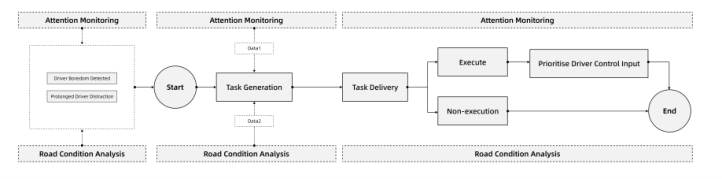
Task-Based Collaborative Interaction Design Classical information processing theory categorises interaction behaviour into four stages: information acquisition, information analysis, decision selection, and action implementation. Building upon this, the design of task-based interfaces frequently references the ‘analysis support’ and ‘decision support’ frameworks within human-machine collaboration, executing an interaction logic of ‘pre-judgement – task proposal – driver approval – feedback execution’. To balance driver agency, participation, and cognitive load, the HMI does not require the driver to intervene in every subsequent vehicle behavioural trajectory. Instead, it solely triggers the approval process for tasks involving control transfer or significant trajectory alterations (e.g., overtaking, exiting slip roads), thereby averting fatigue induced by excessive interaction. By enabling drivers to perform simple approval operations at critical nodes (such as lane changing or overtaking), the task-based interface distinguishes itself from traditional information interfaces by serving as a decision feedback medium. The established ‘prompt–selection–action’ causal chain assists the driver in remaining ‘in-the-loop’ during automation.
Concept of Task-Based AR-HUD Interaction This study proposes a ‘task-based AR-HUD’ applied to stable driving segments within autonomous driving scenarios. Distinct from traditional AR-HUDs that merely present visual road information, the task-based AR-HUD emphasises the system proposing ‘proactive opportunities’. The autonomous driving system continuously monitors the road environment and vehicle status; upon determining that the current segment is safe and conditions are met, it presents the driver with collaborative driving task opportunities (such as ‘acceleration’ or ‘lane changing’). Upon receiving the task opportunity proposed by the system, the driver is free to choose to ‘accept’ it—thereby actively driving to complete the task themselves—or to ‘decline’ it. Once the driver opts to accept, the system immediately coordinates to smoothly transfer the execution authority of the corresponding task to the driver, and subsequently calculates a return to a safe trajectory after the driver relinquishes control. By interacting with the driver through these tasks, the task-based AR-HUD aims to stimulate the driver’s willingness for active manipulation, thereby enhancing the driver’s agency and participation,
Task-Based AR-HUD in Autonomous Driving 371 effectively guiding their attention to remain on the road, and indirectly optimising their takeover readiness state.
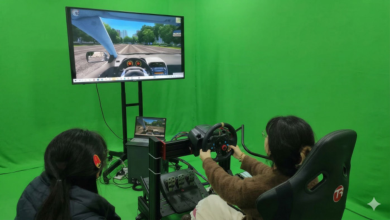
Experimental Design This study established a testing environment comprising a high-fidelity driving simulator (equipped with a steering wheel and pedals), a display terminal, and a control system. The experimental scenario was set within mixed road conditions, encompassing both urban roads and motorways, under cloudy weather. Serving as the core variable of the experiment, we designed three visual feedback modalities featuring a progressive task relationship: 1) linear feedback (baseline), providing merely simple line guidance; 2) dynamic feedback, incorporating dynamically changing elements to enhance visual salience; and 3) task-based feedback, which increases information complexity to stimulate the driver’s active interactive cognitive processing.
Figure 1: Layout of the experimental setup.
Adults aged between 18 and 45 were recruited for this experiment, which was conducted in Changsha, China. The inclusion criteria were defined as follows:
1. Absence of cognitive impairments, possessing basic social cognition and judgement capabilities; 2. Absence of auditory or tactile impairments; 3. A foundational understanding of autonomous driving, alongside an absence of poor driving habits.
From a substantial pool of applicants, 20 healthy adults with prior experience utilising autonomous driving assistance systems were selected to participate in the study.
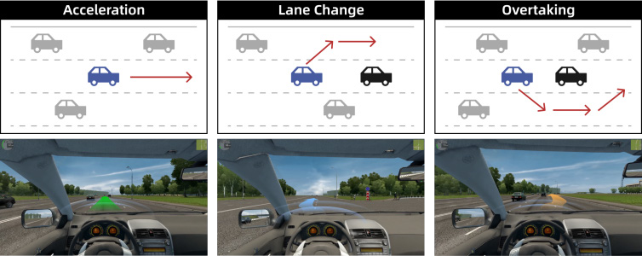
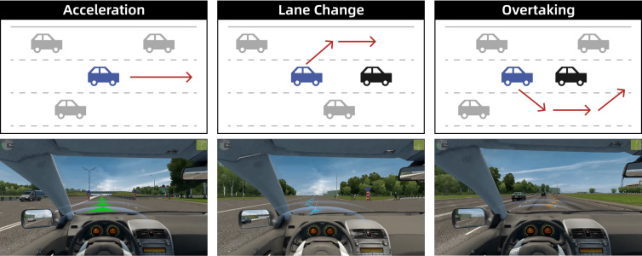
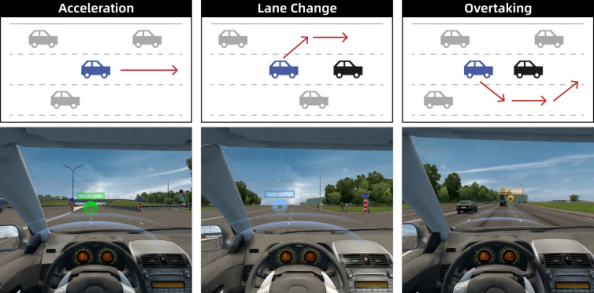
The independent variable in this study is the progressive degree of task proactivity within the autonomous driving scenario, manifested through distinct visual feedback design modalities. Based on the level of proactivity in task information presentation and the corresponding demands on the driver’s cognitive load, we categorised the experimental video interfaces into three modalities: linear, dynamic, and task-based. The fundamental distinction amongst these three modalities lies in the perceived ‘task interactivity’ when the system initiates an ‘opportunity’.
372 Sun and Zhao Linear: Employing static or low-dynamic lines (straight or curved) to provide subtle guidance, this design draws upon the concept of the ‘environment- integrated interface’. Namely, it conveys information through non-intrusive visual cues (such as simple line flows). Its defining design characteristics are minimal visual interference, providing only the most fundamental navigation and lane-keeping information.
Figure 2: Linear AR-HUD interface information.
Dynamic: Building upon the linear baseline, this modality incorporates dynamically changing elements. Dynamic visual stimuli are more adept at capturing peripheral visual attention than static graphics. Consequently, graphic elements (e.g., triangular arrows) generate corresponding motion effects contingent upon the vehicle’s state, such as acceleration, deceleration, or lane changing.
Task-oriented: In addition to foundational guidance, this modality incorporates specific task directives or elements that necessitate information capture and cognitive processing by the driver, such as destinations, textual prompts, or gamified components. Drawing upon Situation Awareness (SA) theory, this design aims to transition the driver from the role of a passive observer into an active decision-making participant.
During the formal experiment, participants were seated within the driving simulator cabin, where a display monitor positioned in front of them played first-person perspective driving videos encompassing urban roads, motorways, and mixed road segments. The video environment was set to cloudy weather to simulate authentic driving visibility. Whilst viewing the videos, participants were required to simulate collaborating with the system under an autonomous driving assistance mode, in accordance with the AR-HUD prompts.
To ensure experimental consistency, the switching of visual feedback interfaces and the playback of videos were managed by off-site experimenters utilising a remote control terminal, ensuring that participants did not interfere with one another.
The experiment comprised three trials, corresponding to the three distinct visual feedback modalities: linear, dynamic, and task-based. Following the completion of each trial (i.e., each visual feedback modality), participants were required to immediately complete a User Evaluation Scale. The scale encompassed dimensions such as perceived control, willingness to use, driver agency and participation, safety, comfort, and emotional experience. After all trials were concluded, the experimenters conducted a semi-structured interview with the participants, lasting approximately 10 to 15 minutes.
ANALYSIS AND DISCUSSION This research provides an in-depth exploration of the psychological and cognitive impacts of task-based AR-HUDs within Level 3 (L3) autonomous driving scenarios, yielding significant results. By comparing various AR-HUD visual feedback modalities, it was found that the task-based AR-HUD demonstrates distinct advantages in enhancing driver engagement, maintaining road-focused attention, and moderately increasing driving enjoyment.
Table 1: Summary of user evaluation form data collected during the experiment.
Table available in the original PDF paper.
Indicators ANOVA Results Significance Relationship Engagement F(2, 57) = 9.84 p = 0.0002 T3 > T2 > T1 Agency F(2, 57) = 0.91 p = 0.41 T1 ≈ T2 ≈ T3
Willingness to Use F(2, 57) = 11.27 p < 0.0001 T3 > T2 > T1 Playfulness F(2, 57) = 3.92 p = 0.025 T3 > T1 ≈ T2 Emotional Experience F(2, 57) = 4.36 p = 0.017 T3 > T1 ≈ T2
Visual Comfort F(2, 57) = 14.62 p < 0.00001 T2 > T1 > T3 Conclusion 1: The Enhancing Effect of Task-Based AR-HUD on Driver Participation. The task-based AR-HUD proposed in this study effectively maintains the driver’s cognitive flow within the driving loop by transforming vehicle motion planning into actionable task opportunities requiring driver approval. Analytical results from subjective evaluation metrics further confirm that, supported by the task-based AR-HUD, drivers engage more proactively in driving decisions, thereby enhancing their perception as a driving agent and increasing their psychological involvement. This proactive interaction modality effectively addresses the challenges stemming from driver passivity in traditional Level 3 (L3) autonomous driving, ensuring they sustain a pivotal role within the automated system.
Conclusion 2: Task-Based AR-HUD Effectively Sustains Driver Road- Focused Attention. The task-based AR-HUD is capable of effectively redirecting and sustaining driver attention on the roadway. Within highly automated driving environments, the risk of driver distraction is a tangible concern. By consistently proposing tasks relevant to the current driving context—such as suggestions for acceleration, lane changes, or overtaking— the system necessitates driver evaluation and approval, thereby prompting continuous monitoring of forward road information and traffic conditions. This continuous and purposeful process of information processing and decision-making ensures that the driver remains ‘in-the-loop’, bolstering their real-time situational awareness of the road environment.
Conclusion 3: Task-Based AR-HUD Appropriately Facilitates Driving Enjoyment within Stable Road Environments. The proposed task-based AR-HUD facilitates a degree of driving enjoyment within specific, stable road environments, such as motorways. Subjective analysis of emotional experiences suggests that by providing meaningful interactive tasks, accompanied by timely feedback following driver decisions, the boredom and monotony typically associated with traditional autonomous driving can
Task-Based AR-HUD in Autonomous Driving 375 be mitigated. This enhanced sense of autonomy, perceived control over the vehicle, and positive emotional experience collectively ensure that the driver is no longer merely a passenger; rather, they experience a sense of ‘driving satisfaction’ through moderate, purposeful participation.
CONCLUSION
The contributions of this study are primarily manifested across three core dimensions. Firstly, this research innovatively proposes the concept of a ‘task-based AR-HUD’, offering a novel theoretical perspective for the design of human-machine authority distribution within autonomous driving scenarios. Secondly, the study empirically validates the potential value of the task-based AR-HUD in Level 3 (L3) autonomous driving, confirming its efficacy in significantly enhancing driver agency and participation. Finally, this research further analyses whether the task interaction mechanism can substantively maintain the driver’s road-focused attention, whilst meticulously evaluating whether the visual design features of the task-based AR-HUD might induce an excessive cognitive load. Notwithstanding these achievements, certain limitations remain. Specifically, objective discrepancies exist between the driving simulator environment and real-world driving conditions. Furthermore, the evolution of drivers’ behavioural adaptability and psychological acceptance following long-term system usage warrants further investigation. These limitations concomitantly delineate essential directions for future in-depth research.
ACKNOWLEDGMENT
The author would like to express his gratitude to the Travel Lab at the School of Design and Art, Hunan University, for providing equipment support.
REFERENCES
A., G., Michael et al. (2024) “An Eye Gaze Heatmap Analysis of Uncertainty Head-Up Display Designs for Conditional Automated Driving,” arXiv (Cornell University) [Preprint]. Carsten, O. and Martens, M. (2018) “How can humans understand their automated
cars? HMI principles, problems and solutions,” Cognition Technology & Work, 21(1), p. 3. Cooper, J. M. et al. (2023) “Driver behavior while using Level 2 vehicle automation: A hybrid naturalistic study,” Cognitive Research Principles and Implications, 8(1), p. 71. Cœugnet, S. et al. (2021) “A User-Centered Approach to Adapt the Human-Machine
Cooperation Strategy in Autonomous Driving,” in Lecture notes in networks and systems. Springer International Publishing, p. 600. Deniel, J. and Navarro, J. (2022) “Gaze behaviours engaged while taking over automated driving: a systematic literature review,” Theoretical Issues in Ergonomics Science, 24(1), p. 54. Du, N. et al. (2020) “Evaluating Effects of Cognitive Load, Takeover Request Lead Time,
and Traffic Density on Drivers’ Takeover Performance in Conditionally Automated Driving,” p. 66. Endsley, M.R. (2018) “Situation Awareness in Future Autonomous Vehicles: Beware of the Unexpected,” Advances in intelligent systems and computing, p. 303.
Reality HUDS: An On-road Study,” arXiv (Cornell University) [Preprint]. Feierle, A., Schlichtherle, F. and Bengler, K. (2021) “Augmented Reality Head-Up Display: A Visual Support During Malfunctions in Partially Automated Driving?,” IEEE Transactions on Intelligent Transportation Systems, 23(5), p. 4853. Figalová, N. et al. (2023) “From Driver to Supervisor: Comparing Cognitive Load
and EEG-Based Attentional Resource Allocation Across Automation Levels,” International Journal of Human-Computer Studies, 182, p. 103169. Gabbard, J.L. et al. (2019) “AR DriveSim: An Immersive Driving Simulator for Augmented Reality Head-Up Display Research,” Frontiers in Robotics and AI, 6, p. 98. Gaspar, J. and Carney, C. (2019) “The Effect of Partial Automation on Driver
Attention: A Naturalistic Driving Study,” Human Factors The Journal of the Human Factors and Ergonomics Society, 61(8), p. 1261. Hancock, P.A. (2018) “Some pitfalls in the promises of automated and autonomous vehicles,” Ergonomics, 62(4), p. 479. Hong, S. and Yang, J.H. (2022) “Effect of multimodal takeover request issued through
A-pillar LED light, earcon, speech message, and haptic seat in conditionally automated driving,” Transportation Research Part F Traffic Psychology and Behaviour, 89, p. 488. Huang, W.-C. et al. (2024) “Enhancing safety in conditionally automated driving: Can more takeover request visual information make a difference in hazard scenarios with varied hazard visibility?,” Accident Analysis & Prevention, 205, p. 107687. Jing, C. et al. (2022) “The impact of different AR-HUD virtual warning interfaces
on the takeover performance and visual characteristics of autonomous vehicles,” Traffic Injury Prevention, 23(5), p. 277. Lee, Joonbum et al. (2026) “With a Little Help From My Car: Sharing Automated Vehicle’s Situation Awareness Reduces Driver-Initiated Automation Disengagement Without Delaying Takeover Response Time,” Human Factors The Journal of the Human Factors and Ergonomics Society [Preprint]. Li, X. et al. (2021) “Get Ready for Take-Overs: Using Head-Up Display for Drivers
to Engage in Non–Driving-Related Tasks in Automated Vehicles,” Human Factors The Journal of the Human Factors and Ergonomics Society, 65(8), p. 1759. Lim, C. et al. (2025) “Multimodal prediction of situation awareness during automated driving: a gaze and EEG-based approach,” Ergonomics, p. 1. Lindemann, P., Lee, T.Y. and Rigoll, G. (2018) “Catch My Drift: Elevating Situation
Awareness for Highly Automated Driving with an Explanatory Windshield Display User Interface,” Multimodal Technologies and Interaction, 2(4), p. 71. Ma, J., Li, Y. and Zuo, Y. (2024) “Design and Evaluation of Ecological Interface of Driving Warning System Based on AR-HUD,” Sensors, 24(24), p. 8010. McWilliams, T. and Ward, N. (2021) “Underload on the Road: Measuring Vigilance
Decrements During Partially Automated Driving,” Frontiers in Psychology, 12, p. 631364. Melnicuk, V. et al. (2021) “Effect of cognitive load on drivers’ State and task performance during automated driving: Introducing a novel method for determining stabilisation time following take-over of control,” Accident Analysis & Prevention, 151, p. 105967. Merat, N. et al. (2018) “The ‘Out-of-the-Loop’ concept in automated driving:
Proposed definition, measures and implications,” Cognition Technology & Work, 21(1), p. 87. Stojmenova, K., Tomažič, S. and Sodnik, J. (2022) “Design of Head-Up Display Interfaces for Automated Vehicles,” SSRN Electronic Journal [Preprint].
Task-Based AR-HUD in Autonomous Driving 377 Tan, X. and Zhang, Y. (2022) “A Computational Cognitive Model of Driver Response
Time for Scheduled Freeway Exiting Takeovers in Conditionally Automated Vehicles,” Human Factors The Journal of the Human Factors and Ergonomics Society, 66(5), p. 1583. Tan, X. and Zhang, Y. (2024) “Driver Situation Awareness for Regaining Control from Conditionally Automated Vehicles: A Systematic Review of Empirical Studies,” Human Factors The Journal of the Human Factors and Ergonomics Society, 67(4), p. 367. Tomasevic, N. et al. (2022) “A Path towards Sustainable Vehicle Automation:
Willingness to Engage in Level 3 Automated Driving,” Sustainability, 14(8), p. 4602. Vasta, N. and Biondi, F. (2025) “Effect of Partially Automated Driving on Mental Workload, Visual Behavior and Engagement in Nondriving-Related Tasks: A Meta- Analysis,” Human Factors The Journal of the Human Factors and Ergonomics Society, 67(9), p. 962. Vogelpohl, T. et al. (2018) “Asleep at the automated wheel—Sleepiness and fatigue
during highly automated driving,” Accident Analysis & Prevention, 126, p. 70. Wei, X. et al. (2025) “Visionary Co-Driver: Enhancing Driver Perception of Potential Risks with LLM and HUD,” arXiv (Cornell University) [Preprint]. Wen, W., Kuroki, Y. and Asama, H. (2019) “The Sense of Agency in Driving
Automation,” Frontiers in Psychology, 10, p. 2691. Wintersberger, P. and Riener, A. (2016) “Trust in Technology as a Safety Aspect in Highly Automated Driving,” i-com, 15(3), p. 297. Wu, Z. et al. (2023) “The Effect of AR-HUD Takeover Assistance Types on Driver
Situation Awareness in Highly Automated Driving: A 360-Degree Panorama Experiment,” International Journal of Human-Computer Interaction, 40(20), p. 6492.
LISTED IN THE AHFE DIGITAL BOOKSTORE CATALOGUE
Explore the complete digital volume
Advances in Human Factors of Transportation
Read this individual research paper free through the original publisher, or explore the full digital proceedings book.
ISBN 979-8-950676-00-0
Explore this ISBN in the AHFE Bookstore ↗Listed in the July 2026 bookstore catalogue; search by ISBN to confirm current availability · Digital book purchase optional