Wei Du, Danhua Zhao (2024). A brief introduction into futures studies methods and its application prospects in field of design. In: Ergonomics In Design. AHFE Open Access, vol. 129, pp. 137–147. https://doi.org/10.54941/ahfe1004819
This article, through a comparison of the similarities and differences between the fields of futures studies and design, as well as an exploration of the necessity and advantages of applying futures studies research methods to design education and practice, reveals the close connection between the two disciplines. The article first outlines the development background and historical evolution of futures studies in the form of a timeline of disciplinary history. By analyzing key developmental stages, milestones, and turning points in its history, it preliminarily demonstrates the macroscopic and diverse characteristics of futures studies. Furthermore, by combining tangible concepts, it provides a detailed introduction to abstract futures study methods covering multiple research directions in futures studies, systematically analyzing the potential benefits of these methods for design practitioners in various aspects. The research finds that futures studies provide a new foundation and perspective for the design industry in inspiring innovative design thinking, predicting scenario trends and design needs, enhancing adaptability of design for the technological and social environment of the future, and deepening designer’s understanding of user experience in the long term. This significantly strengthens the credibility and reliability of design, helping designers better understand and respond to the ever-changing social and technological environment. Finally, the article, supported by examples, vividly illustrates the development prospects of design futures studies and the practical application of futures studies in the design field, presenting a rich and in-depth research perspective to the readers. The article envisions the future direction of futures studies, providing valuable reflections for the future development of the discipline. Through the exposition in this article, we gain a more comprehensive understanding of the mutual influence between futures studies and design, as well as the crucial role of futures studies in design education and practice.
Design Futurology, as is described by many, combines design with ideas from philosophy, sociology, anthropology, and more. It looks forward to creat- ing better futures and trains innovators to handle unknown challenges. It introduces fresh ideas to design, impacting society and civilization. This field
studies how future trends affect society today, guiding industrial and social changes. It uses collaborative methods, discussions, and reflection methods to shape society’s future.
Futures studies and design are both practice-oriented and participate in the work of changing the world through expectations. In this context, futurists have always been designers and designers are also futurists, and design aims to explore the futures and futures studies focuses on design as well. Together, they consciously change the world. Design can allow an individual to open windows on the future in order to better understand the present (Dunne & Raby, 2003). As a result, learning the methodology developed in the field of futurology is imperative for designers to better understand the trend of the world and cope with changes.
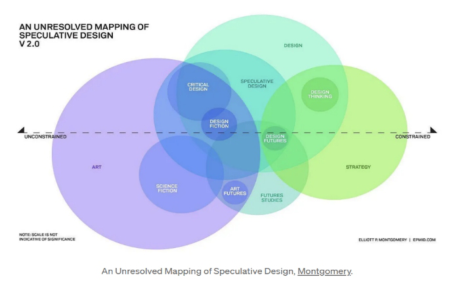
Applying futures thinking to design education and academic fields can better foster reflective practitioners. Figure 1 illustrates the close connection between design futures and the disciplines of design, art, and strategy.
Figure 1: An unresolved mapping of speculative design (adapted from Montgomery, 2005).
Futures Studies explores and analyzes possible, potential, and preferred futures, and how they evolve from the present. It’s not just about predict- ing the future, but systematically thinking and planning for various possible futures. Futurology is a transdisciplinary field (Fu & Xia 2022). As seen in Figure 1, the research domain of futurology overlaps with multiple dis- ciplines, leaning towards art in more divergent Conditions and towards strategy in more structured and rational contexts. Inevitably, there is an over- lap with design and speculative design, as all involve reflective envisioning and construction of the future. Therefore, design futures, based on its varying structural inclinations, maintains close connections with both design fiction and speculative design at its core.
It is not difficult to see that futures thinking, if integrated into the design thinking process, can produce a more diversified adaptability of design for the future. “Design Thinking” is a problem-solving approach that addresses real-world issues by engaging in a process that includes observation, gaining insights, defining needs, creative ideation, and refining prototypes to reach final products. On the other hand, “Futures Thinking” initiates with trend analysis, delves into diverse future scenarios, and develops conceptual per- sonas and artifacts. It is distinguished by its exploration of a wide range of
A Brief Introduction into Futures Studies Methods and its Application Prospects 139
possibilities. Applied in fields such as industrial design and human-computer interaction, Futures Thinking fosters discussions on various future scenar- ios. This approach utilizes design methods to craft and present near-future prototypes across different media, facilitating critical and comprehensive evaluations of ongoing projects and societal-technological possibilities.
HISTORICAL OVERVIEW OF FUTURES STUDIES The research methods of futurology today encompass a variety of tools and techniques. For instance, Scenario Planning aids in understanding potential future changes by constructing different future scenarios, offering diverse per- spectives for decision-making. The Delphi Method utilizes expert opinion surveys to predict and explore potential future developments, enhancing the accuracy of future predictions with professional insights. Trend Analysis fore- casts future development directions by studying historical and current trends, enabling us to better grasp the evolution of society and industries. Cross- Impact Analysis examines the mutual influences among different events or trends, helping us understand potential future outcomes within complex systems. The Futures Wheel is used to explore the direct and indirect conse- quences of a particular event or trend, providing a comprehensive perspective for reflection. These methods collectively constitute the toolkit of futurology, offering robust support for understanding and addressing future uncertain- ties. They also provide designers with reliable analytical methods when facing complex and ever-changing futures.
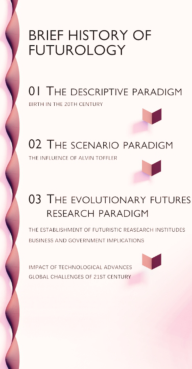
In order to better understand how futurology has developed such a plethora of methods and modes of thought, and how they are applied in var- ious fields, we need to review its developmental trajectory. Futures Studies has evolved significantly since its birth in the mid-20th century, as is shown in Figure 2 mapping up all the important Milestones and Turning Points of the history of futures studies.
Figure 2: History of future studies divided into three stages (Fergnani, Alessandro, 2018).
140 Wei and Dan-Hua
In the 1950s and 1960s, with the uncertainty of the Cold War era and rapid technological advances, interest in the study of the future began to grow. During this period, futurology techniques began to emerge from the RAND Corporation in California in order to analyze the correlation between weapons development and military strategy, thus preparing the U.S. military for future threats. Concurrently, Olaf Helmer, a mathematician at RAND, proposed a theoretical foundation for incorporating expert opinion into forecasting. It then separates as an academic field (Kuosa, 2011).
but it was not until the publication of Alvin Toffler’s Future Shock in 1970 that the dissemination of futurology to the general public was achieved. The book gained heavy populance, so in the 1980s and 90s, futures meth- ods became key in strategic planning and policy-making for businessess and governments to cope with the digital revolution. In 21st Century, Addressed global issues like climate change, resource scarcity, and aging populations also seen strong adoption of futures methods, bust mostly on a political an holistic view (Meadows & Randers, 2004) based on research done by Alessandro Fergnani (Fergnani, Alessandro, 2018).
The development of futurology is also divided into the following 3 stages: Descriptive Paradigm which Focuses on making probable predictions based on past developments. It views the future as predictable, static, and optimistically. The approach is non-turbulent, mainly quantitative, and covers a short timeframe.
The second stage, Starting from the nineteen sixties, is Scenario Paradigm, it Involves outlining various possible futures. The value lies not in predicting but in aiding current decision-making by exploring possibilities and potential developments.
And the third stage is Evolutionary Futures Research Paradigm Dates back to the nineteen eighties which Aims to understand futures in a turbulent world using evolutionary principles. It relies on complexity research findings and acknowledges general evolution (Dator, 2002). So researchers began wonder- ing: What if the methods of futurology can be used for other disciplines to foster greater productivity, since they all have in common in ways of explor- ing the future? Consequently, Futures Studies continues to adapt and expand in response to global challenges and societal changes.
METHODOLOGY IN FUTURES STUDIES Next, in this paper, the discussion of certain methods in future studies is to understand the premise of why these methods need to be applied to the forefront of design research academically. Therefore, this paper will start from some more classical methods of futurology, discussing their potential and prospects for application in the field of design. According to Innayat- ulla’s six pillars of future studies (Inayatullah, 2008), futurologists around the world have adopted a variety of research methods, but these methods lack a structured and systematic summary in future studies. Therefore, he pro- posed six main pillars of future studies for the classification of future studies. The six pillars include: mapping, anticipation, timing, deepening, creating alternatives, and transforming.
A Brief Introduction into Futures Studies Methods and its Application Prospects 141
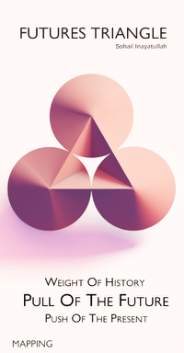
The first one is mapping. In this pillar, relevant factors are mapped into different time phases such as past, present, and future. By categorizing dif- ferent factors into different times, we gain a clearer understanding of where we come from and where we are going. One of the most typical tools is the “Futures Triangle” (Figure 3). The Futures Triangle analyzes contemporary perspectives on the future through three dimensions: the weight or barriers of history, the vision or image of the future, and the driving forces or push of the present.
Weights Of the history represent obstacles to desired changes, such as nationalism hindering globalization or hierarchies challenging more just and equal visions.
Key images of the future Is classified in to different Stereotypicals, Accord- ing to Innayatulla (Inayatullah, 2008), concepts like technological evolution, societal collapse, the Gaia hypothesis, globalism, and a return to simpler times, Which gives you a better direction when you do not know what future really will lead you to.
Figure 3: Illustration of futures triangle.
Present pushes are quantitative trends like aging populations and increas- ing military spending that makes our world a more dangerous place.
By examining these three forces, the Futures Triangle helps us to develop plausible future. In the design process, without sufficient consideration of the interplay and impact of these factors in social development, one may easily fall into the confines of excessive idealism. For example, the Constructivist architecture of the Soviet avant-garde during the Soviet era was admired by the elite class at that time. Despite being the harbinger of modernism and aptly reflecting the spirit of socialism, they failed to account for the weight and significance of history—namely, the simple aspirations of the people and the constraints of tradition. Eventually, such designs lost favor with both the people and the leadership. Instead, it was the Neoclassical architecture that truly became the people’s art, adorning the streets and lanes of the Soviet Union.
142 Wei and Dan-Hua
The Futures Landscape is also method that falls into the mapping category. It is highly useful for assessing an organization’s current position and strategy. This tool divides the organizational environment into four levels:
1. Jungle: Represents a fiercely competitive environment where survival is the primary goal. 2. Chessboard: Focuses on strategy and efficiency. Success here entails setting clear goals and establishing a flexible, responsive organization. 3. Summit: Symbolizes the broader social context in which the organization operates, providing a “big picture” perspective. 4. Starry Sky: Represents the organization’s vision or long-term goals.
This tool prompts organizations to evaluate their focus. Are they merely surviving day by day, progressing strategically, considering alternative futures and assumptions, or being guided by a clear vision? In terms of design, it helps us better understand the current stage of stakeholders, whether they are clients, users, or competitors. This understanding allows us to formu- late design strategies, set design tones, and anticipate stakeholder behavior, providing a clearer picture.
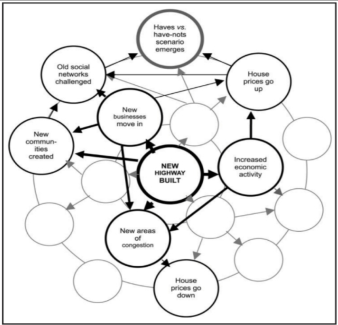
The “Futures Wheel” (Figure 4) is a typical method for anticipating the future. It aims to explore the long-term consequences of current issues. From a practical standpoint, it graphically represents the cascading results of vari- ous aspects of a phenomenon, revealing unexpected outcomes by considering different facets of a problem over time. For example, applying the Futures Wheel to the construction of a new highway in an undeveloped city may reveal a series of effects, such as increased economic activity, more job oppor- tunities, and rising prices. Over time, this may lead to increased traffic, worsening pollution, and health issues. Social dynamics may also change, resulting in disparities between different groups due to uneven growth and development. This comprehensive analysis aids in predicting and planning various future scenarios, which is also highly useful for designers. It allows them to forecast the long-term impact of their designs and better assess whether they have achieved their design goals.
Figure 4: Futures wheel (adapted from Inayatullah, 2008).
A Brief Introduction into Futures Studies Methods and its Application Prospects 143
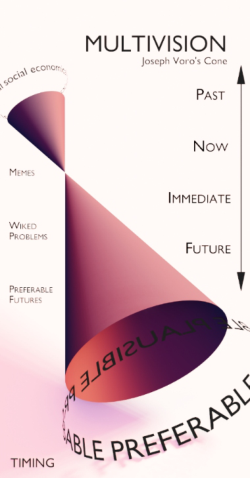
The reason why Futures is plural is because future is not static waiting to happen, it’s determined by many variables and could lead to very different results and scenarios. That’s why The concept of futures cone (Voros, 2021) could not explain this any better.
The “Futures Cone”(Figure 5) is a typical method for creating alternatives of the future. Based on the concept of the futures cone, The future can be divided into four key levels: the possible, the plausible, the probable, and the Preferable. This framework provides a powerful tool to help us better under- stand the diversity and possibilities of the future. Delving into the meanings of these levels and their roles in research and strategic planning, the conver- gence of these four levels into a diverse perspective category aids the Designer in comprehensively understanding the future his design will see. The Method not only focuses on possibilities but also on feasibility and credibility. This comprehensive approach assists us in wisely designing our future path in an era of rapid change and uncertainty, enabling us and our designs to better adapt to future challenges and opportunities.
Figure 5: Illustration of futures cone.
Then there’s timing of the future, as the name suggests, refers to the cog- nition of future development patterns. How do you perceive the future? Or in other words, what is your metaphor for the future? Do you believe the future is merely luck or karma? Or is the future a planned rational activity created through choices and risk analysis? Perhaps the future is completely open, where anything is possible; the world is a magical place? Or maybe the future is like a machine, with patterns that are regular, predictable, and have some kind of winding mechanism, helping to determine what will hap- pen once observed. A comprehensive understanding of how future evolves
144 Wei and Dan-Hua
in different patterns will result in vastly different Design thinking strategies. In a linear future, design requires continuous improvement in details such as user experience and cost-effectiveness factors. However, in a future pattern of upward spirals, designers need to focus on trends of design cycles or retro innovation. In a future characterized by luck and openness, design needs to be as adaptable to transformation and customization as possible to accommo- date diverse needs and explore various possibilities. Recognizing the diversity in timing of the future allows designers to more calmly and confidently find the direction for further progress.
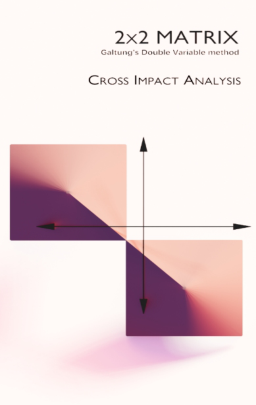
Methods used in deepening the future bear similarities to divergent mod- els such as brainstorming in design studies. For instance, the Cross-Impact Analysis (Figure 6) determines two major uncertainties and formulates sce- narios based on them. This method, developed by Galtung (Galtung, 1998), considers, for example, the future of disabilities, where the key uncertainties are the nature of change and who drives it. Is the change in the lives of people with disabilities driven by material technologies - genetics, digital, brain - or by social technologies - architectural design, microfinance, social marketing? Is the change led by the government as well as corporations or by people with disabilities themselves? This method focuses on intuitively analyzing the interactions between the two factors corresponding to the four quadrants by placing different factors on two axes in a plane coordinate system, aiming to better achieve divergent outcomes. This is similar in mindset to SWOT anal- ysis and intention analysis in design studies, but the Cross-Impact Analysis method emphasizes the construction of design scenarios. Many other meth- ods of deepening the future and creating alternatives are mostly achieved through creating typical impressions (Dator, 1979), somewhat akin to per- sonas in design studies, but with stronger focus on the construction of design scenarios.
Figure 6: Illustration of cross-impact analysis.
A Brief Introduction into Futures Studies Methods and its Application Prospects 145
INTERDISCIPLINARY PROSPECTS The fusion of futurology methodology and design disciplines has garnered widespread attention from universities worldwide. There is a consensus on the significant inspiration that futurology methodology offers to design thinking. Taking the Royal College of Art (RCA) Designing the Future project as an example, the project aims to enable students to venture across dis- ciplines and into more distant fields, building the knowledge and skills necessary to shape the future and address the challenges we face. Through design-led interventions, it seeks to imagine and guide students toward the desired future. The project enables students to pose “key questions” about disruptive innovation, design ethics, design resilience, shared values, future forecasting, and safety design, all of which are indeed the focus of the next stage of design. Designing the Future emphasizes professional development and action through the identification and implementation of research meth- ods and strategies. It allows students to choose areas of interest while simulta- neously cultivating skills to implement ideas. Aligned with participatory and collaborative design perspectives, it underscores interdisciplinary and stake- holder interaction, integrating relevant methods from futurology research, thus offering significant inspirational value to future design education.
Design teams and studios worldwide have also widely incorporated the concepts of future studies into their actual design processes (Battistella & Toni, 2011). Philips’ “FutureLab” serves as a prime example. It is an inter- disciplinary team composed of designers, sociologists, engineers, and trend analysts, showcasing the practical application of future research tools in product and service design. They employ scenario planning to create var- ious future scenarios covering social trends, technological developments, and economic conditions. Trend analysis helps them identify key driving factors that influence consumer behavior and demands. Based on these insights, they develop innovative product and service concepts, such as future healthcare solutions for aging societies and sustainable living solutions like energy-efficient and eco-friendly lighting products.
This approach not only impacts Philips’ product line but also influences broader industry trends, demonstrating how future studies integrate long- term perspectives and profound insights into product design and innovation. The case of Philips’ “FutureLab” showcases the practical application of future research tools such as scenario planning and trend analysis in guid- ing complex and innovative product design, enabling companies to predict and respond to future changes through proactive and flexible solutions. Over the years, design has evolved from designing specific objects to systems and services, and even to the overall organizational architecture of enterprises. Therefore, it is believed futures research methods will be adopted not only by Philips but also by various companies and design studios worldwide.
CONCLUSION
The integration of futures studies methodologies into the field of design marks a pivotal step towards a more informed and forward-thinking
146 Wei and Dan-Hua
approach. By introducing various future studies methods and highlight- ing their practical applications, it becomes evident that design can benefit immensely from a proactive consideration of future scenarios.
The incorporation of futures studies not only enhances the creative ideation process but also provides industrial designers with a strategic frame- work for anticipating and responding to potential challenges and opportu- nities. The concept of exploring diverse future scenarios, conceptualizing personas, and utilizing design methods to create near-future prototypes opens up new avenues for innovation and adaptation.
Moreover, the convergence of futures studies with participatory and col- laborative design viewpoints further emphasizes the importance of engaging stakeholders and end-users in the design process. This holistic approach ensures that design is not only aesthetically pleasing but also aligns with the evolving needs and expectations of the future.
By embracing futures studies methodologies, designers are empowered to navigate the complexities of an ever-changing landscape. This integration fos- ters a mindset that goes beyond the present, encouraging a proactive stance in shaping a future that is both visionary and practical. In essence, the syn- thesis of futures studies and industrial design establishes a foundation for creating products and solutions that are not only relevant today but resilient and adaptable in the face of tomorrow’s challenges.
ACKNOWLEDGMENT
I would like to express my heartfelt gratitude to my mentor and fellow school- mates for their invaluable guidance, support, and encouragement throughout the completion of this paper. To my mentor, your insightful advice and unwa- vering support have been instrumental in shaping the direction of this paper. I am also deeply thankful to my fellow schoolmates for their spirit of con- stantly sharing relevant resources and constructive feedback, which have played a crucial role in refining and improving the content of this paper.
Thank you once again for your invaluable contributions, guidance, and friendship throughout this journey. Your support has been truly appreciated and has made a significant difference in the completion of this paper.
REFERENCES
Battistella, C., & Toni, A. F. (2011). “A methodology of technological foresight: A proposal and field study.” Technological Forecasting and Social Change, 78(6): 1029–1048. Dator, J. (1979), “The futures of cultures and cultures of the future”, in Marsella, T.,
Ciborowski, T. and Tharp, R. (Eds), Perspectives on Cross Cultural Psychology, Academic Press, New York, NY. Dator, J. (2002) “Advancing Futures: Futures Studies in Higher Education.” Dunne, A. and Raby, F., 2013. Speculative everything: design, fiction, and social dreaming. MIT press. Fergnani, Alessandro (2018). “Mapping futures studies scholarship from 1968 to
present: A bibliometric review of thematic clusters, research trends, and research gaps.” Futures, S0016328718303100–. doi: 10.1016/j.futures.2018.09.007.
A Brief Introduction into Futures Studies Methods and its Application Prospects 147
Fu, Z., & Xia, Q. (2022). Exploring Features of the Design on Futures Thinking.
In G. Bruyns & H. Wei (Eds.), With Design: Reinventing Design Modes. IASDR 2021. Springer, Singapore. https://doi.org/10.1007/978-981-19-4472-7_148 Galtung, J. (1998), Essays in Peace Research, Vols. 1–6. Inayatullah, S. (2002). “Reductionism or layered complexity? The futures of futures studies.” Futures, 34(3–4): 295–302. Inayatullah, S. (2008). “Six Pillars: Futures Thinking For Transforming.” Foresight,
10(1): 4–21. Kuosa, T. (2011). “Evolution of futures studies.” Futures, 43; 327–336. Meadows, D., & Randers, J. (2004). “The Limits to Growth: The 30-year Update (1st ed.).” Routledge. https://doi.org/10.4324/9781849775861 Voros, A. J. (2021). “The Futures Cone, use and history.” https://thevoroscope.com
/2017/02/24/the-futures-cone-use-and-history/
LISTED IN THE AHFE DIGITAL BOOKSTORE CATALOGUE
Explore the complete digital volume
Ergonomics In Design
Read this individual research paper free through the original publisher, or explore the full digital proceedings book.
ISBN 978-1-964867-05-2
Explore this ISBN in the AHFE Bookstore ↗Listed in the July 2026 bookstore catalogue; search by ISBN to confirm current availability · Digital book purchase optional