Rafał Przesmycki, Marek Bugaj, Jarosław Bugaj, Paweł Skokowski, Krzysztof Malon, Michał Kryk (2026). Possibilities of using commercial unmanned aerial vehicles due to the level of electromagnetic radiation emissions. In: Human Factors in Robots, Drones and Unmanned Systems. AHFE Open Access, vol. 218, pp. 124–135. https://doi.org/10.54941/ahfe1007685
This article presents the use of commercial unmanned aerial vehicles (UAV’s) in the context of electromagnetic emissions and electromagnetic compatibility (EMC) requirements. With the increasing use of UAV’s in monitoring, telecommunications, inspection, and measurement applications, understanding the impact of electromagnetic interference (EMI) generated by on-board propulsion systems, power converters, radio communication modules, and flight control electronics is essential. Commercial UAVs are typically not designed as low-emission platforms, limiting their use in missions requiring high electromagnetic purity. The presented research results demonstrate typical sources of high-frequency interference in UAV’s and their impact on both on-board systems and interference-sensitive radio sensors. UAV applications are classified according to their sensitivity to electromagnetic interference, indicating situations in which commercial platforms can be used directly and situations in which additional EMC measures are required. A key part of the work consists of laboratory measurements of radiated emissions in the frequency range from 30 MHz to 10 GHz for six commercial drones of different classes, conducted in an anechoic chamber. The results indicate significant differences in emission levels, particularly in frequency bands associated with engine harmonics, radio communications, and switching power supplies.
In recent years, Unmanned Aerial Vehicles (UAV’s) have emerged as one of the most rapidly advancing technological platforms for both civilian and industrial applications. Their relatively low cost, high mobility, ease of integrating diverse sensors, and the ability to operate in inaccessible or hazardous environments have led to the increasing adoption of commercial UAV’s in environmental monitoring, telecommunications, critical infrastructure inspections, photogrammetry, mapping, and measurement tasks. At the same time, the growing requirements for the accuracy and reliability of the acquired data mean that devices sensitive to electromagnetic interference are Received February 2, 2026; Revised April 9, 2026; Accepted April 23, 2026; Available online July 20, 2026
Possibilities of Using Commercial Unmanned Aerial Vehicles 125 increasingly installed on board UAV’s, including radio sensors, broadband receivers and equipment for measuring electromagnetic fields.
However, the electromagnetic environment on board a commercial UAV is extremely complex and difficult to control. Numerous electronic components, such as brushless drive motors, speed controllers, switching converters, radio communication systems, GNSS modules and flight control systems, generate broadband electromagnetic disturbances ranging from several tens of kilohertz to several gigahertz. These emissions may not only affect the correct operation of the UAV itself, but also significantly disrupt the operation of measurement devices, leading to sensitivity degradation, increased noise levels and incorrect interpretation of the recorded signals.
Commercial UAV platforms are designed primarily with flight stability, energy efficiency, and reliable communication in mind, and electromagnetic compatibility issues are often limited to meeting minimum regulatory requirements. As a consequence, these UAV’s are not optimized for low electromagnetic emissions, which significantly limits their use in tasks requiring high electromagnetic purity, such as precise monitoring of the radio spectrum, measuring the level of electromagnetic fields or locating interference sources.
Current literature increasingly emphasizes the necessity of analyzing electromagnetic emissions generated by UAV’s and assessing their impact on the feasibility of advanced measurement missions. It is particularly crucial to determine the frequency ranges with the highest emission levels and to identify the dominant interference sources. This knowledge provides a foundation for developing sensor integration methods and selecting technical countermeasures to mitigate interference, such as shielding, power line filtering, and the optimization of RF component placement.
This article addresses the issue of the possibility of using commercial UAV’s in the context of the electromagnetic emissions they generate and electromagnetic compatibility requirements. An analysis of typical interference sources occurring onboard UAV’s and their impact on various application classes is presented. A significant element of the work is the results of laboratory tests of radiated emissions across a wide frequency range, conducted for selected commercial UAV platforms. The obtained results allow for the assessment of the limitations of existing solutions and the indication of directions for further work on the adaptation of UAV’s to applications requiring increased EMC standards.
CHARACTERISTICS OF THE TESTED UAV’S In recent years, there has been a dynamic development in the applications of unmanned platforms—both ground-based (UGV – Unmanned Ground Vehicle) and aerial (UAV – Unmanned Aerial Vehicle). Drones are taking over more and more functions of their manned counterparts, while also offering entirely new capabilities. They can be controlled from the ground via radio communication or operate completely autonomously—carrying
out a pre-programmed mission or making independent decisions within a defined scope.
Drones are used in numerous fields—from rescue operations, observation, and telecommunications to transport and military tasks. In the military environment, UAV’s play an increasingly important role—they enable real- time intelligence, surveillance, and reconnaissance (ISR) with minimal risk to personnel. Small UAV’s can carry out precision strikes, disrupt enemy communications, or support logistics. Their role in modern conflicts continues to grow.
Long-range and heavy drones do not use battery-powered electric engines due to their high energy requirements. Instead, they employ combustion engines, which generate a high level of electromagnetic interference (EMI). Such interference is broadband in nature and can negatively affect the sensitivity of radio receivers.
In contrast, electrically powered drones (using LiPo batteries) generate a significantly lower level of EMI. The most commonly used are BLDC (Brushless Direct Current) motors—brushless units characterized by high power, durability, and low interference levels. In COTS (Commercial Off- The-Shelf) class UAV’s, they represent the dominant solution. During laboratory tests, six popular models of commercial drones were analysed. Their technical parameters are summarized in Table 1.
The analyzed drones differ in terms of weight, imaging capabilities, flight time, and operational range; however, all six platforms represent the current state of civilian UAV technology. The study includes Autel Robotics models AUTEL EVO Pro, AUTEL EVO Lite, and AUTEL EVO Nano, as well as DJI platforms DJI Mavic 3, DJI Air 2S, and DJI Mini 2, which together cover a broad spectrum of application classes.
AUTEL EVO Pro and DJI Mavic 3 are advanced, semi-professional to professional UAV’s equipped with high-resolution cameras, precise GNSS positioning, long flight endurance, and sophisticated flight-assistance functions, enabling demanding imaging and inspection tasks. AUTEL EVO Lite and DJI Air 2S represent compact yet capable platforms offering high image quality, extended autonomy, and good mobility, making them suitable for both advanced recreational use and professional field operations. In contrast, AUTEL EVO Nano and DJI Mini 2 are lightweight drones designed primarily for recreational and mobile applications; despite their small size, they provide high-quality imaging and stable flight performance. Together, these six UAV’s illustrate the wide range of civilian drone applications— from recreational and prosumer use to professional data acquisition— and reflect technological progress driven by advancements in electronics, battery systems, and wireless communication technologies.
These drones exemplify a wide range of applications—from amateur to professional—and their development is driven by advances in electronics, battery technology, and communication systems. Human Factors Engineering involves understanding the need for comprehensive integration of human capabilities (cognitive, physical, sensory, and team dynamics) into a system design, beginning with conceptualization and continuing.
8192x6144 12,5 MP (default): 4096x3072 Video: 4K, 2160p, to
type:2306 Brushless motor
Omnidirectional
back, top, bottom.
8192x6144 12,5 MP (default): 4096x3072 4K: 3840 x 2160 4K video
sensor system: front,
5.1K, 50 fps – 4K, 120 fps Foto: 50MP:
bottom of the drone
sensor located at the
vision system, infrared
Photo
type:3507 Brushless motor Brushless motor
sensor system Omnidirectional
Characteristic AUTEL EVO Pro DJI Mavic 3 AUTEL EVO Lite AUTEL EVO Nano DJI Air 2S DJI Mini 2
Material Polymer mixture Polymer composite Polymers Thin-walled
Weight 1191 g 895 g 820 g 249 g 570 g 249 g
Engine Brushless motor
Image and video 1 inch CMOS; 6K Video & 20MP
Functions and
sensors Omnidirectional
Communication
and Control 2.400-2.4835GHz 5.725-5.850GHz 2.400-2.4835GHz 2.400-2.4835GHz 5.725-5.850GHz 5.150-5.250GHz
Battery 7100 5000 6175 2250 3500 5200
MP – Mega Pixels, fps – frames per second
Table 1: Technical parameters of the tested UAV’s.
Table available in the original PDF paper.
THE LABORATORY STAND In order to determine the sources of electromagnetic emissions from unmanned aerial vehicles, it is necessary to estimate the amount of signals generated by the UAV on-board components, such as propulsion systems, communication systems and control electronics, in the signal recorded by the laboratory stand as radiated emissions. The analysis covers both intentional emissions related to radio transmission and telemetry, as well as unintentional radiation components resulting from the operation of switching converters and digital systems.
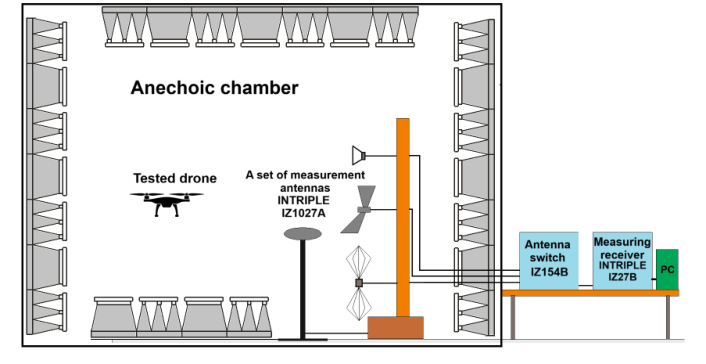
The laboratory stand intended for testing radiated emissions generated by drones should enable the reception of electromagnetic signals propagating in space over a wide frequency range. The measurement system must provide adequate sensitivity and selectivity to enable the identification of characteristic spectral components associated with the operation of individual UAV modules. An example system for radiated emissions testing, developed using the equipment available at the Electromagnetic Compatibility Laboratory, Military University of Technology, is shown in Fig. 1.
Figure 1: Block diagram of the laboratory stand for testing UAV radiated emissions.
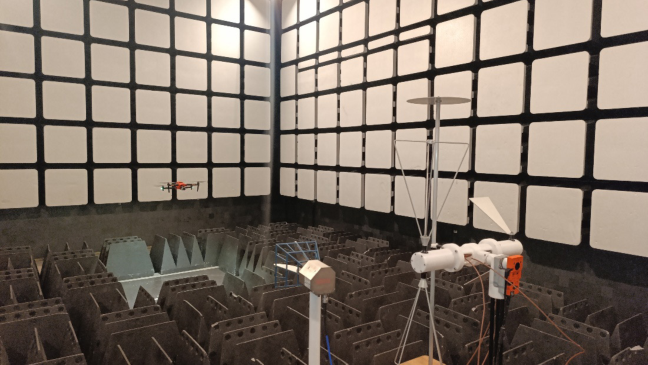
The laboratory stand was designed to carry out precise measurements of electromagnetic field parameters generated by UAV’s in controlled environmental conditions. The entire system was placed in an anechoic chamber, which eliminates the influence of electromagnetic wave reflections from walls and surrounding elements. Figure 2 shows the view of the laboratory stand during testing.
The anechoic chamber is the basic element of the laboratory stand designed to test radiated emissions from unmanned aerial vehicles in the frequency range from 30 MHz to 10 GHz. The walls, ceiling, and floor of the chamber are covered with electromagnetic wave-absorbing materials in the form of conical absorbers, which effectively suppresses waves across a wide frequency band. This solution provides conditions similar to free space, minimizing the impact of reflections and interference on measurement results.
Figure 2: View of the laboratory stand for testing UAV radiated emissions.
The test object, a UAV, is positioned in the center of the chamber. During testing, the UAV is maintained at a specific height relative to the measurement antennas. Its position and orientation are precisely defined and repeatable, which is critical for ensuring the comparability of radiated emission measurements from the propulsion, communication, and control subsystems.
Measurements are performed using a set of INTRIPLE IZ1027A measurement antennas mounted on an adjustable antenna tripod. This set enables the recording of electromagnetic field components in various polarizations across the entire analyzed frequency range. The antennas are positioned at a specific distance from the UAV under test, in accordance with the requirements of the adopted measurement procedure and applicable EMC standards. The antenna stand allows for precise adjustment of the antennas height and position, enabling measurements at various points within the measurement space without the need to reconfigure the entire test setup.
Signals received by the measurement antennas are transmitted to the INTRIPLE IZ27B measurement receiver, which analyzes and records electromagnetic emission parameters. The receiver provides high sensitivity and adequate frequency resolution, necessary for identifying both narrowband and broadband components of UAV emissions.
An integral element of the measurement chain is the IZ154B antenna switch, which enables automatic switching between individual antennas without mechanical interference with the measurement system. This solution increases measurement repeatability and shortens the time required to complete a full test series.
The measurement receiver and antenna switch are connected to a PC, which serves as the control and data acquisition system. The computer enables remote control of the measurement equipment, configuration of parameters, as well as the recording, archiving, and preliminary analysis of results. The use of dedicated software allows for the automation of measurement procedures and ensures the consistency and high repeatability of the obtained data.
MEASUREMENT RESULTS This chapter presents the radiated emission measurement results for six selected commercial unmanned aerial vehicles: AUTEL EVO Pro, DJI Mavic 3, AUTEL EVO Lite, AUTEL EVO Nano, DJI Air 2S, and DJI Mini 2. Measurements were conducted in the frequency range from 30 MHz to 10 GHz in an anechoic chamber. For each drone, the radiated emission characteristics and the chamber noise floor (anechoic chamber background) were recorded, allowing for a clear distinction between the UAV’s own emissions and the level of environmental interference at the measurement site.
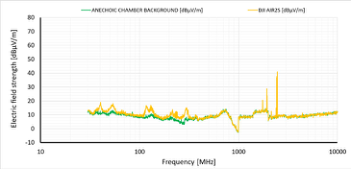
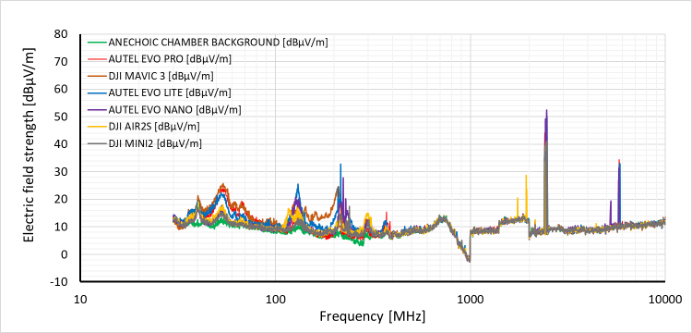
The graphs depicting the measurement results clearly illustrate the differences between the chamber’s noise floor (green) and the emission levels generated by the individual drones (other colors). The noise floor is characterized by a relatively low and stable profile across the entire analyzed band, with minor fluctuations resulting from the sensitivity of the measurement chain. This enables the reliable identification of signals originating directly from the tested objects. Figure 3 illustrates the radiated emission results of individual UAV’s compared to the anechoic chamber’s noise floor, while Figure 4 provides a comparison of the emission levels for all tested drones across the 30 MHz to 10 GHz frequency range.
a) b)
c) d)
e) f)
Figure 3: Radiation emission results of individual UAV’s: a) AUTEL EVO PRO, b) DJI MAVIC 3, c) AUTEL EVO LITE, d) AUTEL EVO NANO, e) DJI AIR2S, f) DJI MINI2.
Possibilities of Using Commercial Unmanned Aerial Vehicles 131 Larger and more advanced UAV models, including the AUTEL EVO Pro and DJI Mavic 3, show increased radiated emissions across a broad spectrum. Significant interference components are visible from several dozen to several hundred MHz, originating from Electronic Speed Controllers (ESCs) and DC-DC switching regulators. Furthermore, the 2.4 GHz and 5.8 GHz ISM bands show sharp emission peaks corresponding to the control uplink, telemetry, and high-definition video downlink.
For mid-range drones such as the AUTEL EVO Lite and DJI Air 2S, radiated emissions are generally lower than those of larger platforms, yet they still significantly exceed the chamber’s noise floor in key frequency ranges. These UAV’s exhibit fewer broadband components but still show distinct harmonics related to their propulsion and radio systems.
The lowest emission levels were recorded for the lightweight recreational drones, the AUTEL EVO Nano and DJI Mini 2. Their emission profiles approach the chamber’s noise floor across a large portion of the frequency band. Emissions significantly exceeding the background noise are observed primarily within the operational bands of the communication modules, indicating that radio transmission systems are the primary source of radiation in these platforms.
Figure 4: Comparison of radiated emission levels of all tested UAVs.
A comparison of the results for all six drones reveals a clear correlation between the UAV’s design class, the complexity of its onboard electronics, and the levels of radiated emissions produced. The higher the power of the propulsion systems and the greater the density of electronic circuits and transmission systems, the higher the emission levels and the more numerous the spectral components. Furthermore, contrasting these emission profiles with the chamber’s noise floor confirms the precision and high sensitivity of the measurement setup used.
In the 30–100 MHz range, the graphs—particularly for the DJI Mavic 3 and, to a lesser extent, the AUTEL EVO Pro and EVO Lite—exhibit distinct broadband “humps” above the noise floor. This elevated emission level is typically attributed to the operation of DC/DC switching regulators,
Electronic Speed Controllers (ESCs), and large current loops within the power cabling. The combination of low switching frequencies and steep pulse edges generates a wide harmonic spectrum that extends into the VHF band. Furthermore, components related to clock oscillators and their subharmonics may be present, radiating effectively through the wiring and the airframe structure.
In the 100–300 MHz band, several platforms—most notably the AUTEL EVO Lite and AUTEL EVO Nano—exhibit local maxima and narrowband peaks (on the order of several to several dozen dBµV/m above the noise floor). This is a typical region where emissions from system clocks (e.g., 24/26/40/48/80/160 MHz and their harmonics), high-speed interfaces, and converters operating at switching frequencies of hundreds of kHz to MHz (with harmonics in the VHF range) become visible. These discrete, narrowband peaks suggest a clocked source (such as an oscillator or PLL) rather than “pure” broadband noise.
Around ~1 GHz, all traces show a similar “dip” (level drop) occurring simultaneously for both background and drones. Since this dip is the same for each series, it is most likely due to the properties of the measurement path (e.g., antenna/band change, broadband antenna characteristics, path switching, AF/CF correction) or site specifics, rather than to an actual fading of UAV emissions.
The most unambiguous and repeatable peaks are observed in the ~2.4 GHz band, appearing for all drones. The highest levels are visible for the AUTEL EVO Nano and AUTEL EVO Lite, followed by the AUTEL EVO Pro, DJI Mini 2, and DJI Mavic 3 (where the latter shows a particularly distinct, narrowband peak). Emissions in this region primarily correspond to control, telemetry, and data transmission links operating within the 2.4 GHz ISM band (e.g., Wi-Fi, OcuSync, or Autel Link, depending on the platform). Since these are intentional emissions from the onboard transmitters, they appear as high, narrow maxima or clusters of peaks.
In the ~5 – 6 GHz band (typically around 5.8 GHz), distinct components appear especially for the AUTEL EVO Pro and AUTEL EVO Lite, and also as smaller peaks for the AUTEL EVO Nano. This is characteristic of the alternative video/telemetry transmission channel in the 5.8 GHz ISM band (or adjacent channels in the 5 GHz band). The lack of equally distinct peaks for some models (e.g., DJI Air 2S and DJI Mini 2 in the shown traces) may mean that the 2.4 GHz band was mainly active during the measurement, and the 5 GHz band was not used or had lower power/different configuration.
The DJI Air 2S, on the other hand, is characterized by additional, narrowband peaks around ~1.8 – 2.2 GHz (visible before the main 2.4 GHz maximum), which may result from mixing products and harmonics of the radio path, the operation of local oscillators/PLLs, or parasitic emissions related to RF circuits and their power supplies. In practice, such “single spikes” in the GHz band are more likely to indicate frequency synthesis products than emissions from the drive.
In summary, the graphs show a typical UAV emission pattern: below ~300 MHz, interference from power supply and power electronics (ESC/DC-DC) and clocks dominates, while around 2.4 GHz and 5–6 GHz, emissions from
Possibilities of Using Commercial Unmanned Aerial Vehicles 133 communication systems (most often intentional) dominate. Differences between models result mainly from different power supply architecture, cabling, shielding, and radio channel operation modes during measurement.
POSSIBILITIES OF COMMERCIAL UAV APPLICATIONS The level of radiated emissions generated by commercial unmanned aerial vehicles (UAV’s) has a significant impact on their practical applications in both civilian and industrial settings. The platforms analyzed – from DJI and Autel Robotics – represent different design classes, which translates into varying levels of electromagnetic emissions and, consequently, different requirements for interference mitigation measures.
Lightweight, recreational and compact drones, such as the DJI Mini 2 and AUTEL EVO Nano, are characterized by relatively low-power propulsion systems and simplified onboard electronics architecture. This allows them to be used without additional shielding in most civilian applications, such as aerial photography and videography, recreational flights, basic visual inspections, terrain mapping, and environmental monitoring that do not require precise electromagnetic measurements. Their use near sensitive radio installations is feasible, provided tasks do not require the detection of very low RF signals.
Mid-range drones, such as the DJI Air 2S and AUTEL EVO Lite, offer greater operational capabilities, higher image quality, and more advanced communication systems. These platforms can be used unshielded for typical industrial applications, such as energy and building infrastructure inspections, construction site surveillance, survey documentation, and industrial site monitoring. However, for applications involving operation near radio equipment or the installation of simple RF sensors, partial shielding or filtering of the sensor power supply is recommended to reduce the impact of the UAV’s own emissions.
The most advanced platforms, such as the DJI Mavic 3 and AUTEL EVO Pro, are designed for semi-professional and professional applications, including advanced technical inspections, high-resolution photogrammetry, critical infrastructure monitoring, and security-related tasks. Due to their complex communication systems, larger number of electronic circuits, and higher drive power, their use in electromagnetically sensitive environments – such as radio spectrum measurements, EMF, or interference location – requires additional EMC measures. These include shielding of sensor housings, power line filtering, antenna separation, and optimized cable routing.
In summary, commercial UAV’s can be widely used in civilian and industrial environments without additional modifications for missions with low to moderate sensitivity to electromagnetic interference. However, for applications requiring high electromagnetic purity, appropriate shielding and filtration solutions are necessary, especially for larger and more advanced platforms. This approach significantly expands the range of possible UAV applications while simultaneously limiting the negative impact of their own emissions on the electromagnetic environment.
CONCLUSION
This article presents a comprehensive analysis of the potential applications of commercial unmanned aerial vehicles (UAV’s) in the context of their electromagnetic radiation emissions and electromagnetic compatibility requirements. Theoretical considerations and laboratory tests confirmed that the electromagnetic environment on board UAV’s is highly complex and largely determined by the architecture of the on-board electronics, propulsion systems, and communication solutions.
A key element of the article was the measurement of radiated emissions across a broad frequency range from 30 MHz to 10 GHz, performed in an anechoic chamber for six commercial drones representing various design classes. The results showed that emission levels generated by the UAV’s significantly exceed the chamber’s noise floor across most of the analyzed range. In the frequency range up to several hundred megahertz, broadband interference related to the operation of engine controllers, switching converters, and power supply systems predominates, with levels exceeding the noise floor by several to several dozen dBµV/m. In the 2.4 GHz and 5 – 6 GHz bands, distinct narrowband emission peaks are observed, resulting from the intentional operation of communication, image transmission, and telemetry systems, reaching the highest amplitudes among all analyzed ranges.
Based on the results obtained, the practical application possibilities of the tested UAV’s were assessed. It was demonstrated that lightweight and compact platforms can be used without additional EMC measures in most civilian observation, recreational, and inspection applications. Mid-range and high- end drones, offering greater operational capabilities, are suitable for industrial applications; however, in electromagnetically sensitive environments, they may require partial shielding or filtration. For advanced measurement tasks – such as radio spectrum monitoring, electromagnetic field measurements, or interference localization – UAV emissions pose a significant limitation, necessitating dedicated EMC solutions, including sensor shielding, antenna separation, and power supply path optimization.
In summary, the presented research confirms that commercial UAV’s offer a wide range of applications in both civilian and industrial environments. However, their use in missions requiring high electromagnetic purity requires informed platform selection and the implementation of appropriate measures to limit radiated emissions. The results obtained can form the basis for the development of integration guidelines and further work on UAV designs optimized for electromagnetic compatibility.
ACKNOWLEDGMENT
This work was financed by Military University of Technology under research project entitled “Testing of radiated emission disturbances of selected smartphones using an anechoic chamber and an OTEM chamber in the aspect of the requirements of the PN-EN 17025 standard”.
The authors carried out the research using equipment purchased as part of the project “Polish Network of EMC Laboratories (EMC-LabNet)”, (POIR.04.02.00-02-A007/16).
REFERENCES
Birk, A.; Wiggerich, B.; Bulow, H.; Pfingsthorn, M.; Schwertfeger, S. Safety, security, and rescue missions with an unmanned aerial vehicle. J. Intell. Robot. Syst. 2011. Commission Implementing Regulation (EU) 2019/947 on the rules and procedures
for the operation of unmanned aircraft, Official Journal of the European Union, L 152. 2019. Directive 2014/30/EU of the European Parliament and of the Council of 26 February 2014 on the harmonization of the laws of the Member States relating to electromagnetic compatibility, Official Journal of the European Union, L 96. 2014. Kang, H.; Joung,; Kim, J.; Kang, J.; Soo Cho, Y. Protect your sky: A survey of counter
Unmanned Aerial Vehicle systems. IEEE Access 2020, 8, 168671–168710. Mil-Std-461G, Requirements for the control of electromagnetic interference characteristics of subsystems and equipment, U.S. Department of Defense, Washington D.C. 2015. Zhang, Q.; Cheng, E.; Wang, Y.; Chen, Y.; Ma, L. Research on the electromagnetic
interference effect of UAV satellite navigation system. J. Syst. Eng. Electron. 2020, 42. Zhao, M.; Chen, Y.; Zhou, X.; Zhang, D.; Nie, Y. Investigation on Falling and Damage Mechanisms of UAV Illuminated by HPM Pulses. IEEE Transactions on Electromagnetic Compatibility 2022, 64(5).
LISTED IN THE AHFE DIGITAL BOOKSTORE CATALOGUE
Explore the complete digital volume
Human Factors in Robots, Drones and Unmanned Systems
Read this individual research paper free through the original publisher, or explore the full digital proceedings book.
ISBN 978-1-964867-94-6
Explore this ISBN in the AHFE Bookstore ↗Listed in the July 2026 bookstore catalogue; search by ISBN to confirm current availability · Digital book purchase optional