Tanya Paul, Daniel Lafond, Alexandre Marois (2024). NeuroTeaming: Using Power Spectral Density for Adjusting Teaming Dynamics in Pilot-AI Task Allocation. In: Neuroergonomics and Cognitive Engineering. AHFE Open Access, vol. 126, pp. 23–33. https://doi.org/10.54941/ahfe1004735
Human-autonomy teaming (HAT) is becoming a subject of high interest in the human factors literature. It has several applications, including the collaboration between a human and an autonomous unmanned aerial vehicle (UAV) for security and defence use cases (e.g., for search and rescue tasks). This work is focused on methods for task-allocation between human and autonomous UAV agents. The proposed approach is human-centred, using a coactive design framework which relies on enabling adaptive team dynamics where different agents might act as key players for specific tasks based on an interdependent relationship. This method helps solve complex issues in understanding and adjusting to complementary team dynamics where agents might have different skill levels, experiences, roles, and helps understand which agent is more competent to perform a task. Additionally, such a framework promotes transparency towards the control and task-allocation strategies. To demonstrate this task-allocation strategy, this study looked at the use of neurophysiological features as indicators of task-specific capacities in UAV operations, more specifically electroencephalogram (EEG) signals, which opens up for the development of task-allocation adaptive systems, dependent upon variations in brain activity. Results found that EEG spectral power bands have potential to help determine different task-based abilities across groups (i.e., obstacle avoidance vs. target identification), hence contributing to pinpointing variations in the type of autonomous support needed. Overall, this research explores how task-dependencies can be observed through EEG signals for better transparency and explainability of adaptive control in pilot-AI teaming.
Human-autonomy teaming (HAT) enables the cooperation of a human oper- ator and an automated system performing a task interdependently. A current research challenge in this area is to understand the role of the automated agents within the teaming dynamics (Johnson et al., 2014; Lematta et al., 2019). Some researchers argue that such agents should be considered as equivalent to their human teammate to define their role in adaptive teaming
frameworks, which can help avoid out-of-the-loop problems and enhance system performance (Calhoun, 2022; Demir et al., 2019). Understanding and having well-defined roles is necessary to avoid ethical challenges through the misuse of automation, e.g. when using automation with the sole purpose of relieving difficult tasks (Neubauer et al., 2020). Maladaptive HAT strategies can also lead to replicating human-like biases, leading to amplification of potential deficiencies (Bainbridge, 1982). In addition, poorly designed HAT systems can generate uneven dynamics, decision biases, failure in monitor- ing, neglect such as when automation is overused (Parasuraman & Riley, 1997). Overuse of automation can lead to decrease in human situational awareness (SA), where the human operator is out of touch with the envi- ronment/control, or skills degradation due to the decrease in opportunity to practice. Ultimately, this can result in a loss of capabilities and cognitive performance over time (Gu et al., 2022). Negative performance generally arises in teaming frameworks with cognitive underload or overload due to the inability to assimilate information coming from the environment or the incapability of the human to understand the limitation of the machines during missions (Hussein et al., 2022). While designing HAT collabora- tion, it is important to highlight the limitations of automated agents which can lead to ‘catastrophic failure’, and degradation of system HAT perfor- mance (Bainbridge, 1982). HAT challenges could be related to different factors such as inefficient communication, misunderstanding goals, unde- fined responsibilities, local or shared mental models, or other conflicting issues (Decostanza et al., 2018). Additionally, it is important to note that dif- ferent team members have different cognitive and behavioral abilities based on time, viewpoints, representation and mental model, which might affect the ability to act or make a decision towards the type of collaboration and the dynamic control between agents.
This paper focuses on understanding the required capacities towards HAT teaming for optimal collaboration. It explores how to unveil task-allocation strategies required for human unmanned aerial vehicle (UAV) operators using an adjustable coactive design framework and brain-computer interface (BCI). Thus, the study explores methods to find patterns in human behaviors which might help determine the types of support needed to enhance human- autonomy collaboration. Below we present a brief literature review on HAT framework with an explanation of the key components of the coactive design framework, followed by a discussion on BCI approaches for improving HAT. Then, the goal of the study and details on the experiment are presented and discussed.
Human-Autonomy Teaming Frameworks Adjustable autonomy describes the division of labour between humans and artificial agents as not fixed, but rather varying in real time (Singh et al., 2021). It has been shown that adjustable autonomy can allocate workload, improve performance, and enhance SA (Zhao et al., 2020). In this paper, we focus on a coactive design framework which takes a team-centred approach where human and autonomous components support each other and create
NeuroTeaming: Using Power Spectral Density for Adjusting Teaming Dynamics 25
synergies through their complementary capabilities. This framework offers both agents to display a very transparent exchange by undertaking each other’s tasks and negotiating dynamic allocation strategies. It demonstrates aspects of interdependencies and reliability on each other to optimise per- formance (Johnson et al., 2011). Johnson et al.’s coactive design framework has been found useful in domains such as UAVs or even unmanned ground vehicles. Additionally, this approach has recently been used in a DARPA challenge for robots capable of assisting humans in responding to natural and man-made disasters (Lundberg et al., 2021; Johnson et al., 2014). The coactive design framework helps understand each of the agent’s intentions, motivations and cognitive modelling (Johnson et al., 2011; Wang et al., 2020). The framework addresses the complexity of more sophisticated roles within which humans and automated systems or robots are being teamed up in a complex environment. Coactive design is based on the principles of interdependence, dependence and capacity. Interdependence is described as a complementary relationship between entities which generates depen- dencies during a joint activity (Johnson et al., 2014). Dependence exists when an entity lacks a required capacity to competently perform an activ- ity. Capacity captures all components required such as skills, knowledge and understanding, which facilitates an entity to competently perform an activity independently. The team dynamics are based on principles of observability, predictability and directability (OPD; Johnson et al., 2014). In this paper, we focus on the human operator capabilities to fit OPD in order to adjust the use of potential automated systems for specific support. One novel approach to the coactive design framework is the use of electroencephalogram (EEG) signals, and exploring how EEG can help observe and anticipate human capacities.
Neuroadaptive Systems and EEG Signals EEG is a device capable of measuring electrical activity of the brain. EEG uses electrodes placed on the scalp which can then feed systems by processing and extracting frequency bands to assess the amplitude of event-related potentials of the EEG. It can help extract information about the operator’s mental, cog- nitive or affective states, such as cognitive workload (Neubauer et al., 2020; Rozado and Dunser, 2015). The use of common spectral bands has been asso- ciated with SA and other cognitive states such as fatigue, drowsiness, mental workload, and cognitive workload. A way to enhance SA is through “aug- mented cognition”, which is a form of human-system interaction in which physiological sensing of the UAV operator can be used to predict invoked automation when needed (Wilson et al., 2021). Being able to determine the optimal combination of EEG factors to predict an opportunity for augmented cognition would help gain transparency towards collaboration between auto- mated systems and humans. This would enable more adaptive assistance by analysing physiological data.
One promising method for measuring SA is by measuring EEG frequency bands (Gu et al., 2022). Those frequency bands are delta, theta, alpha, beta, and gamma, called power spectral density (PSD), and can inform on the
operator’s states. For example, the theta band has been found to increase as fatigue and workload increases (Singh et al., 2021), and augment while vigilance or cognitive capacity decreases (Borghini et al., 2014). Secondly, the alpha band has been demonstrated to decrease as workload and sus- tained attention “awake” frequencies increased (Pfurtscheller and Aranibar, 1977). Increases in beta bands are associated with problem solving skills and decision-making capabilities (Kumar and Bhuvaneswari, 2012), alert- ness, engagement or even motor skills and decrease with fatigue (Borghini et al., 2014). Gamma bands are often paired with hyper alertness and inte- gration of sensory inputs (Duta et al., 2010; Kumar and Bhuvaneswari, 2012; Singh et al., 2021; Stikic et al., 2011). Using PSD as an indication for certain specific mental states reveals to be complex and sometimes contradic- tory (e.g., alpha-band activity might reflect inattentiveness and as selective attention; Foxe and Snyder, 2011). Nevertheless, the use of PSD has been previously tested as a predictor of workload in pilots (Salvan et al., 2023). However, no study has yet explored the possibility of using PSD bands to determine differences among capacities, and types of support required in the context of dynamic task-allocation strategies in a coactive design framework.
Study Goal The goal of our study was to rely on neurophysiological features, extracted from them PSD of EEG signals, to identify capacities and strategies during UAV operations. To reach this goal, participants took part in a simulated semi-autonomous UAV control task. Half of them were assigned to a target identification training whereas the other half focused on object avoidance. Across all participants, EEG signal—more specifically PSD—was analysed as a marker for cognitive workload and SA. We hypothesized that group attri- bution would affect capacities in mission performance and therefore impact required levels of support from the automated agent. When analysing the PSD, it was hypothesized that differences would be reflected across the two skill-based training groups.
METHOD
Participants Ten participants (4 women, 6 men) took part in this study conducted in Thales Research and Technology premises, which was approved by the Bath University’s Research Ethics Committee. They had a mean age of 28.2 (SD = 6.42). All provided informed consent before starting the experiment.
Material and Procedure A simulated environment was created for human operators to navigate a UAV quadrotor. Participants were told to navigate the UAV for a search and rescue mission using a PlayStation 3 wired USB controller. The task was developed using Unreal Engine Simulator and Airsim plug-in to mimic realistic flight dynamics. Participants were wearing Conscious Lab EEG
NeuroTeaming: Using Power Spectral Density for Adjusting Teaming Dynamics 27
SUPRA headphones. Those headphones collected electrical signals from across different regions of the brain: frontal (Fp1, Fp2, F3, Fz, F4), cen- tral (C1, C2, Cz), parietal (P3, Pz, P2), occipital (O1, Oz, O2), and temporal (T3, T4).
To generate coactive interdependence and capacity variability on the task and EEG signal, participants were divided into two groups. Five participants were randomly assigned to Group 0 (G0). Their training was focused on finding the optimal path to reach and identify their targets during the UAV mission. Group 1 (G1) was rather trained on obstacle avoidance, that is to swerve and avoid obstacles to minimize the risk of collision. Each group had four training opportunities and was tested after each session. Then, they were tested on their ability to perform the exact same mission. Thus, both groups were rated on the same subtask capacities composed of the ability to detect (targets or obstacles), the ability to navigate (reaching for a waypoint versus swerving an obstacle), as well as their ability to remain in the area of interest (AOI) set by the mission.
Data Processing and Analysis The performance metrics on the task were collected using the number of collisions, number of targets reached, if targets are present within the oper- ator’s field of vision, and the percentage of time spent outside of the AOI. As for EEG signal, following a missing value and outliers signal assess- ment, PSD extraction was performed using the eeglib Python library with a window size of 2000 ms. This allowed the extraction of spectral power feature measures from the EEG signal for each electrode. The five PSD fre- quencies used went as follows: delta (δ: 1–4 Hz), theta (θ: 4–7 Hz), alpha (α: 8–12 Hz), beta (β: 12–30 Hz) and gamma (γ : 30–45 Hz). A Fast Fourier Transform function was applied to the PSD for each electrode as it allows to transform the signal from time domain to the frequency domain and to implement spectral analysis. A high-pass filter of 1 Hz and low-pass filter of 45 Hz was applied. A total of 80 (16 × 5) features was extracted. This enabled analysis on the mean of the five PSD bands as well as comparisons between brain region means throughout the performance results (frontal, parietal, central, temporal and occipital). Additionally, the mean of the PSD signal across both groups was compared representing the length of the missions.
RESULTS
Both groups were assessed based on their performance score during mis- sions for all subtasks. The mean of their capabilities for each subtask was then transformed into two categories where participants with scores equal or below 1 were classified in “High Capacities”, which means lower depen- dence, vs. higher than 1 in “Low Capacities”, which means higher depen- dence. These findings enable us to confirm the manipulation of variation and interdependence between groups, where G1 had higher capacities, thus lower requirement of support from the automated system, compared with G0. The results demonstrated statistically significant differences between both groups
for all sub-tasks, using a Mann-Whitney test with at least p-value < 0.005 for all subtasks: detection of targets (U = 1540.0, p <0.001), detection of obsta- cles (U = 1520, p <0.001),ability to avoid obstacles (U = 1460.0, p <0.001), ability to reach targets (U = 1080.0, p = 0.004), ability to remain in the area of interest (U = 1280.0, p <0.001).
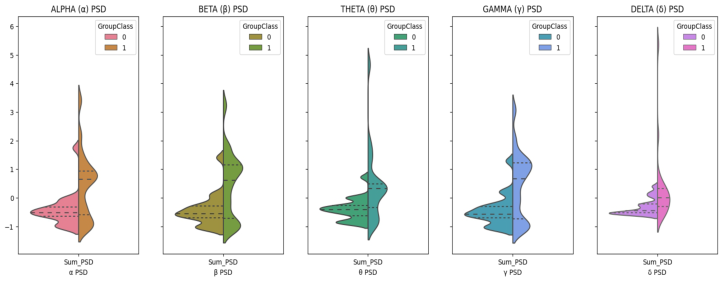
Figure 1 displays distribution of the PSD during the test mission. It shows G1 (obstacle avoidance) had higher levels of activations across the different power spectral bands, with higher peaks for the delta, and theta, compared to G0 (path finding) which had much lower activation in higher densities with lower peaks. These findings were confirmed with Mann-Whitney tests showing statistical differences across both groups for the δ (U = 502.0, p = 0.0042), θ (U = 481.0, p =0.0021), α (U = 526.0 p = 0.0084), β (U = 539.0, p = 0.0121), and γ (U = 531.0, p = 0.0097) bands. These differences demonstrate the distinct activation patterns across groups, correlating with the skill-based training each individual had. Thus, these results demonstrate the potential for detecting differences among capac- ities between UAV operators and could help observe the different teaming dynamics required for each agent.
Table 1 shows the more precise grouped mean PSD bands across brain regions (frontal, central, parietal, occipital and temporal). Major changes across activation occurred in FP2 with a mean difference of +4 in beta activity on the F4, C2 and T3 channels. However, the largest mean difference between groups was found to be related to the frontal lobes (FP1, FP2, F3, Fz, F4), and central lobe (C1, Cz, C2), with the lowest mean difference PSD being related to the occipital lobe (O1, Oz, O2), then lastly temporal lobe with only T3 hav- ing a significant difference compared to T4. The overall pattern demonstrates a higher activation for individuals with obstacle avoidance skills training (G1), where peaks aligned with the mean difference in the FP2, F4, C2 and T3. Additionally, larger drops in channels Pz, P2 and O2 also align with decreases in G0 within all five PSD bands. The first eight electrodes related to the frontal and central brain regions had much larger activation in G1. Among all PSD bands, the highest standard error was found in delta waves with their activation being lower across G1, compared to G0. On the other hand, G0 PSD had peaks in similar channels (FP2, P2), with higher peaks in FP1 and Cz for the theta band. Additionally, compared to G1, the highest activation of G0 was within T3 and not T2 which was consistently higher than T2 in G0. Overall, G0 had much lower variability and lower drops and peaks. The statistical tests demonstrate that activation in occipital lobe does not have any significant difference (ps > 0.05). The most prominent differ- ence found was within the frontal brain region, with all five bands differing between groups. The three main PSD bands across the central, parietal and temporal regions that constantly differed were the alpha, beta and gamma bands.
NeuroTeaming: Using Power Spectral Density for Adjusting Teaming Dynamics 29
Figure 1: Comparing PSD (α, β, δ, γ , θ) across groups G0 and G1 during test mission.
DISCUSSION
In this study, we relied on neurophysiological features to index human capac- ities in a simulated semi-autonomous UAV control task. The experimental manipulation was found to impact interdependence among groups. G0 had lower capacities (thus higher dependency on the automated agent) compared to G1. The two groups had different activation within their PSD mean bands during the mission, and demonstrated peaks of different magnitudes in the frontal lobe. More precisely, PSD activity during mission testing was higher for G1 as opposed to G0. In addition, both groups experienced drops at P3 and Pz. Individuals trained in optimal path avoidance had higher peaks in the P2 (all bands) as well as Cz theta. Those findings can help observe the differ- ence in activation patterns based on group capacities and training experience, suggesting distinct neural processing based on capacities. Higher activa- tion in certain regions may suggest task-specific neural processing related to planning, decision-making and visual attention.
Table 1. Brain activation variability within PSD based on groups during mission.
Based on previous studies, the role of the prefrontal cortex has been viewed as a major contributor to navigation and for the processing of future goals to guide action (Spiers and Maguire, 2007). Studies demonstrate a simi- lar pattern within the significance of the frontal region. In addition, the medial region is hypothesized to play a role in goal-related information, especially when goal-action might have a dynamic interaction over time (Matsumoto, 2003; Matsumoto and Tanaka, 2004). Functional magnetic resonance imaging research showed the importance and higher activity in the medial prefrontal cortex correlating with goal proximity during naviga- tion, which requires consistent monitoring of spatial relationship between current location and the goal while negotiating with obstacles (Epstein et al., 2017). This is aligned with our findings for G1 with higher activation in the frontal regions compared to G0. Based on spatial navigation research, studies indicate major roles primarily from hippocampal and entorhinal spatial codes which are used in conjunction with frontal lobe mechanisms to plan routes during navigation, such as the optimal path finding tasks (Epstein et al., 2017).
More “navigation network” regions have major activity in the frontal lobe during active navigation and planning. For tasks related to path and plan- ning, the retrieval of path options tends to be related to the hippocampus whereas the assessment of these paths are mostly related to the prefrontal cortex (Javadi et al., 2017). Parietal regions also play a major role with repre- sentations of heading direction and activates when perceiving landmarks such as targets during virtual navigation (Epstein et al., 2017; Sato et al., 2006; Spiers and Maguire, 2007). This pattern of activation in parietal regions might be particularly interesting when assessing capacities related to G0. Thus, further investigation could be conducted comparing the activation of PSD with respect to brain regions in relation to skill-based capacities and type of support.
On the other hand, research focusing on analysing PSD bands found that gamma band plays a role in increased state of hyper alertness and integra- tion of sensory input; likewise, the beta band relates to increase in alertness and is known to decrease with fatigue (Kumar and Bhuvaneswari, 2012).
NeuroTeaming: Using Power Spectral Density for Adjusting Teaming Dynamics 31
Previous literature results found that increases in task difficulty is associ- ated with frontal theta, decrease alpha in posterior brain, and increase in beta (Borghini et al., 2014; Diaz-Piedra et al., 2020; Smith et al., 2005; Zokaei et al., 2020). Beta PSD bands are related to motor control and known to be associated with increased level of engagement, alertness and vigilance. Thus, similar assessments could be investigated through the use of SA subjec- tive questionnaires to compare the differences within specific mental states and the relationship to PSD differences between groups.
CONCLUSION
The results of this study contribute to exploring the use of EEG for optimizing human-autonomy teaming dynamics among training and mission capacities. More specifically, results demonstrate the ability to use PSD for assessing trained skills between groups with different capacities. These features have the potential to assess an individual or team differences on their capacities and interdependence. Further research could explore how these features could be implemented within a closed-loop system for adjustable automated support for manned-unmanned teaming or even among human-human collaboration. Thus, these results show the potential of EEG cues for online detection of task-specific assistance required, which is a key component for HAT.
ACKNOWLEDGMENT
The authors would like to acknowledge Benjamin Ralph at Bath University for the support and scientific mentorship, Kadoukpe Henri Joel Akougbe, and Jonathan Richard from Thales Canada for the support in hardware and set-up.
REFERENCES
Bainbridge, L. (1982) “Ironies of automation”, IFAC Proceedings Volumes 15, 129–135. https://doi.org/10.1016/s1474-6670(17)62897-0 Borghini, G., Astolfi, L., Vecchiato, G., Mattia, D. and Babiloni, F. (2014) “Measur-
ing neurophysiological signals in aircraft pilots and car drivers for the assessment of mental workload, fatigue and drowsiness”, Neuroscience & Biobehavioral Reviews, 44, 58–75. https://doi.org/10.1016/j.neubiorev.2012.10.003 Calhoun, G. (2022) “Adaptable (not adaptive) automation: The forefront of human automation teaming”, Human Factors, 64, 269–277. https://doi.org/10.1177/ 00187208211037457 https://doi.org/10.1177/00187208211037457 Decostanza, A., Marathe, A., Bohannon, A., Evans, W., Palazzolo, E., Metcalfe, J.
and Mcdowell, K. (2018) Enhancing Human-Agent Teaming with Individualized, Adaptive Technologies: A Discussion of Critical Scientific Questions. Retrieved from https://apps.dtic.mil/sti/pdfs/AD1051552.pdf Dehais, F., Lafont, A., Roy, R. and Fairclough, S. (2020) “A neuroergonomics approach to mental workload, engagement and human performance”, Frontiers in Neuroscience, 14, 268. https://doi.org/10.3389/fnins.2020.00268 Demir, M., Likens, A. D., Cooke, N. J., Amazeen, P. G. and McNeese, N. J.
(2019) “Team coordination and effectiveness in human-autonomy teaming”, IEEE Transactions on Human-Machine Systems, 49, 150–159. https://doi.org/ 10.1109/thms.2018.2877482
Diaz-Piedra, C., Sebastián, M. V. and Di Stasi, L. L. (2020) “EEG theta power activity reflects workload among army combat drivers: An experimental study”, Brain Sciences, 10, 199. https://doi.org/10.3390/brainsci10040199 Epstein, R. A., Patai, E. Z., Julian, J. B. and Spiers, H. J. (2017) “The cognitive map in
humans: spatial navigation and beyond”, Nature Neuroscience, 20, 1504–1513. https://doi.org/10.1038/nn.4656 Fernandez Rojas, R., Debie, E., Fidock, J., Barlow, M., Kasmarik, K., Anavatti, S., … Abbass, H. (2020) “Electroencephalographic workload indicators during teleoperation of an unmanned aerial vehicle shepherding a swarm of unmanned ground vehicles in contested environments”, Frontiers in Neuroscience, 14, 40. https://doi.org/10.3389/fnins.2020.00040 Foxe, J. J., and Snyder, A. C. (2011) “The role of alpha-band brain oscillations
as a sensory suppression mechanism during selective attention”, Frontiers in Psychology, 2, 154. https://doi.org/10.3389/fpsyg.2011.00154 Gu, H., Yao, Q., Chen, H., Ding, Z., Zhao, X., Liu, H., … Li, X. (2022) “The effect of mental schema evolution on mental workload measurement: An EEG study with simulated quadrotor UAV operation”, Journal of Neural Engineering, 19, 026058. https://doi.org/10.1088/1741-2552/ac6828 Hussein, A., Ghignone, L., Nguyen, T., Salimi, N., Nguyen, H., Wang, M. and
Abbass, H. A. (2022) “Characterization of indicators for adaptive human-swarm teaming”, Frontiers in Robotics and AI, 9, 745958. https://doi.org/10.3389/frob t2022.74595 Javadi, A.-H., Emo, B., Howard, L. R., Zisch, F. E., Yu, Y., Knight, R., … Spiers, H. J.
(2017) “Hippocampal and prefrontal processing of network topology to simulate the future”, Nature Communications, 8, 14652. https://doi.org/10.1038/ncomms 14652 Johnson, M., Bradshaw, J. M., Feltovich, P. J., Hoffman, R. R., Jonker, C., Riemsdijk, B. van, and Sierhuis, M. (2011) “Beyond cooperative robotics: The central role of interdependence in coactive design”, IEEE Intelligent Systems, 26, 81–88. https: //doi.org/10.1109/mis.2011.47 Johnson, M., Bradshaw, J. M., Feltovich, P. J., Jonker, C. M., Van Riemsdijk, M. B.,
and Sierhuis, M. (2014) “Coactive design: Designing support for interdependence in joint activity”, Journal of Human-Robot Interaction, 3, 43. https://doi.org/10. 5898/jhri.3.1.johnson https://doi.org/10.5898/jhri.3.1.johnson https://doi.org/10.5898/jhri.3.1.johnsonKumar, J. S., and Bhuvaneswari, P. (2012) “Analysis of electroencephalography (EEG) signals and its categorization–A study”, Procedia Engineering, 38, 2525–2536. https://doi.org/10.1016/j.proeng .2012.06.298 Lematta, G. J., Coleman, P. B., Bhatti, S. A., Chiou, E. K., McNeese, N. J.,
Demir, M., and Cooke, N. J. (2019) “Developing human-robot team interdepen- dence in a synthetic task environment”, Proceedings of the Human Factors and Ergonomics Society Annual Meeting, 63, 1503–1507. https://doi.org/10.1177/ 1071181319631433 Lundberg, J., Arvola, M., and Palmerius, K. L. (2021) “Human autonomy in future drone traffic: Joint human–AI control in temporal cognitive work”, Frontiers in Artificial Intelligence, 4, 704082. https://doi.org/10.3389/frai.2021.704082 Matsumoto, K. (2003) “Neuronal correlates of goal-based motor selection in the pre-
frontal cortex. Science, 301, 229–232. https://doi.org/10.1126/science.1084204 Matsumoto, K. (2004) “Neuroscience. Conflict and Cognitive Control”, Science, 303, 969–970. https://doi.org/10.1126/science.1094733
NeuroTeaming: Using Power Spectral Density for Adjusting Teaming Dynamics 33
Matsumoto, K., and Tanaka, K. (2004) “The role of the medial prefrontal cortex in achieving goals”, Current Opinion in Neurobiology, 14, 178–185. https://doi.or g/10.1016/j.conb.2004.03.005 Mihaela D., Alford, C., Wilson, S. G., and Tarassenko, L. (2004) “Neural net-
work analysis of the mastoid EEG for the assessment of vigilance”, International Journal of Human-Computer Interaction, 17, 171–195. https://doi.org/10.1207/ s15327590ijhc1702_4 Neubauer, C., Schaefer, K., Oiknine, A., Thurman, S., Files, B., Gordon, S., … Gremillion, G. (2020) Multimodal Physiological and Behavioral Measures to Esti- mate Human States and Decisions for Improved Human-Autonomy Teaming. Retrieved from https://apps.dtic.mil/sti/pdfs/AD1111968.pdf Parasuraman, R., and Riley, V. (1997) “Humans and automation: Use, mis-
use, disuse, abuse”, Human Factors, 39, 230–253. https://doi.org/10.1518/ 001872097778543886 https://doi.org/10.1518/001872097778543886 Pfurtscheller, G., and Aranibar, A. (1977) “Event-related cortical desynchronization detected by power measurements of scalp EEG”, Electroencephalogra- phy and Clinical Neurophysiology, 42, 817–826. https://doi.org/10.1016/0013- 4694(77)90235-8 Salvan, L., Paul, T. S., and Marois, A. (2023) “Dry EEG-based mental workload
prediction for aviation”, IEEE/AIAA 42nd Digital Avionics Systems Conference (DASC). https://doi.org/10.1109/dasc58513.2023.10311163 Sato, N., Sakata, H., Tanaka, Y., and Taira, M.(2006) “Navigation-associated medial parietal neurons in monkeys”, Proceedings of the National Academy of Sciences of the United States of America, 103, 17001–17006. https://doi.org/10.1073/pn as.0604277103 Singh, G., Chanel, C. P. C., and Roy, R. N. (2021) “Mental workload estimation
based on physiological features for pilot-UAV teaming applications”, Frontiers in Human Neuroscience, 15, 692878. https://doi.org/10.3389/fnhum.2021.692878 Smith, M. S., and Gevins, A. (2005) “Neurophysiologic monitoring of mental workload and fatigue during operation of a flight simulator”, Proceedings of the SPIE, 5797, 116–126. https://doi.org/10.1117/12.602181 Spiers, H. J., and Maguire, E. A. (2007) “A navigational guidance system in the
human brain”, Hippocampus, 17, 618–626. https://doi.org/10.1002/hipo.20298 Stikic, M., Johnson, R. R., Levendowski, D. J., Popovic, D. P., Olmstead, R. E., and Berka, C. (2011) “EEG-derived estimators of present and future cognitive performance”, Frontiers in Human Neuroscience, 5, 70. https://doi.org/10.3389/ fnhum.2011.00070 Wang, Z., Wang, C., and Niu, Y. (2020) “Mixed-initiative manned-unmanned
teamwork using coactive design and graph neural network”, 3rd International Conference on Unmanned Systems, pp. 538–543. https://doi.org/10.1109/ICUS 50048.2020.9274913 Wilson, N., Gorji, H., VanBree, J., Hoffman, B., Tavakolian, K., and Petros, T. (2021) “Identifying opportunities for augmented cognition during live flight scenario: An analysis of pilot mental workload using EEG”, 94th International Symposium on Aviation Psychology, pp. 444–449. Retrieved from https://corescholar.libraries.wr ight.edu/isap_2021/74/ Zhao, Z., Niu, Y., and Shen, L. (2020) “Adaptive level of autonomy for human-UAVs
collaborative surveillance using situated fuzzy cognitive maps”, Chinese Journal of Aeronautics, 33, 2835–2850. https://doi.org/10.1016/j.cja.2020.03.031 Zokaei, M., Jafari, M. J., Khosrowabadi, R., Nahvi, A., Khodakarim, S., and Pouyakian, M. (2020) “Tracing the physiological response and behavioral performance of drivers at different levels of mental work- load using driving simulators”, Journal of Safety Research, 72, 213–223. https://doi.org/10.1016/j.jsr.2019.12.022
LISTED IN THE AHFE DIGITAL BOOKSTORE CATALOGUE
Explore the complete digital volume
Neuroergonomics and Cognitive Engineering
Read this individual research paper free through the original publisher, or explore the full digital proceedings book.
ISBN 978-1-964867-02-1
Explore this ISBN in the AHFE Bookstore ↗Listed in the July 2026 bookstore catalogue; search by ISBN to confirm current availability · Digital book purchase optional