Sébastien Tremblay, Delphine De Hemptinne, Gabrielle Teyssier Roberge, Benoit Béchard, Daniel Lafond, Alexandre Marois (2025). CODEM: A Microworld Platform for Research, Training, and Assessment in Complex Problem-Solving. In: Human Factors in Design, Engineering, and Computing. AHFE Open Access, vol. 199, pp. 1476–1484. https://doi.org/10.54941/ahfe1006959
Complex problem-solving (CPS) skills – the ability to comprehend, manage, and adapt to complex, evolving situations – is essential in the 21st-century workplace. However, empirical evidence shows individuals are limited, computationally and cognitively, in managing complex systems (e.g., delayed feedback, nonlinearity, and conflicting goals). Traditional cognitive tasks are deemed too simple and often fail to capture these properties, whereas field studies lack control over conditions and measurement. Microworlds offer controlled complexity: they can reproduce properties of complex systems but remain tractable for systematic manipulation and data collection. We wish to present and demonstrate CODEM (COmplex DEcision Making), a microworld platform designed to simulate complex dynamic systems at different levels and trace the cognitive processes underlying CPS and decision-making. CODEM serves as a testbed where one can build environments with customizable variables, feedback loops, semantics, and opacity. The platform provides performance (e.g., comparing human goal attainment with random simulations), cognitive process-tracing (e.g., use of heuristics) and behavioural (e.g., structural information seeking) logs, intelligent tutor extensions (e.g., for system thinking training), and multiplayer options for collaborative problem solving. CODEM has three key applications. First, as a research tool, it enables systematic study of CPS and decision heuristics under complexity. Second, as a training and awareness tool, it highlights pitfalls in reasoning (e.g., most individuals assume linearity and neglect delayed effects) while promoting system thinking and metacognitive strategies. Third, as a personnel selection tool, it holds promise as a measure of the capacity to manage complexity beyond general intelligence. Results from a series of experiments showed that participants perform poorly on CODEM complex scenarios, often close to or even below chance levels, despite the presence of system thinking behaviour. These results are in line with the view that complexity poses a dire cognitive challenge, highlighting the need for tools to assess, train, and support CPS.
Complex problem-solving (CPS) has emerged as a defining cognitive skill for the digital era. It encompasses the ability to comprehend dynamic systems, manage interdependent goals, and adapt under uncertainty. CPS also requires critical thinking, defined as the capacity to evaluate information, question assumptions, and make reasoned judgments under conditions of ambiguity (Funke, 2025). Yet, managing such complexity poses a profound cognitive challenge that often exceeds the limits of human reasoning and working memory. Microworlds are open-ended, computer- simulated, rule-based environments that reproduce the dynamics of real- world systems while maintaining experimental control (Gray, 2002; Brehmer, 1992). They allow researchers to study how people reason, plan, and
CODEM: A Microworld Platform for Research, Training, and Assessment 1477
act under conditions of complexity and uncertainty—conditions in which traditional laboratory tasks are too simple and field studies too uncontrolled. Building on this approach, CODEM (COmplex DEcision Making) is a microworld platform designed to simulate dynamic decision environments, trace cognitive processes, and support applications in research, training, and assessment of complex problem-solving skills. Insights from such simulations highlight the importance of developing tools and training approaches that help individuals better cope with complex problems—or at least raise awareness of the cognitive barriers that hinder decision-making in dynamic and uncertain environments.
THE COGNITIVE CHALLENGE OF DEALING WITH COMPLEXITY Decades of research in complex problem-solving and dynamic decision- making show that even well-trained individuals, like engineers, policymakers, or elected officials, often fail to manage complex and dynamic systems effectively (Dörner & Funke, 2017; Sternberg, 2024). Across microworld experiments, participants perform only marginally above random baselines despite comprehension of task rules and sustained motivation. These findings support the view that complexity constitutes a fundamental cognitive barrier rather than a temporary performance deficit (see Béchard et al., 2025).
The Properties of Complexity Complexity arises from the interplay of structural, temporal, and informational factors whose interactions produce higher-order consequences, such as non-linearity, emergence, and adaptive dynamics (Ladyman & Wiesner, 2020; see Table 1). These emergent properties, by multiplying interdependencies and feedbacks, often exceed the limits of human cognitive processing capacity (Funke, 2021; Simon, 1972). In microworld environments such as CODEM, these properties can be manipulated to examine their impact on task performance.
Table 1: Complexity properties operationalized in CODEM and cognitive challenges.
Table available in the original PDF paper.
Property Definition Cognitive Challenge Multiplicity Numerous variables and goals (polytely) Working-memory overload; failure to process interactions beyond four relations Interconnection Dense causal linkages Misjudgment of indirect effects; local focus bias Feedback Loops Recursive positive/ negative influences
Failure of proportional reasoning; erratic correction
Oscillations, reactive control, and misinterpreted delays Non-linearity Non-proportional cause–and–effect relations Delays Temporal lags between action and outcome Misattribution of cause and effect; over-/under-correction Opacity Partial information visibility
Reliance on heuristics; confirmation bias
Cognitive Limitations and Decision Biases While these structural, temporal, and informational properties define what makes complex systems inherently difficult to control, their effects must be understood relative to the limitations of the human cognitive system (see Table 2). The failures observed in complex problem-solving can be traced back to inherent limits in human cognition rather than knowledge gaps. These constraints include working memory limits that hinder the simultaneous manipulation of as few as four interdependent variables at once (Halford et al., 2007), heuristic shortcuts that misrepresent nonlinear dynamics (Cronin et al., 2009), the tendency to shift from reflective to heuristic decision-making (Georgalos & Nabil, 2025), and poor integration of delayed feedback (Lurie & Swaminathan, 2009; Sterman, 1989). Humans also tend to cope with overwhelming complexity by (over)simplifying their mental models, often by overemphasizing the causal power of a single factor (see Béchard et al., 2023). As Schoppek (2019) observes, this reductionist strategy provides a false sense of control and leads to systematic misjudgments.
Table 2: Common cognitive and behavioral patterns in complex problem-solving.
Table available in the original PDF paper.
Behavioral Patterns Description/Consequences Single-cause reasoning Oversimplifying problems by isolating one cause and ignoring interactions. Symptom treatment Acting on visible outcomes instead of addressing root causes, leading to recurrence. Linear projection Assuming proportionality and steady trends while neglecting feedback effects. Short-termism Prioritizing immediate results while disregarding delayed consequences. Confirmation bias Ignoring counter-evidence and reinforcing prior assumptions. Overconfidence Overestimating understanding of complex systems. External attribution Blaming external factors instead of revising one’s strategy.
The context of uncertainty characteristic of complex problem-solving further exacerbates reasoning failures. Indeed, as Funke (2025) suggests, increasing complexity and the inherent uncertainty of the future drive people toward reductionist interpretations and fast, simplifying judgments. As interdependencies and feedback loops accumulate, mental models collapse, leading to heuristic reasoning and local rather than systemic control. People tend to focus on visible, short-term cues and neglect time delays, indirect effects, and second-order consequences. Additionally, individuals show little metacognitive awareness of these failures and often display overconfidence in flawed mental models (Dörner & Güss, 2022). According to Fiedler et al. (2023), individuals tend to process available information uncritically, assuming its validity without questioning bias, sampling error or reliability. This recurrent failure reflects metacognitive myopia, a lack of critical monitoring and control over one’s own reasoning processes. Such metacognitive miscalibration is characterised by overconfidence,
CODEM: A Microworld Platform for Research, Training, and Assessment 1479
perseverance in failing strategies, and the misattribution of outcomes to external causes, symptoms of poor metacognitive monitoring and limited volitional control.
CODEM: A MULTI-PURPOSE PLATFORM Microworlds have become a cornerstone in the study of complex problem- solving (CPS) and decision-making (Herde et al., 2016). Pioneered by Dörner and colleagues (e.g., Tailorshop), they provide dynamic, rule- governed environments in which participants must regulate interdependent variables over time to achieve multiple goals (Brehmer & Dörner, 1993). Unlike static cognitive tasks, microworlds embed feedback, uncertainty, and delayed consequences, thereby reproducing properties of real-world complexity. Over the past three decades, they have been used to investigate cognitive load, strategy development, and adaptive expertise (Funke, 2010). In the educational context, microworlds also serve as experiential learning environments that foster systems thinking (Qudrat-Ullah, 2014). This dual research-and-pedagogical function provides the foundation for CODEM—a flexible platform for systematically exploring, training, and assessing human performance in complex dynamic systems.
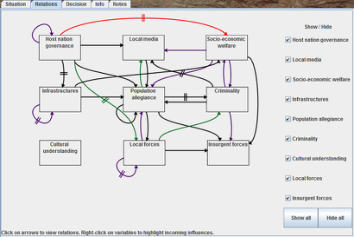
CODEM represents two decades of interdisciplinary research on human cognition in complex environments. In the present work, CODEM has now been updated to allow its deployment as a web-based modular simulation platform for dynamic decision research. It comprises six main interfaces— Situation, Relations, Prediction, Decision, Info, and Notes—each designed for cognitive process tracing (measure of info acquisition behaviors and duration; see Lafond et al., 2012). The scenario editor allows for full customization without programming expertise: the scenario designer can define variables, causal relations, feedback loops, opacity, and delays. Data logging captures every player action for behavioral analytics. The system supports both single-player and multiplayer configurations. Examples of possible scenarios include interagency operations, ecosystem or organisation management and societal governance. These simulations model the same principles of dynamic complexity and allow researchers to study information seeking, strategic reasoning, and learning under uncertainty (see Figure 1).
Figure 1: Relations tab displaying interconnections between variables allowing users to explore variable interactions. The red arrow indicates the active selection. Green and purple arrows refer to positive and negative effects. A double bar represents delayed impacts.
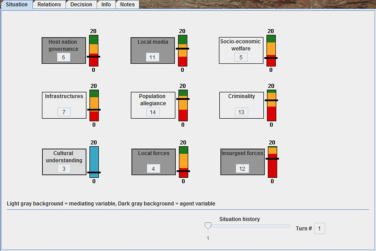
Depending on the configuration, participants engage in one of two task types. In the control mode, the goal is to stabilize the system by bringing all key factors into an equilibrium or “green zone,” (see Figure 2) similar to the goal of other microworlds such as Ecopolicy (see Lafond et al., 2012). In the prediction mode, participants do not intervene but must anticipate how the system will evolve over time based on its causal structure and initial conditions. This mode focuses on systems understanding and forecasting accuracy (see Forester, 1994).
Figure 2: Situation tab in CODEM showing variable states and color-coded indicators (green, orange, red) for each system dimension.
CODEM as a Testbed for Research and Development CODEM was conceived as an experimental platform to analyze human decision-making under controlled yet ecologically valid forms of complexity. It supports experimental manipulation of multiple system features (e.g., number of variables, feedback delays, opacity, and uncertainty), enabling the decomposition of how these properties influence cognitive performance, strategy, and learning.
Data logs record every decision, prediction, and action across turns, offering a detailed trace of cognitive processes. Measures include performance (goal attainment), process indicators (information-seeking frequency, feedback consultation), and metacognitive variables (confidence judgments, calibration accuracy). These indicators can be combined into indices of cognitive adaptability and system understanding. By tracing how individuals explore, infer, and adjust within such environments, microworlds offer a window into the mechanisms underlying human cognition—and its frequent breakdown—under complexity.
CODEM can also be employed as a research and development environment for testing decision-support systems (DSS) and explainable artificial intelligence (XAI) prototypes. Its modular architecture allows real- time integration of AI-based cognitive aids designed to enhance situation awareness, recommend adaptive strategies, or visualize causal structures. These integrations provide a human-in-the-loop framework to study how users interact with automated reasoning and explanations under uncertainty.
CODEM: A Microworld Platform for Research, Training, and Assessment 1481
This capability positions CODEM as a testbed for evaluating not only human cognition but also the transparency, trust, and usability of emerging XAI tools (see Tremblay et al., 2017).
CODEM as a Training Tool and Interactive Learning Environment CODEM was also designed to serve as a training environment aimed at improving cognitive readiness for complexity. The Interactive Learning Environment (ILE) component integrates interactive simulation, intelligent tutoring, and structured debriefing within a single platform. Training is designed around five skills: (1) system thinking and feedback reasoning, (2) adaptive problem-solving, (3) situation awareness, (4) metacognitive monitoring, and (5) transfer of learning. These skills collectively constitute cognitive readiness—the ability to anticipate, adapt, and sustain effective performance under uncertainty.
The pedagogical design follows a learning approach that promotes conceptual insight and metacognitive reflection. The training system includes four modules:
Tutorial Module: Introduces the concept of dynamic complexity and teaches the user interface using introductory scenarios.
Information Module: Presents conceptual content (feedback loops, time delays, leverage points) integrated with the ongoing scenario.
Intelligent Tutor: Monitors behavioral indicators in real-time. When poor strategies such as reactive or goal-distance allocation patterns are detected, the tutor intervenes with targeted prompts encouraging systemic thinking.
Debriefing Module: Provides a metacognitive review at the end of each scenario. It contrasts predicted versus actual outcomes, displays efficiency scores, and highlights optimal strategies.
Results from Lafond et al. (2014) showed that training with CODEM significantly increases the adoption of adaptive heuristics such as Net-Think, a systemic meta-heuristic balancing short-term interventions with long-term systemic control. In controlled studies, participants trained under CODEM improved their decision strategies, showing greater exploration, anticipation, and feedback use.
CODEM as a Psychometric Tool In modern personnel selection, organizations increasingly seek to evaluate more than technical expertise or general mental ability. The capacity to navigate uncertainty, manage interdependent goals, and adapt from feedback—collectively captured under the construct of CPS—is now seen as a key predictor of success in dynamic, innovation-driven workplaces (Funke, 2021). CODEM captures both performance outcomes and process- level behaviors, including information-seeking, exploration, and feedback integration, offering insight into how individuals reason rather than simply how well they perform (Lafond et al., 2012).
As a game-based assessment, CODEM may increase engagement and perceived fairness (Landers & Sanchez, 2022) while reducing faking effects. Behavioral analytics enable multidimensional scoring based on exploration efficiency, metacognitive regulation, and cognitive flexibility, aligning with advanced game analytics and psychometric modeling (DiCerbo, 2017). By combining ecological realism, adaptive measurement, and positive candidate experience, CODEM bridges cognitive science and applied HR practice. It complements traditional measures like GMA by assessing reasoning in motion—a dynamic indicator of system thinking and adaptability (Hodgetts et al., 2023).
Another advantage of CODEM is its capacity for scenario co-creation with organizational stakeholders. Tailoring the storyline, variables, and performance indicators to a specific role (e.g., policy analysis, operations management, or crisis coordination) increases both face validity and situational relevance. Customization ensures that participants engage with challenges that mirror the decision structures, trade-offs, and constraints of the target work activities.
CONCLUSION
As a microworld platform, CODEM unifies experimental precision, instructional innovation, and applied assessment. By reproducing the essential features of complexity—feedback, delay, interconnection, and emergence—CODEM provides researchers, educators, and practitioners with a robust tool, now deployable online, to study, train, and evaluate adaptive decision-making. It stands as both a cognitive laboratory and a human- centered assessment system for understanding how individuals navigate complexity in an increasingly interconnected world.
ACKNOWLEDGMENT
This work was supported by grants from the National Sciences and Engineering Research Council of Canada (NSERC) and Prompt Québec awarded to Sébastien Tremblay. Special thanks to Oleg Oulanov and Steven Thomas for the development of the new online version of the CODEM platform. We are also grateful to Michel DuCharme and Defence R&D Canada for CODEM.
REFERENCES
Béchard, B., Hodgetts, H. M., Teyssier-Roberge, G., Morneau-Guérin, F., Ouimet, M., & Tremblay, S. (2025). Breaking through the ‘wall of complexity’ in a politically themed microworld: A challenge for elected officials and the general public. Cognitive Processing, 26(3), 689–706. https://doi.org/10.1007/s10339- -025-01257-w. Béchard, B., Hodgetts, H., Morneau-Guérin, F., Ouimet, M., & Tremblay, S. (2023).
Political complexity and the pervading role of ideology in policy-making. Journal of Dynamic Decision Making, 9. https://doi.org/10.11588/jddm.2023.1.94755.
CODEM: A Microworld Platform for Research, Training, and Assessment 1483
Boyle, E. A., Hainey, T., Connolly, T. M., Gray, G., Earp, J., Ott, M., Lim, T., Ninaus, M., Ribeiro, C., & Pereira, J. (2016). An update to the systematic literature review of empirical evidence of the impacts and outcomes of computer games and serious games. Computers & Education, 94, 178–192. https://doi.org/10.1016/j.comped u.2015.11.003. Brehmer, B. (1992). Dynamic decision making: Human control of complex systems.
Acta Psychologica, 81(3), 211–241. https://doi.org/10.1016/0001–6918(92) 90019-A. Cronin, M. A., Gonzalez, C., & Sterman, J. D. (2009). Why don’t well-educated adults understand accumulation? Organizational Behavior and Human Decision Processes, 108(1), 116–130. https://doi.org/10.1016/j.obhdp.2008.03.003. Dörner, D., & Funke, J. (2017). Complex problem solving: What it is and what it is
not. Frontiers in Psychology, 8, 1153. https://doi.org/10.3389/fpsyg.2017.01153. Dörner, D., & Güss, C. D. (2022). Human error in complex problem solving and dynamic decision making: A taxonomy of 24 errors and a theory. Computers in Human Behavior Reports, 7, 100222. https://doi.org/10.1016/j.chbr.2022. 100222. Fiedler, K., Prager, J., & McCaughey, L. (2023). Metacognitive myopia: A major
obstacle on the way to rationality. Current Directions in Psychological Science, 32(1), 49–56. https://doi.org/10.1177/09637214221126906. Forrester, J. W. (1994). System dynamics, systems thinking, and soft OR. System Dynamics Review, 10(2–3), 245–256. https://doi.org/10.1002/sdr.4260100211. Funke, J. (2021). It requires more than intelligence to solve consequential world
problems. Journal of Intelligence, 9(3), 38. https://doi.org/10.3390/jintelligenc e9030038. Funke, J. (2025). Critical thinking : A key competency in the twenty-first century to deal with uncertainty and complexity. In R. J. Sternberg & W. Niu (Eds.), Critical thinking across disciplines : Applications in the digital age (Cham, Vol. 2, pp. 109–123). Springer Nature Switzerland. https://doi.org/10.1007/978–3-031– 82640-5_5. Gagnon, J.-F., Lafond, D., DuCharme, M. B., St-Louis, M.-E., DuCharme, M.
B., & Tremblay, S. (2012). Identification of adaptive behaviors and decision heuristics in a simulated strategic decision-making task. In Proceedings of the IEEE International Conference on Cognitive Methods in Situation Awareness and Decision Support (CogSIMA) (pp. 103–108). IEEE. https://doi.org/10.1109/CogS IMA.2012.6188406. Georgalos, K., & Nabil, N. (2025). Testing models of complexity aversion. Journal of Behavioral and Experimental Economics, 116, 102354. https://doi.org/10.1016/j. socec.2025.102354. Gonzalez, C., Vanyukov, P., & Martin, M. K. (2005). The use of microworlds to
study dynamic decision making. Computers in Human Behavior, 21(2), 273–286. https://doi.org/10.1016/j.chb.2004.02.014. Halford, G. S., Baker, R., & McCredden, J. E. (2005). How many variables can humans process? Psychological Science, 16(1), 70–76. https://doi.org/10.1111/j. 0956–7976.2005.00782.x. Herde, C. N., Wüstenberg, S., & Greiff, S. (2016). Assessment of complex problem
solving: What we know and what we don’t know. Applied Measurement in Education, 29(4), 265–277. https://doi.org/10.1080/08957347.2016.1209208. Ladyman, J., & Wiesner, K. (2020). What Is a Complex System? Yale University Press. https://doi.org/10.2307/j.ctv14rmpwc.
Lafond, D., DuCharme, M. B., Gagnon, J.-F., & Tremblay, S. (2012). Support requirements for cognitive readiness in complex operations. Journal of Cognitive Engineering and Decision Making, 6(4), 393–426. https://doi.org/10.1177/ 1555343412446193. Lafond, D., DuCharme, M. B., Rioux, F., Tremblay, S., Rathbun, B., & Jarmasz,
J. (2014). Training systems thinking and adaptability for complex decision making in defence and security. In Proceedings of the IEEE International Multi- Disciplinary Conference on Cognitive Methods in Situation Awareness and Decision Support (pp. 51–58). IEEE. https://doi.org/10.1109/CogSIMA.2012. 6188408. Landers, R. N., & Sanchez, D. R. (2022). Game-based, gamified, and gamefully designed assessments for employee selection: Definitions, distinctions, design, and validation. International Journal of Selection and Assessment, 30(1), 1–13. https: //doi.org/10.1111/ijsa.12376. Lurie, N. H., & Swaminathan, J. M. (2009). Is timely information always better? The effect of feedback frequency on decision making. Organizational Behavior and Human decision processes, 108(2), 315–329. https://doi.org/10.1016/j.obhdp.2008.05.005. Qudrat-Ullah, H. (2014). Yes we can: Improving performance in dynamic tasks.
Decision Support Systems, 61, 23–33. https://doi.org/10.1016/j.dss.2014.01.009. Sterman, J. D. (1989). Misperceptions of feedback in dynamic decision making.
Organizational Behavior and Human Decision Processes, 43(3), 301–335. https: //doi.org/10.1016/0749--5978(89)90041-1. Tremblay, S., Gagnon, J.-F., Lafond, D., Hodgetts, H. M., Doiron, M., & Jeuniaux, P.
(2017). A cognitive prosthesis for complex decision-making. Applied Ergonomics, 58, 349–360. https://doi.org/10.1016/j.apergo.2016.07.015.
LISTED IN THE AHFE DIGITAL BOOKSTORE CATALOGUE
Explore the complete digital volume
Human Factors in Design, Engineering, and Computing
Read this individual research paper free through the original publisher, or explore the full digital proceedings book.
ISBN 978-1-964867-75-5
Explore this ISBN in the AHFE Bookstore ↗Listed in the July 2026 bookstore catalogue; search by ISBN to confirm current availability · Digital book purchase optional