Stress is a multifaceted phenomenon impacting multiple cognitive functions, including decision-making, memory, and attention. In high-risk environments, these effects have significant safety implications. Therefore, it is essential to continuously and non-invasively assess stress levels of human operators, to eventually allow for real-time interventions that can lower the risk of errors or accidents. Ambulatory wearable monitoring technologies, including smart shirts and smartwatches, enable continuous tracking of physiological markers associated with stress, such as heart rate (HR) and respiration rate (RR). These technologies are increasingly integrated within Human-Autonomy Teaming (HAT) systems that can interpret human signals in real time, support decision making and prevent stress overload in demanding settings. Advances in artificial intelligence (AI), particularly machine learning (ML), make it possible to assess stress levels through detection models capable of estimating stress based on physiological markers. However, evidence shows that different types of stressors, such as cognitive, social and environmental stressors, elicit distinct physiological and psychological responses. Developing context-specific detection models requires a better understanding of how different stressors uniquely influence stress responses. This study addresses this need through an experimental validation within a simulation, paving the way to delineate the impact of different stressors on physiological stress signatures. The aim of this study was to compare the effect of three different stress-inducing methods on a set of physiological and subjective stress responses. The three stress manipulations included: a) time pressure alone; b) time pressure combined with a disturbing noise; and c) time pressure with social evaluation inspired by the Trier Social Stress Test. To this end, 120 participants were randomly assigned to one of three stress conditions within a five-scenario OpenMATB (Open Multi-Attribute Task Battery) protocol. Each participant completed a baseline, a tutorial, and two low-stress scenarios interleaved with a stressful scenario. Subjective measures included a Visual Analog Scale for Stress (VAS-Stress) and the NASA-TLX for workload, while HR and RR were continuously monitored using a Bioharness and a Fossil smartwatch. All subjective and physiological measures (VAS-Stress, NASA-TLX, HR, and RR) were compared across conditions and scenarios using 3 (Condition) × 5 (Scenario) mixed ANOVAs. Analyses tested whether physiological and subjective responses during stress induction differed from baseline and control trials. The results show that stress was effectively induced in the participants. Indeed, VAS, NASA-TLX, and RR scores varied significantly across scenarios, with stressful trials producing higher scores. A significant interaction between condition and scenario was observed for HR, revealing that the stressful scenario differed significantly from the two easy scenarios, but only within the social stress condition. These findings show that HR may be particularly sensitive to social stress, whereas subjective measures and RR appear to reflect overall stress levels. By highlighting different sensitivities across measures, the present study offers a more detailed view of stress responses. These results provide a basis for training AI agents to detect and respond to human stress states in real time, advancing the development of intelligent systems for high-risk operational contexts such as space missions, aviation, or emergency response.
Stress is a complex and multifaceted phenomenon that plays a central role in both psychological and physiological functioning (Giannakakis et al., 2019). Acute stress refers to a type of stress triggered by a specific event that feels new or is unpredictable (Arsalan et al., 2023). It can lead to many cognitive, emotional and physiological consequences (Crosswell & Lockwood, 2020). In experimental research, acute stress is often induced using manipulations such as increased workload, time pressure and social evaluative threat (Dismukes et al., 2015). The stress response consists of physiological and behavioural changes triggered by a stressor, defined as any stimulus that disrupts the body’s dynamic equilibrium (also known as homeostasis; Chu et al., 2025; Selye, 1984). When a potential threat is detected, the amygdala signals the hypothalamus, thus activating two stress response systems. The fast-acting sympathetic-adreno-medullary axis releases adrenaline, increasing heart rate, respiration, blood pressure, and alertness. The slower hypothalamic- pituitary-adrenal axis releases cortisol, sustaining arousal and energy availability (Chu et al., 2025).
Although the stress response is adaptive and essential for survival, considerable evidence suggests that it can negatively impact cognitive functioning (Dismukes et al., 2015). Notably, stress has been shown to impair attention (Crump et al., 2021), memory (Schwabe, 2025) and decision-making (Yu, 2016). These cognitive impairments present significant concerns in high-risk domains such as aerospace and aviation, where optimal cognitive performance is essential. In such contexts, stress is inherent and unavoidable. For instance, astronauts are exposed to numerous stressors during spaceflight, including isolation, excessive workload, microgravity and noise (Giguère et al., 2025a; Yin et al., 2023). These stressors are major contributors to safety breaches and, at times, fatal accidents (Dismukes et al., 2015). Findings from aviation accident analyses highlight this risk: among 212 flight crew errors examined across 12 major airline accidents, a large proportion was associated with failures in attention management, working memory limitations, and decision-making disruption, all of which are exacerbated by acute stress (Dismukes et al., 2015). In high-risk scenarios, strategies to reduce the impact of acute stress on cognitive performance are essential. One promising approach is human-autonomy teaming (HAT), in which human operators and autonomous agents work interdependently, sharing tasks and adapting to each other’s strengths and weaknesses (Lyons et al., 2021). By integrating near real-time stress monitoring into HAT models, autonomous systems could detect signs of operator overload and adjust task load (Korivand et al., 2024).
Stress monitoring can rely on both subjective and objective indicators. Subjective self-reports of stress are generally obtained using standardized and validated questionnaires, which contain one or multiple questions about the respondents’ experiences of stress (Dorsey et al., 2022). These questionnaires include, for example, the Acute Stress Disorder Scale (Bryant et al., 2000) and the Visual Analog Scale of Stress (VAS-S; Lesage et al., 2012). Objective indicators include several types of measures, among them physiological
measures which assess internal bodily responses using sensors, such as heart rate (HR) and respiratory rate (RR; Arsalan et al., 2023). Since most physiological measures are involuntary and regulated by the autonomic nervous system, they are often considered reliable indicators of stress (Giannakakis et al., 2019). Their use enables continuous monitoring with minimal demands and interruptions, making them particularly appropriate for monitoring operator state in adaptive systems (Teo et al., 2018). Ambulatory wearable monitoring devices, such as smart shirts (e.g., BioHarness or Hexoskin) and smartwatches (e.g., Fitbit), can track physiological activity in a non-invasive manner, which is especially valuable in dynamic environments. Integrated into adaptive HAT systems, detection models using these signals would allow for real- time interventions, augmenting performance and increasing psychological safety in multiple high-risk domains such as aviation and space exploration (Lyons et al., 2021). In fact, space health monitoring is already transitioning toward increasingly autonomous systems, designed to support crews during missions where contact with Earth is limited (CSA, 2021). These systems will eventually rely on wearable sensors to track indicators such as exercise and sleep, with artificial intelligence (AI) analysing the data in real time to enable quick interventions aimed at preserving health and psychological well-being (CSA, 2021).
Study Goal To be applicable in real-world contexts, stress detection models must demonstrate strong generalizability (Prajod et al., 2024). Yet, generalizability is often limited by the type of stressor, as different stressors may elicit distinct stress responses and, potentially, different physiological responses (Prajod et al., 2024). Systematically examining physiological responses across multiple stressors within the same experimental design could help characterize their unique and shared signatures. This could help build stress models that are more ecologically valid and, in the end, make HAT systems more effective. Building on this reasoning, the current paper takes preliminary steps toward the identification of physiological signatures associated with different types of stressors. This study provides a manipulation check for a stress-induction protocol using distinct types of stressors in a context involving multiple tasks typically faced by operators in aeronautical and aerospace situations.
To reach this goal, we asked participants to complete the Open Multi- Attribute Task Battery (OpenMATB; Cegarra et al., 2020). Different levels of stress scenarios (low and high) were presented. The high stress scenario could either involve: (1) time pressure (single cognitive stressor); (2) time pressure combined with a distracting noise (multiple cognitive stressors); and (3) time pressure with a social-evaluative component (social and cognitive stressor combination). Continuous physiological monitoring was conducted using a BioHarness Zephyr chest strap and a Fossil Gen 5 smartwatch. As a manipulation check, we aimed to determine whether all three conditions successfully induced stress during the high stress scenario, and whether different types of stressors elicited distinct subjective and physiological response patterns. It was hypothesized that all three conditions would elicit a stress response, reflected by higher subjective workload and stress scores,
Validating Stress Induction for Spaceflight Scenarios 205 as well as increased HR and RR. Additionally, at a more exploratory level, we anticipated that preliminary analyses might reveal condition-dependent differences in stress response patterns across stressor types.
METHODS
Participants One hundred and twenty participants were recruited for this study. Participants were 18 years or older, French speaking students or employees from Université Laval (63 women, 55 men, 2 non-binary individuals; mean age = 30.23 years; SD = 12.82). All participants had normal or corrected- to-normal vision and hearing, no reading difficulties and no diagnosed neurological disease. Participants were healthy and reported no clinical diagnosis that could influence their physiological response to stress. Informed consent was obtained twice: initially with a general description to minimize bias, and again after debriefing with the full study purpose. The study was approved by the Research Ethics Committee of Université Laval (No 2024- 335 A-1 / 31-01-2025).
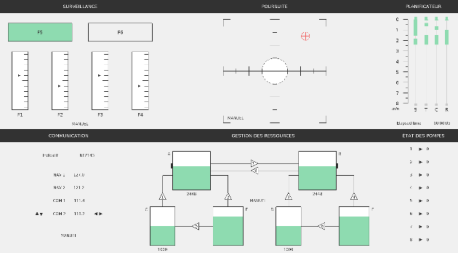
Materials and Procedure Before beginning the first task, participants completed a brief sociodemographic questionnaire including age, gender, education level, physical fitness level and employment status. After completing this questionnaire, a baseline measure was obtained by instructing participants to fixate on a cross displayed on a white screen for a duration of five minutes while physiological data were recorded. Throughout the experiment, HR and RR were continuously monitored using the BioHarness. For this study, we used features directly provided by the device and no further preprocessing was done. Participants were then asked to perform tasks of the OpenMATB (Cegarra et al., 2020) which requires participants to simultaneously perform four tasks. The task typically involves: (1) a monitoring task; (2) a tracking task; (3) an auditory communication task; and (4) a resource management task. Since the OpenMATB environment is configurable, only three of the four tasks were administered in this study. The tracking task was omitted to avoid inducing excessive mental workload, which could lead to participant disengagement.
Figure 1: Screenshot of the OpenMATB task interface (Cegarra et al., 2020).
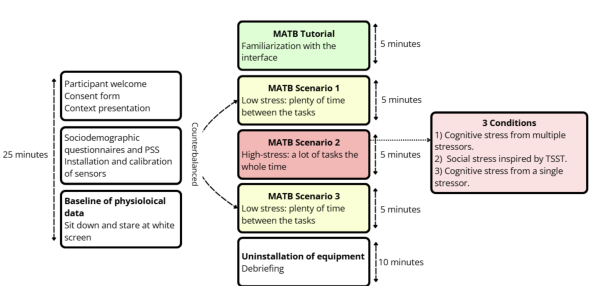
Participants completed four OpenMATB scenarios. The first scenario was the tutorial and was programmed to help the participants to familiarize themselves with the subtasks. The second, considered easy, was not intended to induce stress. The third was the only one where participants should feel stressed. The fourth was another easy scenario that was not expected to elicit stress. Participants were randomly assigned to one of three conditions (n = 40 per condition): a single stressor condition, where the only stressor was the task itself, a multiple stressors condition, where time pressure was combined with a noise that was generated to stress the participants, and a social stress condition, where time pressure was combined with the presence of an evaluator, a procedure inspired by the Trier Social Stress Test (TSST; Kirschbaum et al., 1993). In the middle of each scenario, the participants had to stop the task for 60 seconds and were asked to briefly describe their current situation. This data is not analysed here but will be the subject of other studies. After each task, participants rated their level of stress on a VAS-S (Lesage et al., 2012) scale with values ranging from 0 to 10. They also completed the NASA-Task Load IndeX (NASA-TLX; Hart & Staveland, 1988) to report their subjective workload level.
Figure 2: Experimental protocol with three stress conditions.
RESULTS
We analysed the differences in self-reported stress (VAS-S), self-reported workload (NASA-TLX), and mean HR and RR within each scenario and condition (see Giguère et al., 2025b for the dataset). To this end, we conducted a series of 3 (Condition: multiple stressors, social stress, single stressor) × 5 (Scenario: baseline, tutorial, low-stress 1, stressful, low-stress 2) mixed analyses of variances (ANOVAs). When the sphericity assumption was violated, we report Greenhouse-Geisser corrected p-values. Bonferroni corrections and Dunn’s method were performed for multiple comparisons and simple main effects analysis, respectively (Dunn’s corrected value for simple effect tests = .01875). Finally, Spearman correlations were carried out across all measures.
Validating Stress Induction for Spaceflight Scenarios 207 Subjective Measures
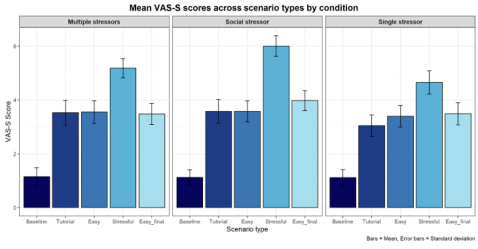
Figure 3 presents the VAS-S scores as a function of the Condition and Scenario. The 3 × 5 mixed ANOVA conducted on the VAS-S revealed a significant main effect of the Scenario, F(4, 468) = 97.923, p < .001, η2
Equation reproduced from the original PDF.Equation reproduced from the original PDF.
p = .02. Post hoc comparisons showed that the stressful scenario elicited significantly higher scores than other scenarios (ps < .001). Baseline scores were significantly lower than those from all other scenarios (ps < .001).
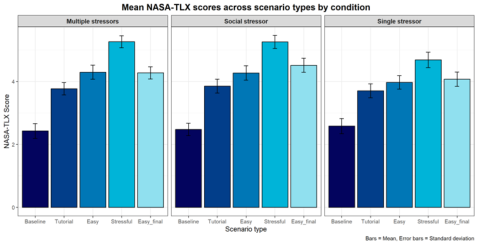
Regarding the NASA-TLX scores (see Figure 4), the analysis revealed a significant main effect of Scenario, F(4, 468) = 157.739, p < .001, η2
p = .57. Neither the main effect of Condition, F(2, 117) = 0.668, p = .515, η2
Equation reproduced from the original PDF.
p = .03, reached significance. As with VAS-S, post hoc analyses showed that the stressful scenario produced higher scores than all other scenarios (ps < .001). Baseline and tutorial scores were also lower than all other experimental scenarios (ps < .001).
Figure 3: Depiction of the VAS-S mean scores across scenarios and conditions. Error bars represent the standard error of the mean.Figure 4: Depiction of the NASA-TLX mean scores across scenarios and conditions. Error bars represent the standard error of the mean.
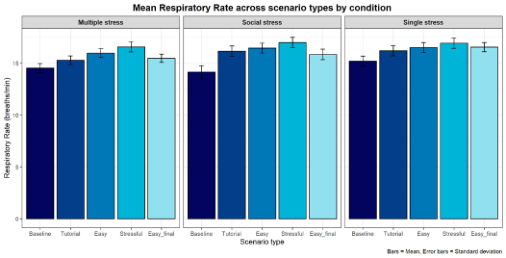
Objective Measures The analysis showed a significant main effect of Scenario regarding mean RR measures, F(4, 468) = 34.808, p < .001, η2
p = .23 (see Figure 5). However,
Equation reproduced from the original PDF.Equation reproduced from the original PDF.
p = .03. Post hoc analyses showed that the stressful scenario resulted in higher scores than all other scenarios (ps < .001) and baseline RR measures were lower than all others (ps < .001).
Figure 5: Depiction of the mean respiration rate (RR) across scenarios and conditions. Error bars represent the standard error of the mean.
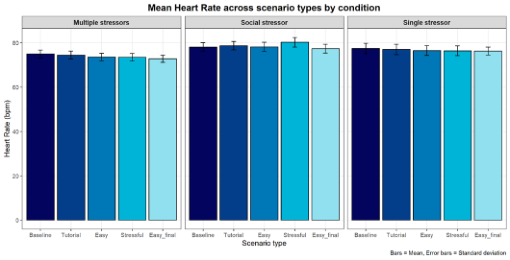
Regarding the mean HR values (see Figure 6), the analysis revealed a significant main effect of Scenario, F(4, 468) = 8.944, p < .001, η2
Equation reproduced from the original PDF.
p = .06, both indicating modest effect sizes. No main effect of Condition was observed, F(2, 117) = 2.184, p = .117, η2
p = .04. Decomposition of the interaction showed that, within each of the three conditions, at least one significant difference could be found across the five scenarios (Fs > 5.059, ps < .001). Within the Multiple stress condition, the mean HR measured during the second easy scenario was significantly lower than the one observed in the baseline (p = .007) and in the tutorial (p = .011). In the social stress condition, the stressful scenario induced a higher mean HR compared with the two easy scenarios (ps < .001). In the single stressor condition, the mean HR was lower in the second scenario compared with the HR measured during baseline (p = .020). Within each scenario, the differences between conditions did not reach significance once Dunn’s correction were applied (Fs < 3.551, ps > .032).
Figure 6: Depiction of the mean heart rate (HR) across scenarios and conditions. Error bars represent the standard error of the mean.
Validating Stress Induction for Spaceflight Scenarios 209 Relationships across Subjective and Objective Measures
Spearman’s rank-order correlations were conducted to examine the relationships between subjective stress (VAS-S), perceived workload (NASA- TLX), RR and HR, all averaged across the different scenarios. A strong, positive relationship was found between VAS-S and NASA-TLX scores, rS = .795, p < .001. RR showed a weak but statistically significant positive correlation with NASA-TLX scores, rS = .180, p = .049. All other correlations failed to reach significance.
DISCUSSION
The aim of the present study was to conduct a manipulation check to validate the stress induction procedure and to perform preliminary analyses assessing the subjective and physiological responses across the different stress conditions. Participants completed four MATB-II tasks, including one scenario designed to induce stress under different conditions (time pressure, time pressure with noise, or time pressure with a social-evaluative component). Throughout the task, subjective stress and workload were assessed using the VAS-S and the NASA-TLX, while continuous physiological activity (HR and RR) was recorded.
Results showed significant main effects of scenario on the VAS-S, NASA- TLX, HR and RR, indicating that participants reported higher stress and workload in the high-stress scenario, which also produced modest increases in HR and larger effects on RR. These results confirm that the stress induction method was effective, consistent with prior studies showing that MATB-II tasks can reliably induce stress (Kennedy & Parker, 2017; Nuamah, 2024).
With the stress manipulation validated, preliminary analyses were conducted. Correlation analyses revealed a strong relationship between NASA-TLX and VAS-S. RR showed only weak correlations with NASA- TLX, while HR showed no correlations. This is in line with previous studies, showing weak correlations between subjective and objective measures (Hilger et al., 2024). Mixed ANOVAs indicated that VAS-S, NASA- TLX and RR did not differ across conditions, suggesting that the type of stressor did not significantly impact the stress response. In contrast, HR showed a different pattern, with only the social stress condition producing a noticeable distinction between the stressful scenario and the easier ones. This pattern suggests that HR may be particularly sensitive to social- evaluative stress, which is consistent with previous findings showing that cardiovascular responses are activated in socially threatening situations (Hellhammer & Schubert, 2012; Kirschbaum et al., 1993). By comparison, RR and subjective measures appeared to capture overall stress levels but were not sensitive to the differences between stressor types. These results suggest that different stressors may elicit distinct physiological signatures. However, these findings remain preliminary, particularly given the minimal preprocessing. Replications across different samples are essential to validate these patterns and improve the generalizability of our results. Understanding these variations in stress responses to different stressors is key to building
more accurate stress detection models. This has important implications for the development of adaptive, context-sensitive models that can generalize across real-world settings, particularly in high-stakes environments, where operators are exposed to multiple sources of stress. In applied contexts such as HAT, this would allow for more tailored and effective interventions, which would ultimately reduce errors and accidents in high-risk environments.
CONCLUSION
In conclusion, this study demonstrates that the experimental manipulation successfully induced stress in participants, as shown by both self-reported and physiological measures. This confirms that our protocol can effectively elicit stress responses and may therefore support the development of HAT models. Furthermore, the observation that distinct stress protocols produced variations in both physiological and subjective responses emphasizes the importance of accounting for context-dependent patterns in stress response to develop accurate and generalizable stress models, applicable to high-risk settings.
ACKNOWLEDGMENT
The authors would like to acknowledge the valuable support from the Canadian Space Agency (CSA), the Canadian Safety and Security Program (CSSP), Mitacs, the Natural Sciences and Engineering Research Council (NSERC) and the Fonds de Recherche du Québec - Nature et Technologies (FRQNT). We also thank the Thales team and our research assistants, L. Berthod, L. Dionne and O. Morin, for their dedication in data collection, technical support and project management.
REFERENCES
Arsalan, A., Majid, M., Nizami, I.F., Manzoor, W., Anwar, S.M., Ryu, J. (2023).
“Human Stress Assessment: A Comprehensive Review of Methods Using Wearable Sensors and Non-wearable Techniques”, arXiv, [Preprint]. https://doi. org/10.48550/arXiv.2202.03033. Bali, A. and Jaggi, A.S. (2015). “Clinical experimental stress studies: methods and assessment”. Reviews in the Neurosciences, 26(5), 555–579. https://doi. org/10.1515/revneuro-2015-0004 Bryant, R.A., Moulds, M.L., Guthrie, R.M. (2000). “Acute Stress Disorder Scale: a
self-report measure of acute stress disorder”. Psychological Assessment, 12(1), 61–68. Canadian Space Agency. (2021). “Health Beyond: Report of the Advisory Council on Deep-Space Healthcare”. Available at: https://www.asc-csa.gc.ca/eng/ publications/health-beyond-report-advisory-council-deep-space-healthcare.asp (Accessed 13 November 2025). Cegarra, J., Valéry, B., Avril, E., Calmettes, C., Navarro, J. 2020. “OpenMATB: A
Multi-Attribute Task Battery promoting task customization, software extensibility and experiment replicability”. Behavioral Research Methods, 52(5), 1980–1990. https://doi.org/10.3758/s13428-020-01364-w
Validating Stress Induction for Spaceflight Scenarios 211 Chu, B., Marwaha, K., Sanvictores, T., Awosika, A.O., Ayers, D. (2025). “Physiology,
Stress Reaction”, in StatPearls. StatPearls Publishing. Available at https://pubmed. ncbi.nlm.nih.gov/31082164/ (Accessed: 10 November 2025). Crosswell, A.D., Lockwood, K.G. (2020). “Best practices for stress measurement: How to measure psychological stress in health research”. Health Psychology Open, 7(2), 2055102920933072. https://doi.org/10.1177/2055102920933072 Crump, C., Walenchok, S., Johnson, C., Pauszek, J., Young, D., 2021. “Stress,
Operator Error, and Transportation Accidents”. Proceedings of the Human Factors and Ergonomics Society Annual Meeting, 65(1), 1453–1458. https://doi. org/10.1177/1071181321651171 Dismukes, R.K., Goldsmith, T.E., Kochan, J.A. (2015). “Effects of Acute Stress on Aircrew Performance: Literature Review and Analysis of Operational Aspects”. NASA. Available at: https://ntrs.nasa.gov/citations/20190002685 (Accessed 10 November 2025). Dorsey, A., Scherer, E.M., Eckhoff, R., Furberg, R., (2022). “Measurement of human
stress: A multidimensional approach”. RTI Press, Occasional Paper, No. OP-0073- 2206. https://doi.org/10.3768/rtipress.2022.op.0073.2206 Giannakakis, G., Grigoriadis, D., Giannakaki, K., Simantiraki, O., Roniotis, A., Tsiknakis, M. (2019). “Review on Psychological Stress Detection Using Biosignals”. IEEE Transactions on Affective Computing, PP(99), 1–1. https://doi. org/10.1109/TAFFC.2019.2927337 Giguère, R., Benesch, D., Paul, T.S., Ouellet, D., Chamberland, C., Marois, A. and
Tremblay, S., 2025. “SPACE – Stress and Physiological Assessment in a Controlled Environment”. [dataset]. Zenodo. Available at: https://doi.org/10.5281/ zenodo.15330494 (Accessed: 27 November 2025). Giguère, R., Marois, A., Fortin-Guichard, D., Charest, J., Rocheleau, J., Thompson, K. Stolberg, M., St-Martin, P., Bergouignan, A., Niaussat, V., Paquette, J.S., Gagnon Sasseville, M., Rhéaume, C. (accepted). “Space Exploration and Lifestyle Medicine: A Narrative Review of its Implication for Astronaut Health and Remote Earth-Based Environments”. Frontiers in Physiology. Hart, S.G., Staveland, L.E. (1988). “Development of NASA-TLX (Task Load Index):
Results of Empirical and Theoretical Research”. Advances in Psychology, 52, 139–183. https://doi.org/10.1016/S0166-4115(08)62386-9 Hellhammer, J., Schubert, M. (2012). “The physiological response to Trier Social Stress Test relates to subjective measures of stress during but not before or after the test”. Psychoneuroendocrinology, 37(1), 119–124. https://doi.org/10.1016/j. psyneuen.2011.05.012 Hilger, K., Talic, I., Renner, K.-H. (2024). “Individual Differences in the
Correspondence Between Psychological and Physiological Stress Indicators”. bioRxiv, [Preprint]. https://doi.org/10.1101/2024.08.23.609328 Kennedy, L., Parker, S. (2017). “Making MATB-II medical: Pilot testing results to determine a novel lab-based, stress-inducing task”. Proceedings of the International Symposium on Human Factors and Ergonomics in Health Care, 6(1), 201–208. https://doi.org/10.1177/2327857917061044 Kirschbaum, C., Pirke, K.M., Hellhammer, D.H. (1993). “The ‘Trier Social Stress Test’:
a tool for investigating psychobiological stress responses in a laboratory setting”. Neuropsychobiology, 28(1-2), 76–81. https://doi.org/10.1159/000119004 Korivand, S., Galvani, G., Ajoudani, A., Gong, J., Jalili, N. (2024). “Optimizing Human–Robot Teaming Performance through Q-Learning-Based Task Load Adjustment and Physiological Data Analysis”. Sensors, 24(9), 2817. https://doi. org/10.3390/s24092817
Lesage, F.-X., Berjot, S., Deschamps, F. (2012). “Clinical stress assessment using a visual analogue scale”. Occupational Medicine, 62(8), 600–605. https://doi. org/10.1093/occmed/kqs140 Li, Y.-H., Qu, L.-N., Chen, H.-L. (2013). “Space stress injury and related protective
measures”. Sheng Li Ke Xue Jin Zhan, 44(5), 354–358. Lyons, J.B., Sycara, K., Lewis, M., Capiola, A. (2021). “Human–Autonomy Teaming: Definitions, Debates, and Directions”. Frontiers in Psychology, 12, 589585. https://doi.org/10.3389/fpsyg.2021.589585 Nuamah, J. (2024). “Effect of recurrent task-induced acute stress on task
performance, vagally mediated heart rate variability, and task-evoked pupil response”. International Journal of Psychophysiology, 198, 112325. https://doi. org/10.1016/j.ijpsycho.2024.112325 Prajod, P., Mahesh, B., André, E. (2024). “Stressor Type Matters! — Exploring Factors Influencing Cross-Dataset Generalizability of Physiological Stress Detection”. arXiv, [Preprint]. https://doi.org/10.48550/arXiv.2405.09563 Schwabe, L., (2025). “Memory Under Stress: From Adaptation to Disorder”. Biological
Psychiatry, 97(4), 339–348. https://doi.org/10.1016/j.biopsych.2024.06.005 Selye, H. (1984). The Stress of Life. McGraw-Hill Education. Teo, G., Reinerman-Jones, L., Matthews, G., Szalma, J., Jentsch, F., Hancock, P.
(2018). “Enhancing the effectiveness of human-robot teaming with a closed- loop system”. Applied Ergonomics. 67, 91–103. https://doi.org/10.1016/j. apergo.2017.07.007 Yin, Y., Liu, J., Fan, Q., Zhao, S., Wu, X., Wang, J., Liu, Y., Li, Y., Lu, W. (2023). “Longterm spaceflight composite stress induces depression and cognitive impairment in astronauts-insights from neuroplasticity”. Translational Psychiatry, 13(1), 342. https://doi.org/10.1038/s41398-023-02638-5 Yu, R. (2016). “Stress potentiates decision biases: A stress induced deliberation-
to-intuition (SIDI) model”. Neurobiology of Stress, 3, 83–95. https://doi. org/10.1016/j.ynstr.2015.12.006
LISTED IN THE AHFE DIGITAL BOOKSTORE CATALOGUE
Explore the complete digital volume
Human Interaction and Emerging Technologies (IHIET-AI 2026): Artificial Intelligence and Future Applications
Read this individual research paper free through the original publisher, or explore the full digital proceedings book.
ISBN 978-1-964867-77-9
Explore this ISBN in the AHFE Bookstore ↗Listed in the July 2026 bookstore catalogue; search by ISBN to confirm current availability · Digital book purchase optional