François Vachon, Sébastien Tremblay (2019). What Eye Tracking Can Reveal about Dynamic Decision-Making. In: Advances in Cognitive Engineering and Neuroergonomics. AHFE Open Access, vol. 7. https://doi.org/10.54941/ahfe100226
While eye tracking can provide invaluable information on visual cognition, it is uncertain whether the pattern of one’s ocular behavior could reflect mental processes beyond the mere visual encoding of task-relevant information. The present study is concerned with the use of eye-movement measures as indicators of the cognitive processing involved in situation monitoring and dynamic decision-making tasks. In the context of a computer-controlled simulation of radar-based risk assessment, we monitored eye movements and extracted metrics relative to 1) scanpath, 2) eye fixations, and 3) pupillary response in order to predict the quality of decisions and time taken to classify aircraft displayed on a radar screen according to their threat level. Based on multiple regressions performed on almost 10,000 classifications, eye-tracking data can explain 77.9% of the variance in decision time but failed to predict classification accuracy. However, when regressions were applied to individual differences, eye movements can predict both classification time (69.2%) and accuracy (45.9%). While the analysis of scanpath and fixation duration is a good indicator of information seeking and can predict the time taken to make a decision, pupil dilation appears to be informative on the quality of that decision. These findings show how dynamic, event-based measures of eye movements could serve as an assessment method that goes beyond traditional usability testing and provide insights in the design of user interface and decision support systems.
Dynamic decision-making involves a sequence of multiple interdependent decisions made in real-time in a continuously evolving environment. In dynamic environments such as air-traffic control, emergency response and security surveillance, there are severe constraints to information processing and decision-making. Indeed, situation uncertainty, information overload, multitasking, time pressure and fatigue may all impose a heavy demand on cognition. System operators must constantly monitor, assess, and integrate incoming information in order to make decisions in these complex task environments. In order to maximize operators’ performance, there is a need for an effective technological support of dynamic decision-making (Gonzales, 2005). To benefit fully from technological advances being made with decision support and user interface technologies, it is essential to first understand the cognitive processes and limitations of the human operator.
One avenue to achieve such an understanding and to characterize the pattern of information processing limitations related to continuous monitoring and dynamic decision-making tasks is using eye tracking in a manner that is closely linked to the dynamics of the situation (e.g., Vachon, Vallières, Jones, & Tremblay, 2012). The tracking of eye movement can provide online, non-obtrusive indices of cognitive functioning: Oculometry has been invaluable in investigating cognitive processes such as those involved in reading and memory (Rayner, 2009; Theeuwes, Belopolsky, & Olivers, 2009). Eye tracking can also offer insights into the design of system interface as well as diagnostic information in usability testing (Goldberg & Kotval, 1999). However, there is debate as to whether oculometry can truly reveal the underlying cognitive processes involved in monitoring and dynamic decision- making tasks.
Views are mixed with regards to the extent to which oculometry can reveal the functioning of mental processes. There is a relative consensus with regards to the view that eye movements can reflect online information processing (Pearson & Sahraie, 2003; Zelinsky, 2008) but some researchers claim that eye movements do not indicate processing that follows the encoding of information (Anderson et al., 2004). We wish to contribute to the testing of the so-called mind-eye hypothesis—the correspondence between eye gaze and information processing—and address the issue of whether eye movements may reflect mental processes beyond the mere visual encoding of task-relevant information. Eye tracking can provide a ‘trace’ of where one’s attention is directed on a visual display. For instance, in search or monitoring tasks, analyzing the pattern of alternation of fixations and saccades to various regions of interest of a visual scene, assumed to be under top-down attentional control (Privitera, 2006), can reveal how efficient is the search for information. An optimal ‘scanpath’ is typically considered as being a straight line to desired target information, with relatively short fixation duration at the target (e.g., Poole & Ball, 2006). Measuring eye fixations can also reveal the amount of processing applied to objects. In fact, the time spent fixating a location can be considered as an index of the encoding effort, where longer fixation durations are usually associated to more engagement in interpreting or relating the component representations in the interface to internalized representations (e.g., Just & Carpenter, 1976; Goldberg & Kotval, 1999). Besides measurements of eye movements per se, other eye-tracking metrics can be informative about cognitive processing. For example, pupil dilation, which is influenced by autonomic nervous system activities, has been shown to be sensitive to various psychological manipulations such as cognitive workload (e.g., Beatty, 1982; Pomplun & Sunkara, 2003) and arousal (e.g., Murphy, Roberston, Balsters & O’Connell, 2011). Nevertheless, it is not clear whether the movements of our eyes can be informative on the nature of higher-level mental processes such as reasoning and dynamic decision-making. The present study aims at testing whether eye movement can be used to predict decision quality as well as the time taken to make a decision.
The present research adopts an experimental methodology that attempts to bridge the gap between basic and applied research by maintaining both empirical control—hence the ability to identify causal relationships—and external realism through the use of a synthetic environment or microworld (see Brehmer & Dörner, 1993). In the context of a low-level computer-controlled simulation of single ship naval above-water warfare (see Hodgetts, Vachon, & Tremblay, 2014; Rousseau, Tremblay, Lafond, Vachon, & Breton, 2007; Vachon et al., 2012), a single participant playing the role of a tactical coordinator has to monitor a radar screen representing the airspace around the ship, be sensitive to changes to air traffic in the operational space, evaluate the threat level of every aircraft moving in the vicinity of the ship based on a list of parameters, and take appropriate defensive measures against hostile aircraft. In this study, dynamic decision-making was evaluated through the classification of aircraft according to the level of threat they posed to the ship.
Beyond the classical static analysis of pre-defined regions of interest, we adopted an approach of eye-tracking analysis that is closely related to the dynamics of the situation and in synchrony with specific events, such as the sequence of information intake that precedes a decision within a given time window. By tracking the sources of information that are gathered during decision-making tasks (measures related to scanpath and fixation durations) and measuring attentional engagement (indexed by pupil dilation) within a decision-time window (the time between the selection of an aircraft and its classification), a set of well-established eye-movement metrics are tested for their ability to predict the decision outcome and decision time in the context of dynamic decision-making.
METHOD
Participant Twenty students from Université Laval (10 men; mean age: 22.5 years) reporting normal or corrected-to-normal vision took part in the experiment. They received $20 compensation for their participation in a single 2-hr experimental session.
Material Eye movements were recorded with a Tobii T1750 eye tracker at a sampling rate of 50 Hz. The threshold to detect an eye fixation was set at 100 ms and the fixation field corresponds to a circle with a 30-pixel radius.
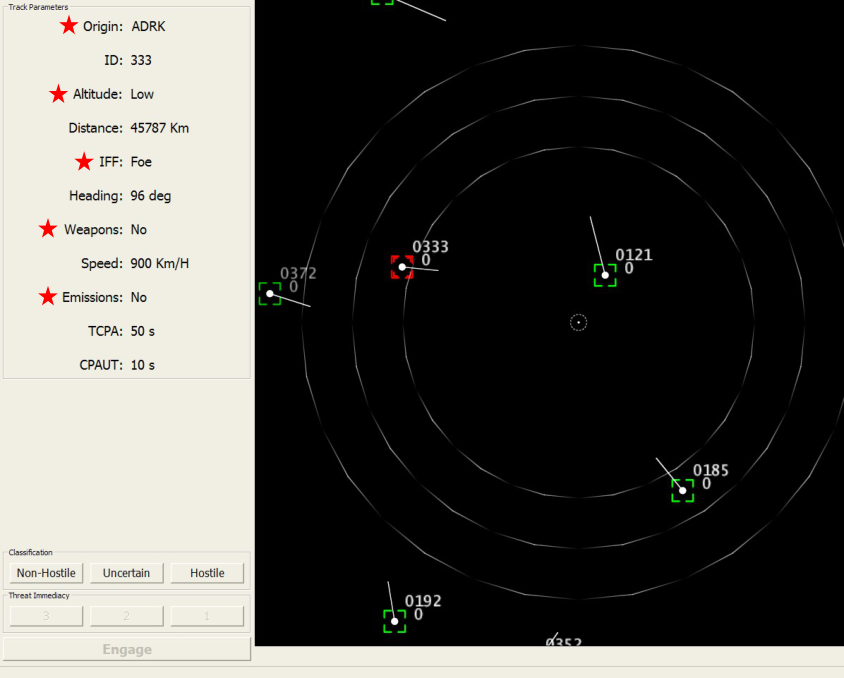
We used a low-level, computer-controlled simulation of naval air-defense. This simulation is dynamic and evolves according to a scenario in interaction with the operator’s actions. Typical scenarios involve multiple aircraft moving in the vicinity of a ship with possible attacks requiring retaliatory missile firing from the ship. The participant plays the role of tactical coordinator who must observe and comprehend the operational space, conduct threat assessments including the categorization and prioritization of threats, and plan and schedule the application of combat power. See Figure 1 for a description of the various parts of the visual interface.
Task Participants assessed the level of threat posed by an aircraft by classifying it as non-hostile, uncertain, or hostile. They had to take into account 5 out of the 11 parameters displayed in the list (see Figure 1), none of them being intrinsically more important than the others. Each critical parameter can take either a threatening or a non- threatening value. Participants were asked to employ the following classification rule based on the number of threatening cues to classify aircraft appearing on their radar: An aircraft is ‘non-hostile’ when it shows 0–1 threatening cue, ‘uncertain’ when it manifests 2–3 threatening cues, and ‘hostile’ if it exhibits 4–5 threatening cues. When a decision was made, participants had to click on the corresponding classification button. The white dot representing the selected aircraft changed color according to the level of threat assigned to it: green (non-hostile), yellow (uncertain), or red (hostile). Given that threat level could change over time, participants had to check regularly the parameters of previously classified aircraft in order to determine whether they need reassessment.
Procedure Following a tutorial describing the context of the simulation and the task, participants undertook the threat- evaluation task from static screenshots to verify their understanding. Familiarity with the simulation was established in two training sessions, each comprised of four 3-min scenarios. After calibrating the eye tracker, participants performed four randomized experimental blocks comprised of four 4-min scenarios of similar difficulty. Each scenario involved 27 aircraft (8 hostile) varying in speed and trajectory. A maximum of 10 aircraft could appear on the radar screen at the same time.
Eye-Tracking Metrics Among the various ways in which eye movements can be measured to study cognitive functioning, Poole and Ball (2006) identified different categories of eye-movement metrics, each reflecting the action of specific cognitive processes. In the present study, we focused on three of these categories: scanpath, fixations, and pupil size. Although multiple metrics can be extracted in each category, we decided to focus on a single metric per category to prevent any potential multicollinearity issue. Scanpath metrics relate to saccade-fixation-saccade sequences of eye movements. To index the efficacy in information seeking, we extracted the scanpath length, which is the mean number of pixels in the scanpath associated with a classification, from the start of the decision to the time when a decision is made. Longer scanpaths indicate less efficient searching. Fixation metrics measure what type of information is extracted and processed. To estimate the processing (or encoding) time during dynamic decisionmaking, we analyzed the mean time (in ms) spent fixating decision-relevant parameters during a classification. Longer fixation times suggest increased processing of relevant information. Pupillometry measures variations in the pupil diameter during dynamic decision-making. To index the level of cognitive load, we computed the percentage of change in pupil size (%CPS) during the classification compared to a baseline level. This baseline corresponded to the average dilation level computed during all classifications for each participant. An increase in pupil diameter reflects a higher cognitive load and a greater attentional engagement.
Figure 1. Screenshot of the simulation visual interface. This interface can be divided into three parts: 1) A radar display depicting in real-time all aircraft (represented by a white dot surrounded by a green square) moving at various speeds and trajectories around the ship (represented by the central point); 2) A parameters list providing information on a number of parameters about the selected aircraft; 3) A set of action buttons allowing the participant to allocate ‘threat level’ and ‘threat immediacy’ to an aircraft and, to engage with missile fire a candidate ‘hostile’ aircraft. The red stars indicate the five parameters relevant to perform the classification task. Threat immediacy and engagement actions were not part of the present study.
RESULTS
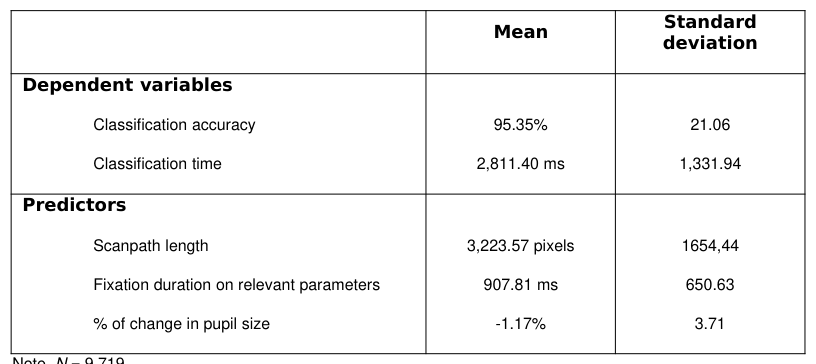
To determine whether eye movements can predict decision quality and time, we performed multiple regressions testing the prediction of classification accuracy (i.e. the percentage of correct classification) and classification time (i.e. the time between the selection and the classification of an aircraft) from the three eye-movement metrics (scanpath length, fixation duration, and %CPS). Table 1 presents descriptive statistics for the dependent variables and predictors computed over 9,719 classifications recorded across all scenarios of all participants. The results of the two regressions are presented in Table 2.
Table 1. Descriptive statistics for the two dependent variables and the three predictors computed over all classifications.
Although the regression performed on classification accuracy was significant (due to the large number of classifications), the three predictors explained only 0.6% of the variable, suggesting that eye movements do not contribute to distinguish between correct and incorrect decisions. However, eye-movement metrics significantly predicted 77.8% of the variance in classification time, indicating that eye movements were good predictors of decision time. Among the three metrics, scanpath length constitutes the best predictor, explaining 65.8% of the variance in classification time on its own. Fixation duration on relevant parameters significantly contributed another 12.0% of explained variance while %CPS significantly increased R2 by only 0.1%.
Because classification accuracy is a binary variable (correct or incorrect) we also performed a logistic regression on these data. Like the linear regression, the logistic regression with the three predictors failed to appropriately predict decision quality as the 452 incorrect classifications were classified as being correct by the regression model.
Table 2. Results from the multiple regressions predicting classification accuracy and classification time from the three eye-movement metrics based on all classifications.
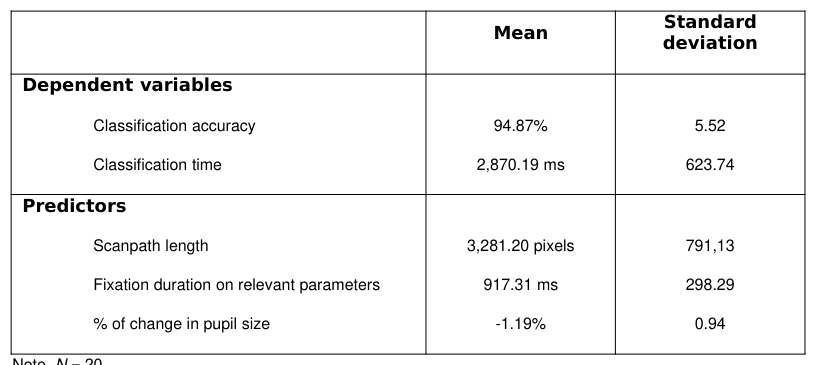
An inspection of Table 1 reveals somewhat high standard deviations for the dependent variables, which could potentially indicate a high level of individual differences. Such differences could be indicative, for instance, of various scanning strategies, which could have the potential to provide additional insight into decision making. Therefore, we performed the same regression analyses on eye-tracking data computed for each of the 20 participants. Descriptive statistics for the dependent variables and predictors are presented in Table 3 whereas the results of the two regressions are presented in Table 4.
Table 3. Descriptive statistics for the two dependent variables and the three predictors computed per participant.
With regards to the prediction of classification time, the results from a linear regression performed on individual data were similar to those found when the analysis was carried out on all classifications. Indeed, eye-tracking metrics significantly predicted 69.2% of the variation in classification time. This time, however, both fixation duration on relevant parameters and scanpath length contributed almost equally to the prediction, being responsible for 37.9% and 36.0% of explained variance, respectively. The contribution of %CPS was not significant. In stark contrast with the failure of eye movements to predict classification accuracy based on all classifications, the regression based on individual differences revealed that the three eye-tracking measures significantly predict 45.9% of the variance of decision accuracy. In fact, this level of prediction can be attributed almost exclusively to %CPS, which explained 45.7% of the variance in classification accuracy on its own.
Table 4. Results from the multiple regressions predicting classification accuracy and classification time from the three eye-movement metrics based on all individual differences.
Table available in the original PDF paper.
DISCUSSION
In the context of a simulated, complex dynamic task, we aimed at determining whether eye-tracking data can be used to predict decision-making efficiency in terms of accuracy and time taken to make the decision. Adopting an event-based approach to eye tracking during threat evaluation, the results revealed that scanpath and fixation measures can be predictive of decision time regardless of whether data were pooled across participants or not whereas the pupillary response is a good predictor of decision quality, at least when taking individual differences into consideration. Overall, these findings confirm that eye movements offer a way to capture ‘online’ cognitive processing related to information seeking and decision-making.
Of course, there is other ways by which oculometry can tell us a great deal about the pattern of information seeking and decision-making. Because it interferes minimally with the decision-making process compared to other methods (Morrison, Marshall, Kelly, & Moore, 1997; Rehder & Hoffman, 2005), eye tracking is an increasingly popular method for process tracing and policy capturing. These analytical techniques aim to characterize how people actually make a decision, and extract strategies and heuristics (Ford, Schmitt, Schechtman, Hults, & Doherty, 1989). Such a dynamic pattern of information seeking as revealed by eye movements can inform our understanding of dynamic decision-making (Glaholt & Reingold, 2011). For instance, using a similar simulation of maritime dynamic decision-making, Lafond et al. (2009) provided evidence that threat evaluation was based on a fast-and-frugal decision heuristic through the analysis of fixations on the key attributes looked at prior to making a classification. Another interesting approach is the use of formal computational models to enhance the predictive sensitivity and specificity of eye movements. By exploiting such a technique in the context of a static, probabilistic value-based decision-making task, Cavanagh, Wiecki, Kochar, and Frank (2014) recently showed that gaze time and pupillometry can reflect the operations of dissociated latent decision processes.
Based on the current approach of online eye-tracking analysis, the combination of time-related ocular metrics appeared to provide very good estimates of decision time. This finding can be summarized as saying: the more distance the eyes cover and the longer the eyes look at relevant information, the longer it takes for a decision to be made. Although this may be seen as an obvious result, this predictive power of eye movements can have important implications for the implementation of adaptive aiding systems (e.g., cognitive countermeasures; see Dehais, Causse, & Tremblay, 2011) and adaptive tutoring systems. A critical aspect of adaptive interfaces is to provide help in a timely and accurate matter (Visser & Parasuraman, 2011). Adaptive automation based on an online prediction of the operators’ cognitive functioning represents a promising solution to this challenge (Sheridan, 2011). Oculometrically- and psychophysiologically-activated adaptive aiding is, in a sense, a special case of brain- computer interface wherein the purpose is not direct control but rather monitoring and providing aiding to operators to enable them to work more effectively (Christensen & Estepp, 2013). The present findings also showed that Cognitive Engineering and Neuroergonomics (2019) individual differences in pupillary response can predict a fair amount of variation in decision quality. This suggests that at the individual level, eye tracking through the online analysis of variation on pupil dilation can be indicative of the ability to manage workload and deal with information overload and stressful situations, crucial in making accurate decisions. Such a finding is also in line with the adaptive automation approach since it has been claimed that individual differences in cognitive functioning should be taken into consideration as user models in the implementation of computer-based adaptive and intelligent technologies (Pronovost, Roberts, & Banbury, 2008). Overall, the present pattern of results provides further support to the idea that the online measurement of eye movements, combined or not with other behavioral and physiological measurements can provide information about the objective and subjective state of an operator within a mission context and then provide a basis for the intelligent adaptation of computer-based aid or tutor (Banbury, Gauthier, Scipione, & Hou, 2005).
With regards to the mind-eye hypothesis, our findings show some limitations to what eye movements can reveal about “internal” cognition. Indeed, the correspondence between the pattern of eye movements and high-level mental processes is not perfect as reflected by the failure to predict the overall pattern of decision accuracy—i.e. without considering individual differences—based on a combination of various eye-tracking metrics supposed to reflect different facets of information processing. It is possible that given the complexity of cognitive functioning, the relationship between eye movements and cognitive processes occurs at a rather complex level that is not detectable with a linear approach. Nevertheless, the present findings illustrate how dynamic, event-based measures of eye movements could serve as an assessment method that goes beyond traditional usability testing and provide invaluable insights in the design of decision support systems.
ACKNOWLEDGMENT
A special thanks is due to Guillaume Hervet for is assistance with data analysis. This work was supported by a R&D partnership grant from the National Sciences and Engineering Research Council of Canada with Thales Canada, Systems Division, awarded to Sébastien Tremblay.
REFERENCES
Anderson, J. R., Bothell, D., & Douglass, S. (2004). Eye movements do not reflect retrieval. Psychological Science, 15, 225–231.
doi:10.1111/j.0956-7976.2004.00656.x Banbury, S., Gauthier, M., Scipione, A., & Hou, M. (2005). Intelligent adaptive systems literature research of design guidance for intelligent adaptive automation and interfaces. Contract Report, DRDC Toronto CR 2007-075. Beatty, J. (1982). Task-evoked pupillary responses, processing load, and the structure of processing resources. Psychological
Bulletin, 91, 276–292. doi:10.1037/0033-2909.91.2.276. Brehmer, B., & Dörner, D. (1993). Experiments with computer-simulated microworlds: Escaping both the narrow straits of the laboratory and the deep blue sea of the field study. Computers in Human Behavior, 9, 171–184. doi:10.1016/0747- 5632(93)90005-D Cavanagh, J. F., Wiecki, T. V., Kochar, A., & Frank, M. J. (2014, February 17). Eye tracking and pupillometry are indicators of
dissociable latent decision processes. Journal of Experimental Psychology: General. Advance online publication. doi:10.1037/a0035813 Christensen, J. C., & Estepp. J. R. (2013). Coadaptive aiding and automation enhance operator performance. Human Factors, 55, 965–975. doi:10.1177/0018720813476883 Dehais, F., Causse, M., & Tremblay, S. (2011). Mitigation of conflicts with automation: Use of cognitive countermeasures.
Human Factors, 53, 448–460. doi:10.1177/0018720811418635 Ford, J. K., Schmitt, N., Schechtman, S. L., Hults, B. M., & Doherty, M. L. (1989). Process tracing methods: Contributions, problems, and neglected research questions. Organizational Behavior and Human Decision Processes, 43, 75–117. doi:10.1016/0749-5978(89)90059-9 Glaholt, M. G., & Reingold, E. M. (2011). Eye movement monitoring as a process tracing methodology in decision making
research. Journal of Neuroscience, Psychology, and Economics, 4, 125–146. doi:10.1037/a0020692 Gonzalez, C. (2005). Decision support for real-time, dynamic decision-making tasks. Organizational Behavior and Human Decision Processes, 96, 142–154. doi:10.1016/j.obhdp.2004.11.002 Hodgetts, H. M., Vachon, F., & Tremblay, S. (2014). Background sound impairs interruption recovery in dynamic task situations:
Procedural conflict? Applied Cognitive Psychology, 28, 10–21. doi:10.1002/acp.2952 Just, M. A., & Carpenter, P. A. (1976). Eye fixations and cognitive processes. Cognitive Psychology, 8, 441–480.
doi:10.1016/0010-0285(76)90015-3 Lafond, D., Champagne, J., Hervet, G., Gagnon, J.-F., Tremblay, S., & Rousseau, R. (2009). Decision analysis using policy capturing and process tracing techniques in a simulated naval air-defense task. Proceedings of the 53th Human Factors and Ergonomics Society Annual Meeting (pp. 1220–1224). Santa Monica, CA: Human Factors and Ergonomics Society. Morrison, J. G., Marshall, S. P., Kelly, R. T., & Moore, R. A. (1997). Eye tracking in tactical decision making environments:
Implications for decision support evaluation. Proceedings of the 3th International Command and Control Research and Technology Symposium (pp. 1–12). Fort McNair, DC. Murphy, P. R., Robertson, I. H., Balsters, J. H., & O’Connell, R. G. (2011). Pupillometry and P3 index the locus coeruleusnoradrenergic arousal function in humans. Psychophysiology, 48, 1531–1542. doi:10.1111/j.1469-8986.2011.01226.x Pearson, D. G., & Sahraie, A. (2003). Oculomotor control and the maintenance of spatially and temporally distributed events in
visuo-spatial working memory. Quarterly Journal of Experimental Psychology, 56A, 1089–1111. doi:10.1080/02724980343000044 Pomplun, M. & Sunkara, S. (2003). Pupil dilation as an indicator of cognitive workload in human-computer interaction. In D.
Harris, V. Duffy, M. Smith & C. Stephanidis (Eds.), Human-Centred Computing: Cognitive, Social, and Ergonomic Aspects. Vol. 3 of the Proceedings of the 10th International Conference on Human-Computer Interaction (pp. 542–546). Poole, A., & Ball, L. J. (2006). Eye tracking in human-computer interaction and usability research. In C. Ghaoui (Ed.), Encyclopedia of human computer interaction (pp. 211–219). Hershey, PA: Idea Group Reference. Privitera, C. M. (2006). The scanpath theory: Its definitions and later developments. Proceedings of SPIE, 6057, 87–91.
doi:10.1117/12.674146. Pronovost, S., Roberts, S., & Banbury, S. (2008). A study of suitable learning styles for adaptive learning and intelligent tutoring methods. CAE Professional Services Report to DRDC Toronto. Rayner, K. (2009). Eye movements and attention in reading, scene perception, and visual search. The Quarterly Journal of
Experimental Psychology, 62, 1457–506. doi:10.1080/17470210902816461. Rehder, B., & Hoffman, A. B. (2005). Thirty-something categorization results explained: Selective attention, eyetracking, and models of category learning. Journal of Experimental Psychology: Learning, Memory, and Cognition, 31, 811–829. doi:10.1037/0278-7393.31.5.811 Rousseau, R., Tremblay, S., Lafond, D., Vachon, F., & Breton, R. (2007). Assessing temporal support for dynamic decision
making in C2. Proceedings of the Human Factors and Ergonomics Society 51st Annual Meeting (pp. 1259–1262). Santa Monica, CA: Human Factors and Ergonomics Society. Sheridan, T. (2011). Adaptive automation, level of automation, allocation authority, supervisory control, and adaptive control: Distinctions and modes of adaptation. Systems, Man and Cybernetics, Part A: Systems, 41, 662–667. doi:10.1109/TSMCA.2010.2093888 Theeuwes, J., Belopolsky, A. V., & Olivers, C. N. L. (2009). Interactions between working memory, attention and eye
movements. Acta Psychologica, 132, 106–14. doi:10.1016/j.actpsy.2009.01.005, Tremblay, S., & Saint-Aubin, J. (2009). Evidence of anticipatory eye movements in the spatial Hebb repetition effect: Insights for modeling sequence learning. Journal of Experimental Psychology: Learning, Memory, & Cognition, 35, 1256–65. doi:10.1037/a0016566 Tremblay, S., Saint-Aubin, J., & Jalbert, A. (2006). Rehearsal in serial memory for visual-spatial information: Evidence from eye
movements. Psychonomic Bulletin and Review, 13, 452–57. doi:10.3758/BF03193869 Vachon, F., Vallières, B. R., Jones, D. M., & Tremblay, S. (2012). Nonexplicit change detection in complex dynamic settings: What eye movements reveal. Human Factors, 54, 996–1007. doi:10.1177/0018720812443066. Visser, E. D., & Parasuraman, R. (2011). Adaptive aiding of human-robot teaming: Effects of imperfect automation on
performance, trust, and workload. Journal of Cognitive Engineering and Decision Making, 5, 209–231. doi:10.1177/1555343411410160 Zelinsky, G. J. (2008). A theory of eye movements during target acquisition. Psychological Review, 115, 787–835.
doi:10.1037/a0013118
LISTED IN THE AHFE DIGITAL BOOKSTORE CATALOGUE
Explore the complete digital volume
Advances in Cognitive Engineering and Neuroergonomics
Read this individual research paper free through the original publisher, or explore the full digital proceedings book.
ISBN 978-1-4951-2101-2
Explore this ISBN in the AHFE Bookstore ↗Listed in the July 2026 bookstore catalogue; search by ISBN to confirm current availability · Digital book purchase optional