Mikako Itoa, Atsushi Endob, Yuka Takaic, Takashi Yoshikawad, Akihiko Gotoc, Noriaki Kuwaharab (2018). Study on Kind Transfer Assistance Between Wheelchair and Bed In the Case of Eye Movement Analysis. In: Advances in Physical Ergonomics and Human Factors: Part II. AHFE Open Access, vol. 2. https://doi.org/10.54941/ahfe100062
As of October, 2012, the elderly make up 24.1% of the Japanese population. Japanese society is aging at one of the highest rates in the world. The number of recipients of nursing care is likely to increase dramatically in the near future. Due to a shortage of expert nursing staff, training caregivers for long-term care facilities has become a growing concern. To help speed the training process, we examined one of the processes where caregiver experience is most obvious: transferring patients between their bed and a wheelchair. To better understand the benefits of experience, we measured the nursing staff's eye movements during transfer, and found that expert caregivers' eyes moved more quickly than non-experts', which suggests that transfer assistance can be improved by instructing the caretakers to focus on specific parts of the patient's body.
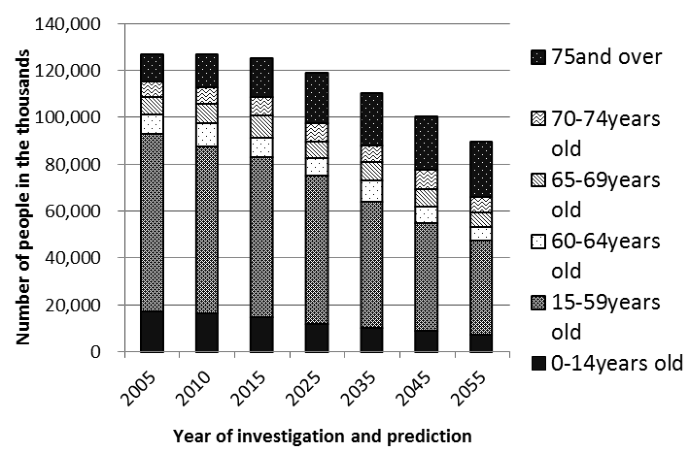
Japan's Super-Aging Society Japan is one of several “super-aging societies” in the world today, with 24.1% of the nation’s population over the age of 65. If the population continues at its current rate, the number of recipients of long-term care will likewise continue to increase. Figure 1 shows the prediction of the age group of population change from 2005 to 2055 of the Ministry of Health, Labor and Welfare announced the “2012 fiscal version elderly white paper”.
Figure 1. Population of Japan, By Age.
As the wave of elderly continues to swell, current long-term care facilities are exhausted. The turnover rate for caregivers in these facilities is also quite high compared to other occupations, causing even dedicated staff to quit from overwork. Table 1 shows the comparison of the turnover rate between the whole industry and the care industory for the past six years nased on the publication “nursing staff and visiting nursing staff turnover” from Care Worker Foundation in Japan.
Table 1: Comparison of Job Turnover Rates.
Table available in the original PDF paper.
Goals of this Study For the people who work in long-term care facilities for the elderly, acquiring the training needed to serve the residents is a laborious task. Workers are expected to assist the elderly from beds to wheelchairs; help bathe them and clean themselves after using the bathroom; and assist them with many of the functions that make up day to day life.
In this study, we hope to find some way to guide inexperienced caregivers in transferring patients between bed and wheelchair, one of the most difficult aspects of the work. Patients must be transferred both safely and securely. To that end, we have analyzed and verified differences in eye movements between inexperienced and expert caregivers.
EXPERIMENT Subjects
For this study, we worked with four caregivers from a nursing home. As shown in Table 2 the information of the caregiver. Two of our caregivers had only ten months’ experience, while the other two had over ten years’ experience. We also worked with an elderly male resident of the home, who had lost the use of his left arm and leg.
Table 2: Caregiver’s List.
Table available in the original PDF paper.
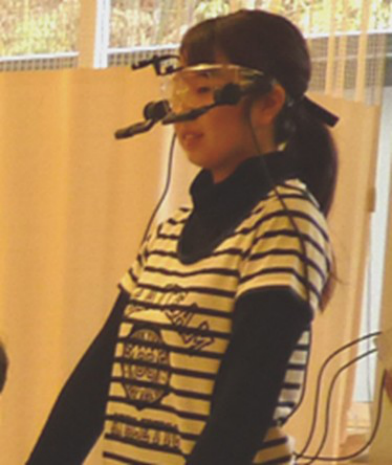
Measuring Condition We conducted our research on-site in one of the rooms of the home. To analyze the caregivers’ eye movements, we used the “Talk Eye II” from Takei Equipment (Figure 2). The caregivers wore the goggles over their eyes as seen in the below photograph. The goggles are equipped with CCD cameras above and beside the user’s eyes to record and detect the field of view.
Figure 2. Experiment Photograph.
Measurements A. Assisted transfer of the patient from bed to wheelchair.
The caregiver entered the room with the wheelchair, approached the patient sitting on the bed, and transferred him to the wheelchair.
B. Assisted transfer of the patient from wheelchair to bed.
The caregiver entered the room with the patient in the wheelchair, moved to the bed, and transferred the patient from the wheelchair to the bed.
All trials of each type followed the same steps, with B-trials performed after A-trials. The trials were also carried out with the wheelchair facing the foot of the bed. Both procedures were broken down into three steps, as listed below.
Table 3: Transfer Processes.
Table available in the original PDF paper.
RESULTS
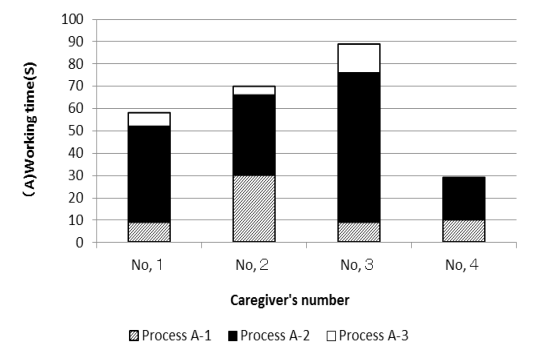
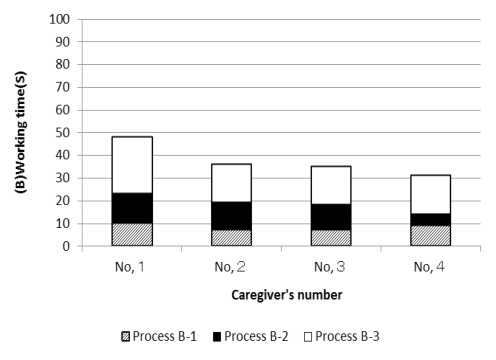
Comparison of Transfer Times Transfer times for each caregiver for procedures A and B are shown in Figure 3 and 4.
Figure 3. (Procedure A) Working Time and Time per Step.Figure 4. (Procedure B) Working Time and Time per Step.
For both procedures, the step of physically transferring the patient from one location to another, (to the wheelchair in A-2, or to the bed in B-3,) took the greatest amount of time for all caregivers. This makes sense regardless of experience, as the patient’s physical safety and comfort is the caregiver’s primary concern. With that in mind, we will examine A-2 in more detail.
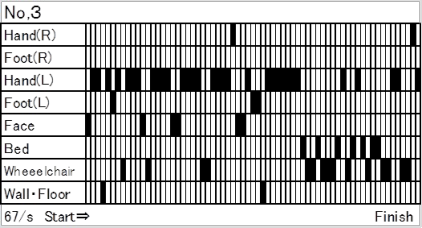
Eye Movements Dividing the caregiver’s eye movements into one second intervals, we represented the objects in focus throughout step A-2 as shown below.
As shown in Figure 5, Caregiver 4 pays close attention to the patient's right foot, which the patient can move under his own power. Caregiver 3, who has a similar length of experience, is focusing mainly on the patient's left hand, and occasionally on his facial expressions. Caregivers 1 and 2 both pay attention to the patient's left hand, but Caregiveker 2 also spends time focusing on other body parts.
Figure 5. Objects in Focus in Step A-2.
DISCUSSION
While this data may give the impression that new or inexperienced caregivers may take longer during transfer simply because they are not used to the process, it should be noted that Caregiver 3, who had 124 months of experience, took longest to transfer the patient from his bed to the wheelchair. This was not due to awkwardness while assisting the patient, but due to Caregiver 3’s conduct. While transferring the patient, Caregiver 3 spoke to the patient, reading his facial expressions and making eye contact, in order to help him relax throughout the procedure. Caregiver 4, on the other hand, aimed to make the transfer as smooth and efficient as possible, in order to minimize the discomfort of the other party. As expected, he provided assistance in the shortest amount of time for both procedures A and B.
CONCLUSIONS
This research suggests that the finer points of these skills would be difficult to contain in some detailed manual, as this experience is not something that can be put into words. It is instead something that each caregiver must learn from regular practice, as part of training, and is related to the broader skills that come with being a support worker.
Even among workers with the same level of experience, individual caregivers have different priorities while providing care. While each caregiver has distinct strengths, only those receiving care know what they value in a caregiver, so we would like to refrain from further discussion of this topic in this paper.
To repeat this experiment, we would like to also analyze the pulse or brainwaves of the patient at the same time, and have them rate the treatment they received in a survey.
REFERENCES
Care Work Foundation. (2011), “Turnover Rates of Nursing Care Staff and Home Visit Care Staff”. Care Work Factual Investigation. Ministry of Health, Labor and Welfare. (2012), “2012 fiscal version elderly white paper”.
LISTED IN THE AHFE DIGITAL BOOKSTORE CATALOGUE
Explore the complete digital volume
Advances in Physical Ergonomics and Human Factors: Part II
Read this individual research paper free through the original publisher, or explore the full digital proceedings book.
ISBN 978-1-4951-2105-0
Explore this ISBN in the AHFE Bookstore ↗Listed in the July 2026 bookstore catalogue; search by ISBN to confirm current availability · Digital book purchase optional