Masato Takanokura, Kenji Ariizumi, Nozomu Imai, Seiko Taki, Tetsuo Yamada (2018). Identification of High-Intensity Physical Activities during Child Rearing Using a Triaxial Accelerometer. In: Advances in Physical Ergonomics and Human Factors: Part II. AHFE Open Access, vol. 2. https://doi.org/10.54941/ahfe100059
Child rearing is an important activity for parents or caregivers, but the workload involved in child rearing has not yet been quantitatively assessed to improve the works. This study measured the daily physical activity of three fathers and one mother by an activity meter which included a triaxial accelerometer, in terms of metabolic equivalents (METs) and the type of activity (locomotive or non-locomotive). Participant wore the activity meter around their chest from awakening in the morning to sleeping at night during child rearing and while working. They also manually recorded their activity during certain 30-minutes periods via a questionnaire. All the participants undertook the high-intensity activities (3.0-6.0 METs) while having meals, tidying, accompanying, playing, shopping, and moving with the children. The mother also undertook the high-intensity activity (3.0-4.7 METs) during housework and cooking. Activities for child rearing registered the same intensity as commuting or working, but these activities appeared intermittently. The results suggest that services such as child-care rooms in shopping centers or short-term care by caregivers at the parent’s home should be provided for parents and their children. These services will motivate parents to think that child rearing is positive and worthwhile.
Child rearing or caring is an important activity, but is highly demanding both physically and mentally for parents or caregivers. We consider that childcare is a part of child rearing. In Japan and other developed countries, the child- rearing generation is positively seeking males who take part in child rearing in homes and societies (Yamada et al., 2013). They are called “iku-men” in Japan (Ministry of Health, Labour and Welfare Japan, 2014). The Japanese prefix “iku-“ means child rearing. To improve the works in the childcare (Gilbreth et al., 1954), it is necessary to measure the activity quantitatively. However, the workload involved in child rearing has not been quantitatively assessed. Especially, some services are required in Japan to support the child-rearing generation as the incidence of nuclear families is increasing. In the field of sports science, researchers have focused on physical activity while developing measures for prevention of lifestyle-related diseases, in addition to the provision of health education (Miyawaki et al., 2011; Ohkawara et al., 2011; Tanaka and Tanaka, 2009, 2012). Miyawaki et al. (2011) evaluated the physical activity level in 151 middle-aged working men. They suggested that detailed instructions about health education should be tailored according to the individual lifestyle of this population group. Tanaka and Tanaka (2012) examined the relative contribution of non-locomotive physical activity to total habitual physical activity in Japanese workers and suggested that locomotor measurements alone may substantially underestimate habitual physical activity in workers engaged in certain occupations (e.g., licensed cooks and garbage collectors). Tanaka and Tanaka (2009) evaluated moderate-to-vigorous physical activity by using triaxial accelerometry in Japanese preschool children. A triaxial accelerometer has been used for estimation of physical activity, and some devices have been developed for measurement of physical activity. The validity of these devices has been confirmed, and a device including a triaxial accelerometer can estimate physical activity precisely (Ohkawara et al., 2011). In addition, recent developments in information and communications technology have made it possible to collect data on personal daily activities in real time over long periods. From the viewpoint of health promotion, activity meters could be used to measure physical activity (Miyawaki et al., 2011; Tanaka and Tanaka, 2012; Yamada et al., 2013). Although this device is mainly used for health promotion in daily life, it could be applicable to other daily activities. In this study, we focused on physical activity related to child rearing (Yamada et al., 2013). Child rearing is an important activity for life, but the physical activity involved in child rearing has not been quantitatively assessed. This information may increase understanding of the physical demands of child rearing and inform service innovations for caregivers, especially, parents who have been constantly engaged in child rearing for a long period. Child rearing is a worthwhile activity, but parents often experience high-intensity physical activities simultaneously. Some services and information systems are required for parents and their children, to alleviate parent’s physical and mental workloads. Unfortunately, they are not sufficiently provided in Japan. In this study, we assessed the daily activities of fathers (iku-men) and a mother (iku-woman) using a triaxial accelerometer and identified high-intensity physical activities involved in child rearing. We also discuss which services would be appropriate for child rearing, on the basis of the experimental results.
MATERIALS AND METHODS
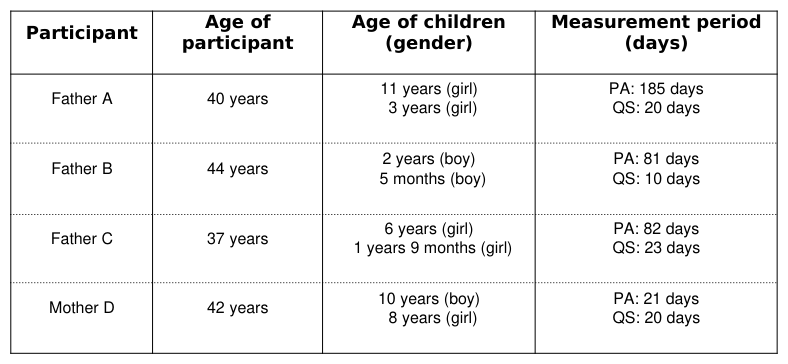
Participants Three fathers and one mother (age: 37-44 years) participated in the experiment. Informed consent of the participants was obtained before participation of the experiment. All the participants were rearing two children, whose ages ranged from 5 months to 11 years old in August 2013. Table 1 shows the age and gender of the participants and their children. As described later, activity meter measured physical activity, and participants manually recorded their activity on a questionnaire. The measurement period of physical activity and the questionnaire is also shown in Table 1. This experiment was approved by the ethical committee of The University of Electro-Communications.
Table 1: Age and gender of participants and their children (as of August 2013), and measurement period of physical activity (PA) and questionnaire (QS).
Activity meter Physical activity was measured by an activity meter (Active style Pro, OMRON Healthcare, Japan) as metabolic equivalents (METs) per a minute. The METs value is defined as the ratio of the work metabolic rate to a standard resting metabolic rate of 1.0 kcal/kg/h (Ainsworth et al., 2011). One MET is considered the energy cost of a person at rest. According to Exercise and Physical Activity Reference for Health Promotion 2006 (Ministry of Health, Labour and Welfare Japan, 2006), a high-intensity physical activity was 3.0 METs and more. A middle-intensity was an activity of 2.0-3.0 METs (Tanaka and Tanaka, 2012). A triaxial accelerometer was included in the activity meter. In addition to the METs, the activity meter measured the type of activity (locomotive or non-locomotive), number of steps, exercise value (the product of METs and time of any activity), and the duration of each level of activity. The type of activity could be classified by the direction of three-dimensional acceleration. Locomotive activity was measured while the participant was not stooping (e.g., walking and running). Non-locomotive activity was detected while the participant was stooping during housework (e.g., carrying some baggage or cleaning a room). The upper body of the participant was reclined forward during the non-locomotive activity (Ohshima et al., 2012). Participant wore the activity meter around their waist. The activity meter had a weight of 60 g, width of 74 mm, height of 46 mm, and depth of 34 mm. It did not obstruct the participant’s motion. The METs and other variables were measured from awakening in the morning to sleeping at night every day of the measurement period.
Figure 1. Sample questionnaire and answer (original was written in Japanese)
Figure available in the original PDF paper.
Questionnaire for Participant Activity The activity meter could measure the METs and the other variables while being worn, but not what activity the participant engaged in. Therefore, we asked participants to manually record their activity on a questionnaire every 30 minutes for 10-23 days, as shown in Table 1. A sample of the questionnaire and answer is shown in Figure 1. The participant recorded the type of activity. If the activity was related to child rearing, the participant marked a sign (○) on either “child rearing with other activities” or “child rearing only.”
RESULTS AND DISCUSSION
In this study, the activity meter and the questionnaire identified high-intensity physical activities. All the participants were employed full-time. Therefore, we classified the data into those recorded on a day in which the participants were mainly engaged in their full-time jobs and those on a day that they were mainly rearing their children. We called the former “Working Day” and the latter “Child-rearing Day.” First, we analyzed the physical activity on Child-rearing Day and identified high-intensity physical activities related to child rearing. Second, we compared the physical activities recorded on Child-rearing Day and on Working Day and discussed the characteristics of the physical activities related to child rearing.
Physical Activities on Child-rearing Day (a) Measured data of Father C on a Child-rearing Day
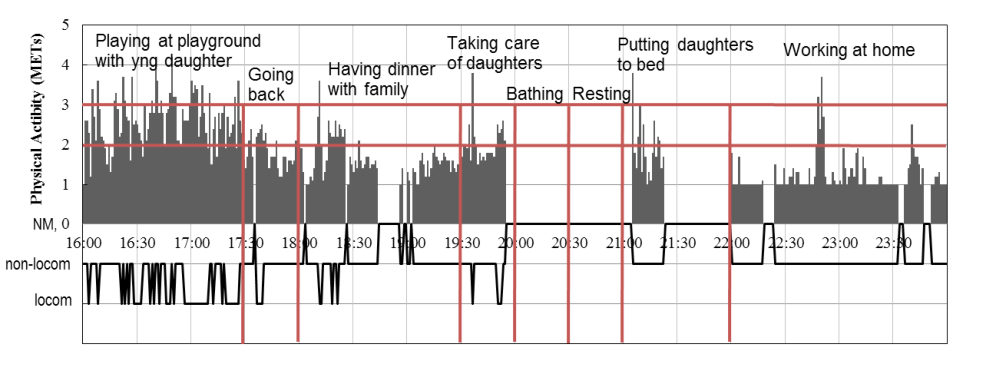
Figure 2 shows an example of the METs and the type of activity on a Child-rearing Day of “Father C.” He had two daughters aged 6 years old and 1 year old. Father C got up at 9:00 and had breakfast with his wife and daughters. He watched his younger daughter in the morning with a video program. After lunch, he played with the younger daughter at home and then at a playground outside the home. He went back home with his daughter, and then he had dinner with his family at a restaurant. He took care of his daughters and put them to bed at 21:00. The physical activity exceeded 3.0 METs in non-locomotive during breakfast in the morning. Although Father C spent time with the children at home after breakfast, the physical activity was low intensities between 1.0-2.0 METs. The physical activity exceeded 3.0 METs again while Father C had lunch with caring for his younger daughter. This activity was non-locomotive. The high-intensity activity of 3.0 METs and more was observed frequently when he played with his younger daughter at home and at the playground outside the home. The activity at home was non-locomotive. The activity at the playground was mainly locomotive. It was the highest on this Child-rearing Day. During bathing, Father C could not wear the activity meter; therefore, the intensity of physical activity was 0.0 METs during this period.
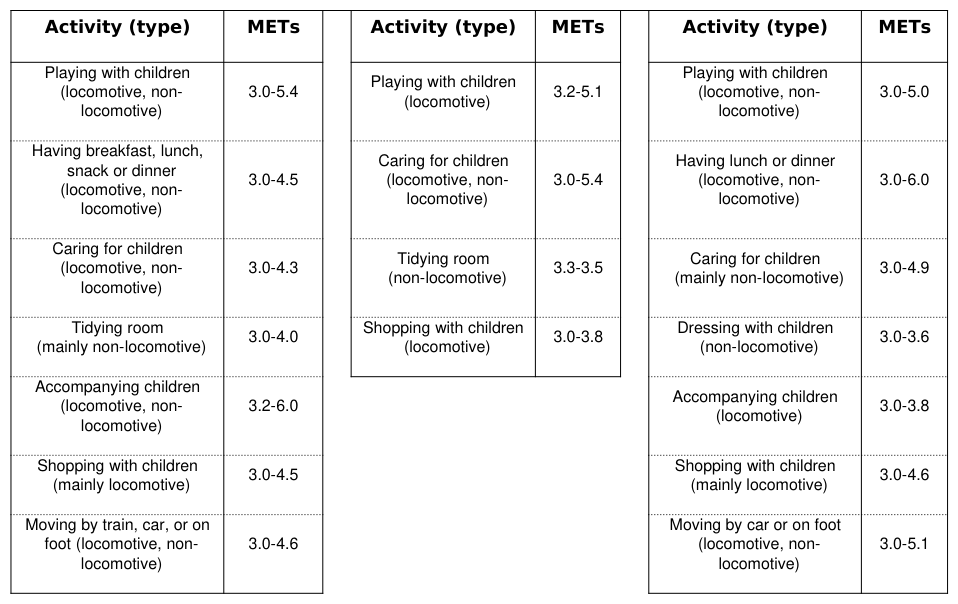
(b) Comparison of high-intensity activities of Fathers A, B, and C We could identify the high-intensity physical activities of all the participants on Child-rearing Day as shown in Figure 2. First, the physical activities were compared for the male participants “Fathers A-C.” Table 2 shows the high-intensity activities of 3.0 METs and more for Fathers A-C. Father A had two daughters aged 11 years old and 3 years old. High-intensity physical activity was observed inside and outside his home. At home, he was asked to look after his younger daughter, for example, by having breakfast, lunch, and dinner with her as well as by playing with the daughters. Caring for the daughters was also higher at 3.0-4.3 METs. An intensity of 3.0-4.0 METs was observed when tidying the room with his daughters. When he went out with his daughters, high-intensity activity was observed while playing at the playground, accompanying, shopping, and moving by train, car or on foot. Especially, accompanying children was the highest intensity of 3.2-6.0 METs. Father A accompanied his daughters to a tutored school. Shopping and moving were daily activities, not specifically for child rearing. However, such activities had a higher intensity when children accompanied the parent. In general, the activities in home (having meals, caring, tidying, playing in home) were non-locomotive, and those outside home (accompanying, shopping, moving, and playing outside home) were locomotive.
Figure 2. An example of METs and type of activity on a Child-rearing Day of "Father C." Activities of 2.0-3.0 METs are middle intensity, and those of 3.0 METs and more are high intensity. The words "yng", "NM", and "locom" stand for young, not measured, and locomotive, respectively.
The participants “Fathers B and C” had similar results as shown in Table 2. Father B had two sons aged 2 years old and 5 months old. Father C had two daughters aged 6 years old and 1 year old. Caring for the children was generally a high-intensity activity. Outside home, playing and shopping were also high-intensity locomotive activities. Father B played with his sons outside the home; therefore, playing with children registered as locomotive only. Father C had high-intensity activities during having lunch or dinner and accompanying children. The latter activity was obtained while Father C accompanied his elder daughter for a haircut. This result was similar to Father A. Dressing with the children was also the high-intensity activity of 3.0-3.6 METs. Father C dressed himself and his daughters to go to the playground in the morning. This activity should be regarded as “caring for children.”
(c) Comparison of high-intensity activities between Mother D and Fathers A-C
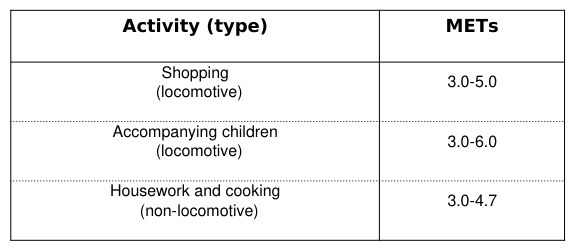
Table 3 shows the high-intensity activities of the female participant “Mother D.” She had two children aged 10 years old and 8 years old. They were older than the children of the male participants. Therefore, a high-intensity activity was not observed only during child rearing such as playing with children. However, daily activities like shopping and accompanying children had a high intensity of 3.0-6.0 METs. This result was similar to the male participants. In general, mothers spent more time rearing for their children than fathers; further, mothers mainly perform the housework and cooking for Japanese families. Therefore, high-intensity activity of 3.0-4.7 METs in non-locomotive was also observed during housework and cooking. Father A had activities of housework and cooking at once during the measurement period. The intensity of this activity was 3.0-4.1 METs. Housework and cooking were also the high-intensity physical activity for daily life.
In general, all the participants showed daily activities with a high-intensity of 3.0-6.0 METs during child rearing. According to compendium of physical activity, the METs value for home activities is 1.5-6.0 METs (Ainsworth et al., 2000, 2011). For example, performing multiple household tasks is 3.5 METs for moderate effort and 4.0 METs for vigorous effort. Elder care is 4.0 METs. Playing with animals is 4.0 METs for moderate play and 5.0 METs for vigorous play. The highest activity is butchering animals (6.0 METs). In this study, the participants were three fathers and one mother. We needed to gather more data on various type of physical activity from a larger sample of parents. However, the daily activities during child rearing had an intensity as high as that of household tasks and playing animals with vigorous effort. Other high-intensity activities (6.0 METs) are farming and taking care of animals (grooming, shearing sheep, etc.) as well as track and field events (high jump, long jump, javelin, etc.).
Table 2: High-intensity physical activities of 3.0 METs and more related to child rearing for Fathers A,
B, and C
(a) Father
(b) Father
A
B (c) Father C Activity (type) METs Activity (type) METs Activity (type) METs
Table 3: High-intensities physical activities of 3.0 METs and more related to child rearing for Mother D.
Were Physical Activities on Child-rearing Day Higher Than Those on Working Day?
We could extract the high-intensity activities related to child rearing as shown in Tables 2 and 3. However, we should discuss whether these activities on Child-rearing Day had a higher intensity or not than those on Working Day. It is critical for parents to have a continuous activity with a high intensity rather than a momentary activity. Therefore, we extracted the physical activity of 3.0 METs and more that lasted for three minutes and longer. We assumed that the activity of less than 3.0 METs with a duration below three minutes was not critical for daily life.
(a) Fathers A, B, and C
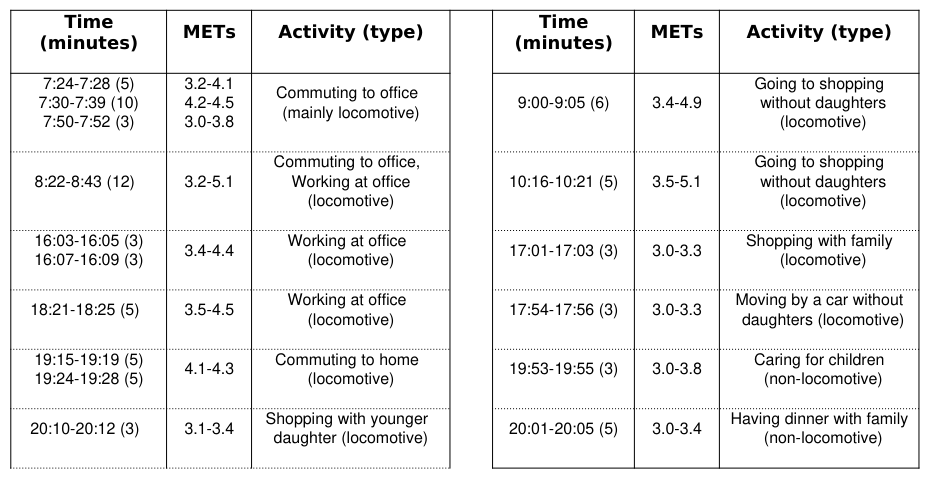
Table 4 shows a comparison of physical activities on a Working Day and a Child-rearing Day for Father A. On a Working Day, the physical activity was higher in the locomotive category (up to 5.1 METs) while commuting to office or to home, and while working at the office. In addition, high-intensity activity was observed while shopping with his younger daughter after commuting back to home. This activity was related to child rearing on a Working Day. As shown in Table 4(b), high-intensity activities were also observed on a Child-rearing Day. However, such activity was not continuous, compared with commuting on a Working Day. Thus, activities for child rearing had a high intensity similar to those on business, but did not last as long. This hypothesis was supported by the activities after arriving at home on a Working Day: shopping with the younger daughters.
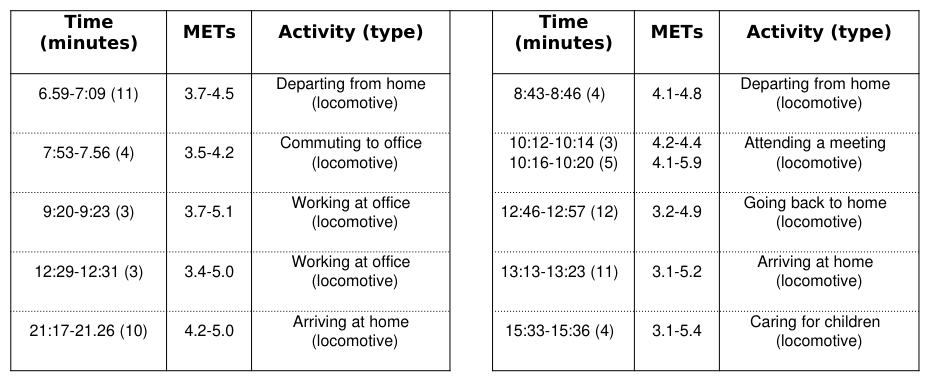
The results for Fathers B and C supported the hypothesis for the male participants. Table 5 shows the comparison of physical activities on a Working Day and a Child-rearing Day for Father B. On a Working Day, the physical activity increased in the locomotive category when he departed from home and commuted to the office in the morning as well as on returning home in the evening. It also increased to 5.1 METs while working at office. These activities were all in the locomotive. On a Child-rearing Day, Father B attended a meeting in the morning. The METs increased in the locomotive category during the commute to work and back home, as well as during the meeting. Subsequently, high-intensity locomotive activity was obtained while caring for children. This activity had an intensity of 5.4 METs, but did not last longer than four minutes.
Table 4: Comparison of METs for "Father A." Time (minutes) indicated when (and how long) METs were observed.
(a) Working
(b) Child-rearing Day (Sunday)
Day (Tuesday) Time (minutes) METs Activity (type) Time (minutes) METs Activity (type)
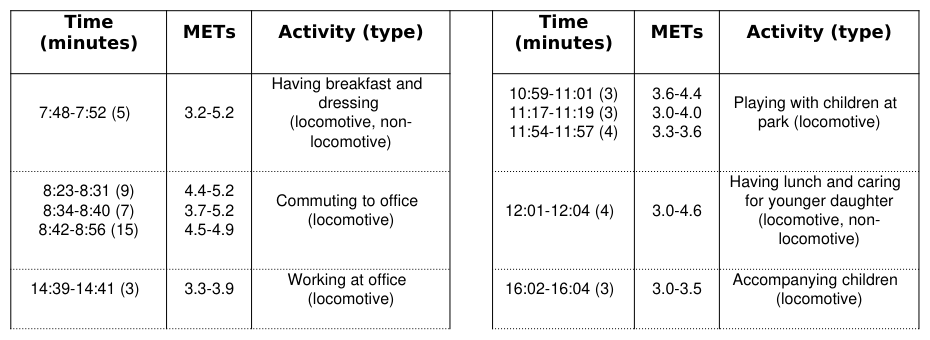
Table 6 shows the comparison of physical activities on a Working Day and a Child-rearing Day for Father C. Similar to Fathers A and B, high-intensity locomotive activity was observed while commuting to his office or home on a Working Day. Before departing home, having breakfast and dressing were also higher. On a Child-rearing Day, Father C had the higher-intensity activities to 4.4, 4.6, and 4.8 METs while playing with children at a park, during meal times, and while caring for his children at his home, respectively. However, these activities did not last longer than for six minutes.
Table 5: Comparison of METs for "Father B." Time (minutes) indicated when (and how long) METs were observed.
(a) Working
(b) Child-rearing Day (Sunday)
Day (Monday) Time (minutes) METs Activity (type) Time (minutes) METs Activity (type)
Table 6: Comparison of METs for "Father C." Time (minutes) indicated when (and how long) METs were observed. (a) Working
(b) Child-rearing Day (Saturday)
Day (Tuesday) Time (minutes) METs Activity (type) Time (minutes) METs Activity (type)
(b) Mother D and comparison between her and Fathers A-C
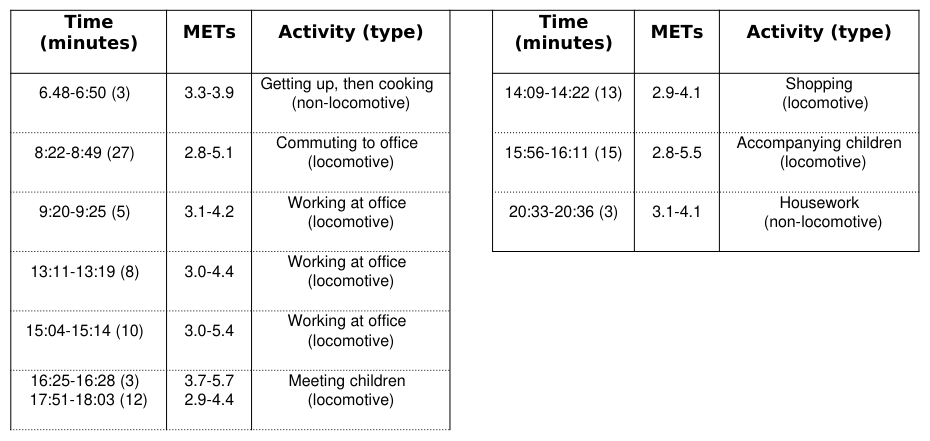
Table 7 shows the comparison of physical activities on a Working Day and a Child-rearing Day for Mother D. Similar to the male participants, Mother D had high-intensity locomotive activity while commuting to office and working at office (up to 5.4 METs) on a Working Day. Commuting was absolutely the high-intensity locomotive activity for all the participants. However, some specific activities were identified for Mother D. Her children went to an elementary school and to a child care room in the school after classes while their mother was at work. Therefore, Mother D met her children at the child care room in the evening. This locomotive activity had a high intensity (up to 5.7 METs). In addition, housework and cooking were also high (up to 4.7 METs) before and after her work, and these were non-locomotive activities. The physical activities on a Child-rearing Day were the same as those described previously.
Results show that all the participants had high-intensity activities (3.0 METs to 6.0 METs) while caring for, playing with, and shopping with their children on Child-rearing Day. These activities had the same intensity as those during commuting or working on Working Day, but they occurred intermittently. Some services should be provided for parents and their children such as child care rooms in shopping centers, short-term care by caregivers at the parent’s home, and information systems by the government or NGOs to share knowledge or to construct a network for stakeholders of child rearing (parents, caregivers, the government, NGOs, etc.). These services motivate parents to think of child rearing as positive and worthwhile. These services lower the high-intensity physical activities for child rearing. In addition, parents and other stakeholders would join in development of these services on child rearing and caring for the next generation.
Table 7: Comparison of METs for "Mother D." Time (minutes) indicated when (and how long) METs were observed.
(a) Working
(b) Child-rearing Day (National Holiday)
Day (Monday) Time (minutes) METs Activity (type) Time (minutes) METs Activity (type)
CONCLUSIONS
This study measured daily physical activity in three fathers and one mother using an activity meter that included triaxial accelerometer. Child rearing was a high-intensity activity to 6.0 METs. In general, fathers had the high intensity in non-locomotive activities such as having meals, caring, tidying, playing in the home, and the high intensity locomotive activities during accompanying, shopping, moving, and playing outside home. The mother also engaged in the same activities, but she showed a high intensity during housework and cooking. The physical activities during child rearing had the same intensity as those while working, but they occurred intermittently. Some services should be provided for parents and their children such as child care rooms in shopping centers, short-term care by caregivers at the parent’s home, and information systems by the government or NGOs. These services will lower the high-intensity physical activities for child rearing.
ACKNOWLEDGEMENT
This work was supported by JSPS KAKENHI Grant-in-Aid for Exploratory Research Number 25560158.
REFERENCES
Ainsworth, B.E., Haskell, W.L., Whitt, M.C., Irwin, M.L., Swartz, A.M., Strash, S.J., O’Brien, W.L., Bassett Jr., D.R., Schmitz, K.H., Emplaincourt, P.O., Jacobs Jr., D.R., Leon, A.S. (2000), “Compendium of Physical Activities: An Update of Activity Codes and MET Intensities”, Med. Sci. Sports Exerc. Vol. 32 No.9 Suppl., pp. S498-516 Ainsworth, B.E., Haskell, W.L., Herrmann, S.D., Meckes, N., Basset Jr., D. R., Tudor-Locke, C., Greer, J.L., Vezina, J., Whitt-
Glover, M.C., Leon, A.S. (2011), “2011 Compendium of Physical Activities: An Second Update of Codes and MET Values”, Med. Sci. Sports Exerc. Vol. 43 No.8, pp. 1575-1581 Gilbreth, L.M., Thomas, O.M., Clymer, E. (1954), “Management in the home”. New York: Dodd, Mead and Company. Ministry of Health, Labour and Welfare Japan (2014), “Ikumen Project”, Ministry of Health, Labour and Welfare Japan Website (in Japanese): http://ikumen-project.jp/index.html (available on Feb 28, 2014) Ministry of Health, Labour and Welfare Japan (2006), “Exercise and Physical Activity Reference for Health Promotion 2006”,
Ministry of Health, Labour and Welfare Japan Website (in Japanese): http://www.mhlw.go.jp/bunya/kenkou/undou01/pdf/data.pdf (available on Feb 28, 2014) Miyawaki, T., Ohara, K., Sonoda, M., Aoyama, N., Ogawa, H., Kotani, C., Minamide, Y., Fujiwara, Y., Oue, K., Ikeda, M., Fukuda, K., Oshima, Y., Moriyama, K. (2011), “The Physical Activity Level of Middle-aged Men Evaluated Using a Tri- axial Accelerometer Activity Monitor –Different Activity Patterns between Weekdays and Weekends –”, Jpn. J. Cardiovascular Disease Prevention Vol. 46, No. 1, pp. 30-37 (in Japanese) Ohkawara, K., Oshima, Y., Hikihara, Y, Ishikawa-Tanaka. K., Tabata, I., Tanaka, S. (2011), “Real-time Estimation of Daily
Physical Activity Intensity by a Triaxial Accelerometer and a Gravity-removal Classification Algorithm”, Br. J. Nutr. Vol. 105, pp. 1681-1691 Ohshima, Y., Kawaguchi, K., Tanaka, S., Ohkawara, K., Hikihara, Y., Ishikawa-Takata, K., Tabata, I. (2012), “Classifying Household and Locomotive Activities Using a Triaxial Accelerometer”, Gait Posture Vol. 31 No. 3, pp. 370-374 Tanaka, C., Tanaka, S. (2009), “Daily Physical Activity in Japanese Preschool Children Evaluated by Triaxial Accelerometry:
the Relationship between Period of Engagement in Moderate-to-Vigorous Physical Activity and Daily Step Counts”, J. Physiol. Anthropl. Vol. 28 No. 6, pp. 283-288 Tanaka, C., Tanaka, S. (2012), “Contribution of Non-locomotive Activity to Habitual Physical Activity in Japanese Workers”, Jpn. J. Phys. Fitness Sports Med. Vol. 61 No. 4, pp. 435-441 (in Japanese) Yamada, T., Sakurada, S., Takanokura, M., Taki, S., Sato, T. (2013), “A Study on Childcare Service Innovation Using
Measurement of Real Time Life Log”, The Decision Sciences Institute (DSI), The 44th Annual Meeting, Baltimore, USA
LISTED IN THE AHFE DIGITAL BOOKSTORE CATALOGUE
Explore the complete digital volume
Advances in Physical Ergonomics and Human Factors: Part II
Read this individual research paper free through the original publisher, or explore the full digital proceedings book.
ISBN 978-1-4951-2105-0
Explore this ISBN in the AHFE Bookstore ↗Listed in the July 2026 bookstore catalogue; search by ISBN to confirm current availability · Digital book purchase optional