Deep focus states, like Immersion and Flow are important parameters when it comes to an enjoyable experience during learning activities. To measure these mental states usually self-assessment questionnaires, answered by the subject after the experience, are used. Because of the shortcomings of this method, the ultimate goal is to establish an alternative measuring method through correlations of physiological sensor data. Exploring the Physiology of deep focus, in the course of prior studies, physiological data of participants was recorded during activities and inspected for correlations with Flow and Immersion. By broadening the experimental scope, this paper explores the effect of participant's emotions on reaching states of deep focus.
One of the central questions in games research and psychology and of par- ticular interest for the development of serious games is how video games are perceived as enjoyable, more so how this fun can be transferred into learn- ing or working contexts, as enjoyment is proven to be linked to an effective learning process (Deci and Ryan, 1985; Krapp, 2009).
Mihály Csíkszentmihályi defined “the optimal experience of an action” as Flow, which is achieved when the individual is so engrossed in the activity that nothing else seems relevant anymore. It is a deep sense of enjoyment, that occurs when a “person’s body or mind is stretched to its limits in a voluntary effort to accomplish something difficult and worthwhile” (Csikzentmihaly, 1990). A similar experience in the video game domain is commonly called Immersion, describing the transfer of consciousness into a virtual world. Cairns et al. define game Immersion by dividing it into three levels: Engage- ment, Engrossment, and Total Immersion. These levels are used to describe the degree of involvement with the game (Brown and Cairns, 2004; Cairns et al., 2006).
Both Flow and Immersion are linked to an intrinsic motivation in the task or game, which means deriving enjoyment from the action itself rather than from external gains like money or a fear of punishment for not completing a task. Due to the similarities of definitions and conditions for Immersion and
Flow, authors suggest on unifying and not separating both terms for further research, especially in the video game domain (Michailidis et al., 2018).
RELATED WORK
A model combining Immersion and Flow, based on the definitions by Csík- szentmihályi and Cairns, was proposed (Kannegieser et al., 2018) and later extended by additional emotional dimensions in 2021 (Kannegieser et al., 2021). Traditionally, questionnaires have been used to measure Flow and Immersion, but this method has limitations such as potential inaccuracies due to delayed elicitation and subjective answers. An alternative approach to measure deep focus states could be to record subjects’ physiological data during an activity and analyze correlations between the physiological data and states of Flow and Immersion. This could establish a more robust and objective measurement method, potentially making questionnaires obsolete. One particular area of interest is the measurement of brain activity using electroencephalography (EEG), which non-invasively records electrical brain activity from the scalp. EEG is easy to use in medicine and research and pro- vides valuable information on the mental states of subjects (Kannegieser et al., 2021).
STUDY In order to assess and understand perceived flow, an experiment has been designed using video games to induce a flow state and questionnaires to assess perceived emotions. During the experiment, the subjects’ physio- logical data from various sources (e.g., heart rate, skin conductance and electroencephalography) are also recorded.
PROCEDURE A study was conducted with 23 self-selected participants, who all had at least some experience with video games in the past. Game selection was free, i.e., participants were allowed to bring their own games or use a distribution platform like Steam to install a game of their choice. Free game selection was chosen to improve the odds of players reaching higher flow levels, at the cost of game-specific analysis options.
Participants played their chosen game for 30 minutes, during which phys- iological data was recorded. Among other data sources, heart rate and skin conductance were measured using the Mionix Naos QG mouse. After play- ing, participants watch a re-cording of their game session as well as web cam footage of themselves. While watching this footage, they answer question- naires about their mental states during the time frames they just watched. This way, more accurate and time correlated data is gathered without inter- rupting the flow during the game session, as shown in a similar study by Rajava and Kivikangas (Rajava and Kivikangas, 2008).
ANALYSIS Perceived flow was measured every two minutes using the flow short- scale questionnaire by Rheinberg (Rheinberg et al., 2003). It was originally designed for being used multiple times in a row, making it perfect for this iterative approach.
The study was originally designed to understand the relationship between flow and immersion in addition to physiological data. As such, arousal and valence were not directly part of the questionnaires. However, perceived valence could be inferred from a question within the used immersion ques- tionnaire by Cheng (Cheng et al., 2015), which specifically asks players how much they liked to play the game in the given time frame.
Arousal on the other hand could not be inferred in a similar way, which is why physiological data was used to measure arousal. Arousal is proven to be linked to a higher heart rate (Azarbarzin et al., 2014) as well as higher spon- taneous skin conductance (Wang et al., 2018). Therefore, heart rate and skin conductance data captured by the Mionix mouse was used as an indicator of arousal. Measured data was normalized and averaged over every two-minute portion of the recording to fit to the flow and valence assessments.
RESULTS
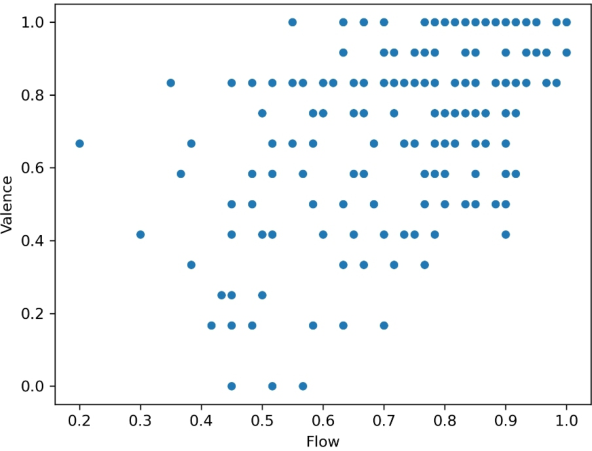
First, only flow and valence data are correlated leaving out arousal data. Figure 1 shows the combination of both variables in a scatterplot. Pear- son correlation coefficient between valence and flow was calculated as 0.587, indicating a strong positive correlation. However, flow combined with arousal values (i.e., heart rate and skin conductance) only, resulted in no linear relation (Pearson corr. < ±0.1).
Figure 1: Scatterplot of the assessed flow and valence values.
110 Kannegieser and Ratz
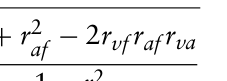
In order to calculate the relation between combined arousal-valence and flow, multiple correlation (Abdi, 2007) was used. The multiple correlation coefficient R of two predictor variables (v=valence, a=arousal), one target variable (f=flow), and their Pearson correlation coefficient r is calculated as:
vf + r2
Equation reproduced from the original PDF.
v u u tr2 1 −r2va
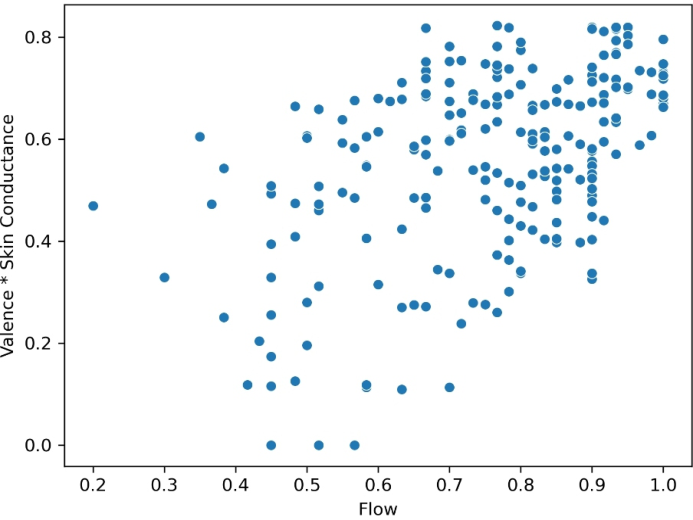
Depending on using heartrate or skin conductance as indicator for arousal the multiple correlation coefficient results in Rhr = 0.612 and Rsc = 0.590, both indicating strong correlations between perceived arousal-valence and flow. This can also be shown by multiplying arousal and valence values and combining the resulting value with flow (Figure 2).
Figure 2: Scatterplot of combined arousal-valence (skin conductance for arousal) and flow.
DISCUSSION
Results show a correlation between perceived valence and flow and more- over a correlation between combined arousal-valence and flow. While the connection between valence and flow is rather apparent as flow is proven to be connected to an intrinsic enjoyment in the task, it is interesting to see the connection between flow and the arousal-valence emotion model. Figure 2 shows that especially very high flow values (>0.9) are related to a high com- bination of both valence and arousal. However, when it comes to comparing
lower flow values to combined arousal-valence, there’s less of a relation. This corresponds to the proposed model of arousal-valence and flow in section 2, as flow is only perceived when combined arousal-valence is high.
Though, the results are not yet generalizable and need to be proven by fur- ther studies and investigations. Due to the study not being initially intended for assessing arousal-valence workarounds needed to be made in order to get the data. Valence was only measured by one question, and arousal was directly concluded from heart rate and skin conductance data. This heavily reduces the result significance.
Still, the found correlations suggest further research possibilities and offer a potential advancement of the arousal-valence model. Future studies should focus on assessing the variables of interest correctly and in a generalizable way. Arousal-Valence could be measured by another questionnaire e.g., the self-assessment manikin (SAM) (Bradley and Lang, 1994) and physiological data could be measured to further strengthen result significance.
REFERENCES
Abdi, Herve. “Multiple correlation coefficient.” Encyclopedia of measurement and statistics 648 (2007): 651. Azarbarzin A, Ostrowski M, Hanly P, Younes M. Relationship between arousal
intensity and heart rate response to arousal. Sleep. 2014 Apr 1;37(4): 645–53. doi: 10.5665/sleep.3560. PMID: 24899756; PMCID: PMC4044744. Bradley, M. M., & Lang, P. J. (1994). Measuring emotion: The self-assessment manikin and the semantic differential. Journal of Behavior Therapy and Experi- mental Psychiatry, 25(1), 49–59. https://doi.org/10.1016/0005-7916(94)90063-9 Brown, E., & Cairns, P., 2004. A grounded investigation of game Immersion. CHI ‘04
Extended Abstracts on Human Factors in Computing Systems, pp. 1297–1300. Cairns, P., Cox, A. L., Berthouze, N., Jennett, C., & Dhoparee, S., 2006. Quantifying the experience of Immersion in games. CogSci 2006 Workshop: Cognitive Science of Games and Gameplay. Cheng, M.-T., She, H.-C., & Annetta, L. A., 2015. Game Immersion experience:
Its hierarchical structure and impact on game-based science learning. Journal of computer assisted learning, 31(3), pp. 232–253. Csikzentmihaly, M., 1990. Flow: The psychology of optimal experience. Harper & Row, New York. Deci, E. L., & Ryan, R. M. (1985). Intrinsic Motivation and Self-Determination in
Human Behavior. Berlin: Springer Science & Business Media. https://doi.org/10. 1007/978-1-4899-2271-7 Kannegieser, E., Atorf, D., & Meier, J., 2018, Surveying games with a combined model of Immersion and Flow. IADIS International Conference Information Systems 2018, Lisbon, Portugal. 1Kannegieser, E., Atorf, D., Herold, J. (2021). Measuring Flow, Immersion and Arousal/Valence for Application in Adaptive Learning Systems. In: Sottilare, R. A., Schwarz, J. (eds) Adaptive Instructional Systems. Adaptation Strategies and Methods. HCII 2021. Lecture Notes in Computer Science, vol. 12793. Springer, Cham. Kannegieser, E., & Ratz, J. (2021). Measuring Game Immersion and Flow with Elec-
troencephalography. Proceedings of the 15th International Conference on Inter- faces and Human Computer Interaction 2021 and 14th International Conference on Game and Entertainment Technologies 2021.
112 Kannegieser and Ratz
Krapp, Andreas. “Kapitel 14 Pädagogische Psychologie: Lernmotivation und Interesse.” Psychologie–Experten als Zeitzeugen (2009): 166. Michailidis, L., Balaguer-Ballester, E., & He, X., 2018. Flow and Immersion in
video games: The aftermath of a conceptual challenge. frontiers in Psychology, 9, pp. 1682–1690. Ravaja, Niklas, & Kivikangas, J Matias, 2008. “Psychophysiology of digital game playing: Effects of competition versus collaboration in the laboratory and in real life.” pp. 432–435. Rheinberg, F., Vollmeyer, R., & Engeser, S., 2003. Die erfassung des Flowerlebens.
Diagnostik von Motivation und Selbstkonzept, pp. 261–279. Wang, Chin-An, et al. “Arousal effects on pupil size, heart rate, and skin conductance in an emotional face task.” Frontiers in neurology 9 (2018): 1029.
LISTED IN THE AHFE DIGITAL BOOKSTORE CATALOGUE
Explore the complete digital volume
Neuroergonomics and Cognitive Engineering
Read this individual research paper free through the original publisher, or explore the full digital proceedings book.
ISBN 978-1-964867-02-1
Explore this ISBN in the AHFE Bookstore ↗Listed in the July 2026 bookstore catalogue; search by ISBN to confirm current availability · Digital book purchase optional