Martin Pszeida, Yannick Lieb, Michael Schneeberger, Jochen A Mosbacher, Amir Dini, Christian Poglitsch, Johanna Pirker, Lucas Paletta (2025). Learning Analytics Using Eye Tracking-based Biomarkers on Serious Games for Adults with Autism Spectrum Disorder. In: Cognitive Computing and Internet of Things. AHFE Open Access, vol. 165, pp. 69–80. https://doi.org/10.54941/ahfe1006091
Social interaction deficits are a core feature of Autism Spectrum Disorder (ASD), often rooted in atypical attentional processing of socially relevant information. A research protocol is proposed to investigate facial emotion processing and attentional switching in ASD to better understand mechanisms of social dysfunction and inform sensor-based learning analytics in serious games. A sample of individuals with ASD as well as neuro-typical (NT) controls will complete a standardized psychological test battery and two computer-based eye-tracking tasks using advanced eye tracking technology as well as wearable bio-signal monitoring. The envisioned tasks include (1) an emotion recognition and regulation test (ERRT) comparing responses to real versus artificial emotional faces, and (2) a cognitive control test implemented with the antisaccade paradigm evaluating attentional orienting and inhibitory control on the basis of reactions to the presentation of emotionally loaded stimuli. Physiological (eye movement, pupillary, heart rate) and psychological data will be analyzed for correlations with emotion recognition and regulation performance.
In the United States, ASD affects approximately 1 in 44 children, with a 4:1 ratio of boys to girls, and is characterized by debilitating cognitive and social impairments (Amercian Psychiatric Association, 2013). One core challenge is ‘social blindness’—the inability to recognize emotions in others—which significantly hinders social interaction in terms of deficits in ‘Theory of Mind’ in ASD (Pagni et al., 2020; Baron-Cohen, 1995). Conventional therapies to address this, such as one-on-one or small group emotion recognition training, are expensive, resource-intensive, and often unavailable to many due to therapist shortages. As diagnoses increase, especially among boys, there is growing concern about a potential “lost generation”of individuals with ASD who are unable to fully develop their social and emotional competencies.
Research has shown that emotion training can significantly improve interpersonal skills in adults (Schlegel, 2021), including outcomes in workplace negotiation and collaboration (Elfenbein et al., 2007). However, traditional training methods remain limited in scope, frequency, and scalability. In response, new digital interventions have emerged. Group psychotherapy (Ebert et al., 2013) and internet-based programs (Rosenblau et al., 2019) aim to support high-functioning adults by training emotion recognition using static images, prosody, and scripted scenarios (Marchi et al., 2019). Some also include video-based modules and basic adaptivity (Müller et al., 2020), as well as XR-based technologies (Poglitsch et al., 2024), yet few are truly personalized or responsive.
The long-term vision for our proposed solution embraces a paradigm shift toward personalized digital therapy using a serious game framework (Wunsch et al., 2025). At its core is a two-way Digital Therapy Solution (‘2-DTS’) that leverages computer vision and psychophysiological measurements to deliver interactive, individualized emotion recognition training. Hyper-realistic avatars—such as those created with Soul Machines’ Digital DNA Studio—serve as dynamic emotional templates. These avatars, embedded in gamified scenarios, react to user behavior in real time, facilitating rich, adaptive emotional interactions. Personalization is central to the 2-DTS.
User data, including eye movements and physiological signals, guide adaptive gameplay and therapy delivery. Avatars may even mimic users to encourage self-observation, increasing emotional awareness and reflection. Gamification introduces structured tasks and feedback loops that enhance motivation and engagement, allowing for continuous, 24/7 access to emotional learning. Rather than replacing therapists, the platform complements their work, scaling access and increasing therapy intensity in an accessible digital format (Figure 1).
Figure 1: Serious game for the training of persons with ASD to successfully engage in social scenarios, with the virtual avatar “Camilla” in communication with the user and social gaze point (green) super-imposed.
A serious game framework aims to support learning analytics by estimating Executive Function (Diamond, 2013) characteristics through digital phenotyping. We aim at extracting cognitive, affective, and
Learning Analytics Using Eye Tracking-Based Biomarkers on Serious Games for Adults 71
motivational markers by sensor fusion techniques during gameplay, enabling better understanding of user profiles and adaptation of training content. This could be particularly powerful for individuals with limited access to professional care.
Two psychological tests form the foundation of this research. The first, ERRT, compares physiological responses—such as heart rate, eye movements, and pupil dilation—to emotional stimuli from both real and AI-generated faces. The second is an antisaccade eye tracking task (Sahuquillo-Leal et al., 2024) which measures attentional control and inhibition by requiring participants to shift their gaze away from emotional stimuli. Together, these methods are expected to generate robust, multimodal data for assessing emotional processing and executive control in individuals with ASD. Ultimately, this research aims to inform the design of future adaptive, sensor-based learning tools embedded in serious games. These tools may not only train emotion recognition and regulation skills but also provide rich analytic insights into the cognitive and emotional mechanisms underlying social dysfunction in ASD.
RELATED WORK
Emotion Regulation and Eye Tracking in Adults With ASD ASD is a neurodevelopmental condition marked by persistent difficulties in social communication and interaction, alongside restricted and repetitive behaviors. Among the most impactful impairments are challenges in emotion recognition and emotion regulation, which significantly affect social functioning and quality of life. In recent years, eye tracking has become a relevant method for studying these deficits (Uljarevi´c et al., 2016), offering precise insights into visual attention during emotional and social tasks, especially in adults with ASD.
Studies consistently show that individuals with ASD exhibit atypical gaze patterns—such as reduced fixations on the eyes and increased attention to non-social areas—leading to lower accuracy in identifying emotions (Uljarevic & Hamilton, 2013; Kliemann et al., 2012). Metrics like fixation duration and scan path variability help researchers quantify these differences. For example, Klin et al. (2002) found that adults with ASD focus more on the mouth or irrelevant features than on emotionally salient facial regions.
Emotion regulation is similarly impaired. Eye tracking studies (e.g., García-Blanco et al., 2017; Waddington & White, 2017) reveal reduced attentional flexibility and difficulty disengaging from negative emotional stimuli, reflecting underlying executive function challenges.
To address these issues, recent research has explored virtual agents or avatars as tools for both assessment and intervention. Unlike real human faces, virtual agents offer full control over emotional expression and context, enhancing standardization. Studies show that simplified or cartoon-like avatars can improve attention and emotional comprehension in ASD populations by reducing anxiety and cognitive load (Grynszpan et al., 2012). However, too much realism may trigger discomfort—the so-called
“uncanny valley”effect (Saygin et al., 2012), highlighting the need to balance abstraction and realism in avatar design.
Eye tracking comparisons between real and virtual faces indicate that gaze behavior in ASD is less influenced by stimulus realism (Madsen et al., 2016), suggesting stable, stimulus-independent attentional patterns. Incorporating eye tracking into adaptive training systems with avatars allows for real- time feedback and personalized therapeutic scenarios (Bölte et al., 2006), particularly useful for motivated adult learners.
The current research aims to evaluate how virtual agents influence emotion recognition and regulation in adults with ASD, compared to traditional real- face stimuli, using eye tracking as a primary analytic tool.
Attentional Orienting and Inhibitory Control in Persons With ASD Atypical development of social interaction skills in individuals with ASD has been linked to deficits in attentional processing of socially relevant stimuli, such as emotional faces (Keehn et al., 2013; Chawarska et al., 2012; Waters et al., 2008). Individuals with ASD may struggle with both orienting toward emotionally salient cues and inhibiting attention to irrelevant or contextually inappropriate stimuli (Goldberg et al., 2002; Guillon et al., 2014; Hill, 2004).
One method to investigate such attentional mechanisms is the antisaccade task, which measures both facilitative attention (prosaccade trials) and inhibitory control (antisaccade trials) through eye movement responses (Yiend, 2010). While neuro-typical individuals typically perform well on these tasks, individuals with ASD often exhibit higher error rates and slower reaction times in antisaccade conditions, even when using non-social stimuli, indicating impaired inhibitory control (Luna et al., 2007; Manoach et al., 2004; Mosconi et al., 2009). Recent studies have adapted the antisaccade task to include emotional facial expressions as stimuli, enabling the exploration of attentional responses to socially relevant emotional cues (Bastiaansen et al., 2011; Beall et al., 2008). This may be particularly relevant given the Intense World Theory (Markram & Markram, 2010), which suggests that threatening stimuli (e.g., angry faces) hyperactivate bottom-up attention systems, particularly the amygdala, in individuals with ASD. This hyper-responsivity may result in overwhelming distress and subsequent top-down attentional avoidance (Kleinhans et al., 2010; Smith, 2009).
In the context of an antisaccade task, such mechanisms may make it especially difficult for individuals with ASD to inhibit reflexive orienting toward threatening faces, leading to higher error rates and emotional dysregulation (Zhao et al., 2016). These findings underscore the importance of studying early attentional responses to emotional stimuli in ASD, particularly using dynamic tasks like the antisaccade paradigm, to better understand the cognitive and affective disruptions underlying social difficulties in this population.
This research study intends to understand the emotional regulation of adults through their behavior in response to stimuli with emotional faces and in comparison with virtual agents.
Learning Analytics Using Eye Tracking-Based Biomarkers on Serious Games for Adults 73
RESEARCH PROTOCOL: METHODS The objective of our work is to examine facial emotion processing in the context of attentional switching to socially relevant stimuli as an important avenue to elucidate the mechanisms underlying social dysfunction in ASD. The presented work addresses, in particular, the potential application in sensor-based learning analytics in serious games for persons with ASD.
The study plan aims at including N = 20 neuro-typical (NT) and N = 20 persons with ASD into a psychological test regime that will present visual stimuli and apply eye tracking and wearable cardiovascular signal monitoring.
The participants will firstly apply psychological tests on (i) the level of intelligence (CFT 20-R; Weiß, 2006), (ii) the assessment of subjective impairment due to physical and especially psychological symptoms (SCL-90-R; Derogatis, 1977), (iii) the PASA (Primary Appraisal Secondary Appraisal; Gaab, 2009) for recording stress-related cognitive assessments of a situation, and (iv) the identification of ASD in adults (RAADS-R, Ritvo Autism Asperger Diagnostic Scale – Revised: Ritvo et al., 2011). After a familiarization phase, wearables will be applied and participants will get into the computer-based tests.
We will apply Tobii Fusion Pro eye tracking with 250 Hz scanning frequency (Tobii AB, 2025) to enable analysis of the eye movements (fixation and saccade features) and pupillometry (pupil dilation) using Tobii Pro Lab software. Furthermore, we will apply a Polar Verity Sense sensor (Polar Electro Oy, 2025) on the arm that provides precise measurements using photoplethysmography signals to enable analysis of heart rate (HR) and heart rate variability (HRV).
The first test applies the ERRT and the second test implements the Antisaccade Eye Tracking and Emotion Regulation Task (ASERT). The Ethics Committee at the University Freiburg Clinics authorized the study (No. 25-1071-S1).
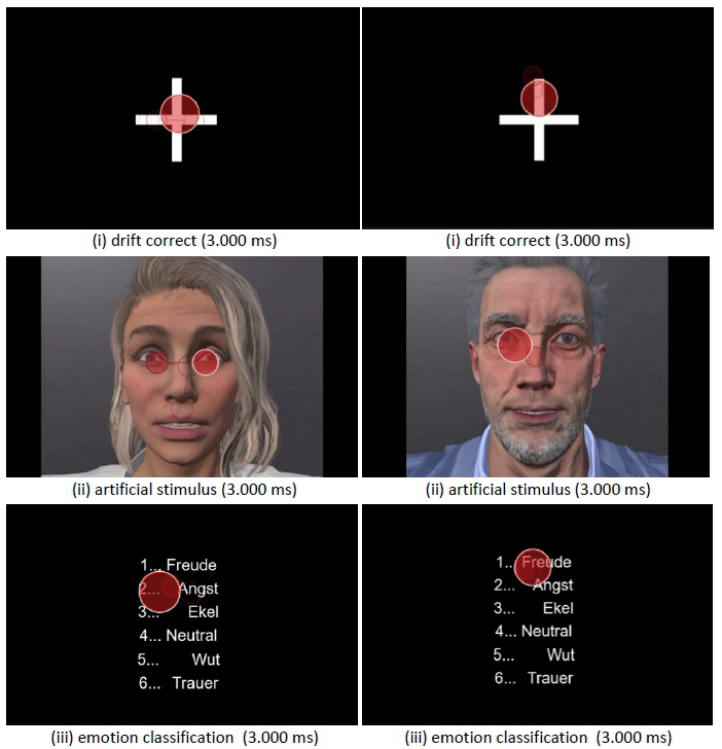
Emotion Recognition and Regulation Task In an emotion recognition paradigm, the virtual avatars used are to be validated with regard to the representation of emotions (Figure 2). Evaluated stimuli from the Dynamic FACES database (Ebner et al., 2010) will be used as a comparison. Four different virtual avatars are used, each showing six of the basic emotions (joy, sadness, fear, disgust, anger, neutral) according to Eckman (1971). These are compared with the equivalent stimuli with real faces from the Dynamic FACES Set. The order of presentation is randomized. In addition to the correct identification of the emotion presented, an evaluation of the characters is also aimed at, which, in addition to the naturalness and authenticity of the stimulus presented, also records the subjects’ confidence in interpretation.
Figure 2: Emotion recognition and regulation task. Fixations are visualized using Tobii Pro Lab. The task consists of three phases: (i) fixation to correct for pupil dilation drift, (ii) presentation of a stimulus video, (iii) user-based emotion classification (1 = joy, 2 = fear, 3 = disgust, 4 = neutral, 5 = anger, 6 = sadness), using artificial stimuli (and stimuli from the FACES database by Ebner et al., 2010).
Eye movement analysis is one of the most non-invasive, cost-effective and feasible approaches to identify biomarkers for early autism diagnosis (Frazier et al., 2018). Typical biomarkers include pupil diameter at rest (Anderson et al., 2013) and differences in basic oculomotor measures such as fixation duration (Wass et al., 2015) and saccade amplitude (Bast et al., 2021). Although these are almost exclusively laboratory-based studies with effect sizes that suggest limited diagnostic utility (Loth et al., 2021), these results suggest that multiple eye-tracking indices can be combined to increase discriminative power (Slinger et al., 2023) and hold promise for identifying autism not only in infants and young children, but also in adults.
Successful emotion induction in response to presented emotional stimuli is then expected to be indicated by pupil size enlargements, after viewing
Learning Analytics Using Eye Tracking-Based Biomarkers on Serious Games for Adults 75
negative compared to neutral pictures. Likewise, emotion regulation strategies, such as distracting or reappraisal, are also expected to lead to corresponding results in contrast to simply viewing the negative pictures (Langer et al., 2023).
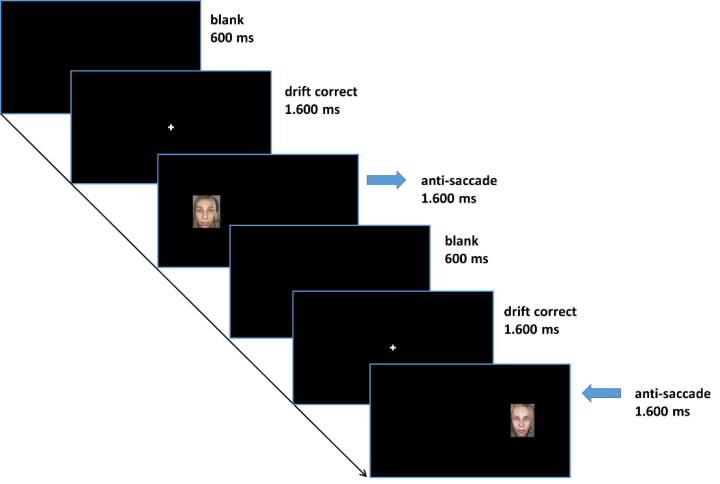
Antisaccade Eye Tracking and Emotion Regulation Task The antisaccade task (AST; Hallett, 1978) measures how well the frontal lobe of the brain can control the reflexive saccade, i.e. the eye movement (Levy et al., 2004). In the AST, a visual target stimulus indicates that a saccade should be made to the side of the fixation point opposite the target stimulus, at approximately the same distance from the fixation point (Figure 3).
Figure 3: Schematic sketch of the antisaccade eye tracking and emotion regulation task (ASERT). After a blank screen and a fixation cross, the user is required to perform antisaccades in response to the randomized position of an emotional stimulus.
Dependent variables in the AST are typically the latency of the response, measured from the time of stimulus presentation, and the percentage of erroneous ‘prosaccades’ towards the stimulus (Sahuquillo-Leal et al., 2024). Persons with ASD showed a higher error rate in the antisaccade block than those with TD indicating that children with ASD have inefficient inhibitory control of attention. It should be noted that this is considered a key executive function involved in inhibiting inappropriate behaviors to respond more adaptively to environmental stimuli (Goldberg et al., 2002). Furthermore, we expect in the latency data slower responses in antisaccadic blocks in ASD than in TD participants.
Research Hypothesis and Learning Analytics It is hypothesized that statistically significant digital biomarkers for the psychological constructs of emotion recognition and emotion regulation can be identified from eye tracking and biosignal data elicited during the ERRT and ASERT protocols. These biomarkers will subsequently be integrated into a serious game to assess and interpret the responses of individuals with ASD to specific, predetermined stimuli.
These biomarkers may facilitate the interpretation of players’ affective and cognitive states in response to social-emotional stimuli, enabling adaptive feedback, difficulty modulation, and personalized learning paths. This approach supports continuous assessment, the development of individualized emotional profiles, and evidence-based tracking of progress, ultimately enhancing the effectiveness of interventions for individuals with ASD.
Serious Game The gaming component of the study is not detailed in this publication, which focuses on eye tracking. In the serious game, participants interact with virtual avatars in realistic, everyday scenarios such as phone calls or scheduling lunch with colleagues. The story-based framework involves four recurring characters, allowing users to gradually become familiar with them. At each decision point, users select responses, shaping the interaction’s direction. Repeated tasks simulate real-life familiarization with new environments and people. After each task, the system provides feedback on social behaviour and perceived emotional responses. Physiological stress data (e.g., heart rate) is recorded, and participants self-report stress levels. The game allows experimentation with different interaction strategies in a safe setting, supporting adaptive learning without real-world consequences.
CONCLUSION AND FUTURE WORK This study plan introduces a sensor-based learning analytics approach for assessing emotion recognition and regulation in adults with ASD. Using eye tracking, physiological sensors, and serious games, the framework captures real-time responses to both real and AI-generated emotional stimuli.
The combination of antisaccade and emotion recognition tasks allows for detailed analysis of attentional control, emotional processing, and executive functioning. The results aim to inform the development of personalized digital therapies that adapt to individual user profiles.
Future work will perform the research study and expand this framework into fully interactive serious games, enabling immersive training in social scenarios. Planned extensions include machine learning integration for adaptive feedback and larger validation studies to confirm long-term efficacy and generalizability of the system across diverse ASD populations.
ACKNOWLEDGMENT
This research was partially supported by the European Commission by project ETAP (Reference Number: ERAPERMED2022-276).
Learning Analytics Using Eye Tracking-Based Biomarkers on Serious Games for Adults 77
REFERENCES
American Psychiatric Association. (2013). Diagnostic and Statistical Manual of Mental Disorders (5th ed.). Arlington, VA: American Psychiatric Publishing. Anderson, C. J. et al. (2013). Visual attention to social and nonsocial stimuli in infants
at high risk for autism spectrum disorder. Journal of Autism and Developmental Disorders, 43(4), 937–948. https://doi.org/10.1007/s10803-012-1636-2 Baron-Cohen, S. (1995). Mindblindness: An essay on autism and theory of mind.
MIT Press. Bast, N. et al. (2021). Oculomotor measures in autism spectrum disorder: A systematic review and meta-analysis. Neuroscience & Biobehavioral Reviews, 129, 123–138. https://doi.org/10.1016/j.neubiorev.2021.07.004 Bastiaansen, J. A. et al. (2011). Age-related increase in inferior frontal gyrus activity
and social functioning in autism spectrum disorder. Biological Psychiatry, 69(9), 832–838. https://doi.org/10.1016/j.biopsych.2010.11.007 Beall, P. M., & Herbert, A. M. (2008). The face wins: Stronger automatic processing of affect in facial expressions than words in a modified Stroop task. Cognition and Emotion, 22(8), 1613–1642. https://doi.org/10.1080/02699930701741070 Bölte, S., Feineis-Matthews, S., Leber, S., Dierks, T., Hubl, D., & Poustka, F. (2006).
The development and evaluation of a computer-based program to test and to teach the recognition of facial affect. International Journal of Circumpolar Health, 65(1), 53–58. Chawarska, K., Macari, S., & Shic, F. (2012). Context modulates attention to social scenes in toddlers with autism. Journal of Child Psychology and Psychiatry, 53(8), 903–913. https://doi.org/10.1111/j.1469–7610.2012.02538.x Derakshan, N., Ansari, T. L., Hansard, M., Shoker, L., & Eysenck, M. W. (2009).
Anxiety, inhibition, efficiency, and effectiveness: An investigation using the antisaccade task. Experimental Psychology, 56(1), 48–55. https://doi.org/10.1027/ 1618-3169.56.1.48 Derogatis, L. R. (1977). SCL-90-R: Administration, scoring and procedures manual for the R (evised) version. Johns Hopkins University School of Medicine. Diamond, A. (2013). Executive functions. Annual Review of Psychology, 64,
135–168. https://doi.org/10.1146/annurev-psych-113011-143750 Ebert, A. et al. (2013). Modifying social cognition in schizophrenia: A pilot study using a manualized group intervention. Cognitive Neuropsychiatry, 18(1–2), 49–62. https://doi.org/10.1080/13546805.2012.730979 Ebner, N. C. et al. (2010). FACES—A database of facial expressions in young, middle-
aged, and older women and men: Development and validation. Behavior Research Methods, 42(1), 351–362. https://doi.org/10.3758/BRM.42.1.351 Ekman, P.(1971). Universals and cultural differences in facial expressions of emotion.
In J. K. Cole (Ed.), Nebraska Symposium on Motivation (Vol. 19, pp. 207–283). University of Nebraska Press. Elfenbein, H. A. et al. (2007). Reading your counterpart: The benefit of emotion recognition accuracy for effectiveness in negotiation. Journal of Nonverbal Behavior, 31(4), 205–223. https://doi.org/10.1007/s10919-007-0033-7 Frazier, T. W. et al. (2018). A meta-analysis of gaze differences to social and
nonsocial information between individuals with and without autism. Journal of the American Academy of Child & Adolescent Psychiatry, 56(7), 546–555. https:// doi.org/10.1016/j.jaac.2017.05.005 Gaab, J. (2009). PASA: Primäre und sekundäre Bewertung stressreicher Ereignisse – Manual. Universität Freiburg, Institut für Psychologie.
García-Blanco, A., Perea, M., & Salmerón, L. (2017). Eye fixation patterns in emotion regulation: A meta-analysis. Cognition and Emotion, 31(8), 1528–1540. https://doi.org/10.1080/02699931.2016.1231213 Goldberg, M. C. (2002). Subtle executive impairment in children with autism and
children with ADHD. Journal of Autism and Developmental Disorders, 35(3), 279–293. https://doi.org/10.1023/B: JADD.0000018063.36788.f0 Grynszpan, O., Martin, J. C., & Nadel, J. (2012). Multimedia interfaces for users with high functioning autism: An empirical investigation. International Journal of Human-Computer Studies, 70(10), 699–710. Guillon, Q., Hadjikhani, N., Baduel, S., & Rogé, B. (2014). Visual social
attention in autism spectrum disorder: Insights from eye tracking studies. Neuroscience & Biobehavioral Reviews, 42, 279–297. https://doi.org/10.1016/ j.neubiorev.2014.03.013 Hallett, P. E. (1978). Primary and secondary saccades to goals defined by instructions. Vision Research, 18(10), 1279–1296. https://doi.org/10.1016/0042- 6989(78)90218-3 Hill, E. L. (2004). Executive dysfunction in autism. Trends in Cognitive Sciences, 8(1), 26–32. https://doi.org/10.1016/j.tics.2003.11.003 Hutton, S. B., & Ettinger, U. (2006). The antisaccade task as a research tool in
psychopathology: A critical review. Psychophysiology, 43(3), 302–313. https:// doi.org/10.1111/j.1469–8986.2006.00403.x Keehn, B., Müller, R. A., & Townsend, J. (2013). Atypical attentional networks and the emergence of autism. Neuroscience & Biobehavioral Reviews, 37(2), 164–183. https://doi.org/10.1016/j.neubiorev.2012.11.014 Kleinhans, N. M. et al. (2010). Abnormal functional connectivity in autism spectrum
disorders during face processing. Brain, 131(4), 1000–1012. https://doi.org/ 10.1093/brain/awm334 Kliemann, D. et al. (2012). Atypical reflexive gaze patterns on emotional faces in autism spectrum disorders. J of Neurosc, https://doi.org/10.1523/ JNEUROSCI.5294–11.2012 Klin, A., Jones, W., Schultz, R., Volkmar, F., & Cohen, D. (2002). Visual fixation patterns during viewing of naturalistic social situations as predictors of social competence in individuals with autism. Archives of General Psychiatry, 59(9), 809–816. Langer, K. et al. (2022). Rapid effects of acute stress on cognitive emotion regulation.
Psychoneuroendocrinology, https://doi.org/10.1016/j.psyneuen.2022.105694 Levy, D. L., Sereno, A. B., Gooding, D. C., & O’Driscoll, G. A. (2004). Eye tracking dysfunction in schizophrenia: Characterization and pathophysiology. Current Topics in Behavioral Neurosciences, 1, 311–347. https://doi.org/10.1007/ 7854_2007_42 Lopez, B. R. et al. (2005). Examining the relationship between executive functions
and restricted, repetitive symptoms of Autistic Disorder. Journal of Autism and Developmental Disorders, 35(4), 445–460. https://doi.org/10.1007/s10803-005- 5035-x Loth, E. et al. (2021). Identification and validation of biomarkers for autism spectrum disorders. Nature Reviews Drug Discovery, 20(7), 471–484. https:// doi.org/10.1038/s41573-021-00178-w Luna, B. et al. (2007). Maturation of executive function in autism. Biological
Learning Analytics Using Eye Tracking-Based Biomarkers on Serious Games for Adults 79
Madsen, G. F., Parvaneh, H., & Jahanshahi, A. (2016). Eye-tracking metrics differences between real and animated emotional facial stimuli in adults with autism. Journal of Autism and Developmental Disorders, 46(4), 1172–1185. Manoach, D. S. et al. (2004). Schizophrenic subjects show deficient inhibition but
intact task switching on saccadic tasks. Biological Psychiatry, 55(7), 837–845. https://doi.org/10.1016/j.biopsych.2003.12.025 Marchi, E., Zhang, Y., Eyben, F., Ringeval, F., & Schuller, B. (2019). Autism and speech, language, and emotion – a survey. In H. A. Patil, M. Kulshreshtha, & A. Neustein (Eds.), Signal and Acoustic Modeling for Speech and Communication Disorders (pp. 139–160). De Gruyter. https://doi.org/10.1515/9781501502415- 007 Markram, H., & Markram, K. (2010). The intense world theory – a unifying theory
of the neurobiology of autism. Frontiers in Human Neuroscience, 4, 224. https:// doi.org/10.3389/fnhum.2010.00224 Markram, K. (2007). The intense world syndrome – an alternative hypothesis for autism. Frontiers in Neuroscience, 1(1), 77–96. https://doi.org/10.3389/ neuro.01.1.1.006.2007 Minshew, N. J., Luna, B., & Sweeney, J. A. (1999). Oculomotor evidence for
neocortical systems but not cerebellar dysfunction in autism. Neurology, 52(5), 917–922. https://doi.org/10.1212/WNL.52.5.917 Mosconi, M. W. et al. (2009). Impaired inhibitory control is associated with higherorder repetitive behaviors in autism spectrum disorders. Psychological Medicine, 39(9), 1559–1566. https://doi.org/10.1017/S0033291708004984 Müller, E. et al. (2020). Emotion recognition training in adults with autism spectrum
disorder: A study of computerized and adaptive methods. Journal of Autism and Developmental Disorders, https://doi.org/10.1007/s10803-019-03930-4 Pagni, B. A., Walsh, M. J. M., Rogers, C., & Braden, B. B. (2020). Social cognition in autism spectrum disorder across the adult lifespan: Influence of age and sex on Reading the Mind in the Eyes Test in a cross-sectional sample. Frontiers in Integrative Neuroscience, 14, 571408. https://doi.org/10.3389/ fnint.2020.571408 Poglitsch, C., Safikhani, S., List, E., Pirker, J. (2024). XR technologies to enhance
the emotional skills of people with autism spectrum disorder: A systematic review, Computers & Graphics, Volume 121, 2024. https://doi.org/10.1016/ j.cag.2024.103942. Polar Electro Oy. (2025). Polar Verity Sense product description. Retrieved May 31, 2025, from https://www.polar.com/us-en/products/accessories/polar-verity-sense. Ritvo, R. A. et al. (2011). The Ritvo Autism Asperger Diagnostic Scale–Revised
(RAADS-R). J of Autism and Developm Disorders, https://doi.org/10.1007/ s10803-010-1133-5 Rosenblau, G., Kliemann, D., Heekeren, H. R., & Dziobek, I. (2019). Emotional prosody processing in adults with autism spectrum disorder: A pilot study of a computer-based training program. Autism Research, 12(5), 733–745. https:// doi.org/10.1002/aur.2098 Saygin, A. P. et al. (2012). The thing that should not be: Predictive coding and the
uncanny valley in perceiving human and humanoid robot actions. Social Cognitive and Affective Neuroscience, 7(4), 413–422. https://doi.org/10.1093/scan/nsr025 Schlegel, K. (2021). Empathy and emotion recognition: The conceptual role of trait emotional intelligence. Emotion Review, 13(1), 26–34. https://doi.org/10.1177/ 1754073919886276
Schlegel, K., Grandjean, D., & Scherer, K. R. (2017). Emotion recognition: Unidimensional ability or a set of modality- and emotion-specific skills? Personality and Individual Differences, 115, 42–49. https://doi.org/10.1016/ j.paid.2016.09.042 Slinger, J., Witherow, A., Murray, L., & Pickles, A. (2023). Combining eye-tracking
metrics to enhance early autism diagnosis: A machine learning approach. Autism Research, 16(1), 12–26. https://doi.org/10.1002/aur.2845 Smith, A. (2009). The empathy imbalance hypothesis of autism: A theoretical approach to cognitive and emotional empathy in autistic development. The Psychological Record, 59(3), 489–510. https://doi.org/10.1007/BF03395676 Tobii AB. (2025). Tobii Pro Fusion product description. Retrieved May 31, 2025,
from https://www.tobii.com/products/eye-trackers/screen-based/tobii-pro-fusion. Uljarevic, M., & Hamilton, A. (2013). Recognition of emotions in autism: A formal meta-analysis. Journal of Autism and Developmental Disorders, 43(7), 1517–1526. https://doi.org/10.1007/s10803-012-1695-5 Uljarevi´c, M., Vivanti, G., & Dissanayake, C. (2016). Attention to emotional
faces in autism: Meta-analysis of eye-tracking studies. Journal of Autism and Developmental Disorders, 46(2), 312–331. https://doi.org/10.1007/s10803-015- 2561-3 Waddington, F., & White, S. W. (2017). Attention bias and mental health in adults with autism spectrum disorder. Journal of Autism and Developmental Disorders, 47(6), 1613–1622. https://doi.org/10.1007/s10803-017-3080-y Wass, S. V. et al. (2015). Visual orienting in autism: Hyper-responsiveness to
social cues in early infancy. Developm Cognit Neurosci. https://doi.org/10.1016/ j.dcn.2014.09.005 Waters, S. F., West, T. V., Karnilowicz, H. R., & Mendes, W. B. (2008). Affect contagion between mothers and infants: Examining valence and touch. Journal of Experimental Psychology: General, 147(7), 1042–1053. https://doi.org/10.1037/ xge0000489 Weiß, R. H. (2006). CFT 20-R – Grundintelligenztest Skala 2 – Revision. Hogrefe. Wunsch, V., Möller, K., Wagner-Hartl, V. (2025). Avatar-based emotion representation with varying degrees of realism. In: Tareq Ahram, Waldemar Karwowski, Carlo Martino, Giuseppe Di Bucchianico and Vincenzo Maselli (eds) Intelligent Human Systems Integration (IHSI 2025): Integrating People and Intelligent Systems. AHFE (2025) International Conference. AHFE Open Access, vol. 160. AHFE International, USA. http://doi.org/10.54941/ahfe1005824 Yiend, J. (2010). The effects of emotion on attention: A review of attentional
processing of emotional information. Cognition and Emotion, 24(1), 3–47. https://doi.org/10.1080/02699930903205698 Zhao, H., Li, J., Fang, F., & Wang, L. (2016). The neural mechanisms of threat detection and regulation in individuals with autism spectrum disorders. Neuroscience & Biobehavioral Reviews, 68, 794–805. https://doi.org/10.1016/ j.neubiorev.2016.06.016
LISTED IN THE AHFE DIGITAL BOOKSTORE CATALOGUE
Explore the complete digital volume
Cognitive Computing and Internet of Things
Read this individual research paper free through the original publisher, or explore the full digital proceedings book.
ISBN 978-1-964867-41-0
Explore this ISBN in the AHFE Bookstore ↗Listed in the July 2026 bookstore catalogue; search by ISBN to confirm current availability · Digital book purchase optional