Martin Pszeida, Michael Schneeberger, Wolfgang Weiss, Clemens Koenczoel, Alexander Elser, Klaus Tschabuschnig, Deborah Huber, Manfred Pollheimer-Stadlober, Sandra Pichler, Jasmina Schmidt, Josef Rampitsch, Georg Schwarzott, Dietrich Albert, Bettina Kubicek, Marie Ottilie Frenkel, Jochen A Mosbacher, Hannes Kern, Lucas Paletta (2026). Mobile Platform for Integrated Multimodal Data Capture in Immersive First Responder Training and Decision. In: Cognitive Computing and Internet of Things. AHFE Open Access, vol. 205, pp. 84–94. https://doi.org/10.54941/ahfe1007928
Immersive VR training is increasingly adopted by first-responder academies, yet objectively assessing decision-making under operational stress remains challenging. This is largely due to bio-signals, gaze data, and contextual video being captured with heterogeneous tools that produce inconsistent timestamps and offer limited robustness for field use.We present a mobile, deployment-ready platform that integrates psychophysiology, eye tracking, and synchronized video capture into a single workflow to support reproducible studies in real training environments, as piloted at the State Firefighting Academy Carinthia.Methods. The platform combines (i) immersive VR via Meta Quest 3 (2064×2208 per eye, up to 120 Hz) connected by cable for stable streaming, (ii) high-frequency eye tracking using a mounted Pupil Labs Neon module (two IR eye cameras, 192×192 @200 Hz; ~150 Hz when extracting gaze features), and (iii) multi-channel bio-signals captured through a BIOPAC MP160 with BioNomadix transmitters for ECG and EDA, configured in AcqKnowledge. In addition, a Polar H10 chest strap provides a redundant ECG source for cross-checking physiological recordings. All streams are consolidated in a custom “Study Recording Software/Study Controller” that supports connection setup and status monitoring, live signal visualization, anonymous user ID entry, standardized baseline recordings, manual start/stop of scenario recordings, and automatic folder structures for traceable data storage.To capture the context and enable behavioral annotation, two complementary video channels are recorded: (a) an external camera overview and (b) a first-person VR perspective recorded with Open Broadcaster Software, including an on-screen system timestamp for post-hoc alignment. Temporal synchronization is achieved using system timestamps embedded in received sensor streams, by continuously measuring device clock deviations relative to a common time server and complemented by event anchors in the ego videos.Scenario segmentation is automated by detecting these anchors and generating standardized clips; additional expert-defined anchors enable narrower excerpts (e.g., “arrival at incident scene”) for structured expert ratings.Results and discussion. In the pilot field deployment, the platform demonstrated stable multi-stream recording and consistent data packaging across bio-signals, gaze, and dual video. The synchronization and segmentation pipeline produced analysis-ready datasets and expert-review clips without disrupting the training operations. The approach increases robustness, reliability and trustworthiness through redundancy (dual ECG), explicit time-referencing, and standardized recording protocols. The next steps focus on scalable feature extraction from the synchronized exports (blink rate, saccade metrics, pupil diameter) and linking multimodal biomarkers to decision-quality indicators to support evidence-based debriefing and future adaptive assistance in immersive first-responder training.
Firefighting and rescue operations require fast decisions under uncertainty, time pressure, incomplete information and high consequence conditions (Klein et al., 2010; Wheeler et al., 2021). These situations are also shaped by physiological arousal, stress and cognitive load, which can influence situational awareness, decision making and operational performance (Oliveira et al., 2024; Wheeler et al., 2021). Training environments therefore need to reproduce not only the visual and procedural elements of an incident, but also the cognitive demands and stress-related dynamics that shape performance in realistic emergency contexts (Oliveira et al., 2024; Wheeler et al., 2024). Immersive virtual reality (VR) is a promising medium because it can expose trainees to rare, complex or dangerous situations without putting people, equipment or infrastructure at risk (Engelbrecht et al., 2019; Berthiaume et al., 2024). It also allows instructors to repeat scenarios, vary task demands and compare trainee performance across sessions under controlled and ecologically valid conditions (Oliveira et al., 2024; Wheeler et al., 2024).
However, the scientific value of immersive training depends on more than the VR scene itself. Trainers and researchers need reliable evidence about when relevant decisions occur, which cues are inspected, whether the trainee shows physiological activation, and how these signals relate to mission events. In practice, these data are often distributed across the VR system, an eye tracker, a biosignal recorder, local video files and handwritten trainer notes. This fragmentation makes post-hoc analysis slow, reduces trust in timestamps and limits the effectiveness of structured debriefing.
The EMERDEC mobile platform addresses this gap by integrating multimodal data streams from eye tracking, psychophysiological monitoring, scenario video, and event-based segmentation into a unified mobile data- capture workflow for operational training environments. The platform was developed within a research project investigating the fundamentals of decision-making processes in primary emergency response and provides a methodological basis for reproducible human-factors studies, evidence-based debriefing, and future decision-support systems (Kern et al., in press; Elser et al., in press; Koenczoel et al., in press).
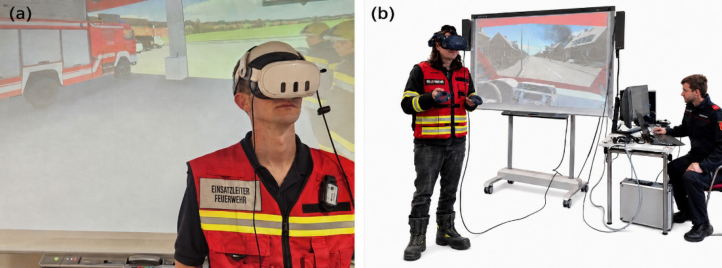
The goal of this mobile data-capture system is not to replace instructors or to automate performance assessment. Instead, the platform creates synchronized evidence that can support structured expert ratings, explainable debriefing and later development of adaptive assistance. Figure 1 illustrates the operational context of the EMERDEC platform, where trainees engage in an immersive fire-service scenario while an operator monitors the session.
RELATED WORK AND CURRENT STATE OF RESEARCH Immersive VR has been discussed as a training and research tool for emergency response, disaster medicine and safety-critical education because it combines ecological cues with controllability and repeatability. Reviews of VR head-mounted displays emphasize benefits for spatial learning and experiential training, while also noting the need for carefully designed learning objectives, usability checks and outcome measures (Jensen and Konradsen, 2018; Radianti et al., 2020). In disaster medicine and first- responder settings, VR has been used for triage, mass-casualty response and
hazardous incident rehearsal (Farra et al., 2013; Paletta et al., 2022; Brown et al., 2023; Kman et al., 2023).
Figure 1: Immersive first-responder training setup: (a) decision-maker wearing a Meta Quest 3 headset in front of the projected fire-service scenario; (b) VR trainee and operator workstation in a training room at the State Firefighting Academy Carinthia.
For firefighters, the value of VR depends on whether the virtual environment creates sufficient perceptual and behavioural equivalence to real training or operations. Recent work on virtual firefighting scenarios therefore evaluates presence, perceived stress, fatigue, knowledge transfer and physiological indicators rather than relying only on subjective acceptance (Reim et al., 2022; Narciso et al., 2024; Wrzus et al., 2024). This aligns with a human-factors view: decision quality in an incident is shaped by attention allocation, workload, situational awareness, physiological arousal and interaction constraints.
To assess these factors, different measures can be employed. Eye tracking provides a direct measurement channel for visual attention and visual- cognitive behaviour. Fixations, saccades, gaze transitions, blink rate and pupil diameter can help to describe scanning strategies and task engagement. Cognitive pupillometry has a long tradition as an indicator of processing load (Beatty, 1982), but field use requires careful control of luminance, movement and device quality. In parallel, heart-rate variability and electrodermal activity are common psychophysiological measures for autonomic regulation and stress-related arousal (Benedek and Kaernbach, 2010; Shaffer and Ginsberg, 2017; Schneeberger et al., 2022; Wrzus et al., 2024). Despite these advances, most training studies still collect behavioural, physiological and contextual data using separate systems, making reliable temporal synchronization and integrated analysis difficult. Multimodal experiments often combine various devices, deployed as distributed systems with individual clocks, sampling rates, buffers and transmission paths. Frameworks such as the Lab Streaming Layer illustrate how per- sample timestamps and clock offset estimation can support synchronized neurophysiological and behavioural recording (Kothe et al., 2025).
Building on these synchronization principles, the EMERDEC platform provides an operationally deployable framework that integrates eye tracking, psychophysiological monitoring, video capture and event-based analysis within a single workflow for immersive first-responder training.
SYSTEM ARCHITECTURE The architecture consists of four functional layers: (1) immersive scenario execution, (2) wearable sensing, (3) study control, and (4) synchronized recording and data management. Together, these layers provide a unified workflow for multimodal data acquisition in operational VR training environments.
The immersive layer uses a Meta Quest 3 headset connected via cable to the scenario workstation for stable streaming and screen capture. A mounted Pupil Labs Neon module captures high-frequency eye videos and gaze- related features. Physiological sensing is implemented through a BIOPAC MP160 with BioNomadix wireless transmitters and a Polar H10 chest strap as redundant ECG source. This redundancy is useful because it allows cross- checking of heart-rate-derived measures and helps identify signal dropouts during movement.
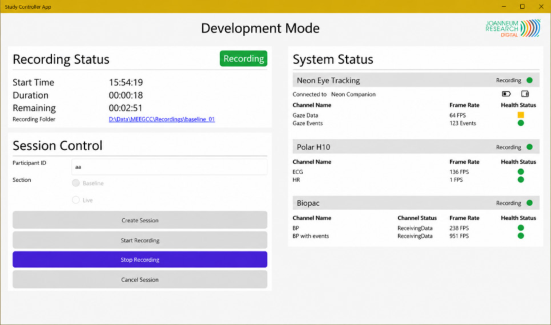
The Study Recording Software (Figure 2) provides a unified operator interface for participant management, baseline acquisition, recording control, device-status monitoring, and automated session packaging. This reduces operator workload and minimizes synchronization errors that commonly occur when multiple vendor-specific tools must be managed independently.
(a)
(b)
Figure 2: Biosignal and control components: (a) BIOPAC MP160/BioNomadix wireless measurement setup; (b) custom Study Recording Software showing recording status, session control and live connection health for Neon eye tracking, Polar H10 and BIOPAC streams.
This design reduces the number of independent operator actions that would otherwise be needed across several vendor tools. It also enables a standardized baseline before the scenario and consistent data packaging after the scenario.
The architecture includes two complementary video channels. First, an external camera records the participant, controllers, room context and operator actions. Second, the first-person VR perspective is recorded from the scenario computer using screen-recording software and an embedded on-screen timestamp. Together, these channels make it possible to what the trainee perceived, how the trainee responded physiologically, and what the operator observed. The external view is essential for behavioural annotation and quality control, while the ego perspective provides direct scenario context and event anchors.
A key design objective is robust temporal synchronization across heterogeneous devices. To achieve this, the platform combines timestamped sensor streams, clock-offset logging, controller-generated event markers, and visual anchors embedded in first-person recordings. This multi-layer synchronization strategy increases resilience against field-related disturbances such as wireless latency, temporary signal loss, asynchronous buffering, or delayed video encoding.
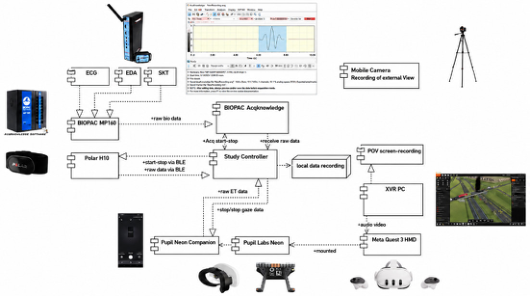
Figure 3: System architecture of the integrated multimodal data recording system, connecting BIOPAC/AcqKnowledge, Polar H10, Pupil Labs Neon Companion, Meta Quest 3, XVR scenario PC, screen recording and external camera recording through JR recording software and local per-user data storage.
Figure 3 shows the resulting modular architecture. The biosignal data is captured by ECG, electrodermal activity and skin temperature through BIOPAC/AcqKnowledge, while the Polar H10 adds an independent ECG stream via Bluetooth Low Energy. The eye-tracking system uses the Neon Companion mobile app and a mounted Neon from Pupil Labs1 module inside the headset. The scenario side includes the XVR PC, the Meta Quest 3 headset, first-person screen recording and external camera recording.
1https://pupil-labs.com/
Mobile Platform for Integrated Multimodal Data Capture in Immersive 89 The Study Controller recording software acts as the integration layer that starts, stops and stores the session data in a common folder structure.
The synchronized data package supports several analysis levels. At the low level, raw sensor streams and videos are preserved for audit and re-analysis. At the feature level, the platform extracts blink rate, pupil diameter, gaze validity, saccadic activity, heart rate, heart rate variability and EDA measures in windows around scenario events. At the interpretation level, the synchronized timeline enables trainer-defined event ratings, for example whether the trainee noticed a hazard, delayed a critical decision or showed signs of overload during the approach to the incident scene.
PILOT EVALUATION OF THE SYNCHRONIZED DATA CAPTURE WORKFLOW A field deployment for a pilot study was conducted in a firefighter VR training setting. The pilot deployment was designed to evaluate whether multimodal data streams could be recorded, synchronized, and segmented under realistic training conditions without disrupting operational training procedures.
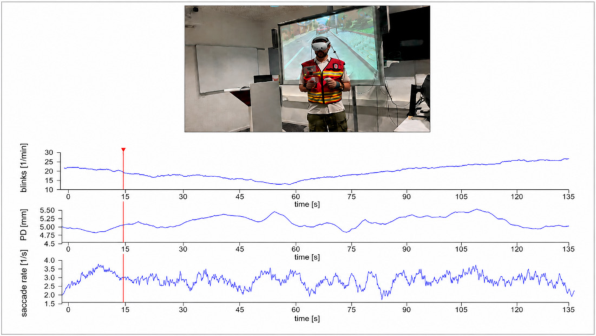
Figure 4: Example of synchronized video and numerical signal visualization. The upper panel shows the VR trainee in the training room; aligned time-series below show blink rate, pupil diameter (PD) and saccadic activity. A red marker indicates individual task duration with numerical biosignal data that are synchronized with the presented video frame.
Figure 4 illustrates an example of synchronized video and numerical signal visualization. The upper panel shows the VR trainee in the training room and provides the behavioural and scenario context for the displayed moment. The aligned time-series below show blink rate, pupil diameter (PD) and saccadic activity as synchronized numerical biosignal data. The red marker indicates the individual task duration and links the presented video frame to the corresponding signal values. This representation supports post-hoc inspection of how observable training behaviour relates to oculomotor and pupillometric responses within the same synchronized analysis window.
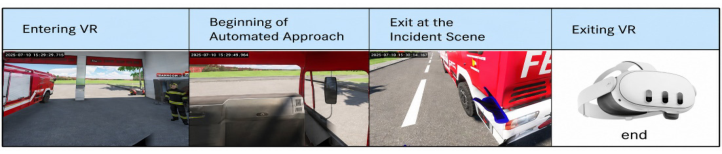
Figure 5: Video sequence analytics output. Four labelled segments are extracted from the VR mission: entry into VR, beginning of automated approach, exit at the incident scene and exit from VR. Labels become temporal anchors for synchronized feature extraction and expert-review clips.Table 1: Video-sequence analytics output and analytical use.
Table available in the original PDF paper.
Segment Operational Meaning Use in Multimodal Analysis Entry into VR Trainee enters the immersive environment and scenario context becomes visible.
Defines the start of scenario exposure and separates baseline from VR phase.
Automated approach begins
Vehicle movement starts and the trainee receives dynamic visual information.
Supports workload and attention analysis during transition from preparation to incident approach.
Exit at incident scene Trainee leaves the vehicle and the operational task becomes action-oriented.
Marks a decision-critical interval for expert review and gaze/ physiology windowing.
Command to enter building
Marks a decision-critical interval for expert review and gaze/ physiology windowing.
Trainee has finished exploration of incidence site and gives command for squad to enter the building.
Squad signals status
Marks a decision-critical interval for expert review and gaze/ physiology windowing.
Trainee receives response from squad inside the building about the progress of efforts & status of squad
Squad signals accident
Marks a decision-critical interval for expert review and gaze/ physiology windowing.
Trainee receives response from squad that a member of their team has issue with oxygen and needs assistance Exit from VR Training scenario ends and headset use stops.
Defines endpoint for recovery analysis and post-scenario debriefing alignment.
The video-sequence analytics module transforms continuous VR recordings into structured event timelines. Each identified anchor defines a reproducible temporal window that can be linked directly to gaze behaviour, physiological responses, and expert assessments (Figure 5; Table 1). The currently implemented anchors identify entry into VR, beginning of automated approach, exit at the incident scene and exit from VR. The same mechanism can be extended with expert-defined anchors such as dispatch, hazard recognition, arrival, first report, first command, victim contact or scenario termination. These segments create standardized video-clips for re-analyses such as expert ratings and define reproducible windows for physiology and gaze analysis.
Mobile Platform for Integrated Multimodal Data Capture in Immersive 91 Three practical findings emerged from the pilot’s deployment. First, the centralized session control makes multi-device recording feasible for a single operator with sensor health, recording state and session control being visible in one window. Second, the combination of first-person and external video supports both scenario-based annotation and behavioural quality control. Third, event-based video segmentation substantially reduces review effort by transforming long recordings into standardized analysis segments that can be reviewed by trainers and aligned with numerical signals (HR, HRV, eye-tracking signals, see Figure 4). This is essential for scaling from anecdotal debriefing toward quantitative evidence about attention, stress and decision-making.
The result should be interpreted as a proof of technical integration as an enabler for human-factors validation, to capture temporal synchronized data streams from distributed sensor systems. The pilot study was not designed to evaluate decision quality or develop predictive classifiers. Instead, its purpose was to validate the technical infrastructure required for future human-factors research. The principal contribution is the establishment of a reproducible multimodal data infrastructure.: Each session generates a standardized package containing synchronized sensor recordings, video streams, baseline measurements, event markers, and analysis-ready segments. Such consistency is a prerequisite for future investigations of how gaze behaviour, physiological responses, and training outcomes relate to decision quality under operational stress.
DISCUSSION AND OUTLOOK The proposed platform supports a transition from immersive training environments that primarily provide experiential learning to training environments that also enable systematic human-factors assessment. It allows instructors and researchers to ask not only whether a trainee completed a task, but also how attention, physiological activation and scenario events unfolded over time. This is particularly relevant for first-responder decision- making, where errors often emerge from delayed cue detection, narrowed attention, stress-related overload or poor timing rather than from lack of procedural knowledge alone. Previous VR-based training research has likewise highlighted the importance of understanding attentional and psychophysiological mechanisms underlying operational decision-making under stress (Voigt & Frenkel, 2023; Frenkel & Strahler, 2025).
Future work will focus on three directions. The first is automated feature extraction from synchronized exports, including gaze validity, fixation structure, blink rate, pupil dynamics, heart-rate variability and EDA responses. The second is a trainer-oriented debriefing interfaces that links video clips, physiological summaries and event notes without exposing raw technical complexity. The third is validation against expert assessments and training outcomes to determine which multimodal indicators are robust enough for decision support or adaptive training. Beyond these, the platform can also be extended with speech, location, inertial motion or team-level communication features. As the platform evolves toward larger-scale deployment, ethical and
privacy considerations become increasingly important because eye-tracking recordings, video data, and physiological measurements constitute sensitive personal information.
Publication or sharing of identifiable images requires appropriate consent, and research datasets should use pseudonymous identifiers, secure storage, and restricted access. In operational use, the platform should remain a decision- support and debriefing tool; it should not replace instructor judgement or impose automated performance scores without validated evidence and transparent interpretation. In conclusion, the EMERDEC mobile platform demonstrates a practical architecture for synchronized multimodal recording in immersive first-responder training.
By combining immersive VR, eye tracking, psychophysiological sensing, dual video capture, and video-sequence analytics within a synchronized workflow, the platform contributes to three core objectives. First, it establishes a reproducible methodological foundation for repeated and comparable data capture across trainees, scenarios, and sessions. Second, it enables human- factors research by linking observable behaviour with gaze, pupillometric, and physiological indicators of workload and stress. Third, it provides the basis for future decision-support systems that use synchronized multimodal evidence to support debriefing, performance assessment, and adaptive emergency-response training
ACKNOWLEDGMENT
This research was conducted within the framework of the EMERDEC project (Fundamentals of Decision-Making Processes in Primary Emergency Response FFG project No. FO999914127). EMERDEC is funded by the Austrian Security Research Programme KIRAS of the Federal Ministry of Finance. The authors thank the State Firefighting Academy Carinthia and all involved instructors, operators and trainees for supporting the pilot deployment and for providing feedback on the mobile recording workflow. They also gratefully acknowledge XVR Simulation for providing access to the XVR On Scene simulation environment. The views expressed in this paper are those of the authors.
REFERENCES
Beatty, J. (1982). Task-evoked pupillary responses, processing load, and the structure of processing resources. Psychological Bulletin, 91(2), 276–292. https://doi. org/10.1037/0033-2909.91.2.276. Benedek, M., and Kaernbach, C. (2010). Decomposition of skin conductance data by
means of nonnegative deconvolution. Psychophysiology, 47(4), 647–658. https:// doi.org/10.1111/j.1469-8986.2009.00972.x. Berthiaume, M., Kinateder, M., Emond, B., Cooper, N., Obeegadoo, I., & Lapointe, J.-F. (2024). Evaluation of a virtual reality training tool for firefighters responding to transportation incidents with dangerous goods. Education and Information Technologies, 29, 14929–14967. https://doi.org/10.1007/s10639-023-12357-5
Mobile Platform for Integrated Multimodal Data Capture in Immersive 93 Brown, N., Margus, C., Hart, A., Sarin, R., Hertelendy, A., and Ciottone, G.
(2023). Virtual reality training in disaster medicine: A systematic review of the literature. Simulation in Healthcare, 18(4), 255–261. https://doi.org/10.1097/ SIH.0000000000000675. Elser, A., Koenczoel, C., Huber, D., Pollheimer-Stadlober, M., Kern, H., Huttenbrenner, K., Mosbacher, J. A., Pszeida, M., Weiss, W., Pichler, S., Schmidt, J., Tschabuschnig, K., Rampitsch, J., Schwarzott, G., Paletta, L., Albert, D., Kubicek, B., & Frenkel, M. O. (in press). Investigating mindfulness and decision-making under stress using immersive virtual reality firefighting scenarios. In L. Paletta (Ed.), Cognitive computing in sociotechnical systems. AHFE Open Access. Engelbrecht, H., Lindeman, R. W., & Hoermann, S. (2019). A SWOT analysis of the
field of virtual reality for firefighter training. Frontiers in Robotics and AI, 6, 101. https://doi.org/10.3389/frobt.2019.00101 Farra, S. L., Miller, E. T., Timm, N., and Schafer, J. (2013). Improved training for disasters using 3-D virtual reality simulation. Western Journal of Nursing Research, 35(5), 655–671. https://doi.org/10.1177/0193945912471735. Frenkel, M., Strahler, J. (2025). Virtual reality meets the police badge: Qualitative
findings on attention, decision-making, and action. In: Lucas Paletta (eds) Cognitive Computing and Internet of Things. AHFE (2025) International Conference. AHFE Open Access, vol 165. AHFE International, USA. http://doi. org/10.54941/ahfe1006094 Jensen, L., and Konradsen, F. (2018). A review of the use of virtual reality headmounted displays in education and training. Education and Information Technologies, 23(4), 1515–1529. https://doi.org/10.1007/s10639-017-9676-0. Kern, H., Huttenbrenner, K., Koenczoel, C., Huber, D., Pollheimer-Stadlober,
M., Elser, A., Mosbacher, J. A., Pszeida, M., Weiss, W., Pichler, S., Schmidt, J., Tschabuschnig, K., Rampitsch, J., Schwarzott, G., Frenkel, M. O., Paletta, L., Albert, D., & Kubicek, B. (in press). Decision-making in emergency response organisations: Human factors challenges and implications for digital support systems. In L. Paletta (Ed.), Cognitive computing in sociotechnical systems. AHFE Open Access. Klein, G., Calderwood, R., & Clinton-Cirocco, A. (2010). Rapid decision making on the fire ground: The original study plus a postscript. Journal of Cognitive Engineering and Decision Making, 4(3), https://doi.org/10.1518/1555343 10X12844000801203 Kman, N. E., Price, A., Berezina-Blackburn, V., et al. (2023). First Responder Virtual
Reality Simulator to train and assess emergency personnel for mass casualty response. Journal of the American College of Emergency Physicians Open, 4(1), e12903. https://doi.org/10.1002/emp2.12903. Koenczoel, C., Huber, D., Pollheimer-Stadlober, M., Elser, A., Mosbacher, J. A., Pszeida, M., Weiss, W., Pichler, S., Schmidt, J., Tschabuschnig, K., Rampitsch, J., Schwarzott, G., Kern, H., Frenkel, M. O., Paletta, L., Albert, D., & Kubicek, B. (in press). Integrating firefighters’ individual physical state in enhanced automated respiratory protection monitoring as decision-support: Influence on cognitive load in complex incident operations in a VR-study. In L. Paletta (Ed.), Cognitive computing in sociotechnical systems. AHFE Open Access. Kothe, C., Shirazi, S. Y., Stenner, T., Medine, D., Boulay, C., Grivich, M. I., Artoni,
F., Mullen, T., Delorme, A., and Makeig, S. (2025). The Lab Streaming Layer for synchronized multimodal recording. Imaging Neuroscience, 3, IMAG.a.136. https://doi.org/10.1162/IMAG.a.136.
Narciso, D., Melo, M., Rodrigues, S., Dias, D., Cunha, J., Vasconcelos-Raposo, J., and Bessa, M. (2024). Assessing the perceptual equivalence of a firefighting training exercise across virtual and real environments. Virtual Reality, 28, 14. https://doi. org/10.1007/s10055-023-00917-6. Oliveira, J., Aires Dias, J., Correia, R., Pinheiro, R., Reis, V., Sousa, D., Agostinho,
D., Simões, M., & Castelo-Branco, M. (2024). Exploring immersive multimodal virtual reality training, affective states, and ecological validity in healthy firefighters: Quasi-experimental study. JMIR Serious Games, 12, e53683. https:// doi.org/10.2196/53683 Paletta, L., Pszeida, M., Schneeberger, M., Dini, A., Reim, L., Kallus, K.W. (2022).
Cognitive-emotional Stress and Risk Stratification of Situational Awareness in Immersive First Responder Training, 2022 IEEE-EMBS International Conference on Biomedical and Health Informatics (BHI), Ioannina, Greece, 2022, pp. 1–4, https://doi.org/10.1109/BHI56158.2022.9926805 Radianti, J., Majchrzak, T. A., Fromm, J., and Wohlgenannt, I. (2020). A systematic review of immersive virtual reality applications for higher education: Design elements, lessons learned, and research agenda. Computers & Education, 147, 103778. https://doi.org/10.1016/j.compedu.2019.103778. Reim, L., Kallus, K.W., Pszeida, M., Schneeberger, M., Schönauer, C., Peer, A.,
Feischl, R., Aumayr, G., Wallner, D., Dini, A., Ladstätter, S., Weber, A., Almer, A., Paletta, L. (2022). Evaluation of Virtual Reality-based First Responder Training under Physiological and Cognitive-Emotional Strain, In: Paletta, L., Ayaz H., eds., Cognitive Computing and Internet of Things, AHFE open access, http://doi. org/10.54941/ahfe1001840. Schneeberger, M., Paletta, L., Kallus, K.W., Reim, L., Schönauer, C., Peer, A., Feischl, R., Aumayr, G., Pszeida, M., Dini, A., Ladstätter, S., Weber, A., Almer, A., Wallner, D. (2022). First Responder Situation Reporting in Virtual Reality Training with Evaluation of Cognitive-emotional Stress using Psychophysiological Measures, In: Paletta, L., Ayaz H., eds., Cognitive Computing and Internet of Things, AHFE open access, http://doi.org/10.54941/ahfe1001841 Shaffer, F., and Ginsberg, J. P. (2017). An overview of heart rate variability
metrics and norms. Frontiers in Public Health, 5, 258. https://doi.org/10.3389/ fpubh.2017.00258. Slater, M., and Sanchez-Vives, M. V. (2016). Enhancing our lives with immersive virtual reality. Frontiers in Robotics and AI, 3, 74. https://doi.org/10.3389/ frobt.2016.00074. Voigt, L., & Frenkel, M. O. (2023). How Officers Perform and Grow under Stress:
Police Training in Virtual Reality. In M. S. Staller, S. Koerner, & B. Zaiser (Eds.), Police Conflict Management, Volume II: Training and Education, 187–211. Springer. https://doi.org/10.1007/978-3-031-41100-7_9 Wheeler, S. G., Engelbrecht, H., & Hoermann, S. (2021). Human factors research in immersive virtual reality firefighter training: A systematic review. Frontiers in Virtual Reality, 2, 671664. https://doi.org/10.3389/frvir.2021.671664 Wheeler, S. G., Hoermann, S., Lukosch, S., & Lindeman, R. W. (2024). Design and
assessment of a virtual reality learning environment for firefighters. Frontiers in Computer Science, 6, 1274828. https://doi.org/10.3389/fcomp.2024.1274828 Wrzus, C., Frenkel, M.O. and Schöne, B. (2024). Current opportunities and challenges of immersive virtual reality for psychological research and application, Acta Psychologica, 249, p. 104485. https://doi.org/10.1016/j.actpsy.2024.104485.
LISTED IN THE AHFE DIGITAL BOOKSTORE CATALOGUE
Explore the complete digital volume
Cognitive Computing and Internet of Things
Read this individual research paper free through the original publisher, or explore the full digital proceedings book.
ISBN 978-1-964867-81-6
Explore this ISBN in the AHFE Bookstore ↗Listed in the July 2026 bookstore catalogue; search by ISBN to confirm current availability · Digital book purchase optional