Clemens Koenczoel, Deborah Huber, Manfred Pollheimer-Stadlober, Alexander Elser, Jochen A Mosbacher, Martin Pszeida, Wolfgang Weiss, Sandra Pichler, Jasmina Schmidt, Klaus Tschabuschnig, Josef Rampitsch, Georg Schwarzott, Hannes Kern, Marie Ottilie Frenkel, Lucas Paletta, Dietrich Albert, Bettina Kubicek (2026). Integrating Firefighters’ Individual Physical State in Enhanced Automated Respiratory Protection Monitoring as Decision-Support: Influence on Cognitive Load in Complex Incident Operations in a VR-Study. In: Cognitive Computing and Internet of Things. AHFE Open Access, vol. 205, pp. 41–51. https://doi.org/10.54941/ahfe1007360
Publisher statistics will load when you open Metrics.
AHFE OPEN ACCESS OPEN ACCESS CONFERENCE PROCEEDINGS PAPER
Integrating Firefighters’ Individual Physical State in Enhanced Automated Respiratory Protection Monitoring as Decision-Support: Influence on Cognitive Load in Complex Incident Operations in a VR-Study
We developed an extended automated respiratory protection monitoring system integrating firefighters’ physical states to reduce cognitive load on incident commanders in complex firefighting operations. Background: During critical firefighting operations, decisions must be made in the presence of potentially stressful factors such as threats, lack of assessment criteria, or interruptions and disruptions. These are related to limited cognitive processing and memory capacities influencing the quality of information processing in decision-making. Method: In total, 63 incident commanders participated in an experimental VR-study with a 2x2 design, which varied the use of the extended automated respiratory protection monitoring system and incident complexity. Results: The results reveal a significant interaction between the extended automated respiratory protection monitoring system and the incident complexity of the operation on cognitive load (F (1, 56) = 5.69, p = .02, η2 = .09). While the monitoring system reduces cognitive load in operations with medium incident complexity, it increases cognitive load in operations with high incident complexity resulting from the accident of a team member. Conclusion: This study highlights the relevance of extended automated respiratory protection monitoring with its potential positive impacts on incident commanders’ cognitive load, while also emphasising a human factors orientated design of the information interface.
During firefighting operations, tasks and decisions must be executed under conditions such as uncertainty, hazard potential, lack of assessment criteria, or interruptions. These factors are particularly significant as they negatively affect cognitive processing and memory capacities (Sweller, 2020) of emergency services and thus impact the quality of information processing in decision-making (Kinsey et al., 2019; Choudhury and Saravanan, 2025; Okoli et al., 2022). To support incident commanders in information processing, the EMERDEC project has developed an extended automated respiratory monitoring system as decision support system (DSS), which displays the remaining air supply of self-contained breathing apparatus (SCBA) wearers as well as their current physical state, as derived from electrocardiogram (ECG). The DSS aims to continuously support incident commanders in monitoring the SCBA team while reducing cognitive load.
Cognitive Load, Information Processing & Decision Making Cognitive load, the effort required to complete a task under certain conditions (Tierney et al., 2025), is particularly relevant in highly complex situations where lots of information must be processed during decision making. Due to limited processing and memory capacities, cognitive load can impede the cognitive capabilities needed for firefighting operations (Cowan, 2001). Time- critical and complex processes require rapid processing of large amounts of information, which can lead to cognitive overload when demands exceed the cognitive resources of the individual (Sweller, 2020). Dual systems theory (e.g. Kahneman, 2011) suggests that when high cognitive load challenges information-processing capacities, decisions are based on rapid, intuitive (System 1) processing, which is less deliberate and often based on heuristics, expertise, and scripts (e.g. standard operating procedures) (Butler et al., 2023). People also show more impulsive behaviour under high cognitive load (Israel et al., 2021). In addition, complex firefighting operations that deviate from routine scenarios often prompt automatic decision-making, although they require extensive consideration of alternatives (Butler et al., 2023). Therefore, reducing cognitive load with the help of a DSS could be a viable approach to release cognitive resources required for deliberate (System 2) decision-making.
Incident Complexity Firefighting operations are characterised by a combination of multiple factors creating a unique operational environment differing in complexity and cognitive demands. Factors that contribute to challenges in decision making include time pressure (Reale et al., 2023), noise (Schlittmeier and Marsh, 2021), threats (Robinson et al., 2013), fatigue (Stout et al., 2021), thermal stressors (Thompson et al., 2024), interruptions, and distractions
Integrating Firefighters’ Individual Physical State 43 (Tremblay et al., 2012). These factors reduce cognitive performance and may cause additional stress, which also impacts cognitive capabilities (Staal, 2004; Sandi, 2013). Mitigating these stressors can help with information processing and maintaining incident commanders’ cognitive capabilities.
Incident complexity itself also places cognitive load on incident commanders. Task complexity is the number of actions and cues necessary to achieve a task outcome (Hærem et al., 2015). The more information to process and the greater the number of steps to complete, the more complex is the task, which influences cognitive load (Zaphir et al., 2025). As an incident becomes more complex, more cues occur, challenging incident commanders to filter relevant information (Okoli et al., 2022) and process cues efficiently (Choudhury and Saravanan, 2025). Experience can help to make quick decisions based on recognition (System 1), which mostly leads to appropriate and fast outcomes (Kahneman and Klein, 2009). However, it can also lead to misconceptions when commanders lack experience or information and therefore rely on inappropriate heuristics, which can lead to cognitive bias (Kinsey et al., 2019). To support commanders in complex scenarios, DSS could be used to avoid bias and reduce cognitive load.
Decision Support Systems DSS attempt to assist users in processing information during decision making in complex environments to reduce cognitive load and improve performance (Schaffer et al., 2023). Information used by DSS can be obtained from existing databases and pre-processed to reduce the amount of information and speed up information processing. DSS can also acquire new information or, by combining different sources, improve information quality. By simulating specific situations, DSS produce new information that helps to anticipate operational developments (Bonazountas et al., 2007). DSS can analyse and so facilitate interpretation or directly interpret information, as well as suggest decisions (Li and Li, 2024). They can also reduce the likelihood of human errors during cognitive processing. While DSS intend to have positive impact on the decision-maker, they can conversely have negative effects (e.g. increase in cognitive demands) (Rezaeian et al., 2025).
The DSS we developed provides commanders with objective information about the physical state of their SCBA team that might be affected by subjective factors (e.g. distractions) and thus provide distorted information.
Respiratory Protection Monitoring as DSS The SCBA control and external breathing apparatus (BA) control boards are critical in structured fire operations providing an independent, objective safety layer for SCBA teams in immediately dangerous to life and health atmospheres (Dotson and Niemeier, 2013). Rather than relying solely on verbal reports, external BA control uses elapsed time and cylinder pressure readings to support air-management decisions. By identifying deviations in air consumption from the last known (lowest) cylinder pressure against elapsed time and the initial (lowest) cylinder pressure at entry, estimates of the SCBA
team’s remaining operation time can be made. Integrating the SCBA wearer’s current physical strain into the monitoring extends the BA control function with objective information not based on self-reports from the SCBA team. This should stimulate anticipatory processes to take preventive action and subsequently avoid further escalation and thus increase safety. It might also reduce cognitive load at an early stage, releasing cognitive resources later on. The pressure readings therefore also serve as an indicator of possible misjudgement: If the reported physical strain and pressure trends do not match, the incident commander can query sooner, intervene preventively, and enforce timely corrective actions (e.g. status checks, rotation, withdrawal thresholds). In effect, external BA monitoring should add a time advantage in decision-making and also potential escalation, enabling earlier fulfilment of the core task: Protecting SCBA teams in an immediately dangerous to life and health environment.
As task load influences performance (Longo, 2018), the effect of the additional information of physical strain on cognitive load has to be assessed, as it can distort perception or judgement (e.g. attentional narrowing, impaired situational awareness, optimistic bias) potentially leading to misjudgement of capabilities and risk.
Hypotheses Based on these findings, we derived the following hypotheses:
H1: Participants using the extended automated respiratory protection monitoring system are expected to report lower levels of cognitive load than the control group with manual monitoring.
H2: Participants in the high incident complexity group are expected to report higher levels of cognitive load than participants in the medium incident complexity group.
H3: Cognitive load differs depending on an interaction of the extended automated respiratory protection monitoring system and the incident complexity.
METHOD
This research was approved by the ethics committee of the University of Graz (No. 186 – 2024/25) and complied with the American Psychological Association Code of Ethics. Each participant gave written informed consent.
Sample A total of 63 active incident commanders from professional and volunteer fire departments participated in the study, 62 being male and 1 female. The average age was 39.13 (SD = 9.27), ranging from 21 to 59 years. The participants received certificates of attendance. Three participants did not complete all relevant questionnaires due to individual (e.g. VR-Sickness) and technical reasons. 60 participants were included in the analysis.
Integrating Firefighters’ Individual Physical State 45 Study Design and Procedure
In a 2 × 2 design, incident complexity was varied by the occurrence of an emergency in the SCBA team in addition to the use of either the manual or extended automated monitoring system. Participants were randomly assigned. A multi-level approach measuring subjective ratings, psychophysiological parameters and video data was applied. This paper focuses solely on cognitive load as outcome. The experiment took place in a VR-laboratory of a fire training centre. Participants received a general introduction and completed first questionnaires before leading two firefighting operations in immersive VR. They were instructed to lead the operations as they would in reality, decide freely how to proceed the operation and articulate every order and message. On the commander’s orders, the VR operator could trigger events (e.g. send the SCBA team into an interior attack). After each VR scenario, questionnaires were given.
Experimental VR-Scenarios and Tasks The commanders received written information about the fictive fire station, personnel, neighbouring stations and written instructions on the manual or extended automated respiratory monitoring system. Two scenarios were then presented in the VR simulation in which each participant took the role of the incident commander. Since the extended automated respiratory protection monitoring was exclusively examined in the second scenario, only this scenario is described, which was a simulation of a basement fire with a missing person. Events in the VR happened at standardised times.
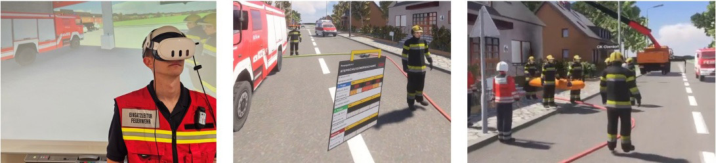
Scenario Description The participants entered the VR at the fire station, where they received their dispatch order – a small, suspected fire in a residential building. The incident commanders and their teams then drove to the scene. During the ride to the scene, distractions (e.g. people on the roadside, speeding cars) appeared along the way to increase cognitive load and arousal. Upon arrival, the commanders were informed by a resident that a person was missing in the building. As soon as they ordered the SCBA team to enter for rescue, the BA control board appeared, see Fig. 1. The commanders received a radio call from the SCBA team reporting that they were still advancing and searching the person. After that, the complexity differed. For the medium complexity level, the SCBA team was able to rescue the missing person on their own. In the high complexity group, commanders received a Mayday call from their SCBA team, signalling an accident. Additionally, a loss of contact occurred, during which the commander had to continue the operation as normal. Finally, the SCBA team performed a self-rescue and a resident informed the commander that the missing person was not involved in the incident. The VR operator awaited the commander’s final orders before defusing and ending the scenario.
Figure 1: Left: Participant in the VR-Setting; middle: The extended automated respiratory monitoring system during the operation; right: Rescue of the team member.
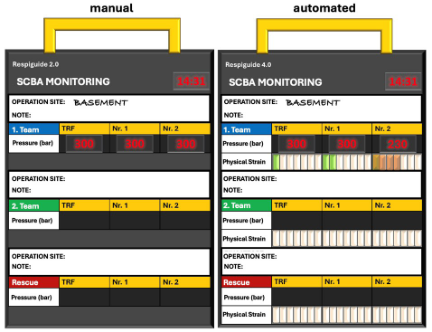
RespiGuide as DSS We implemented our DSS on a BA control board, widely used in Austria and able to include multiple teams. It shows the elapsed time and cylinder pressure at entry with updates for each member. Commanders can estimate the remaining operation time and identify deviations in air consumption from the last known pressure, based on the initial pressure and elapsed time. For the extended automated respiratory monitoring system, we included the physical strain as additional parameter for air consumption (see fig. 2). It was represented as a scale, where more area is filled as strain gets higher and gradually turns from green (low strain) over orange to red (high strain). Values were simulated, while in reality they would be derived from ECG.
Figure 2: RespiGuide – Comparison of the manual (control group) and extended automated breathing apparatus control board (experimental group).
General Questionnaires Questionnaires were presented in LimeSurvey. Prior to the VR, participants were asked for demographic data (e.g. age, experience, years in service).
Cognitive load was assessed using the NASA Task Load Index (Hart, 2006), a subjective, multidimensional measure of workload consisting of six single item scales: mental demand, physical demand, temporal demand, performance, effort, and frustration. Participants rated the just completed
Integrating Firefighters’ Individual Physical State 47 VR task on a continuous scale (0 to 100 with anchored endpoints), with higher scores indicating higher demands.
XVR-Environment The study was conducted in XVR On Scene (V. 10.1), a software platform used to train emergency responders. XVR On Scene and XVR Control Centre are developed by XVR Simulation (www.xvrsim.com/). The scenarios were created and managed in XVR Control Centre (VR environment participants experienced via XVR On Scene). Operators could trigger events manually (e.g. on a verbal command) in addition to predefined ones (e.g. at standardised times, entering a space in the VR environment).
RESULTS
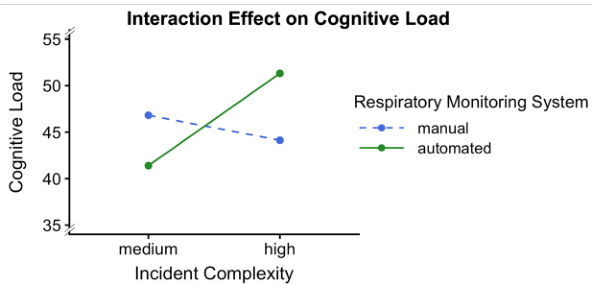
To examine the influence of the extended automated respiratory protection monitoring and incident complexity on cognitive load, we conducted a multifactorial univariate analysis of variance (ANOVA), using one-tailed tests for directed hypotheses (main effects) and a two-tailed test for the undirected interaction hypothesis. In accordance with Hypothesis 2, the two-way ANOVA revealed a main effect for incident complexity (F(1, 56) = 4.51, p < .05, η2 = .09), with cognitive load being significantly higher for participants in high complexity incidents (M = 46.93, SD = 17.65) than for those in medium complexity incidents (M = 38.51, SD = 13.60). Contrary to our expectations, the main effect of the extended automated respiratory monitoring system was non-significant (F(1, 56) < 0.01, p > .05, η2 < 0.01). However, supporting Hypothesis 3, this effect was qualified by a significant interaction effect (F(1, 56) = 5.69, p = .02, η2 = .09), demonstrating that at medium complexity, the extended automated respiratory monitoring system reduced cognitive load, while at high complexity levels cognitive load increased, see fig. 3. Furthermore, the mean cognitive load of the manual respiratory monitoring group was similar in both complexity conditions.
Figure 3: Interaction of respiratory monitoring system & incident complexity on cognitive load.
DISCUSSION
This study examined the influence of an extended automated respiratory monitoring system on cognitive load considering different incident complexities in firefighting operations. The results reveal the varying effect of the extended automated respiratory protection monitoring system, depending on the incident complexity. Although it reduces cognitive load in medium complex operations, it increases cognitive load in high complex operations. Cognitive load shows similar levels in both complexity conditions for the manual respiratory protection monitoring.
The results highlight the potentially varying effects of technical support systems on incident commanders’ cognitive load. These findings are in line with Sweller (2020) who states that different cognitive load reflects different inputs, depending on the context. Although the extended automated respiratory monitoring system reduces the cognitive load at medium levels of complexity, it increases the load at high levels of complexity. In the high complexity scenario, decision-makers were already confronted with a lot of information. Additional objective information from the tool might contribute to higher load, which could explain this interaction. As DSS can also increase cognitive load (Rezaeian et al., 2025), it is important in an early stage design to consider what information (structure, type etc.) is presented. Although the cognitive load in operations with higher complexity was increased by the extended automated respiratory monitoring system, it can still enhance performance or lead to deviations from SOPs (Butler et al., 2023), which in turn contribute to faster or safer operations (e.g. preventing escalation). Taking performance variables (e.g. reaction time) into account could help determine additional benefits and risks of the system.
In accordance with dual system theory (Kahneman, 2011), results suggest that the use of the extended automated respiratory monitoring system in operations with medium complexity can reduce cognitive load, resulting in more deliberate decisions than without the tool. In high complexity situations where cognitive load is higher when using the extended automated respiratory monitoring system, one might expect a greater influence of System 1. Therefore, it is important to examine which specific aspect increases cognitive load (e.g. additional information, broader meaning).
However, it can be assumed that an extended automated respiratory monitoring system can also reduce cognitive load in high complexity operations without an emergency involving one of the SCBA team members. It remains unclear whether the observed increase in cognitive load is solely due to the increased complexity in combination with the extended automated respiratory monitoring system (Choudhury and Saravanan, 2025), or whether the kind of information (e.g. type, significance) (Sweller, 2020) given to the incident commanders also plays a role.
Even though the DSS was based on an existing tool familiar to most commanders, they interacted with the extended system for the first time. This could have contributed to a higher cognitive load (Tomasi et al., 2018)
Integrating Firefighters’ Individual Physical State 49 during an already demanding highly complex scenario, as e.g. users’ pre- experience with technical systems impacts cognitive load and other usability related factors (Frering et al., 2023). More experience and expertise in using this extended automated respiratory monitoring system might help reduce cognitive load even in high complexity operations.
The extended automated respiratory monitoring system can also positively affect factors such as interruptions or distractions, as commanders decide for themselves when to seek information, instead of relying on SCBA wearers, thereby reducing cognitive load and also improving the availability and quality of information during decision-making; especially when SCBA wearers could potentially convey information in a biased way due to the effects of stressors (Reale et al., 2023; Schlittmeier and Marsh, 2021; Robinson et al., 2013; Stout et al., 2021; Thompson et al., 2024; Tremblay et al., 2012) during their actions.
CONCLUSION
This study highlights the potentially positive effects of DSS on the cognitive load of incident commanders, while also emphasising the importance of context-sensitive and human-centered design. External respiratory monitoring is suitable for automated support in information processing during decision- making, as the commander is provided with objective information and can retrieve it when required, without being interrupted by the system. The extended automated respiratory monitoring system can reduce cognitive load, specifically in medium complex scenarios. It should be noted that in emergencies there is a risk of increased cognitive load. To further develop this DSS, the effects of specific individual, technical, and contextual factors during the respiratory monitoring must be investigated.
REFERENCES
Bonazountas, M., Kallidromitou, D., Kassomenos, P. and Passas, N. (2007), ‘A decision support system for managing forest fire casualties’, Journal of Environmental Management 84(4), 412–418. Butler, P. C., Bowers, A., Smith, A. P., Cohen-Hatton, S. R. and Honey, R. C. (2023),
‘Decision making within and outside standard operating procedures: Paradoxical use of operational discretion in firefighters’, Human Factors 65(7), 1422–1434. Choudhury, N. A. and Saravanan, P. (2025), ‘Mapping critical decisions and cues in firefighting: A structured analysis using the critical decision method’, Journal of Cognitive Engineering and Decision Making pp. 26–50. Cowan, N. (2001), ‘Metatheory of storage capacity limits’, Behavioral and Brain
Sciences 24(1), 154–176. Dotson, G. S. and Niemeier, R. (2013), ‘Derivation of immediately dangerous to life or health (idlh) values’. Frering, L., Koenczoel, C., Mosbacher, J. A., Kames, M., Eder, M., Mohr-Ziak, P.,
Gabl, S., Kalkofen, D., Albert, D., Kubicek, B. et al. (2023), Impact of robot related user pre-experience on cognitive load, trust, trustworthiness and satisfaction with vr interfaces, in ‘International Conference on Robotics in AlpeAdria Danube Region’, Springer, pp. 123–131.
Hærem, T., Pentland, B. T. and Miller, K. D. (2015), ‘Task complexity: Extending a core concept’, Academy of Management Review 40(3), 446–460. Hart, S. G. (2006), Nasa-task load index (nasa-tlx); 20 years later, in ‘Proceedings
of the human factors and ergonomics society annual meeting’, Vol. 50, Sage publications Sage CA: Los Angeles, CA, pp. 904–908. Israel, A., Rosenboim, M. and Shavit, T. (2021), ‘Time preference under cognitive load - an experimental study’, Journal of Behavioral and Experimental Economics 90, 101633. Kahneman, D. (2011), ‘Fast and slow thinking’, Allen Lane and Penguin Books, New
York 2. Kahneman, D. and Klein, G. (2009), ‘Conditions for intuitive expertise: A failure to disagree’, American Psychologist 64(6), 515. Kinsey, M., Gwynne, S., Kuligowski, E. D. and Kinateder, M. (2019), ‘Cognitive
biases within decision making during fire evacuations’, Fire Technology 55(2), 465–485. Li, J. and Li, C. (2024), ‘Characterizing urban spatial structure through built form typologies: A new framework using clustering ensembles’, Land Use Policy 141, 107166. Longo, L. (2018), ‘Experienced mental workload, perception of usability, their
interaction and impact on task performance’, PloS one 13(8), 1–36. Okoli, J., Watt, J. and Weller, G. (2022), ‘A naturalistic decision-making approach to managing non-routine fire incidents: Evidence from expert firefighters’, Journal of Risk Research 25(2), 198–217. Reale, C., Salwei, M. E., Militello, L. G., Weinger, M. B., Burden, A., Sushereba,
C., Torsher, L. C., Andreae, M. H., Gaba, D. M., McIvor, W. R. et al. (2023), ‘Decision-making during high-risk events: A systematic literature review’, Journal of Cognitive Engineering and Decision Making 17(2), 188–212. Rezaeian, O., Bayrak, A. E. and Asan, O. (2025), ‘Explainability and ai confidence in clinical decision support systems: Effects on trust, diagnostic performance, and cognitive load in breast cancer care’, International Journal of Human–Computer Interaction pp. 1–21. Robinson, S. J., Leach, J., Owen-Lynch, P. J. and Su¨nram-Lea, S. I. (2013), ‘Stress
reactivity and cognitive performance in a simulated firefighting emergency’, Aviation, Space, and Environmental medicine 84(6), 592–599. Sandi, C. (2013), ‘Stress and cognition’, Wiley Interdisciplinary Reviews: Cognitive Science 4(3), 245–261. Schaffer, C., Goldart, E., Ligsay, A., Mazwi, M., Gallant, S. and Ehrmann, D. (2023),
‘Take a load off: Understanding, measuring, and reducing cognitive load for cardiologists in high-stakes care environments’, Current Treatment Options in Pediatrics 9(3), 122–135. Schlittmeier, S. J. and Marsh, J. E. (2021), Review of research on the effects of noise on cognitive performance 2017-2021, in ‘The 13th ICBEN Congress on Noise as a Public Health Problem, Karolinska Institutet, Stockholm’. Staal, M. A. (2004), Stress, cognition, and human performance: A literature review
and conceptual framework, Technical report, NASA. Stout, J. W., Beidel, D. C., Brush, D. and Bowers, C. (2021), ‘Sleep disturbance and cognitive functioning among firefighters’, Journal of Health Psychology 26(12), 2248–2259. Sweller, J. (2020), ‘Cognitive load theory and educational technology’, Educational
Technology Research and Development 68(1), 1–16.
Integrating Firefighters’ Individual Physical State 51 Thompson, C., Ferrie, L., Pearson, S. J., Highlands, B. and Matthews, M. J. (2024),
‘Do extreme temperatures affect cognition? a short review of the impact of acute heat stress on cognitive performance of firefighters’, Frontiers in Psychology 14, 1270898. Tierney, M., Adeyemi, E. O. and Bommer, S. (2025), ‘A systematic literature review: Cognitive workload assessment in human factors research’, Advances in Human- Computer Interaction 2025(1), 9313239. Tomasi, S., Schuff, D. and Turetken, O. (2018), ‘Understanding novelty: How task
structure and tool familiarity moderate performance’, Behaviour & Information Technology 37(4), 406–418. Tremblay, S., Vachon, F., Lafond, D. and Kramer, C. (2012), ‘Dealing with task interruptions in complex dynamic environments: Are two heads better than one?’, Human Factors 54(1), 70–83. Zaphir, J. S., Murphy, K. A., MacQuarrie, A. J. and Stainer, M. J. (2025),
‘Understanding the role of cognitive load in paramedical contexts: A systematic review’, Prehospital Emergency Care 29(2), 101–114.
LISTED IN THE AHFE DIGITAL BOOKSTORE CATALOGUE
Explore the complete digital volume
Cognitive Computing and Internet of Things
Read this individual research paper free through the original publisher, or explore the full digital proceedings book.
ISBN 978-1-964867-81-6
Explore this ISBN in the AHFE Bookstore ↗Listed in the July 2026 bookstore catalogue; search by ISBN to confirm current availability · Digital book purchase optional