Savira Aristi, Kenta Ono, Hisa Martinez Nimi (2026). Distributed Cognition in Phygital Design Interventions: Community–System Communication in Marginalized Urban Contexts. In: Cognitive Computing and Internet of Things. AHFE Open Access, vol. 205, pp. 138–147. https://doi.org/10.54941/ahfe1007368
Design interventions in marginalized urban communities involve complex interactions among people, material artifacts, and digital systems. In such settings, cognition and decision-making are not confined to individuals but are distributed across social, physical, and computational elements. This paper examines how communication between community members and a supporting system shapes collective sense-making during community-based design interventions. Drawing on comparative fieldwork in Campana-Altamira (Mexico) and Kampung Gedong Pompa (Indonesia), the study analyzes participatory workshops in which physical artifacts (e.g., maps, models, and visual notations) were combined with a lightweight digital system that recorded, organized, and re-presented community-generated knowledge. The paper introduces the concept of a Situated Knowledge Ecosystem (SKE) to describe this arrangement—not as a standalone technology, but as an emergent cognitive ecosystem situated between physical and digital interventions. Empirical observations show that communication between the community and the system played a critical role in distributing cognitive labor. Physical artifacts supported immediate discussion and negotiation, while the digital layer functioned as a persistent external memory that stabilized interpretations across time and participants. Rather than producing decisions directly, the system mediated how information was revisited, compared, and reflected upon, thereby influencing how collective judgments evolved. This paper highlights how cognitive ecosystems can support distributed cognition in socially complex environments. The findings suggest that the effectiveness of such systems lies not in computational intelligence, but in how they are embedded within ongoing human practices and material interactions.
Community-based design interventions increasingly combine participatory, hands-on practices with digital infrastructures that capture, stabilize, and circulate knowledge across actors and time. In HCI and design research, these interventions are rarely only methodological; they are also political Received March 6, 2026; Revised April 6, 2026; Accepted April 24, 2026; Available online July 20, 2026
Distributed Cognition in Phygital Design Interventions 139 arrangements that redistribute who can author representations of local realities and whose knowledge becomes actionable (Cook & Karvonen, 2024; Costanza-Chock, 2020). Understanding cognition in these settings therefore requires analytic lenses that treat thinking and decision-making as sociotechnically distributed, enacted through representations and infrastructures that coordinate attention and meaning.
A key gap remains in existing literature. While HCI and adjacent fields analyze participatory mapping, Participatory Design (PD) at urban scale, and datafication in marginalized communities, there are limited empirical accounts of community-system communication as a focal mechanism in distributed cognition. The interface between digital recording and participatory processes in informal contexts remains under-examined, and accounts of data-driven interventions frequently lack the interpretation infrastructures needed to understand how communities make sense of and revisit knowledge over time (Koesten et al., 2021; da Silva et al., 2024).
To address this gap, this paper examines how cognition is distributed across people, physical artifacts, and a lightweight digital system, and how interactions with that system shape what communities recall, compare, and treat as salient when revisiting design issues across time and participants. Drawing on comparative fieldwork in Campana-Altamira, Mexico, and Kampung Gedong Pompa, Indonesia, we analyze participatory workshops that combined tangible artifacts with a digital layer that organized and re-presented community contributions. We introduce the concept of a Situated Knowledge Ecosystem (SKE) to characterize the emergent cognitive arrangement produced between physical and digital interventions in situ. Our contributions are threefold: empirical evidence from two comparative field sites, an analysis of physical–digital cognitive distribution in community- based design interventions, and the SKE concept as a vocabulary for describing situated cognitive ecosystems shaped through community–system communication.
LITERATURE REVIEW
A sociotechnical systems perspective is useful for understanding interventions in marginalized urban contexts because it highlights the interdependence between social actors, technical systems, and contextual constraints rather than treating planning or decision-making as isolated technical tasks (Patorniti et al., 2018; Naikar, 2017). In such contexts, questions of what counts as valid evidence, who can represent local realities, and how claims become legible in planning or resource allocation are frequently contested (Heeks & Shekhar, 2019). Critiques of data-driven urbanism further warn that technocratic forms of representation can narrow how cities are understood by privileging computational and managerial logics over situated and deliberative forms of judgment (Cook & Karvonen, 2024). This is especially significant in marginalized communities, where local knowledge is frequently underrepresented within formal systems of governance.
Recent HCI and sociotechnical research increasingly conceptualizes cognition as a system-level process rather than an individual one, in which
reasoning and decision-making emerge through the interaction of people, tools, representations, and organizational constraints (Gupta et al., 2023). External cognitive artifacts play a central role in this process: rather than serving only as records, they can guide attention, support shared memory, and stabilize interpretation during joint activity (Mateescu & Kauffeld, 2024). Sensemaking in data-rich environments similarly depends on practices of inspection, contextualization, and documentation that enable information to be interpreted and revisited over time (Koesten et al., 2021). Together these perspectives frame collaborative interventions as systems in which cognition is distributed across participants, artifacts, and technical supports.
Participatory design in sociotechnical settings organizes relations among people, technologies, institutions, and local forms of knowledge. Recent research shows that participation in practice depends on the creation of shared spaces and the management of tensions between open-ended collaboration and institutional constraints (Elsayed-Ali et al., 2023). Datafication and digital mapping can increase visibility and support planning, but may also reinforce asymmetries when external actors control data production and interpretation (Heeks & Shekhar, 2019; da Silva et al., 2024). Experimental work further shows that interactive and spontaneous forms of representation may shape final ideas more strongly than authoritative descriptive ones, suggesting that participation also depends on how knowledge is presented and negotiated during co-creation (Yasuoka et al., 2024). This reinforces the view that participatory design should be understood as a sociotechnical process of mediated communication, in which artifacts and systems help structure how community knowledge is expressed, interpreted, and sustained over time.
STUDY CONTEXT AND METHODS Field Contexts and Intervention Setups
This study draws on iterative fieldwork in two marginalized urban contexts: Campana-Altamira in Monterrey, Mexico, and Kampung Gedong Pompa in Penjaringan, North Jakarta, Indonesia. Although the paper presents the cases comparatively, the research process was iterative rather than strictly side by side, with data from each site informing the framing and interpretation of the other. Consequently, some findings are supported more strongly by data from Campana-Altamira, while others rely more heavily on data from Kampung Gedong Pompa.
Campana-Altamira is a hillside settlement in southern Monterrey characterized by socioeconomic vulnerability, uneven access to urban resources, and a longer history of intersectoral territorial intervention (Iniciativa Campana-Altamira, n.d.; Parra, 2024). In this study, the site is positioned within the PULI (Post Urban Living Innovation) program, a collaboration between Chiba University and Tecnológico de Monterrey that supports community-oriented educational and design activities (Post Urban Living Innovation, 2018). Fieldwork in Campana-Altamira builds on several iterations of participatory design workshops conducted primarily with secondary high school students.
Distributed Cognition in Phygital Design Interventions 141 Kampung Gedong Pompa, by contrast, is a dense urban kampung in coastal North Jakarta, an area shaped by informal settlement patterns, tidal flooding, and broader environmental and infrastructural precarity (Prana et al., 2024; Putri et al., 2020). The research there was conducted as an independent project in collaboration with Kampung Kollektief. Participatory design workshop iterations in this site involved a broader mix of adults, secondary high school students, and high school students. As a result, the two sites produced different types of data. This difference is understood as part of the situated nature of participatory fieldwork across distinct local conditions.
Data and Analysis The data consisted of physical artifacts produced during participatory design workshops and records generated through a supporting digital system. The analysis combined observational analysis, focusing on how participants interacted with one another, facilitators, and physical materials, with artifact- based analysis examining how knowledge was translated across maps, models, notes, and records. Three analytical concerns guided interpretation: communication flows between participants, artifacts, and the digital system; representational shifts as community knowledge moved from discussion into physical and digital forms; and the temporal stabilization of meaning as ideas became more durable and retrievable across workshop moments.
FINDINGS: DISTRIBUTED COGNITIVE PROCESSES Workshop Context and Continuity
The Campana-Altamira material draws on two workshops. Workshop Campana 1 was conducted at Tecnológico de Monterrey, where junior high school students participated in a week-long program focused on recycling plastic waste, introducing basic principles of problem-solving and sustainability (Nimi et al., 2024). Workshop Campana 2 was a brief field visit to the community initiated by the first author, supported by PULI members and the Campana-Altamira Iniciativa organization, during which students responded to written prompts about individuals they admired (Aristi et al., 2025). Physical artifacts across both workshops included written annotations, cardboard-based models, sketches, and completed solution- mapping templates.
Data from Kampung Gedong Pompa were drawn from two iterative workshop cycles. Workshop Kampung 1 was a 3-day workshop led by an architect in collaboration with Trisakti University and Kampung Kollektief, focusing on residents’ relationships with water in the context of rebuilding a flood-damaged local orphanage. Workshop Kampung 2 was led by the first author in collaboration with Kampung Kollektief, combining photo elicitation focused on local materials with an examination of residents’ relationships with digital knowledge systems. Physical artifacts included maps, spatial models, sketches, and written annotations produced collectively by participants.
This paper does not aim to provide a detailed procedural account of the workshops themselves. Instead, it focuses on how communities interacted with the available artifacts and the supporting system, and how these interactions can be analyzed to develop a conceptual framework.
Physical Artifacts as Local Cognitive Anchors Across both sites, physical artifacts functioned as local cognitive anchors. They made ideas discussable, supported negotiation among participants, and enabled fast sense-making through embodied interaction. Their value was not only representational accuracy, but their ability to stabilize shared reference points for community discussion and for communication with outsiders.
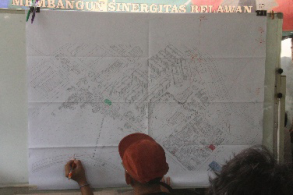
In Kampung Gedong Pompa, participants engaged strongly with physical maps and clay models during Workshop Kampung 1. The map worked as a shared surface for pointing, tracing, and negotiating priorities, while clay modeling helped externalize tacit spatial ideas into a form others could immediately interpret and modify (Figure 1). In Workshop Kampung 2, photo elicitation using locally recognizable material photos generated quick alignment as participants could immediately locate and contextualize what they saw.
Figure 1: Physical maps and clay model results from workshop Kampung 1 (photo: Kampung Kollektief, 2025).
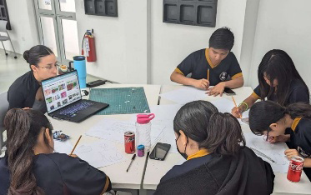
In Campana-Altamira (PULI workshops; Figure 2), physical artifacts functioned differently. They primarily scaffolded learning and communication between university students and junior high school students. Artifacts reduced abstraction and supported participation, but they also interacted with an age and status gap, creating a risk that younger participants’ ideas could be steered by older students’ framing.
Figure 2: Discussion between university students and junior high school students in PULI workshops (photo: PULI Program, 2024).
Distributed Cognition in Phygital Design Interventions 143 Across both sites, physical artifacts functioned as cognitive anchors by providing shared reference points that made negotiation possible through interaction. Their value lay in how they supported embodied alignment. Pointing, tracing, shaping, and recognizing materials allowed participants to externalize tacit knowledge and coordinate interpretation with minimal reliance on abstract explanation. The cases also show that artifacts structure interpretive authority. While tangible media can widen participation by lowering barriers to expression, they can also channel outcomes when framing and evaluation are controlled by particular actors, such as older students or facilitators. This suggests that artifacts redistribute cognitive labor unevenly, depending on who controls the representational space.
Finally, when artifacts were kept, displayed, or reused by community leaders, they shifted from workshop outputs to durable communicative resources. This persistence matters because it stabilizes shared accounts over time and makes community priorities more legible to external audiences.
Digital System as Persistent Cognitive Memory In the workshops reported in this study, a fully deployed digital system was not yet used during the community activities. However, the concept of a supporting digital layer was discussed directly with residents, particularly in Workshop Kampung 2. These discussions indicated that many participants were already familiar with contemporary technologies and communication practices, suggesting practical opportunities for digitally supported knowledge sharing in marginalized urban contexts. The aim is not to replace physical workshop practices, but to design a digital layer that remains synchronized with them so cognition can stay distributed across people, artifacts, and time.
In participatory design, physical artifacts serve as continuity bridges between iterations; when the artifacts disappear, so does the knowledge embedded within them (Müller & Thoring, 2011). A lightweight digital system can complement physical artifacts by functioning as persistent cognitive memory in three ways. First, it can stabilize interpretations by capturing what an artifact meant at the time it was produced, for example through photographs, brief annotations, and short rationales. Second, it can support revisiting and comparison by organizing outputs so earlier ideas and iterations can be inspected side by side, enabling reflection and revision rather than repeated restarting (Koesten et al., 2021). Third, it can support continuity across participants when attendance shifts, by making prior contributions legible to newcomers and reducing the labor of reconstructing common ground (Elsayed-Ali et al., 2023).
Design Implications for a Sociotechnical Cognitive Support System The findings from both sites point toward actionable guidelines for designing systems that support distributed cognition in community-based design interventions:
1. Support contextual learning before workshops begin. A system should provide structured onboarding access so that incoming participants can orient themselves without burdening community members with repeated explanation.
2. Complement physical artifacts during collaboration, not replace them. The system’s role during workshops is to remain synchronized with tangible practices such as maps, models, and annotations, supporting collaboration rather than substituting embodied negotiation. 3. Capture and archive knowledge immediately after production. A post- workshop archiving function through photographs, annotations, and rationales recorded at the moment of production stabilizes interpretations and prevents loss of meaning between iterations. 4. Maintain two distinct but connected circulation loops. A system should support an internal community loop for brainstorming and feedback, while enabling a separate outsider cycle for onboarding, collaboration, and data review. 5. Centralize data review through a trusted intermediary role. A lightweight administrative layer managed by a social worker, volunteer, or trusted community figure can mediate what is shared, balancing transparency with community data sovereignty. 6. Reduce asymmetries in representational control. System design should support multiple authorship and low-barrier contribution, actively distributing cognitive labor rather than concentrating interpretive authority among particular actors.
Together, these guidelines frame the requirements for the Situated Knowledge Ecosystem (SKE), introduced in the following section.
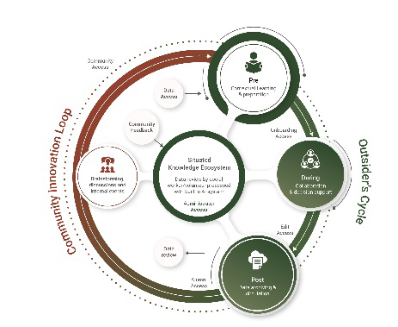
Introducing: Situated Knowledge Ecosystem (SKE) This paper introduces the Situated Knowledge Ecosystem (SKE) to describe the emergent cognitive arrangement through which this mediation occurs (Figure 3). The SKE is not a platform or a tool, but a cognitive ecosystem composed of three interacting elements: people, physical artifacts, and a lightweight digital memory layer. Its defining properties are fourfold. It is situated, meaning it is embedded within the specific social, material, and historical conditions of a given community rather than designed for generic application. It is distributed, in that cognitive labor is spread across participants, artifacts, and the digital layer rather than concentrated in any single actor or system. It is temporal, supporting reflection and reinterpretation across workshop iterations rather than producing one-time outputs. And it is non-authoritative, meaning the system does not determine what counts as valid knowledge; that authority remains with the community.
This positions the SKE in deliberate contrast to conventional decision- support systems and intelligent automation. Where decision-support systems aim to reduce uncertainty by narrowing options, and where intelligent automation seeks to replace human judgment with computational inference, the SKE operates by keeping interpretive space open. It stabilizes enough meaning to support continuity, while remaining sufficiently flexible to allow community knowledge to evolve through ongoing negotiation.
This framing is directly relevant to cognitive computing in sociotechnical systems. Rather than locating intelligence in the system itself, the SKE distributes cognitive work across the sociotechnical arrangement. Drawing
Distributed Cognition in Phygital Design Interventions 145 on distributed cognition theory, reasoning and decision-making emerge through the interaction of people, representations, and infrastructures rather than residing in any single node. The SKE operationalizes this principle by treating the digital layer not as a cognitive authority, but as a persistent external memory that makes collective reflection possible.
The SKE operates through two interconnected circulation loops. The Community Innovation Loop describes the internal cycle through which community members generate, discuss, and revise knowledge among themselves through brainstorming, internal events, and feedback processes. This loop preserves community ownership over how knowledge is produced and interpreted. The Outsider’s Cycle describes how external actors such as researchers, designers, and planners engage with community knowledge across three phases: a Pre phase for contextual learning and preparation, a During phase for collaboration and decision support, and a Post phase for data archiving and circulation. Structured access differentiation across these phases prevents the Outsider’s Cycle from destabilizing the Community Innovation Loop.
At the center sits a trusted intermediary — a social worker, volunteer, or community-appointed figure — who mediates what is recorded and shared. This role is redistributive rather than gatekeeping, designed to counteract the tendency, observed across both sites, for representational control to concentrate around particular actors.
The SKE’s effectiveness lies not in computational intelligence, but in how it situates, distributes, and sustains cognitive work within the ongoing practices of a community.
LIMITATIONS AND CONCLUSION Several limitations should be acknowledged. The term “marginalized urban” in this paper refers specifically to communities shaped by long-established informal settlement patterns, as observed in both Campana-Altamira and Kampung Gedong Pompa. Communities described as marginalized in other national contexts may carry different structural conditions, and the SKE
framework’s applicability beyond this configuration remains to be tested. Additionally, the interventions reported here were short-term, and whether the SKE sustains distributed cognition over longer periods or through institutional transitions remains an open empirical question. The digital system was also not fully deployed during community activities, meaning the framework’s effectiveness as an operational system has not yet been empirically evaluated. As part of ongoing PhD research by the first author, the full conceptual elaboration of the SKE will be developed in future work. This paper’s contribution is to introduce the concept and establish its relevance to distributed cognition in community-based design.
These limitations notwithstanding, the findings carry broader implications for cognitive computing in sociotechnical systems. Intelligence in participatory contexts is better characterized as coordination and memory than as inference, and computational systems are better understood as participants within a cognitive arrangement rather than controllers of it. For sociotechnical design, this means designing for reflection and continuity, respecting the iterative rhythms of human sensemaking, and remaining cautious about over-formalization that risks concentrating interpretive authority away from communities.
The effectiveness of cognitive systems in marginalized urban contexts lies not in computational intelligence, but in how they are embedded within human practices, material interactions, and the situated knowledge that communities have built over time.
ACKNOWLEDGMENT
The authors would like to thank the communities of Campana-Altamira and Kampung Gedong Pompa for their participation and openness throughout the fieldwork process. We are grateful to the Campana-Altamira Iniciativa organization, Tecnológico de Monterrey, and the PULI program for their support in facilitating workshops in Monterrey. We thank Kampung Kollektief, Trisakti University, and Alexandre Humbert for their collaboration in Kampung Gedong Pompa. This research is part of ongoing PhD work at Chiba University.
REFERENCES
Aristi, S., Nimi, H. M., Quintero, J. C. C., Baca, A., & Ono, K. (2025). Leveraging data communication systems to empower local innovations in marginalized slum communities through behavioral profiling. Journal of Design Service and Social Innovation, 3(3), 54–79. https://doi.org/10.59528/ms.jdssi2025.1019a40 Cook, M., & Karvonen, A. (2024). Urban planning and the knowledge politics of the smart
city. Urban Studies, 61(2), 370–382. https://doi.org/10.1177/00420980231177688 Costanza-Chock, S. (2020). Design justice: Community-led practices to build the worlds we need. MIT Press. da Silva, A. A., da Silva, I. F. K., & Westerholt, R. (2024). Mapping the margins:
A systematic scoping review of the impact of digital mapping on public participation in informal settlements. Habitat International, 147, Article 103040. https://doi.org/10.1016/j.habitatint.2024.103040
Distributed Cognition in Phygital Design Interventions 147 Elsayed-Ali, S., Bonsignore, E., & Chan, J. (2023). Exploring challenges to inclusion
in participatory design from the perspectives of Global North practitioners. Proceedings of the ACM on Human-Computer Interaction, 7(CSCW1), Article 6. https://doi.org/10.1145/3579606 Gupta, P., Nguyen, T., González, C., & Woolley, A. (2023). Fostering collective intelligence in human–AI collaboration: Laying the groundwork for COHUMAIN. Topics in Cognitive Science, 17(2), 189–216. https://doi. org/10.1111/tops.12679 Heeks, R., & Shekhar, S. (2019). Datafication, development and marginalised urban
communities: An applied data justice framework. Information, Communication & Society, 22(7), 992–1011. https://doi.org/10.1080/1369118X.2019.1599039 Iniciativa Campana-Altamira. (n.d.). Iniciativa Campana-Altamira. https:// campanaaltamira.org/ Koesten, L., Gregory, K., Groth, P., & Simperl, E. (2021). Talking datasets: Understanding
data sensemaking behaviours. International Journal of Human-Computer Studies, 146, Article 102562. https://doi.org/10.1016/j.ijhcs.2020.102562 Mateescu, M. & Kauffeld, S. (2024). Interactive external representations for knowledge-building processes and performance in dyads: An experimental study. Computers in Human Behavior Reports, 16, Article 100519. https://doi. org/10.1016/j.chbr.2024.100519 Müller, R. M., & Thoring, K. (2011). Understanding artifact knowledge in design
science: Prototypes and products as knowledge repositories. In Proceedings of the Seventeenth Americas Conference on Information Systems (AMCIS 2011) (pp. 1933–1941). Association for Information Systems. Naikar, N. (2017). Human–automation interaction in self-organizing sociotechnical systems. Journal of Cognitive Engineering and Decision Making, 12(1), 62–66. https://doi.org/10.1177/1555343417731223 Nimi, H., Martínez Baca, A., Aristi, S., & Chacón Quintero, J. C. (2024). PULI
project Semillas del Futuro: Implementing design-led education to transform communities. In Cumulus Conference Proceedings Series: Design Across Borders United in Creativity, Monterrey 2024 (pp. 957–973). Cumulus Association with Universidad de Monterrey and Tecnológico de Monterrey. Parra, V. (2024). Transformando comunidades: La Iniciativa Campana-Altamira y la innovación social en acción. Estudios de la Gestión: Revista Internacional de Administración. Patorniti, N. P., Stevens, N., & Salmon, P. M. (2018). A sociotechnical systems
approach to understand complex urban systems: A global transdisciplinary perspective. Human Factors and Ergonomics in Manufacturing & Service Industries, 28(6), 281–296. https://doi.org/10.1002/hfm.20742 Post Urban Living Innovation. (2018). Post Urban Living Innovation: Education and research program. Chiba University and partner institutions. Prana, A. M., Dionisio, R., Curl, A., Hart, D., Gomez, C., Apriyanto, H., & Prasetya,
H. (2024). Informal adaptation to flooding in North Jakarta, Indonesia. Progress in Planning, 186, Article 100851. Putri, P., Amanda, R. A. S. D., & Chotib. (2020). Detecting informal settlement development in Penjaringan sub-district, North Jakarta, Indonesia. IOP Conference Series: Earth and Environmental Science, 436(1), Article 012008. Yasuoka, M., Nakatani, M., Taoka, Y., & Hamaguchi, N. (2024). Interactivity
matters: A role of external representations in knowledge transfer during participatory design workshops. In Proceedings of the 57th Hawaii International Conference on System Sciences (pp. 5471–5480). HICSS. https://aisel.aisnet.org/ hicss-57/ks/knowledge_flows/3/
LISTED IN THE AHFE DIGITAL BOOKSTORE CATALOGUE
Explore the complete digital volume
Cognitive Computing and Internet of Things
Read this individual research paper free through the original publisher, or explore the full digital proceedings book.
ISBN 978-1-964867-81-6
Explore this ISBN in the AHFE Bookstore ↗Listed in the July 2026 bookstore catalogue; search by ISBN to confirm current availability · Digital book purchase optional