Gabriele Goretti, Lorenzo Masini, Sonia Massari, Caterina Dastoli (2025). Introducing 3D printing of TPU in the leather industry: a discontinuous innovation of local manufacturing practices in Italy. In: Human Aspects of Advanced Manufacturing, Production Management and Process Control. AHFE Open Access, vol. 184, pp. 133–143. https://doi.org/10.54941/ahfe1006457
This study investigates how design processes can drive the transformation of production models in local manufacturing districts by integrating co-design and co-creation in these multi-stakeholder contexts. Particularly, this research, as part of the PNRR EAR – Enacting Artistic Research project, aims at investigating the bridge between the expertise of master artisans and the potential of additive manufacturing. Indeed, by combining 3D printing technology with traditional artisanal practices, the research reinterprets Made in Italy as a dynamic balance between heritage and innovation. It examines the Italian leather tanning industry in the Santa Croce sull’Arno Leather District, which consists of over 1,100 companies generating a turnover of 4.3 billion euros. In this context, the research analyzes the use of 3D printing to produce thermoplastic polyurethane (TPU) components for leather embossing, which is traditionally performed with high-frequency (HF) techniques. This approach enhances production flexibility and customization, particularly benefiting small and medium-sized enterprises (SMEs) in artisanal sectors. Indeed, the Italian manufacturing model—positioned between craftsmanship and industry—relies on intermediate technologies that ensure both efficiency and adaptability. The research underscores the design’s role in social change and disruptive innovation. It demonstrates how emerging technologies like 3D printing can provide accessible, cost-effective solutions when design acts as a strategic tool, fostering innovation while respecting cultural, material, and territorial heritage. Through a critical examination of technological transitions, the study concludes that: (a) design serves as a key driver for rethinking production models and strengthening local expertise within a global framework; and (b) shifting from traditional to additive manufacturing in leather embossing is not just a technical upgrade but a fundamental transformation—cultural, systemic, and multidimensional. This shift presents new growth opportunities for the sector while promoting a more sustainable, inclusive, and adaptable approach to design, capable of reconfiguring resources even in peripheral areas.
The proliferation of digital technologies is profoundly impacting Italian design culture, reshaping creative methodologies and production systems by intensifying the experimental nature of design practice. The intersection of design, advanced manufacturing, and technological innovation is giving rise to new aesthetic paradigms and operational models within Italy’s national production framework (Micelli, 2011). This transformation is exemplified by the adoption of CNC machinery, the integration of digital tools for production planning and control, and the increasing role of scientific research in supply chain processes.
Within this evolving context, the distinction of the “Made in Italy” brand should not be regarded as a static emblem of heritage, but as a dynamic construct that must continually adapt. Innovation, therefore, must proceed in continuity with traditional craftsmanship, balancing heritage with the contemporary imperatives of efficiency, sustainability, and international competitiveness. In this regard, Italy’s industrial districts—territorially embedded networks of interrelated firms—offer a fertile environment for the hybridization of emerging technologies with artisanal production, facilitating the development of new markets and product typologies.
This study investigates the potential of industrial districts to maintain global competitiveness through the integration of digital manufacturing technologies into traditional craft processes. Specifically, it examines the application of TPU-based 3D printing in the leather embossing practices of Santa Croce sull’Arno, a Tuscan district historically dependent on labor- intensive and high-cost high-frequency (HF) embossing methods.
The research positions Design as a strategic enabler within decentralized and human-centered production ecosystems. Italian industrial districts have long leveraged design as a tool for innovation, where it plays a critical role in collaborative product development processes aimed at shaping novel artefacts (Maffei & Zurlo, 2000). As noted by Bertola and Teixeira (2003), the ability to translate informal and distributed knowledge into coherent design strategies constitutes a core competitive advantage in these contexts. Designers function as intermediaries, fostering cross-boundary knowledge integration through interactional expertise, rather than direct technical input alone.
Consequently, this study highlights the transformative potential of design in driving systemic innovation and social change. It contends that technologies such as 3D printing, when strategically framed through a design- led approach, can yield scalable, cost-effective solutions that respect and enhance local cultural, material, and territorial values. The analysis of this technological shift reveals two principal conclusions: (a) design operates as a key agent in reconfiguring production models while strengthening localized expertise within a globalized context; and (b) the transition from conventional to additive manufacturing in leather embossing entails a comprehensive transformation—encompassing cultural, systemic, and epistemological dimensions. This transition presents an opportunity to foster more sustainable, inclusive, and resilient forms of innovation, particularly within peripheral or craft-intensive production environments.
Introducing 3D Printing of TPU in the Leather Industry 135
THEORETICAL BACKGROUND Manufacturing has long been characterized by the organization of new product development (NPD) through networks of specialized expertise, notably within industrial districts (Becattini, 2002). These geographically concentrated models have consistently yielded favorable outcomes, such as the fostering of innovation, the facilitation of entrepreneurial endeavors, the enhancement of economic competitiveness, sustained growth, and long- term industrial success (Scaringella & Radziwon, 2018). Through active engagement in local industrial networks, manufacturing firms are able to leverage economies of scale, thereby developing highly efficient and performance-oriented production systems.
In this context, the transmission of artisanal knowledge has traditionally served as the primary catalyst for innovation, driving the unique characteristics of Italian production. This knowledge transfer has historically been embedded within apprenticeship systems, guilds, and communities of practice, forming the backbone of Italy’s distinct manufacturing identity (Sennett, 2008). More recently, artisans have begun to contribute to academic and research settings, providing insider perspectives on professional practices and studio-based creation processes (Groth, 2015; Mäkelä, 2016). Despite these contributions, there remains a significant gap in the literature concerning the collaborative dynamics within professional artisanal practices.
In light of this, there is an urgent need to further investigate and formalize the collaborative mechanisms that underpin artisanal innovation within industrial districts. By bridging the gap between traditional craft knowledge and contemporary academic frameworks, future research could elucidate the ways in which localized expertise contributes to broader system-level innovation within manufacturing. This study advocates for an interdisciplinary approach that not only values the experiential knowledge of artisans but also critically examines their evolving roles within larger production networks. Such an approach would facilitate the development of more resilient, knowledge-driven ecosystems that integrate the heritage of craftsmanship with technological and organizational advancements, thereby fostering sustainable and inclusive innovation in the manufacturing sector.
The District of Santa Croce Sull’Arno The Italian leather tanning industry holds a position of paramount importance within the design and fashion sectors, offering valuable insights into the complex relationships between the design departments of major corporate brands (e.g., LVMH, Kering, Prada) and manufacturing districts. According to the 2023 report on the Italian Leather Industry by UNIC (Italian Leather Union), the sector employs 17,882 individuals, consists of 1,139 companies, and generates an annual turnover of approximately 4.3 billion euros. In this production context, the distribution of output is diverse: 4.1% of production is directed toward the apparel sector, 33% toward footwear, 31.1% toward leather goods, 15.7% toward automotive applications, 13.7% toward furniture, and 2.4% for other applications. Key regions for this
industry include Veneto, which employs 8,538 individuals, Tuscany with 5,956 employees, Campania with 1,937, and Lombardy with 912. The Santa Croce sull’Arno Industrial Leather District exemplifies leadership within this sector. It is responsible for 30% of Italy’s leather production, and 98% of the nation’s sole leather output. Furthermore, the district demonstrates an impressive export profile, with nearly 70% of its total turnover derived from international sales. In terms of sustainability, the district excels in environmental management, treating over 98% of the pollution load produced by local companies. This success can be attributed to a distinctive operational model known as district-based management. This model entails the centralized coordination of tanning-related activities, such as organizing trade fairs, promotional campaigns, and addressing critical challenges like the environmental impact of industrial production.
The origins of tanning activities in the region can be traced back to the early 19th century, with industrial-scale production emerging after World War II. The industry became increasingly integrated into the urban structure of local municipalities, continuing the area’s historical connection to leather tanning. Initially rooted in craftsmanship, small tanneries operated within homes in rural villages, gradually expanding as new technologies were adopted and the sector gained recognition in key markets. In the 1970s, the relocation of production facilities from urban centers to newly established industrial zones marked the onset of industrialization. This transformation was facilitated by a strategic collaboration between local public administrations and business leaders, with trade associations playing a pivotal role in institutional representation. It was during this period that the district-based model of production began to take form, fostering a collective entrepreneurial spirit dedicated to addressing the sector’s most significant challenges. Trade associations grew in influence, providing the necessary specialized knowledge to tackle emerging issues and supporting the district’s ongoing development (Consorzio Vera Italiana Pelle Conciata al Vegetale Report, 2023; Vallini, 2013).
Computational Design and Traditional Manufacturing Techniques: The 3D Printing of Leather The integration of 3D printing technology into the fashion industry has significantly altered the design and fabrication of materials (Zheng et al., 2021). From haute couture to functional wearables, designers are increasingly adopting additive manufacturing techniques to develop innovative structures, textures, and forms. The disruptive potential of 3D printing lies in its capacity to merge computational design with traditional manufacturing practices, enabling rapid iteration, reducing material waste, and facilitating the customization of production at an unparalleled scale. Additionally, additive manufacturing enhances design freedom by enabling the creation of complex, organic, and parametric geometries that would be virtually impossible to achieve using conventional molding or machining techniques. Moreover, 3D printing promotes sustainability by supporting on-demand production, thereby minimizing the accumulation of excess inventory.
Introducing 3D Printing of TPU in the Leather Industry 137
The transition toward digitally driven embossing techniques aligns with the broader industry trend toward on-demand production, sustainability, and advanced customization. The use of TPU introduces novel possibilities by incorporating performance-driven attributes such as controlled flexibility, varying stiffness, and enhanced durability. Unlike traditional embossing methods, which depend on rigid, predefined molds, TPU-based embossing enables precise adjustments to texture depth, surface behavior, and elasticity, making it an ideal solution for both aesthetic and functional applications in leather goods.
The potential for innovation presented by TPU-based leather embossing is particularly significant in decentralized manufacturing ecosystems. By combining additive manufacturing with traditional craftsmanship, small and independent producers gain access to advanced design tools that were previously confined to large-scale industrial operations. The ability to digitally model customized surface treatments without incurring the costs associated with mold creation reduces financial barriers, fostering a more agile and responsive design process.
METHODOLOGY
This study seeks to explore the role of design in supporting co-creation interventions of stakeholders within decentralized manufacturing ecosystems, particularly when new technologies are integrated into traditional production techniques. To investigate this, an experiment of leather embossing through 3D printing was analyzed as a case study to understand how the adoption of TPU-based 3D printing for leather embossing can potentially create emerging markets where multiple actors can collaborate for new product development.
Specifically, this research was developed as part of the PNRR EAR – Enacting Artistic Research project under Mission 4 of the Italian PNRR. It focuses on the intersection of digitalization, sustainable production, and local artisanal knowledge. The integration of enabling technologies, such as 3D printing, fosters a “discontinuous” innovation model, shifting away from centralized, linear production systems toward more flexible, distributed fabrication strategies. The use of TPU-based 3D printing for leather embossing offers an alternative approach to the fashion industry, where new material solutions, digital workflows, and local production clusters converge to form innovative districts for sustainable manufacturing (Sun et al., 2017).
This project was showcased at MICAM in November 2024 as part of the Innovative Start-up selection within the international trade fair. Its inclusion underscores the significant potential of this approach to transform future leatherworking processes. By combining traditional craftsmanship with cutting-edge digital fabrication methods, the project presents a resource- efficient, adaptable solution to leather embossing.
3D Printing of TPU for Discontinuous Innovation in the Leather Industry The experiment explored the application of TPU-based 3D printing for leather embossing, a process traditionally dominated by labor-intensive and
costly high-frequency (HF) embossing techniques. The study was conducted as part of a workshop program organized by Supermateria, a start-up focused on bridging additive manufacturing, computational design, and traditional manufacturing methods within the design and fashion industries. The project was developed in collaboration with DESTEC, the Industrial Design department at the University of Pisa.
The experiment followed different phases and started with defining why 3D printing technology for leather embossing is relevant for leather industry actors. Thus, Supermateria engaged with multiple fashion brands and independent designers to understand their needs and identify technological gaps in the leather embossing sector. Through consultations, it became evident that there was a demand for more accessible, sustainable, and customizable embossing methods that could support small-scale and artisanal production while maintaining the high-quality standards of traditional techniques. Building upon insights from the first experimental phase, the second phase focused on translating research findings into clear project objectives. Through engagement with leather artisans, industrial partners, and fashion brands, Supermateria outlined three key innovation targets: (1) Customization and Personalization (2) Sustainable Manufacturing, and (3) Material and Process Feasibility.
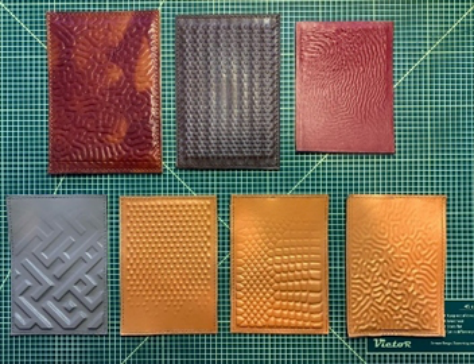
A prototyping (Figure 1) and user testing phase that reflected project objectives in the form of innovation targets served to provide tangible outputs and multiactor discussion around the potential benefits of transitioning from traditional leather embossing processes to discontinuous ones. Indeed, 3D printing of TPU can be a process that support highly customizable products, reduces costs and increase production efficiency, and supports sustainability in fashion manufacturing.
Figure 1: Prototypes of embossed TPU leather obtained from the 3D printing process (supermateria Srl).
Introducing 3D Printing of TPU in the Leather Industry 139
RESULTS AND DISCUSSION
This study demonstrates how TPU 3D printing can be an alternative to traditional HF embossing methods, offering greater design flexibility, reduced costs, and improved sustainability. Supermateria’s approach to digitally driven embossing methodologies paves the way for new applications in fashion design, particularly for independent creators seeking customization and agile production workflows.
However, the study also highlights the main challenges of adopting discontinuous innovation in advanced craftmanship approaches that are typical of manufacturing in industrial districts.
The critical discussion conducted together with the diverse participants in the experiment highlights both challenges and opportunities within the collaborative dynamics between designers and artisans. One key issue is the failure to value the role of artisans by designers, who often appropriate the authorship of the project without acknowledging the decisive contribution of artisanal skills. This situation is widely discussed, but concrete solutions to overcome it remain scarce. Therefore, it is necessary to develop new business models that go beyond simple outsourcing of production, recognizing the artisan not only as an executor but as an innovator and co-author of the creative process.
Artisanal skills represent a dormant resource, as they are often tacit, intangible, and complex, as well as interdisciplinary. Their valorization requires more effective communication strategies from production districts, similar to those already employed to promote traditional materials, such as vegetable tanning in the Santa Croce sull’Arno district. In this sense, studying artisanal expertise from an interdisciplinary perspective is crucial today (Gibbons, 1994). Analyzing the challenges and potentials of collaboration can help identify new methodologies to enhance the experiential knowledge of the artisan and their material agency.
Recent studies on co-creation confirm that the success of a project heavily depends on the relationships between participants (Greenhalgh et al., 2016). However, while in service co-design, mutual trust and shared responsibility are enabling factors (Pirinen, 2016), it remains to be verified whether these elements are equally effective in the manufacturing context. The case of the Santa Croce sull’Arno leather district, analyzed in this study, highlighted how interactions between designers and artisans are often characterized by a disconnection between design expectations and material realization.
Implications for Design for Decentralized Manufacturing Ecosystems The challenges highlighted in the previous section move the level of Design intervention from the individual actor (i.e. company or artisan), to the entire system of participants. Dastoli (2022) investigated co-creation as a process of interaction between multi-actor entrepreneurial ecosystems. Indeed, entrepreneurial ecosystems move the logic of competition of participating companies from relying on industry efficiency through the establishment of dominant designs to taking advantage from the collective usage of the high amount of available knowledge through “industry agnostic” adaptation
(Spigel & Harrison, 2018). Specifically, new product development in entrepreneurial ecosystems is dependent on the ability of companies to adapt their available technologies to new organizational configurations of entrepreneurial knowledge, or the knowledge about the entrepreneurial process. Indeed, by following the entrepreneurial ecosystems approach, available technologies reflect actionable technological properties that creates feasibility spaces for social practice. Consequently, the ability of companies to access and strengthen complex entrepreneurial knowledge networks support the identification, development and implementation of new technology application opportunities through social exchange and collaboration This bottom-up approach to NPD has emerged as a relatively recent perspective in research on entrepreneurial ecosystems (Spigel, 2018). Studies adopting this approach frequently draw upon complex adaptive systems theory, which examines microscopic interactions at the individual level and assesses their broader macro-level implications (Holland, 2006). In this context, the relational dimension of entrepreneurial ecosystems—particularly the interactions among entrepreneurial actors—assumes a central role in research that adopts a community-based perspective on the entrepreneurial process (Fredin & Lidén, 2020). Understanding the collaborative dynamics within these ecosystems is essential, as the absence of such relationships would compromise the functionality of the ecosystem as a whole.
By focusing on individual-level interactions, the bottom-up perspective on entrepreneurship offers significant insights into the evolution and development of decentralized manufacturing ecosystems for discontinuous innovation. This approach emphasizes relationship-building, positioning engagement as a critical lens through which the role of Design is examined. This perspective aligns with Björgvinsson et al.’s (2010) conceptualization of Design in multi-actor environments, in which they describe design as an ongoing process of co-creation that interweaves people, objects, and processes. Furthermore, when Design considers the interconnection between technical, social, and organizational aspects, it actively contributes to infrastructuring activities (Karasti, 2014). Expanding on this concept, Bødker et al. (2017) define Design for infrastructuring as a set of targeted actions aimed at fostering the participation of diverse stakeholders in the development of new initiatives. Therefore, the success of collaborative manufacturing infrastructure in local production contexts largely depends on the willingness of local manufacturers to collaborate toward a shared goal— gaining a competitive advantage through a platform-based manufacturing model. Design plays a crucial role as an organizational driver by enhancing entrepreneurial motivation and promoting large-scale engagement through design-driven initiatives (Dastoli, 2022; Dastoli et al., 2021). While participatory design literature (Simonsen & Robertson, 2013) traditionally associates the role of Design in complex socio-technical systems with facilitation activities, Bødker et al. (2017) argue that its function should not be confined to facilitation alone but should also extend to its preparatory aspects, referred to as the process of “tying different knots.” These preparatory activities are crucial for enabling multiple actors to effectively participate in new product development. Within this framework,
Introducing 3D Printing of TPU in the Leather Industry 141
staging activities leverage cognitive design capabilities that support relational interactions throughout the entire product development process.
CONCLUSION
This study examined the role of design in enabling discontinuous innovation within decentralized manufacturing ecosystems, with a specific focus on the application of TPU-based 3D printing in the leather embossing processes of the Santa Croce sull’Arno district. The findings underscore the capacity of design-led approaches to mediate between emerging digital technologies and traditional craft practices, facilitating the development of sustainable, customizable, and accessible production methods. In this context, design operates not solely as a tool for form-giving or problem-solving, but as a strategic and infrastructural agent capable of reconfiguring socio-technical systems.
The experimental intervention conducted through the Supermateria initiative illustrates the efficacy of design in orchestrating multi-stakeholder collaboration, promoting knowledge integration, and enabling new product development within complex local ecosystems. By foregrounding the potential of additive manufacturing technologies such as TPU-based 3D printing, the study contributes to current discourses on material innovation, distributed manufacturing, and the hybridization of artisanal and computational practices.
At the same time, the research surfaces critical tensions within collaborative dynamics—particularly the persistent undervaluation of artisanal expertise in design-led innovation processes. Despite longstanding recognition of the tacit, embodied knowledge held by artisans, their contributions are frequently subordinated to dominant narratives of design authorship. Addressing this imbalance necessitates the articulation of new models of co-creation, wherein artisans are positioned not as peripheral executors but as epistemic agents and co-innovators.
Drawing on the theoretical framework of entrepreneurial ecosystems, the study advances a relational and systemic understanding of design as a mode of infrastructuring—one that facilitates participation, coordinates diverse knowledge domains, and fosters the emergence of shared innovation trajectories. From this perspective, design assumes a critical role in supporting the transition of industrial districts toward more resilient, adaptive, and inclusive manufacturing paradigms.
In conclusion, the integration of enabling technologies within traditional production contexts must be accompanied by equally robust design strategies that attend to the social, organizational, and cultural dimensions of innovation. Only through such an integrated and reflexive approach can decentralized manufacturing ecosystems realize their full potential in the face of ongoing technological, environmental, and economic transformations
ACKNOWLEDGMENT
The authors would like to acknowledge Supermateria S.r.l for providing data on the experiment conducted.
REFERENCES
Becattini, G. (2002) ‘From Marshall’s to the Italian “Industrial districts”: A brief critical reconstruction’, in Pyka, A. and Küppers, G. (eds.) Complexity and industrial clusters: Dynamics and models in theory and practice. Heidelberg: Physica-Verlag HD, pp. 83–106. Bertola, P. and Teixeira, J. C. (2003) ‘Design as a knowledge agent: How design as a
knowledge process is embedded into organizations to foster innovation’, Design Studies, 24(2), pp. 181–194. Björgvinsson, E., Ehn, P. and Hillgren, P. A. (2010) ‘Participatory design and “democratizing innovation”‘, ACM International Conference Proceeding Series, pp. 41–50. https://doi.org/10.1145/1900441.1900448 Bødker, S., Dindler, C. and Iversen, O. S. (2017) ‘Tying Knots: Participatory
Infrastructuring at Work’, Computer Supported Cooperative Work (CSCW), 26(1–2), pp. 245–273. https://doi.org/10.1007/s10606-017-9268-y Consorzio Vera Pelle Italiana Conciata al Vegetale (n.d.) Consorzio Vera Pelle Italiana Conciata al Vegetale. Available at: https://www.pellealvegetale.it/ pellealvegetale/ (Accessed: 29 April 2025). Dastoli, C. (2022) Design capabilities and entrepreneurial ecosystems: Investigating
design under an adaptive logic of competition for developing new products in manufacturing. Doctoral dissertation. Politecnico di Milano. https://doi.org/ 10.13140/RG.2.2.25214.84808 Dastoli, C., Del Curto, B., Cautela, C. and Teixeira, C. (2021) ‘Design capabilities and entrepreneurial ecosystems: Envisioning a new role that design can play in manufacturing’, in Proceedings of the 28th Innovation and Product Development Management Conference (IPDMC), pp. 1–23. Fredin, S. and Lidén, A. (2020) ‘Entrepreneurial ecosystems: Towards a systemic
approach to entrepreneurship?’, Geografisk Tidsskrift - Danish Journal of Geography, 120(2), pp. 87–97. https://doi.org/10.1080/00167223.2020.1769491 Gibbons, M. (ed.) (1994) The new production of knowledge: The dynamics of science and research in contemporary societies. London: SAGE Publications. Greenhalgh, T., Jackson, C., Shaw, S. and Janamian, T. (2016) ‘Achieving research
impact through co-creation in community-based health services: Literature review and case study’, The Milbank Quarterly, 94(2), pp. 392–429. https://doi.org/ 10.1111/1468-0009.12197 Groth, C. (2015) ‘Emotions in risk-assessment and decision-making processes during craft practice’, Journal of Research Practice, 11(2). Karasti, H. (2014) ‘Infrastructuring in participatory design’, ACM International
Conference Proceeding Series, 1, pp. 141–150. https://doi.org/10.1145/ 2661435.2661450 Maffei, S. and Zurlo, F. (2000) ‘Design e competenza: un’analisi del caso italiano’, in Il design per i distretti industriali. Milano: Poli.design, pp. 59–86. Mäkelä, M. (2016) ‘Personal exploration: Serendipity and intentionality as altering
positions in a creative process’, FORMakademisk, 9(1), pp. 1–12. Micelli, S. (2011) Futuro artigiano: L’innovazione nelle mani degli italiani. Venezia: Marsilio Editori Spa. Available at: http://id.sbn.it/bid/UAN0171469. Pirinen, A. (2016) ‘The barriers and enablers of co-design for services’, International
Journal of Design, 10(3), pp. 27–42. Scaringella, L. and Radziwon, A. (2018) ‘Innovation, entrepreneurial, knowledge, and business ecosystems: Old wine in new bottles?’, Technological Forecasting and Social Change, 136, pp. 59–87. https://doi.org/10.1016/j.techfore.2017.09.023 Sennett, R. (2008) The craftsman. New Haven: Yale University Press.
Introducing 3D Printing of TPU in the Leather Industry 143
Simonsen, J. and Robertson, T. (2013) Routledge International Handbook of Participatory Design. London: Routledge. Available at: http:// www.routledge.com/books/details/9780415694407/. Spigel, B. (2018) ‘Envisioning a New Research Agenda for Entrepreneurial Ecosystems: Top-down and Bottom-up Approaches’, in Katz, J. A. and Corbett, A. C. (eds.) Reflections and Extensions on Key Papers of the First Twenty-Five Years of Advances. Bingley: Emerald Publishing Limited, pp. 127–147. Spigel, B. and Harrison, R. (2018) ‘Toward a process theory of entrepreneurial ecosystems’, Strategic Entrepreneurship Journal, 12(1), pp. 151–168. https:// doi.org/10.1002/sej.1268 Sun, G., Zhao, R. and Gu, X. (2017) ‘Envisioning the era of 3D printing: A
conceptual model for the fashion industry’, Fashion and Textiles, 4(12). https:// fashionandtextiles.springeropen.com/articles/10.1186/s40691-017-0110-4 Vallini, V. (2013) Concia al vegetale. Storia e sostenibilità del distretto toscano della pelle. Firenze: Edifir Edizioni. Available at: http://id.sbn.it/bid/LIA0963513. Zheng, Y., Li, M. and Liu, Z. (2021) ‘Application of 3D printing technology in
fashion design’, Francis Academic Press. Available at: https://francis-press.com/ papers/13637.
LISTED IN THE AHFE DIGITAL BOOKSTORE CATALOGUE
Explore the complete digital volume
Human Aspects of Advanced Manufacturing, Production Management and Process Control
Read this individual research paper free through the original publisher, or explore the full digital proceedings book.
ISBN 978-1-964867-60-1
Explore this ISBN in the AHFE Bookstore ↗Listed in the July 2026 bookstore catalogue; search by ISBN to confirm current availability · Digital book purchase optional