Liliana Cruz-Ausejo, Consuelo Cano Gallardo, Juan Jose Valverde Ayte, Jose del Carmen Abad Castillo, Jerome Galea, Amit Bhattacharya (2026). Designing for adoption: a culturally grounded, 3D-prototyped ergonomic hand tool for Andean potato harvesting. In: Physical Ergonomics and Human Factors. AHFE Open Access, vol. 223, pp. 85–92. https://doi.org/10.54941/ahfe1007799
Small-scale potato harvesting in the Peruvian Andes relies on traditional hand tools that were not designed with ergonomic or user-centered principles. Farmers therefore face high physical demands, awkward postures, and increased risk of work-related musculoskeletal disorders. This study presents preliminary findings from the Discover and Define phases of a mixed-method project, guided by the 'Double diamond' design model, to develop an ergonomic harvesting tool. Physical evaluations and interviews with 12 rural farmers explored perceptions, needs, and cultural requirements for adoption. Anthropometric, hierarchical task analysis (HTA), and a Rapid Entire Body assessment (REBA) characterized tasks and postural risk. Surface electromyography (sEMG) measured muscle activation during traditional tool use, and a standardized comfort scale captured perceived discomfort. Farmers (49 years; IQR:45.5-54.0; 50% women) emphasized local repairability, similarity to familiar tools (e.g., picks and allachu), and easy of transport by hand and pack animals for adoption.HTA identified soil digging as the highest-risk subtask. REBA classified 83.3% of participants as high postural risk. sEMG showed elevated activation of the extensor carpi radialis (143.6 ± 56.8 µV) and biceps brachii (118.6 ± 53.3 µV). Mean overall comfort rating was 38.7 ± 7.2. These insights informed concept generation and rapid iteration from cardboard prototypes to a 3D-printed mock-up. The current design includes a telescopic handle adjustable from 84–90.5 cm and an ergonomic grip diameter of 39–41 mm, accommodating 80% of the sample, while preserving functional familiarity through a dual head with a 21.5 cm tip and blade. Prototype evaluation in field-like trials is underway.
Musculoskeletal disorders (MSDs) remain a major occupational health concern in agricultural work (Jain, 2018; Occupational Safety and Health Administration, 2020). In Central and South America, the 12-month prevalence of low-back MSDs has been estimated at 28.5%, and global evidence from agricultural workers in low-and middle-income countries reports annual prevalences of 36.0% in shoulder, 16.1% in elbow, and 22.2% in the hand-arm region, indicating a substantial burden on the upper extremity (Shivakumar et al., 2024). In Peru, this issue is particularly relevant in the Andean highlands, where 67% of producers are concentrated and family farming predominates, with 60% primarily oriented toward subsistence production (Castillo, 2021), conditions that often sustain manual labor and the continued use of traditional hand tools (Maradei, 2019; Madriz-Quirós, 2021).
Ergonomic hand tools have been proposed to reduce required muscular force, particularly at the grip force, while 3D printing enables rapid, low-cost iteration, new materials inclusion and the integration of anthropometric and ergonomic criteria to improve fitting and usability relative to conventional approaches (Dianat, 2015; Naeini, 2020). Therefore, this study adopts the Double diamond framework (Design Council, 2005; Shen et al., 2024) and reports the Discover- Define phases to guide the design of a culturally grounded ergonomic hand tool for Andean potato harvesting. In Discover, contextual inquiry (needs, perceptions, barriers, and enablers for adoption as well as perceived satisfaction with traditional tools) is combined with a baseline established through anthropometric measurements, EMG-based muscular effort, and musculoskeletal comfort during traditional tool use. In Define, these findings are synthesized into design requirements and translated into an early prototype.
METHODS
Discover Phase Methodology: Contextual Inquiry and Baseline Establishment The study employed a complex mixed-method design (evaluation) (Creswell, 2022), in which quantitative and qualitative data were collected in parallel, analyzed separately, and later integrated during the Define phase to inform design requirements.
The ‘discover phase’ embedded quantitative data including anthropometry measurements, postural risk assessment using REBA, muscle activity measured with EMG, and a validated comfort scale. In parallel, the qualitative component followed a phenomenology approach using semi-structured interviews to explore farmers’ perceptions, needs and factors influencing tool adoption. A Hierarchical task analysis (HTA) (Stanton et al., 2017) was conducted to identify and decompose the main tasks involved in potato harvesting, allowing the identification of critical subtasks for ergonomic intervention.
The quantitative phase included 12 healthy farmers, while the qualitative phase included 13 participants (6 men and 7 women), all from an Andean agrorural community in Apurímac, Peru. Fieldwork was carried out in May 2025. All participants provided informed consent.
Designing for Adoption: A Culturally Grounded, 3D-Prototyped Ergonomic 87 Define Phase Methodology: Synthesizing Evidence into Design Requirements, Concept Specification and Prototyping
The phase 2, definition stage translated phase 1 findings into a design concept and preliminary tool design. Quantitative outputs (anthropometric profile, postural risk, and biomechanical analysis) and qualitative inputs (farmer needs, expectations, traditional tool references, field observations and perceived satisfaction) were translated into design requirements matrix. Quantitative data and qualitative insights were integrated to establish design criteria.
Requirements were prioritized based on biomechanical relevance, frequency of task execution and user-reported importance. The concept development was conducted through co-creation sessions involving a multidisciplinary team (industrial designer, ergonomist and physiotherapist). In the initial stage, cardboard mock-ups and preliminary prototypes were produced to evaluate overall dimensions, grip, and functional performance. The selected solution was modeled using CAD software (Autodesk fusion 360), from which detailed technical and assembly drawings were generated. The prototype was fabricated using FDM 3D printing (G-code prepared in Ultimaker Cure) with PLA and PETG. Each iteration was qualitatively evaluated through focus group feedback, which informed refinements in dimensions, functionality, and materials.
RESULTS
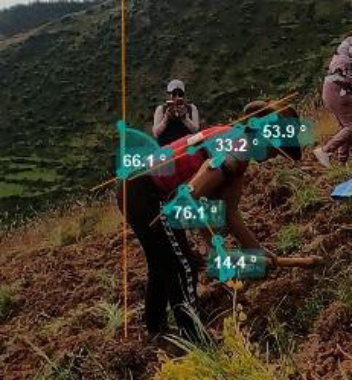
Discover Phase Findings HTA analysis showed that the digging subtask concentrates the most physically demanding conditions within the harvesting process. The most critical posture, characterized by maximum trunk flexion and extended tool reach, was selected for detailed biomechanical assessment (Figure 1). These findings support prioritizing digging as the primary target for ergonomic intervention.
Figure 1: Digging activity during potato harvesting.
Due to the lack of an anthropometric profile for the Peruvian Andean farmer population that would allow direct comparisons with local references, the sample’s anthropometric profile (p5-p95) was constructed. Key measurements included arm length (p5-p95: 270-352 mm), forearm length (p5-p95: 231-282 mm), and functional grip diameter (p5-p95:37-48 mm), given its direct implications for handle dimension an anthropometric curve was built to estimate the diameter grip range.
Postural risk assessment using REBA classified 83.3% of participants as high risk. Musculoskeletal comfort showed a mean score of 38.7 ± 7.2 (on an 8–56 point scale). Finally, muscle activity was assessed in four muscles on the dominant (right) side: spinal erector, anterior deltoid, biceps brachii, and extensor carpi radialis indicating high upper-limb demand during tool use. Table 1.
Table 1: Electromyographic activity of Andean rural farmers.
†: median and interquartile range; RMS: root mean square (muscle activation during work); MCT: maximum muscle contraction during work; RMS (%): RMS relative to MCT; dma%: distribution of muscle activity; µV: microvolts.
Semi-structured interviews identified five thematic domains relevant to tool design: human, product, task, qualitative, and environmental. Regarding needs, farmers primarily prioritized technical and physical attributes of the hand tool: and appropriate weight, a handles finish that does not produce splinters or cause hand friction, and an improved head-to-handle fit to reduce frequent repairs. As adoption facilitators, participants highlighted similarity to familiar tools (e.g., pick and allachu) the possibility of repair using locally available materials, and easy transport on hand or packing animals; however, affordability emerged as a barrier. Perceived satisfaction with traditional hand tools was linked to a bond built through continuous use and familiarity, reinforced by cultural heritage and intergenerational learning. In addition, good performance was valued and was related both with preparatory actions (head sharpening and tightening/adjustment) and with performance during the task. Participants also presented some sketches of hand tool redesign or improvements, which were integrated into the concept.
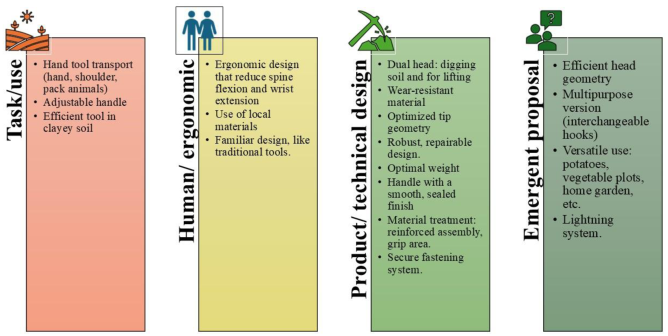
Define Phase Findings The integration of the information enabled the identification of four areas of focus and their associated requirements, encompassing tool transport, functional characteristics, materials, adaptability, maintenance, and sociocultural
Designing for Adoption: A Culturally Grounded, 3D-Prototyped Ergonomic 89 factors. These requirements were organized and prioritized in four groups (Figure 2).
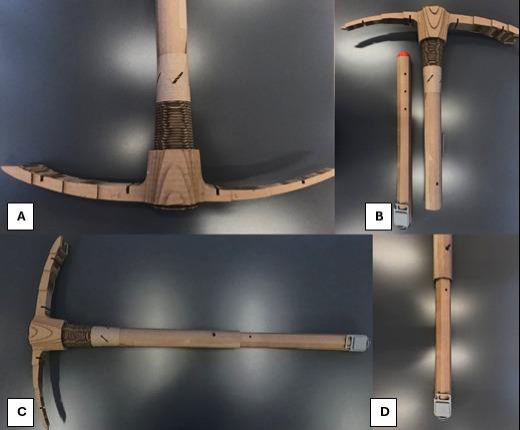
Based on this information, sketches were developed and preliminary functional mechanisms were proposed. The resulting concept featured a removable, dual-ended head (pick tip and rear flat blade), with each end measuring 25 cm in length; the blade incorporated a 2cm bifurcation. In addition, a telescopic handle adjustable between 84–96 cm was considered, with a handle diameter of 41–43 mm, as well as the integration of a rechargeable light positioned laterally at the distal end. A cardboard mock-up was constructed (Figure 3) and subsequently evaluated in a focus group session.
Based on the focus group feedback, design adjustments and iterative parameters were defined to improve performance, ergonomics, and safety: (a) recalibrating the head tip angle to balance penetration and traction, enabling users to reach the product with fewer “digs”; (b) adjusting the tip length to a 20–22 cm range according to digging depth and product location, while minimizing product damage (estimated depth: 25 cm); (c) assessing a reduction in grip diameter from 42mm to 39–41mm without compromising light integration; and (d) reassessing the telescopic handle range by incorporating intermediate positions (81,86 and 90 cm) to enhance postural adaptability. From a functionality and safety perspective, priority was given to optimizing the head-handle interface through a conical fit to reduce slippage, while accounting for potential wear or vibration, and to maintaining the bifurcated blade slit (2cm) as an open parameter due to its potential to reduce product damage.
Figure 2: Design requirements.
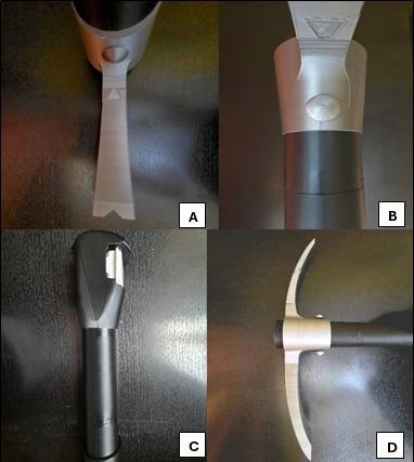
The second 3D-printed mock-up (PLA, PETG) incorporated revisions to the bifid blade, the distal clamping mechanism, the conical distal end, and the lateral placement of the light, along with refinements to the head dimensions (Figure 4). The focus group identified priority modifications across dimensions, functionality, and materials: increasing the blade width to 5 cm (to enlarge the soil-removal contact area) and the tip width to 4cm;
reducing blade thickness to control overall weight, while considering forged steel to mitigate fracture risk; confirm the adjustment of the grip diameter to 39 mm (max. 41 mm) to improve grasp and task performance; and optimizing the head-handle interface via a conical fit, retaining wood for local repairability and assessing carbon fiber for the distal telescopic segment to enhance durability.
Figure 3: Cardboard mock-up showing the tool structure and mechanism (A), dual- ended head dimensions—pick and flat blade (B), detachable telescopic handle (C), assembled tool (D), and light position on the front face of the handle.Figure 4: 3D-printed mock-up: (A) bifurcated blade, (B) distal clamping mechanism, (C) tapered distal tip and light placement in lateral side, and (D) head dimensions adjusted.
CONCLUSION
This work shows that human-centered design is essential for developing tools with potential adoption among Andean rural farmers. Applying the Discover- Define phases of the Double diamond framework with a sociocultural requirement must be integrated from the early stages, rather than treated as downstream refinements. These insights translated into a preliminary tool concept allowed to iteratively be refined from a cardboard mock-up to a 3D-printed prototype through rapid, evidence-informed iteration. The final prototype converged on key user-tool fit specifications, particularly a telescopic handle range of 84-90.5 cm and a grip diameter of 39-41 mm, while also incorporating assembly and material decisions aligned with local repair context-specific human factors can directly shape actionable specifications and produce usable and adoptable solutions for rural farming contexts.
Limitations and Future Work This study presented preliminary findings from the Discover and Define phases and has some limitations. The sample size was limited and restricted to a single rural community, which may affect generalizability of results, and the prototype has not yet been validated under real field conditions, comparative analysis with traditional tools, and further work will focus on field-based validation and iteratives refinement with rural farmers.
ACKNOWLEDGMENT
The authors gratefully acknowledge the rural farmers of the Yanaca community (Apurímac, Peru) for their valuable collaboration and support.
FUNDING This work was funded by the Consejo Nacional de Ciencia, Tecnología e Innovación Tecnológica (CONCYTEC) and the Programa Nacional de Investigación Científica y Estudios Avanzados (PROCIENCIA), within the framework of the E077-2023-01-BM “Becas en Programas de Doctorado en Alianzas Interinstitucionales” contest, grant number N° PE501090201- 2024-PROCIENCIA-BM and the E033-2023-01-BM “Alianzas Interinstitucionales para Programas de Doctorado”, grant number N° PE501084306-2023-PROCIENCIA-BM.
REFERENCES
Castillo, M. L. (2021). Peruvian agriculture: Post-COVID-19 situation and outlook (Spanish version). Friedrich-Ebert-Stiftung. https://library.fes.de/pdf- files/bueros/peru/18971.pdf Creswell, J. W. (2022). A Concise Introduction to Mixed Methods Research
(second). SAGE. Design Council. (2005). The Double Diamond. https://www.designcouncil.org.uk/ our-resources/the-double-diamond/
Dianat, I., Nedaei, M., & Mostashar Nezami, M. A. (2015). The effects of tool handle shape on hand performance, usability and discomfort using masons’ trowels. International Journal of Industrial Ergonomics, 45, 13–20. https://doi. org/10.1016/j.ergon.2014.10.006 Jain, R., Meena, M. L., & Dangayach, G. S. (2018). Prevalence and risk factors of
musculoskeletal disorders among farmers involved in manual farm operations. International Journal of Occupational and Environmental Health, 1–6. https:// doi.org/10.1080/10773525.2018.1547507 Madriz-Quirós, C. E., & Sánchez-Brenes, O. (2021). Ergonomic risk factors for agricultural workers in the northern area of Cartago, Costa Rica. Revista Tecnología en Marcha. https://doi.org/10.18845/tm.v34i1.4575 Maradei, F., Jaimes, C. P. A., & Sarmiento, S. J. S. (2019). Musculoskeletal
Symptoms in Blackberry Harvesting Activities in Piedecuesta, Colombia. Hacia la Promoción de la Salud, 24(2), 91–106. Naeini, H. S., Karmegam, K., & Mohammadreza, S. (2020). Prevention of occupational traumas by developing an ergonomic design and modifying farmers’ postures in walnut gardens of Tuyserkan, Iran. 9(24), 24–29. https:// doi.org/dx.doi.org/10.4103/atr.atr_48_19 Occupational Safety and Health Administration. (2020). Musculoskeletal disorders.
https://osha.europa.eu/es/themes/musculoskeletal-disorders Shen, Y., Bosch, G., Pino, L., & Gopalan, V. (2024). Use of the “double diamond” design framework to nurture creativity in life sciences research. Trends in Biochemical Sciences, 49(8), 654–657. https://doi.org/10.1016/j. tibs.2024.04.008 Shivakumar, M., Welsh, V., Bajpai, R., Helliwell, T., Mallen, C., Robinson, M., &
Shepherd, T. (2024). Musculoskeletal disorders and pain in agricultural workers in Low- and Middle-Income Countries: A systematic review and meta-analysis. Rheumatology International, 44(2), 235–247. https://doi.org/10.1007/s00296- 023-05500-5 Stanton, N. A., Salmon, P. M., Rafferty, L. A., Walker, G. H., Baber, C., & Jenkins, D. P. (2017). Human Factors Methods: A Practical Guide for Engineering and Design (2nd ed.). CRC Press. https://doi.org/10.1201/9781315587394
LISTED IN THE AHFE DIGITAL BOOKSTORE CATALOGUE
Explore the complete digital volume
Physical Ergonomics and Human Factors
Read this individual research paper free through the original publisher, or explore the full digital proceedings book.
ISBN 978-1-964867-99-1
Explore this ISBN in the AHFE Bookstore ↗Listed in the July 2026 bookstore catalogue; search by ISBN to confirm current availability · Digital book purchase optional